Your ShelfYour Projects

Signs of the Times, Vol. 36, No. 49.

Question Corner

Signs of the Times

Dec 15, 1909

Pacific Press Publishing Association · Mountain View, California · Dec 15, 1909

Question Corner

Please Be Definite.—For instance, a question comes to us asking us to be so kind as to explain the meaning of the latter part of “the 28th verse of Hebrews.” But the question is not definite enough so that we may know what chapter is referred to. There are five chapters in Hebrews which have 28 verses or more: chapter 7, chapter 9, chapter 10, chapter 11, chapter 12. If our correspondent will tell us what chapter is referred to we will be glad to answer the question if we can.

2991.—Not Able to Kill the Soul

Kindly explain to me how I can harmonize what you say regarding the condition of the dead with Matt. 10:28: “Fear not them which kill the body, but are not able to kill the soul.” J. H. V.
But the text says nothing concerning the condition of the man in death—absolutely nothing. The Bible nowhere tells us that the soul as it is generally spoken of, has consciousness apart from the body. We might say that the word from which “soul” is taken, psuche in Matt. 10:28, is the same word that is translated “life” in Matt. 16:25, and “soul” in Matt. 16:26. It simply means life and nothing else. Man can not take away our life finally. He can bring temporary death, but our life rests with God. Man can not take away future life; but God can; and the very fact that He can, proves that the soul is not immortal. If we would only get the Bible idea of what is meant by “soul,”—not a being of itself within the man, but just simply life, that which makes a man a living creature, as used in the text under consideration,—we would have no trouble regarding man’s future. The Creator gives man life that he may use it to God’s glory; and if man refuses to do that, God takes it away, and man dies, and eventually eternally dies. This is reasonable and just. “Soul” is sometimes used for the whole person in the Bible, but not in these texts.

2992.—God of the Living

How can I harmonize the topic in a recent number of the SIGNS OF THE TIMES, “Where Are the Dead?” with Luke 20:38: “For He is not a God of the dead, but of the living: for all live unto Him”? J. H. V.
We wish our querist would read the connection. Note why the Sadducees asked the question that they did. Note also that the question was not in regard to man’s intermediate state, but concerning the resurrection. “In the resurrection therefore whose wife of them shall she be?” That is the question. And yet some would use this text to prove that the soul was immortal, and existed in a conscious state after death; utterly regardless of the logic of the situation. What a reflection on the reasoning power of the Master! He starts out to prove to those Sadducees who professedly believed only in the books of Moses, but did not believe in a resurrection,—to prove from the books of Moses that there will be a resurrection; but instead of proving that there will be a resurrection, He proves that the dead live regardless of the resurrection, and therefore there is no use of such an event! Think of it!
Not so did Jesus reason. He proves that there will be a resurrection, and He proves it from Moses. He proves it by saying that God calls Himself the God of Abraham, and Isaac, and Jacob, and He is the God of the living; but if they were forever dead He would be calling Himself the God of the dead. In His purpose they are not dead, in His purpose they will live again; for all the promises of the new heavens and the new earth are given to them, consequently in God’s purpose they live. He calls “things which be not as though they were.” Rom. 4:17. And therefore He speaks of Abraham and Isaac and Jacob, who are dead, just as though they were alive, because in His purpose they will live in the resurrection. Our Lord’s logic was good, and He did prove from the books of Moses that the dead would live again. Why endeavor to pervert the Master’s words? All who are in the graves “live unto Him,” because in the resurrection they shall all live.

2993.—The Earthly House of Our Tabernacle

Does not the expression, “the earthly house of our tabernacle,” in 2 Cor. 5:1, refer to our body? F. R.
There are three conditions mentioned in 2 Corinthians 5: one, this present worldly condition expressed by “the earthly house of our tabernacle,” “in this we groan,” “in this tabernacle,” “mortal;” secondly, the condition of death, by “dissolved,” “unclothed;” thirdly, the immortal life to come, by “the building from God,” “a house not made with hands,” “habitation which is from heaven,” “being clothed,” “clothed upon,” “swallowed up of life.” Remembering these three conditions, there is no difficulty in understanding what the apostle means. This earthly condition is a time of trial, sorrowing, groaning, testing. The condition of death is that which he calls “unclothed.” He does not desire that. He does not wish to be unclothed; but he does desire something, and that is to be “clothed upon with this house which is from heaven.” He desires that mortality might be swallowed up of life. When will that be? That will be at the resurrection. Read 1 Cor. 15: 51-54; where we are told that mortality shall be swallowed up of immortality at the last trump, when Christ shall come. Then we shall all be changed; not unclothed, not die, and thereby go to heaven; but clothed upon, made immortal. Mortality shall be swallowed up by immortality. The same thought is expressed in Rom. 8:23; “Even we ourselves groan within ourselves, waiting for our adoption, to wit, the redemption of our body.” But when is our body redeemed?—At the resurrection, when Christ shall come.

2994.—Woman and Her Hair

Please explain 1 Cor. 11:5, 6. SUB.
Such questions profit little. They relate to customs which existed in the days of the apostle. Heathen women and heathen priestesses dressed in certain ways. The Lord gave certain rules for His own people so that they should not appear like the heathen. The apostle Paul writes here as to what is seemly, what is proper, for modest women in the worship of God; but he tells us in verse 16, “But if any man seemeth to be contentious, we have no such custom, neither the churches of God.” That is, he was not laying down absolute fixed rules for women to follow. God has given us general principles by Timothy and Peter; these should be followed, but just how must be left to each individual. The Christian should aim at modesty, simplicity, and unobtrusiveness in dress. It has been said that those who are best dressed are those whose dress is not noticed, where the individuals themselves dominate over their dress.

OUR BIBLE BAND

Schedule for Week Ending December 25, 1909

Day Date Morning Evening
Su. Dec. 19 Jonah 1, 2, 3, 4 Revelation 10
Mo. “ 20 Micah 1, 2, 3 “ 11
Tu. “ 21 “ 4, 5 “ 12
We. “ 22 “ 6, 7 “ 13
Th. “ 23 Nahum 1, 2, 3 “ 14
Fr. “ 24 Hab. 1, 2, 3 “ 15
Sa. “ 25 Zeph. 1, 2, 3 “ 16

Suggestive Notes

Our morning lessons cover the prophecies of Jonah, Micah, Nahum, Habakkuk, and Zephaniah—five very striking prophecies.
The Book of Jonah.—His mother named her little boy “Jonah,” the “dove,” and yet there is anything but the nature of the dove seemingly in the fiery disposition of the prophet. All that we know of him outside of his book is learned from 2 Kings 14:25, which gives an account of how he predicted to Jeroboam II his victories over the Assyrians. God gave him a very hard mission, so it seemed to him,—to go to a strange people, whose capital city was the greatest city in the earth at that time, and rebuke them for their sins. The story is graphically told in his prophecy.
Micah, whose name means “who is like Jehovah,” was born at Moresheth, a village southwest of Jerusalem. He prophesied in the reigns of Jotham, Ahaz, and Hezekiah, and was also a contemporary of Isaiah, whose writings are similar. Note, for instance, the prophecy of the last days in Micah 4 and Isaiah 2. He also predicted the birth of Christ at Jerusalem; and the 7th chapter is a striking prophecy of last-day conditions.
Nahum, whose name means “rich in comfort,” was born at Elkosh, which may mean Capernaum, for the name Capernaum means “Nahum’s village.” He prophesied, under Josiah, the downfall of Nineveh which took place in 606. The date of his prophecy falls between that date and 660 B.C.
Habakkuk prophesied about 604 B.C., in the reign of Jehoiakim, in the middle period of the career of Jeremiah. The 1st and 2d chapters are concerned with the work and fate of the Chaldeans, that furious nation. Chapter 3 is a wonderful song of a vision of Jehovah.
Zephaniah, the meaning of which is “Jehovah hides,” prophesied in the time of Josiah and before the fall of Nineveh, which occurred 606 B.C. He warns against the great day of God’s judgments, as well as the local judgments which were to fall upon apostate nations. He pleads with the people of God to seek Him so faithfully that they shall be hidden from the great and dreadful day of the world’s judgment.
Our evening lessons begin with Revelation 10 and close with Revelation 16, covering the message of Revelation 10 which was fulfilled at the time of the great Advent Movement of 1840-44. Revelation 11 is a prophecy of the two witnesses, and the chapter closes with the last of the vision of the seven trumpets. Then follow the prophecies of Revelation 12 and 13, the messages of Revelation 14, and the seven last plagues of Revelation 15 and 16, all vital last-day prophecies.

Schedule for December 26 to 31, 1909

Day Date Morning Evening
Su. Dec. 26 Hag. 1, 2 Revelation 17
Mo. “ 27 Zech. 1, 2, 3, 4 “ 18
Tu. “ 28 “ 5, 6, 7, 8 “ 19
We. “ 29 “ 9, 10, 11, 12 “ 20
Th. “ 30 “ 13, 14 “ 21
Fr. “ 31 Mal. 1, 2, 3, 4 “ 22

Suggestive Notes

Our morning lessons begin with Haggai and close with Malachi. Haggai and Zechariah were both prophets of the restoration, encouraging Zerubbabel and Ezra in the building of the temple and the restoration of Jerusalem. That great reformation movement is a type of the last reformation. Malachi prophesied later, about 400 years before Christ; the prophecy of whom speaks for itself.
Our New Testament lessons begin with Revelation 17, a wonderful prophecy of the great world powers under the scarlet-colored beast, and close with the sublime description of the new heavens and the new earth, the glorious triumph of God’s children.

“Unto Us a Child Is Born”

By Abdiel
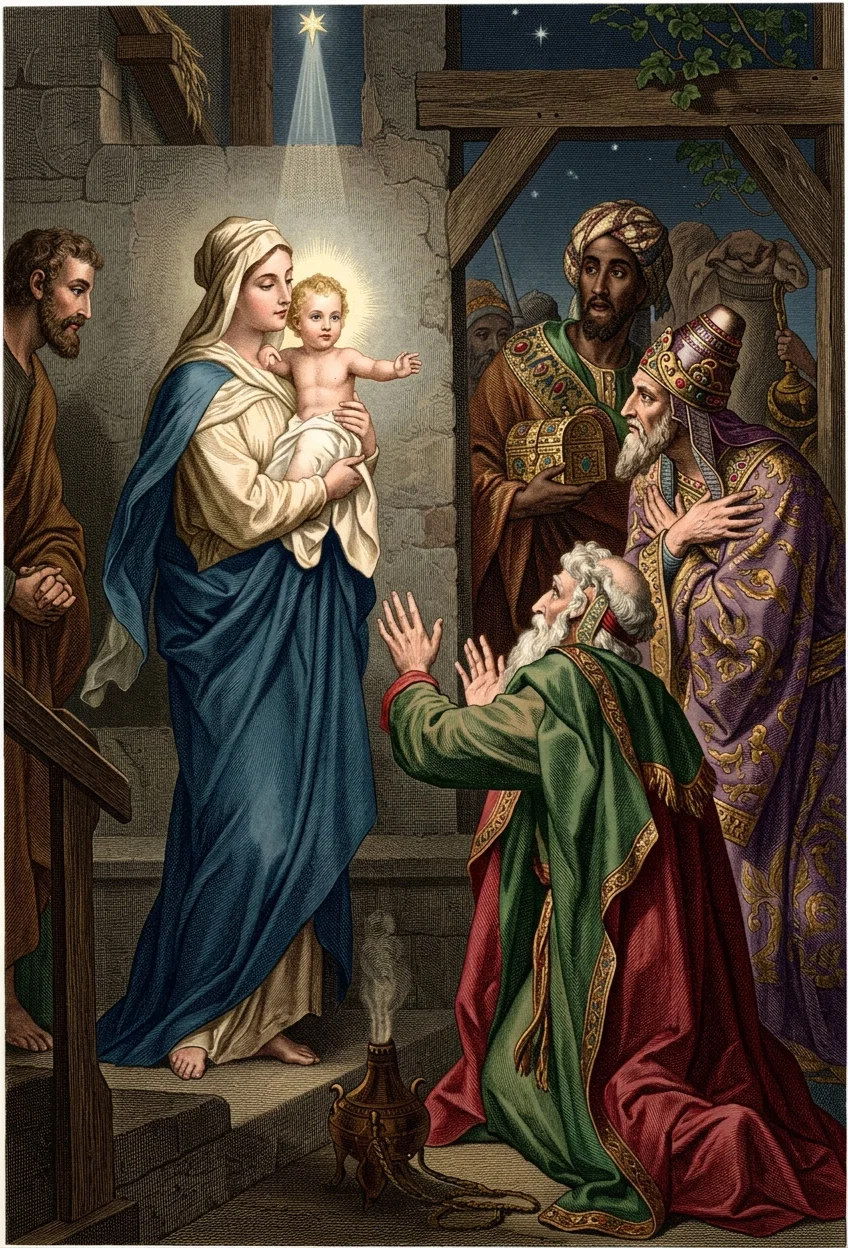
WORSHIP OF THE MAGI H. Hofmann
GLORIOUS indeed was the vision of the shepherds of Bethlehem on that long remembered night, since which time more than nineteen centuries have rolled their round. All unexpected were the glory and the shining heavenly visitants. Had they been told that such a vision would appear to some group of Israelites upon that night, they would not have even presumed to think that they would be thus honored. They would have said that to the priests and scribes the messengers of God would come.
The Day of His Birth.—Never mind the month or the day of the angels’ visit. Uncertain tradition placed it on December 25, a date in all probability upon which the event did not occur. It is not the day which God wishes honored, but the event, the great fact, the soul-saving truth which is in the event. The devil worked shrewdly when he connected with one of the great revelations of the Gospel the old pagan Saturnalian feast, with its gluttony and licentiousness, its selfish giving of gifts, and its abominable idolatries. Sad that so many of the nature-worship customs still persist.
But let us forget the day for the event. Let us transport ourselves to those Judean pastures, and listen to the conversations of the shepherds as they recount the past glories of Israel, the low estate of the chosen people, and the promises of the Messiah. Listen to the chanting of the psalms of Israel as they watch their flocks. Their hearts grow hopeful and their songs exultant as they recall the promises of God.
And even as they talk, the dazzling glory of Divinity shines round about them, and they are sore afraid. They see a strong, bright messenger of God standing by their side. Comforting and assuring was his message:
“Be not afraid; For behold, I bring YOU good tidings of great joy Which shall be to all the people; For there is born to you this day In the City of David, A Saviour, who is Christ the Lord.” — Luke 2:10, 11.
“Glory to God in the highest, And on earth peace among men in whom He is well pleased.”
No longer could that angel’s companions remain invisible. They must disclose their joy and sing the praises of the new-born Child:
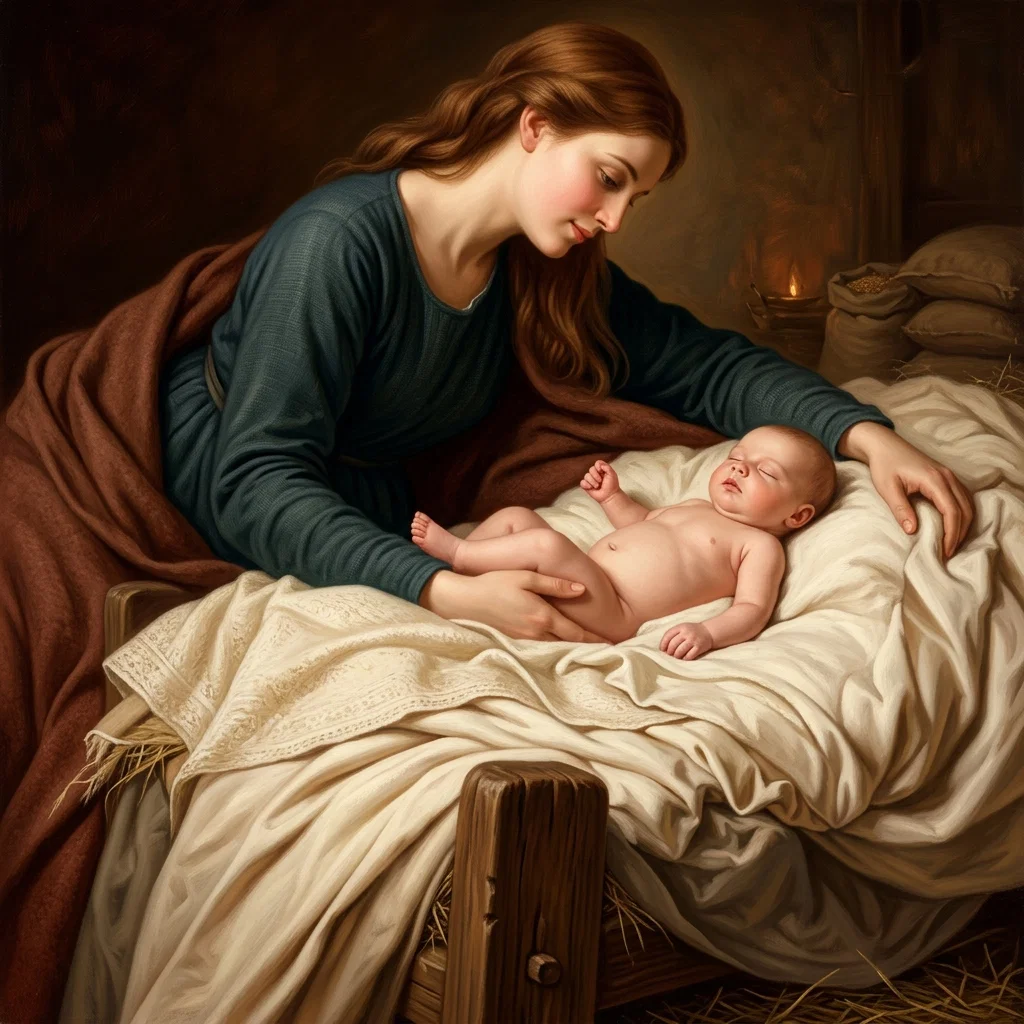
Glorious the song, wonderful the message, glad the hearts of the hearers. The shepherds go to the City of David. They find the little Babe in its lowly birth, wrapped in swaddling clothes and lying in a manger. They join the invisible choir in His worship. The shining messengers who had witnessed His glorious career and triumph on the plane of the angels, now hail Him in holy worship and adoration as He begins the lowlier and fiercer career among men. Surely we may join with the shepherds in their worship and with the wise men in their adoration.
“Born to you . . . a Saviour,” said the angel to the shepherds. “God is no respecter of persons;” the “you” is universal. To every soul of earth comes the glad message. As truly as Jesus died for all, He was born a babe in Bethlehem for all. He took upon Himself humanity for all. In that condescension, in that lowliness, we may see the wonderful love of God. In prophetic vision seven hundredyears before Isaiah saw the same event:
“Unto US a CHILD is born, Unto US a SON is given; And the government shall be upon His shoulder, And His name shall be called Wonderful, Counselor, Mighty God; Everlasting Father, Prince of Peace.”
“Unto us,” you and me, reader. Unto us a Child is born. One in whom will be demonstrated the worthiness of all the titles He bears. He is our Child, our Saviour, our King. Gather these mighty comforts from the birth of the “holy Child Jesus!”
He is one with us, perfectly human. “Since then the children are sharers in flesh and blood, He also Himself, IN LIKE MANNER partook of the SAME,” that He “might deliver.” Heb. 2:14, 15. He is a Brother—Saviour. He, too, is Immanuel—God-with-us. He bore in His flesh, in that body “prepared” for Him, all the weaknesses, all the infirmities, all the susceptibilities to all the temptations to which humanity is subject. He knows our weaknesses, feels our needs, met them all in the flesh, and conquered all for us. Failed He never in any trial. He was supremely, transcendently victorious in our behalf. And we may go to Him as a brother beloved, and find succor for all our needs.
He meets the needs of all. The little child, the youth, young manhood and womanhood, the strength of humanity, and those upon whom the burdens of earth’s weary years rest heavily, may all come to Him, and there find rest and help. He touches all hearts, meets all needs, a Brother-Saviour, beloved and effectual. The heathen people have been compelled with their best conceptions to divide their conceived excellences among many gods, most of whom are sponsors for their vices; but in Jesus Christ blend all excellences, and vice or evil know Him not.
Unlike heathen deities, He is not a mere god of the night or of the day, of the land or of the sea, of the winter, or the spring, or the summer, or the autumn; He is not a mere god of the mountains or of the plains, of this land or of that land, of this nation or of that nation, while all other classes are without His care. He is the Saviour of all men. “He died for all!” He pleads for all, of every land and clime and age, this day, to-morrow, and all days to come. “Lo, I am with you always, even unto the end of the world.”
This Child is to reign forever. “The government shall be upon His shoulders.” “The Lord God shall give unto Him the throne of His father David: . . . and of His kingdom there shall be no end.” “And the seventh angel sounded; and there followed great voices in heaven, and they said, the kingdom of the world is become the kingdom of our Lord, and of His Christ; and He shall reign forever and ever.” Rev. 11:15. To this end was the Bethlehem Babe born. Would we reign with Him then?—Then He must first be born into our hearts and reign there. If He rules in our hearts now, we shall reign with Him forever. Everlasting glad tidings, isn’t it?

1. What is the natural condition of all men morally?

From Sin to Righteousness

1. What is the natural condition of all men morally?

“For all have sinned, and fall short of the glory of God.” Rom. 3: 23.
NOTE.—The root idea of “sin” is “missing the mark.” The mark is perfect righteousness, “the prize of the high calling of God in Christ Jesus,” eternal life in Him. The text does not imply that all are in the same depths of sin or iniquity, but that all in themselves have missed the mark. All are stricken with the dread disease,—the leprosy of sin. All cases are incurable. All fall short of the glory of God.
2. But has not man power to help himself or his fellows?
“For I know that in me, that is, IN MY FLESH, DWELLETH NO GOOD THING: for to will is present with me, but TO DO THAT WHICH IS GOOD IS NOT. For the good which I would I do not: but THE EVIL which I would NOT, that I PRACTISE.” Rom. 7:18, 19.
“None of them can by any means redeem his brother, nor give to God a ransom for him.” Ps. 49: 7.
3. Man being in the condition of sin, what is his inevitable doom?
“For the wages of sin is DEATH.” Rom. 6: 23.
“And THE SIN, when it is full-grown, BRINGETH FORTH DEATH.” James 1:15.
NOTE.—Sin is in its very nature deceptive. It does not come to us garbed in the habiliments of death; it does not show its repulsive features and nature. It comes to us at first seductively, sweet and enticing. It appears as much like righteousness as it is possible for sin to be. It makes itself so necessary to the natural heart of man that its indulgence seems almost a necessity to happiness. Yet in it are the seeds of death, and when full-grown it will produce death. It was no arbitrary sentence which God pronounced in the beginning, “In the day that thou eatest thereof thou shalt surely die.” The dying was in the very sinning. Sin separates man from God—the Source of all life; and separated from Him, life is bound to terminate.
4. By what is sin truly revealed to man?
“Through THE LAW cometh the knowledge of sin.” Rom. 3: 20.
“Howbeit, I had NOT KNOWN SIN, EXCEPT THROUGH THE LAW: for I had not known coveting, except the law had said, Thou shalt not covet.” Rom. 7: 7.
5. What does this law condemn?
“Because the MIND OF THE FLESH is enmity against God; for it is not subject to the law of God, neither indeed can it be.” Rom. 8: 7.
6. Through what agency is this law pressed home upon the heart?
“And He [the Spirit], when He is come, will convict the world in respect of sin, and of righteousness, and of judgment.” John 16: 8.
NOTE.—The Spirit is the great Convictor of sin; but the Spirit uses God’s Word, and our knowledge of that Word, limited though it be, to press home upon the heart what the sin is. God’s Word and God’s Spirit always agree. We are not left to our own imagination as to what sin is. The Word very clearly reveals that “sin is the transgression of the law” which says, “Thou shalt not covet;” and the law of which that is a constituent part, is the Decalogue, found in Ex. 20:2-17. So the apostle James teaches the same great fact. “But if ye have respect of persons, ye commit sin, being convicted by the law as transgressors. For whosoever shall keep the whole law, and yet stumble in one point, he is become guilty of all. For He [the margin, “that law which said,” A.V.] that said, Do not commit adultery, said also, Do not kill. Now if thou dost not commit adultery, but killest, thou art become a transgressor of the law. So speak ye, and so do, as men that are to be judged by a law of liberty.” James 2:9-12. This the apostle tells us is “the royal law according to the Scripture.” And the Scripture in James’s time was the Old Testament Scripture; and the royal law is the law of the great King—the Ten Commandments.
7. What will this revelation of the law through the Spirit produce?
Conviction. “And I was alive apart from the law once: but when the commandment came, sin revived, and I died.” “Sin, that it might be shown to be sin, by working death to me through that which is good;—that THROUGH THE COMMANDMENT SIN MIGHT BECOME EXCEEDING SINFUL. For we know that the law is spiritual: but I am carnal, sold under sin.” Rom. 7: 9, 13, 14.
8. What is the next step after true conviction of sin?
“REPENT YE, and believe in the Gospel.” Mark 1:15.
“REPENT YE therefore, and turn again, that your sins may be blotted out.” Acts 3:19.
“Except ye turn, and become as little children, ye shall in no wise enter into the kingdom of heaven.” Matt. 18: 3.
NOTE.—The Common Version has for “turn again,” “converted,” “except ye be converted.” The thought expressed is not something that is done for us, but something which we must do. Man must use his will, his purpose, in connection with becoming a child of God. As he is convicted of sin, and sees it in all its abhorrence, he must turn from it. Conversion in that sense is an act on his part. The term, however, is often used as embracing every step in the Christian’s progress from sin to righteousness; but it is used in this text and also in Acts 3:19 as having reference to the sinner’s part, which he himself must perform. He turns his back upon sin, upon his sinful course. He has been in the wrong way; he faces about. He has been guilty of sinful habits, which the law reveals; he forsakes them, cuts them off, turns from his old master, and yields himself to a new Master. In other words, he rejects the wrong; he chooses the right.
9. How is true repentance expressed?
“I now rejoice, not that ye were made sorry, but that ye were made sorry unto repentance; for ye were made SORRY AFTER A GODLY SORT, that ye might suffer loss by us in nothing. For a GODLY SORROW worketh REPENTANCE UNTO SALVATION, a repentance which bringeth no regret: but the sorrow of the world worketh death. For behold, this selfsame thing, that ye were made sorry after a godly sort, what earnest care it wrought in you, yea what clearing of yourselves, yea what indignation, yea what fear, yea what longing, yea what zeal, yea what avenging! In everything ye approved yourselves to be pure in the matter.” 2 Cor. 7: 9-11.
NOTE.—We do not know how true repentance could be more forcibly set forth. There are many who are sorry for their sin; but not because they have sinned against a kind heavenly Father, a just and true and wise God who has loaded them with blessings, but because of what sin brings them. It brings to the thief imprisonment. Of course he regrets his crime, because of the suffering it involves. It brings to the ordinary citizen more or less of disgrace and humiliation, and he regrets the sin because of the disgrace and the humiliation. Such is not true repentance. True repentance is sorrow for the sin, and it is a sorrow that will lead to all these things expressed by the apostle Paul against the sin. For the avenging and the indignation are against the iniquity. The longing is for that condition which is freedom from sin.
10. What will true repentance result in?
“I acknowledged my sin unto Thee, and mine iniquity did I not hide: I said, I will CONFESS MY TRANSGRESSIONS unto Jehovah; and Thou forgavest the iniquity of my sin.” Ps. 32: 5.
“He that covereth his transgressions shall not prosper; but whoso CONFESSETH AND FORSAKETH them shall obtain mercy.” Prov. 28:13.
11. What will true confession inevitably bring?
“If we confess our sins, He is faithful and righteous to FORGIVE US OUR SINS, and to cleanse us from all unrighteousness.” 1 John 1: 9.
NOTE.—Confession is breaking partnership with sin. When a man has walked in sin all his lifetime, however short or long it be, it is but justice to God and to his fellow men that he should let them know that he has broken partnership with sin; that he has left it forever; that he has chosen another master. And that is what confession means. With true confession there is restoration, if it be possible for a man to restore that which he has taken wrongfully. This is taught very clearly in the 33d chapter of Ezekiel. Tho a man be in the very deepest of sin, “if the wicked restore the pledge, give again that he had robbed,” he shall live. This does not refer to what is considered ordinary stealing or robbing. There are thousands of people to-day who have by various forms of chicanery and trickery robbed their fellow men. They have glossed the truth; they have covered up that which was bad and sold it for good; they have scrimped in weights and measures; they have used time for their own pleasure for which they were paid; they have robbed hirelings in their wages. Of all this and many other things God takes account; and the man who breaks partnership with sin will, if it be in his power, restore that which he has taken. Justice demands it; his own conscience, if a good conscience, demands it; and progress in the heavenly life demands it. The breadth of the confession should equal that of the sin. He who has sinned against God and in general before the public, should make his confession general. He who has sinned against individuals to their knowledge, should make confession to them. It does not mean that the man who has committed sins before God, should publish to the world his vileness. There has been many times altogether too much of that. If his sins have been public and open, let his confession be public. If the sins have been in private against God, tell God all about them, and in the grace ofChrist, quit the sinning. He who does that, may know—absolutely know, because God can not fail—that his sins are forgiven. “He is faithful and just to forgive us our sins, and to cleanse us from all unrighteousness.”
12. What is the power of that cleansing?
“Already ye are clean BECAUSE OF THE WORD which I have spoken unto you.” John 15: 3.
13. What does the power of this Word do for the individual who thus yields himself to God?
“Wherefore if any man is in Christ, he is A NEW CREATURE: the old things are passed away; behold, they are become new.” 2 Cor. 5:17.
“Having been BEGOTTEN AGAIN, not of corruptible seed, but of incorruptible, THROUGH THE WORD OF GOD, which liveth and abideth.” 1 Peter 1:23.
14. How will the renewed soul regard God’s law, against which he was formerly at enmity?
“For THIS IS THE LOVE OF GOD, that we KEEP HIS COMMANDMENTS: and His commandments are not grievous.” 1 John 5: 3.
15. What next step will the child of God take?
“If thou shalt CONFESS WITH THY MOUTH JESUS AS LORD, and shalt BELIEVE IN THY HEART that God raised Him from the dead, thou shalt be saved: for with the heart man believeth unto righteousness; and with the mouth CONFESSION IS MADE UNTO SALVATION.” Rom. 10: 9, 10.
NOTE.—God does not grant us forgiveness or salvation that we may keep it to ourselves. He who endeavors to hide within himself the life which God gives, perverts it and makes it death. Every blessing selfishly hoarded becomes a curse. It is utterly impossible for a growing Christian not to confess the Lord Jesus Christ; and every one who starts in the way of righteousness and life, ought to make it a principle in his life that wherever the Master gives him opportunity, there he will confess His name.
16. In what ceremony will confession be manifest?
“Repent ye, and BE BAPTIZED EVERY ONE OF YOU in the name of Jesus Christ unto the remission of your sins; and ye shall receive the gift of the Holy Spirit.” Acts 2: 38.
“For as many of you as were BAPTIZED INTO CHRIST DID PUT ON CHRIST.” Gal. 3:27.
NOTE.—Baptism is, so to speak, before the world, the marriage ceremony between Christ and the believer. By that act the believer says that he has renounced all other lords and has taken Christ Jesus alone. “Buried therefore with Him through baptism into death: that like as Christ was raised from the dead through the glory of the Father, so we also might walk in newness of life.” Rom. 6:4. Being “risen with Christ,” he seeks the “things which are above, where Christ sitteth on the right hand of God.” He sets his “affection on things above, not on things on the earth.” He has given up the world with its follies, its pleasures, its sins. He has embraced the far larger world in Christ Jesus. See Col. 3:1-3. Neither can there be any question as to the mode of baptism, if the Scriptures be faithfully followed. The very word “baptism” itself signifies immersion, whelming. It is thus set forth as burial in Romans 6 and in Col. 2:12. The three great facts of the Gospel are Christ’s death, burial, resurrection. See 1 Cor. 15:1-4. In the public profession which the Christian makes of Christ Jesus in baptism, those three great facts are set forth, in the very act of baptism itself,—death to the world, burial, and resurrection, or rising to walk in newness of life. That baptism is not designed to be a ceremony for one time, a regenerating act in and of itself alone. It is to be just what the true marriage ceremony is between man and woman; a constant reminder of living union with Christ. For he who is truly baptized is baptized into the name of the Father, and into the name of the Son, and into the name of the Holy Spirit. Matt. 28:19. Baptized into the name of the Father is for righteousness (See Ex. 34:6, 7); into the name of the Son is self-emptying, the giving up of all for God (Phil. 2:5-7); and baptized into the Holy Spirit is for service.
17. What will the gift of the Holy Spirit do for those who receive it?
“Now there are DIVERSITIES OF GIFTS, but the same Spirit . . . But ALL THESE WORKETH THE ONE AND THE SAME SPIRIT, dividing to EACH ONE severally even as He will.” 1 Cor. 12:4-11.
“According AS EACH HATH RECEIVED A GIFT, ministering it among yourselves, as good stewards of the manifold grace of God.” 1 Peter 4:10.
NOTE.—The true Christian will be a worker; he can not be otherwise. God has called us to serve. As we have served the world, as we have used our gifts and our powers in iniquity, even so now we are to present our members as “servants to righteousness unto sanctification.” Rom. 6:19, 20. But we may do this with the assurance that there shall be fruit of our labor and triumph in warfare. We plead with our readers who do not know the blessings and sweetness of companionship with Jesus Christ, to follow the simple Bible teaching; and then we may truly say with the apostle, “Thanks be to God, who giveth us the victory through our Lord Jesus Christ.” And to those who are following Him, we would say in the language of the same apostle in the same connection, “Wherefore, my beloved brethren, be ye steadfast, unmovable, always abounding in the work of the Lord, forasmuch as ye know that your labor is not in vain in the Lord.”

The Son of God

Out of Infinity, Born from Eternity, Came once a Child from the Father above. Low in the manger He Lay, where Great Destiny Named Him forever the Saviour of Love.
Child of Immensity, Sent to show you and me How that we too may be Saviours of men; Binding the broken heart, Breaking the bonds apart, Bidding the downcast start Upward again.
Deep as Infinity, Broad as Eternity, Great as Immensity, Being of Thine! Thou art the Life, the Way, Thou art the Truth to-day, Thou art the Love for aye, Perfect, divine!
— William A. McKeever.
Continue reading: Christ Our Righteousness