Your ShelfYour Projects

Signs of the Times, Vol. 38, No. 16.

The Necessity of the Resurrection

Signs of the Times

Apr 18, 1911

Pacific Press Publishing Association · Mountain View, California · Apr 18, 1911

The Necessity of the Resurrection

From Rotherham's Emphasized New Testament 1 Corinthians 15:12-20
Now if Christ be proclaimed That from among the dead He hath been raised, How say some among you — Resurrection of the dead there is none? But if resurrection of the dead there is none, - Not even Christ hath been raised. And if Christ hath not been raised, Void after all is our proclamation, Void also our faith, - And we are found even false witnesses of God, Because we have witnessed respecting God That He raised the Christ, - Whom He did not raise, If indeed, after all, the dead are not raised! For if the dead are not raised, Not even Christ hath been raised; And if Christ hath not been raised, To no purpose is your faith, Ye are yet in your sins! Hence also they who are fallen asleep in Christ are lost: If in this life in Christ we have hoped — and that is all, We are of all men most to be pitied. But now hath Christ been raised from among the dead, A first-fruit of them who have fallen asleep.

OUR BIBLE BAND

Schedule for Week Ending April 29, 1911

Sunday April 23 2 Samuel 4-7
Monday " 24 " 8-11
Tuesday " 25 " 12, 13
Wednesday " 26 " 14-16
Thursday " 27 " 17-19
Friday " 28 " 20-22
Sabbath " 29 " 23, 24
—★—
OUR readings for this week lie wholly in 2 Samuel. The record covers almost the entire reign of David over all Israel. Of course, it was not written by Samuel. The two books of Samuel are one in the Hebrew, and were named from the prominence of Samuel in the first part. These were books of Samuel and Nathan and Gad, the seers of Israel, records of the kingdom kept by scribes and secretaries, the poetry and songs of the nation, in fact abundance of material for the history, and it is reasonable to believe that the book was written by one like the faithful Nathan or Gad, who tells the whole truth without fear or favor. Chapter 6 is a solemn warning against the substitution of men's ways for God's ways. The Philistines could send God's ark on an ox-cart, and see no visible tokens of God's displeasure; for they knew no better. They were on their way to the light. But for Israel to substitute the Philistine method for God's way, was to go backward into darkness, leading to disobedience which resulted in death. God's blessing rested where His law was cherished. We ourselves may be, should be, arks of God in which His law is enshrined, written in our minds and affections.
—★—

Question Corner

"IF YE WILL INQUIRE, INQUIRE YE."

This Inquirers' Department is conducted for the purpose of helping those who are studying the Bible. The answers are oftentimes only suggestive. They are never to be considered infallible, only as they agree with the infallible Word. The writer who may answer them does not consider that his opinion is infallible. He will simply give the best that he has, and plead with the inquirer to search the Word.
Such questions only will be answered as, to the editors, seem to minister to the good of the readers and to the mission of the paper. We can not answer repeatedly in the same volume questions upon the same scripture. The name and address must accompany question, not for publication, but as an evidence of good faith, and that answer may be made by letter if deemed advisable. No letters are answered which do not contain the name of the writer. It is well always to enclose stamp for reply.

3414.— The Comma in Luke 23: 43

Is there any reason to believe that Luke 23:43 is translated incorrectly or interpolated by some writer who copied Luke's Gospel? What is the meaning of the original? Is it that of the Authorized Version, or does it demand that the comma should be placed after "to-day"?
W.
The literal word-for-word rendering of Hinds and Noble's Interlinear Greek-English Testament is as follows: "And said to him Jesus verily I say to thee to-day with Me thou shalt be in Paradise," more literally, "the Paradise." Punctuation is the work of men, and human wisdom is fallible. The earlier Greek copies not only have no punctuation, but no division of words. Those who punctuated the Bible, about three centuries ago, punctuated as they believed. This is how Rotherham's very literal emphasized New Testament, in his last edition, based on Wescott & Hort's Greek text, renders: "And He said unto him—verily I say unto thee this day: With Me shalt thou be in Paradise." In his twelfth edition, 1896, he has this note: "It is left for the reader to determine whether the words 'this day' should be joined (A) with the former part of the sentence, or (B) with the latter. In favor of (A) may be urged (1) the fact that semeron, 'this day,' does not always stand first in the clause to which it belongs (see Luke 2:11; 5:26; 22:34; Acts 20:26; 22:3; 24:21; 26:29); (2) that being essentially a demonstrative word, it will bear any reasonable stress which may be laid upon it, whether it be placed before or after the words which it qualifies; (3) that it is far from meaningless if regarded as belonging to the opening words of asservation ('Thou dost ask Me to be remembered then: verily thou art assured now. As on this day of My weakness and shame thou hast faith to ask, I this day have authority to answer;') (4) that the latter part of the verse is thus left free to refer to the very matter of the supplicant's request ('Thou dost ask to be remembered when I come in My kingdom: thou shalt be remembered then, and with distinguished favor: thou shalt be in My kingdom: thou shalt be with Me in the very Paradise of My kingdom, in the garden of the Lord—Isa. 51:3 [Sept. paradeisos]; Eze. 36:35; compare Gen. 2:8 [Sept. paradeisos]; 3:2 [Sept. paradeisos]; Rev. 2:7—in that most central and blessed part of the coming kingdom, of which thou dost believe Me to be the destined king')."
This makes clear that so far as the original is concerned the comma may be properly placed after "to-day," thus making it limit the verb "say;" "I say to thee to-day." In further evidence, three days after this, Jesus said to Mary, "Touch Me not; for I am not yet ascended to My Father," the Father who dwells in Paradise, where are the River and Tree of Life. Compare Rev. 2:7 and 22:1, 2. Then, too, the children of faith enter upon their reward, not at death, but at Christ's coming. Matt. 16:27; 1 Thess. 4:16, 17; Rev. 22:12. The teachings of Christ demand the comma after "to-day," and Greek grammar and usage sanction what truth demands.

3415.— Female Children

Please explain Num. 31:18. What was done with those female children? Were they kept for slaves or for marriage? Some skeptical persons bring up some texts of the Bible which I can not always explain. G.
If we knew the customs of those days we would know that imperfect as the Israelites were, they were far ahead of surrounding nations, so that slaves in Israel were, many times, better off than free men and women in other lands. They were treated much more humanely. These female children may have been kept part for slaves and part for wives. See Deut. 21:10-14 as to how Israelites should deal

Commandments Before Moses

—★— # 3417.— Commandments Before Moses
Is there evidence which certainly shows that God gave His law to the people before the time of Moses? or that any kept the law or the commandments before that time? A. F. H.
Surely there is, plenty of evidence, of which we briefly give a part.
1. God is ever the same, of unchangeable, righteous character. Mal. 3:6; James 1:17. His law, His requirements, must therefore be the same in all ages.
2. He asks men in all dispensations to be like Himself. When He said to Israel of old, "Ye shall be holy: for I the Lord your God am holy" (Lev. 19:2), He meant the same kind of holiness, of the same standard, as He did when He said through Peter, "Be ye holy; for I am holy" (1 Peter 1:15, 16).
When God said to Abraham, "I am the Almighty God; walk before Me, and be thou perfect" (Gen. 17:1); when His Word said, "Noah was a just man and perfect in his generations, and Noah walked with God" (Gen. 6:9); when it was said to Israel, "Thou shalt be perfect with the Lord thy God" (Deut. 18:13); when Jesus said, "Be ye therefore perfect, even as your Father which is in heaven is perfect" (Matt. 5:48); when Paul said, "Be perfect, be of good comfort, be of one mind" (2 Cor. 13:11),—all must have meant the same perfection, the same standard, the same kind of walking, the same mind; for how "can two walk together, except they be agreed?" All were therefore required to keep God's perfect, holy law. See Ps. 18:30; 19:7; Rom. 7:12. These scriptures clearly show that God's requirements are the same in all dispensations.
3. The negative side proves the same. "Sin is the transgression of the law." 1 John 3:4. "Nay, I had not known sin, but by the law: for I had not known lust, except the law had said, Thou shalt not covet." Rom. 7:7. "The wages of sin is death." Rom. 6:23. "Sin, when it is finished, bringeth forth death." James 1:15. Therefore, wherever there is death there is sin, and wherever there is sin there is law. "And so death passed upon all men, for that all have sinned," all have transgressed the law. Rom. 5:12. "Until the law" in the next verse means until it was given at Sinai. Paul proves that the law existed before it was there given, by the very fact that men were counted sinners, and died; for "sin is not imputed when there is no law."
4. Every commandment of the Decalogue can be traced before Sinai, either by its observance or transgression. Note them in order: (1) Joshua

3416.— Every Living Thing

Please explain Gen. 9:3: "Every moving thing that liveth shall be food for you; as the green herb have I given you all." This seems to be contrary to the command for the clean and unclean animals.
The only food that man had to eat immediately after the Flood was clean animals. There were fourteen of each of these preserved in the ark. There was only one pair each of the unclean. The Lord took in man's absolute necessities.

God’s Toleration of Human Weakness

with captive wives. This was much more merciful than it was in the surrounding nations. God did the best He could with the material He had to deal with. Israelites after their long sojourn in Egypt certainly were but little removed from the heathen themselves, and the very laws that they had showed that the origin of these laws was divine. The Lord suffered many things because the people could not be brought to see them, and He will not force men to be machines.

Commandments Before Moses

24:2; (2) Gen. 31:30, 34; (3) Jacob's family must have taken God's name in vain when they worshiped idols (Gen. 35:2, 4); (4) Ex. 16:4, 25-28; (5) Gen. 9:21-25; (6) Ex. 1:16; 2:14; (7) Gen. 39:7-9; (8) Gen. 31:32; (9) Gen. 31:30; (10) Gen. 3:6; 6:2. All the law of God was broken by the antediluvians. Gen. 6:5, 11. Most of its principles were transgressed in the Garden of Eden.
5. There is one more evidence. God said of Abraham, "the father of all them that believe," "Abraham obeyed My voice, and kept My charge, My commandments, My statutes, and My laws." Gen. 26:5. See also 18:19.
Surely this evidence "certainly shows" that God gave His law to the people before it was given from Sinai.

3418.— Respiration or Life

In the quotation stating that the breath returns to the One who gave it, does breath mean earthly life or does it simply mean respiration? T.
Our querist evidently refers to Eccl. 12:7, "The Spirit shall return unto God who gave it." It came from God as the breath of life (Gen. 2:7); it returns at death, as it came from God, as life, but not as a sentient, thinking entity. The original word is ruwach, rendered in our common version into "air," "blast," "breath," "wind," "spirit." It seems clearly to mean life, the life principle, called "the breath of life" in Gen. 2:7. The one text tells of man's creation, the other of his dissolution. Neither of the terms means more than simply life.

A Checkered Lesson

The week's lesson is a checkered one, made up of records of examples to shun, of blunders of men, of the sure results of sin, of rebellion, strife, defeat, victory, and of abundant promises of God. Two psalms sing themselves into the narrative, songs of devout worship and clear hope in God. Note in the twenty-fourth chapter that David did not choose one of three things; he let God choose for him.

Brief Note

D.

Brief Note

W.

The Value of Prayer

The eyes of the Lord are over the righteous, and His ears are open unto their prayers.
We are told that Elijah "was a man subject to like passions as we are, and he prayed earnestly," and his prayer was answered. A royal decree was signed in the courts of Babylon, that if for thirty days any man asked a petition of any God or man, save of Darius the King, he should be cast into the lions' den. But Daniel, notwithstanding he knew of the decree, failed not to pray three times a day, with his windows open toward Jerusalem, as he had done before the decree was made; and the God whom he served continually, delivered him out of the power of the lions. These holy men knew the value of communion with God.
When Jesus was upon earth, and walked a man among the children of men, He prayed, and O, how earnest were His prayers! How often He spent the whole night upon the damp, cold ground, in agonizing supplication! And yet He was the beloved and sinless Son of God. If Jesus felt the necessity of communion with His Father, and manifested so much earnestness in calling upon Him, how much more should we, whom He has called to be heirs of salvation, who are subject to the fiery temptations of the wily foe, and dependent upon divine grace for strength to overcome, have our whole souls stirred to wrestle with God! The language of our souls should be, "I will not let Thee go, except Thou bless me." But many have allowed their hearts to become overcharged with the cares of this life, and God and His Word have been neglected.
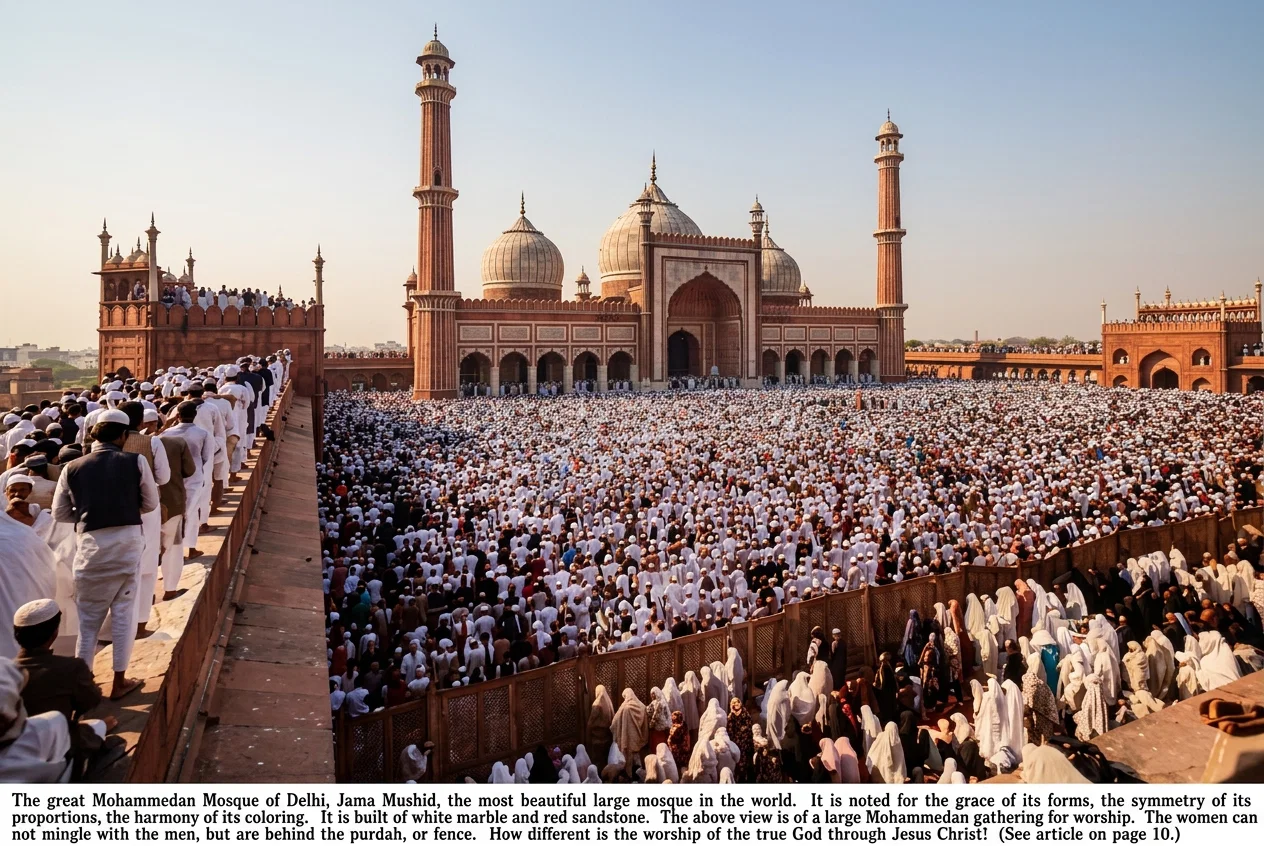
The great Mohammedan Mosque of Delhi, Jama Mushid, the most beautiful large mosque in the world. It is noted for the grace of its forms, the symmetry of its proportions, the harmony of its coloring. It is built of white marble and red sandstone. The above view is of a large Mohammedan gathering for worship. The women can not mingle with the men, but are behind the purdah, or fence. How different is the worship of the true God through Jesus Christ! (See article on page 10.)
The subjects of Satan, altho they hate and war with one another, are active and united in the one object of destroying souls. They are vigilant in improving every opportunity to advance their common interest, and war against the kingdom of Christ. But He who is the great Commander in heaven and on earth, has limited their power.
Satan is ever ready to insinuate that prayer is a mere form, and avails us nothing. He can not bear to have his powerful rival appealed to. At the sound of fervent prayer, the hosts of darkness tremble. Fearing that their captive may escape, they form a wall around him, that Heaven's light may not reach his soul. But if in his distress and helplessness the sinner looks to Jesus, pleading the merits of His blood, our compassionate Redeemer listens to the earnest, persevering prayer of faith, and sends to his deliverance a re-enforcement of angels that excel in strength. And when these angels, all-powerful, clothed with the armory of Heaven, come to the help of the fainting, pursued soul, the angels of darkness fall back, well knowing that their battle is lost, and that one more soul is escaping from the power of their influence.

The One Remedy

Prayer is the Christian's life. There is a remedy for the sin-sick soul, and that remedy is in Jesus. Precious Saviour! His grace is sufficient for the weakest, and the strongest must have His help or perish. A Christian has victory over his passions and besetments. I would not dishonor my Master so much as to admit that a careless, trifling, prayerless person is a Christian. It is the privilege of the Christian to enjoy the deep movings of the Spirit of God. A sweet, heavenly peace will pervade his mind. He will love to meditate upon God and heaven, and to feast upon the glorious promises of the written Word.
But how shall this victory over the world be obtained? Go to your closet, dear reader, and there plead with God, "Create in me a clean heart, O God; and renew a right spirit within me." Be in earnest; be sincere; Jacob-like, wrestle in prayer. Do not leave your closet until you feel strong in God. Remain until unutterable longings for salvation are awakened in your heart, and the sweet evidence is obtained of pardoned sin. Then when you leave your closet, watch; and so long as you watch and pray, the grace of God will appear in your life.

The Soul of Religion

In no case neglect secret prayer; for it is the soul of religion. If you expect salvation, you must pray. Take time. Be not hurried and careless in your prayers. Intercede with God to work in you a thoro reformation, that the fruits of the Spirit may dwell in you, and that, by your godly life, you may shine as a light in the world. When you sincerely feel that without the help of God you perish, when you pant after Him as the hart panteth after the water-brooks, then will the Lord strengthen you speedily, and you will have that peace that passeth understanding.
While you pray that you may not be led into temptation, remember that your work does not end with the prayer. You must then answer your own prayer as far as possible, by resisting temptation, and leave that which you can not do for yourselves for Jesus to do for you. We can not be too guarded in our words and deportment, lest we invite the enemy to approach us with his temptations. With the Word of God for our guide, and Jesus for our heavenly teacher, we need not be ignorant of the divine requirements or of Satan's devices. And it will be no unpleasant task to be obedient to the will of God, when we yield ourselves fully to be directed by His Spirit.

Family Prayer

Pray in the family. Morning and evening obtain the victory at your family altar. Let not your daily labor keep you from this duty. Take time to pray. And as you pray, believe that God hears you, have faith mixed with your prayers. Let faith take hold of the blessing, and it is yours.
In the morning the Christian's first thoughts should be of God. Come before Him with humility, with a heart full of tenderness, and with a sense of the temptations and dangers that surround yourself and your children. Morning and evening, by earnest prayer and persevering faith, make a hedge about your children. Patiently instruct them; kindly and untiringly teach them how to live so that they may please God.
Teach your children reverence for God and the hour of prayer. The Lord our God is holy, and His name is to be treated with great reverence. Angels are displeased and disgusted with the irreverent manner in which the name of God, the great Jehovah, is sometimes used in prayer. They mention that name with the greatest awe, even veiling their faces when they speak the name of God; the name of Christ also is sacred, and is spoken with the greatest reverence. And those who in their prayers use the name of God in a common and flippant manner, have no sense of the exalted character of God, of Christ, or of heavenly things.
Pray in faith. "This is the victory that overcometh the world, even our faith." Prevailing prayer is the prayer of living faith; it takes God at His word, and claims His promises. Feeling has nothing to do with faith. When faith brings the blessing to your heart and you rejoice in the blessing, then it is no more faith, but feeling. How strange it is that men will put confidence in the word of their fellow men, and yet find it so hard to exercise living faith in God! The promises are ample; why not accept them just as they read? "He that spared not His own Son, but delivered Him up for us all, how shall He not with Him also freely give us all things?"

Answered Prayer

Every petition that is offered to God in faith, and with a true heart, will be answered. Such prayer is never lost; but to claim that it will always be answered in the very way and for the particular thing that we desire, is presumption. God is too wise to err, and too good to withhold any good thing from them that walk uprightly. Then do not fear to trust Him even tho you do not see the immediate answer to your prayers. Rely upon His sure promise, "Ask, and ye shall receive."
Fervent and effectual prayer will be regarded in heaven. It is the privilege of Christians to obtain strength from God to hold every precious gift of His Spirit. The power of God has not decreased. His grace and His Spirit will be just as freely bestowed now as formerly. It is the church of God that have lost their faith to claim, their energy to wrestle, as did Jacob, crying, "I will not let Thee go, except Thou bless me." Enduring faith has been dying away, and must be revived in the hearts of God's people. There must be a claiming of the blessing of God. Living faith always bears upward to God and glory; unbelief, downward to darkness and death.
"To him that overcometh will I grant to sit with Me in My throne, even as I also overcame, and am set down with My Father in His throne." We can overcome, fully, entirely. Jesus died to make a way of escape for us, that by prevailing prayer, by His grace, we might overcome every temptation, every subtle snare of the adversary, and at last sit down with Him in His kingdom.

How Manifold Are Thy Works!

By May Wakeham
How manifold Thy works, O Lord, How bright Thy glories shine! All Nature's voices in accord, Declare Thou art divine.
Thou dwellest in the "holy place" Beyond the mortal view, Yet hast Thou left us many a trace Of what Thy hands can do.
We see Thee in the mighty deep, Or brooklet's silver sheen, Or in the tiny flowers that peep From out their beds of green.
Thou ridest on the wingéd wind That fans the mountain's brow, And on old Ocean's waves of brine Thy stately footsteps go.
Thou speakest, and the thunder crash Is heard on sea and land, And rain and hail and lightning flash Go forth at Thy command.
Thy breath sendeth forth ice and snow; Nature seemeth congealed. Thou makest gentle zephyrs blow— New beauties stand revealed.
Thou part'st the curtains of the night, And there appear to view A serried host arrayed in light, Bedecking heaven's blue.
Yea, teeming worlds dash on through space, Held by Thy mighty word, Each keeping its appointed place, Obedient to their Lord.
Ages on ages roll along, Vast empires rise and fall; Man's greatest works fade like a song; Death covers with a pall.
Thou changest not. Divinity Knoweth nor time nor change. Thou holdest vast infinity Within Thy vision's range.
O God, how measureless the sum Of power and love divine! Our hearts and lips with awe are dumb. We bow before Thy shrine.
Thou mighty One, Thou King of Kings, Who fillest eternity, How canst Thou stoop to mortal things, Mere atoms such as we,
To rebels who have dared to raise Their weak and puny hands Against Thy true and holy laws, Thy wise and just commands!
But love and grace, O mighty One, A never-ebbing tide, Flow out forever from Thy throne, Unmeasured, deep, and wide.
This God is ours forevermore. We rest beneath His wings. With hearts and voices we adore, And crown Him King of Kings.
Port Townsend, Washington.

Religion and Courage

RELIGION gives a man courage. . . . I mean the higher moral courage which can look danger in the face unawed and undismayed; the courage that can encounter loss of ease, of wealth, of friends, of your own good name; the courage that can face a world full of howling and of scorn—aye, of loathing and of hate; can see all this with a smile, and, suffering it all, can still toil on, conscious of the result, yet fearless still.—Theodore Parker.

XXIV. The Witnessing Church

BEFORE we leave the study of the eleventh chapter of Revelation, with its important topic of the witnesses, studied two weeks ago, let us apply God's law of witness to the church. There is instruction and comfort in the truth. What is the truth regarding the witnessing church? In this study we shall be able to offer only the merest outline, suggestions so to speak, of the great amount of evidence God has given in the twofold witness of His Word.
Many of our readers are acquainted with the claim that is made by our Roman Catholic friends; namely, that the Roman Catholic Church is the one witnessing, living church through all the centuries. As the Rt. Rev. John Milner, D.D., F.S.A., in his "End of Controversy," page 95, expresses it, "There is but one inquiry to be made; namely, 'Which is the true church?' . . . By solving this question, 'Which is the true church?' you will at once solve every question of religious controversy that ever has been or that ever can be agitated." In the same connection he declares the true church to be the Roman Catholic as evidenced by "the Scriptures, both Old and New, from the Apostle's Creed, and from constant tradition."
Before we enter upon this study direct let us recall the law of God's witness, which we place in the form of the following self-evident or easily demonstrated propositions:
1. God's witness which He offers in confirmation of a fact is always reliable and infallible.
2. This witness is at least twofold, a double agreeing witness so to speak, witnesses which in the very nature of the case are not and can not be collusive; that is, there has not been nor can there be any secret agreement between the witnesses to testify together to uphold a claim.
3. In all positive truth God writes His Word at least twice in such a way and at such distances apart that the Word itself becomes an infallible witness of itself; and these testimonies are multiplied and cumulative in force throughout the ages. His precepts He writes again in character. His predictions He writes again in fulfilment. To this proposition the ages bear multiform testimony.
4. In His power and wisdom God makes His enemies, the traitors to His truth, the apostasies in His church, the crime and sin of all ages, testify to the truth of His Word, while they are proclaiming error. He does this by the "sure word of prophecy" uttered many times centuries before fulfilment, and always with that particularity in detail that its clear application may be seen by the honest seeker after truth.
5. The human claim to be the people or church of God is nothing; for even Satan appears as an angel of light. The apostate Jews declared themselves to be Abraham's seed; but John declared them to be a "generation of vipers;" and Jesus, children of "the devil." Matt. 3: 7-10; John 8: 39-44.
6. God's church and people have ever consisted not of the great mass, unless the mass stood right, but of the faithful remnant, those who stood for His truth when all others wandered, drifted, rebelled, apostatized.
7. The vital, true, infallible witness is ever that of the Word of God, not the word of men; and the true power in the church of God is the power of the living message she bears in consecrated lives, not in tradition, or a passing from man to man some blessing or commission given of God centuries before. The one thing that God regards above all others is truth. He is the "God of truth," and therefore "just and right is He." Deut. 32: 4. "All His works are done in truth." Jesus said to Him, "Thy Word is truth." The psalmist: "Thy law is the truth." "All Thy commandments are truth." He "keepeth truth forever." "The truth of the Lord endureth forever." "His truth endureth to all generations." His Word being the expression of His truth. Inspiration declares, "Thou hast magnified Thy Word above all Thy name." Therefore as to the human, "Behold, Thou desirest truth in the inward parts." Jesus prays, "Sanctify them through Thy truth: Thy Word is truth." His ministers are to "preach the Word" of truth; and "the lip of truth shall be established forever." And in that day when all things earthly fail, He declares to His trusting child, "His truth shall be thy shield and buckler."
Jesus Christ came to "bear witness unto the truth." John 18: 37. Not in triumph and prosperity always, but in hardship, adversity, and seeming defeat. Even so His church should bear witness to Him. "Ye are My witnesses." And therefore John the Baptist "bare witness unto the truth," and upon His apostles He placed "the Spirit of truth," that they also should "bear witness." The witness they bear, the power they possess, would be in the God-given message. So Jeremiah, responsive to God's call, bearing God's message, was set "over the nations and over the kingdoms, to root out, and to pull down, and to destroy, and to throw down, to build, and to plant." But the doing of the one or the other rested not in the man, but in his message, and the attitude which the nations and peoples assumed toward his message. Jer. 1: 10; 18: 7-10. So to Peter and the other apostles was given power to bind or loose, but the power rested not in the mere men or their successors, but in the Gospel message of truth they bore, and how men related themselves to it. Matt. 16: 19; John 20: 23; Mark 16: 16; 2 Cor. 2: 15, 16. And even so it was with Jesus the Son of God. He was built up who received His word; he was listed for destruction who would not receive it. Matt. 7: 24-27.
One other thing that God regards as of pre-eminent worth in men is loyalty, the true, perfect, devoted heart. Therefore "the eyes of Jehovah run to and fro throughout the whole earth, to show Himself strong in the behalf of them whose heart is perfect toward Him." 2 Chron. 16: 9. God is not demanding perfect knowledge or perfect wisdom or errorless conduct; but He does demand the perfect heart, the heart obedient to all the light it has; and the people with such a heart constitute God's church, or people, wherever found.
This is in harmony with the original term from which "church" comes; namely, ekklesia, the classical meaning of which, according to Liddell and Scott, is "an assembly of citizens summoned by the crier, opposed

"They Have Taken My Lord Away"

(Lawrence W. Neff, in Sunday School Times)
To His empty tomb the woman Steals forth at the dawn of day, And the cry is wrung from her breaking heart, "They have taken my Lord away." In sorrow she turns, but—"Mary"— Uplifting her drooping head, At the spoken word of her living Lord She knows that Death is dead.
In the dawn of faith I seek Him 'Mid the learned of earth, but they With subtle logic and sophist's guile Have taken my Lord away. Then, stooping to lift a brother O'erburdened with toil and strife, In the glowing morn of hope new-born I walk with the Lord of Life.
Continue reading: At What Are You Aiming?