Pacific Press Publishing Company · Oakland, California · Oct 28, 1897
Editorial
By Editor
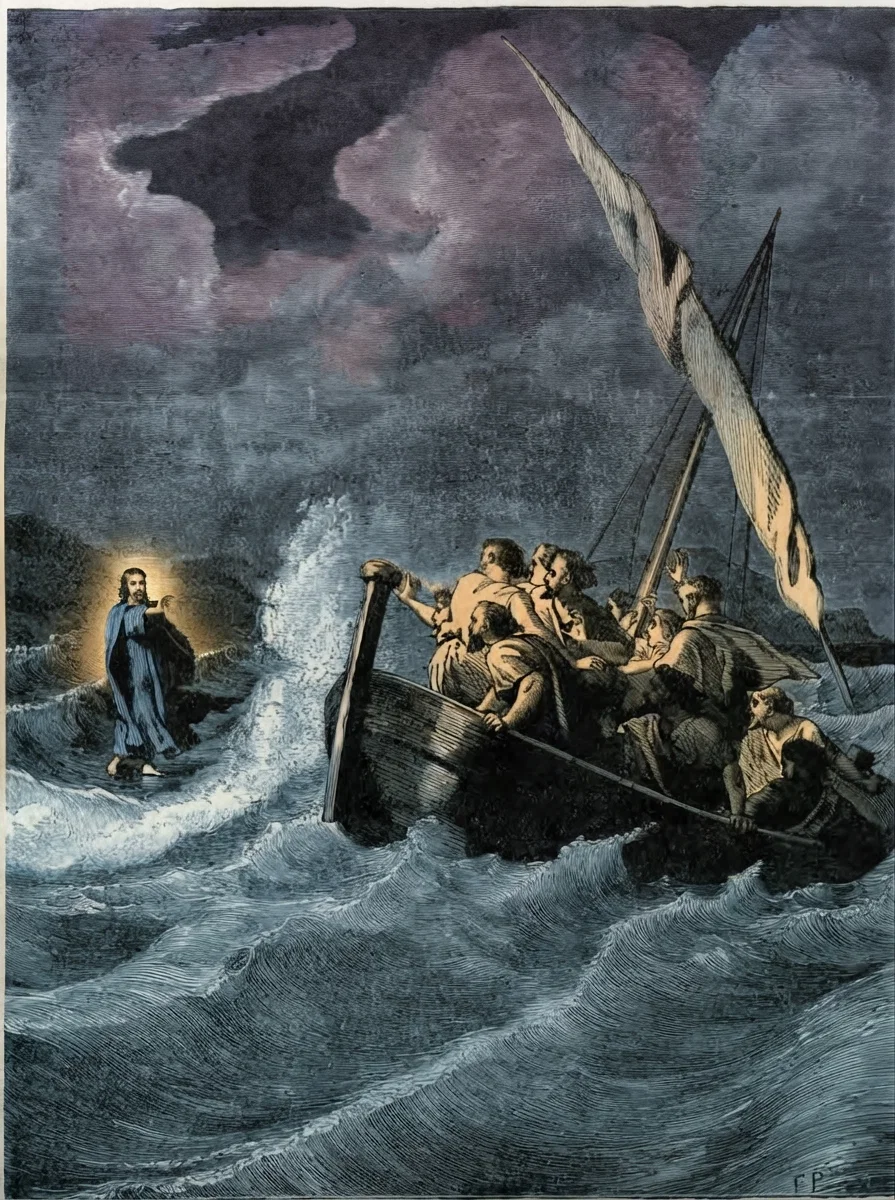
"It is I; be not afraid." The words are those of the Son of God, the Creator of the heavens and the earth, and Master of sea and storm.
The occasion of the words is recorded in the sixth chapter of John, verses 15-21. The day of the event had been a remarkable one. The great Provider had dispensed to the multitude the bread of life, and e're sending them to their homes, had fed with temporal food by means of five barley cakes and two little fishes the five thousand men and the accompanying women and children. All, too, were sufficiently fed, and the fragments of the desert feast filled twelve baskets. Blessings in the hands of our Lord ever increase.
But slow of heart the multitude did not learn the spiritual lessons, did not accept the food as from God, did not hunger for the bread of eternal life, which Christ alone could give. Truly, thought they, this is the king we desire. If he will not assume kingship we will compel him to be king. But Christ's "kingdom is not of this world." John 18:36. Neither expediency, politics, nor force can make him king. He will reign in every individual heart which will truly say, "Thine is the dominion," but he will never sit upon the temporal sinful thrones of men either in person or by proxy. When, therefore, he perceived that they would by force attempt to make him king, he despatched his disciples, some of whom, at least, appeared to be leaders in the plot, to Bethsaida, on the other side of the sea, while he sent the multitude away, and "departed again into a mountain himself alone," to pray for the people who longed not so much for inward holiness as for the loaves and fishes. Mark 6:45, 46; John 6:15, 26. So will he depart from every man or body of people who desire to make him an expedient in politics, or seat him on a political or theological throne of their own devising.
IT IS I, BE NOT AFRAID.
The disciples departed, doubtless disappointed that their cherished hopes had perished. As they proceeded on their journey, the night fell, and a fierce wind, common to the beautiful sea, arose with the deepening darkness. They endeavored to proceed to the other side, but they made no progress; "the wind was contrary." The distance was but seven or eight miles, but in the deep hours of the night, preceding the breaking of the day, the boat was still "in the midst of the sea, tossed with the waves." Their progress on the sea well befitted their disappointed hopes, and their spirits were at low ebb as their physical natures grew more weary with the rowing.
Frightened.—
The weary boatmen were in a proper condition both mentally and physically to give way to groundless fears. The refusal of Jesus to be made king, the sending of them away alone on the stormy sea, the terrible tempest, the swelling sea, made the night one of terror and gloomy foreboding. To cap the climax, as they peered into the darkness they saw a human form walking upon the tossing waves. All the superstitious tales so common among fisher folk invest to them the dread apparition with a deadly meaning. It was to them the storm wraith, foretokening their destruction. Some one whispers, "It is an apparition," and, paralyzed with fear, they cry out in agony.2But what joy succeeds the fear as there comes over the waves, through the darkness, from that Being who treads the stormy sea even as on land, the well-known voice, "Be of good cheer, it is I; be not afraid." They receive him into the boat, and immediately the journey is over, the little ship is at the land.
The lessons are obvious to the storm-tossed, disappointed children of earth. First of all, the Lord knows our needs. He knew that the disciples needed not a temporal kingdom in a world of sin, but a spiritual fitting for an eternal and sinless kingdom. Disappointed as they were, he did not utterly forsake them. He noted the storm raised by the prince of the power of the air, he saw them in the darkness of night "distressed in rowing," and he went to their relief. So he sees us. He knows our needs, knows the storms of trial, the furnace heat, the flail of tribulation. He will leave us no longer than is for our best good. He not only desires and purposes our salvation, but he is able to save. "The sea is his, and he made it." No storm-tossed deep can overwhelm him. He treads the rolling waves as tho they were solid rock. And yet our gloomy fears often think his very deliverances to be omens of fearful ill. Like Jacob we will say, "All these things are against me." Like Jerusalem of old, we moan, "Behold, and see if there be any sorrow like my sorrow." Sometimes our eyes are too dim with selfish weeping to discern his form; our ears are too benumbed to hear his voice. But he is there. We may behold him, and "there is life in a look." We may hear him say, "Be of good cheer; it is I; be not afraid." And he will come into our frail boat of life and being if we will let him. But, soul, if you can not see him or hear him, "feel after him and find him," for he is "not far from each one of us." Acts 17:27, R. V.
Jesus alone can save
From every stormy wave;
Trust in His power,
Ever, in dark or day,
Ever, in peace or fray,
Ever, and all the way,
Trust every hour.
Letter and Spirit.
'Who hath made us able ministers of the new testament; not of the letter, but of the spirit; for the letter killeth, but the spirit giveth life.' 2 Cor. 3:6. Note that the apostle does not say, 'not of the letter of the old testament, but of the spirit of the new;' that is not the thought of the text; but, 'able ministers of the new testament; not of the letter [of the new testament]; but of the spirit [of the new testament]; for the letter [of the new testament] killeth, but the spirit giveth life.' The letter of truth is its mere form. The mightiest and most blessed truth of God's Word in its mere form or letter will not save; for wherever the Bible has gone, unsaved men hold it in the letter. It only condemns them. To partake of the Lord's supper, to go through a form of baptism, to rest on the seventh day, will save no one. The truth must be received in the heart, in the love of it, and thus become a very part of the being, changing the man to the glory of God.
It was of this mighty truth that Paul was minister. If men rejected it, he did not put them to death, nor did Christ, nor has he given that commission to any of his servants. The words rejected, or held only in the letter, will condemn in the last day. John 12:48; 2 Cor. 2:16.
WHAT IS YOUR WITNESS?
ARE you the Lord's? Is he your personal Saviour? Do you know this to be a fact? If so, how?
"Why," says one, "I have the blessed inward consciousness that this is so. I have the witness within myself. What more do I need?"—But you do need more. An "inward consciousness" of your own, apart by itself, however "blessed" it may seem to you, is of little worth. Thousands have been deceived before you, and you may be just as surely deceived. Your witness at best is only a human, fallible witness.
"But how may I know?" do you ask? You may know. God would have you have a better witness. The law of the Word of God in the matter of witness is that "at the mouth of two witnesses, or at the mouth of three witnesses, shall the matter be established." Deut. 19:15; Matt. 18:16; 2 Cor. 13:1. Even our Lord's mission was thus established. John 8:18. And he himself declared, "If I bear witness of myself, my witness is not true." John 5:31.
But did he not bear witness of himself, and was not his witness true?—Yes, but its truth was confirmed by even greater witness, witness which would appeal to minds far beyond any claim which Jesus of himself could make. Further, Jesus did not put forth his "inner consciousness" as a witness. Of course he possessed an inner consciousness which made his own heart glad. But the two witnesses were these:—
Witness of Jesus. | Witness of the Father.
"I am one that bear witness of myself." John 8:17. | "The Father that sent me, beareth witness of me." John 8:17.
"The works which the Father hath given me to finish, the same works that I do, bear witness of me, that the Father hath sent me." John 5:36. | "Search the Scriptures; for in them ye think ye have eternal life; and they are they which testify [bear witness] of me." John 5:39.
For all the hundreds of years in the past from Moses to Malachi, God had by his Spirit in his Word borne witness to his Son. Unchanged that witness had remained through all the centuries. Every phase and characteristic of Christ's time and life and work had been foretold.
When Jesus Christ, the Son of God, the eternal Logos, came to this world, God gave him his Spirit without measure. That Spirit wrought out in Jesus Christ just what God had foretold in his Word. The Incarnated Word agreed with the written Word, and thus did God establish Christ's mission to all men.
That written God-breathed Word comes down to us to-day. It is the voice of the Spirit of God speaking to the children of men. It is the infallible Witness of the ages. No man living can say that any other contemporaneous man wrote it, or has altered it to suit his purpose.
Our human soul comes to that Word. It hears God speak. It yields to his voice. That Word declares the soul a sinner; the soul says, "Amen, Lord." It agrees with God. That Word says, "If we confess our sins, he is faithful and just to forgive us our sins, and to cleanse us from all unrighteousness." The soul again says, "Amen, Lord." He listens further; the Word tells him that he may have the love of God through the Spirit of God, that God is willing to give that Spirit, that by that Spirit that soul will obey God, and keep all his commandments. And the soul again and at all times responds: "Amen, Lord. To thee be the dominion of my heart, for thine is the glory and the power. O, how love I thy law! I delight greatly in thy commandments."
Has not that soul a witness?—Yea, verily. The spirit which is in him agrees with the Spirit of God in the Word; and therefore he knows (1) that the spirit in him is the Spirit of Christ, and (2) that he is indeed the Lord's, for the Lord says it, and with it all he is agreed. O brother, this is the witness God desires you to have that you are his child! It is his witness to you. But your witnessing is not to yourself, or of yourself, it is to the world of the goodness of God, of God's power to transform character, and to do all that he has promised.
HOW TO LOVE GOD.
By Ellet Joseph Waggoner
'I do not love God, and it does not seem as tho I ever could; how can I learn to love him?' Thus writes an inquiring soul. The only answer is, Get acquainted with God. The trouble with our friend is a lack of acquaintance with God; for 'he that loveth not knoweth not God.' 1 John 4:8. 'And they that know thy name will put their trust in thee; for thou, Lord, hast not forsaken them that seek thee.' Ps. 9:10.
Don't trouble yourself about 'trying to love God.' Love doesn't come in that way. Love is a spontaneous growth springing from acquaintance with one who is loving and lovable. Get acquainted with God, and you can't help loving him. The god whom you are trying to love, is not the true God.
'The love of God is shed abroad in our hearts by the Holy Ghost which is given unto us' (Rom. 5:5), and we are taught (Luke 11:13) that God is more ready to give the Holy Spirit to them that ask him, than a parent is to give good things to his children. The Spirit has, indeed, been poured out upon all flesh (Acts 2:16, 17), so the gift of love has been bestowed upon us even before we ask it. Air and water, the first essentials to life, and the freest of the gifts of God, are the best representations of the measureless gift of the Spirit, and so of the infinity of God's gift of everlasting love.
'But how can I get acquainted with God?' O, that is not difficult! He is 'not far from every one of us' (Acts 17:27), and is very accessible, for he invites everybody to come to him. Through Christ all men, of every class and nation, 'have access by one Spirit unto the Father.' Eph. 2:18. Begin to hold conversations with him. Do not be afraid of intruding, or of putting yourself forward; for when you speak to the Lord, you are only replying to the words that he has already spoken to you. If you consider what he has said to you, you will be at no loss to know what to say to him. You3can not expect to love one with whom you are not acquainted; but what is more natural than the growth of love between persons who frequently converse together?
We get acquainted with God also through his works. 'The earth is full of the goodness of the Lord.' Ps. 33:5. All his works praise him. The evidences of his love and loveliness are stamped upon every leaf and flower; they descend with the rain, and flow with the streams; they shine in the sunbeams, and are diffused in the air. 'O, taste and see that the Lord is good; blessed is the man that trusteth in him;' for unto you who believe 'he is precious.'
E. J. W.
OBEDIENCE, AND WHOSE?
God's law, the Decalog, demands obedience. The transgression of that law is sin. 1 John 3:4; Rom. 7:7. "All have sinned, and come short of the glory of God." Rom. 3:20. All are therefore condemned by the law, and worthy to die; for "the wages of sin is death." Rom. 6:23; Eze. 18:4. God's glory is his goodness, his righteousness. Ex. 33:18, 19; 34:6, 7. Now as God created man for his glory (Isa. 43:7), and as man has sinned and come short of that glory, there must be some means by which he may be brought back to that glory if he is to be saved. That means is the Gospel, "the power of God unto salvation to every one that believeth; for therein [that is, in the Gospel] is the righteousness of God revealed from faith to faith; as it is written, the just shall live by faith." Rom. 1:16. "Even the righteousness of God which is by faith of Jesus Christ unto all and upon all them that believe." Rom. 3:22.
He, therefore, who believes in Jesus Christ is counted righteous, not with his own righteousness, not with his own law-keeping, but with "the righteousness of God," with the obedience of Jesus Christ; "for as through the one man's disobedience the many were made sinners, even so through the obedience of the One shall the many be made righteous." Rom. 5:19. To this righteousness the law and the prophets bear witness, showing that the righteousness which God gives by faith is the same that is demanded by the law and taught by the prophets. Rom. 3:21.
From our transgressions of the first commandment—the worship of false gods—we are through faith justified by Christ's obedience to that commandment. From our transgressions of the sixth commandment—murder and hatred—we are through faith justified by Christ's obedience to that commandment. From our transgressions of the fourth commandment,—Sabbath-breaking,—we are justified through faith by Christ's Sabbath-keeping.
Now, if we are justified from idolatry, or murder, or adultery, or profanity, are we free to indulge in those things?—"God forbid, how shall we that are dead to sin ["transgression of the law"] live any longer therein [in transgression]?" Rom. 6:1. By so doing we would make Christ the "minister of sin," building again the things that were destroyed. Gal. 2:17, 18.
Now is not all this just as true of the Sabbath precept as of any other part of the law? Shall Christ's obedience be accepted or be hoped for as respects one precept and despised as regards another? He would live his own life in us, in each one of his children, over again? Would he live a different life, a different righteousness, than when he was here on earth?—Nay, he would not. He is "Jesus Christ, the same yesterday, and to-day, and forever." He who rejects a part of the obedience of Christ really rejects all. The law is a whole law of the one God and one Saviour. Those who are "partial in the law" do not keep God's ways. Mal. 2:9.
FOR CHRIST, OR AGAINST HIM.
By Ellen G. White
"He that is not with Me, is against Me; and he that gathereth not with Me, scattereth abroad." The mind, the heart, the strength, of every son and daughter of Adam, belongs to God. None of us are at liberty to shape our own course of action as we please. And we can not possibly be neutral. Our influence is cast either for the right or for the wrong. Do not think that because you do not manifest decided hostility against Christ, you are doing him service. Those who think thus deceive their own souls. Every time that you are not guided by the Holy Spirit, your influence is used against Christ. You are scattering abroad. We can not withhold from Christ a portion of his intrusted goods and resources without giving the power of darkness an advantage. By withholding that which God has given us to use in his service, be it time, or means, or influence, we work against him.
God's workers should earnestly co-operate with heavenly intelligences, using every particle of light and grace for the saving of the souls for whom Christ has died. When one of Christ's professed servants relaxes his hold, Satanic agencies take up the work, hurting and destroying where an active, interested worker might save and strengthen.
Souls are in the darkness of error, ignorant of God, of Christ, and of the truth. But too many of those who call themselves Christians, carry no burden for their fellow-beings. They expect the minister to devise all the plans, and set in operation all the influences that are to win souls to the cross of Christ. By far the larger number of professed Christians feel themselves detached from the perishing world around them. Yet they are a part of the great web of humanity, and Heaven looks upon them as brothers to sinners, as well as to saints. As they mingle with others, they exert an influence that either helps souls on the way to4heaven, or helps to drive them to perdition. Each one acts himself.
I would that those who profess to be servants of Christ could, with the angels, look down from the heavenly courts upon the world, and upon the churches that profess to be serving God and obeying his orders. What would they see?—They would see God's precious time spent, and nothing accomplished. They would see his intrusted means used for self-gratification and self-indulgence.
What more would they behold from the lofty heavens, from which angels descend, co-operating with every one who is dedicated to the service of God?—They would see that this world is the scene of a continuous conflict. They would see that human beings are required to fill posts of duty. They would see unnumbered agencies of evil at work, taking advantage of those who are off guard, to set in operation influences fraught with evil.
What further would they see?—They would see that in the great judgment day those who have not worked for Christ, who have drifted along, carrying no responsibility, thinking of themselves, pleasing themselves, will be placed by the Judge of the whole earth with those who did evil. Both receive the same condemnation. If those who thus wasted their lives were given another probation, would they not work soberly and righteously, with soul and mind and strength, to accomplish something for the Master, who left them an example by his life of self-denial and self-sacrifice, by his diligence in the work of saving perishing souls?
When Satan succeeds in lulling the professed followers of Christ to carnal security, so that they fall asleep at their post, a shout of joy runs through the ranks of the invisible foe. The enemy uses the listless, sleepy indolence of Christians to strengthen his forces and win souls to his banner. Many who think that, though they are doing no actual work for Christ, they are yet on his side, are enabling the enemy to preoccupy ground and gain advantages. By their failure to be wide-awake, diligent workers for the Master, by leaving duties undone, and words unspoken, they have allowed Satan to gain control of souls.
There is an abundance of work to be done in our world, and no one with reason and a knowledge of the will of God will be excused from doing his share. "Curse ye Meroz, said the angel of the Lord, curse ye bitterly the inhabitants thereof; because they came not to the help of the Lord, against the mighty." These words mean much to those who have no spirit to labor, no desire to wear the yoke or lift the burdens in the service of Christ. Our faith must be a living faith. It must work by love, and purify the soul. We are to study to show ourselves approved, workmen that need not to be ashamed. We are to employ our intrusted capabilities in God's service, thus demonstrating our fidelity to him. If we do only a third of what our talents enable us to do, with the other two-thirds of our power we are working against Christ.
"Wherefore gird up the loins of your mind, be sober, and hope to the end, for the grace that is to be brought unto you at the revelation of Jesus Christ." "Take unto you the whole armor of God, that ye may be able to withstand in the evil day, and having done all, to stand. Stand therefore, having your loins girt about with truth, and having on the breastplate of righteousness; and your feet shod with the preparation of peace; above all, taking the shield of faith, wherewith ye shall be able to quench all the fiery darts of the wicked. And take the helmet of salvation, and the sword of the Spirit, which is the Word of God; praying always with all prayer and supplication in the Spirit, and watching thereunto with all perseverance and supplication for all saints."
MRS. E. G. WHITE.
THE LILY OF THE VALLEY.
By Emma L. Pardon
BEFORE me as I sit and rest there stands
A vase of lilies beautiful and sweet;
They seem to charm my weariness away,
Their power to soothe and calm is so complete.
Tho calm their outward form, on looking close,
The spark of fire within each bell I've found,
That proves their mission one of love to man,
And makes our hearts to God's own praise re-dound.
Amidst their cool, broad, sheltering leaves they stand,
Modestly hiding in their safe retreat,
Exerting over all an influence kind,
Gladdening the eye, and rendering life more sweet.
Behold the sick-room: enters in a child,
Bearing sweet lilies in her little palm;
With feeble eagerness the sick one turns,
Thy soothing presence bringeth rest and balm.
Behold sad parents by a little grave;
With lilies of the valley low they bend,
And gently cover her, their only child,
Whose brief career a perfume sweet did lend.
O lily of the vale, our Lord chose thee
An emblem of Himself; and oft my mind
Doth turn from symbol to reality,
To Jesus, holy, glorious, loving, kind!
EMMA L. PARDON.
Albany, N. Y.
Not a Type, but Eternal.
The Sabbath of the Lord is not a type in the sense that it points out something in which it ends. The Passover was a type which ended by limitation at the cross. But the Sabbath of the Lord is a memorial of creation and a sign of our acknowledgment of God as Creator and Redeemer. Ex. 20:8-11; Eze. 20:12, 20. It is an emblem of the rest in Christ Jesus. Heb. 4:1-11. It can never pass away, because the facts upon which it is founded are eternal, and the reasons why God gave it are eternal. But the yearly sabbaths and feasts, of which not less than seven are noted in Leviticus 23, "beside the Sabbaths of the Lord" (verse 38), "are a shadow of things to come." Col. 2:17. This was emphatically true of the yearly sabbaths, but not at all true of the Sabbath of the Lord. If sin had never entered, the Sabbath would still exist, even as it will throughout all eternity in the earth made new. Isa. 66:22, 23. What the priests and kings of the people of God in past dispensations were among men, such were the yearly sabbaths among institutions. Priests, kings, and sabbaths were typical. But what God has always been and will be to his people,—Creator and Redeemer,—such has his memorial, his sign, his Sabbath, ever been and will be. It is like its Author,—eternal.
"PRINTING ON THE SKIES."
THE following is from the pen of Dr. L. A. Banks in the N. Y. Voice; it is suggestive of a higher truth:—
A man in Cincinnati has invented an apparatus by which it is proposed to print in letters of fire news or bulletins on the sky. The apparatus is worked by electricity. First, a shadowy sheet regulated to suit the size of the bulletin or telegram is cast upon the heavens by an electric camera, and then, with another camera, words in letters of fire are cast on this. It is the dream of the inventor that the time will come when the important news of the day will be spread out on the skies every evening, so that every toiler can read them in comfort and at his leisure. These news bulletins will be prepared by conscientious, intelligent, and incorruptible public officials, and the result would be the abolition of ignorance, misinformation, and prejudice. Whatever may be the result of this invention, we know that there is an invention as old as the human race that has been registering matters of infinite moment in the skies. Jesus said to his disciples when they were rejoicing that even the devils were subject to them, that it would be more appropriate to rejoice because their names were written in heaven. We may know that our names are written there if we have within us the Spirit of Christ; but Paul declares that if we have not the Spirit of Christ we are none of his.
In Ps. 50:3-6 is set forth the second coming of our Lord, and the final judgment. The sixth verse reads: "And the heavens shall declare his righteousness; for God is judge himself." God's law is the rule of his righteousness (Isa. 51:6, 7), the standard of his judgment (Eccl. 12:13, 14; James 2:8-12). What more reasonable to suppose than that God will in that day emblazon his holy law, revealed in his Word, kept by his Son, which men now deny, on the very heavens in sight of all beholders?
WHO ARE BLINDED BY THE VAIL?
IN a recent number of the Pacific Christian is an article on "The Bible versus Sabbatarianism," which we are requested to notice. Really it is not worth while, for it presents no reasons against the law of God which have not been answered scores of times. However, as the main argument is based on an evident misunderstanding on the part of the writer of 2 Corinthians 3, we will notice what he says relating to that:—
The thing that remains after the ministration of death written on stones, the old covenant, was abolished, is the ministration of the spirit, or principles of moral righteousness without the use of the statutes of the Decalog. The New Testament is essentially an institution of moral principles. It has but three purely statutory laws in it,—the Lord's supper, Christian baptism, by command, and the Lord's day, by apostolic example. When the Lord said, "I will put my laws in their mind, and write them in their hearts" (Heb. 8:10), he taught that the principles of moral right would not stand on a statutory basis in the new, as they did in the old dispensation.
How there can be three purely statutory laws, one of which is by "apostolic example," would puzzle even a sophist to explain. Of course there is no law for Sunday observance in the Scriptures. Neither is there apostolic example; for there is the fact of but one religious meeting on the first day of the week in all the record of the apostles, and that an incidental meeting, on the evening of a day the greater part of which was spent in manual labor. God's law has never stood among his people on a mere statutory basis. When the law has not been written in the heart of his people it has not stood with them. The only thing that will establish the law, or ever has established the law, among any people, is faith. "Do we then make void the law through faith? God forbid; yea, we establish the law." Rom. 3:31. The only thing that established the law in the hearts of Moses, Isaiah, Elijah, and Daniel was faith in God's statutes. So also with Jesus Christ and his apostles. The only faith that profits is the "faith that worketh by love" (Gal. 5:6), and "this is the love of God that we keep his commandments" (1 John 5:3); and how shall we know what he has commanded but by the commandments themselves? Faith by the power of the Spirit writes the principles of righteousness, God's statutory righteousness, in the heart. He who ignores God's statutes has no witness of his righteousness by faith. See Rom. 3:21, 22. He despises the Word of God. Why?—Let Rom. 8:7 answer: "Because the carnal mind is enmity against God; for it is not subject to the law of God, neither indeed can be." Jesus said, "I delight to do thy will, O my God; yea, thy law is within my heart." Again we read in the same article:—
In verse 13 of this third chapter of 2 Corinthians the apostle explains the meaning of the placing of the vail over Moses' face, teaching that the vailing of his face symbolized that Israel would fail to see that the glory of the ministration of death written on the stones which he had in his hands, would come to an end. He farther says, to this day (when this Second Letter was written to the Corinthians), "the vail is still upon their minds and heart." Nevertheless, when it, the heart, turns to the Lord, the vail shall be taken away.
The same vail is on the minds and hearts of all Sabbatarians even to this day of our Lord, 1897. When will it be taken off, that they may stand before the Lord with unveiled face, seeing clearly that the ministration of death written and engraved in stones is done away?
Moses took the vail off his face when he went into the holy place of the tabernacle to minister before the Lord, typifying thereby that Christians, under the new covenant, would minister before the Lord without the vail on their minds and hearts; that is, they would not be blind to the fact that the old covenant, the ministration of death written, and engraved on stones, was abrogated. "But we all with open or unveiled face, beholding, as in a glass, the glory of the Lord, are changed into the same image from glory to glory, even as by the Spirit of the Lord." Verse 18.
That which remains is more glorious than that which is done away. "For if that which is done away was glorious, much more that which remaineth is glorious." Now the glorious thing was "the ministration of death written and engraven in stone." 2 Cor. 3:7. God's law was ministered to the Israelites when it came to them; spoken by the voice of God, or written on the tables of stone, it came in exceeding glory. But to the unbelieving, that glory only condemned them. The giving of the law was to them "the ministration of condemnation." Verse 9. They said to Moses, "Speak thou with us, and we will hear; but let not God speak with us lest we die." Ex. 20:19. Not receiving God's voice brought condemnation and death. See also Deut. 5:25-28.
But how was it with Moses? He lays his own heart open before God, receives God's law by faith in a living Redeemer, and the glory of condemnation and death is abolished in him by the power and indwelling presence of God, so much so that his face shone by the glory of the righteousness within.
But Moses could not give that righteousness of faith to Israel. He could only give them the law as spoken of God, as written on tables of stone. But Israel instead of receiving that law from God as did Moses would not listen to the words of life; and even its glory by grace, shining in the face of Moses, condemned them. God wanted them to take his righteousness, his law, in their hearts by faith even as did Moses. He says, "O that there were such an heart in them, that they would fear me, and keep my commandments always." Deut. 5:29. But they saw only the glory of condemnation and death, which the Lord longed should be done away in the greater glory of justification and regeneration, even as the light of the moon is abolished by the light of the sun.
The same glory condemned them when Moses came down from the mount. Their unbelieving, sinful hearts could not look upon the glory of God's righteousness as it shone from Moses' face. Instead of looking beyond that to the God who had declared himself in that very law a merciful God, their unbelief asked that that glory should be vailed, hidden from them. That vail over Moses' face represented their unbelief. Compare 2 Cor. 3:14 with 4:4.
But Moses saw beyond the outward glory to the inward character of God. Instead of pleading as did Israel, "Let not God speak with us, lest we die," the humble servant of God, with a heart emptied of selfishness, pleads in holy boldness, "I beseech thee, show me thy glory," and God answers the prayer, "I will make all my goodness pass before thee" (Ex. 33:18, 19), and then revealed himself to Moses as "the Lord God, merciful and gracious, long-suffering, and abundant in goodness and truth, keeping mercy for thousands, forgiving5iniquity, transgression and sin" (Ex. 34:6, 7). The Lord showed Moses his glory by placing it in his heart. And it was the forthshining of this glory from within that the unbelief of Israel desired should be vailed. Ex. 34:29-35. It condemned them because of their unbelief.
It is just as true with every Sabbatarian today, and every one else who attempts to keep the Sabbath in the letter alone, and who will not receive the law into his heart and life by Jesus Christ. Such an one gets it only through Moses. "For the law was given by Moses, but grace and truth came by Jesus Christ." John 1:17. It was in Christ that Moses himself obtained the glory, just where he obtained the law coming from God to him; it was grace and truth, righteousness and life, by faith. The law was "the law of the Spirit of life in Christ Jesus." Rom. 8:2. But, refusing to hear God speak, and receiving it only from Moses, the children of Israel were condemned. The ministration of God's Word to them, through man, they receiving it as from man, hid from them God's glory. By their own unbelief, they could not see beyond the glory of condemnation to the glory of justification. When in unbelief they hid from their eyes the lesser glory which condemned self to death, they could not behold and receive the greater glory which brought righteousness and life. And so it is with every one who may profess to keep that whole law. He must take it as from God in Jesus Christ, by faith. If he shuts out the heart-righteousness by unbelief, truly the vail is upon the heart. But if he looks beyond man to God as manifest in Jesus Christ, he will find the law indeed to be grace and truth. So Moses, and Samuel, and David, and Elijah, and Isaiah, and Daniel, and all the faithful of old, and Jesus Christ and his apostles, found it.
The vailed professors of religion in these days are those who will not hear God speak through his law. Of them the prophet speaks: "Now go, write it before them in a table, and note it in a book, that it may be for the latter day; that this is a rebellious people, lying children, children that will not hear the law of the Lord; which say to the seers, See not; and to the prophets, Prophesy not unto us right things, speak unto us smooth things, prophesy deceits; get you out of the way, turn aside out of the path, cause the Holy One of Israel to cease from before us." See Isa. 30:8-13, margin. It is the old cry which we now hear from them which would abolish God's law to-day. They would not only vail their own faces, but would spread a vail over the nations, and hide from the people God's glorious righteousness in Jesus Christ, to which and of which his holy law is a blessed and eternal witness.
But there is coming a time when God will speak, when every case will come before him in judgment, when "the heavens shall declare his righteousness; for God is judge himself," when his holy, unchangeable law, kept by Jesus Christ, by whose obedience we are justified, will both condemn its transgressors, who have rejected it, and acquit those in whose hearts it is written, in whose lives it is practised; when all will be undeceived forevermore, some to meet the inevitable result of chosen sin,—the second death,—some to enter into the everlasting kingdom of God, where against his law and Sabbath no hand shall be raised, no tongue shall speak. "And he will destroy in this mountain the face of the covering cast over all people, and the vail that is spread over all nations." Isa. 25:7. Before it shall be too late God asks us to "consider this." Ps. 50:16-22. Reader, are not the Word of God and the example of Jesus Christ sufficient? X.