ONE of the great charges the Lord preferred against ancient Israel was that the people were destroyed for lack of knowledge. Hosea 4:6. The Hebrew word meb-le, translated "lack," really means deficient. They had some knowledge of God and His law, but it was a deficient one. The result was that they were cut off, which is the full meaning of the word need-moo, translated "destroyed." By not having the correct knowledge of God they did not worship the Lord properly; this cut many off from God. It brought to them backsliding, coldness, formality, alienation. Is this not a true picture of the condition of the religious world to-day? Is there not an alienation from God, a coldness, a backsliding, an increase in formality? There must be a reason for this. The world is not a chance one; for whatsoever is sown, a harvest of the same kind will be produced. Gal. 6:7, 8.
Wrong Ideas of the Sabbath.
Among the things the professed church of God is deficient in to-day is the relation of the law of God to the Sabbath truth. The Bible has but one Sabbath. Luke 23:56. This is true from Genesis to Revelation. Gen. 2:2, 3; Rev. 1:10. But the tradition for some time has been, and it is a growing one to-day, that the seventh day is the Jewish Sabbath, a day that was given to the Jews when the law was given to them on Sinai; that when Christ died on the cross the law was abrogated and the Sabbath was changed to the first day of the week; and that the first day was observed by the apostles and the early Christian church during the first centuries, and has been handed down to the religious world till the present time.
Inasmuch as the real idea of the abrogation of the law and what was involved in it has been shown in previous articles, we will pass this by for the present, and proceed to examine the Sabbath law as it is in the Bible. The record of it is given in Ex. 20:8-11. We will give a word for word translation from the original Hebrew: "Remember the day which is the Sabbath to set it apart for a holy purpose. Six days thou mayest serve, and perform all kinds of labor, and the day which is the seventh is Sabbath to Jehovah thy God. In it thou shalt not perform any work; thou, and thy son, and thy daughter, thy manservant, and thy maidservant, and thy cattle, and the sojourner who is in thy gates. Because in six days Jehovah made heaven and earth, the sea, and all that is in them, and rested in the day which is the seventh. For this reason Jehovah blessed the day which is the Sabbath, and set it apart for holy purpose."
How Man Can Keep the Holy Sabbath.
In this command, as we read it, we find God telling us just why this Sabbath was made. To begin with, it states that the Sabbath must be observed for a holy purpose. Can every body do this? Can every one observe a holy day? The answer must be in the negative, because all mankind is not holy. Man sinned, and came short of the glory of God. Rom. 3:23. And all mankind is as an unclean thing, and this uncleanness is true both of within and without. Isa. 64:6; 1:5, 6. It is absolutely necessary, therefore, that a person become holy before he can observe the Sabbath according to the commandment. But one can not become holy of himself. John 15:5. He can be made holy only through partaking of the holiness of Jesus Christ. "Be ye holy; for I am holy." 1 Peter 1:16. Therefore to observe the Sabbath of the Lord as given in the law, one must be converted, be born again, know the power of the holy life, know the transforming grace of Jesus Christ. Matt. 18:1-3; John 3:3-5. No one, then, but a Christian can keep the Sabbath of Jehovah. Any one may observe any other day, but only a child of God can rightly keep the Sabbath of Jehovah.
There is nothing, however, in this law said about the Jews. It can be read and reread, and still not a single line nor a single word in it, from beginning to end, is said about the Jews. The Sabbath is said to be that of Jehovah; it is the Lord's holy day. Isa. 58:13. Then the Sabbath of the law belongs to Jehovah. But this Sabbath day is the seventh day, definite, clear, specific. In fact, all through the command the definite article is used, either for the seventh day or the day which is the Sabbath. The Sabbath of Jehovah is therefore the seventh day; and it is this definite seventh day which is Jehovah's Sabbath. It is not any other day; He never mentions any other day; therefore it can be no day save the one which He gave. There can be no Jewish Sabbath, no Gentile Sabbath; there was and is the Sabbath of Jehovah. This is the day that Jehovah gave to man. And why? He tells us the reason—because that in six days He made the heaven and earth, the sea, and all that in them is.
Christ and Creation.
This, therefore, brings us to the matter of creation. In the first two chapters of Genesis it is plainly stated that God made this world in six days, and rested on the seventh. But the word "God" in Genesis 1 is invariably in the plural form. In no case is the word in any other form. (For a fuller discussion of this subject, see "Practical Lessons from the Experience of Israel for the Church of To-day," pages 136-139; 350-352.)
When the world was created God had a Co-worker. Who was the Co-worker? Here is the answer: "In the beginning was the Word, and the Word was with God, and the Word was God. The same was in the beginning with God. ALL THINGS were made by Him; and without Him was not anything made that was made." "And the Word was made flesh, and dwelt among us." John 1:1-3, 14.
This Word was Jesus Christ, the divine Son of God. It was therefore Jehovah Jesus who made this world. It was He, therefore, who made the Sabbath; for the Sabbath was made. Mark 2:27. Then when He had finished creating the world in six days, He made the seventh day the Sabbath. This Sabbath therefore became Jehovah Jesus' rest day. It was made by Him; it was made for Him. 1 Cor. 8:6; Col. 1:16.
When He came to earth He said that He was Lord of the Sabbath day. Mark 2:28. And why?—Because He was the one who, as Jehovah, made it. But He made it for man. Then from the time the first man was made, as long as there shall be man on the earth, for every such person the Sabbath was made. The first man Adam, however, became unholy by sin. God promised the second Man Adam, who was the Holy Man. 1 Cor. 15:45, 47. When the Holy Man imparts the new life to the unholy man, the latter becomes a new man in Christ Jesus (2 Cor. 5:17); and only in this way can the Sabbath of Jehovah Jesus be observed.
He made the Sabbath, originally, as soon as He could. In fact, the Sabbath could not be made any sooner than it was, unless the earth had been made in shorter time than He made it. As soon as the heavens and the earth were finished, He immediately made His blessed rest day for this earth. Gen. 2:1-3.
Christ the Re-Creator.
When He came to earth as the God-Man, He continued yet to do His work. John 10:30; 5:17. He came to earth as the Re-Creator; for "if any man be in Christ, he is a new creature." When a man accepts Jesus he is created in Christ Jesus anew, a recreation. After the Saviour had finished His work in this earth as the Re-Creator, in the afternoon of the sixth day, between the two evenings, just before the setting of the sun, He gave up His life for the sins of men, and as the Sabbath was about to begin, He was laid to rest. Luke 23:54-56. As at Creation, He rested again from His labors on the seventh day. So what the Sabbath was to Creation—the rest of Jehovah Jesus—it became to the work of recreation—the rest of Jehovah Jesus.
When on the cross, the last words the Saviour uttered were, "It is finished." His work in providing a ransom for sinners was done, and full and ample provision had now been made for man's sins. The blood was shed, the sacrifice offered. It will be freely admitted, however, that at this time the observance of any other day but the seventh was not known nor believed nor accepted. The Jews observed this seventh day; it was part of the divine law for which Jehovah Jesus died. It is then evident when He cried, "It is finished," and His blood was shed, there was no provision made for the observance of any other day in the Gospel plan for sinners, than the seventh day. There can, therefore, be no blood for non-observance of the first day, Sunday, or for any other day, save the day which is in the law for which Jesus Christ shed His own precious blood. Christ died to save men from violating the law; every command in the law; the law of seventh day breaking as for every other precept.
First-day observance having been introduced after the resurrection, it must be something for which there is no provision in the blood of Jesus; and where there is no law, there is no transgression. Rom. 4:15. Then the observance of any other day for the Sabbath must be7the same kind of doctrine the Jews originally believed, the doctrine of justification by works. But they were deficient in knowledge then, and were cut off. Should we not therefore learn some valuable lessons from their experience?
EARTHQUAKES IN DIVERS PLACES.
By C. M. SNOW
THE words of our Saviour are being verified in the earth to-day. He told His disciples (Matt. 24 : 3-7), that as a sign of the approach of the day of His return, there would be "earthquakes in divers places." Earthquakes have been increasing rapidly during these last years. They have not been confined to any one portion of the globe. They have truly been in "divers places."
In the twelfth century two are recorded, in Sicily and Syria; in the thirteenth century, one, Cilicia; in the fourteenth century none recorded; in the fifteenth century, one, Naples; in the sixteenth century, one, Lisbon; in the seventeenth century, five, Naples, Schmaki, Santiago, Jamaica, and Sicily; in the eighteenth century, fourteen, Aquila (Italy), Yeddo, The Abruzzi, Algiers, Palermo, Peking, Lima and Calao, Grand Cairo, Kashan (Persia), Lisbon, Syria, Guatemala, Ezinghian (Asia), Santa Fe to Quito; in the nineteenth century, twenty-seven, Naples, Southern California, Aleppo, Murcia, Canton, Cape Haytien, Calabria, Quito, Mendoza (S. America), Peru and Ecuador, Inyo (Cal.), Colombia, Manila, Scio, Ischio, Java, Anatolia (Turkey), Island of Kishim, Alhama, Java, Cashmere, Sopar (India), Asia Minor, Greece, Charleston, villages of India, Kien-Shin.
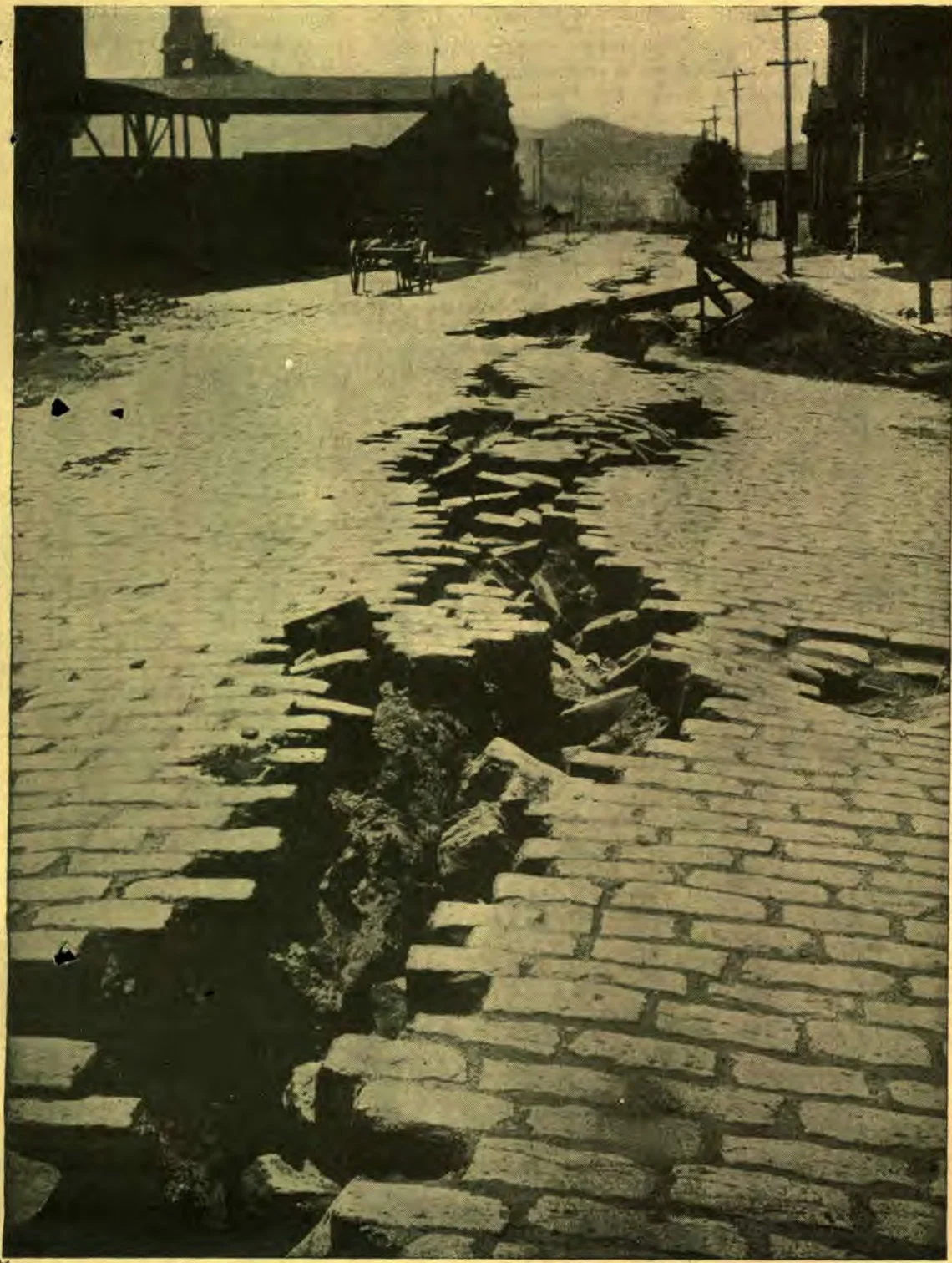
What the Earthquake did on 17th Street, near Howard, San Francisco.
It will be seen from this that there has been an increase of nearly one hundred per cent. in the earthquakes of the 19th century over those of the 18th. Seismologists tell us that at the present time the earth is in a constant tremor. For instance one hundred and forty-seven earthquakes were recorded in Greece during February, March, and April, 1896. Thirty-four were recorded in January alone.
Some would have us believe that earthquakes and volcanic eruptions are growing less and less, and have expressed displeasure with us for not teaching that such is the case. But we have no desire to teach that which is not true. The record stands for itself and speaks for itself, and for us to teach the diminution of these terrestrial phenomena would be to falsify facts and contradict the records.
Notice, for instance, the strenuous activity of volcano and earthquake within recent months, or even weeks. Within one single month two terrible earthquakes have visited the island of Formosa, each of which resulted in the death of more than one thousand persons. It was something unheard of, something utterly at variance with the "law" of earthquake phenomena, that two severe earthquakes should occur in the same place within so short a time. But Formosa broke the "law."
The recent eruption of Vesuvius was more extensive, buried more territory, than any previous eruption in history. The terrible earthquake which resulted, through what followed, in the destruction of San Francisco was in reality an earth quake. It was felt around the world. The Japanese sesmologists detected that earth tremor coming around the earth from both directions. That brought with it a disaster which is unparalleled in history. Immediately on its heels occurred a rapid succession of shocks of the Pacific Coast, lasting about six weeks. There were fifty-one earthquakes in all during that time, twenty-four during the first twenty-four hours following the great earthquake.
But seismic activity has not been confined to the Pacific Coast of North America during the past few months. Early in March a volcano that had been quiescent for forty years became violently active on the island of Tofua, Tongan group. At the same time there occurred volcanic outbursts on the islands of Fonalaci and New Britain. In the same month also occurred the first of the two great Formosan earthquakes. On April 12 the second occurred. In that month Vesuvius assumed its most menacing aspect.
On May 8 the second of two serious earthquake shocks occurred at Arica, Chile, which lasted two minutes, terrorizing the people and rendering many buildings uninhabitable. On May 8 an eminence on the island of Luzon known as Mount Detula settled outright, and a lake of considerable size formed in its place. An earthquake shock accompanied the sinking of the mountain. During the week ending May 13 there was a series of earthquakes in Great Britain, in Devon, Cornwall, the Channel Islands, and some parts of Scotland. On May 14 a sharp earthquake was felt at Rockaway, N, J., sufficiently strong to throw articles from shelves. On May 21 a severe earthquake visited Southern Illinois, especially pronounced in Clay County, and severe enough to break a water main in the town of Flora. A Honolulu report of May 29 states that the ocean for miles in the vicinity of Laysan Island and8French Frigate Shoals was covered with a heavy coating of pumice stone. The daily papers state that in one day recently fifty-seven earthquake shocks were felt in Michigan. On May 29 there was a decided earthquake shock in southern Berks County, Pa., which caused great alarm.
The disease of sin seems to have fastened upon this old earth. She is palsied with the infirmities of her great age, and truly smitten with the ague of sin. This trembling earth is nearing the time when it will "reel to and fro like a drunken man." The approaching dissolution of this old earth is synchronous with the approaching advent of our Lord.
C. M. SNOW.
Christ the New Creator.
We read, furthermore, that when the new heaven and the new earth are created, the Sabbath will also be observed there. Isa. 66: 22, 23. Why?—Because what the Sabbath was at creation, what it became at re-creation, it will become at the new creation. "All things were made by Him" (John 1: 1–3), and He said, "Behold, I make all things new." Rev. 21: 5. Thus we see that Jesus Christ shed His precious blood that the Sabbath of Jehovah might be rightly understood, and promised men power to become holy in order that they might observe the blessed holy Sabbath of Jehovah Jesus. "If ye know these things, happy are ye if ye do them." John 13: 17.
South Lancaster, Mass.
Steps to the Throne of Service
"The mountains of the most glorious visions are but steps to the throne of service."
TEMPORAL POWER OF THE PAPACY
By C. E. Milton
SEPARATION OF CHURCH AND STATE.
How the Vatican Regards It.
[The last two articles have been considering arguments for and against the Restoration of the Temporal Power to the Papacy. Among contributions to the subject a bishop has advocated absolute separation of church and state, as given in our last. This article continues the subject.]
THE question that naturally interests us most is what attitude the Vatican has taken in light of these principles. Many of the ranks of the church at first received this discourse with enthusiasm, and it seemed for a while to strike a friendly chord in the hearts of the people. But it must never be forgotten that the opinion of the people in the Catholic Church counts for very little, and it is soon smothered under the overwhelming authority of the hierarchy. Therefore after the people have expressed themselves, they quietly resign themselves to hear the verdict of the powers in the Vatican, and when that word has been uttered the question generally stops there. The matter caused such a stir, however, that Cardinal Ferrari, one of the most energetic prelates of the Catholic Church, took up the question in the provincial council of the bishops at Milan and they formulated a letter addressed to the pope, asking for a word from him on the subject. I quote from the cardinal’s letter as follows:
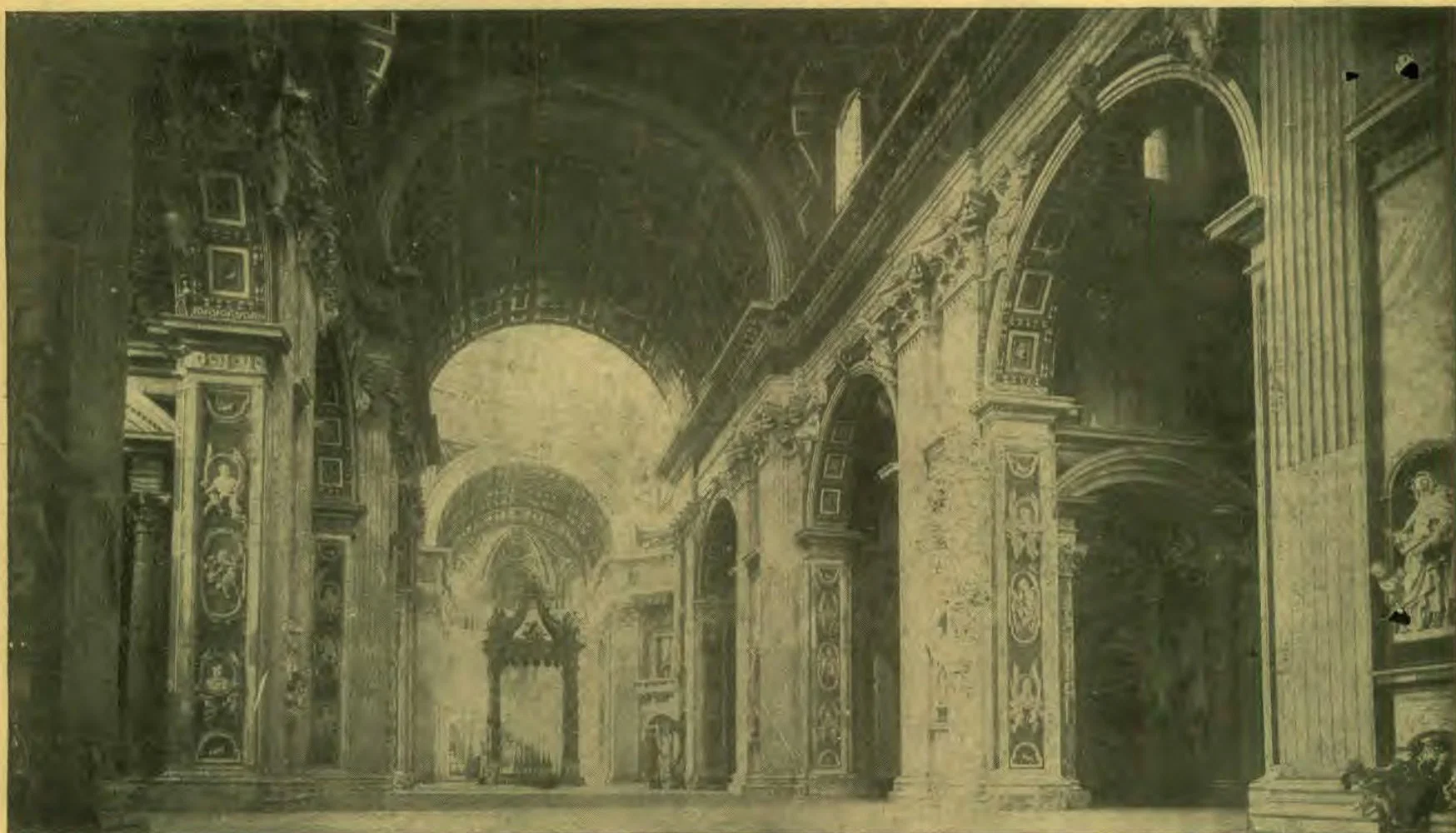
Interior of the Vatican Church.
We, the undersigned, gathered for the preparation of the acts of the provincial council, fully comprehend the profound impression that your word produces upon the children of the Catholic Church when you deplore the evils inflicted upon the church in France, and the proof of paternal benevolence that your holiness desires to extend to that noble nation. And our emotion is so much greater in that we are constrained to see with our own eyes, right around us, that is, in our own diocese, a voice [that of the bishop before referred to] which makes itself heard that is entirely out of harmony with yours, and one from which the liberal press takes the greatest advantage, to the detriment of the right doctrine and ecclesiastical discipline. And therefore, O holy father, we can not keep silent; for we greatly desire to comfort your soul which because of it is profoundly pained, and to show you that we adhere fully to your teachings and partake of your sorrows.
The pope, after consulting the cardinals of Rome, responded to the cardinal of Milan as follows:
I am grateful, sir cardinal, for the sentiments expressed in the letter which you, together with the bishops of the provincial council of Milan, have sent me. In the midst of our great grief for the ills that threaten the church of France, we feel comforted by the thought that our apostolic voice finds a response in the souls of the pastors and that they unite themselves to us in such a manner that not being able to accompany personally those generous faithful ones who are disposed to such great sacrifices, we have at any rate given a proof of our special affection, invoking upon these bishops the divine blessing.
We are furthermore very grateful to you, sir cardinal, and to the other venerable brethren, for your participation in the bitter grief of which our soul is full on account of the recent publications about the relation of the church and the state; a report truly deplorable in itself and for the unfortunate circumstances under which it was given, and more deplorable on account of its sorrowful consequences, as you and your colleagues, with profound regret, have lamented in the cited letter, as have also not a few other Italian bishops; that is to say for the most terrible damage which it causes in the minds of the great number of those who draw from the opinions of modern liberalism, and unaware of the distinction of subtilities, looking only at the source, believed as authoritative, whence emanate certain writings, and drink afterwards with the concurrence of a perverse press the deadly poison of certain teachings which will never be accepted by the church. For the rest, that we are watching with great solicitude that which regards the right doctrine and discipline you and your venerable pastors may be very sure, and that also in this case the care of the apostolic providence will not be lacking.
We can plainly see from what we have quoted above that the church has met the issue in no uncertain terms, and has defined its position with vehemence. And that which is but a just statement of the principles of religious liberty has been regarded and defined as a thing in itself deplorable by the head of the church, and the discourse of the bishop has been made out to be a document worthy of the severest reproof. It is evident, therefore, that the church of Rome has in nowise changed its position on the subject of the separation of church and state, but has again reiterated her former position with vehemence even in the face of a declaration of one of its own bishops to the contrary.
9
In fact, if we will note with some care the letter of the pope, we shall find that instead of discountenancing the fight against the government as it is at present carried on in France by the Catholics, he sanctions it. We have all read of the fierce fight that the Catholics are waging in France in their endeavor to defeat the law of the separation of the church from the state. Speaking of this conflict the pope says in his letter that while he may not be permitted to go in person to help the bishops of France, he can still send them his benediction in their struggle. So that the outbreaks in France have rather the sanction than the frown of the pope. The Catholic Church in France has never consented to the separation, but has fought it at every turn, and that with the approval of the Vatican. It is clear, therefore, that the Papacy has not changed its position one iota on the question of church and state, but rather insists, as one prelate has lately expressed it, that “it is absurd to think that one can divide the church altogether from the state, and that one can call the latter entirely secular.” This prelate was asked what disposition would be made of the case of Bishop Bonomelli, to which he replied that he thought he would be compelled to retract as he has had to do on another occasion when he uttered teachings that did not conform with the church.
The bishop who preached the discourse that has caused such a sensation came to Rome with the special purpose of explaining his position to the pope, after seeing how the Vatican viewed his utterance. But the pope did not wish to hear any explanation from him and would not even grant him an audience, altho the pope and the bishop have been intimate friends for many years. So that the bishop had to return home without even having seen the pope. The Vatican has, therefore, we see, taken a very decided position in the question, and has left no room for doubt as to its belief on the point in controversy.
C. E. MILTON.
THE POWER OF THE CROSS.
By Rosalind A. Young
“O love divine, that stooped to share
Our sharpest pang, our bitterest tear!”
THESE two opening lines of that beautiful hymn of Oliver Wendell Holmes’ impressed themselves on my heart this morning, as I listened to the following little story told me by a friend, who had it from the lips of a lady recently returned from a visit to Palestine, and who was one of the party.
The lady told how their party visited the different places of interest, places familiar through the dear old Bible stories.
“It was at Calvary,” she said, “that the hearts of all were touched. While there, gaily chatting and laughing together, a party of Russian pilgrims came on the scene. They had come long miles on foot, and were toil-worn, dusty, and travel-stained. They were only ignorant men and women, whose sandaled feet had become tired through their long journey, but they had reached their goal at last. They had reached Calvary! To them the place was sacred as the scene of the Saviour’s crucifixion and death.
“Throwing themselves upon the ground, they cried and wept, at the same time throwing dust upon their bodies. The crucifixion scene was vividly present to their minds, and their grief was very real as the onlooker beheld them.
“The gay laugh and light conversation were suddenly checked. The power of the cross that moved the pilgrims to lamentation and grief, touched the hearts of the party that had come merely to visit, and,” said the lady, “we, too, mingled our tears with those of the poor Russian pilgrims, and left the place subdued and quiet, and I do not think any of us will ever forget that sight.”
Thank God, we can approach in faith to Calvary, and learn of the divine love manifested there, and feel that love moving our hearts as we realize that
“The Father’s well-beloved Son
Bore all my sins upon the tree!
The Son of God for me has died,—
My Lord, my Love, is crucified.
“Then let us sit beneath His cross
And gladly catch the healing stream;
All things for Him account but loss,
And give up all our hearts to Him!
Of nothing think or speak beside,—
My Lord, my Love, is crucified.”
ROSALIND A. YOUNG.
Papeete, Tahiti, May 7, 1906.
Behold, I Stand at the Door
"BEHOLD, I stand at the door, and knock; if any man hear My voice, and open the door, I will come in to him, and will sup with him, and he with Me." Rev. 3:20.
Seek Ye the Lord
“SEEK ye the Lord while He may be found, call ye upon Him while He is near.” Isa. 55:6.
CROWNED WITH GLORY AND HONOR.
By H. A. St. John
IN Heb. 2:7 the writer tells us that the first Adam was made only a little lower than the angels, and was crowned with glory and honor. Had he remained loyal to His Creator, no doubt he would have retained his crown of glory and honor to this day. But by transgression he fell. He lost his first estate, he lost his dominion, his glory, and honor. He lost his great wealth, and had not where to lay his head, nor wherewith to clothe his body. He forfeited his life also, bringing death upon himself and all his posterity. All was lost.
But the Lord Jesus, the divine Son of God, of His own free will and accord, gave up His crown, glory, honor, and dominion in heaven, and came to this world "to seek and to save that which was lost." He became poor for our sakes—so poor that He had not where to lay His head; and He gave up His life also. By thus taking the place of the first Adam after the fall, He overcame in man's behalf, and is set down with His Father upon His throne, henceforth expecting the joyful day to come, as it surely will, when, as the second Adam, the "Tower of the Flock," the first dominion will be given to Him in its more than pristine glory, and His kingdom shall never have an end.
It is also a most cheering thought and truth that all of the human race who shall be justified, sanctified, and glorified by the Lord Jesus, shall, like Him, be crowned with glory and honor. They will receive eternal life, eternal riches, and eternal dominion; for they shall reign with Christ in Paradise restored, in the earth made new. God's original purpose to people the earth with a race of kings and priests will then be accomplished.
Pre-eminently the Son of God.
"For unto which of the angels said He at any time, Thou art My Son, this day have I begotten Thee?" Heb. 1:5. From this scripture it appears that Christ was the Son of God in an eminent and special sense, even before the Creation of the world. But it also further appears that after the sacrifice of Himself for the redemption of a lost world He was made the Son of God in a pre-eminent sense. All other sons of God may appropriately worship Him. The angels in rapturous joy exclaim, "Worthy is the Lamb that was slain to receive power, and riches, and wisdom, and strength, and honor, and glory, and blessing." Rev. 5:12.
Likewise the many sons that Jesus will at last lead unto glory will be the sons of God in a pre-eminent sense. These and these only of all the sons of God will have come up from great depths of sin and degradation, through great tribulation, and have washed their robes, and made them white in the blood of the Lamb; and hence, as the subjects of God's amazing grace, they will be the children of His special consideration, love, and care. And the first dominion restored, with such a King and such subjects, will undoubtedly be a center of attraction to all the universe of God. On the principle that there is more joy in heaven over one sinner that repenteth, than over ninety and nine just persons that need no repentance (Luke 15:7), there will be more joy over one lost world redeemed than over ninety and nine worlds that needed no redemption.
H. A. ST. JOHN.
LOWERING MORALS BY RAISING MONEY.
EVERY time that the church of Christ asks an individual to contribute to the progress of Christ's kingdom, and offers a saucer of ice-cream, or a fancy scrap-basket, or two hours of comic charades, as a partial and tangible return for the investment, the worthiness of Christ's cause is questioned, and the motives of the one solicited are discredited. To put it bluntly, money-getting for the church by barter is an insult either to the church, or to the one whose money is sought, or to both. Such "money-raising" practically says: "The church of Christ is not worth supporting; you know it, and I know it, therefore I won't ask you to believe that it is. But it has got to be supported, so buy this thing, almost getting your money's worth, and we'll turn over the profit to the unworthy church." Or it says: "The church is worth supporting, but we don't give you credit for believing this, or for any willingness to help in its support, so we'll offer you something that will appeal to you." Such an appeal is a travesty on Christ's charge: "Freely ye received, freely give."
The root evil in church fairs and all commercial methods of securing money for the Lord's work is that they are an unworthy appeal to an unworthy motive. They defraud people of a blessing that God wants to give, and that can only come from faith-filled, free-will offerings. "Bring ye the whole tithe into the storehouse, . . . and prove me now herewith, saith Jehovah of hosts, if I will not open you the windows of heaven, and pour you out a blessing, that there shall not be room enough to receive it." If the church fair is right in principle, then far better let the church trustees conduct a regular and high-class business enterprise as a permanent institution, the profits of which shall go to meet church expenses. If that would not seem advisable, why make amateurish and cheap and spasmodic attempts at the same thing?—Sunday-School Times.
O YE TEARS!
By Letta Sterling Lewis
O ye tears, what consolation,
What relief ye bring about
When Distress, in robes of anguish,
Doth the bitter dregs deal out;
Or when Grief her gloomy curtain,
Many plied, hangs o'er the soul,
Darkening Hope's bright recesses,
Hiding fate from man's control.
O ye tears, when from the heart's core
Ye do cry, thy plaintive speech
Melts the rock of human hardness,
Ushers pity into reach.
Ah, the stillness of thy footsteps
Brings a hush, doth mirth enthrall,
For thy footprints tell a story
That is common unto all.
O ye tears, what would we mortals
Do without your kindly aid?
With no outlet to the feelings
Hearts must burst and lives must fade.
Thanks to Thee, O mindful Parent,
For this gift—the dew of heaven.
Note the tears of sin's repentance,
Write with Pity's tears, "Forgiven."
LETTA STERLING LEWIS.
A CLEAR CONSCIENCE
By Abdiel
TALKS TO YOUNG MEN. No. 5.
A CLEAR CONSCIENCE.
WE have been talking about physical health; for "the glory of young men is their strength." And surely this includes physical strength. Many see no farther than this. They want to be splendid animals. They want you to see and feel how big and hard their biceps are, what their chest expansion is, how much they can lift, etc. And physical strength is good. Elijah possessed it in abundance, hardy mountaineer that he was. Till his very death Moses was a perfect physical man. At eighty Caleb was as able to go out to war, as when, a young man, Moses sent him to spy out the land.
Of the seven essentials in physical strength and health we have talked about good food, pure air, exercise, and sunshine. Not less essential than these is a clear conscience.
There is no worse depressant on all the bodily functions than a mind ill at ease. It stops digestion, sours the stomach, chills the blood, and makes general war on the system. If one has a just sense of right and a full purpose to do it, the guilty conscience is to him a worse tormentor. It brings the evil Past into the living Present, and shuts down all the hopes that rise, unless we heed the monitor's voice in everything. Peace of conscience may be obtained in two ways: (1) By heeding not its warnings till its voice is forever stilled; but this is death to the soul—eternal death. (2) By listening to the voice of conscience and putting away the sin, and asking God in Christ to cleanse the conscience. He will give a "good conscience;" then keep it, and keep it in everything. "Trust that man in nothing who has not a conscience in everything." Conscience in everything means peace to the soul, and health to the body.
"Why are you particular in painting that fence next to the hedge?" asked one man of another; "no one will know whether you painted it or not." "But I shall know," was the reply. He could not afford to stultify his conscience for a little gain or time. He could go to his rest that night at peace with God and man, and every fiber of his physical being, every drop of blood in his heart, would healthfully respond.
A Sunny Disposition.
To some this is natural. There is no credit to them because they are smiling and pleasant. They are strong, well, healthy, and have inherited a sunny disposition. Their pleasant ways are no credit to them. Yet let them be thankful. When real trial comes to such, they are often the most peevish and fretful.
There are others who have inherited a morose disposition. They are inclined to look upon the dark side. They see the cloud instead of the sunshine. They mean to do right. They are honest, upright, conscientious. But they live on their feelings, and the devil sees that the feelings are not spared.
Let such cultivate a sunny disposition. Smile. Speak pleasantly, smilingly, to all, whether you feel like it or not. Think of the many good things there are, and rejoice. "A merry countenance doeth good like a medicine; but a broken spirit drieth the bones." It will do others good; it will do the pleasant, healthful man more good. Do not growl or gloom or grieve; scatter sunshine and it will return a thousandfold in health and a better life.
Our next study will consider the will, or purpose.