Your ShelfYour Projects

Signs of the Times, Vol. 32, No. 29.

THE MORAL WARFARE

Signs of the Times

Pacific Press Publishing Association

THE MORAL WARFARE.

BY J. G. WHITTIER. When Freedom, on her natal day, Within her war-rocked cradle lay, An iron race around her stood, Baptized her infant brow in blood, And, through the storm which round her swept, Their constant ward and watching kept.
Then, where our quiet herds repose, The roar of baleful battle rose, And brethren of a common tongue To mortal strife as tigers sprung, And every gift on Freedom's shrine Was man for beast, and blood for wine.
Our fathers to their graves have gone; Their strife is past—their triumph won; But sterner trials wait the race Which rises to their honored place— A moral warfare with the crime And folly of an evil time.
So let it be. In God's own might We gird us for the coming fight, And, strong in Him whose cause is ours, In conflict with unholy powers, We grasp the weapons He has given— The Light, the Truth, the Love of Heaven.

CALIFORNIA'S BIG TREES

And the Famous Yosemite Valley
are attractively described and beautifully pictured in that remarkable book
"In the Heart of the Sierras"
It is the most authentic and intensely interesting description of these wonders ever written. The book contains nearly 500 pages of text, with over 150 illustrations, twenty-eight of which are full-page artotypes. To read its pages is almost to see the trees of whose discovery it speaks and to hear the thunder of the Valley's waterfalls.
Prices Fine English cloth - - - - - - - - - - - - - - - - - - - - - - - - - - - - - - - - $2.75 Fine English cloth, gold edges - - - - - - - - - - - - - - - - - - - - - - - - - 3.25 Full Sheep Library style - - - - - - - - - - - - - - - - - - - - - - - - - - - - - - 3.50

A Cheaper Edition

The Tourist Edition contains everything described above except the full-page plates. It is bound in paper. Regular price 75 cents, Reduced to 50 cents.

Terms of Subscription.

Per Year, post-paid . . . . . . . . . . . . . . . . . . $1.50
Six Months, 75 cts. Three Months, 40 cts.
To Foreign Countries, per year. $1.75.
The Home of the "Signs of the Times."

SPECIAL TERMS.

1. One new yearly subscription and one renewal, or two new yearly subscriptions, sent at one time, $2.50.
2. Two new yearly subscriptions and one renewal, or three new yearly subscriptions, sent at one time, $3.25.
3. Three new yearly subscriptions and one renewal, or four new yearly subscriptions, sent at one time, $4.00. Sample copies sent on application.

TO OUR PATRONS.

Please be careful to write all names of persons and places plainly.
Send money by Post-office Money Order, Express Order, or Bank Draft on New York, Chicago, or San Francisco.
Orders and Drafts should be made payable to the Pacific Press Publishing Co.
Paper money or silver should be sent in a registered letter.
Registered mail is safe. Unregistered mail is at the risk of the sender.
The address label on your paper will indicate the time to which your subscription is paid. In case of non-receipt of papers, or any other irregularity, please notify us immediately.
When subscriptions expire, no more papers are sent to the party except by special arrangement.
You are requested to watch the date on your label, and renew early, and save the loss of papers. We can not always furnish missing numbers.
When requesting change of address, be sure to give both old and new addresses.
Important.—If you order Signs, Our Little Friend, books, etc., at the same time, use a separate sheet of paper for each. If this request is complied with, it will materially assist in the prompt and accurate despatch of the business.
When writing to the editor, be sure to use a separate sheet of paper.

THE SOUVENIR SPECIAL.

A minister from San Francisco ordered several copies of the Souvenir Edition of the Earthquake and Fire Special. He says, "These are the best I have seen on the calamity."
A soldier from the Presidio, San Francisco, sends an order for the Souvenir Special, saying, "I have several times purchased from you before, but the paper is getting better all the time, and I feel that I must mail some of these last most excellent numbers."
We give the foregoing as samples merely of the expressions of appreciation that we are receiving in regard to this edition of our paper. Have you seen it? Have you sent any copies to your friends and acquaintances? Some are ordering them sent to their friends in the Old World.
This edition of our paper is recognized as the very best yet gotten out on the great calamity that recently visited the Pacific Coast. This Souvenir Edition of the SIGNS OF THE TIMES not only gives the facts in regard to the calamity in an honest, truthful way, but it also tells what none of the other papers have told, the meaning and cause of the disaster. The prices are as follows:
In lots of 5 to 500, 6 cents a copy. In lots of 500 or over, 5 cents a copy.
Address SIGNS OF THE TIMES, Mountain View, Cal.

EARLY WRITINGS

BOOKS
New and Old

EARLY WRITINGS

The plates from which this book has been printed have been used so often that they are worn out and we have had to reset the entire book. While the subject matter is identical with former editions, this edition contains the following indices: References to Texts, Scriptural Index, and a General Index. These indices make a valuable addition to this already popular book. Including them, "Early Writings" now contains 316 pages. It is bound in cloth uniform with "Testimonies for the Church" at 75 cents. Also in Limp Leather at $1.25.

MAKING HOME PEACEFUL

By Mrs. L. D. Avery-Stuttle. All of the little folks (and some of the big ones) who have read "Making Home Happy" will be delighted to know that they can now read the sequel to that story in the new book, "Making Home Peaceful," by the same author. It is written in the same happy vein as her former book, that so delights the heart of the reader, and will prove very interesting and helpful from beginning to end.
It has been the supreme purpose of the author to show to the reader, by means of a happily-conceived object-lesson, how the true spirit of the ever-blessed Christ-love can be given tangible expression in every-day home life, and how the incoming of that love will transform a joyless abode into a happy home. Too often this must be accomplished through the ministry of pain and sorrow. Far better to read and heed a lesson of love and peace, and of escape from unloveliness and strife, such as is so plainly and clearly set forth in the pages of this book. 232 pages, attractive cloth cover, 75 cents.

CAPITAL VERSUS LABOR

I have read the book entitled "The Conflict Between Capital and Labor" by Elder E. T. Russel. This book presents a compilation of striking and startling facts, gleaned from a wide range of reliable sources. It is an up-to-date work dealing with one of the gravest problems confronting society at the present time. It should have a wide circulation. —A. T. Robinson, President Nebraska Conference.
The above-mentioned book of over 160 pages, bound in substantial board covers, will be mailed post-paid on receipt of 50 cents.

THE DIVINE PROVIDER.

THE revelation of God's character in Jesus Christ in time is a revelation for eternity. What God was then He is still. "I am Jehovah; I change not," is His message to us by His messenger. Mal. 3:6. He loved then; He loved before; He loves still. He is the "same yesterday, and to-day, and forever." He has lost nothing by age in eternal youth, in plenitude of power and wisdom.
GREAT and infinite as He is, with His greatness unsearchable, He cares for poor finite humanity. Not even a sparrow escapes His notice, and the hairs of our head are all numbered. Truly we can say with the psalmist, "Such knowledge is too wonderful for me, I can not attain unto it."
AN instance of God's care for the children of men, and His ability to feed them, is recorded in all the Gospels, Matthew 14, Mark 6, Luke 9, and John 6. The story runs thus: While Jesus was teaching, there came to Him messengers who bore tidings of the death of John the Baptist. Jesus takes His disciples and starts for some quiet retreat where He can instruct them better concerning the nature of His kingdom and work. Doubtless He and they had become physically weary, because of the great throngs of people who constantly came and went.
But the people anticipated them and went before. And as the Master saw the great multitude, as sheep without a true shepherd, His great heart of compassion was moved, and He taught "them many things, and healed their sick." So the day was spent till the even came. Doubtless His disciples grew hungry as the long hours passed. They went to Jesus and asked Him to send the multitude away, so that they could buy food.
A STRANGE reply came from the lips of the Master: "They have no need to go away; give ye them to eat." And the disciples declare that two hundred shillings (about $34.00), probably the whole sum in their treasury, would not suffice to give each one a little. And then, too, where could the bread be obtained? He asks them how much food they have. And they reply that a lad has five barley loaves and two small fishes, but what is such a small quantity as that among so many?
Surely, the Master's judgment was greatly to be questioned.
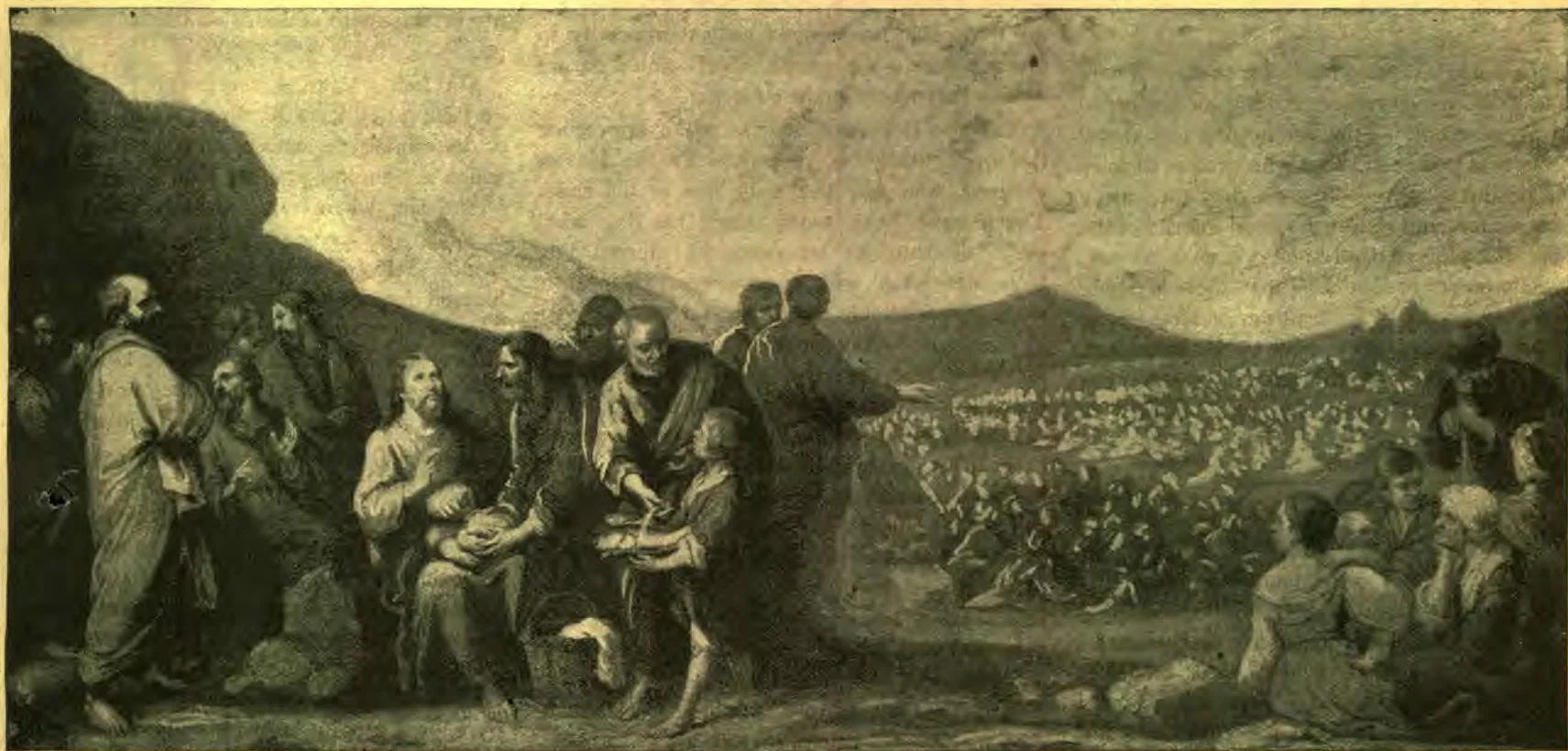
Feeding the Five Thousand.
BUT Jesus was neither surprised nor frustrated. He commands His disciples to arrange the people in groups of fifties on the grass. This done He takes the bread and the two small fishes in His blessed hands, looks up to heaven, invokes God's favor upon the coarse food, breaks it, and distributes to His disciples, and they to the multitude. As He breaks the small, thin loaves to the disciples, the food multiplies. As they break from the pieces they hold, they multiply. As the people receive the food and eat it, it multiplies, till the five thousand men, and the women and children unnumbered, are fed and filled. Then, a lesson in economy; "Gather up the fragments that remain, that nothing be lost." And twelve baskets were gathered.
WE must either deny the record or admit the miracle of creative power. By no juggling of words can we distort the four Gospel records to make them mean something else. The record declares that out in that Syrian country, away from all towns, Christ Jesus caused thousands upon thousands of hungry people to be fed to fulness from five thin barley loaves and two little fishes, which a lad brought with him, — fed them all and still had left more than twelve times the original quantity. To us the record is true, the Master fed the multitude. The creative word multiplied the food.
THERE was a divine spiritual lesson in it for all time which the people there failed to receive, and which it is as easy for us to reject.
The multitude then wanted to make Him king. John 6:15. They sought Him for the loaves and fishes, as many have sought Him since. Verse 26. Having before them one of the most conclusive evidences of His connection with God, they were still demanding signs that they might believe. Verse 30.
THEN He tells them that there was a higher thing to seek than the food which perished. They must eat of the flesh of the Son of Manand drink His blood. Unless they did this, they had no life in them. But if they fed upon this Living Bread, they had eternal life. Verses 33 to 59.
AND then there came more questionings, and by some, rejection of His word. He makes His meaning still plainer: "It is the Spirit that giveth life; the flesh profiteth nothing; the words that I speak unto you, they are spirit and they are life." Verse 63. Some would pervert the words of the Master as did the grosser ones of old. His flesh must be eaten; but as there is no way by which we can do this save by making it, the people have been made to believe in the transmuted wafer through priestly prestidigitation. Still others would have us believe that all physical food and drink are His flesh and blood, and that in them we may obtain eternal life. Not so. The flesh profiteth nothing beyond this life. Material food and drink and air feed the physical man, and at the end he dies. But to live eternally man must feed upon the spiritual Bread of God, Jesus Christ in the Word. The Word is spirit and life, and only as souls feed upon it in faith and assimilate its creative power do they live.
BUT where the Word of God is truly eaten, day by day, when it becomes a part of the man, then do we behold again the miracle of the loaves repeated. He who truly feeds upon Jesus Christ himself becomes a living epistle, a new translation, so to speak, of God's Word. He gives it to others, and they feed upon it and live, and so the food multiplies through men and women regenerated by the power of the word of Jesus Christ.
THE world is waiting in hunger to-day. There are breadlines everywhere waiting for the bread that perishes not. They are hoping that it will manifest its power in those who profess to minister it; but alas, too often do they turn away disappointed, and doubt the word instead of the feeble disciple. To all such we wish to say, There is power in God's Word; there is power to cleanse, power to feed, power to strengthen, power to keep, power to save to the uttermost. O taste, and see that the Lord is good. Eat and drink direct from the great Source of supply and live.

PROFITABLE INVESTMENT.

A RICH man once came to Jesus and asked, "Good Master, what good thing shall I do, that I may have eternal life?" Jesus replied, "If thou wilt enter into life, keep the commandments." The man claimed that he had done so from his youth up, and the Lord proceeded to test his profession. "Jesus said unto him, If thou wilt be perfect, go and sell all that thou hast, and give to the poor, and thou shalt have treasure in heaven; and come and follow Me."
The Lord did not want the man's money, but He wanted the man to have the gift of eternal life, and his riches stood in the way. His desire to hold on to his wealth, when there were so many poor around him, was proof that he was not keeping the commandment to love his neighbor as himself. His money could not buy the gift of God, and his selfish spirit precluded the self-denial implied in the Lord's commandment. Therefore He could not receive eternal life even as a gift.
Jesus loved the man, but this would not avail as long as the deluded sinner loved his earthly treasures more than he loved the riches of God. "A rich man shall hardly enter the kingdom of heaven," because his worldly riches have no purchasing power at the throne of grace. The condition of eternal life is a faith that will lead one to obey the commandments of God at any and all cost—a "faith that works by love."
The Lord wants us to lay all we have on the altar, place it at His command, thus manifesting that measure of faith that entitles one to the gift of eternal life. If a man have wealth, with the true spirit of consecration that will commend him as a faithful steward, the Lord may see proper to leave the consecrated means in his hands, for use as His Spirit may direct. But in the case of the rich man noted in this instance that consecration was lacking, hence it would be better for the man to part entirely with the wealth that claimed first place in his affection.
He was not asked to make this sacrifice without consideration. Even from the standpoint of an investment, it ought to commend itself to any one who appreciates eternal life and believes such an attainment possible. This man professed to so believe, therefore it should have appeared to him a wise precaution to make material preparation for such a life. He certainly knew, as any one must know, that the present life is very uncertain, and short at most; so, logically, it would be even a good business proposition to part with treasure that could be enjoyed only temporarily in order to gain an estate which would insure wealth that would endure forever.
But the rich man who failed to appreciate the opportunity as presented by the Master Himself, was not the only one of his class. There have been many since his day who, while desiring an assurance of eternal life, have not been willing to invest their little stock of perishable treasure in order to secure it. Somehow they imagine, against all reason for hope, that they can give their time, their talents, and their energies to the accumulation of this world's goods and the enjoyment of them here, and gain eternal life also. But it is poor business tact to overlook or to neglect the opportunity for investment so freely offered to every one—a few rusting dollars or a tract of sin-cursed land for an eternal home and imperishable treasure; a few days of sin, sorrow, and pain for an eternity of righteousness and pleasures indescribable.
The "wisdom of men," which is "foolishness with God," causes men to act as tho they deemed the price too high, or else that the opportunity is too flattering to be true. The one great barrier to the acceptance of the prize is that it must be accepted by faith in the Word of God; and the god of this world has so blinded their eyes that they can not see by faith, and therefore they can not act by faith.
Thus the greatest enterprise in the world is passed over by those seeking opportunities for investment, and the work is sustained in the main by the self-denial of the poor but wiser ones, who heed the Saviour's good counsel: "Lay up for yourselves treasures in heaven, where neither moth nor rust doth corrupt, and where thieves do not break through and steal; for where your treasure is, there will your heart be also." G.

OUR GOD IS MERCIFUL.

GOD is not vindictive. He is the only merciful God. All other gods are represented by their votaries as terrorists; but of our God we know that "His mercy endureth forever." Sin, misery, death, destruction, never were in His plan; but He foresaw all these as obstacles that would temporarily confront His eternal purpose, and was prepared for any emergency. His declaration to Adam, that if he should eat of the forbidden tree he would surely die, was not a threat, but a merciful warning. Death is not primarily a punishment, but a consequence. The decree that "the soul that sinneth, it shall die," is based on the fact that, in the very nature of things, it could not be otherwise. God in His mercy, had cut off the sinner from the tree of life. While a curse came upon the earth because of sin, that curse would surely become much more intolerable to all concerned if it should be perpetuated forever. That was demonstrated in the age before the Deluge. With the long life enjoyed by that people, in a comparatively short time it became manifest that "the wickedness of man was great in the earth, and that every imagination of the thoughts of his heart was only evil continually." Corruption comes into the world through the lust of sinful men, who disregard the law of God, and corruption naturally ends in destruction. So death is not God's arbitrary decree, for He has "no pleasure in the death of him that dieth." Eze. 18:32.
Sin being "the transgression of the law" (1 John 3:4), it is the direct result of the lust, or inordinate desires, of the "carnal mind," which is "enmity against God" (Rom. 8:7). "And sin, when it is finished, bringeth forth death." James 1:15. "The wages of sin is death." Rom. 6:23. Thus God can not be blamed for the terrible consequences that sinners bring upon themselves. They have the choice of life or death plainly set before them, and are responsible themselves, and "without excuse" if they choose the way of death.
Some will ask, Does not God say that the wicked shall be cast into the lake of fire and burned up? Is that necessary to their death? Yes, but all that is the result of their attaching themselves to sin, and having all their belongings attached to the earth. In the eternal purpose of God to have a clean universe, it becomes necessary for Him to purify this sin-cursed earth and renew it, or make it new and pure, as it was in the beginning.
During this process, those who have heeded the Gospel warning, and have attached themselves to a mighty, merciful Saviour, will be preserved unto eternal life in the new earth, "wherein dwelleth righteousness." See 2 Peter 3:9-13. But all who have rejected the way of salvation, the only means of escape, will have to bide the inevitable result of their choice. "Behold, the day cometh, that shall burn as an oven; and all the proud, yea, and all that do wickedly, shall be stubble; and the day that cometh shall burn them up, saith the Lord of hosts, that it shall leave them neither root nor branch." Mal. 4:1.
God is "long-suffering to usward, not willing that any should perish, but that all should come to repentance." "God is love," and His every act is an act of love, having in view the eternalwelfare of the universe. But every creature that deliberately stands in the way of His progressive righteous purpose will be caught and destroyed in the purifying fires of the final judgment, just as surely as the puny arm attempting to stay the oncoming cyclone would be carried on with the general crash. Therefore the merciful Father has made a great sacrifice in order to prepare a way of escape and a place of refuge from the impending doom, from the sure result of choosing a life of sin. And His assurance is, "Him that cometh unto Me, I will in nowise cast out."
From every point of view justified by reason and revelation, God is love, is merciful, and is just; and is moreover able to perform all of His great eternal purpose. "The Lord is righteous in all His ways, and holy [margin, merciful] in all His works." Ps. 145:17.
G.

1869.—Eusebius and Sunday.

Was Eusebius a believer in the first day? I.
Yes, as an expedient. None of the early fathers, so far as we know, set forth the first day as a holy day or taught that it was enjoined by the Lord. They felt that they could convert the heathen better if they yielded to heathen customs, and so they took that day on which the Lord arose from the dead as one of those days. In a certain sort of way they observed among themselves the resurrection day, betrayal day, the crucifixion day, and the ascension day; not that they considered them holy, but they called to their minds these events. But all these fell into disuse except the Sunday, and that day continued because it was the heathen high day. And Eusebius, ever a man of expedience and policy rather than principle, advocated the custom, and plainly declared that the things that belonged on the Sabbath "we [that is, Eusebius, Constantine, and others] consecrate to the Sunday." (See "North British Review," vol. 18, page 409, quoted in Anderson's "History of the Sabbath." Also "The Seventh-day Sabbath," by Rev. Mr. Chafie, published 1652, pages 61, 62; Dr. Peter Heylyn's "History of the Sabbath," part 2, chap. 1, sec. 10.) But during the entire early period Sunday was not considered a sacred day, even by those who observed it. Common occupations were carried on on that day the same as others.

Peter and the Church

1871.—Peter and the Church. Matt. 16:18, 19.
Explain about Peter and the church, binding and loosing. Matt. 16:18, 19. P.
Our querist says John 16, but Matthew evidently is meant. Note these facts: (1) Simon son of Jonah had confessed Christ to be the Son of the living God; (2) Jesus declared that this was not revealed to him by flesh and blood, but by the Lord. Because of Simon's faith, he came in living connection with Christ; (3) Therefore Jesus gave him the name of Peter, Greek, petros, stone, and declares that upon this rock (petra), that which made Simon a living stone, that confession in Christ including Christ, is the Rock upon which He would build His church. So Paul calls Christ the foundation. 1 Cor. 3:11. So Peter declares that Christ is the living foundation stone, while believers are the living stones builded on that foundation. Surely the apostles ought to know the foundation.
The keys to the kingdom, the binding and the loosing, are the declaration of the principles of the kingdom and men's relations thereto. Peter was chosen of God to proclaim these principles first, to both Jews and Gentiles; to the first, on the day of Pentecost (Acts 2), and to the Gentiles later (Acts 15:7). See answer to 1875. All the power to bind or loose is in the Word of God that His servants bear.

Question Corner

We wish to say again that anonymous communications to this department, whatever the questions, find their quickest way to the waste basket. We do not ask the writer's name for publication, and invariably append whatever the querist desires if not too long. If no request is made, we give initials.

1867.—Sanctification and Its Meaning.

Will you please explain in the Signs “sanctification”? There seem to be several definitions in the dictionary; one that seems to give me the most light is “consecration.” C.
The literal meaning of the word “sanctification” is to separate, set apart. When God separates, sets apart, that implies consecration. The word “holy” comes from the same root. A holy man or a holy thing is that which is separated from the common and set apart unto God. We use profane in the sense of wicked, but in Eze. 22:26 it is used as the opposite of holy or common. When men profane God’s things they make them common, so God sanctified the Sabbath; that is, He separated it from the other days of the week and set it apart for Himself. So He sanctifies His people, He separates them from the world and sets them apart to Himself. This does not imply absolute sinlessness on the part of His people, but it does imply that they are obedient; they are set apart, that they may develop sinless characters.

Nehemiah and the Sabbath

1868.—Nehemiah and the Sabbath.
Would you explain why Nehemiah expelled the sellers of wares from the city on the Sabbath as recorded in the thirteenth chapter? Were all those that sold living under his authority, or did he go beyond what he ought in the realm of religious liberty in threatening to punish them if they came back? C.
Jerusalem was a holy city, set apart unto God. Its governors, its kings, its rulers, were there to execute the laws of God. It was not a city in which men made their laws. It was, so to speak, God's household, and all should keep the Sabbath just as every man should keep the Sabbath in his own house, and all within his care should at least outwardly observe it. That is all that Nehemiah asked of the men in Jerusalem; and it does not seem to us that he in anywise transcended the proper authority which God had given him. Perverted as the government of Israel had been, it was still in nature theocratic, and Nehemiah was still acting under God's orders, subject, of course, to all Nehemiah's imperfections.

1870.—Eating of Pork. Mark 7:15-19.

Does Mark 7:15-19 permit the eating of pork? INQUIRER.
Read the whole chapter from verses 1 to 23. This instruction of Jesus to the Jews had absolutely nothing to do with the distinction between foods clean and unclean. That was not a question which was raised at all as between classes of animals which had been by the Lord from the very beginning classed as clean and unclean. The whole question was as to eating with unwashed hands. The Pharisees claimed that unless one went through certain ablutions and forms, it made the food unclean. The disciples of Jesus had eaten their bread with hands "defiled," as the Pharisees called it, and therefore they were eating unclean food. The whole question was aroused over this. And Jesus goes on to tell them that it was not the matter of eating the food that counted, nor the food they ate, but what was within the man. All evil in the man proceeds from the heart. God would regenerate the evil heart and dwell there Himself, so as to control all its desires and appetites. A man controlled by the Spirit of God would desire to eat only that which would be best food for him for the Lord's service; in other words, he would eat and drink to the glory of God. 1 Cor. 10:31. A well-instructed Christian would want to use only those things which the Lord has said are good for food, and the Word of God has classed among the unclean animals the swine. Science has placed it among the most undesirable foods, that which is among the first prohibited to the sick. The commonest sort of investigations have shown it to be the most diseased food furnished among flesh foods, and the investigations of the slaughter-houses complete the picture and place it among the most abominable of things which the perverted and voracious appetite of man crams into the poor diseased stomach. The very word scrofula comes from the same root as sow, a female swine; and the very disease comes from feeding on the swine; and there is no question but what this kind of diet helps to prepare many for the ravages of the dread white plague, tuberculosis. It seems to us that two reasons above all others ought to govern every Christian, namely, swine's flesh is among the very worst of foods, and there is an abundance of better things on every side.

1872.—They That Pierced Him.

Please explain Rev. 1:7. If the wicked dead are not raised at the first resurrection, then when shall they that pierced Him see Him?
The text reads: "Behold, He cometh with clouds, and every eye shall see Him, and they also which pierced Him; and all kindreds of the earth shall wail because of Him. Even so, Amen." This text stands as the promise of the book of Revelation, the one great event around which all the other great events of the plan of salvation cluster, the great "day of the Lord;" for Christ's coming is not simply at the very moment when He shall come the second time, but it takes in all that that coming means to the very close of the thousand years, when the wicked dead are raised. Looking at it in that way, when the second resurrection takes place, Christ and all His saints shall descend to the New Jerusalem on this earth. Then the wicked will, of course, all see Him. Yet it is very probable indeed that the text refers to a special resurrection which will take place before Christ comes the second time. See Dan. 12:1. When Michael (Christ) stands up to reign, that is, leaves His mediatorial seat as High Priest, "many" that sleep in their tombs shall awake; some of this many (not all) to everlasting life, and some to shame and everlasting contempt. God in His wisdom deems it wise that some of His own children of the past shall pass through the last fearful scenes and glorious triumphs of the Gospel, and that some of those who have rejected Him in the past may see the awful result of their selfish decision. Looking at the text in either way we can see how they that pierced Him shall behold Him.

1873.—Forgiveness of Sin. John 20:23.

Explain about forgiving sins. John 20:23, “Whosoever sins ye forgive, . . . whosoever sins ye retain,” etc. P.
Christ gave His apostles and ministers, as He did His prophets, the authority to proclaim His terms to a world of sinners. If the sinner complied with that Word, it could be said, “Thy sins are forgiven.” If he would not comply, it could be said, “Thy sins are retained.” 1 John 1:7, 9; Mark 16:15, 16. So Jeremiah was set to establish and pull down kingdoms (Jer. 1:10), but the prophet did it by declaring the terms on which nations could be established, neglecting which they would fall (Jer. 18:7–10). The two cases are parallel.

1874.—Where Are the Twelve Apostles?

Are we to understand that the twelve apostles are in heaven now? Matt. 19:28. X.
Certainly not from that text. Matt. 19:28 plainly states that in the regeneration they shall sit on twelve thrones, but that regeneration will not come until the Lord Jesus shall come the second time. We have no reason to suppose otherwise than that the disciples are sleeping and will sleep until Christ calls them in the first resurrection. It was at that time that they expected to be rewarded, as all their writings indicate. Matt. 25:31; 1 Thess. 4:13-17; 2 Tim. 4:8.

1875.—Possessed of a Devil.

What is being possessed of a devil? Matt. 4:24; Mark 1:26; Mark 5:6–13; Luke 9:42. It does not appear like common insanity. P.
"Demon" is better than "devil." A "demon" is one of the devil's angels. The devil is one; demons are many. To be possessed by a demon is to be under the control of the demon, the will subject to its will. There are many cases of insanity which are owing to sickness, inherited weaknesses, etc.; but doubtless there are also many in which somehow the individual came under Satan's power, and was given by him under charge of a demon. This control seems to be sometimes intermittent, sometimes constant. But Christ can deliver now as ever.
Continue reading: The Royal Law