Your ShelfYour Projects

Signs of the Times, Vol. 30, No. 18.

MOUNTAINS AND VISIONS OF GOD

Signs of the Times

May 4, 1904

Pacific Press Publishing Company · Oakland, California · May 4, 1904

MOUNTAINS AND VISIONS OF GOD.
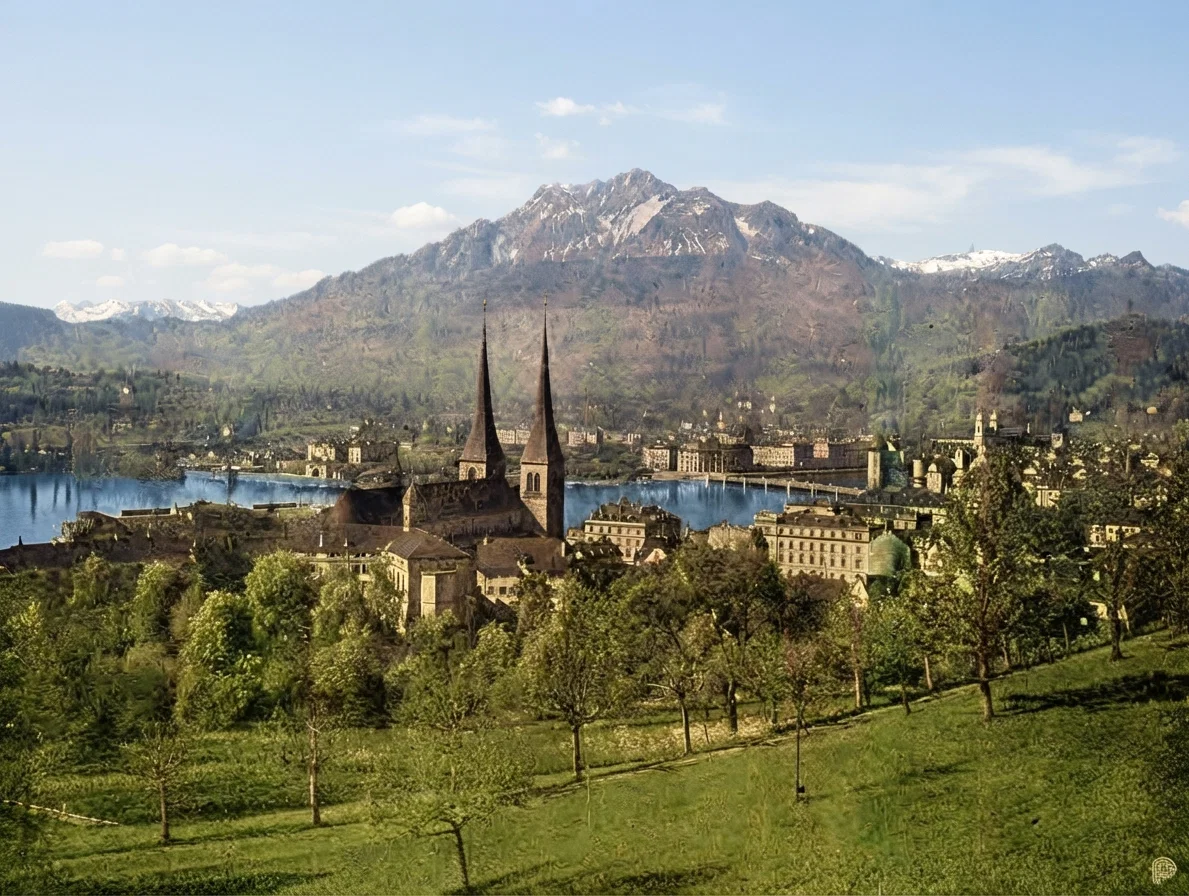
OUR illustration is of the city of Lucerne, nestling in a valley of the Alps Mountains, upon an arm of the Four-canton Lake, while seven miles in the distance, toward the south, is Mount Pilate, rearing in solemn majesty amidst the clouds its proud head to the height of almost seven thousand feet. The region is noted for its wild storms, its inspirations to liberty, and the legendary tales which cluster around its ancient hero, William Tell.
THE chief attraction, however, interesting as are city and lake and varied surrounding scenery, is the grand old mountain. This is not because Mount Pilate is the highest mountain in Switzerland and the Alps; for Mont Blanc in the south rears its white crest to more than twice the height of Mount Pilate. It is not in the configuration or shape of the mountain itself. It is not in its chasms, or forests, or glaciers, that the interest centers. It is because from the top of the mountain may be obtained such a view of the whole Alpine system as can be gotten from no other mountain. The whole range of the Alps comes before it, from Mont Blanc in the southwest to where the higher ranges slope down to Lake Constance in the northeast. What a majestic sweep it is, and how well worth the while of him who delights himself in seeing the mountains, upreared by the power of God!
Lucerne on the Four-canton Lake, Mount Pilate in the Background.
BUT Pilatus is not always accommodating to the tourist, and especially to the hurried sight-seer. Oftentimes this wonderful terrestrial observatory is enshrouded in clouds; and for days and days they hang heavy upon it. The hurried tourist must pass on, ever bemoaning the fact that the cloud did not lift, that the wonderful vision of glory was not revealed to his eager gaze. But the man of more wealth and leisure, the greater devotee of the mountains, can wait. And wait he does, and wait many do, till the days grow into weeks, and the weeks measure a month, and the month is multiplied by two and three, to be rewarded at last with one of the grandest visions of earth that mortal eye is ever permitted to behold. There may be as great vantage-points, as mighty pillars of vision, in the Andes or the Himalayas, but they are either not known or not accessible to humanity.
READ in all this a wonderful lesson of God regarding His revelations to man in His Word. What mighty mountains of truth rear their proud heads in His Revelation! What glorious Mont Blancs stand out strong and white intheir individual majesty! What Jungfraus and Matterhorns and Washingtons and Pike's Peaks, and McKinleys, and Aconcaguas, and Deodhungas rear their mighty volumes above storm-swept seas and quiet lakes, and fruitful vineyards and green valleys! What magnificent views men obtain as they climb some one of these pillars of vision! Yet, how often is one's views limited and so perverted by looking from one mountain alone out upon the revelation of God. Jonathan Edwards saw God's sovereignty alone, and lost the glorious visions of His mercy. Others have seen visions from the mountain-top of Mercy, and have lost the sense of justice. Some endeavor to get views of God's plan from Mount Creation, others from Sinai, others from Calvary, others from Olivet, and all are more or less limited and perverted.
MANY are in too great a hurry. They want to see all at one time. One view from Calvary, beautiful but superficial and evanescent, and the soul is satisfied! One view from rugged Sinai, glorious but superficial and evanescent, and the soul is discouraged! Sometimes the cloud covers the mount, and the impatient soul is unwilling to wait. He who waits long enough upon the heights of Sinai will see Calvary bathed in a glory and beauty he never saw before. He who looks from Calvary upon Sinai will see a holiness, a strength, a grandeur, which transcends all former visions.
"COME up to Me into the mount, and be there," said Jehovah unto Moses; and after the days of sojourn with God, Moses came down with his face shining like that of an angel. It was in a "very high mountain" that Ezekiel saw his "visions of God." To those who would give God's message to the world, the Voice cries, "O thou that tellest good tidings to Zion, get thee up on a high mountain."
THERE is one mighty tower of vision in God's Word like the Pilatus of the Alps. From it one can see the whole great range of God's system of truth as from no other vantage-point. That tower is God's great purpose as revealed in the sanctuary in past and present ages on the Zion of His holiness. There in the very center of the holy shekinah is God's holy law; there over the transgressed law is the mercy-seat; there is the great High Priest; and in the sanctuary is revealed all the relations between God and His creatures, all the fearful outcome of sin and those who persist in loving it; all the glory which will come to the trusting, steadfast child of God.
SOMETIMES the cloud covers this watch-tower of vision. God's glory hides the vision because of sin-blinded, easily-satisfied hearts, and we must wait for its removing. The heart must bow in submission to God and to His law; the sins must be yielded and put away; self must be emptied, the eyes anointed, and then with clarified vision will we see God's wondrous plan in all its beauty and sympathy and perfection. Are you in darkness, dear soul?—Go up into the mount of God, and there enter into the sanctuary with God, as did Moses and Ezekiel and David. Are you in doubt? Do you wonder at the seeming triumph of the wicked? Are you envious at their prosperity? Are you shocked at their deception, their scoffing, their blasphemy? So was Asaph of old, and he tells us, "When I thought to know this, it was too painful for me; until I went into the sanctuary of God; then understood I their end." He saw before them, in their wickedness, destruction, as in a moment, but trusting in God he could say, "Thou shalt guide me with Thy counsel, and afterward receive me to glory."
COME, soul, and let us get up into Mount Zion with God, and there abide with Him. Wait till the vision clears, and the sunlight of His love sweeps away the clouds of sin, and there view the beauty of His holiness, and in beholding become changed.

THE MEDIUM OF LIFE.

BY WILLIAM COVERT.
THE Creator is represented as giving material form to His thoughts by speaking. Necessarily all created things had a formal beginning. There was a time and a way in which they were started on their mission. When it suited the purpose of God to have our own world occupy its place among His works, He called for it. Before the call, it existed in His thoughts. When He had spoken the word, it was in its place. His word was potent to generate and form it. The same word that set it going, holds it in place, and keeps it going; for it is said: "By the word of the Lord were the heavens made; and all the host of them by the breath of His mouth. . . . For He spake, and it was done; He commanded, and it stood fast." Ps. 33:6, 9.
The agency that gives life must possess life. Christ said, "The words which I speak unto you, they are spirit, and they are life." John 6:63. Every word of God is designed to accomplish a definite thing. "For as the rain cometh down, and the snow from heaven, and returneth not thither, but watereth the earth, and maketh it bring forth and bud, that it may give seed to the sower, and bread to the eater; so shall My word be that goeth forth out of My mouth; it shall not return unto Me void, but it shall accomplish that which I please, and it shall prosper in the thing whereunto I sent it." Isa. 55:10, 11.
In an apostrophe to all created things, David says: "Praise ye Him, all His angels; praise ye Him, all His hosts. . . . Praise Him, ye heavens of heavens, and ye waters that be above the heavens. Let them praise the name of the Lord; for He commanded, and they were created. He hath also stablished them forever and ever; He hath made a decree which shall not pass." Ps. 148:2-6.

Art and Creation.

Creative power does not construct things out of visible material. Art is not, as some have said, the complement of creation. The growing of the oak is creation, but the cutting into lumber, and the making into desks, are works of art. The first builds up; the second destroys. One is exhibition of life; the other is a separation from life. Art tears down the work of creation that it may construct itself. Creation, through the living word, calls into being worlds that had no previous existence. "The worlds were framed by the word of God, so that things which are seen were not made of things which do appear." Heb. 11:3.
Every design bears witness to the existence of the designer. Every visible thing testifies that there is an invisible power which gave it being. Men compound and construct out of things which are made to their hand. Not so with creation. When God works, He simply speaks the word, and the thing desired comes forth. In this manner He formed the world. Upon it He placed mountains. Within the mountains He put mines of ore. Out of the ore man has constructed all kinds of instruments. He has made the simple pocket-knife, and the complicated steam engine. Yet in all the works of men there is nothing like creation. Men who labor in shops destroy created things that from them they may construct their implements.
In the field of art, men try to imitate things in nature; but the productions of the brush and the chisel remind the naturalist more of death than of life; they oftener start tears of grief than smiles of joy. They deepen rather than relieve mourning.
Art leads its devotees to admire that which has no life. The painter gives us a lifeless picture. The sculptor places before his friends a cold, hard stone. The taxidermist takes the life of a beautiful animal, and tries to preserve the remains for the cabinet of some one who imagines himself to be a lover of nature. But would it not be better to go to the homes of these creatures, and there study God through the life which He has given them? The secrets of their lives can be learned if they themselves are properly studied.
In the most exquisite production of art, even that particular piece which the classic ardently admires, is not found the lesson for study that may be learned from the simplest leaf in the forest. The tiniest insect which makes its home upon the foliage of some plant, or the lowliest worm that crawls at our feet, can never be equaled in their structure, by the art of man. He that plucks the wild flower of the glen, or gathers flakes of moss from the lone rock, mars a form more beautiful than painter ever drew with brush or weaver ever formed in loom.

Life from the Word.

All life must come from God, and it has pleased Him to make His word a medium of transmission.The life which man receives through fleshly birth is adulterated with sin, tainted by disease, and must soon pass away. But that which comes through the word of redemption is free from sin.
Concerning the nature of God's word, and what it does for the believer, the apostle uses these expressive words: "Born again, not of corruptible seed, but of incorruptible, by the word of God, which liveth and abideth forever. . . . And this is the word which by the Gospel is preached unto you." 1 Peter 1:23-25.
Every organic thing grows from some seed which God has endowed with life after its kind. Every perfect seed properly planted in the soil under favorable conditions gives birth to a new life. It works in harmony with a law which operates through the whole scale of nature, so that life, operating through the agency of a plant, builds the mineral into organic form. This form is called a vegetable. Life through the vegetable seed transforms the plant food and raises it into a higher kingdom.
The spiritual kingdom works in lines parallel with the physical realm. Man is grasped by the power of the life in the incorruptible seed (1 Peter 1:23), and borne upward to become a partaker of the divine nature. The Christian is "rooted and built up in Him." Col. 2:7. "For in Him dwelleth all the fulness of the Godhead bodily. And ye are complete in Him, which is the head of all principality and power; in whom also ye are circumcised with the circumcision made without hands, in putting off the body of the sins of the flesh by the circumcision of Christ; buried with Him in baptism, wherein also ye are risen with Him through the faith of the operation of God, who hath raised Him from the dead." Col. 2:9-12. "But we all, with unveiled face, reflecting as a mirror the glory of the Lord, are transformed into the same image from glory to glory." 2 Cor. 3:18, R. V. The transforming power comes from life, and lifts man into glory. It is the life of the incorruptible seed working in humanity that transforms man into a new creature. Thus man is born from above, and the divine image is restored. This birth will be completed physically in the resurrection.

The Word Distilled.

The beautiful way in which God imparts divine life to man is told in the last song of Moses: "My doctrine shall drop as the rain, My speech shall distil as the dew, as the small rain upon the tender herb, and as the showers upon the grass." Deut. 32:2.
The newborn plant thrives best when watered in mildness by the dewdrops, or by the gentle rain falling in spray upon it. The heavy, beating pour, or the storm of hail upon the tender herb, are agencies of death. So do hard words bruise the tender spirit of others, while gentle words impart life to the soul.
The farmer desires, not the noisome visitation upon his fields, but the copious shower; for it dissolves the elements of earth, and provides healthful food for the plant. In like manner does the living word of God fall as the dew of heaven or the rain of summer upon the thirsty soul. The Christian is strengthened with all might, because he is held in the divine word. "He [Christ] shall come down like rain upon the mown grass; as showers that water the earth." Ps. 72:6. It is the living Christ in the word that draws man to God.

Growing like the Lily.

There is no flower that exceeds the lily in loveliness. Its rich fragrance is sweeter than the odor of incense. It is this gem of the valley and mountain that the Son of God uses as an emblem of the divine life. "Consider the lilies of the field, how they grow; they toil not, neither do they spin; and yet I say unto you, That even Solomon in all his glory was not arrayed like one of these." Matt. 6:28, 29.
The lily grows, but not by its own care or effort. It increases, but not by its own planning or anxiety. It feeds upon the appointed elements of the soil, which are transformed by divine power into a vision of gorgeous splendor.
God provides every plant with multitudes of rootlets. To each fiber is given a mouth that drinks in the milk of nature, that has been dissolved by the moisture placed in the earth for that purpose. The life in the plant, tho it is only a vegetable, enables it to transform its food elements into a wonderful exhibition of God's glory.
When God, through this living way, has decorated the plant with glory, and perfumed the air with fragrance, He has more than equaled all the splendor of Solomon's kingdom. It could be said of Solomon's grandeur, as he sat in kingly robes upon his ivory throne overlaid with gold, "There was not the like made in any kingdom." 2 Chron. 9:19. Yet the child that possesses one lily may behold in it a treasure richer than all the glory that art expended upon Solomon.
Let Christians think more upon these beautiful symbols of divine power, and less about the vanities of human greatness. That which is esteemed as greatness often proves in the end to be only the evidence of folly and weakness.

Incarnation of the Word.

"In the beginning was the Word, and the Word was with God. . . . And the Word was made flesh and dwelt among us." John 1:1-14. Christ was made the embodiment of the Father's Word when He dwelt in human flesh. He was a brother tempted in all points like us, and yet without sin. Heb. 4:15. He came to show us how to live in the flesh, and yet to live by the Word. In all His temptations He rested wholly in the Word. In every onset His weapon was the Word.
When suffering the pangs of hunger, He was asked to use His divine power to make bread from stones, and thus obtain food. His reply was, "It is written, Man shall not live by bread alone, but by every word that proceedeth out of the mouth of God." Matt. 4:4.
When the tempter suggested that He throw Himself from the pinnacle of the temple, and thereby prove His divinity, He answered, "It is written again, Thou shalt not tempt the Lord thy God." Verse 7. When He was offered all the kingdoms of earth if He would fall before Satan and worship him, He said, "It is written, Thou shalt worship the Lord thy God, and Him only shalt thou serve."

MAY.

BY MRS. SUSAN BIRDSALL ROBERTS.
BRIGHT, cheery May comes tripping o'er The velvet lawn with dewy feet. I hear her voice, I know her smile; Her fragrant breath is on my cheek.
Fairest of all the sisters twelve That greet us yearly one by one; We've sighed for her full many a day; We'll bless her till her work is done.
From out each flowing sylvan tress Drop wild flowers gaily at her feet; And in her palm she starts the seed That man must garner ere he eat.
Her brow is wreathed with buds and flowers, With fruitage-roses nodding plume. And when she softly steals away, She leaves us in the lap of June.
Bewitching May! Her nectar cup We sip and quaff, insatiate quite; And still she pours for all a draught, Still pouring leaves our ravished sight.
  • *
If this is sin-stained earth we see, What must the charms of heaven be? "Eye hath not seen, ear hath not heard, Nor heart of man hath e'er conceived, The things My Father hath prepared."

A WAY OF ESCAPE FOR SINNERS.

THE Lord is "not willing that any should perish, but that all should come to repentance." When Moses came down from the mount, and found Israel worshiping the golden calf as the god that brought them out of Egypt, he stood in the gate of the camp, and said, "Who is on the Lord's side? let him come unto me." Ex. 32 : 26.
If only Israel had been swift to hear, they would have recognized in this call an opportunity to discard their sin and renounce it. The call was not, "Whoever has not worshiped this golden calf, come to me." Whosoever would might come. If Israel had only risen as one man and said: "We have sinned, but we want to be on the Lord's side. Just as we are, we come," how differently that day would have ended. There would have been no need for the sons of Levi to draw the sword and smite their brethren.
God's call is still to sinners, "Who is on the Lord's side? let him come unto Me." Naked, as Israel was then, caught red-handed in sin, with death overhanging their guilty heads, they may come to God and find immediate acceptance and full salvation.—Selected.

TAKING GOD AT HIS WORD.

WHEN the child of God falls under severe temptation, intense darkness will often follow. All he can see or think about is the evil he has done. Even tho the first thought may have been the prayer, "O God, forgive me," the enemy may still press in with his taunts and suggestions of discouragement, till he is dismayed with the enormity of his guilt. He feels so ashamed to have yielded. Perhaps his pride is touched; for, depend upon it, there has been the feeling at some moment of his experience that he was superior to some temptations. Along with these is a real sorrow, too, often not unmixed with the fear that he may have grieved away the Holy Spirit forever.
It is at such moments that the enemy would utterly discourage and wreck a soul. Other temptations quickly follow; and unless one flies immediately to the pitying Saviour, thoughts are often suggested that make him feel that there is no use in ever trying to do right again. Sometimes, in extreme cases, self-destruction is brought to the mind as a relief from the darkness, and many a poor soul has yielded at just such a time in his experience, and the enemy has had one more triumph to flaunt in the face of our pitying Redeemer.
This morning, everything seemed to go wrong. I was physically weak, and in trying to accomplish the usual work, almost before I realized it, I was fretting. Soon something occurred which was especially vexing, and I gave way to impatience. In a flash, anger followed. Then a full realization of what I had done came rushing over me, and my heart cried out in anguish.
Something told me to go and pray. Those who know what it is to walk with God will recognize that it was a suggestion from one of His ministering ones. I obeyed, but as I sank on my knees it seemed that I was utterly barren of anything to present before Him, except as I might tell Him of my sorrow. Before even going to my room, I had lifted my heart in a silent prayer for forgiveness, but it seemed impossible for me to realize that I could have forgiveness so soon. I longed for that peace which follows a realization of full forgiveness. But as I continued on my knees before Him, in a few moments these words came as plainly as tho spoken: "Come unto Me, all ye that labor and are heavy laden, and I will give you rest."
"Yes, Lord," I replied, "I do want rest."
"Take My yoke upon you, and learn of Me; for I am meek and lowly of heart; and ye shall find rest unto your souls. For my yoke is easy, and my burden is light."
"O, if only I had been meek and lowly in heart, I should not have become so vexed!" I told the Lord in answer to this.
Still yearning for more comfort, I remained on my knees, hoping that God would speak to me again. But nothing more came. "Well," I thought, "there is some reason for God giving me just this and no more. He has just told me to come to Him; perhaps He would talk with me now from His Word."Returning to the kitchen, I easily arranged my work so that I might leave it a few minutes longer, and then sat down with the Word. Trusting God to direct me to just the right place, I opened my Bible, and immediately my eyes rested upon this marked passage in Micah 7: "Who is a God like unto Thee, that pardoneth iniquity, and passeth by the transgression of the remnant of His heritage?" I stopped, and in my heart praised God for this comfort. And now for the most wonderful part. As soon as I began to praise Him for forgiveness, immediately the clouds began to lift from my soul! I knew this had been written especially for me, for am I not one of the remnant of His heritage?
I read on into the next verse: "He will subdue our iniquities." Praise the Lord again! None but a God like ours could promise or do more than this. Soon He led me to read just across from this in the same chapter, and the words rang with victory for me: "Rejoice not against me, O mine enemy; when I fall, I shall arise; when I sit in darkness, the Lord shall be a light unto me."
I praised God for the consolation of His Word. The darkness and discouragement were gone. I went about my work with new strength; for I had stopped for a few moments with the Lord, and He had forgiven my iniquity; He had exchanged His strength for my weakness; He had healed my sore heart, and put a new song on my lips, even praise unto our God.
Who is a God like unto our God?

The Russo-Eastern Question Prophetically and Historically Considered

THE RUSSO-EASTERN QUESTION PROPHETICALLY AND HISTORICALLY CONSIDERED. NO. 1.

BY BRYN MAWR.
[The following exposition of the thirty-eighth and thirty-ninth chapters of Ezekiel is presented for the study of our readers. The writer feels the profound conviction that the views as set forth in the articles which follow are truth. For these views the editors are not responsible. The prophecy is an open one, one about which various opinions exist, and much uncertainty; therefore we give these articles space. Let the prophecy be carefully, prayerfully considered. If there are decided objections, let us hear from you.—ED. S. OF T.]
IN view of the unhappy condition of affairs in the "Far East," and the rapidity with which events of national interest and worldwide import are developing, there is good need for inquiry as to the cause and trend of these events. In other words, "What do these things mean?"
Surely the "distress of nations, with perplexity" is most palpable at this time,—"men’s hearts failing them for fear" as never before, and they are "looking after those things which are coming on the earth," with never a thought that "those things" are of the greatest importance to earth’s inhabitants, meaning eternal salvation to some and everlasting destruction to others.
Men are striving as never before to discover a solution of the problems confronting international life, or a panacea for social and industrial ills, or a safeguard for threatened liberties; discerning not that "F-a-i-l-u-r-e" must be written across the face of every score save one,—His Word. "Except the Lord build, . . . they labor in vain," or, man "waketh in vain" except the Lord keep. Ps. 127:1.
The secret things of heaven or earth belong unto God, but all things whatsoever He has revealed in His Word belong unto us; and with tender and unfailing love God assures us that nothing shall be done in all His universe, that concerns us, without first giving us full and faithful warning of the thing He would do. Deut. 29:29; Amos 3:7. Is it not strange, then, that we do not seek the Lord to know His will concerning ourselves, or any property-vested interests we may have in the things of earth? God’s Word is manifested to us in the Holy Scriptures, which are given by "inspiration of God" (2 Tim. 3:16, 17), and they are "able to make us wise unto salvation through faith which is in Christ Jesus." They present "ensamples unto us." They were "written for our admonition upon whom the ends of the world are come" (1 Cor. 10:11), and we have the "more sure word of prophecy" to guide us safely, as a "light that shineth in a dark place" (2 Peter 1:19).
Now, whether we consider the Scriptures ethically, prophetically, or historically, they are alike unassailable. God’s character, as expressed in His law, is its standard of ethics; its prophecies are history foretold; its history is prophecy fulfilled; and the prophecies were given by "holy men of God," who spake as they were moved by the "Holy Ghost," who knew the "end from the beginning." 2 Peter 1:21; Isa. 46:10.
Insomuch as prophecy is given for a warning, it would be useless for that purpose if it were not applied till after fulfillment. Therefore, with the light God has given us, and trusting Him for guidance all along the way, we will proceed to study Russia and her international policy and her ultimate destiny, as revealed through the prophet Ezekiel. In part this has been fulfilled, but there is much that isyet to come to pass in the immediate and near future.

Origin of Russian Empire.

Written more than three thousand years ago, the oldest and most trustworthy history of the dispersion of the human race over the "face of all the earth," is the Scriptures—God’s written Word. The discoveries of ethnologists of all times, and especially of modern times, verify—if verification were necessary—the compilations and prophetic revelations of Moses.
To these sources—the Bible first—we will look for our information and instruction, and to God for wisdom and guidance in the study of this Russo-Eastern question, with its American complications. After giving a record of several generations of the descendants of Noah, Moses closes the narrative tersely in these words: "And by these were the nations divided in the earth after the Flood." Gen. 10:32. See also ch. 9:19.
In view of these facts, we are constrained to consider these descendants, as they are brought to our notice, either by name or by country, as presented by the prophet in Ezekiel, chapters 38 and 39, and such other scriptures as relate to the subject under study. Ch. 38:1-6 reads as follows:—
"And the word of the Lord came unto me, saying, Son of man, set thy face against Gog [of], the land of Magog, the chief prince of Meshech and Tubal, and prophecy against him, and say, Thus saith the Lord God: Behold, I am against thee, O Gog, the chief prince of Meshech and Tubal: and I will turn thee back, and put hooks in thy jaws, and I will bring thee forth, and all thine army, horses and horsemen, all of them clothed with all sorts of armour, even a great company with bucklers and shields, all of them handling swords: Persia, Ethiopia, and Libya with them; all of them with shield and helmet: Gomer, and all his bands; the house of Togarmah of the north quarters, and all his bands: and many people with thee."
Verse 1. The prophet is careful to give himself proper designation in contradistinction of the source of the word he is to give, showing direct communication between the Lord and man by the Holy Ghost, when such method was necessary to accomplish His will.
Verse 2. "Set thy face," i. e., turn thy face toward Gog, earnestly behold him, give your undivided attention, for the time being, to Gog and his doings; and this is what the prophet did, as proved by the details of the record.
Verse 3. Who is Gog?—Ruler of the land of Magog, and chief prince of Meshech and Tubal. Magog was the second son of Japheth and progenitor of the ancient Scythians, inhabiting what is now known as Siberia and northern Russia. Nearly 4,000 years ago the Japhethic tribes were scattered over the "face of all the earth" in fulfilment of the prophecy that he should be "enlarged" (Gen. 9:27), the Magogian and Gomerian branches of the family intermingling and dispersing northward, becoming a very powerful and warlike people as early as 1,000 B. C. And about that time began the expanding and absorptive processes that made the great modern empire.
Gog is the ideal official name of the ruler of the land of Magog, as the word "Pharaoh" signifies the ruler or king of Egypt, no matter what man bore it, or as "tzar" signifies the ruler of Russia, whether it be Nicholas II. or Nimrod I.
Magog was the original kingdom of this ideal head, whose first exploit of absorption was in the cases of Meshech (Moschi) and Tubal (Tiberani); these tribes merged in the Magogian kingdom, degenerating (?) into the recent modern serfdom of Russia. Moscow and Tobolsk are, perhaps, modern ethnological reminders of their ancient greatness. Through this acquisition Gog became their "chief prince" (R. V.), "Prince of Rosh" (Rosh, the Scythian Tauri, and the Araxes were called Rhos, whence Russia).—Bible Cyclopedia, Art., "Meshech," Fausett. The best modern examples of the ancient Scythians may be found in the modern Cossack.
After considering this subject geographically and ethnologically, it does not require any stretch of the imagination to find in the ancient Gog the modern "Czar of all the Russias;"—always in the plural, because the Russian Empire is made up by the accretion of many kingdoms.
Verse 4. "I am against thee," i. e., I am opposed to your schemes, you are working contrary to My will and purpose, therefore, "I will turn thee about" (R. V.), and "put hooks in thy jaws," or, "I will turn you from the accomplishment of your purpose for this time, and will restrain you." The use of hooks in the jaw was anciently a favorite method of managing unruly, self-willed animals. See Job 41:1, 2, and 2 Kings 19:28. And history records the fact that Russia is only restrained in the accomplishment of her schemes by sheer brute force; for example, the Crimean War, and the war of 1878, when the combined action of the great world powers compelled her to desist from her purpose; for, if settled diplomatically, Russia will always win her point. Under these acknowledged restraints the Lord "brings" him "forth," that is, He causes "Gog" to change time and mode, but not purpose. The rest of verse 4 faithfully describes the heterogeneous character of the Russian military; and, when considered in detail, is not so "ancient" as might at first appear. "Clothed with all sorts of armor." "Armor" is supplied; and the modern uniform meets all the requirements, even to the "shield," wide straps crossing the breast, with wide belt buckled around the waist; and the military head-piece of the Russian soldier supplies the "helmet" of verse 5. And with the modern sword bayonet they would all be "handling swords."
Verse 5. Persia, Ethiopia, and Libya are "Cushite," racially and geographically, anciently as well as modernly,—now known as Arabians, and if not Russian territory, under Russian influence.
Verse 6. Gomer and all his bands, "warlike ally of Magog;" originally dwelling in what is now southern Russia; inhabited northwestern Asia 600 to 500 B. C.; anciently Cimmerian (now Crimea). They are the progenitors of the Gaul, of Ireland and Scotland, and the Cymri or Welsh, of Wales, England. Welsh is an old English term meaning "foreigners," applied to the Cymri when they first invaded the "Isles." Bear this in mind, as we will have occasion to refer to this matter again in another connection.
Togarmah—son of Gomer, of the "north quarters"—"uttermost parts of the north" (R. V.)—"and all his bands, and many people with thee." The descendants of this Gomerian band are also "Cymric," and are represented, as nearly as possible, by the present-day Armenians and Turcomans. It is also an established fact that the descendant tribes of the "house of Togarmah" came forth from the "remote recesses of the north," locating in the above-named countries, and also passed westward through the most northern Russian possessions—Siberia and Alaska—to different parts of the Western Continent, known now as American, but then as Fushang; and the language of these aboriginal tribes thus founded retains many Cymric words, and many of the inscriptions digged from Indian mounds are undecipherable except to the Chinese savant; to him the characters are simply ancient Chinese. The foregoing Scripture language is both definite and comprehensive, as it includes not only the principal Japhetic, but also many of the "Cushite" tribes, and later, as we shall see, and, as the language implies, many people of mixed races, not particularly specified here, but comprehended in the phrases, "all his bands," and "many people with thee."
While the tribes mentioned in the above scriptures made many raids toward Palestine, making some conquests, and absorbing some peoples and lands, there was nothing in their relations or intercourse with the Israelites that can in any way be considered as implying a fulfilment of these prophecies.
Verse 7. "Be thou prepared, and prepare for thyself, thou, and all thy company that are assembled unto thee, and be thou a guard unto them." This verse reveals the secret of Russia's persistent diplomacy,—the Lord's command to "be prepared" and to "prepare" or make ready all others under "Gog's" rule or influence—to marshal all allies, and to be a leader or commander of them; or, as the language implies, to have a special care for all that are "assembled unto thee." He can be a father unto them, for "Father" is one of the titles of the "Czar of all the Russias." This command carries with it, so to speak, the warrant for her diplomacy. For many, many years she has been preparing; watch her!
Verse 8. "After many days thou shalt be visited; in the latter years thou shalt come into the land that is brought back from the sword, and is gathered out of many people, against the mountains of Israel, which have always been waste: but it is brought forth out of the nations, and they shall dwell safely all of them." "After many days" is qualified by the term "latter years," doubtless the "time of the end" spoken of in Dan. 12:4 (q. v.), as the events here described immediately precede the close of the world's history. "Thou shalt be visited," that is, called upon to do God's will; and, in default of this (for "Gog" willfully determines upon his own way), the visitation is consummated in destruction in the last plagues.
(To be continued.)

THE NEW YEAR AND THE SABBATH.

BY A. SMITH.
IT is well known, that, according to Roman time, the old year ends on December 31, and immediately the new year is ushered in. It may not be quite so generally understood that it requires just twenty-four hours to establish the new year all over the earth. Commencing at about the 180th meridian in the Pacific Ocean, at 12 o’clock, midnight, that time is carried westward around the earth to the starting-point at the rate of fifteen degrees an hour; all points east of the moving line being January 1, and all west of it being December 31, until it reaches 180° west longitude, where it will meet the midnight of January 2. Notwithstanding the apparent difficulty involved in the case on account of the rotundity of the earth, there is probably never any complaint made of any difficulty whatever in determining the time when the old year should end and the new year commence. The writer never knew a person to refuse to sit down to a dinner of roast turkey and plum-pudding on New Year’s Day just because the earth was so round that the celebration could not be observed all over the world at the same moment of time.
But when the observance of the Sabbath of the Fourth Commandment is urged upon the people as an obligation, professed ministers of the Gospel, who are supposed to be men of erudition and piety, will urge the rotundity of the earth as an insurmountable obstacle to the keeping of that day.
The only reason why the Sabbath of the Fourth Commandment can not be as easily observed on a round world as the feast of the New Year, may be briefly expressed in the phrase, “Don’t want to.”
When people will yield with evident interest to the custom of gratifying appetite on certain feast days, but oppose every possible argument to the sanctification of the Sabbath, is not their interest in the god whom they serve made apparent by the violation?
Continue reading: How They Became Convinced