Your ShelfYour Projects

Signs of the Times, Vol. 29, No. 3.

God's Message to the Laodiceans

Signs of the Times

Jan 21, 1903

Pacific Press Publishing Company · Oakland, California · Jan 21, 1903

God's Message to the Laodiceans.
THE city of Laodicea was but the enlargement of the old city of Diospolis by Seleucus II., and named Laodicea by his wife. It was situated in Asia Minor, on a branch of the Meander River, a few miles distant from Colosse. It became, under Roman rule, a great commercial center. A Christian church was early established here, from the central church Ephesus. (See Col. 4:15, 16.) In the fourth century an important religious council convened in Laodicea. The city was destroyed by the Mohammedans, and it is now a heap of ruins around a poor, miserable village. Thus much for the city.
THE name Laodicea means the judgment or judging of the people. That ancient church stood as a type of a last great, prominent feature of the professed church of Christ. The very language is self-evident in its application to existing conditions in the Christian church. It is the last letter of the great Master, pregnant with pathos and power to arouse a slumbering, backslidden indifferent people. We will make no application of its solemn words to any particular denomination of God's people. He who sends these letters would have the individual take them to heart and be benefited thereby. It is he that hath an ear, whoever he may be, that is admonished to hear what the Spirit saith unto the churches. Suffice to say that the time of its application is in the closing part of the Gospel work, in the time of the judgment. Let us question the letter (Rev. 3:14-21) that it may the better and more in detail disclose its message:
How does our Lord refer to Himself?
“And to the angel of the church in Laodicea write: These things saith the Amen, the faithful and true Witness, the Beginning of the creation of God.”
What does He say of the condition of those in Laodicea? “I know thy works that thou art neither cold nor hot.” What would He prefer to their condition? “I would that thou wert cold or hot.” What is declared because of their condition? “So then because thou art lukewarm, and neither hot nor cold, I will spew thee out of My mouth.” What opinion do the people have of themselves?
“Because thou sayest, I am rich, and have gotten riches, and have need of nothing.” What is their true condition? “And knowest not that thou art the wretched one and miserable and poor and blind and naked.” Because of their poverty what does the True Witness counsel?
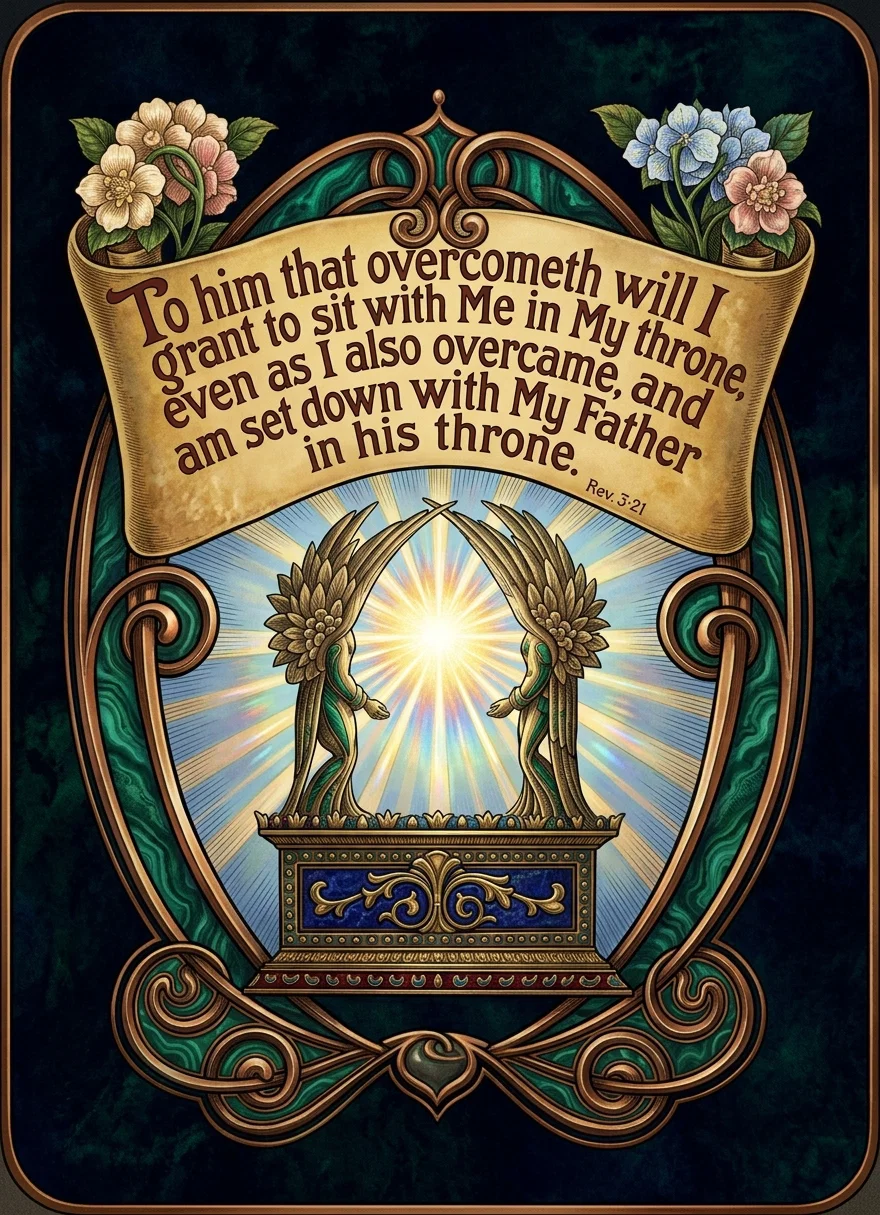
“I counsel thee to buy of Me gold refined by fire, that thou mayest become rich.” What does He counsel for the nakedness? “And white garments, that thou mayest clothe thyself, and that the shame of thy nakedness be not made manifest.” What remedy does He offer for blindness? “And eyesalve to anoint thine eyes, that thou mayest see.” What evidence does He give of His love? “As many as I love I reprove and chasten.” What is the object of His reproof and chastening? “Be zealous therefore and repent.” How does He express His readiness to help us? “Behold, I stand at the door and knock.” What blessed assurance does He give? “If any man hear My voice and open the door, I will come in to him, and will sup with him, and he with Me.” What is His promise to the overcomer? “He that overcometh, I will give to him to sit
down with Me in My throne, as I also overcame, and sat down with My Father in His throne.”

Exposition and Comment.

1. “The Amen.”—How suggestive is the term! The One who has been with His people all the way, the sure Builder, the Establisher, the Confirmer of all promises, the Amen. How fitting is this title in the close of His sevenfold letter. “The faithful and true Witness,”—the Amen Witness; the One who has truly witnessed in His life and sufferingsand providences of God's wonderful character of love to His people. All others have failed in some respects; He has been faithful in all. And all this not for a little time, but from the beginning of the creation of God. For “without Him was not anything made that hath been made.” “For in Him were all things created, in the heavens and upon the earth, things visible and things invisible, whether thrones or dominions or principalities or powers; all things have been created through Him, and unto Him.” He it is, the Faithful, the True, the Mighty, who thus tenderly comes to those in Laodicea.
2. “Neither cold nor hot.”—How sad is the condition of those in Laodicea. Both hot and cold are conditions of feeling. Hot may well denote warm, earnest zeal (See Hosea 7:7, where it is used of zeal in an evil work); cold, a condition of discouragement in which one feels his distance from God, and longs to better it. (See Job 23:3, 8, 9.) Either of these conditions is infinitely preferable to lukewarmness,—a feeling of utter indifference, of don't care, of ease and satisfaction; and yet most nauseating to others. We can endure hot water, and many like it. Weak indeed the stomach which rejects it. Cold water is always refreshing to a thirsty soul; but lukewarm water is nauseating, and a standard emetic. Sad indeed is the condition of God's professed people when the Christ of infinite love can use such language.
3. “I am rich.”—The lukewarm is drunken in his satisfaction with himself and his times. He is living in a wonderful age of progress and enlightenment, God's Word has been opened as never before, times are good, and he sits down satisfied, contented, feeling rich and increased in goods. How many intoxicated men are rich and strong and great—in their imagination. Spiritual intoxication is worse than this. The stupor is of longer duration. The true Witness reveals the real condition of the lukewarm; of all others he is “the wretched one;” for he is “miserable and poor and blind and naked.” What has any mortal soul on earth that he did not receive? In what can he boast? Not for one hour can he live of himself. For all good things he is dependent upon God. Apart from God he is prolific in all things evil and that result in evil.
4. “I counsel thee.”—Is it not well to take the counsel of the Infinite One, the Faithful and True Witness? His witness of our nothingness is as faithful as His witness of God's goodness. Man does not know himself. “The heart is deceitful above all things, and it is exceedingly corrupt.” God desires that we should learn this lesson by faith, and so learn the Healer. If we will not learn it by faith, He will suffer us to fall and fall, till we learn the lesson or identify ourselves with the sin. He never counsels the latter. “Buy of Me gold.”—He has the only true riches, “the exceeding riches of His grace” (Eph. 2:7), gotten by faith (James 2:5), the “faith which worketh by love” (Gal. 5:6). The faith and love of Christ are true character-builders, the only character-builders. In these the poor may become rich. But never will one boast of these riches in himself. He will not say “I have gotten riches.” Nay, but “I received them ‘without money and without price,’ ‘freely by His grace.’” O wretched, poverty-stricken soul, feeding with swine, far from your Father's house, drunken perhaps, in indifference, rise from your stupor, come home, and partake of the riches of His grace.
5. “White garments,”—await the casting away of the filthy rags of our own righteousness, the white raiment of Christ's own righteousness, without spot or wrinkle, woven in the loom of earth's trials and temptations. He will forgive the sin. He will wash clean the stains in His own blood. He stoops to lift the low and the fallen, and makes them to sit in heavenly places with Himself. Then can we sing, in the language of Inspiration, “I will greatly rejoice in Jehovah, my soul shall be joyful in my God; for He hath clothed me with the garments of salvation, He hath covered me with the robe of righteousness.” Why go naked, soul, when royal garments await thee? No garments of thine own weaving will hide thee, when thou standest before His throne (Isa. 59:5, 6); only the robe of “Jehovah our Righteousness” (Jer. 23:6). “And the work of righteousness shall be peace; and the effect of righteousness quietness and assurance forever.” Isa. 32:17. 6. “Anoint thine eyes.”—What would not a blind man give to have his sight restored! But how much worse is the spiritually blind! Yet there is remedy. When Jesus met the blind of old, He made eyesalve of the clay, and anointed the man's eyes, told him to wash in the pool of Siloam; and the man washed and saw. It was the power of the Spirit of God which wrought the change. So Christ with holy unction would anoint the eyes of the blind in Laodicea, that in the visions—seeings—of God they might see the littleness of little things, and the greatness of God's eternally great things. There are eyes which ought to be seeing in the light of God, but they are blinded by the glare of wealth, by the films which passion spreads, by fame, by the fading glamour of authority. Let Christ heal the vision, that the eternal glories of God may be seen. 7. “I reprove and chasten.”—The wise parent or friend does not always praise us or please us. It is easy for mortals to stray, easy to form wrong habits, easy to make mistakes and perpetuate them, easy to become self-centered, easy to get to seeking the peace instead of the righteousness, easy for the natural heart to sin. O, then, how much we need the wise friend!
“I have learned that a friend that is worth the having Is a friend that will hurt you now and then; That will turn to ice at your sickly craving For sympathy uttered by word or pen, That will tear you with brave, rough hands away From the altars you build to your gods of clay, And break them down, lest you kneel again.”
“Faithful are the wounds of a friend; but the kisses of an enemy are deceitful.” “He is in the way of life that heedeth correction; but he that forsaketh reproof erreth.” Blessed is he who can pray, “Let the righteous smite me, it shall be a kindness; and let him reprove me, it shall be as oil upon the head; let not my head refuse it.” God reproves and chastens, not because He wishes us to suffer, but to save us from greater suffering. He is like the wise surgeon who finds it necessary to set the broken bone, and take the stitches in the wound, even tho it cause pain, in order to save the limb, and better heal the wound. “He doth not willingly afflict nor grieve.” He doth not reprove to free His mind, but to save our soul. He could not be love, if He permitted us unhindered, unreproved, to go on in sin. He will not compel righteousness; it can not be compelled; but He will do all He can to save us from sin. “As I live, saith the Lord Jehovah, I have no pleasure in the death of the wicked; but that the wicked turn from his way and live; turn ye, turn ye from your evil ways; for why will ye die.” This is God's message of love to the sinner. See Prov. 3:11, 12.
8. “Be zealous therefore, and repent.”—It is less difficult to arouse and to help the discouraged and despairing than the indifferent. The stupor of death is upon him. “Awake, thou that sleepest, and arise from the dead, and Christ shall shine upon thee.” No one will do it who has not faith in God,—faith that believes what God says of us, that our condition is what He declares, that the only true riches, and garments, and sight are His, and that it is death, eternal death, to continue in indifference. “Awake, arouse, or be forever fallen.” Be zealous in repenting. Put away all sin by reparation and confession, and seek God earnestly. See Zeph. 2:1-3. Only in this is there safety.
9. “Behold I stand at the door and knock.”—The Faithful One does not wait indifferently (nor anxiously, ever) for us to come to Him. He comes to our dwelling of revelry or slumber, and knocks, knocks, knocks, many times and persistently, to arouse us. He waits for response, and knocks and calls again. Is the ear deafened with the din? O listen. Life, eternal life, depends on your hearing. He knocks, and calls, and waits as long as there is hope. Who knows but that thou art now reaching that limit. Heed now.
10. “If any man hear My voice.”—He does not ask to be received into a marble palace or splendid banqueting room; He does not ask for a splendid company of the great, the learned, the wise, the pious to receive Him; He does not ask for priest or prelate or saint to act as intermediary; He does not ask that the whole church shall bid Him welcome. “If any man.” It takes in the lowest, the poorest, the wickedest in Laodicea. He may listen; he may hear; he may open. “My voice.”—How may we know it among the multitude of voices? Measure it by the law which His voice uttered from Sinai, which He wrote on tables of stone. Take His law, take His Word; learn its teaching; open thy heart to receive it. “If any man willeth to do His will, he shall know of the teaching.” These are Christ's own words. Open the door, let Him in, that He may sup with you. But I have nothing fit to place before Him, you say. Of course you have not. You never can have in yourself. Neither can any one else. Man is poor, and wretched, and miserable, and blind, and naked. He knows it; therefore He comes. Do not strive to hide it from Him who knows your works. Spread your own starvation diet all before Him. Lo, He is partaker of your wretchedness, your misery, your poverty. He is a brother beloved to bear it; and His admitted presence reveals and shines away all the evil, and glorifies our humble board. And then He spreads the table with all the delectable viands of heaven, and we sup with Him. His glorified Word in us becomes righteousness, peace, glory, unutterable. It is the blessing which every one in Laodicea may enjoy, the blessing of the latter rain, which immediately precedes His second coming.
11. “I will give.”—He does not wait in His giving till we overcome. He gives the overcoming. “This is the victory that overcometh the world, even our faith” in Christ Jesus. But at the end of the overcoming liesthe crown, the kingdom, the everlasting reign. Christ overcame as we must overcome. He met the enemy in the weakness of human flesh. He prayed and supplicated “with strong crying and tears unto Him that was able to save;” He learned “obedience by the things which He suffered,” and so earned the power to become an all-effectual, ever-living High Priest for us, in the throne of the Majesty of the heavens. Heb. 5:7-10; Ps. 110:1; Heb. 8:1, 2. He reigns a king-priest, a conquering priest, on the throne of grace. And to every soul who will overcome in Him, He will give a place with Him in His throne, even as He has a place with the Father. This is the glorious climax of this sevenfold promise of this sevenfold letter. Christ reigned with God the Father because the Father's law was in His heart. We will reign with Christ eternally, only when that same law is written in our hearts. It is not enough that we should know of it in His Word. It is not enough that we should possess the veritable ark and tables of stone. “Knowledge puffeth up, but love buildeth up.” That law must be enshrined in the heart, and live in the life, and our God must, by His Spirit, be enthroned there, our King, our everlasting Reward.

THE ACCUSATION.

[By a little one of the great company. Ps. 68:11.]
Did you ever, dear reader, fellow Christian, realize that it was the question of the Sabbath day—how to keep it—that so enraged the Pharisees against Christ and formed the basis of their accusation against Him, which finally ended in His crucifixion?
“And they asked Him, saying, Is it lawful to heal on the Sabbath days? that they might accuse Him.” Matt. 12:10.
“And they watched Him, whether He would heal him on the Sabbath day; that they might accuse Him.” Mark 3:2.
“And the scribes and Pharisees watched Him, whether He would heal on the Sabbath day; that they might find an accusation against Him.” Luke 6:7.
Just after Jesus had healed the woman who had been bound by Satan for eighteen years, “the ruler of the synagogue answered with indignation, because that Jesus had healed on the Sabbath day, and said unto the people, There are six days in which men ought to work; in them therefore come and be healed, and not on the Sabbath day.” Luke 13:14.
“Jesus saith unto him, Rise, take up thy bed, and walk. . . . And on the same day was the Sabbath. The Jews therefore said unto him that was cured, It is the Sabbath day; it is not lawful for thee to carry thy bed.” “Therefore did the Jews persecute Jesus, and sought to slay Him, because He had done these things on the Sabbath day.” John 5:8–10, 16.
And in the eighteenth verse, we find added to that cause the claim that Christ made of His relationship to the Father: “Therefore the Jews sought the more to kill Him, because He not only had broken the Sabbath, but said also that God was His Father, making Himself equal with God.”
Because He healed the blind man on the Sabbath, some of the Pharisees said, “This man is not of God, because He keepeth not the Sabbath day.” John 9:16.
But surely He who was with God from the beginning, when the Sabbath was made, He who was and is “Lord of the Sabbath,” (Matt. 12:8; Mark 2:28; Luke 6:5), knows best how the day should be spent so as to most honor the God who gave it. And that way we learn from His own teachings and example to be by doing good. Mark 3:4.
And the Lord always intended that day—His day—to be a blessing spiritually and physically, a physical rest, not only to mankind but even to the beasts of burden; the law also providing for the necessary care and rescue from danger even on the Sabbath. Christ Himself taught this by His own reference to Deut. 22:4.
“What man shall there be among you, that shall have one sheep, and if it fall into a pit on the Sabbath day, will he not lay hold on it, and lift it out? How much then is a man better than a sheep? Wherefore it is lawful to do well on the Sabbath days.” Matt. 12:11, 12.
Praise the Lord for His light, for His plain teaching, for His wonderful example!
The Lord’s day—for such claim the Lord makes in the Old as well as in the New Testament—was made and blessed for man’s highest and best good.
“Verily My Sabbaths ye shall keep, . . . that ye may know that I am the Lord that doth sanctify you.” Ex. 31:13.
“Moreover also I gave them My Sabbaths, to be a sign between Me and them, that they might know that I am the Lord that sanctify them. Eze. 20:12. “For the Son of Man is Lord even of the Sabbath day.” Matt. 12:8.
Yes, for his greatest good: “The Sabbath was made for man and not man for the Sabbath.” Mark 2:27.
The Lord gave the Sabbath to be a blessing, but over and over again has it been so trampled underfoot that the profaning of it has brought death and destruction. Again and again has the Lord God been grieved by man’s pollution of His holy day.
“What evil thing is this that ye do, and profane the Sabbath day? Did not your fathers thus, and did not our God bring all this evil upon us, and upon this city? yet ye bring more wrath upon Israel by profaning the Sabbath.” Neh. 13:17, 18.
“I would not bring them into the land which I had given them, . . . because they despised My judgments, and walked not in My statutes, but polluted My Sabbaths; for their heart went after their idols.” Eze. 20:15, 16. “They polluted my Sabbaths; then I said, I would pour out My fury upon them, to accomplish My anger against them in the wilderness.” Verse 21.
Did not the Lord care then how His day was treated? Does He not care now? Aye, verily!
There are two questions which naturally arise concerning the Sabbath day,—when to keep it, and how to keep it.
God’s when is to be found in Gen. 2:2, 3. “And on the seventh day God ended His work which He had made; and He rested on the seventh day from all His work which He had made. And God blessed the seventh day, and sanctified it; because that in it He had rested from all the work which God created and made.”
And again, from the commandment given in Exodus 20, we read: “Remember the Sabbath day, to keep it holy. Six days shalt thou labor, and do all thy work; but the seventh day is the Sabbath of the Lord thy God.”
“The Sabbath was made for man.” Mark 2:27. “Six days shall work be done, but on the seventh day there shall be to you an holy day, a Sabbath of rest to the Lord.” Ex. 35:2.
God’s how is to be found in many parts of His Word. Two or three citations will suffice, with our Saviour’s teachings and example:—
“Blessed is the man, . . . that keepeth the Sabbath from polluting it, and keepeth his hand from doing any evil.” Isa. 56:2.
God says of certain ones that keep His Sabbaths, and choose the things that please Him, and take hold of His covenant, “Even unto them will I give in Mine house and within My walls a place and a name better than of sons and of daughters; I will give them an everlasting name, that shall not be cut off.” Isa. 56:5.
“If thou turn away thy foot from the Sabbath [it was and is trampled under foot], from doing thy pleasure on My holy day; and call the Sabbath a delight, the holy of the Lord, honorable; and shalt honor Him, not doing thine own ways, nor finding thine own pleasure, nor speaking thine own words. Then shalt thou delight thyself in the Lord; and I will cause thee to ride upon the high places of the earth, and feed thee with the heritage of Jacob thy father; for the mouth of the Lord hath spoken it.” Isa. 58:13, 14.
As it was in the days of the Old Testament, so it is now; as it was in the days of Christ, so it is now; a misunderstanding of the true Sabbath, and of the true meaning of it—in Christ’s time, and even to the end, leading to persecutions. Jesus said:—
“Wherefore it is lawful to do well on the Sabbath days.” Matt. 12:12.
“Let us hear the conclusion of the whole matter: Fear God, and keep His commandments; for this is the whole duty of man.” Eccl. 12:13.
“Here is the patience of the saints; here are they that keep the commandments of God, and the faith of Jesus.” Rev. 14:12.
“Blessed are they that do His commandments, that they may have right to the tree of life, and may enter in through the gates into the city.” Ch. 22:14.
Dear friend, let us follow our dear Saviour’s teachings and example. He is a safe Leader; none other is. For the when and the how look to Him.
May we be found on the Lord’s side of this and all other great questions; yes, even unto persecutions which will arise, or unto death, if need be, and He shall count us worthy.
Take heed, and the Lord be thy righteousness and thy strength. Isa. 45:24.

RELIGIOUS LESSONS FROM RUTH.

[Alexander McLaren, D. D., in S. S. Times.]
The first is that it tells of the entrance of a Moabitess into Israel. Boaz speaks a great lesson for Israel of all ages when he invokes on Ruth’s head a “full reward” from the “God of Israel, under whose wings thou art come to take refuge.” It is the lesson that Israel’s privileges were theirs first, in order that they might belong to all the world, and that therefore hand and heart should be open to all from every land who turned to Jehovah. The lamp was set on a candlestick that it might give light to all that were in the great house, which is the world with its “many mansions.” Israel needed the lesson; the church has not yet laid it enough to heart.
Another reason for the presence of the book is its bearing on the ancestry of David. That reason is set forth in the appendix in the last verses of Ruth, containing David’s genealogy. A tinge of Moabite blood, then, ran in the veins of the royal house, and it may be remembered that when he was a fugitive he took his father and mother to the king of Moab, and sought an asylum for them there. The significance of Ruth’s being David’s ancestress is brought distinctly out by her inclusion (exceptionally) in Matthew’s genealogy. She is one of the four women mentioned there. The other three have tainted reputations. They suggest Christ’s kinship with sinners; Ruth suggests His brotherhood with aliens and Gentiles.

Confidence Adds Power

“GOD never made man for failure. Confidence adds power, but doubt paralyzes confidence.”

Love as God’s Character

“LOVE is more than a characteristic of God; it is His character.”

“CONSIDER HIM”

BY PROF. G. W. RINE

“BEHOLD YOUR KING.”

THROUGHOUT the prophecies of the Old Testament is depicted, with vivid portraiture, the visions of a divine Messiah-King. In the promise to our first parents, that the seed of the woman should bruise the serpent’s head, is clearly implied the promise that a divine Ruler would ultimately erect upon the ruins of Satan’s realm an imperishable kingdom. Moved by the Holy Spirit, Jacob declared: “The scepter shall not depart from Judah, nor a lawgiver from between his feet, until Shiloh come; and unto Him shall the gathering of the people be.” Gen. 49:10. The forty-fifth psalm is one of the many Messianic psalms. In the sixth verse the Father is represented as declaring to the Son: “Thy throne, O God, is forever and ever; the scepter of Thy kingdom is a right scepter.” In the seventy-second psalm, also a Messianic psalm, it is prophesied that dominion also from sea to sea, and unto the ends of the earth. “Yea, all kings shall fall down before Him; all nations shall serve Him” (verses 8–11). In vision, Isaiah exclaims: “Behold, a King shall reign in righteousness” (32:1). Jeremiah writes of this prospective King, under the figure of a Branch raised up unto David; as a King who should reign and prosper, and should execute judgment and justice in the earth (23:5). “David shall never want a man,” declares the same prophet, “to sit upon the throne of the house of Israel” (33:17).
The prophets of Israel saw that this Shiloh, this Branch of Righteousness, this Desire of all nations, would be a King of more than human beauty; full of grace were to be His lips; the sword of a world-wide justice should be girded on His thigh; before Him all kings were to fall down, all nations were to do homage at His feet. His throne would rest, not upon the love of power, but upon the power of love. He would be a King whom the daughter of Jerusalem would one day behold coming to her, not through blood and carnage, but in lowly guise, sitting upon an ass—yet a King whose dominion shall be from sea to sea and shall never pass away. Righteousness and peace, salvation and deliverance, judgment and victory—these were to be the “pomp and circumstance” of His empire.
Nor did this hope in Israel wane in the least, even in the years immediately preceding the birth of Jesus. True, the prophetic ideal of a great moral Deliverer and spiritual King had become utterly debased in the popular belief. But still the belief was cherished—the belief in a world-wide Conqueror, some Jewish Cæsar, who was to rescue the nation and fulfil its most glorious political aspirations. Even the Gentiles were yearning for the advent of the long-expected seer and philosopher, who should resolve all the problems of humanity; “a princely infant before whom the rocks should flow with honey and the briars bloom with roses.”
Hence how pertinent was the question of the “wise men from the east,” after the birth of the Saviour: “Where is He that is born KING of the Jews?” How natural therefore that the ministry of Christ was ushered in by the proclamation, “The kingdom of God is at hand.” How wondrously significant, therefore, the words of the angel respecting Jesus, to Mary His mother: “He shall be great, and shall be called the Son of the Highest; and the Lord God shall give unto Him the throne of His father David; and He shall reign over the house of Jacob forever; and of His kingdom there shall be no end.” Luke 1:32, 33. So throughout the entire life of Jesus there is always to be seen a most serene and absolute conviction of His royalty. He repeatedly adverts to Himself as King and Master. Again and again He expressly claims the character and functions of that divine Messiah-King for whom the nation had for ages been wont to look. When Pilate in his judgment hall asked Jesus, “Art Thou a king then?” Jesus answered, “Thou sayest that I am a king. To this end was I born, and for this cause came I into the world, that I should bear witness unto the truth.” John 18:37.
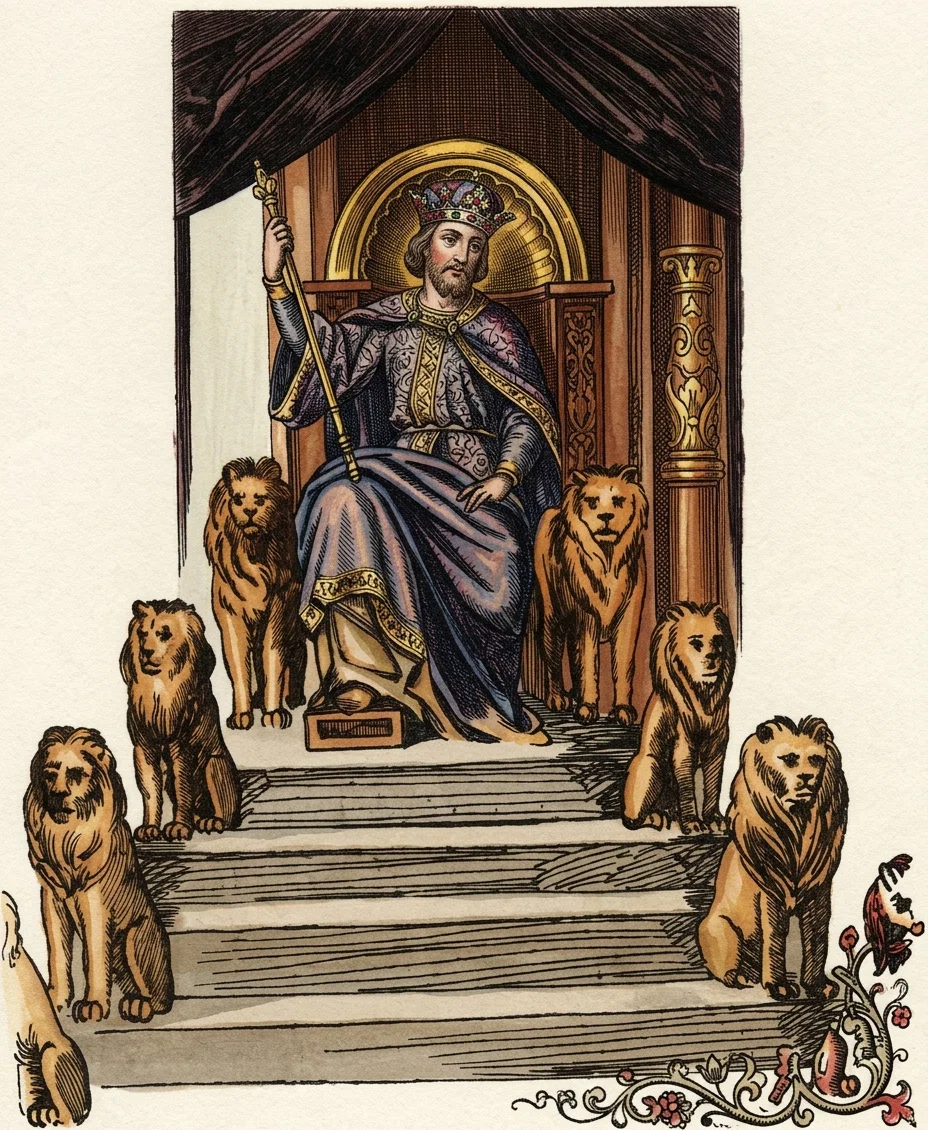
Throne of Solomon.
Throne of Solomon.
And yet He never for a moment allowed Himself to be regarded as an earthly monarch; He persistently repudiated the splendors of an earthly throne. And this was the secret of His ultimate rejection by the Jews. By proclaiming the kingdom of God is at hand He raised their hopes to the highest pitch, only to dash them down before their eyes. The kingdom to which they were looking forward as an earthly kingdom, He revealed as a spiritual kingdom. Against the proud, bigoted exclusiveness of their expectations, He announced a kingdom for all the world. Hence in their blind ambition for carnal power and worldly glory, the Jews were staggered at the paradox of a ruler without a throne, a monarch without tribute money, a sovereign without armies, a king without crown or scepter. They could not reconcile His royal pretensions with the humble, homely tenor of His life. How He could declare Himself a King and yet aver that His kingdom was not of this world, was to these Jews an inexplicable enigma.
It is well known that the Jewish leaders had, in the days of the Son of Man, so far apostatized from the truth of God that they had lost approximately all spiritual discernment. They could not see that the Messiah had never contemplated the assumption of civil rule in “this present evil world.” They knew not that until “the mystery of God should be finished,” (that is, until the Gospel should have completed its mission in the earth) Christ should occupy nothing more than a “throne of grace,” and that as long as He ministered grace to the sinner, by ministering His own blood, as a priest, for the remission of sins, He could not sit upon the throne of David, inasmuch as David could not have been a priest, not being of the tribe of Levi. No; they could not understand the doctrine of rendering to Cæsar the things that are Cæsar’s, and to God the things that are God’s; and that this must be done until, in the Lord’s own good time, the kingdoms of this world should become the kingdoms of our Lord and of His Christ; and that then “He shall reign forever and ever.” Rev. 11:15. By reading the first part of this verse we learn that the “kingdoms” do not become Christ’s until the time of the sounding of the seventh angel. By reference to Rev. 10:7, we read that when the seventh angel begins to sound “the mystery of God should be finished.”
Rom. 16:25 and other scriptures clearly teach that the “mystery of God” is identical with the Gospel. Hence the irresistible conclusion is that Christ takes His kingdom after the work of the Gospel closes. Our Lord Himself declares: “When the Son of Man shall come in His glory, and all the holy angels with Him, THEN shall He sit upon the throne of His glory.” Matt. 25:31. Every one knows that Christ has not yet come in His glory with the holy angels with Him; and that He therefore does not yet sit upon the throne of His glory. Let the reader refer to Dan. 7:9–14, and he will see how explicitly it is there taught that Christ does not assume “dominion, and glory, and a kingdom,” in which “all people, nations, and languages should serve Him” until after the investigative judgment—in which the destiny of all men will be decided—will have closed. None but those who now receive Christ as King in their own hearts, and whose names He confesses in that solemn judgment above, will share in the glory of His kingdom in the world to come. Be not deceived. There is no future age in which the conditions of salvation will be extended to procrastinators. For further corroborative evidence read the parables recorded in Luke 19:11–27 and in Matt. 13:36–43. In the latter parable the Master states that the harvest is the end of the world. THEN “the Son of Man shall send forth His angels, and they shall gather out of His kingdom all things that offend, and them which do iniquity; and shall cast them into a furnace of fire; there shall be wailing and gnashing of teeth. Then shall the righteous shine forth as the sun in the kingdom of their Father.”
Christ’s kingdom now is a spiritual kingdom, but visible in the living exemplification of the Golden Rule; in the loosing of the bands of wickedness, in the undoing of the heavy burdens, in letting the oppressed go free. Jesus is King of Righteousness, Prince of Peace. He reigns in the hearts, in the thoughts and affections of His subjects—of WILLING subjects only. He never appeals to force or to civil authority, in behalf of His own kingdom. Christians, who, in the interests of religion, appeal to secular power, forget that their Master declared, “My kingdom is not of this world.” It is only a willing service, a service incited by love that is acceptable with our King, for He is God, and “God is love.”
Ah, it is only in love that this King commands. Hence “His commandments are not grievous.” His laws are simply indications of where our happiness lies. Obedience to our King means joy, peace, life. His name shall be called Wonderful, Counselor, the mighty God; hence in boundless wisdom does He guide and instruct His loving subjects. There can be no bondage in the service of our King, for He is not only our King, but our Redeemer, our Brother, our spiritual Husband. Hence He makes us sharers with Him in the glories of His royalty; for has He not “made us kings and priests unto God”? Rev. 1:6. Yes, His service is our recreation; His courts ourdelight, His glory our honor, His cross our crown. We bless Thee, our Father, for exalting Jesus to be a Prince and a Saviour to us.
[The next and last article in the series is “Thy Kingdom Come.”]
Continue reading: Contradictions of Bible Doctrine