Your ShelfYour Projects

Signs of the Times, Vol. 24, No. 30.

PEACE ON EARTH

Signs of the Times

Jul 28, 1898

Pacific Press Publishing Company · Oakland, California · Jul 28, 1898

PEACE ON EARTH.
WHEN Christ the Lord came into the world as the infant Saviour, “the heavenly host” greeted the shepherds in the fields of Bethlehem with the anthem, “Glory to God in the highest, and on earth peace, good-will toward men.” Luke 2:14.
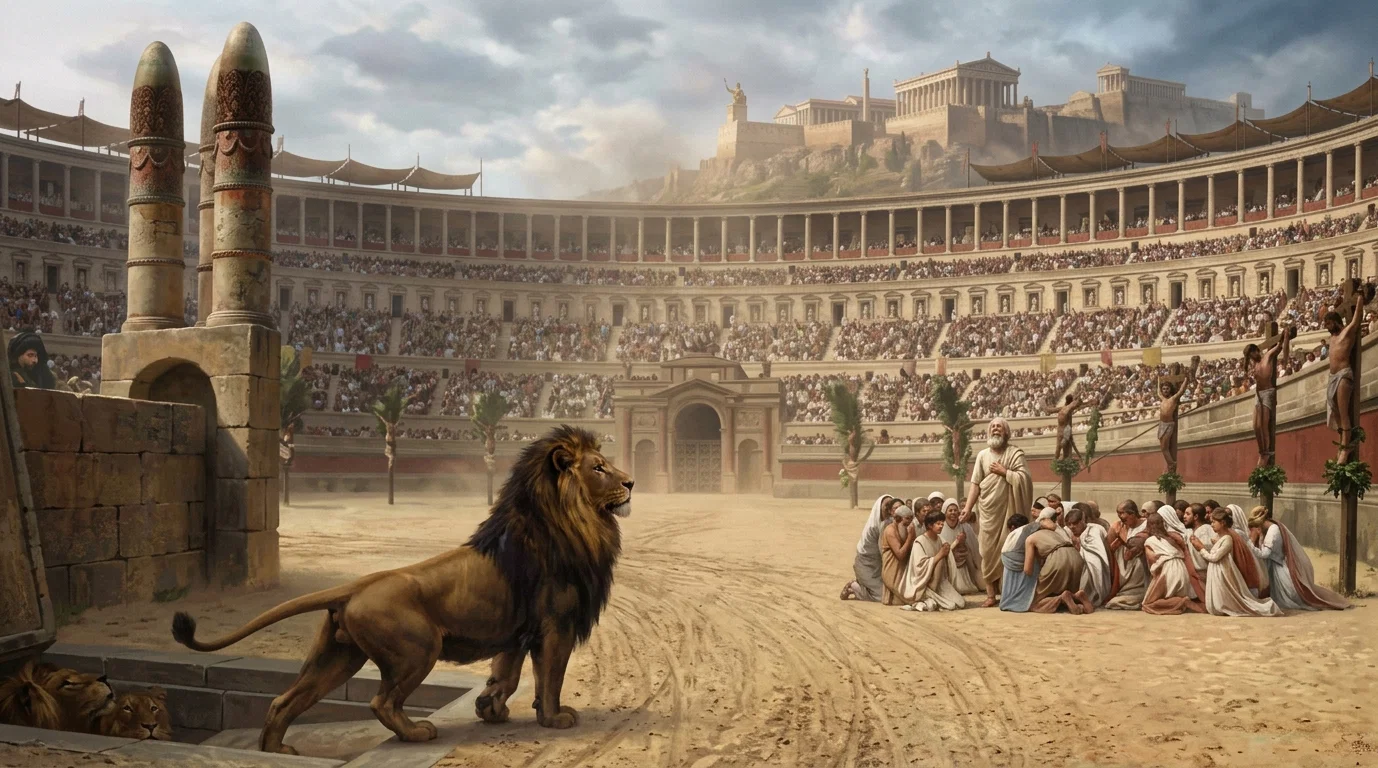
“Thousands have been fed to the wild beasts, while assembled multitudes have madly cheered the inhuman work.”
What a thrilling chorus that must have been! The perfect melody of each angel voice, and in the perfect time of heaven’s choir, blended into a soul-stirring harmony. But it was not alone the music, altho its enchanting and thrilling sublimity was infinitely beyond the powers of human description, that filled the hearts of the shepherds with overflowing gladness. The music was rather the celestial medium through which was conveyed the “good tidings of great joy, which shall be to all people. For unto you is born this day in the city of David a Saviour, which is Christ the Lord.”
The hearts of the people must have fairly burst with joy when they heard the good news that the Saviour—the divine Deliverer—had come to earth. And how wonderfully fitting is the time in which He chose to come! The whole world was then under the imperial tyranny of the Roman Cæsars. The military spirit and the universal despotism of the imperial arms was the dominating idea. The peace of the world was in the hands of a single emperor, and the tramping of the legions of Rome mingled its sound with the pitiful appeals of the oppressed slaves.
Right into the midst of this military subjugation, and at a time, too, when the Israelitish nation was feeling the burden of the Roman yoke the most severely, there came the heralds from heaven announcing the arrival of the Prince of Peace. What “good tidings” these were! The Prince of Peace Himself has come. Prophets and priests had been inspired to tell all that human language could convey to the minds of men about Him. But here is the Christ, even the Lord Himself.
And what a soul-satisfying title He bears: The “Prince of Peace” is He. He came into this old world of strife and war to proclaim peace. Hear His words: “Peace I leave with you, My peace I give unto you; not as the world giveth, give I unto you. Let not your heart be troubled, neither let it be afraid.” John 14:27.
“Not as the world giveth, give I unto you.” Yes, yes, His peace is another sort, and comes in a different way from the world’s peace. The world can give only an imperfect peace at best. It has nothing complete or permanent to offer. But Jesus comes as a personal Friend to each individual heart, and says, “My peace I give unto you.” And this peace is perfect; it is full, it is complete. Any one who has quaffed at the Fountain of the Prince of Peace has no longer a relish for this world’s joys. He has drunk at that living Fountain, and nothing else gives refreshment and abiding satisfaction.
“These things I have spoken unto you, that in Me ye might have peace. In the world ye shall have tribulation; but be of good cheer: I have overcome the world.” John 16:33. Yes, in the Master we do have “peace.” But “in the world ye shall have tribulation.”
The world has gone astray. It is out of harmony with the principles of peace. The unconverted heart is ready to make war at the slightest provocation. It is ready to fight a neighbor, or to join the army and fight a nation. The principles of real peace are not rooted and growing there. The world’s heart says, “Peace while everything suits me, otherwise, war.”
So in such a world as this the followers of the Prince of Peace could expect nothing less than “tribulation.” Those who “come out from the world” and become Christians indeed, and not in name only, will find themselves going one way and the world the other. And while the spirit of ruthless war is in the hearts of men, the follower of Christ may besure of more or less tribulation. “In the world ye shall have tribulation.” There is no qualification. “Tribulation” surely overtakes every one who is continually on the watch lest he make a compromise with sin.
The Prince of Peace can not arm His followers with carnal weapons. “For the weapons of our warfare are not carnal, but mighty through God to the pulling down of strongholds.” 2 Cor. 10:4. So, then, as champions of peace, acting under the banner of the Prince of Peace, war and its consequent bloodshed is not for us to wage. As we imbibe the principles of the Master, we have no heart for war. We can not ruthlessly strike down a fellow-man. No! no! An abiding peace that forbids it is in the heart.
The Christian, like his Lord, is ready to suffer any kind of affliction or hardship, but his heaven-born kindness makes it unnatural and impossible for him to strike a blow that will hurt or harm another. These elevated and elevating principles planted in the heart are the enabling power that has ever made it possible for Christian men and women to endure without a murmur the cruelest treatment that could be invented. Thousands have been fed to the wild beasts, while assembled multitudes have madly cheered the inhuman work. Yet so firmly were the principles of peace fixed in these truly Christian hearts that no trace of anger or ill-will beclouded the unrevengeful faces of the devoted souls.
The enemies of the Lord sought continually to destroy His life. Secret plottings were all the time being made against Him. Yet He was the kindest person that ever trod the earth. He was the divine embodiment of “peace, and good-will toward men.” And His “peace” and “good-will” never forsook Him. Even the tortures of the cross could not draw an unkind word or a sentiment of harshness from His lips. The suffering produced by the most fiendish instruments of death that were ever devised could not overthrow the throbbings of peace that were the life-blood of His tender heart. Oblivious to His suffering, and unmindful of the indignities and reproach heaped upon Him, His last moments were spent in pouring out the prayer, “Father, forgive them.”
What a scene is here presented! What an object-lesson is thus given by the great Prince of Peace! He who commanded the host of heaven and who could have summoned legions of angels to put His enemies to rout, offers a prayer for them instead.
Jesus of Nazareth is a wonderful Teacher. His life is a wonderful life. His peace is a wonderful peace. Do you possess it?
T.

“THEIR LAND IS FULL OF IDOLS.”

NO MORE graphic description of any time was ever written by a historian than was given of our time by the prophet of old when he penned the second chapter of Isaiah. This and the two succeeding chapters furnish food for the most sober reflection upon the part of this generation. Alas, that it is so little heeded!
The chapter opens with a glowing picture of a popular church in the last days. “The mountain of the Lord’s house shall be established in the top of the mountains, and shall be exalted above the hills; and all nations shall flow unto it.” This is a positive prediction that ecclesiastical authority will be established in the heights of civil power. The present movement, to Christianize the citizenship of the governments of earth and to enthrone Jesus as Arbiter of nations, or some similar movement, is certain to succeed so far as human effort and the consent of nations, without the divine sanction, can make it a success. There will be more talk of peace, of arbitration, and of human brotherhood, and more awful preparation for war. (Compare Isa. 2:4 with Joel 3:10.) We have no occasion to impugn, nor even to question, the motives of those who are engaged in pushing on this swelling tide of a popular demand for the recognition by the nations of the Christian religion. But that they are mistaken is made as clear as Inspiration could write it. The effort to popularize religion is a blow at its vital power. The success of the effort sacrifices the divine approval. Read verses 6-9 of Isaiah 2, just referred to: “Therefore Thou hast forsaken Thy people the house of Jacob, because they be replenished from the East, and are soothsayers like the Philistines, and they please themselves in the children of strangers. Their land also is full of silver and gold, neither is there any end of their treasures; their land is also full of horses, neither is there any end of their chariots; their land also is full of idols; they worship the work of their own hands, that which their own fingers have made; and the mean man boweth down, and the great man humbleth himself; therefore forgive them not.”
The Revised Version reads, “Because they be filled with customs from the East.” Oriental religions, encouraged by the Congress of Religions held in connection with the late Chicago World’s Fair, have filled the Christian world with the savor of their pleasing sophistries. Plenty of pretended Christian teachers will tell us that Gautama or Confucius stands on an equality with Christ. We are taught to believe that the Shastas, the Koran, and the Bible are all on a par. The customs and religions of the East are exerting an immeasurable influence over a popular church.
Silver and gold lie cankering in heaps, and millions are being constantly added to the coffers of the rich. Horses were never so plentiful as now; and chariots of all kinds, from the rushing railway train to the ubiquitous bicycle, are everywhere in evidence. So far the picture is complete.
“Their land also is full of idols; they worship the work of their own hands, that which their own fingers have made.” Idolatry is generally supposed to be characteristic of heathendom. If it be so, no country is nearer heathenism than our own fair land; for in no part of the world is idolatry more universal than in America. And, sad to say, ours is the worst form—it is self-worship. The great fairs that are held at such an enormous expense are apparently and practically for the purpose of the laudation of men. Nations, states, cities, and individuals vie in the strongest competition for supremacy and praise. Gold medals are flourished as tokens of triumph over all competitors; but God is forgotten. Works of art, of literature, of science, or genius are praised, and become the pillars on which human pride perches itself aloft. Palatial mansions are monuments of pride. Fine furniture and pleasant pictures awaken the envy of those who can not get them; and observe the thought—and we may say the devotion—of those who can own them. The world to-day presents a scene of strife for vain-glory. Hero-worship is far more prevalent than the worship of God.
I would not overdraw this picture. It does no good to exaggerate the evil. But it is hardly possible to make it stronger than God has done; and we shall be false to our highest interest and to our most sacred obligations, if we do not look at it as it is. That we have reached a most solemn time in our world’s history is startlingly evident on every side. It is painfully impressed upon us by the solemn prayer with which the verses quoted above close: “Therefore forgive them not.”
Human pride is certainly a heinous sin. In the last days it is to be all-prevailing, and “the day of the Lord of hosts shall be upon every one that is proud and lofty, and upon every one that is lifted up; and he shall be brought low.” Isa. 2:12. No wonder, then, that the Lord calls upon His people to “seek ye the Lord, all ye meek of the earth, which have wrought His judgment; seek righteousness, seek meekness: it may be ye shall be hid in the day of the Lord’s anger.” Zeph. 2:3.
G. C. TENNEY.

Is This a Christian Nation?

Many people, of all shades of belief, have become very fond of claiming that “this is a Christian nation.” The thing is ABSOLUTELY IMPOSSIBLE! Only an individual can become a Christian, and a comparatively few Christians in a nation does not make it a Christian nation, any more than a few righteous people in Sodom and Gomorrah made those cities righteous. To claim that this is a Christian nation is tantamount to saying that religion and civil government are already united in this country; for no government becomes “Christian” without forming a union with the church, the same as the individual does upon joining, to be subject to her laws and doctrines.—American Banner.

CHRIST is the Way, the Truth, and the Life.

THE WAY OF THE CROSS.

“Come unto Me,” He said; and as I heard His voice, that strange, vague longing in me stirred That from that moment never hushed its cry. And, pitying, He stood and looked on me In tenderest sympathy, And called my name, and would not pass me by.
“My yoke,” the Master gently said; and I, Impatient, pushed the helpful, kind hand by, Muttering, “Nay, lift this burden on me pressed; I can not lift my head Thy face to see, It weighs so heavily; Was not Thy promise, ‘I will give you rest’?”
Yet still He waited. Sad the longing eyes Of Him who meekly stood in suppliant guise And pleaded with me, O, so tenderly! And my heart yearned to answer—but I heard His softly-spoken word, “Child, take My yoke upon you—learn of Me.”
The years passed on. Unwearying, He stood Beside me still, His footprints marked with blood, His gentle voice entreating, “Take My yoke;” And that sharp cry of need within my breast Pleading with Him for rest, While evermore His voice of labor spoke.
But the imploring eyes, the thorn-scarred brow, The face, seamed with unutterable wo, At last woke love in my complaining heart. “Even Thy yoke, O Master,” then I said, Albeit with drooping head, “Because Thou sufferedst, I will bear my part!”
And, lo! the grievous burden I had borne, Bound fast with cords, my aching shoulders torn And scarred, but proudly covered from sight, Seemed lifted from me. And with upraised head And grateful tears I said, “Thy yoke is easy, and Thy burden light.”
—Hattie M. Nottage.

What We Place in God’s Hands

MARTIN LUTHER said, “I have had many things in my hands, and I have lost them all; but whatever I have placed in God’s hands, I still possess.”

DID CHRIST CHANGE THE SABBATH.

Christ is recognized as man's example, therefore what Christ did every one of His followers with the same occasion may do likewise. And as it is proper to inquire into the relation Christ sustained to every phase of Christian experience, it is but reasonable also to inquire what relation he sustained to the law of God, and especially to the Sabbath commandment. Did Christ during His earthly ministry preach or practise the abrogation of the law or any part of the law? Did He anywhere in His earthly life declare that the sacredness of the Sabbath of the past had been transferred to another day of the week? If He did, His course forever settles the Sabbath controversy.
What relation did the work of Christ sustain to the law of God? What relation do the prophecies of the Bible say that he would sustain? What relation did Christ and His apostles say that He did sustain? Certainly from the concurrent testimony we should be able to draw a safe conclusion.
David, in the fortieth psalm, by the inspiration of the Spirit, speaks these words in Christ's stead: “Then said I, Lo, I come; in the volume of the book it is written of Me, I delight to do Thy will, O My God; yea, Thy law is within My heart.” Verses 7, 8. The prophet Isaiah speaks as follows: “The Lord is well pleased for His righteousness' sake; He will magnify the law, and make it honorable.” Isa. 42:21. If the law of God was in the heart of Christ, it would be hard to see how His outward practise could be the exact opposite of the principle existing within. The highest manifestation of love for God is obedience. Says the Saviour, “If ye love Me, keep My commandments.” Hence, if the law of God existed in the heart of Christ, the outward manifestation would be conformity of life to the divine precepts. It also would be difficult to understand how Christ could magnify the law of God and at the same time discount its claims or nullify a tenth part of its demands. He did indeed magnify it in that He manifested in His own life its divine principles, and taught men that it embraced more than dry forms, pertaining to the essence and spirit of Christianity. The testimony of our Saviour regarding His position on the law of God is clearly defined in His Sermon on the Mount. He says emphatically that He came not to destroy the law but to fulfil it, or do it. (See Matt. 5:17–20; Luke 16:17; John 4:34.)
The apostle Paul states emphatically that faith in Christ, far from making void the law of God, only serves to establish and confirm that law. Rom. 3:31. How does the death of Christ and faith in His atonement establish the law? Christ died for sinners. Sin is the violation of the law of God. 1 John 3:4. The law of God is the foundation of His government. The authority of God Himself rests upon government, the same as the authority of every earthly power. And the fact that it required the death of the Son of God to meet the demands of that law in order that the sinner might be free, proves that the law was something which could not be set aside. Thus we see the strength of the law and the stability of the government of God through the sacrifice of the life of Christ, which was required to meet its demands. How unreasonable in the great Law-giver tomeet the demands of that law, and then count the law of so little consequence as to annul or abolish it! Why should not the loving Father set aside the law before the death of Christ, thus sparing the agony of His beloved Son? The fact that Christ died to meet its legal claims is an argument forever as to its immutability.
But now we come more directly to the detail of the inquiry as to whether Christ wrought any change in the Sabbath. It was the custom of our Saviour to meet with His countrymen on the seventh day and engage with them in religious service. Luke 4:16. In His argument with the Jews on the point of His healing the man with the withered hand on the Sabbath day, Christ recognized the existence of the law of God, and the Sabbath, as a part of that law, which should be observed. Matt. 12:1–12. When Christ was crucified, His most intimate disciples petitioned Pilate to deliver His body for burial before the seventh-day Sabbath, on account of their regard for that day. Matt. 27:57, 58. And others of His intimate friends, including Mary Magdalene, and doubtless His own mother after the flesh, after preparing spices and ointments for the anointing of His body on the sixth day of the week, ceased their labors on account of the Sabbath of the Lord, which they counted so sacred as to be an unsuitable time for the embalming of their blessed Jesus. And Christ Himself, after finishing His work and ending His earthly ministry upon the sixth day of the week, rested in undisturbed sleep and repose in the tomb during the seventh day, and again upon the first day of the week took up the work and labors of His earthly ministry. And the Spirit of the Lord, as recorded in Matt. 28:1, in Mark 16:1, and in Luke 23:56 and 24:1, declares that the Sabbath had just passed when the first day of the week dawned.
Thus we find that Christ and His most intimate followers recognized throughout His earthly ministry the Sabbath observed by the Jews as the Sabbath of the Lord. Not a word does He utter regarding the abrogation of the Sabbath commandment nor the sacredness of another day. Nor from His practise can any other inference be drawn than that He held as sacred the day that He Himself had commissioned with His own divine blessing. Therefore in answer to the inquiry at the head of this article we may answer emphatically and without a single reserve, Christ did not institute any change in the Sabbath of the Lord. “He that saith he abideth in Him ought himself also so to walk, even as He walked.” 1 John 2:6. F. M. W.

COUNTING THE COST. No. 2.

THE faith of our Lord Jesus Christ is an intelligent faith. The service of God is a work of self-denial, of soberness, of thoughtfulness, of decided purpose to obey all the requirements of God, even if they take away that which is as dear to us as the right eye or the right arm.
Christ would have His followers use their intellect in spiritual matters as in business transactions, conscientiously weighing evidence irrespective of results. He desires them to think deeply. They must not begin to build the tower and leave it unfinished. They must not engage in warfare when there is before them the prospect of certain defeat. Life, eternal life, is to be gained or lost, and the conviction of the Spirit of God comes to every man who has the Scriptures and will study them for himself.
Christ is truth, and those who hesitate to obey the truth, deny Christ. They show that they are ashamed to stand under His blood-stained banner, ashamed to own that they are doers of the Word, ashamed to place themselves on the side of Christ as keepers of His law. They feel that it is dishonoring to them to love His commandments, to respect the memorial of God’s work of creation. Christ declares, “Whosoever shall be ashamed of Me and of My words, of him shall the Son of man be ashamed, when He shall come in His own glory, and in His Father’s, and of the holy angels.”
This is the sure result. Will you risk it? Will you become disloyal to God because your neighbors are disloyal? Will you be found among the transgressors because your neighbors are there? Are you content to be outside the city of God, to perish with the companions you have chosen in the world?
God would have His people place a proper estimate upon the compassion and love and energy that He has bestowed upon men in order to reclaim them. He gave for them the best Gift of heaven. But men work out their own eternal destiny. If they love praise from their neighbors more than the approval of God, the truth will soon become a dead letter to them. If they refuse the offer of salvation, if they rebel against the government of God, they will share the fate of Satan and his angels.
Bible religion is not impulse. It is not a zeal that rushes on, Jehu-like, and does not consider the situation. The whole plan of salvation is placed before us. There is eternal life to win, eternal death to shun. Selfish considerations are not to be cherished. There must be a fixed purpose to serve God, who has given His only-begotten Son, that whosoever believeth in Him should not perish, but have everlasting life.
The mystery of godliness deepens upon consideration. It was because the Father and the Son loved the world with infinite love, that Christ subjected Himself to such amazing humiliation. All that God could do, He did in giving Himself in His Son, that He might become the propitiation for the sins of the world. Christ gave His life to reproach; He suffered, being tempted; He was falsely accused, and His motives were misjudged. But if men consider not the dear sacrifice made for them, if they are not willing to die to self and to the world, they become spiritually blind. They do not discern the value of eternal riches. They do not love or honor the Christ-life. They know not at what they stumble. They are enslaved by their own carnal inclinations, which they are not willing to relinquish. And when trials and difficulties arise, they give up building a temple for God, a pure, holy character after the divine similitude. Instead of driving them to the solid rock, the least rebuff makes cowards of them. Scorn and ridicule make them ashamed of Jesus, and they turn from Him to associate with and do honor to His persecutors. Thus, like Peter in the judgment-hall, they put Christ to open shame. Such can not endure all things for Christ’s sake. They can not endure to the end. They have not counted the cost. They have not been converted to Christ.
No man who after a time resolves to go back to the beggarly elements of the world, is worthy to be called a disciple of Christ. If he does not intend always to be on the side of truth and righteousness; if he does not mean to be a brave, whole-hearted soldier, to endure opposition from a determined foe, and to press close to the bleeding side of Jesus, not faltering or turning back, “he can not,” says Christ, “be My disciple.”
“Salt is good; but if the salt have lost his savor, wherewith shall it be seasoned? It is neither fit for the land, nor yet for the dunghill; but men cast it out.”
Christ was calling the Jews to repentance, but they would not heed His message. They approached the altar, and presented their slain beasts in expiation of their sin, while He whom their offerings typified was among them unacknowledged and disowned. The Jews crucified Christ, because they refused to know Him as the One in whom their hopes of eternal life were centered. Christ’s heart was full of tenderness and love and sorrow on their account. He knew that they were fastening upon themselves the guilt of crucifying Him who was the foundation of all their religious service. When riding into Jerusalem, He exclaimed, “If thou hadst known, even thou, at least in this thy day, the things which belong unto thy peace! but now they are hid from thine eyes.” How loath He was to pronounce the irrevocable sentence, “But now they are hid from thine eyes!” Blindness of mind had indeed come to Israel, in that they would not come to Christ that they might have life.
The compelling power could go no farther than this. The Jewish nations had been educated, taught of God; to them had been committed the living oracles of God; but they perverted their sacred trust. They invented so many religious restrictions, which were placed above the real injunctions of the Holy One, that minds became confused. The “Thus saith the Lord” and the “Thus saith” of the priests and rulers, were mingled together. The commandments of God were set aside, and the sayings of men put in their place.
Their lack was the same as that of Cain. In every offering that pointed to Christ, the shedding of blood was to represent the death of the Saviour. But for His offering Cain brought of the first-fruits of the ground, by which no faith in Christ was manifested. Cain’s offering was refused. So with the religion of the Jewish nation. Their faith and doctrines became as salt without a savor. They had a form of religion, as had Cain; they had an altar, as had Cain; they had a sacrifice, as had Cain; and, like Cain, they lacked the only thing by which their offerings could express faith in God’s promise,—the slain Lamb.
And the evil that existed in the Jewish nation is apparent to-day. The salt has lost its savor. The very ones who condemn and despise the Jewish nation because they refused to see in Christ all the specifications of prophecy, are in a similar deception. They have nailed to the cross the law of God, which made a necessity the gift of God’s Son to the world. They have crucified the law of God, the foundation of His government in heaven and in earth. But all who thus claim to accept Christ and yet refuse to obey the law which Christ came to vindicate, place themselves in a position similar to that of the man who began to build, and was not able to finish.
MRS. E. G. WHITE.

A DREAM.

Methought the world a-slumbering lay. Silence reigned, and darkness, how profound! When suddenly there came a midnight cry, clear, pealing, far-reaching, penetrating to the uttermost ends of the earth, so that no mortal ear but must needs hear and give heed unto that cry.
The heavens, the earth, the air, were filled with one harmonious sound, as of the voice of the Archangel. All mankind heard. With one accord there gathered together a mighty concourse, all those that had escaped the dread visitations with which the earth had been plagued, as ’twere upon a great plain. It seemed as tho the valleys were exalted, every mountain brought low.
Childhood, youth, manhood, old age, all were there—some grouped together in unbroken families; some whom death had robbed of their loved ones, and prisoned them in the grave; many separated by the vicissitudes of life; whilst others in that vast multitude stood from their own apart, as broken links: severed, parent from child, brother from brother, friend from friend; severed, whom God had joined, through the wiles of that wicked one whose mission upon earth is to promote discord. Angels—God’s messengers that stand ever ready to protect and defend our weak humanity, to give us power to resist the tempter, courage to bid him, tho he appear as an angel of light, “Get thee behind me, Satan”—beheld, and wept.
In this gathering throng were a vast number prominent because of their peculiarity, in that a mark or seal was in their foreheads, a shield, “the Word of God,” was on each breast. These bore a joyous, expectant look.
As by one impulse this restless, waiting multitude became silent. The sound that called them forth had ceased, and with it vanished the dim, pervading light. All heaven and earth stood still. ’Twas the darkness of midnight, when, in the twinkling of an eye, the curtain of night was lifted, and the light as of a thousand suns filled all space with a radiance never before known.
Methought myself apart, severed from my best beloved on earth, yet yearning toward them. A voice whispered unto me, “Behold the signs in the heavens.” Just then there issued from infinite space these words, serene, yet in triumphant tone, “O mankind, upward look!” There, poised ’twixt heaven and earth, in spotless garment clad, appeared a heavenly being with uplifted hand, directing all eyes toward the shining east.
A luminous cloud appeared, which swiftly extended until it spanned the heavens, reaching to the distant west. At first of milky hue, it seemed a broad band across the clear, azure sky. Gradually changing, it became first limpid, then of silvery white, most dazzling to behold. Portentous sight! Lo, upon our tranced vision burst an innumerable company of angels, their silvery wings glistening and scintillating in the light; at the same time began to sound an indescribably sweet, penetrating, harmonious strain, an angelic chorus swelling and heralding—what?
I perceived a drawing together of those having in their foreheads the “seal of the living God,” and they spake one to another, “Lo, He cometh; we have watched and waited for Him;” and the angel that stood by me said, “Here is the patience of the saints; these are they who keep the commandments of God and the faith of Jesus.”
Nearer approached the angelic host, whose glory outshone the brilliance of a thousand suns, and we perceived in their midst, the central figure, one like unto the Son of man, clothed in the white robe of righteousness, surrounded by the beaming brightness of heaven’s glory, and crowned with majesty and power.
Spellbound we gazed, then simultaneously burst forth from the wondering throng a shout of rapture, “It is, it is the coming of the Lord.” He who was in the midst, stretched forth His hand, whereupon a mighty angel flying swiftly to the earth, proclaimed, “Ye shall not prevent them which are asleep.” Forthwith, upon that celestial trump, prepared for the day and the hour, he blew a blast that e’en the dead were wakened, and came forth from Satan’s prison-house.
O wondrous scene! Nearer swept that glorious company; more beautifully clear shone the gentle face of the Redeemer, yet with a light of kingly authority, as He, in loving voice, called: “Come unto Me, ye blessed of My Father. Blessed and holy is he that hath part in the first resurrection; on such the second death hath no power, but they shall be priests of God and of Christ, and shall reign with Him a thousand years.”
Methought as we were caught up into the clouds, together with the resurrected ones, wafted without volition, we became like unto the heavenly host,—were clothed upon with the robe of righteousness,—and joyfully the redeemed host broke forth into singing that new song which no man could learn but they who were redeemed from the earth.
Alas, of all that waiting multitude, many were “consumed by the brightness of His coming”! Some of the most prominent in evil, the worshipers of the beast, the false prophet, and they who pierced Him, the Saviour of mankind, were brought out of their graves but to “witness His glorious advent,” then left powerless of life, until the expiration of the thousand years, during which time the redeemed are “with theLamb whithersoever He goeth;” the earth left desolate of inhabitants save for the presence of “that old serpent; the devil, with his angels,” chained by the will of God, in that there remaineth no living soul upon whom to practise his wiles; chained by the power of that One who alone hath the keys of the prison-house; that One who will, “when the thousand years are finished,” call forth “the rest of the dead” to the judgment.
Then will Satan marshal his great army, making his last, mightiest effort to contend against the just and holy One, and seek to take the holy city, New Jerusalem, which cometh down from God out of heaven. Then shall he be destroyed by the fierceness of the wrath of God; for the Word saith, “And fire came down from God out of heaven, and devoured them.”
Whilst surrounded by, and soaring aloft with, this glorious host, mine ears ravished with heavenly harmonies, my being merged into infinity, I heard and joined a refrain that rose: “Just and holy art Thou, Lord God Almighty: the blessing, the glory, the wisdom, the thanksgiving, and the honor, and the power, and the might, be to our God forever and ever, Amen.”
Then I awoke and found ’twas but a dream. Yet what a dream!
Teach us, O Lord, the way to tread, That we rest among the dead, At that great day, we’ll hear Thy voice, And with Thy waiting saints rejoice; That we may join that happy band Who on the sea of glass shall stand, When Thou dost from our Father’s throne Come to this world to claim Thine own. L. S.

THOUGHTS

Believe that Jesus saves now.
Jesus calms the troubled waves.
There is room in heaven for you.
All are invited to the Gospel feast.
Jesus is not only Saviour but Keeper.
Now is the time to receive Him.
Jesus gives rest to the weary soul.
We shall be made perfect by His love.
Now is the time to save the lost.
Have you enlisted in the army of the Lord?
You are invited to be a guest of the King.
Only believe, and some day you shall see Him as He is.
If we hope to reach the haven, we must trust continually.
Jesus will heal the wounds received in the battle of life.
It is only by the grace of God that we can run the race.
No matter what the world may do, Christ will never deceive you.
Jesus is our only refuge when the storms of sin are breaking about us. C. F. Ladd.
Jersey City, N. J.

EVERY-DAY HEROES.

No battered flags are in their trail, No garments drenched with blood, No martial music swells the gale To help their hardihood.
Yet firmly in the post of right, To do or die, they stand, And never think to shirk or slight The living trust in hand.
No stern command, no trumpet call, These inborn heroes need; Wherever death and danger fall, Instinctively they speed.
No royalty of creed or birth, No outward sign is theirs; Unknown, unguessed, the hero’s worth Till some great deed he dares.
Yet countless sons the land may claim, In hamlet and in hall, Who quick would rise in manhood’s name And sacrifice their all.
Another’s risk, another’s pain, Is all the spur they need; To save the helpless is their gain; No other thought they heed.
—Thomas Wistar, in City and State.
Continue reading: WORDS OF TRUTH