Your ShelfYour Projects

Signs of the Times, Vol. 23, No. 46.

Editorial

Signs of the Times

Nov 25, 1897

Pacific Press Publishing Company · Oakland, California · Nov 25, 1897

Editorial

The Voice of the Deep.—It is impossible that any one who is acquainted to any degree with the Lord should stand by the sea without being reminded of the mighty power of the Creator. Yet many gaze upon the sea day after day with never a thought of its Maker, and even openly defy him.

God's Power.—To such the Lord says: "Hear now this, O foolish people, and without understanding; which have eyes, and see not; which have ears, and hear not: Fear ye not me? saith the Lord; will ye not tremble at my presence, which have placed the sand for the bound of the sea by a perpetual decree, that it can not pass it; and tho the waves thereof toss themselves, yet can they not prevail; tho they roar, yet can they not pass over it?" Jer. 5: 21, 22.

His Faithfulness.—But it is not in order to produce fright that the Lord reminds us of his mighty power, that can set bounds for the sea, so that it can not pass over in its fiercest tumult. No; it is that we may trust him. Perfect faith and love drive fear away. So the power of God over the sea is referred to as evidence of his faithfulness. "O,
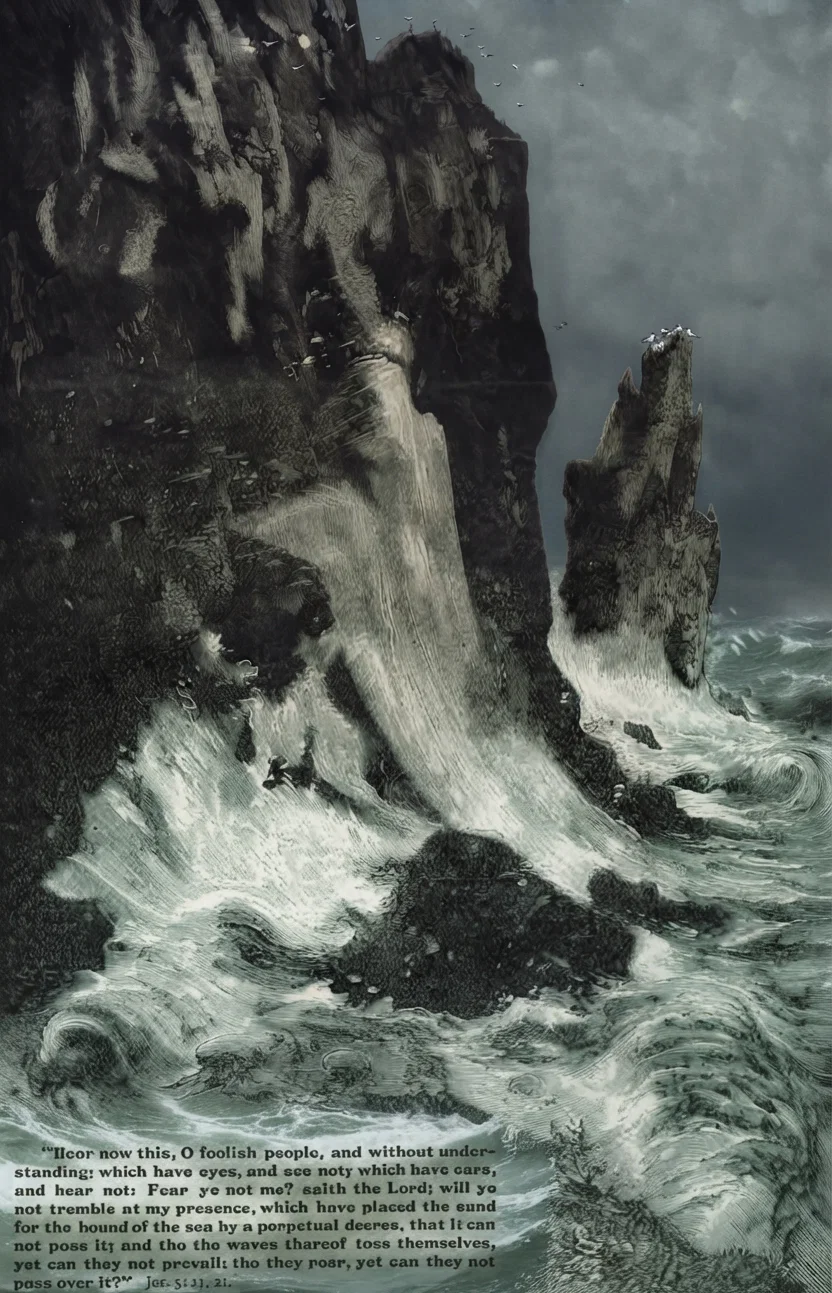
"Hear now this, O foolish people, and without understanding; which have eyes, and see not; which have ears, and hear not: Fear ye not me? saith the Lord; will ye not tremble at my presence, which have placed the sand for the bound of the sea by a perpetual decree, that it can not pass it; and tho the waves thereof toss themselves, yet can they not prevail; tho they roar, yet can they not pass over it?" Jer. 5:21, 22.
Lord God of hosts, who is a strong Lord like unto thee? or to thy faithfulness round about thee? Thou rulest the raging of the sea; when the waves thereof arise, thou stillest them." Ps. 89: 8, 9.
An example of this faithfulness is given in the description of the storm at sea, when the terrified disciples awakened Jesus and he "rebuked the wind, and said unto the sea, Peace, be still. . . . And there was a great calm." This was but the manifestation of the original creative power. He who created the heavens and the earth, the sea, and all that in them is, retains full control over all. In those words, "Peace, be still," we hear the same voice that said, "Let the waters under the heaven be gathered together into one place." And this is the Word which by the Gospel is preached to us; so we are to learn from God's power over the sea, which is his because he made it, his power over the waves of strife that surge through human hearts.

Peace in the Heart.—For the angry sea represents the wicked. "The wicked are like the troubled sea, when it can not rest, whose waters cast up mire and dirt." Christ is our peace. The word which he spoke to the Sea of Galilee that night is the word which he speaks to us. "I will hear what God the Lord will speak; for he will speak peace unto his people, and to his saints; but let them not turn again to folly." Surely here is comfort for those who have long struggled in vain with fierce passions.

Saving Forever.—Not only is God's power over the sea a symbol of his power to save men from the tide of sin, but it is also a pledge and surety of their final complete deliverance. It also shows the power with which God is going to clothe the preaching of the Gospel message in the last struggle preceding his second coming. Read the soul-thrilling words of Isaiah 51: 9-16. E. J. W.

"T H E floods have lifted up, O Lord, the floods have lifted up their voice; the floods lift up their waves. The Lord on high is mightier than the noise of many waters, yea, than the mighty waves of the sea."

THE GREAT THREE-FOLD MESSAGE

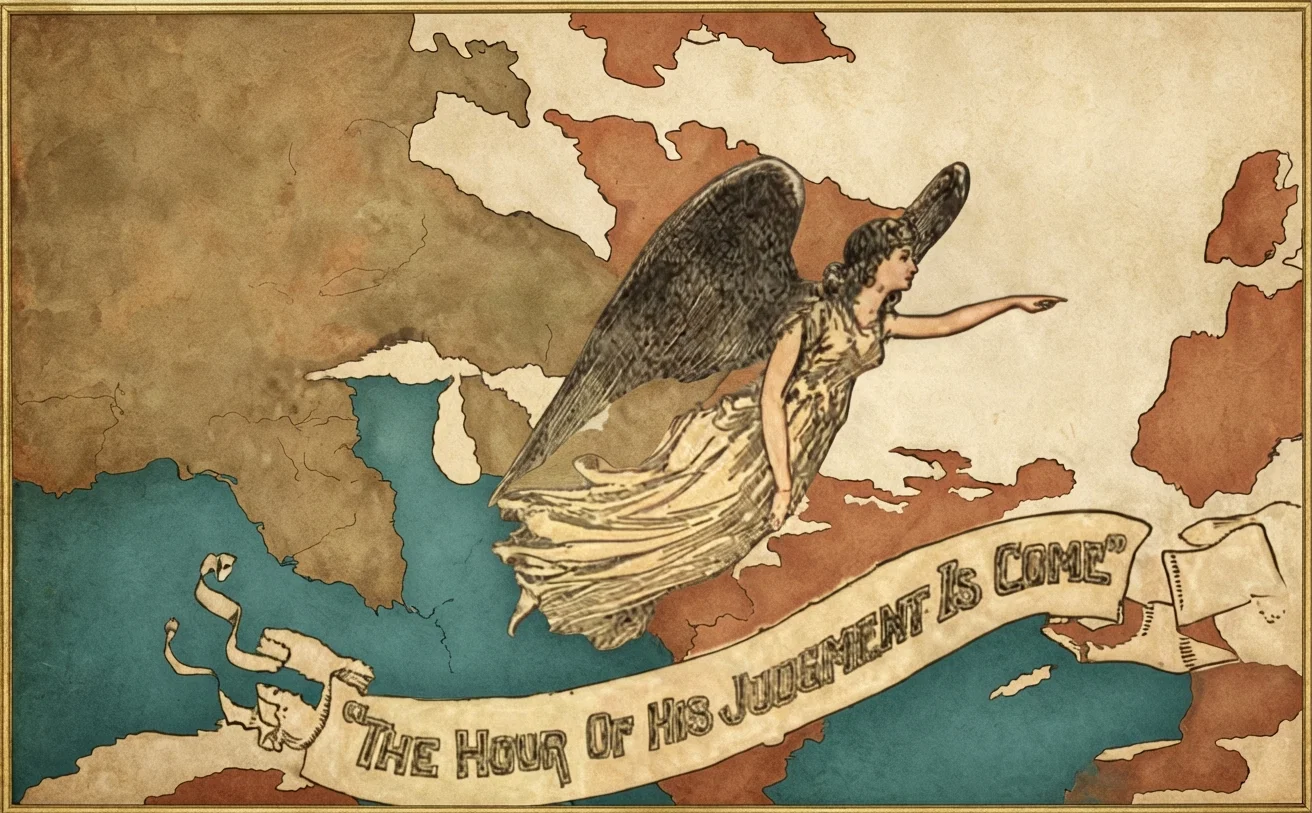
The Hour of HIS JUDGMENT IS COME "We have also a more sure word of prophecy; whereunto ye do well that ye take heed, as unto a light that shineth in a dark place, until the day dawn, and the day-star arise in your hearts."

GOD'S REMEDY FOR THE ILLS OF CHRISTENDOM.

The Condition.

It is a sad yet well-known fact that the professed Christian churches are terribly back-slidden from God. This no earnest, observant Christian will deny. One testimony on this point will suffice. It is from Dr. Moore, editor of the Western Christian Advocate (Methodist Episcopal), of Cincinnati, Ohio, and appeared in that paper in its issue of May 19, 1893. It is headed, "To the Church of Methodists, Write." We can not quote it entire. That which we do not quote is as striking and pointed as that which we do quote. We also apprehend that the Methodist Church will average fairly with the other great Protestant denominations. Dr. Moore says:—
The class-books are filled with names of unconverted men and women. Official members may be found in box, dress circle, and parquet of opera and theater. Communicants take in the races, and give and attend card parties and dances. The distinction between inside and outside is so obscure that men smile when asked to unite with the church, and sometimes tell us that they find the best men outside.
When we go to the masses, it is too often with such ostentatious condescension that self-respect drives them from us.
And yet we have so spread out, under the inflation of the rich and ungodly, that they are a necessity to us. The enforcement of the unmistakable letter of the discipline for a single year would cut our membership in half, bankrupt our missionary society, close our fashionable churches, paralyze our connectional interests, and leave our pastors and bishops unpaid and in distress. But the fact remains that one of two things must happen,—the discipline must purge the church, or God's Holy Spirit will seek other organized agencies. The ax is laid at the root of the tree. The call is to repentance. God's work must be done. If we are in the way, he will remove us.

Division—Confusion—Unbelief.

It is a sad and undeniable fact that the great numerous Christian church is hopelessly divided. Human federations may in a way bring them together, but human federation is not divine union. Human compacts or agreements are not bonds of divine life. All that the human can do is to confederate around a human standard called a creed. But God's method is to unite all in one by the divine indwelling life. Jesus thus expresses it: "I in them, and thou in me, that they may be made perfect in one." John 17:23. Confederation about a human creed is but the worship of an image on paper. Union in and by and through Jesus Christ is the worship and power of the living God.
It is a sad and undeniable fact that the many divisions in the great professed church and in the several churches are a stumbling-block to worldlings and unbelievers. It is seeking unholy justification for an abnormal condition to say that all this division is unity in diversity, and all are well-organized parts of one great army under the One Leader, when the greater part of the vital strength of the church is absorbed in the very churches themselves, which, instead of growing better, are growing worse, and, instead of being the pastor's force to second him in aggressive work, are his field of labor.
Jesus Christ said that union, not division, was an evidence of his divine mission. Hear him pray: "That they all may be one; as thou, Father, art in me, and I in thee, that they also may be one in us; that the world may believe that thou hast sent me." John 17:21. Neither is this union to exist in mere sentiment, but in teaching, in doctrine, in purpose. Thus the Spirit speaks through Paul: "Now I beseech you, brethren, by the name of our Lord Jesus Christ, that ye all speak the same thing, and that there be no divisions among you; but that ye be perfectly joined together in the same mind and in the same judgment." 1 Cor. 1:10.
It need scarcely be said that the only mind which will thus unite mortal man, with all their limitations of early environment, education, habits, prejudices, and sins, is the mind of Christ. Therefore "let this mind be in you, which was also in Christ Jesus." Phil. 2:5.

A Whole Christ.

To thus be united to Christ and by the means of Christ's life to each other, means to accept Christ in the fullest sense. To accept Christ as a saviour, a redeemer, a way of life, an example, or a teacher, will not suffice. He declares, "I am the Way, the Truth, and the Life; no man cometh unto the Father, but by me." John 14:6.
To accept Jesus Christ as the Way is to give up all our ways and yield all, willingly (for he will never compel), to his way. "Whosoever he be of you that forsaketh [renounceth] not all that he hath, he can not be my disciple." Luke 14:33.
To accept Jesus Christ as the Truth, means to accept the Word of God, as God's message through Christ to this world. For Christ is the Word, the one through whom all the Word was given. John 1:1-3; 1 Cor. 8:6. It was his power that created all things; it was his Spirit which spake through the prophets. Col. 1:16; 1 Peter 1:10, 11. He it is who has in all times and ages declared the Father to the children of men, whether as the Angel of the Covenant, the Pillar of Cloud and Fire, the exhaustless Rock-fountain in the desert, the Man Christ Jesus in Judea, the Inspirer of the Holy Writings, or the Sender of the Comforter, his Representative. The Holy Word, with its one law and one Gospel, its one Spirit and one object, is the message of God through Jesus Christ to the sons of men. So Christ prays of those whom he would make one, "Sanctify them through thy truth; thy Word is truth;" for by that Word was he sanctified, "that they also might be sanctified through the truth." John 17:17-19.
He therefore who receives Christ, the Truth, will receive his Word in law and Gospel, in precept and promise, with all the heart. No tradition will make void in his heart the commandments of God to render vain his worship. Matt. 15:6, 9. No sophistry of man will be allowed to nail upon the cold, dead, irresponsive arms of a cruel creed the life-giving truths of that Word. He who truly accepts Christ will take the Word of Christ into his heart, and there let its vital principles live and grow, fashioning him day by day like the Master. That Word will be the Christ revealed in writing. And Christ will be that Word revealed in character.
He who receives Jesus Christ as the Life will not cut off the life which is in Him by the old serpent fable of Eden, "Thou shalt not surely die." In the light of God's presence in his Word the humble soul will acknowledge his sinfulness, and thereby his mortality, and look to Jesus Christ alone as the Source of righteousness and eternal life to the believer now, the Bestower of immortality at his coming.
This acceptance of Christ does not mean that all Christ's fulness must be seen and realized if we are to become one in him; for that can never be, because he is infinite. But it does mean that the believer is to accept Jesus Christ as he is, as he is revealed in his Word. He must allow no civil magistrate, no mitered priest, no human creed or council, no worldly ambitions, no arts of the evil one, to come between his soul and Jesus Christ, and he will leave to prayer, study, experience, and the goodness and wisdom of Christ, to supply the fuller knowledge.
Thus accepting Jesus Christ made the early apostolic church what it was, united in heart and purpose, in word and doctrine, in worship, in life. "And they continued steadfastly in the apostles' doctrine and fellowship;" "and the multitude of them that believed were of one heart and of one soul; . . . and with great power gave the apostles witness of the resurrection of the Lord Jesus; and great grace was upon them all." Thus it was in that early church. How precious to them were the truths and hopes of the resurrection, the second coming of Christ, the atonement in its fullest and strongest sense, the power of the simple Word and Holy Spirit of God in those days! Now these very doctrines are scoffed at and ridiculed and "spirited" away by those high in church councils, with but little or no protest from pulpit or press.

God's Plan Ever the Same.

And God's plan for saving men has ever been the same. With him "is no variableness, neither shadow of turning." Human nature has always been the same, and the Gospel of God's grace has ever been effectual to save. Types and symbols and shadows have changed, but the holy law and the divine Saviour have remained the same. "I am the Lord, I change not." "Jesus Christ, the same yesterday, and to-day, and forever."

Confusion—Babylon.

Departing from God's way, erecting human standards, following man's way instead of God's way, adding to his Word, subtracting from it, have always brought division and hence confusion. The would-be wise men of the land of Shinar, promised themselves a better way when they built themselves a city and a tower, and sought to make themselves a name. They prized their work so highly that they called it, according to the story of their brick books, "Bab-il," "the gate of God," or "the gate of heaven;" but God could not serve with their sins. He will not give his glory to another, and he named it what it literally was, Babel, confusion. See Gen. 11:1-9. And so every attempt to improve upon God's work has resulted in confusion in the work of God, of which confusion "God is not the author." 1 Cor. 14:33.

Modern Babylon.

It was confusion, Babylon, which came into the Christian church even before the death of the apostles, till finally, a few centuries after, the great apocalyptic harlot was developed.
The Reformers took some mighty strides toward the one standard of God, albeit in different companies, but they still stopped in Babylon, and confusion reigns even to the present. As truly as the great apostate system of the Papacy became Babylon by departing from the truth of God, so truly did Protestantism in the formulation of a multitude of creeds. Not only was confusion brought into the church, but the people of the world seeking for light are confused and driven to unbelief. Just as surely as papal Babylon committed fornication by forsaking her lawful Spouse, Jesus Christ, and uniting with the civil power, just so surely have those Protestant churches committed fornication with the kings of the earth which have done the same thing. And those who have not yet done this, but who are clamoring for civil power to enforce unscriptural dogmas or institutions (Scriptural would be no different), are trimming their ways for unlawful lovers of spiritual fornication. And is not this the condition of the Protestant churches to-day? Said the Rev. Charles Beecher, in a sermon at the dedication of the Second Presbyterian Church in Fort Wayne, Ind., Feb. 22, 1846:—
Thus are the ministry of the evangelical Protestant denominations not only formed all the way up under a tremendous pressure of merely human fear, but they live, and move, and breathe in a state of things radically corrupt, and appealing every hour to every baser element of their nature to hush up the truth and bow the knee to the power of apostasy. Was not this the way things went with Rome? Are we not living her life over again? And what do we see just ahead?—Another general council! A world's convention! Evangelical Alliance and Universal Creed!
Since 1840 matters have not grown better, but rather worse.

God's Remedy.

Here is God's remedy for this confusion among his people; for he certainly so counted them, and sent his message to heal them:—
"And I saw another angel fly in the midst of heaven, having the everlasting Gospel to preach unto them that dwell on the earth, and to every nation, and kindred, and tongue, and people, saying with a loud voice, Fear God, and give glory to him; for the hour of his judgment is come; and worship him that made heaven, and earth, and the sea, and the fountains of waters." Rev. 14:6, 7.
The time when this message is due to the church and the world is when the judgment of God is impending. In past centuries we are told of a "judgment to come," of a day when God will judge the world (Acts 17:31; 24:25), but in this message the judgment of God is come; it is already here. It is the adjudication of cases in the heavenly courts, the accounting worthy of those who have been faithful, and who will be raised to immortality at Christ's coming to give reward. (See Luke 20:35; 1 Cor. 15:52; Rev. 22:11, 12.)
"Fear God," says the divine message, "and give glory to him." It implies that the church has given glory to men. Tradition has made void the commandments of God. Cold, dead creeds have displaced the living Word. Elaborate ritual has dispossessed simple worship. The pagan solar holiday is accepted as the Lord's holy day in the place of the Sabbath of the Lord, the memorial of Him who created the heavens and the earth. "The fear of the Lord is the beginning of wisdom; a good understanding have all they that do his commandments."
Reverence of God leads to obedience. "Worship him." Turn from the worship of the false to the true. The highest worship is obedience, or service. "Thou shalt worship the Lord thy God, and him only shalt thou serve," are the words which Christ made his own, and which God would have the church make her own, and so return from Babylon, confusion, to Jerusalem, unity and peace.
As the everlasting Gospel brought union in the early church, which came from Pharisee, and Sadducee, and Essene, and publican, so if it had been received when first proclaimed in 1840, and onwards, it would have brought into one all the churches of modern Babylon. God did not condemn them for being in Babylon. He desired to call them out. "We would have healed Babylon," is what God said, but the sad result is "she is not healed." Jer. 51:9. And so has it been.

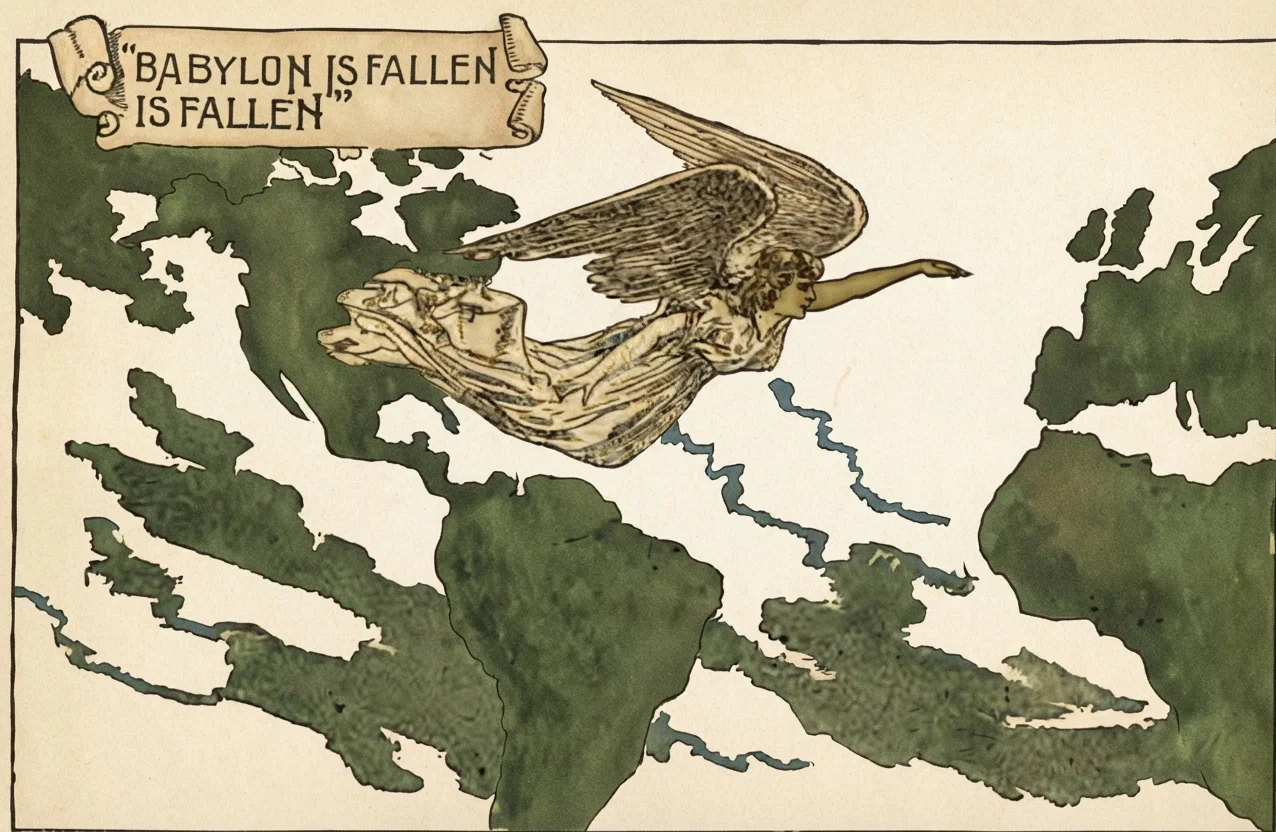
Babylon Is Fallen.

The churches are worse to-day than when Charles Beecher, and many others, uttered their faithful warnings. Since that time the church has turned wonderfully to the world. She is organizing herself into societies, law and order leagues, unions, and civic federations, for the purpose of enforcing civil law, while the Gospel is scarcely heard by the poorer strata of society. More and more is the church leaving Christ and uniting with the world and the State. She is leaving the living spring and cold snow of Lebanon for human, broken cisterns. She has forsaken her Husband, Christ Jesus, and is committing fornication with the kings of earth. And so the angel sorrowfully declares:—
"And there followed another angel, saying, Babylon is fallen, is fallen, that great city, because she made all nations drink of the wine of the wrath of her fornication." Rev. 14:8.
And it could not be otherwise. When the Jewish Church turned from the close, yet healing message of John and Jesus, a message which, if received, would have restored, they were ready to reject Christ, their King, and to say, "We have no king but Caesar." And so when the modern church rejects God's healing message of reproof and warning, she will turn to the world and the State, and, under the guise of "Christian Citizenship," "Patriotism," or "Americanism," will denounce as traitors those who reveal by the Word of God the true nature of the Church-and-State dogmas, the children of fornication.

The Last Solemn Protest.

What is the church now doing in the direction of the last apostasy?—She is centering her efforts and gathering her forces around the Sunday standard. And what is Sunday?—An
institution which as a religious holiday is wholly pagan in origin, which as a weekly worship day is wholly papal, and for which there is no authority save the papal church and tradition. It is a usurper. Its very genius and character arouse a spirit opposed to the Gospel. It has been connected with apostasy and persecution in all ages. It was the mark of apostasy in heathendom; Rome claims it as the mark of her authority, and many of the Protestant churches, as organizations, are conceding Rome's claim by upholding in the face of light that foster child of the Papacy, and by endeavoring to secure the aid of the Papacy to obtain the help of the civil power to enforce the counterfeit as the very test of God and mark of patriotism. Nevertheless it is, in howsoever shining garments dressed, the mark of the beast, opposed to the Sabbath of the Lord, the sign of God's power to create and sanctify and deliver. Eze. 20:12, 20; Ex. 20:8-11; Deut. 5:15.
But, thank God, there are many yet in all these organizations who cleave to the Gospel, who believe in Gospel methods and Gospel means for reforming the world. While mistakenly holding Sunday, they believe in no power save the Spirit to impress hearts, no means save the Word to enforce its claims upon men. These stay the tide, as it were, but do not change the current.
Against this course of Church uniting with the State the Lord offers to each soul the following fearful warning:—
"And the third angel followed them, saying with a loud voice, If any man worship the beast and his image, and receive his mark in his forehead, or in his hand, the same shall drink of the wine of the wrath of God, which is poured out without mixture into the cup of his indignation; and he shall be tormented with fire and brimstone in the presence of the holy angels, and in the presence of the Lamb; and the smoke of their torment ascendeth up forever and ever; and they have no rest day nor night, who worship the beast and his image, and whosoever receiveth the mark of his name." Rev. 14:9-11.

A United Church Once More.

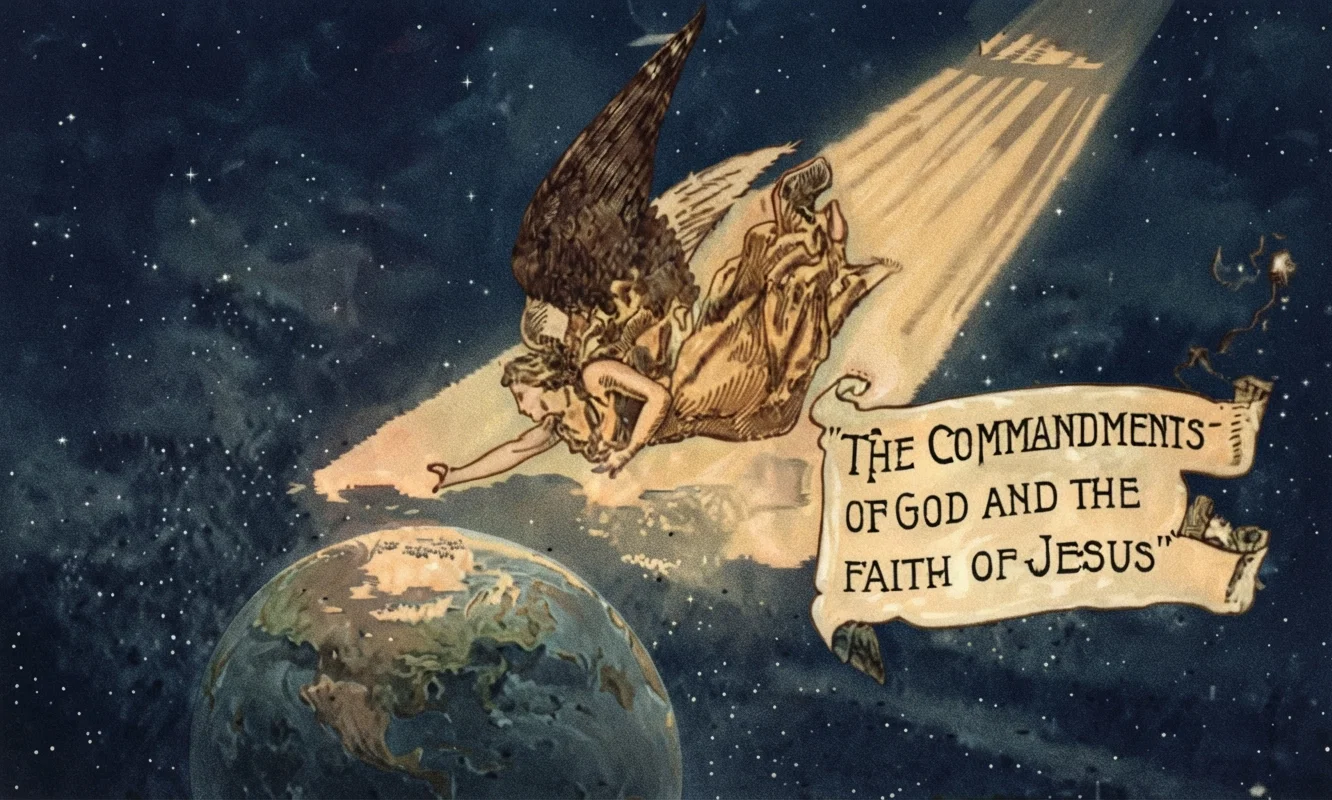
Who will heed the Word of God? Some will. The first message, the healing message, sums up all positive truth of that Word. The second message simply announces the result upon the various organizations composing Babylon of rejecting the first. The third brings to each individual soul the message of warning to turn from "the beast" (the great system of Papal Church and State union), from "the image" (the reproduction of that system by Protestant Church and State union), from "the mark" ("the wild solar holiday of all pagan times," the rival of the Sabbath of the Lord). But out of all these organizations, out of the world, from among the lowest slaves of Satan, from every land and clime, is gathering a company washed by the blood of the Lamb through faith, loyal to God and his law. Thus continues and declares the prophet: "Here is the patience of the saints; here are they that keep the commandments of God, and the faith of Jesus." Rev. 14:12.
They keep therefore all the commandments. It could not be said that he who was breaking the first or eighth commandment was a commandment-keeper. Neither could it be so said of him who violates the fourth precept. Of those who endured the persecution of the Dark Ages, not having all the light, it was said, "Here is the patience and the faith of the saints." Rev. 13:10. They had patience; they possessed faith. But the class developed by this last threefold message of warning, have an additional characteristic—they "keep the commandments of God."
And why not? How could they have an intelligent faith, the faith of Jesus, and do otherwise? His faith led him to keep all God's commandments. It led his disciples, the early Christians, to follow in his steps. "He that saith he abideth in Him ought himself also so to walk, even as He walked." 1 John 2:6. Having the same Spirit, having the indwelling Christ, they will do the same works. He kept the seventh-day Sabbath; why should not his people? He knew it for what God designed it, the very rest of God from sin and self. The remnant church will thus know it.

Christ's Coming.

The next event in the great drama of the prophets is thus described:—
"And I looked, and behold a white cloud, and upon the cloud one sat like unto the Son of man, having on his head a golden crown, and in his hand a sharp sickle." Rev. 14:14.
It is Christ our Lord coming to reap earth's harvest, which is rapidly ripening. The same sun which ripens the wheat for the garner, ripens the tares for the fire. The same truth which, received, develops character for the kingdom of God, rejected, develops character for destruction. O soul, accept of Jesus Christ as he is, as he desires to be to you, the Way, the Truth, and the Life! Accept of the everlasting Gospel, and be saved eternally in God's own way.

FAREWELL WORDS.

(Concluded.)

The Peace of Christ.

IN the East, in Christ's day, the customary greeting when one visited the house of a friend was, "Peace be to this house;" and in leaving it he used the same words. But how different in character is Christ's farewell! "Peace I leave with you," he says; "my peace I give unto you; not as the world giveth, give I unto you. Let not your heart be troubled, neither let it be afraid."
The world in its busy activity will try to give us peace. Its cry is, "Peace and safety;" but no dependence is to be placed on its alluring representations. But the peace that Christ leaves as his legacy, he gives not as the world giveth. His gift is of higher value than can be computed; it is eternal.Of Christ the prophet Isaiah had written, "For unto us a child is born, unto us a son is given; and the government shall be upon his shoulder; and his name shall be called Wonderful, Counselor, The mighty God, The everlasting Father, The Prince of Peace."
Christ bears the title of "Prince of Peace," yet he says of himself, "Think not that I am come to send peace on earth; I am not come to send peace on earth, but a sword." In explanation of this apparent contradiction, he declared, "In the world ye shall have tribulation; but in me ye shall have peace." Christ warned his disciples that the time would come when they should be hated of all men for his sake; that they would be brought before kings and rulers; and that to destroy their lives would be deemed a service done to God. The peace which he bequeathed to his followers was not a peace which would prevent all divisions; it was a peace given and enjoyed in the midst of divisions.
Christ brought this peace with him to the world; he carried it with him throughout his earthly life. And now the time had come when he must give his life in order that that peace might ever abide in the heart by faith. As then he left his peace with his disciples, so now he is implanting and maintaining it in the hearts of all who will welcome its presence. From him alone can come that peace which the world can neither give nor take away. His peace was the consciousness of having done the will of his Father; and that peace in his follower is the consciousness that he is doing the will of God, and reflecting his character in good works.
"If ye loved me," said Christ, "ye would rejoice, because I said, I go unto the Father; for my Father is greater than I. And now I have told you before it come to pass, that, when it is come to pass, ye might believe. Hereafter I will not talk much with you; for the prince of this world cometh, and hath nothing in me. But that the world may know that I love the Father; and as the Father gave me commandment, even so I do. Arise, let us go hence."
The time had come for Satan’s last attempt to overcome Christ. But Christ declared, He hath nothing in me, no sin that brings me in his power. He can find nothing in me that responds to his Satanic suggestions. No other being could say this but the One who was offering up his life as a sinless sacrifice for a sinful race.
"For if the blood of bulls and of goats, and the ashes of an heifer sprinkling the unclean, sanctifieth to the purifying of the flesh; how much more shall the blood of Christ, who through the eternal Spirit offered himself without spot to God, purge your conscience from dead works to serve the living God? And for this cause he is the mediator of the New Testament, that by means of death, for the redemption of the transgressions that were under the first testament, they which are called might receive the promise of eternal inheritance." "And ye know that he was manifested to take away our sins; and in him is no sin." "For he hath made him to be sin for us, who knew no sin; that we might be made the righteousness of God in him."
But why this severe conflict with the prince of the world, when Jesus, through his childhood, youth, and manhood, had lived the law of God? By a word Christ could have mastered the powers of Satan, but he came into the world and took humanity that he might endure every test, every provocation that it is possible for man to bear, and yet not be provoked, or retaliate in word, in spirit, or in action. For the honor and glory of God he was to offer himself a living, spotless sacrifice to the Father. He must bear, under fierce temptations, the test that Adam failed to endure. He suffered, being tempted; but there was no yielding to the temptations of Satan. He did as the Father had given him commandment.
Christ was a spectacle to the world, to angels, and to men. The worlds unfallen, the heavenly intelligences, and the fallen race were watching every movement made by the representative of the Father and the representative of perfect humanity. And in his mouth was found no guile; his character was without a flaw.
All the humiliation which Christ endured was in behalf of the fallen race, that man might have the mind of Christ. Christ revealed to the world the love of God for fallen man and the perfect love which he bore his Father. And in humanity this same love is to be revealed. In the fallen race the very image of God is to be reflected. The cold heart is to be quickened and glow with divine love. It is to beat in unison with the heart of the Redeemer. The honor of Christ must stand complete in the perfection of the character of his chosen people. He desires that they shall represent his character to the world. In the work of redemption, in the sufferings which Christ was called upon to endure, you are to co-operate with him, that you may be complete in him. In being united to him by faith, believing and receiving him, you become part of himself. Your character is his glory revealed in you. Then, when you shall appear in his presence, you will find the benediction awaiting you. "Well done, good and faithful servant; thou hast been faithful over a few things; I will make thee ruler over many things; enter thou into the joy of thy Lord." MRS. E. G. WHITE.

One Sure Thing.

In the book of Proverbs much is said about surety, and people are more than once warned against going surety, not only for a stranger, but even for a friend. In the eleventh chapter, verse 15, we read, “He that is surety for a stranger shall smart for it; and he that hateth suretyship is sure.” In the margin we have in the place of “suretyship,” “those that strike hands.” That is a man can not be safe unless he refrains from giving his hand as surety for another.
But read further, and see what is said in the twenty-first verse: “Tho hand join in hand, the wicked shall not be unpunished; but the seed of the righteous shall be delivered.” Notice that the words “tho” and “join” are in Italic type, indicating that they are not in the Hebrew. The literal Hebrew, as indicated in the margin of the Revised Version, is “hand in hand.” Here, then, we find an instance of giving the hand, or, as rendered, “My hand upon it!” In two translations before me, I read, “One can give his hand for it, that the wicked shall not be unpunished; but the seed of the righteous shall escape.” So sure is it that God will see that justice has its due. Men are often tempted to think, as did David, that the wicked have the best of it, and that in unrighteousness is the most prosperity to be found; but let no one be deceived in this matter. So sure is it that wickedness will be punished, and that the reward of the righteous will not be forgotten, that one may safely give his hand upon it, and be a surety for it. It is the only sure thing in this world. E. J. W.

UNCHANGEABLE.

"I will never leave thee, nor forsake thee." "Jesus Christ, the same yesterday, to-day, and forever."
THE friends of earth may all forsake, The hopes of earth may die, But Jesus' favor none may take, 'Tis pledged for thee on high. Then perish hope and love below, Since Jesus loves, nor count it wo.
Your faults, your errors, and your sin Make friends of earth disown; Your utter weakness pleads to win Your welcome at the throne. E'en mute appeal hath power and art To draw on Christ's compassionate heart.
"Laugh," says the world, "and we'll befriend, "Weep and you weep alone." Not so hath heaven's love an end, Weep, and the angels moan. "Blessed the mourner," for 'tis said, "The mourner shall be comforted."
We have in heaven a great High Priest Who's not from us apart. The very weakest and the least He carries on His heart. He notes each bitter tear that steals; And every pang of wo He feels.
Like priest and Levite, men pass on And leave us to our grief; But Christ's the good Samaritan Who bringeth us relief, Binds up our wounds, pours oil and balm, And gives the troubled soul sweet calm.
Praise unto God for chastening rod; Thy rod it comforts me. Fail earth, I've found my Lord and God, What need have I of thee? Let tempests break, and sorrow fall, Since Christ is mine, and He is all.
O sorrowing mourner, still look up, Nor judge God's constancy By earth's cruel mockery of thy hope In its frail vanity! Yet for thy heart's full meed of love Waits the Unchangeable above. HOPE ONSLOW.
Continue reading: “THE MOST HIGH RULETH.” NO. 5.