Your ShelfYour Projects

Signs of the Times, Vol. 23, No. 8.

The Touch of Faith

Signs of the Times

Feb 25, 1897

Pacific Press Publishing Company · Oakland, California · Feb 25, 1897

The Touch of Faith

Editorial
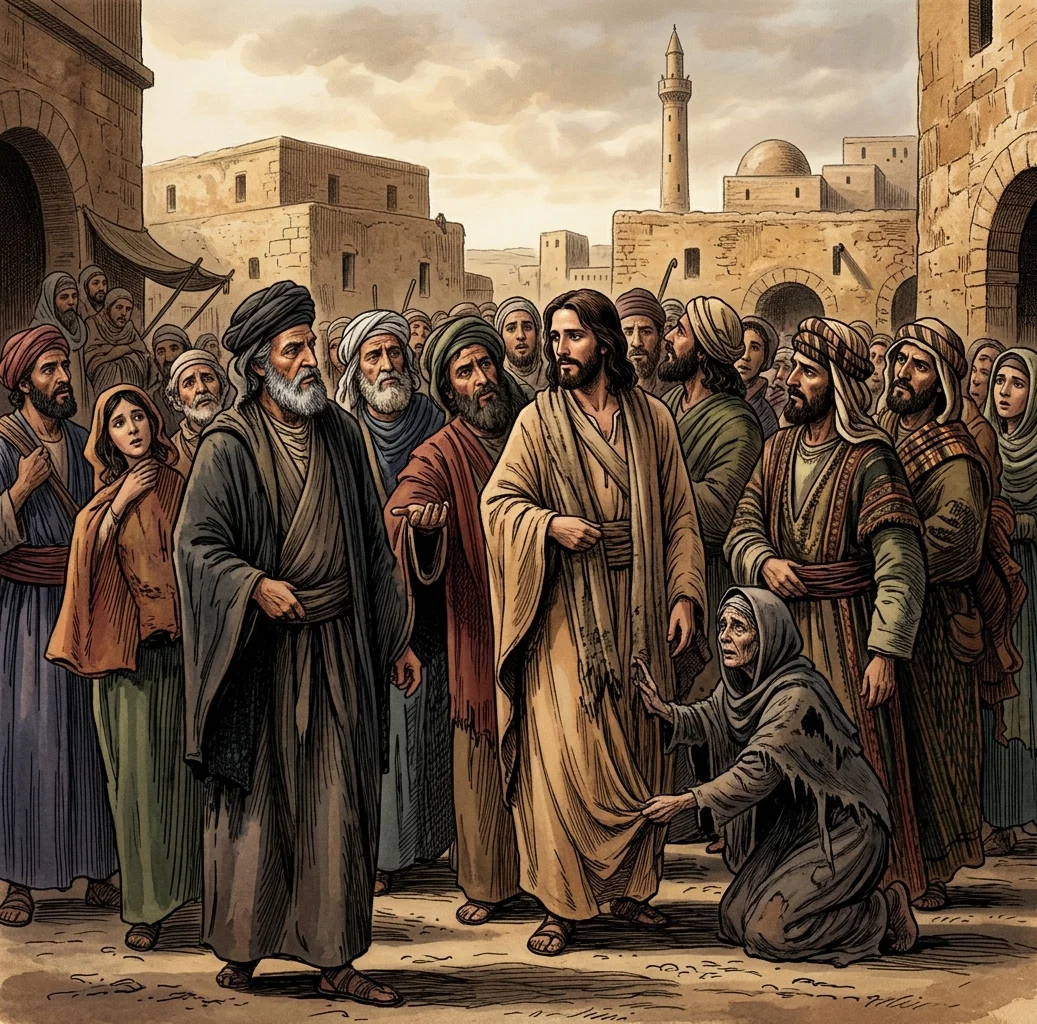
The Touch of Faith.—God reveals himself to man through all the physical senses. Through these, if kept responsive to the will of God, will his power and life and love enter the soul. In our study this week we will consider the touch of faith, the divine power answering to the sense of feeling. The story is a simple one, not unlike many other incidents in the life of our Lord. Read it in all the evangelists.
THE TOUCH OF FAITH.
THE TOUCH OF FAITH.
The scene is laid in Capernaum, by the beautiful “Blue Galilee.” Jesus chose this place as his home when driven from inhospitable Nazareth. Here were performed some of his most noted miracles, and in this vicinity he taught some of his most precious lessons. Truly, as said the prophet, speaking of this time and place seven centuries before, “The people which sat in darkness saw great light; and to them which sat in the region and shadow of death light is sprung up.”
Jesus had just returned from the other side of the sea, where he had healed the demoniac, and had been entreated of the people to depart, because the demons had driven the swine to destruction. The loss of the swine was more to them than the salvation of the soul. But one, so far as we know, among all the people of Gadara, longed for Jesus, and he, the man to whom our Lord had spoken reason, freedom, and salvation. He heard, and was released from his terrible bondage. Before Jesus reached Capernaum, the multitude were waiting to welcome him. One man, a proud ruler, more eager than the rest, could be seen walking to and fro, exhibiting, in oriental intensity, the anxious feelings of his heart. We can imagine him saying in agony almost too intense for utterance, “Will he never come?” But Jesus came. The keel of the fishers’ boat grates upon the pebbles of the beach; the crowd, with many glad utterances, welcome the Great Healer and Teacher. The synagogue ruler, Jairus by name, his pride and dignity crushed by his great grief and overpowering anxiety, falls at the feet of Jesus, and with broken utterances pleads, as only sorrowing love can plead, that Jesus would come and heal his daughter, his one only daughter, who lay a-dying. And the Lord Jesus, ever responsive to the cry of need, went with the sorrowing father to heal the child.
The Faithless Crowd.—But as he went, “the people thronged him,” crowded him, jostled against him in their eager desire to see and hear, and thus impeded his progress. They see, but it is only the man Jesus. They hear, but at the most only a wonderful teacher or prophet. They wonder, but it is to see some miracle wrought, some sign given. They touch him, throng him, press him, but it is the casual contact, at the most a pride of having touched the great and noted, and perhaps obtained from him a passing glance.
The Faithful One.—But there was one in that throng who saw more than this, heard more, felt more. Nay, she wrapped up all the longing and faith and hope of the heart, put it all into the sense of feeling or touch. For years her life current had been oozing away. Physicians many had she consulted, but had grown worse instead of better. Luke, the “beloved physician,” tells us that no doctor could cure her. It was evidently so. Bloodlessly pale, she stood in that throng, and her heart filled with a great thought of the Master. Timid with weakness, she did not dare speak to him. She might have thought herself not worthy that the Master should speak to her, that the Great Healer should “touch” her even as he had others. Her greater faith grasped a simple means. She said: “If I may touch but his clothes, I shall be whole. O, there is virtue in him to heal! Even his garments will connect me with his mighty power.” Pressing through the throng behind, with physical strength, doubtless, well-nigh spent, we can see her reaching out her frail, feeble hand toward the Center of the throng. Will she fail? Will the great hope awakened within perish?—No, thrice no. God never awakens hope after him but that he meets it in blessed fruition. She reaches forth her hand, touches the mere “hem,” the “border” of his seamless robe, and immediately the power of his endless life entered her being, the flow of her blood was staunched, and joyfully she knew herself healed.
Another Knew.—Immediately Jesus turns in that throng and asks, “Who touched me?” The various ones about him answer what seems to the disciples so unreasonable a question in the negative. A strange question! Was the Master bereft of reason? They could keep silent no longer. “Master, thou seest themultitude throng thee and press thee, and sayest thou. Who touched me?” But these did not touch Jesus the Son of God. They simply pressed against the man. But Jesus knew that somebody touched him, felt after him, found him, came in contact with his life. “Somebody hath touched me; for I perceive that virtue is gone out of me.” Triumphantly the woman now comes forward. She sees that she is not hidden from him. She falls down before him, and pours out of a full heart her story, and her gratitude for the wondrous work wrought in her by the power of Jesus. And now he speaks to her heart the blessed words, “Daughter, be of good comfort; thy faith hath made thee whole; go in peace, and be whole of thy plague.”
The Lesson.—Why need we say more? Jesus Christ is still the same, yesterday, to-day, and forever. Tho in heaven, our great High Priest, his blessed Spirit of life and light and peace is everywhere, uniting him by a living bond to every longing soul. He truly can be literally touched by the feeling of our infirmities. Reach out after him. Even tho you can not see in the darkness, or hear amid earth’s din, “feel after him and find him,” for he “is not far from every one of us.” Acts 17:27. Are you soul sick or body sick, reach out, and by faith touch the hem of his garment. From his great heart of love flow out the healing streams of life to all. He knows not the casual touch; he honors the touch of faith. Touch him and live and rejoice; and from him will come to you those blessed words, “Thy faith hath made thee whole; go in peace.”

RELIGIOUS COUNTERFEITS.

THERE are many counterfeit coins and bills in circulation in the commercial world, supposed by good men to be genuine. The same is true in the religious world, and Sunday is one of the counterfeits. Its origin is in the pagan mists of remote ages. It was brought into the Christian Church by half-converted sun-worshipers and called “the Lord’s day,” but it does not bear the mark of genuineness. It was not struck in God’s mint.
It is true that good people have kept Sunday and are keeping it, supposing it to be the Sabbath; but this does not alter its character. A well-worn counterfeit bill is just as truly counterfeit as one just issued from the press. Many good people have passed counterfeit bills, supposing them to be genuine. Good people are doing this to-day. But this does not make the bill genuine; and when sufficient proof that it is a counterfeit is presented, its further use as genuine currency is criminal in intent as well as practise; and so also when sufficient evidence of the falsity of the Sunday claims is presented, its further observance as the Sabbath of the Lord becomes sin.
He who persists in violation of light sets himself on the throne of God, and his opinion of what is expedient in the place of God’s law. This principle of self-exaltation was at the very foundation of Lucifer’s overthrow. It is what led him to substitute his light for God’s glory, and bring in sun-worship and the observance of the sun’s day in the stead of the worship of the great Creator and the observance of the memorial of his power. This principle lies at the foundation of all the Sunday laws and all the religious persecution the world has ever seen.
The makers and passers of counterfeit money are enemies to the government whose notes are counterfeited. Their crime is inexcusable if they know the law and know the coin to be counterfeit. Is this not just as true respecting God’s government, and the counterfeit institutions which Satan has introduced? If one counterfeit is allowable, why not all? If man may substitute a sabbath not of God’s making for the true and only Sabbath, why may he not substitute another god for the one and only God? To utterly set aside the Sabbath is to set aside “the Lord of the Sabbath.”
The question that every Christian ought to ask before he receives any institution or dogma is, Is it of God? Was it coined in the mint of heaven? Is it of God’s planting? Jesus Christ has said, “Every plant which my heavenly Father hath not planted shall be rooted up.”

HOW WE KNOW.

A FRIEND hands us one of Lieut. C. A. L. Totten’s “News Leaflets,” “Saturday versus Sunday,” by title. Mr. Totten believes that the American people are the “lost tribes” of Israel, or, to be more precise, Manasseh. And as the Lord declares that the Sabbath is a sign between himself and Israel (Eze. 20:12, 20), therefore as Americans keep Sunday, that day must be the true Sabbath after all, that is, the creation Sabbath. Of course this is assumption on assumption. Mr. Totten does not seem to be quite sure; he feels, however, that Sunday must be right, as Americans—Israel—can not be wrong. A very small base indeed on which to build.
But in order to make Sunday people feel a little more secure, Mr. T. endeavors to make it appear that Sabbatarians, Seventh-day observers, are not sure of their position. He does this by asking nineteen different questions as to how Seventh-day observers know they have the right day. He wishes to know if they can tell how the week came through the Deluge, if the day can be shown to be correct by chronology and astronomy; and what about “Joshua’s long day,” etc., etc. The devout, intelligent Bible student will not be misled by such questions. But for the sake of those of our readers who may be made to doubt by a multitude of words hiding knowledge instead of eliciting truth, we will state briefly how we know that the day commonly called Saturday is the seventh day. But first let us say that it matters not about the Deluge, the count of weeks from creation to that event, or from that event to the Exodus, or Joshua’s “long day,” or anything of that kind. Let those who wish puzzle themselves over impossible solutions of chronology and astronomy and ignore the simple facts of God’s Word, and history; but let him who believes God trust his Word. Here are our reasons:—
1. God through Christ instituted the Sabbath at Creation. He knew the day, rested upon it, made it into a Sabbath for man, and set it apart for his memorial. God’s work formed the week. The Sabbath or week may have been lost to man between Creation and the Exodus, tho not at all probable; this we do not know; but,—
2. We do know that God knew, and that he marked by a threefold weekly miracle for forty years the day of the Sabbath, and commanded it from heaven on the very grounds upon which he originally gave it. There is therefore no mistake here.
3. Fifteen centuries (or more) pass away. During this time God again and again brought before his people through his prophets his regard and their duty respecting the Sabbath. It was known among them all the way through, notwithstanding Joshua’s “long day,” which by the way was one day. But at the end of this period came the Great Teacher, the Infallible Man. He knew the Sabbath of which he was Creator and Lord. Mark 2:27, 28. He kept it according to law, doing lawful deeds upon that day. Matt. 12:12. Inspiration tells us that while he slept in the grave his disciples kept it according to the commandment. Luke 23:56. The next day was “the first day of the week.” Now we know that he knew, and the Holy Spirit that inspired the Word knew. The day was not lost at the close of the volume of Inspiration.
4. (a) Since that time there has been no disagreement among the Jews or Gentile nations respecting the order of the days of the week. The Sabbath kept by Jesus, by the early Christians, by the Jews, coincided with the Roman Saturday from Friday sunset to Saturday sunset, and the first day of the week in the same way to the Roman Sunday. (b) Before us as we write is a “Chart of Days” prepared at great labor and expense by the late Rev. Wm. Jones, D.D., of London, England, assisted by Prince Louis Lucien Bonaparte and other noted linguists. It gives the week and its days in 160 of the languages and dialects of earth, and 108 of the 160 name the seventh day of the week “the Sabbath,” or by an equivalent name, while all give the order of the days of the week the same. These nations are scattered from China on the east to Britain on the west, Semitic, Japhetic, Hamitic, separated oftentimes by impassable barriers of mountains, seas, national prejudices, race hatred, and discordant tongues, yet in all the order of the day of the week is the same. It is a noted fact, worthy of mention here, that our old English Bibles, faithful to truth, gave in the table of days of the week, the Bible names, and the seventh day is the Sabbath. (c) Added to this is the testimony of the Jewish race and their contemporary enemies all through the Christian era. The testimony is uniform and overwhelming that the seventh day of the week now was the seventh day of the week, the Sabbath “according to the commandment,” that was observed by Christ and his apostles.
It matters not, therefore, what changes may have taken place in the cataclysms of history, God has given us irrefragable proofs of the identity of the week. And the question of the days or order of the days of the week was never raised until it was used to blind men’s minds with reference to God’s Sabbath truth, revived in these last days according to his prophets. And even now when the observance of Sunday alone is argued, either from a religious or political standpoint, there is no question raised as to a possibility of its being the wrong day, or as to a possibility of its being observed or enforced the world over.
But, reader, God’s law stands forever. His Sabbath is enjoined in that law. Jesus Christ, God’s only-begotten Son, through whom the Sabbath and the world were made, our Exampleand Saviour, observed the Sabbath. God commanded it; our Master lived it; and he says, “Follow me.” Can the SIGNS OF THE TIMES, as a Gospel teacher, say less?

THE LAW AND THE GOSPEL.

The Law and the Gospel can not be separated. In Christ mercy and truth are met together; righteousness and peace have kissed each other. The Gospel has not ignored the obligations due to God by man. The Gospel is the Law unfolded, nothing more nor less. It gives no more latitude to sin than does the Law. The Law points to Christ; Christ points to the Law. The Gospel calls men to repentance. Repentance of what?—Of sin. And what is sin?—It is the transgression of the Law. Therefore the Gospel calls men from their transgression back to obedience to the Law of God. Jesus in his life and death taught the strictest obedience. He died, the just for the unjust, the innocent for the guilty, that the honor of God's Law might be preserved, and yet man not utterly perish.
The work of salvation in both the Old and the New Testament dispensation is the same. Christ was the foundation of the whole Jewish economy. The types and shadows under which the Jews worshiped, all pointed forward to the world's Redeemer. It was by faith in a coming Saviour that sinners were saved then. It is through faith in Christ that they are justified to-day.
In giving his Son, God gave himself, that man might have another trial. If God could have changed his Law to meet man in his fallen condition, would he not have done this, and retained his only-begotten Son in heaven?—He certainly would. But because his Law was as changeless as his character, he gave his beloved Son, who was above Law, and one with himself, to meet the penalty which his justice demanded.
Satan is working with all his deceptive power to ensnare the world. He would have them believe that this great sacrifice was made in order to abolish God's Law. He represents Christ as opposed to the Law of God's government in heaven and in earth. But the Sovereign of the world has a Law by which to govern his heavenly intelligences and his human family, and the death of his Son fixes the immutability of that law beyond any question. God has no intention of doing away with hisgreat standard of righteousness. By this standard he can define what a correct character is.
Christ consented to die in the sinner's stead, that man, by a life of obedience, might escape the penalty of the Law of God. His death did not make the Law of God of none effect; it did not slay the law, lessen its claims, or detract from its sacred dignity. The death of Christ proclaimed the justice of his Father's law in punishing the transgressor, in that he consented to suffer the penalty of the law transgressed himself, in order to save fallen man from its curse. The death of God's beloved Son on the cross shows the immutability of the Law of God. His death magnifies the Law and makes it honorable, and gives evidence to man of its changeless character. From his own divine lips are heard the words, “Think not that I am come to destroy the Law or the prophets; I am not come to destroy, but to fulfil.” The death of Christ justified the claims of the law.
But the doctrine is now largely taught that the Gospel of Christ has made the Law of God of no effect; that by “believing” we are released from the necessity of being doers of the word. But this is the doctrine of the Nicolaitans, which Christ so unsparingly condemned. To the church of Ephesus he says: “I know thy works, and thy labor, and thy patience, and how thou canst not bear them which are evil; and thou hast tried them which say they are apostles, and are not, and hast found them liars; and hast borne, and hast patience, and for my name's sake hast labored, and hast not fainted. Nevertheless I have somewhat against thee, because thou hast left thy first love. Remember therefore from whence thou art fallen, and repent, and do the first works; or else I will come unto thee quickly, and will remove thy candlestick out of his place, except thou repent. But this thou hast, that thou hatest the deeds of the Nicolaitans, which I also hate.”
Those who are teaching this doctrine to-day have much to say in regard to faith and the righteousness of Christ; but they pervert the truth, and make it serve the cause of error. They declare that we have only to believe on Jesus Christ, and that faith is all-sufficient; that the righteousness of Christ is to be the sinner's credentials; that this imputed righteousness fulfils the law for us, and that we are under no obligation to obey the law of God. This class claim that Christ came to save sinners, and that he has saved them. “I am saved,” they will repeat over and over again. But are they saved while transgressing the law of Jehovah?—No; for the garments of Christ's righteousness are not a cloak for iniquity. Such teaching is a gross deception, and Christ becomes to these persons a stumbling-block as he did to the Jews,—to the Jews because they would not receive him as their personal Saviour; to these professed believers in Christ, because they separate Christ and the Law, and regard faith as a substitute for obedience. They separate the Father and the Son, the Saviour of the world. Virtually they teach, both by precept and example, that Christ, by his death, saves men in their transgressions.
It is necessary that every intelligent being shall understand the principles of the law of God. Christ through the apostle James declares, “Whosoever shall keep the whole law, and yet offend in one point, he is guilty of all.” These words were spoken this side of the death of Christ; therefore the Law was binding upon all at that time.
The Saviour raised his voice in protest against those who regard the divine commandments with indifference and carelessness. He said, “Whosoever therefore shall break one of these least commandments, and shall teach men so, he shall be called the least in the kingdom of heaven; but whosoever shall do and teach them, the same shall be called great in the kingdom of heaven.” And he also declared, “Till heaven and earth pass, one jot or one tittle shall in nowise pass from the Law till all be fulfilled.”
Men may talk of freedom, of Gospel liberty. They may assert that they are not in bondage to the Law. But the influence of a Gospel hope will not lead the sinner to look upon the salvation of Christ as a matter of free grace, while he continues to live in transgression of the Law of God. When the light of truth dawns upon his mind, and he fully understands the requirements of God, and realizes the extent of his transgressions, he will reform his ways, become loyal to God through the strength obtained from his Saviour, and lead a new and purer life. “Whosoever abideth in him,” says John, “sinneth not; whosoever sinneth hath not seen him, neither known him.”
MRS. E. G. WHITE.

THE WILL OF GOD.

SOME people never think of the will of God except when some disaster comes. Somebody dies, and they say that is the will of God, and we must bow to it. They attribute only that which is terrible or sorrowful to the will of the Lord. When anything comes that we can rejoice in, they seem to think that that is something that slipped in when the Lord was not watching. That is heathenism. Moloch, the god of the heathen, was made to represent the idea of God always watching in anger over the people, and they offered their children as sacrifices to appease his anger. The Lord is good. His tender mercy is over all his works. He sends joy and peace; and even the sorrows which come as the result of the curse and sin, he turns to our good, and those who love him will get good in them. “All things work together for good to them that love God.”
We like to do everything we can for our children. We like to have them enjoy themselves. Sometimes they ask something that we know is not best, and we have to deny them. Suppose they should go away grumbling, and say that we never tried to do anything for them. “It is his will; and I suppose we must yield to it.” They know better. They know that we plan enjoyments for them, and desire their happiness; and when something comes up that is contrary to their minds, they feel it is all right. They thought it was the best thing, but they have confidence in our judgment, and so give it up. In that way they get the good out of that very thing that is denied them.
Sometimes things may look very dubious. The way seems dark, and there are troubles and difficulties on every side. Now shall we groan over it and mourn and get all the hardness out of it? Some people seem to think that we must be duly solemn and mournful about a trial, because the Lord wants to make us miserable, and we must make it as hard as possible. No; there is good in it, and we get the good if we believe what the Lord says. We may not be able to see how there can be good in it; but he is the one who is to make it work for good. We do not have to make it work for good, and so we need not worry if we can not see how it will be done. We can not understand how the Lord will turn a temptation of the devil into strength for us. If he should tell us how he does it, we could not do it nor comprehend it. As it is his power alone that does it, we need not be troubled about how it is done.
What a blessed thing it would be if men would recognize the will of God in prosperity, as well as in the adversity that they suffer! It is the will of God that men should be saved. Why do not men submit to that? If they should, they would find more pleasure in God’s will.
It is the will of God that we should be delivered from this present evil world. Gal. 1:4. It is the “good-pleasure of his will” that he has made us accepted in the Beloved. “It is the will of God that Christ should save us, and God raise us up at the last day. John 6:39. Paul expected “a prosperous journey by the will of God,” to visit the church in Rome. And he had it too, altho he was shipwrecked on the way; for he knew that “all things work together for good to them that love God.” Rom. 8:28.
If people who talk so solemnly about submitting to the will of God, whenever some affliction occurs, would talk also about submitting to his will in the sunshine, the showers, the air, the food, the flowers, and the fruits of the earth, they would soon learn that God is not always trying to make it unpleasant for his children; and they would soon be able to say, “I delight to do thy will, O my God; yea, thy law is within my heart.” E. J. W.

Question Corner

“Enquire, and make search, and ask diligently.”

No. 495. The Earth Renovated.

WHERE, in the light of 2 Peter 3:10, 13, do we find any scriptural proof that this present earth will be renovated, when the same text says that “the earth also and the works that are therein shall be burned up”?
Punctuation is not inspired. In fact, it is but a recent invention. Read 2 Peter 3:10 thus: “But the day of the Lord will come as a thief in the night; in the which the heavens [atmospheric] shall pass away with a great noise, and the elements shall melt with fervent heat, the earth also; and the works that are therein shall be burned up.” God created the earth “not in vain, he formed it to be inhabited.” Isa. 45:18. Therefore “the earth abideth forever.” Eccl. 1:4. It will be inherited by those who now prove faithful to God. Ps. 37:9, 11, 18, 22. But this will not be in its sin-cursed state. Christ was manifested to destroy the devil and his works. Heb. 2:14; 1 John 3:8. This includes all works blasted and ruined by sin. But out of the purifying fires God will create new heavens and a new earth. Isa. 65:17; 2 Peter 3:13. But he does this by making, through the power of his word, the old new, even as he makes the sinner who submits to him a new creature. 2 Cor. 5:17; 2 Peter 3:7. He does not say, “I make all new things,” but, “Behold, I make all things new.” Rev. 21:5. Read from verse 1. Then when this is done, when everything that defiles has been gathered out of that kingdom (Matt. 13:41), the first dominion (Gen. 1:28) will return to man, the second Adam (Micah 4:8), and the saints will inherit the kingdom prepared from the foundation of the world (Matt. 25:34; Dan. 7:27). But this could not be if the earth were burned up. The change in punctuation makes 2 Peter 3:10 in harmony with all these other passages we have cited, and many more.

No. 496. Ps. 28:3, 4. “Endeavors.”

PLEASE explain Ps. 28:3, 4. What is the meaning of the word “endeavors”? J. M.
These verses are an inspired prayer of the psalmist that he might not be drawn away with the wicked, and workers of iniquity, who deceive by speaking peace while it is in their heart to do mischief. The fourth verse is simply that the Lord may deal with such justly, and leaving them in his hands. “Endeavors” means “doings,” and is so translated by the Revised Version.

No. 497. Christ’s Brothers.

PLEASE explain Matt. 13:55. Did Christ have any brothers? F. W.
This text needs no explanation; the statement in this and the following verse is as simple as any one can make it. Of course Christ had brothers (and sisters), or the Scripture would not say so. The same statement is made in Mark 6:3; and there is reference to “his mother and his brethren” in Matt. 12:46, 47; John 2:12, and Luke 8:19, 20. In John 7:3, 5 there is a clear distinction drawn between his “brethren” and his “disciples.” And Paul, in Gal. 1:19, refers to “James the Lord’s brother.” However, it is supposed by some that these brethren were the sons of Joseph by a former marriage, but that would not stand in the way of their being reckoned as Christ’s brothers.

THE COMING KING.

“Thine eyes shall see the King in His beauty.” Isa. 33:17.
I shall see Him! I shall see Him! Whom my soul hath long adored; See the King in all His beauty To His royal right restored. He who once, despised, rejected, On the cross was left to die, Soon shall reappear in glory, For His coming draweth nigh.
I shall see Him! I shall see Him! O, the rapture of the thought! These same eyes shall soon behold Him Who with blood my pardon bought; For we've seen the signs of promise, We have heard the “midnight cry.” Haste, my soul, go forth to meet Him, For His coming draweth nigh.
I shall see Him! I shall see Him! Praise the Lord! ’twill not be long; Heralded by heavenly minstrels, Welcomed by the blood-washed throng, He’ll return the selfsame Jesus, From the glory-mantled sky. Wake, ye saints! arouse! be ready! For His coming draweth nigh!
—Domestic Journal.

THE REAL PRESENCE.

Before the Lord Jesus Christ went away from the world, he said to his disciples, “I will not leave you comfortless; I will come to you.”
As he was about to ascend to heaven from the Mount of Olives, he said again to his disciples, “Go ye into all the world, and preach the Gospel to every creature.” “And, lo, I am with you alway, even unto the end of the world.”
The presence of Christ with his people is thus an assured fact. Nor is it only with them in an outward and separate sense, but with them in the inward and essential sense of oneness with them. He is with them by being in them. And so it is written, “I will dwell in them, and walk in them; and I will be their God, and they shall be my people.” 2 Cor. 6:16.
But his name is Immanuel, which is “God with us.” “God was in Christ, reconciling the world unto himself.” Therefore the presence of Christ with his people is the presence of God also. It is the presence of both the Father and the Son, for they “are one.” And so he has said, “If a man love me, he will keep my words; and my Father will love him, and we will come unto him, and make our abode with him.” John 14:23.
An abode is a dwelling-place. We will come unto him, and make him our dwelling-place. “For thus saith the high and lofty One that inhabiteth eternity, whose name is Holy: I dwell in the high and holy place, with him also that is of a contrite and humble spirit.” Isa. 57:15. “My presence shall go with thee.” Ex. 33:14. And as God is real, and Christ is real, so their presence is real. Their presence with the believer in Jesus is a real presence. This is the true real presence.
How, then, is this real presence manifested? Here is the answer to that question: “Strengthened with might by his Spirit in the inner man; that Christ may dwell in your hearts, that ye might be filled with all the fulness of God.” Eph. 3:16, 17, 19. “For in him dwelleth all the fulness of the Godhead bodily.” Col. 2:9. Thus it is by his Spirit that Christ dwells with his people. It is by the presence of the Holy Spirit in the heart of the believer that the real presence of Christ is manifested to those and in those that are his. For “if any man have not the Spirit of Christ, he is none of his.” Rom. 8:9.
This is more fully stated in the Saviour’s last talk with his disciples (John 14:16-23), before his death. He says, “I will not leave you comfortless; I will come to you.” As he will not leave his children comfortless, he gives them the Comforter. He gives them the Comforter, because he will come to them. Consequently, it is by “the Comforter, which is the Holy Ghost,” that Christ dwells with his people, and that his real presence is manifested to them and in them. So he says: “I will pray the Father, and he shall give you another Comforter, that he may abide with you forever; even the Spirit of truth; whom the world can not receive, because it seeth him not, neither knoweth him; but ye know him; for he dwelleth with you, and shall be in you. . . . At that day ye shall know that I am in my Father, and ye in me, and I in you.” In the day that the child of God receives the Holy Spirit, he knows that Christ dwells in him; he knows the real presence of Christ with him and in him.
This Spirit of Truth, the Comforter, which is the Holy Ghost, which brings the presence of Christ, the world can not receive, “because it seeth him not, neither knoweth him.” And the world sees him not because it does not believe. Instead of believing, that it may see, the world wants to see, that it may believe. And so, because the world sees not the Spirit of God, and sees not Jesus Christ, it will not believe, and therefore can not receive him and can not know him. But to those who do believe, and therefore do receive him, Jesus says, “Ye know him; for he dwelleth with you, and shall be in you.” The presence of the Spirit is received “through faith,” and then we know him. So that it is literally true that by faith we know God and the things of God.
Such is the true doctrine of the real presence of Christ with those who are his, and of his manifestation to them and in them. In one word, this is the Gospel. Without it there is no Gospel of Christ. The Lord’s own definition of the Gospel is that it is Christ in believers, the hope of glory. And here it is: “Be not moved away from the hope of the Gospel, which ye have heard. . . . Whereof I Paul am made a minister . . . to fulfil the word of God; even the mystery which hath been hid from ages and from generations, but now is made manifest to his saints; to whom God would make known what is the riches of the glory of this mystery among the Gentiles; which is Christ in you, the hope of glory; whom we preach.” Col. 1:23-28. Christ in men, the hope of glory; God manifest in the flesh; this, and this alone, is the Gospel of Christ. And therefore Paul tells us that “it pleased God . . . to reveal his Son in me, that I might preach him among the heathen.” Gal. 1:15, 16. Not revealed to him only, but revealed in him, and revealed to him by being revealed in him. He was to preach Christ in men, the hope of glory; but he could not possibly do this unless he knew Christ in himself, the hope of glory. It was not enough to preach about this—he must preach this in very fact. It was not the thing to do to preach about him, but to preach him.
Thus “God, who commanded the light to shine out of darkness, hath shined in our hearts, to give the light of the knowledge of the glory of God in the face of Jesus Christ. But we have this treasure in earthen vessels, that the excellency of the power may be of God, and not of us.” “Always bearing about in the body the dying of the Lord Jesus, that the life also of Jesus might be made manifest in our body.” 2 Cor. 4:6, 7, 10. “For I through the law am dead to the law, thatI might live unto God: I am crucified with Christ; nevertheless I live; yet not I, but Christ liveth in me; and the life which I now live in the flesh I live by the faith of the Son of God, who loved me, and gave himself for me.” Gal. 2:19, 20.
Such is the Scripture doctrine, the true doctrine, of the real presence of Christ with his people and in his people: It is the presence of Christ himself in the believer by the creative power and overshadowing of the Spirit of God. This is the mystery of God.
A. T. JONES.

ARE WE LOOKING FOR THE SAVIOUR?

“So CHRIST was once offered to bear the sins of many; and unto them that look for him shall he appear the second time without sin unto salvation.” Heb. 9:28.
There is no mistaking the way to look for him, for Paul tells us, “For the grace of God that bringeth salvation hath appeared to all men, teaching us that, denying ungodliness and worldly lusts, we should live soberly, righteously, and godly, in this present world; looking for that blessed hope, and the glorious appearing of the great God and our Saviour Jesus Christ.” Titus 2:11–13. Our lives determine whether we are looking for him. Those who do not have the necessary things (faith and love) will not be looking for him. To them he will come as a thief in the night. 1 Thess. 5:1–9.
Paul’s last words to Timothy were: “I have fought a good fight, I have finished my course, I have kept the faith; henceforth there is laid up for me a crown of righteousness, which the Lord, the righteous Judge, shall give me at that day; and not to me only, but unto all them also that love his appearing.” 2 Tim. 4:7, 8.
Do we love his appearing? Do we long for it as we would for the return of a dear friend who has been absent? There are wonderful things to be given to those who are loving his appearing when he comes. “Eye hath not seen, nor ear heard, neither have entered into the heart of man, the things which God hath prepared for them that love him.” 1 Cor. 2:9.
Eternal life is the blessing in which all others are included. In that life will be no sorrow, pain, nor death. What a change from the present! Who would not desire it? Instead of the mourner’s tear will be the song of joy (Isa. 35:10); and where Satan has furled his black banner of death, those who love Christ will wave palms of victory over death and the grave; over every valley and plain where Satan has gone about like a roaring lion, seeking whom he might devour, the saints will roam over plains of bliss and joy forever; and in every nation where Satan has held his empire undisturbed, the King of Righteousness will reign supreme. Is not this sufficient to make an effort to secure an entrance into that better land, where nothing will mar the happiness forever? We need not speculate as to just how it will be in every particular, for it is not revealed; we know nothing of his plans outside of what is revealed. “Great is our Lord, and of great power; his understanding is infinite.” Ps. 147:5. Again David says, “Such knowledge is too wonderful for me: it is high, I can not attain unto it” (Ps. 139:6); but those who are looking for him when he appears, will have all eternity to learn of his plans. C. O. CUSHMAN.
Continue reading: THE KINGDOM OF GOD