Signs of the Times, Vol. 32, No. 37.

FOLLOW CHRIST

Signs of the Times

Sep 26, 1906

Pacific Press Publishing Company · Mountain View, California · Sep 26, 1906

FOLLOW CHRIST.

(Whittier in "Chapel of the Hermits.")
YET lives the lesson of that day; And from its twilight cool and gray Comes up a low, sad whisper, "Make The truth thine own, for truth's own sake.
"Why wait to see in thy brief span Its perfect flower and fruit in man? No saintly touch can save; no balm Of healing hath the martyr's palm.
"Midst soulless form, and false pretense Of spiritual pride and pampered sense, A voice saith, 'What is that to thee? Be true thyself, and follow me!'
"Alas! no present saint we find; The white cymar gleams far behind, Revealed in outline vague, sublime, Through telescopic mists of time!
"Trust not in man with passing breath, But in the Lord, old Scripture saith; The truth which saves thou mayst not blend With false professor, faithless friend.
"Search thine own heart. What paineth thee In others in thyself may be; All dust is frail, all flesh is weak; Be thou the true man thou dost seek?
"Where now with pain thou treadest, trod The whitest of the saints of God! To show thee where their feet were set, The light which led them shineth yet.
"The footprints of the life divine, Which marked their path, remain in thine; And that great Life, transfused in theirs, Awaits thy faith, thy love, thy prayers!"

SIGNS OF THE TIMES BOOKLET.

The following is a list of contents of a booklet recently written by a Conference Missionary Secretary to assist individuals and Missionary Societies in carrying on systematic and effective work with the SIGNS OF THE TIMES:

CONTENTS.

1. What the "Signs" Has Accomplished. (a) Number of its Converts in One Conference. (b) Five Noteworthy Examples. 2. Club Rates for Churches. Showing Exact Cost of Any Club —5 to 100 Copies—For Any Period—One Week to One Year. 3. "Signs" Rates. (a) Single New Subscriptions. (b) To Foreign Countries. (c) Renewal Subscriptions. (d) In Clubs. (e) To Agents.
  1. Who are Agents?
  2. How to Organize and Pay for a Church Club.
  3. How to Use the "Signs."
This booklet is filled with encouraging items and valuable suggestions.
Your State Tract Society will be glad to send you a copy free; or address SIGNS OF THE TIMES, Mountain View, Cal.

SEPTEMBER NUMBERS.

OUR first two issues in September were excellent. They are regular size; have a new and attractive cover design, and are brimful of the Gospel message for to-day. We still have on hand a number of each of these issues. Would you not like to use, say fifty copies, of these valuable papers in introducing the SIGNS among your friends, or in mailing to friends at a distance?
Such letters as the following are constantly coming from those who have received perhaps a single copy of the SIGNS, and who wish to become more acquainted with its message.
GENTLEMEN:
Please send me sample copy of SIGNS OF THE TIMES and oblige. I feel greatly interested in the prophetic omens, and think I shall subscribe for your paper. Respectfully,
This is an excellent opportunity to extend the influence of the SIGNS OF THE TIMES. Fifty or more will be furnished to one name and address at 1½ cents each. Address,
SIGNS OF THE TIMES, Mountain View, Cal.

NEW ARRIVALS

¶ Since our report in this column last week, we have received additional shipments of books from various publishers. Here is a partial list:

Daniel and the Revelation

A history of the rise and fall of nations as foretold in the prophecies of Daniel and John. More than 800 pages, bound in plain cloth, at $1.00.

Helps to Bible Study

A series of Bible Readings, simple and easy, designed as an aid to the personal study of the Scriptures. 125 pages, paper covers, 25 cents.

Glorious Appearing

An illustrated exposition of our Saviour's prophecy concerning the end of the world. Board, 25 cents, cloth, 40 cents.

How a Little Girl Went to Africa

The story of a trip to Africa told by a little girl of eight or nine years. Attractively illustrated and durably bound. Price, $1.00.

Our Paradise Home

An attractive little volume setting forth the beauties and realities of the Christian's future home. Well illustrated, and contains 128 pages. Board, 25 cents; cloth, 50 cents; presentation edition, 75 cents.

Great Nations of To-day

This is a pamphlet of 257 pages, containing chapters on the following important subjects: The Third Angel's Message, The Beast and His Image, The Seven Trumpets, The Hour of His Judgment Is Come, etc. The Eastern Question, Price, 25 cents.

Gospel Primer

This book begins with an attractive alphabet, each letter of which is connected with some Bible scene. Following this the word method is introduced, connected with short Bible stories. It contains many pictures, and is eagerly read by the children. 128 pages; board, 25 cents; cloth, 50 cents. Obtainable also in German, Danish, and Swedish.

Bell's Grammar Series

We have a full stock of these excellent books, as follows: Book No. 1, Primary Language Lessons from life, nature, and revelation, 65 cents. Book No. 2, Elementary Grammar, 65 cents. Book No. 3, Complete Grammar, 80 cents. Book No. 4, Rhetoric and Higher English, $1.25. Book No. 5, Studies in English Literature, $1.75. Postage must be added in each case. On the first three books the postage is ten cents each. On books 4 and 5 it is twelve and fifteen cents respectively.

Steps to Christ

A limited number of this little volume has been received. It is a most excellent guide to enquirers and young converts, and also contains a wealth of counsel and encouragement for those older in the way. Cloth, 50 cents. We also have stock in Danish, Dutch, Italian, Finnish, French, Bulgarian, Rumanian, Hungarian, and Portuguese. Price, 50 cents in each case.

PACIFIC PRESS PUBLISHING COMPANY

MOUNTAIN VIEW, CALIFORNIA

285 Salmon Street, Portland, Oregon 1109 E. 12th Street, Kansas City, Missouri

THE TRUE RICHES.

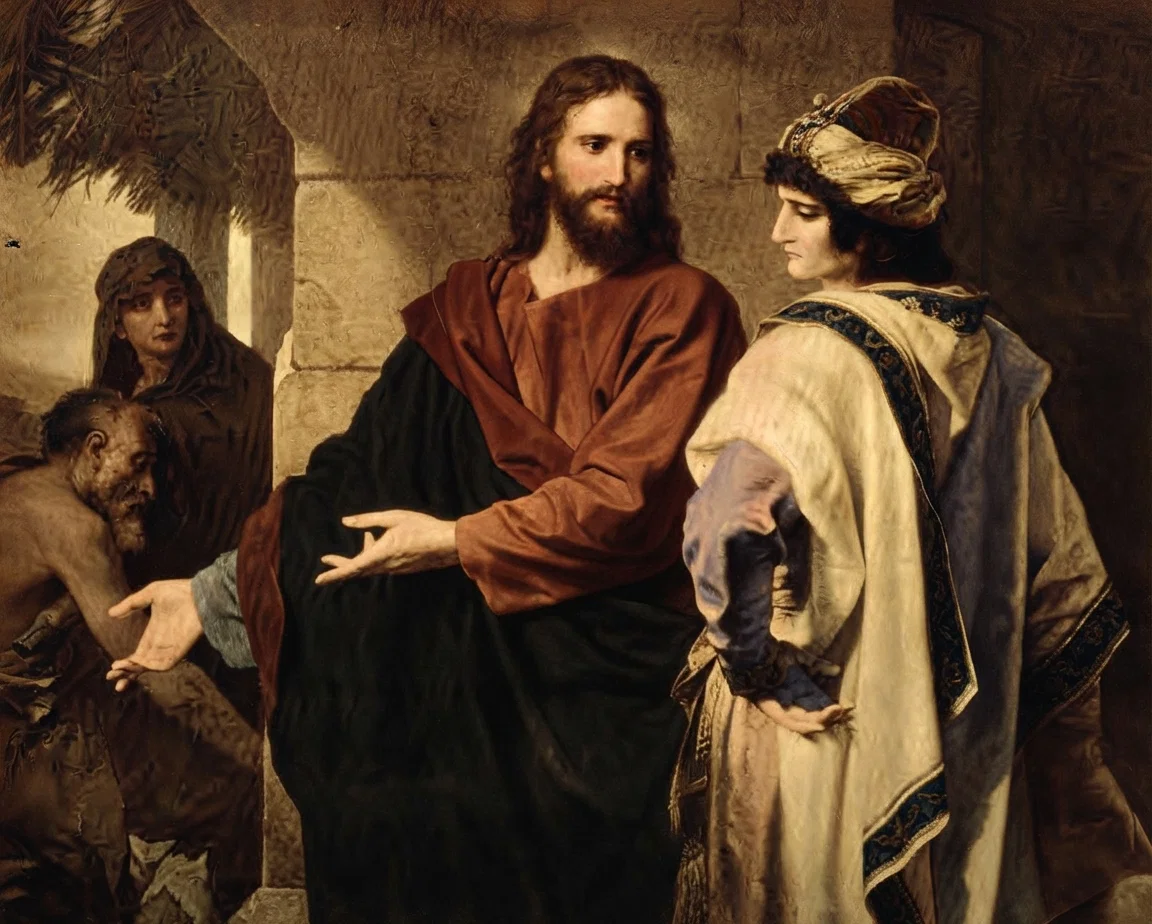
POWERFULLY, indeed, has Hoffman depicted by brush the scene set forth in Matt. 19:16-29; Mark 10:17-30; Luke 18:18-30. Our picture on this page is from a photograph of his great painting.
THE story is that of a rich young ruler, concerned about his soul's salvation, and eagerly coming to Christ and asking, "Teacher, what good thing shall I do, that I may have eternal life?" The young man was in earnest about it. He was willing to brave the criticism of the crowd. He ran to Jesus, and kneeled before Him, as the Master walked in the way. It was a question of more than passing interest, as it should be to every soul.
THE human idea, the Pharisaic idea, the heathen idea, possessed him; namely, that he must himself do some good thing which would merit him eternal life. He must earn it in some way, by some works of supererogation,—a belief which has been responsible for all the ingeniously cruel means which men have invented and devised to torture the human, to do penance to the flesh, and at the same time pile up colossal mountains of self-righteousness.
MAN can never earn eternal life. Jesus Christ alone can bestow it, and He bestows it by gift, wholly and solely by gift. "The wages of sin is death;" the sinner earns it. He is entitled to his wages. "But the gift of God is eternal life through Jesus Christ our Lord." Rom. 6:23. Only by believing in Christ, coming into harmony with the law of His life, can it flow into our being. John 3:16, 36. We may do and do and do till the day of doom, but we can no more lift our souls from the plane and prison of sinful flesh than we can fly. Christ, Christ only, can lift us up, and by His life—eternal life—make us to stand.
NOTE the answer of our Lord. While He demands obedience, He does not declare that obedience would earn life; but "If thou wilt enter into life, keep the commandments." Nor does this mean that at the end of keeping the commandments life lay as a prize. Not at all. It meant that in harmony with God's commandments was the very law of life. "In the way of righteousness is life; and in the pathway thereof there is no death." Prov. 12:31. And this doesnot say that at the end of the way of righteousness is life; but "in the way of righteousness is life." Just as soon as the young man should truly enter that way, he would enter life. Just as soon as we truly enter the way of keeping God's commandments, we enter into life. God's life flows in perfect purity and mighty power in the channel of His law. Outside of that channel it is perverted, and becomes the "vain life" of man.
BUT the keeping of God's commandments can be accomplished by man only through faith, simple, childlike, submissive, obedient faith in God and God's means of salvation. Apart from such faith in Christ, all our obedience becomes superficial, outward, selfish, self-righteousness. This was the unsatisfactory righteousness of the young man. While keeping outwardly God's commandments from his youth up, he was still unsatisfied. He did not know that the law demanded more than the outward morality; he had not been taught it by the formalists of his day.
JESUS knew it and pitied him. But He could not for this reason make the way easier. "One thing thou lackest," "if thou wilt be perfect, go and sell" "all that thou hast, and distribute unto the poor, and thou shalt have treasure in heaven: and come, follow Me." Jesus looked upon him and loved him. His heart yearned over him. He saw the possibilities for good in him. He placed before him four incentives: Sell that which did not give him relief; give to the poor and needy, and receive their blessing; lay up treasures where they were forever safe; and go with the Good Master. How the poor ought to have appealed to him! The artist presents it as tho Jesus were pointing to the patient, sad-faced woman, standing, perhaps, by her sick, suffering husband, herself the worse sufferer, looking longingly for the response of the young man, as he waits, thoughtful and perplexed, while the calm eyes of Jesus read his very soul.
THE rich young ruler wants eternal life, but he wants more his own great possessions and the position he occupies and the praise of men, which his great wealth brings, and he turns away sorrowful. He has allowed the lust of gold and gain to wind their tendrils about his heart till they bind him fast. Sad decision, perhaps for eternity.
THERE are many to-day to whom the Master is calling, "Sell," "distribute," "come, follow Me." The needs of the poor are calling, but they heed them not. God's suffering cause is in need, giving them opportunity to identify themselves with Him, and so lay up treasure where no earthly poison can corrupt or corrode, where no enemy can steal. He is inviting them into companionship with Himself. He asks them to take no step that He has not taken before them, that He will not take with them. Yet they hesitate, wait, and turn away. Eternal character is weighing against temporal gain, and the temporal gain is chosen.
CHARACTER is determined by such little things. On the roof of a house in Ohio the autumn rains fall. Those on one side find their way to Lake Erie on the north, over turbulent Niagara, down the swift St. Lawrence, and out into the cold frigid regions of the North. Those on the other side find their way into the Ohio, down the Mississippi, and out into the Gulf of Mexico, whose warm, strong current blesses and makes habitable what would otherwise be bleak, barren shores of sea-girt lands. The little act in our lives may be on the wrong side of the "divide." Count character more than coin. Reckon the riches of God more than the treasures of earth. Know that the way of righteousness and life is more than the way of selfishness and death. "If thou wilt enter into life, keep the commandments." "Come, follow Me."

ARE THE GENTILES SUBJECT TO GOD?

To Whom Are the Covenants and Promises?

A CORRESPONDENT in Pomona, Cal., Mr. W. A. Reed, sends us $1.25 and asks us to insert the following advertisement, and send him the paper containing it:

“$50 Reward

“Will be paid to the person producing evidence to show where we, Gentiles, who have turned unto God are given the law of Moses, or commanded to keep the seventh day.”
Now, if we inserted this for an advertisement we should want more than the amount sent. Apart from this we could not thus insert it. As it is, we insert it for the purpose of helping our inquirer and others, perhaps, who may be troubled in the same way.
What is meant by “the law of Moses” we do not know, as our friend does not define it. If he means the laws governing the civil polity of the Hebrews, or the laws regulating sacrifices and oblations, which expired by limitation, surely they are not binding upon either Jew or Gentile now; for the Hebrew commonwealth is no more, and the laws of sacrifices and offerings ceased when the shadow reached the substance, when the typical lamb gave way to the Lamb of God.
If he means all the laws contained in the books of Moses as one system, then it is our duty to discriminate between the laws as the nature of the law demands and as the Scriptures themselves discriminate. For instance: The institution and law of marriage is found in these books, instituted before the fall of man, guarded by safe and wise laws afterward. These are founded in the very nature of mankind, and are always binding. Would our friend say to the contrary?
The Ten Words, or Decalogue, is a code of principles all inclusive of morality, all prohibitive of sin, guarding and governing the relations between man and God and between man and his fellows. There is nothing of a ceremonial or temporary character in any of the precepts of this law.
The Sabbath—the worship day—which is designed to bring man to the united worship and remembrance of the Creator, was made for man—all men—before sin entered, hence is for all the race, and is as much needed now as ever before in the history of man.
When God’s treasure of truth was given to Israel as custodians, teachers, heralds of its holy principles to all the world, God faithfully discriminated between laws. The Decalogue He spoke from heaven with His own voice, and wrote with His own finger upon tables of enduring rock, and ordered them deposited in the holiest place of the sacred sanctuary. Ex. 20: 1-17; 31: 18; Deut. 10: 1-5. These words are expressly called “a law,” showing their completeness. Ex. 24: 12; Deut. 5: 22. The rest of the laws Moses wrote in a book. Deut. 31: 9. And this distinction is recognized by the Scriptures and the Jewish priests. First, “Thou [God] camest down upon Mount Sinai, and spakest with them from heaven, and gavest them right judgments, and true laws, good statutes, and commandments, and madest known unto them Thy holy Sabbath.”
So much God did Himself. But more than this: “Thou commandest them precepts, statutes, and laws, by the hand of Moses Thy servant.” Neh. 9:13, 14.

Given for the World.

God gave this to Israel, not for themselves alone, but that that entire nation might be His priest unto the world. Ex. 19: 5, 6. The exact parallel to this is the giving His truth to the Christian church for the same purpose. 1 Peter 2: 9, 10. It was Israel’s duty so to live this law, that other nations might be won. Deut. 4: 6-8. It was Israel’s duty so to declare Jehovah’s glory among the nations, the Gentiles, that the Gentiles might be converted. 1 Chron. 16: 8-36; 1 Kings 8: 41-43. Then when the people of the nations gave themselves to God, one law should be for both. Ex. 12: 49; Lev. 24: 22; Num. 15: 15, 16, 29.

A Reflect of God’s Character.

We need not take time to prove from Scripture that Jehovah is a perfect, righteous, holy, just, true, faithful God; for all these expressions abound concerning Him. But everything said of Him is also attributed to His holy law of Ten Words, the sum of all morality. “The law of Jehovah is perfect;” “the law is spiritual;” “the law is holy, and the commandment holy, and just, and good;” “all Thy commandments are righteousness;” “they stand fast forever and ever;” “it is easier for heaven and earth to pass than for one tittle of the law to fail.” And such expressions might be multiplied from the Sacred Word. God’s law must be like Himself. He could give no other. God demands that His saved ones shall also be like Himself. He could not do otherwise. This great truth He has set forth in every dispensation. To Abraham: “Walk before Me, and be thou perfect.” Gen. 17:1. To Israel: “Ye shall be holy; for I Jehovah your God am holy.” Lev. 19:2. To His people this side of Christ: “Like as He who called you is holy, be ye yourselves also holy in all manner of living; because it is written [in Lev. 19:2], Ye shall be holy; for I am holy.” 1 Peter 1:15, 16.
Now Jehovah changeth not (Mal. 3:6); with Him can be no variation or shadow of turning (James 1:17); therefore His requirements must be the same in all ages to all men. And as He required without question of His people in our age that they should by His grace observe His holy law of Ten Words, so He requires by His perfect changelessness the same of His people in all ages. Therefore “His precepts are sure. They are established forever and ever.” Ps. 111:7, 8. Therefore, “It is easier for heaven and earth to pass than one tittle of the law to fail.” Luke 16:17. Therefore, faith in Jesus Christ does not make void the law in the heart, but establishes it there. Rom. 3:31. Therefore to the loyal man, whoever he may be, it is the carnal heart which is at enmity with God and not subject to His law, that must die (Rom. 8:5-8), but the new heart and the new mind upon which God’s Spirit has written His law (Heb. 8:10) exclaims, “This is the love of God, that we keep His commandments; and His commandments are not grievous.” 1 John 5:3.

Who Are Israel?

1. In the fullest sense Israel stands for God’s saved people, and so did from the beginning. It is Inspiration’s word for the perfect man as he came from God. In Eccl. 7:29 we read: “Lo, this only have I found, that God hath made man upright.” The original word for “upright” is “Israel.” “God hath made man Israel.” That is God’s design. So when Jacob, “the supplanter,” was converted and became Israel, “the upright,” the prevailer, he was only brought back to God’s original plan. It was therefore the names of God’s ideal Israel who were written in the book of life in the beginning, each name indicative of some character to be developed. Rev. 13:8. It is to one of these characters that every soul who reaches the age of responsibility is called, and, yielding to God and submitting to the discipline, he becomes of the family of Israel, a winner of the name and the crown of life. James 1:12; Rev. 3:5. It is therefore the Israel of God that “shall be saved in the Lord with an everlasting salvation.” Isa. 45:17, 18.

The Promises and Covenants to Israel.

In view of the foregoing we might justly conclude that all the promises and the covenants are to Israel alone, and to all others only as they became a part of Israel. Therefore the apostle to the Gentiles declares of the Hebrews: “Who are Israelites; to whom pertaineth the adoption, and the glory, and the covenants, and the giving of the law, and the service of God, and the promises.” Rom. 9:4.
There is not much left apart from these. Everything of worth is included in this category of what comes through Israel. Altho Israel according to the flesh utterly departed from God, the great purpose still held good, the new covenant must be made with the same people, and the law which Israel of old failed to obey, the law which was counted God’s law 600 B.C., in the days of Jeremiah the prophet, would be written in the hearts and minds of God’s true Israel, and always Israel and Judah. Jer. 31:31-34; Heb. 8:10-12.
“The Gentiles” is simply another term for the nations outside of Israel. In the Old Testament it is from the Hebrew word goy, in the sense of massing together. It is translated in the common version, “Gentile,” “nation,” “heathen,” “people.” The Revised Version quite uniformly renders it “nation.” The only hope for the Gentile is to become one of Israel. As Gentiles they are thus described: “That at that time ye were without Christ, being aliens from the commonwealth of Israel, and strangers from the covenants of promise, having no hope, and without God in the world.” Eph. 2:12. There is, therefore, no hope or promise to the Gentile who elects to remain a Gentile.

What Hope Is There for the Gentile?

To believe in Christ Jesus, the root, the stock, the all in all of the Israel of God. What does faith in Christ do to the one without God?—“But now in Christ Jesus ye who sometimes were far off are made nigh by the blood of Christ. . . . Now therefore ye are no more strangers and foreigners, but fellow citizens with the saints, and of the household of God.” See Eph. 2:11-22. By faith they are grafted into the stock of Israel, and partake of “the root and fatness of the olive tree” bearing the fruit of Israel. Rom. 11:15-24. Truly Jesus said, “Salvation is of the Jews.”

Is There Any Other Conclusion?

Therefore if our Gentile friend truly turns unto God, he becomes one of the Israel of God. As one of the Israel of God, note the following: “Wherefore the children of Israel shall keep the Sabbath, to observe the Sabbath throughout their generations, for a perpetual covenant. It is a sign between Me and the children of Israel forever; for in six days the Lord made heaven and earth, and on the seventh day He rested, and was refreshed.” Ex. 31:16, 17.
Put beside this God’s promise that Israel shall inherit the earth forever in Isa. 45:17, 18; and the further promise that the Sabbath shall be kept in the new earth in Isa. 66:22, 23.
Isaiah has still another Gospel promise to the Gentile, the stranger who turns to the Lord: “Blessed is the man that doeth this, and the son of man that layeth hold on it; that keepeth the Sabbath from polluting it, and keepeth his hand from doing any evil. . . . Also the sons of the stranger [“foreigners,” R. V. Gentiles], that join themselves to the Lord, to serve Him, and to love the name of the Lord, to be His servants, every one that keepeth the Sabbath from polluting it, and taketh hold of My covenant; even them will I bring to My holy mountain, and make them joyful in My house of prayer; their burnt-offerings and their sacrifices shall be accepted upon Mine altar; for Mine house shall be called an house of prayer for all people.” Isa. 56:2-7.
One more scripture. The new Jerusalem is the capital of the new earth. Into that city all the redeemed will enter. That city has twelve gates. Each gate is named after a tribe of God’s spiritual Israel. Every one who enters will enter as a member of one of those tribes. Here is God’s promise: “Blessed are they that do His commandments, that they may have right to the tree of life, and may enter in through the gates into the city.” May our friend be one of them.
We have not sought to answer his question to secure the reward. God’s grace and truth can not be so purchased or dispensed. We have by God’s help sought to aid him and others. God grant that so it may be. His shall be the praise.

SUPPORT OF GOSPEL WORK.

CHRIST and His immediate successors taught the people the Gospel from the Old Testament Scriptures. There were no other Holy Scriptures; but these were the Word of God, and He whose Spirit had indicted them enjoined the people to search them, for in them was eternal life. The apostle Paul also testifies that these Scriptures are able to make one wise unto salvation. Then we are not to understand that the New Testament, which is a compilation from the teaching of Christ and His apostles, is in any way contradictory of the Old Testament, but that it is supplementary thereto. This explains why many things are not minutely set forth in the New Testament, and why so many people who look only to it for Gospel instruction are left in the sloughs of conjecture.
Many times the Old Testament throws clear light on things that are merely touched in the New, and those who neglect or reject the explanations of the older Scriptures fail to get the mind of the Lord on very important matters. A case in point is the support of the ministry and of the Lord’s work in general. There is no detail as to this matter in the New Testament. Why not?—Because it is given in the Old. Therefore those who look only to the New are left to their own imaginations concerning methods. Consequently many inconsistent and hurtful schemes are devised for securing necessary funds.
Of course, the New Testament gives us the principle, but it refers us to the God-devised detail that was “written for our learning” in the Old Testament. In giving instruction on this point, the apostle Paul says: “Do ye not know that they which minister about holy things live of the things of the temple? and they which wait at the altar are partakers with the altar?”
Now the priests and Levites under the Levitical ministration lived upon the tithe from the people. The temple service, which was the work of the Lord, was also sustained by the tithe. In this way they that waited at the altar were “partakers with the altar.” After reminding us of this well-known fact, the apostle adds: “EVEN SO hath the Lord ordained that they which preach the Gospel should live of the Gospel.” Even so, that is, by the tithe, shall the Gospel work be carried on, the ministry being partakers, as were the priests and Levites.
The same apostle tells us that “whatsoever things were written aforetime were written for our learning;” and one of those things,with precious blessing attached, is this: “Bring ye all the tithes into the storehouse, that there may be meat in Mine house, and prove Me now herewith, saith the Lord of hosts, if I will not open you the windows of heaven, and pour you out a blessing, that there shall not be room enough to receive it.” Are you afraid to prove the Lord on His own straightforward promise? Are you afraid that He is not as good as His Word? or do you think the “windows of heaven” are not large enough to let out blessings that would be worth as much to you as that little bit of tithe that you withhold? Remember that God says “all the tithe,” not a little now and then. What a profit it would be if we could only appreciate the value of such blessing as would necessitate the opening of the windows of heaven in order to pour it out! How much trouble it would save in devising doubtful, experimental, and often fruitless, plans to sustain the work of the church! G.

THE SABBATH IN THE EARLY CHURCH.

THERE was nothing which so embittered the Jews against Christ as His disregard of their traditions. These were their own variations and explanations of the law of God, requirements which had no divine sanction. They had become much more tenacious concerning the observance of these traditions than they were of the commandments and ordinances proper. To such an extent was this custom carried that Christ said they had made of none effect the Word of God through their traditions.
And of all their traditions there was none upon which they laid so much stress as those they had imposed upon Sabbath observance; nor were there any which Christ so conspicuously ignored during His public ministry. It was this public disregard of their authority in extraneous Sabbath laws that more than once determined the priests and scribes to have Him put to death. But at no time did Christ ever teach or intimate that there ought to be, or would be, any change of the day of the Sabbath.
So also of the apostles; they were severely criticized for ignoring the authority of the Jewish rulers, and of violating the ceremonial law; but in no instance is there any record of their being accused of setting apart another day as the Sabbath. All manner of pretexts for persecution of the disciples were devised. Saul, in his exceeding zeal for the traditions of the fathers, sought every possible excuse for hailing men and women to prison and to death for believing in Christ. But he made no charge against them on account of their Sabbath observance. Nor was he himself, after he became a disciple and a minister of the Gospel, ever accused of setting up another Sabbath day. Nor is there any record of his ever acknowledging any other day as the Sabbath than that observed by the Jews.
Yet there is nothing that would have been so quickly seized as a pretext for persecution, or so assiduously followed up, by the Jews of that day, as an attempt to establish another Sabbath day. This would have been especially true because the first disciples throughout Palestine were nearly all Jews. The ignoring of the Sabbath day would have been deemed by the Jewish rulers as the most heinous of all offenses. They would hardly have sought any other, so grave would have been the offense, and the conviction so easy of accomplishment. In such case the book of Acts would have furnished abundance of evidence that the disciples of the first century recognized a change of the Sabbath. But there is not a hint that such a change was even suggested. The silence both of the Jews and of the apostles would be indeed remarkable if there had been such a change.
G.

NATIONAL REFORM'S "ONLY HOPE."

AT a recent National Reform convention it was publicly asserted that the theory of the association is "the federation and co-operation of the nations to do away with the military institution. This is the great and the only hope." According to the Word of God, this is a very poor hope. See Ps. 46:3-5; Isa. 2:22. The only hope for the world that is worthy the name is the hope of the Gospel. But the doing away with the military institution is an illusive dream, unless the selfish desire to rule and the mania for tinsel glory, so prevalent in the world, can also be done away. And such a consummation can not be brought about by peace congress, or international law, or any other kind of human law or device.
But federation seems to be the general slogan to-day, the cure-all for human ills, both religious and political. And the ideal federation of the National Reform Association would be a federation of the nations controlled by some religious influence—for instance, the National Reform Association itself.
Now history tells us of a federation of nations—ten in number—under the absolute control of what professed to be the Christian church—the universal church. But those nations did not disarm; they didn't dare to disarm; they lacked the confidence in one another to abolish their military institutions. They well knew that, altho every one of those nations was recognized by "the church" as a Christian nation, every national government stood ready to take advantage of any manifest weakness on the part of the other. Moreover, "the church" itself did not want the military institution done away, the ruling functionaries felt the need of military protection even against many of its professed friends. Those nations were federated to the extent that they gave their united power to the support of the religious and political supremacy of the head of the church of Rome.
The Word of God tells us that there will be another federation of the nations which will give their power to that same church. That church lost its temporal power and prestige in 1798, when the pope was made prisoner by the French, and died in exile. And this humiliation was repeated when the military support of France was withdrawn in 1870; but the prophecy says that its "deadly wound" will be "healed." It will again be sustained by the military power of federated nations; for "they give their power as kings," and the ultimate of such power is force, military force. That they are federated is shown by the declaration that they "have one mind," and "give their power and strength" unto the restored church. When earthly kings give their power and strength, they undoubtedly display military power. But such condition of affairs will be but for an "hour," indicating a very brief period; and the next thing is they are overcome by the advent of the Lord. See Rev. 17:12-14. This will put an end to all human federation business—which the National Reform Association announces as the only hope for the accomplishment of its ideal scheme. G.

Question Corner

1892.—Hopelessness in Persistent Sin.

The unrepentable sin is the unforgivable sin, the sin that can not be removed, because God will not compel the soul to give it up, and the soul still continues therein. Read Heb. 6:4-8 in the light of this: "For as touching those who were once enlightened and tasted of the heavenly gift, and were made partakers of the Holy Spirit, and tasted the good word of God, and the powers of the age to come, and then fell away, it is impossible to renew them again unto repentance [why?]; seeing they crucify to themselves the Son of God afresh, and put Him to an open shame." That is, they continue to do this, doing it constantly, as the illustration immediately following shows: "For the land which hath drunk the rain that cometh oft upon it, and bringeth forth herbs meet for them for whose sake it is also tilled, receiveth blessing from God; but if it beareth thorns and thistles, it is rejected and nigh unto a curse; whose end is to be burned." The surest way to bring an unmitigated, unrepealable curse upon ourselves is to turn all God's blessing into our own selfish channels, and there continue. The heart soon gets where it does not sense the sin, and will not, and, therefore, can not, turn from the sin.

1893.—Building Again.

Is it right for us to give money to build up what God has permitted to be burned down?
That depends on several things. If God permitted a thing to be burned down because He was not glorified thereby, if those connected with it could so relate themselves to Him that He should receive the glory, why not build again? If He suffered the burning to try the faith of His people, why not build again? Israel was defeated when they went against the wicked city of Ai, but they went again under different circumstances and conquered. Read Joshua 7 and 8. Twice the children of Israel went up against the wicked Benjamites and were defeated, yet the Lord sent them the third time. Judges 20:18-35. God permitted Jerusalem and the holy temple to be destroyed and burned with fire (2 Chron. 36:14-21); yet He punished the peoples who mocked her in her desolation (Eze. 25:1-11), and He it was who gave commandment to build (Ezra 1:1-3), and reproved His people because they were so slow and selfish (Hag. 1:2-9). As to whether it is the duty of our questioner to give or not we leave with him and God.

1894.—Women Keeping Silence.

Please explain 1 Cor. 14:34, 35.
This question was explained in the SIGNS OF THE TIMES of July 18, 1906, page 433, question 1858.
Continue reading: OUR GREAT TREASURE-HOUSE