Lord, now I see why it was best for me,
This hard, rough way—it was the nearest route
And smoothest, from that dreary, barren waste
Where I was wandering when Thou foundest me,
Back to this narrow path indeed, “To Home.”
I thank Thee, Lord, for love in such disguise;
And never thru the long, long coming years
Shall Doubt’s dark whispers gloom my mind again.
With Our Inquirers
By Editor
“If ye will inquire, inquire ye.”
[All questions to this department will be answered which to the editors will seem to minister to the good of the readers and to the mission of the paper. The same question can not be answered repeatedly in the same volume. The name and address must accompany question, not for publication, but as an evidence of good faith, and that answer may be made by letter if deemed advisable. It is well always to enclose a stamp for reply.]
A Word to Our Inquirers.—Here is a sample of many inquiries which come to us: “Please explain the following scriptures: Gal. 3: 19; Eph. 4: 11; Rom. 5: 13, 14; 1 Cor. 12: 28.” Now these scriptures involve many questions. The fullest kind of explanation would carry us to other scriptures and other parts of God’s word. Brief explanations might not touch the point in the inquirer’s mind at all. Therefore we must insist that the particular points in the scriptures must be stated in the questions asked. This will make it very much better for the one who desires information, and very much better for the one answering the question.
2399.—What Law?
What law is referred to all thru the third chapter of Galatians? Some apply the 19th verse to the moral law, and some to the ceremonial law; which law is referred to? No. 771.
In Galatians sometimes law is referred to in general, sometimes in particular. Law is referred to in general to impress the fact that man is not justified by law; but law is referred to in particular to show that the moral law of God condemns us, and therefore we are under the law. Take the beginning of the third chapter, "Received ye the Spirit by the works of the law, or by the hearing of faith?" Of course they could not do it by the works of the law, because man's works are imperfect, and the Spirit does not come to work in the unrighteous; and so with the man who works miracles, he does not do it by law but by faith. Tenth verse: "For as many as are of the works of the law," depending on the works of the law, "are under a curse," because they can not lift that curse by doing imperfect works; therefore man is not justified by law. Verse 11. Yet if a man could do the law perfectly of himself, he could live in it, but he has sinned and can not. The law is weak thru the flesh, because the flesh is mortal and sinful. Rom. 8: 2. What then is the law for? Why did God speak the law, if it could not save man? The 19th verse tells us, "It was added [spoken, given in that special form] because of transgressions, till the Seed should come to whom the promise hath been made." Now there ought to be no question in regard to the law referred to. After calling to remembrance that law in the fifth chapter of Deuteronomy, Moses tells us that God spoke those Ten Commandments, "and added no more." Rom. 5: 20 tells us that the law came in that the trespass might abound; that is, that sin by the coming might become exceeding sinful. Rom. 7: 13. Man's conscience had become dead; sin had obliterated to some extent the law that was originally written in his heart, it needed the written law to convince him how sinful he was; so Paul tells us, "Nay, I had not known sin, but by the law; for I had not known lust, except the law had said, Thou shalt not covet."Rom. 7: 7.
Who is the Seed?—Christ. Gal. 3: 16. What is the promise?—That He should be Heir of the world. Gen. 22: 17; Rom. 4: 13. He has not yet come to receive that inheritance, has He? That will not occur until His second coming, for when He "shall come in His glory, and all the holy angels with Him, then shall He sit upon the throne of His glory." Matt. 25: 31. Therefore God's law is given to make sin seem exceedingly sinful, to point out sin until Christ shall come the second time. Pointing out the sin, it forces man to the Saviour. God reveals that we are sinners in order that He may reveal Himself to us as our Saviour. He shows us that we are in misery in order that He may reveal His mercy. He reveals to us that we are under the law, in order that He may write the law in our hearts, so that we shall not be bound as slaves, but be free, as willing, loving subjects of His. Before faith comes, we are under the law, but when that law is written in our hearts, then we are fulfilling the fruits of the Spirit, against which there is no law. Gal. 5: 22, 23.
2401.—The God of the Living.
We have been somewhat bothered over Mark 12: 26, 27. It seems to infer that Abraham, Isaac, and Jacob were alive at the time that Moses saw the burning bush. How does it harmonize with Rom. 14: 9?
If our inquirer would stop to think of the object that our Lord had in making the statement that He did, he would have no question whatever over it. The Jews did not ask Him any question in regard to the intermediate state. They did not ask Him that when the woman died whose wife should she be. Their question was upon the resurrection. The Sadducees did not believe in a resurrection, and by this cavil they hoped to disprove it. So they brought up the old story of the wife with seven husbands, and asked the question, "In the resurrection, whose wife shall she be?" The reply of Jesus is that they erred because they knew not the Scriptures nor the power of God, for "when they shall rise from the dead, they neither marry, nor are given in marriage." And then He proves that there must be a resurrection, "But as touching the dead, that they are raised" not as touching the dead that they are now living, but "as touching the dead, that they are raised." Luke has it, "But that the dead are raised, even Moses showed, in the place concerning the bush, when he calleth the Lord the God of Abraham, and the God of Isaac, and the God of Jacob. Now He is not the God of the dead, but of the living; for all live unto Him." Luke 20: 37. It would be no honor to make Him the God of the dead. He is not a dead Deity; He does not rule over a dead kingdom; He has not the homage of dead subjects. All these come in consequence of sin, but He is the living God; and just as truly as He lives, all who are His live in His purpose, and so He counts them alive, because in that purpose they will be raised from the dead; "calleth the things that are not, as tho they were." See Rom. 4: 17. This you will find in perfect harmony with Rom. 14: 9 and with all the rest of the Scriptures. How utterly inconsistent it is to say that the Saviour set out to prove the resurrection and then proved that man needs none. Let us have such argument to a false theology, but not to the divine Teacher.
Questions on Genealogy
2398.—Questions on Genealogy.
Is it important to remember any of the long lines of genealogy that form a part of our Bible lesson? BIBLE BAND.
Not necessarily. Sometimes they are very interesting as showing just how God fulfilled His promises in caring for the promised Seed. It also shows that the particular way in which the records were kept [was] evidence of the truthfulness of the word. In reference to Jacob's dying words to his several sons, this department is not capacious enough to explain these prophecies. They are worthy of study. Many of them were fulfilled in their national life. Some of them await fulfilment thru the Lion of the tribe of Judah.
I am informed by a minister of the Gospel that the Hebrew word muwth, as transliterated by Strong, rendered die in the expression, "Thou shalt surely die," means physical death. Will you please give the best translation of the Hebrew in this text?
P.
We have no fault to find with the translations of the common English versions, both King James and the Revised Versions, of "Thou shalt surely die." The claim that it refers to physical death is based on the theory, which the Bible does not sustain, that man is composed of two entities, the physical man and the spiritual man, and that the soul-man is able to exist apart from the body. Such a doctrine does not have support in the Scriptures of truth. God is dealing with the man as the whole man. It was the whole man that sinned, the whole man who was to die; dissolution was to take place. It may be of worth to refer to Eze. 18: 4 where the same word is used, "The soul that sinneth, it shall die," and again repeated in the 20th verse. So God pleads with Israel to turn from their sins in order that they might live, and asks them, "Why will ye die, O house of Israel?" Eze. 18: 31. Certainly, no mere dissolution of the body, but the death of the entire being, is referred to in this passage.
It seems a strange thing to us that men will declare that the "thou" of Gen. 2: 17 refers to the body, while the "thou" of Luke 23: 43 refers to the soul. It is by such theological gymnastics that the immortal-soul theory is maintained. God spoke to the whole man Adam when He told him that he would surely die if he sinned, and Jesus spoke to the whole man dying by Him on the cross that some day he would be with Him in Paradise.
2402.—The Two-Horned Beast.
Will the two-horned beast, which we understand to be the United States, make fire come down from heaven in a similar manner to that in which Elijah called fire down from heaven, which consumed the burnt sacrifice and the wood, etc.? In other words, will fire come down in a literal manner, or will it be in a figurative sense? Will it be a consuming fire?
No. 237.
It is impossible for us to say in just what manner or way this prophecy will be fulfilled. It evidently seems to mean literal fire. Whether it shall be in the form of electricity or how we do not know. With the prophecies which are yet unfulfilled we may not mark out the express way in which they will be fulfilled. Suffice to say this, that when the fulfillment takes place, the children of God will recognize it as the fulfillment of the prophecy. The reference to Elijah has of course suggestions with it. The real test between Baal and Jehovah was the God that answered by fire. Baal was the sun-god. His worshipers were fire-worshipers, and yet the Lord's prophet did what they could not do. So in the last great test when the false prophet (for so the two-horned beast is also called) shall endeavor to lead men astray, the same miracle may be repeated in counterfeit, altho not in the same manner that it was wrought by Elijah; for we read in 2 Thess 2: 9 that Satan will work "with all power and signs and lying wonders."
The Beginning of Creation
2403.—The Beginning of Creation.—No. 1305.
—We do not necessarily understand from Gen. 1: 5 that God began the creation of the world in the evening. When He began the creation of the world we do not know. That is stated in the first verse, "In the beginning God created the heavens and the earth." How far back it extends or what period of time is covered by that expression "in the beginning," which occurs several times in the word of God, is unknown to us; that is among the mysteries that God has reserved to Himself. The record in Genesis 1 is the taking of this earth from its waste and void and dark condition and fitting it for the home of man in six days; and for the Lord's own good reason He placed the beginning of the day at evening or the dark part.
We have no reason to believe that the light of verses 3 to 5 was any different from the light of verses 14 to 17. The language of verses 16, 17 is doubtless the language of appearances, as regards the fourth day. God made the sun and the moon and the stars, made them perhaps when the earth itself and the whole solar system were created, but on account of the dense clouds which surrounded the earth their light as bodies of light had not penetrated to the earth. On the fourth day this was removed, and the light shone out in the firmament of heaven.
Christ the Teacher and Healer
By Mrs. E. G. White
By Mrs. E. G. White
“He Sent His Word and Healed Them.”
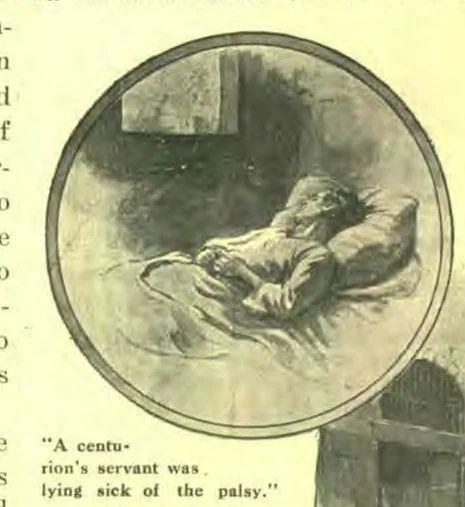
A CENTURION’S servant was lying sick of the palsy. Among the Romans the servants were slaves, bought and sold in the market-places, and often treated with abuse and cruelty; but the centurion was tenderly attached to his servant, and greatly desired his recovery. He believed that Jesus could heal him. He had not seen the Saviour, but the reports he had heard inspired him with faith. Notwithstanding the formalism of the Jews, this Roman was convinced that their religion was superior to his own. Already he had broken thru the barriers of national prejudice and hatred that separated the conquerors from the conquered people. He had manifested respect for the service of God, and had shown kindness to the Jews as His worshipers. In the teaching of Christ, as it had been reported to him, he found that which met the need of the soul. All that was spiritual within him responded to the Saviour’s words. But he thought himself unworthy to approach Jesus, and he appealed to the Jewish elders to make request for his servant’s healing.
The elders present the case to Jesus, urging that “he was worthy for whom He should do this; for he loveth our nation, and he hath built us a synagog.”
But on the way to the centurion’s home, Jesus receives a message from the officer himself, “Lord, trouble not Thyself; for I am not worthy that Thou shouldest enter under my roof.”
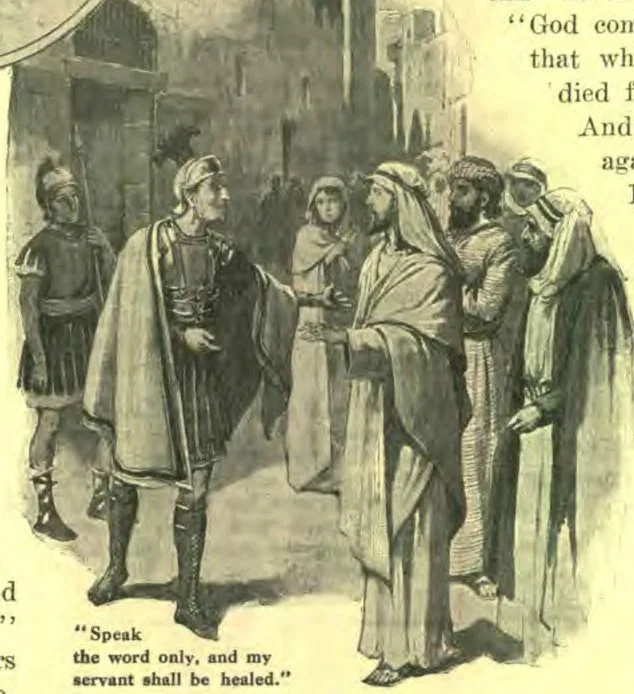
Still the Saviour keeps on His way, and the centurion comes in person to complete the message, saying, “Neither thought I myself worthy to come unto Thee,” “but speak the word only, and my servant shall be healed. For I am a man under authority, having soldiers under me: and I say to this man, Go, and he goeth; and to another, Come, and he cometh; and to my servant, Do this, and he doeth it.”
“I represent the power of Rome, and my soldiers recognize my authority as supreme. So dost Thou represent the power of the infinite God, and all created things obey Thy word. Thou canst command the disease to depart, and it shall obey Thee. Speak but the word, and my servant shall be healed.”
“As thou hast believed,” Christ said, “so be it done unto thee. And his servant was healed in the selfsame hour.”
The Jewish elders had commended the centurion to Christ because of the favor he had shown to “our nation.” “He is worthy,” they said, “for he hath built us a synagog.” But the centurion said of himself, “I am not worthy.” Yet he did not fear to ask help from Jesus. Not to his own goodness did he trust, but to the Saviour’s mercy. His only argument was his great need.
In the same way every human being can come to Christ. “Not by works of righteousness which we have done, but according to His mercy He saved us.” Do you feel that because you are a sinner, you can not hope to receive blessing from God? Remember that Christ came into the world to save sinners. We have nothing to recommend us to God; the plea that we may urge now and ever is our utterly helpless condition, which makes His redeeming power a necessity. Renouncing all self-dependence, we may look to the cross of Calvary and say,—
“In my hand no price I bring; Simply to Thy cross I cling.”
“If thou canst believe, all things are possible to him that believeth.” It is faith that connects us with heaven, and brings us strength for coping with the powers of darkness. In Christ, God has provided means for subduing every evil trait, and resisting every temptation, however strong. But many feel that they lack faith, and therefore they remain away from Christ. Let these souls, in their helpless unworthiness, cast themselves upon the mercy of their compassionate Saviour. Look not to self, but to Christ. He who healed the sick and cast out demons when He walked among men, is still the same mighty Redeemer. Then grasp His promises as leaves from the tree of life: “Him that cometh to Me I will in nowise cast out.” As you come to Him, believe that He accepts you, because He has promised. You can never perish while you do this—never.
“God commendeth His love toward us, in that while we were yet sinners, Christ died for us.”
And “if God be for us, who can be against us? He that spared not His own Son, but delivered Him up for us all, how shall He not with Him also freely give us all things?”
“Who shall lay anything to the charge of God’s elect? It is God that justifieth. Who is he that condemneth? It is Christ that died, yea rather, that is risen again, who is even at the right hand of God, who also maketh intercession for us. Who shall separate us from the love of Christ? shall tribulation, or distress, or persecution, or famine, or nakedness, or peril, or sword? As it is written, For Thy sake we are killed all the day long; we are accounted as sheep for the slaughter. Nay, in all these things we are more than conquerors thru Him that loved us.”
“I am persuaded, that neither death, nor life, nor angels, nor principalities, nor things present, nor things to come, nor powers, nor height, nor depth, nor any other creature, shall be able to separate us from the love of God, which is in Christ Jesus our Lord.”
The Bible and Transformation of Character
“The whole Bible is a revelation of the glory of God in Christ. Received, believed, obeyed, it is the great instrumentality in the transformation of character. It is the grand stimulus, the constraining force, that quickens the physical, mental, and spiritual powers, and directs the life into right channels.”
Miracles and Gifts of Healing
By G. D. Ballou
The Law of Rest in the Healing of Disease
By G. D. Ballou, for Many Years a Devoted Student of Physical and Mental Therapeutics
(Concluded from Last Week.)
Miracles and Gifts of Healing.
WHY, then, in the face of the facts before us and the needs of humanity and the promise of the Saviour in the last commission—“These signs shall follow them that believe: In My name shall they cast out devils; they shall speak with new tongues; they shall take up serpents; and if they drink any deadly thing, it shall not hurt them; they shall lay hands on the sick, and they shall recover”—why do not we see more of the miraculous workings of God’s Spirit?
Some will claim that we are having them in Christian Science. Do not be deceived; there have been no real miracles wrought by these so-called healers. That working is only a perversion of the true application of the law of rest. They have shown no creative power.
By a special process of diversion they have made a multitude of people forget the worryings and frettings which caused their physical ills, by contemplating the vagaries and mysteries of something that is neither Christian nor science. Even Mrs. Eddy is yet troubled occasionally with an “old belief”—her term for a fit of sickness.
Nor does hypnotism present us with any manifestations of divine power. It is only the manipulation of a mind and nervous system that has in a measure lost control of itself.
But are there no miracles among all those who have in the last few years claimed divine power to heal? The writer has kept his eyes open for the last forty years trying to intelligently observe and interpret the religious and other phenomena of these times. Among all those who advertise themselves as possessing the divine power to heal, or are willing and anxious, like Gehazi of old, to look out for the filthy lucre, I must say frankly I have never seen a case of real healing. The lepers have not been cleansed, nor the palsied restored to health, nor the maimed been made whole, nor the crooked made straight. I have seen them throw aside their crutches at the command of Alexander Dowie, but in three days they were on them again as helpless, and more so, than ever. I have seen a sort of hypnotic working that held control for a brief period, and then the invalids lapsed into a worse condition than their former one.
Cases of Genuine Healing.
None of these professional healers have any antidote for poisons, nor do they venture to try their pretensions on smallpox nor spinal meningitis. Christian Scientists have not yet adopted Mark Twain’s advice to them to “stick to surgery.” It is folly to spend time looking for integers where nothing but zeros are written. A few cases I have seen and known among those who unpretentiously and humbly asked God for help, if it could honor Him to grant it, where cancers and other incurable tumors have been removed. I have seen a case where peritonitis had prevailed until the death-damp was upon the brow and the eyes were set as in death. I have seen the change come like a flash of light in answer to the humble petition for help, and the hue of health take the place of the pallor of death, and the patient mend from that moment and live to serve God for years without a single symptom of the old malady. And I know the physicians who have attested these cases. And there are others acquainted with similar cases.
But there was no boasting nor spiritual bombast, if such a thing can be, nor any braggadocio indulged in connection with these cases either before or afterward. God our Father is ready to hear the feeblest cry of His humblest child. His hand is not shortened that it can not save; nor His ear heavy that it can not hear.
But why do we not hear of more of these cases of healing? It is said of one place that Jesus “did not many mighty works there because of their unbelief.” Again, if blessings are asked for selfish ends, the Lord can not, in love for the individual, grant them. Again, where are the men and women to-day who could bear in their persons the gift of miracles and not be exalted by it? If Paul needed a messenger of Satan, a thorn in the flesh, to buffet him lest he be exalted above measure thru the abundance of the revelations given him, what would the men of this generation need to keep them humble under similar circumstances? There are a few here and there, enough to attest the power of God, and He will manifest His power thru them whenever it can honor His name and advance His cause.
But the children of God in the last generation of men are not to be characterized so much by miracle-working as by the spirit of obedience and willingness to suffer. “Here is the patience of the saints; here are they that keep the commandments of God, and the faith of Jesus.” Rev. 14:12. See context to learn when this applies. Paul says, “So that ye come behind in no gift [of the Spirit]; waiting for the coming of our Lord Jesus Christ.” 1 Cor. 1:7, 8. So their endowment is the patience of the saints and the commandments of God in their outward conduct; the faith of Jesus and the gifts of the Spirit for their support and comfort. These are stupendous facts. The patience of the saints shows a life in harmony with natural law. There is no patience without temperance. 2 Peter 1:5-11, particularly verse 6. And they must have absorbed the truths of the text, “I beseech you therefore, brethren, by the mercies of God, that you present your bodies a living sacrifice, holy, acceptable to God, which is your reasonable service.” Rom. 12:1. They will be in condition for the Lord to work for them, because they have been obedient to all God’s requirements, both moral and natural. And having lived up to the light given on the care of their bodies, they have less occasion for the working of miracles in their behalf.
Getting Ready to Live.
Think you, reader, that the Lord will take special pains to work miracles for those who do not care enough about His word to practise self-denial in eating and drinking, and are so fretted and worried about the things of this life that they forget to breathe? We hear much about getting ready to die. It is my opinion that but few of us are fit to live. So it is an important thing to learn how to appreciate, honor, and adorn this life. Does not the life to come depend on this? When that is bestowed it will become infinitely more valuable than this. But now let us show our appreciation of this life by following the simple principles on which it depends, if we want God to take a special interest in our cases and work for us in our extremity. If we have lived carefully and humbly to the best of our light and knowledge, we may look to Him hopefully and joyfully, trusting Him to do just the thing that will be for our good and His glory, both here and hereafter. And here let us say that after unbelief and danger of exaltation, the greatest hindrance to miracle-working in the church is the failure to live up to the laws of health—in other words, failure to daily take care of the life God has bestowed on us here. And then comes the unreconciled heart.5
Death is not the worst thing that can overtake the Christian. An unreconciled heart may be developed at last, if we are not wholly His. Teasing and commanding the Lord are not becoming.
Importunings are not long necessary, for He avenges speedily when the day and night cry begins to ascend. We may not expect that every ailment will be removed in answer to prayer, for then death would not be possible. But “if we ask anything according to His will, He heareth us.” So let calm resignation be the soul of every petition for relief, and then whatever comes is best for time and eternity. Of this very time it is said, “Blessed are the dead which die in the Lord from henceforth: yea, saith the Spirit, that they may rest from their labors; and their works do follow them.” Rev. 14:13. The next verse brings the coming of Christ. So let us with all the apostles and prophets look to that event for the fruition of our hopes and not be too anxious for our way and wishes to be fulfilled, so shaping our lives and our petitions for aid in our extremity that God can safely give favorable answers to our petitions, and thus thru helping His people with miraculous power when needed, advance the interests of His cause.
A Wonder-Working Power.
I can not leave this subject without referring to a wonder-working power that will be developed in this world just before the coming of Jesus and which will constitute one of the signs of the end. In Matthew 24, Jesus, in answering the question, “What shall be the sign of Thy coming, and of the consummation of the age” (A.R.V., margin), says, “For there shall arise false Christs and false prophets, and shall show great signs and wonders; insomuch that if it were possible, they shall deceive the very elect.” In Revelation 16, describing the seven last plagues which just precede the coming of the Lord, it says of a certain manifestation: “They are the spirits of devils, working miracles, which go forth unto the kings of the earth and of the whole world, to gather them to the battle of that great day of God Almighty.” Now here is a wonder-working power from beneath opposing God’s work and pretending to work miracles, and the result is deception and war. Every one living knows of the inception of these manifestations in our own day, foretold in Matthew 24. Their name is legion and their devotees are numbered by millions.
Their working can be called miraculous only on the ground that anything which we can not account for on any known natural principle is a miracle to us; not intrinsically miraculous, but only relatively to us, because we can not understand it. But because I can not understand some occult, mysterious working does not prove it to be of God nor yet for my good.
We have been considering the genuine, now we are looking at the counterfeit. The old Detector shows up this spurious affair. Isa. 8:17 pictures the Lord’s servants as waiting and looking for Him. And right following in this chapter it tells of familiar spirits that, thru modern wonder-workers, are trying to get human hearts and minds turned to them in seeking to the dead.
Verse 20 applies the test: “To the law and to the testimony; if they speak not according to this word, it is because there is no light in them.” The true people of God will have all the gifts and will keep the law and the testimony. The spurious workers will use just enough of the Bible to trap the unwary, but they will every time reveal a character and a teaching that are not in harmony with God’s standards. And it is not only those who openly pretend to deal with the old familiar (from the word family) spirits, but also every wonder-worker whose life is not in harmony with the law of God and the testimony of Jesus Christ and whose teachings must of necessity antagonize God’s word, who are unsafe guides in these perilous times.
So now we have right here before us two classes of teachers, each of which is a sign of the day of God. One class humbly follow God’s law and the faith of Jesus, saying, “Thy will, O God, be done,” developing patience, obedience, and faith until these qualities mark them as God’s children and candidates for His soon-coming kingdom. The other class set forth signs and wonders and pretend to work miracles by divine power, drawing thousands of sentimental, marvel-loving minds after them, setting forth the occult things of the so-called under-world; teaching theories that if received overthrow the Bible doctrine of salvation; leading men and women to trust in the wonder-worker to develop in them the hidden powers—“the God within”—by which they may become masters of every situation, pretending to rise superior to all the forces of nature and control all things of time and sense.
I can not begin to call to mind all the extravagant claims, nor can I name all the long list of wonder-workers that just now are seeking for recognition on account of their wonder-working. They will even carry it thru to the day of final reckoning, when they will say to the Judge: “Lord, Lord, have we not prophesied in Thy name? and in Thy name have cast out devils? and in Thy name done many wonderful works?” The Master will reply: “I never knew you: depart from Me, ye that work iniquity [that break My law].” Matt. 7:22, 23.
The same evil vein runs thru all this false wonder-working like a barbed wire empaling thousands upon its multitudinous prongs—the rejection of God’s word, and the doctrine of an indestructible entity within every man, which is either a part of or superior to the God of the Bible. This error is as old as the world, and came from the father of lies when he said, “Ye shall not surely die; . . . ye shall be as gods.” Gen. 3:4, 5.
Discernment comes only thru the word of God as illumined by His Spirit. Those who seek it will be able to detect the spurious. They will obtain the Spirit “of power, and of love, and of a sound mind,” and they will not be ignorant of Satan’s “devices.” 1 Tim. 1:7; 2 Cor. 2:11.
High Treason.
By Editor
ONE day in Maryborough, Australia, a man called at the house where I was staying—one of the finest looking men I ever saw. He had a splendid head, broad, high, dome-like forehead, overhanging eyebrows, piercing eyes, and a stalwart frame. He said: "What have you against me?" I said: "What do you mean? I don't know that I ever saw you before." He said: "This is what I mean. I am not a Christian, and make no pretensions to being a Christian; but I claim to be a man leading a moral, upright life, doing my duty by my fellow men in all the relations of life as far as I understand it. But I have not accepted Christ, and don't profess to accept Him. Now, what have you against me?" I said: "I have this against you. Jesus Christ is your King by divine appointment. You say you have not accepted Him. You have rejected Him." I looked into those piercing eyes; they looked into mine. I said: "I charge you, sir, with high treason against heaven's King." A dark look came over the man's face. Without a word he rose to his feet, passed out of the room, and out over the lawn without looking around.
Days, weeks, and months passed. We had gone to Tasmania, and had come back to Australia, and were in Ballarat. One day at the close of an afternoon meeting in Ballarat, that same man with the piercing eyes came to me and said: "I have come way down from Maryborough to tell you that you shall never again charge me with high treason against heaven's King." He held out a powerful hand, and I put mine into it. He said: "Down!" and down we sank on our knees, and he handed in his allegiance to heaven's King, Jesus Christ.—Anon.
Sunday Legislation Under Constantine
No historian thinks of denying that Sunday legislation began in 321 A.D., under Constantine; that his first law was pagan, purely, in form, fact, and essence; that it represented the union of church and state after the pagan model. This legislation and the fixing of "Easter" by civil law on Sunday, rather than on the fourteenth day of the month, according to the paschal law of the Jews, completed the civil and political enthronement of Sunday in place of the Sabbath.—A. H. Lewis, in "Swift Decadence of Sunday; What Next?"
Christianity for Revenue Only
"He who becomes a Christian 'for revenue only' will discover sooner or later that he has undertaken a hard job. There's nothing in it."