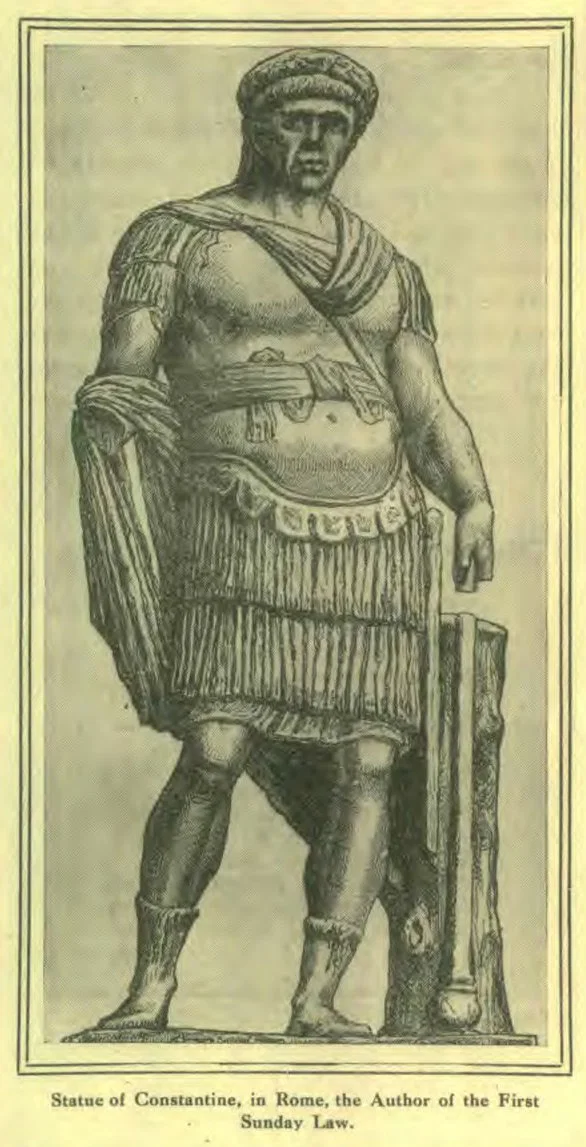
WHO changed the Sabbath? The day originally observed was the seventh day of the week. The day observed by the majority of the Christian church is the first day of the week. Was it not Christ, therefore, who changed the Sabbath at His crucifixion or resurrection? And if He did not do it, was it not changed by apostolic authority? If neither Christ nor His apostles made such a change, who did? The Bible-reading and the statement of facts which follow propose to answer this question. Has the change been legitimate, or has a great crime been committed? What is the testimony of prophecy and history?
I. Prophecies of Christ and His Work.
1. What prophecy of Christ was given thru Moses?
“I will raise them up a Prophet from among their brethren, like unto thee, and will put My words in His mouth; and He shall speak unto them ALL THAT I SHALL COMMAND HIM. And it shall come to pass, that whosoever will not harken unto My words which He shall speak in My name, I will require it of Him.” Deut. 18:18, 19.
2. What did Isaiah prophesy of Christ?
“The LORD [Jehovah] is well pleased for His [Christ’s] righteousness’ sake; He [Christ] will MAGNIFY THE LAW, AND MAKE IT HONORABLE.” Isa. 42:21.
3. As the Spirit of Christ spoke thru the prophets (1 Peter 1:10, 11), what did the great Teacher say thru David as to His attitude toward God’s law?
“Lo, I come; in the volume of the Book it is written of Me, I DELIGHT TO DO THY WILL, O MY GOD; yea, THY LAW IS WITHIN MY HEART.” Ps. 40:7, 8. Compare with Heb. 10:5-10, where this scripture is applied to Christ.
II. Fulfilled in Christ’s Teaching and Example.
4. Was it Christ’s purpose to present a law of His own or a new law?
“I DO NOTHING OF MYSELF; but AS MY FATHER HATH TAUGHT ME, I SPEAK these things.” John 8:28.
“I have not spoken of MYSELF; but the FATHER which sent Me, He GAVE ME A COMMANDMENT, WHAT I should say, and WHAT I should SPEAK.” John 12:49.
5. What honor and regard did He show toward God’s law?
“Think NOT that I am come to destroy the law, or the prophets: I am NOT come to DESTROY, but to FULFIL. For verily I say unto you, Till heaven and earth pass, one jot or one tittle SHALL IN NOWISE PASS FROM THE LAW, till all be fulfilled.” Matt. 5:17, 18.
NOTE.—‘Shall in nowise pass from the law.’ The double negative here strengthens the sense so as to admit of no contradiction. And the word ‘shall,’ it may be observed, is not barely future, declaring what WILL be, but has likewise the force of an IMPERATIVE, ordering what SHALL be. It is a word of authority, expressing the sovereign will and power of Him that spake,—of Him whose word is the law of heaven and earth, and stands fast forever.
“‘One jot or one tittle shall in nowise pass,’ ‘till heaven and earth pass,’ or as it is expressed immediately after, TILL ALL (or rather ALL THINGS) BE FULFILLED, till the consummation of all things. There is therefore no room for that poor evasion (with which some have delighted themselves greatly) that ‘no part of the law was to pass away till all the law was fulfilled; but it has been fulfilled in Christ; and therefore now must pass away for the Gospel to be established.’ Not so; the word ALL does not mean all the law, but all the things in the universe; as neither has the term FULFILLED any reference to the law, but to all things in heaven and earth.”—John Wesley, on Matt. 5:17-19.
6. How did He regard the law?
“I HAVE KEPT MY FATHER’S COMMANDMENTS, and abide in His love.” John 15:10.
“And He came to Nazareth, where He had been brought up; and, AS HIS CUSTOM WAS, HE WENT INTO THE SYNAGOG ON THE SABBATH DAY.” Luke 4:16.
7. How did the holy women who followed Jesus regard the Sabbath, even after His death?
“They returned, and prepared spices and ointments, and RESTED THE SABBATH DAY ACCORDING TO THE COMMANDMENT.” Luke 23:56.
8. What does the commandment enjoin?
“REMEMBER THE SABBATH DAY, TO KEEP IT HOLY. Six days shalt thou labor, and do all thy work; but the SEVENTH DAY is the SABBATH OF JEHOVAH THY GOD.” Ex. 20:8-10.
9. What is the teaching of the apostles?
“Do we then make void the law thru faith? God forbid; yea, we ESTABLISH THE LAW.” Rom. 3:31.
“If ye fulfil THE ROYAL LAW according to the SCRIPTURE, Thou shalt love thy neighbor as thyself, ye do well: but if ye have respect to persons, ye commit sin, and are convinced of the law as transgressors. For whosoever shall keep the whole law, and YET OFFEND IN ONE POINT, HE IS GUILTY OF ALL. For He that said [margin, ‘that law which said’], Do not commit adultery, said also, Do not kill. Now if thou commit no adultery, yet if thou kill, thou art become a transgressor of the law. So SPEAK YE, AND SO DO, AS THEY THAT SHALL BE JUDGED BY THE LAW OF LIBERTY.” James 2:8-12.
NOTE.—There can be no question as to the law here meant. (1) It is the royal law of the great King whose “kingdom ruleth over all.” (2) It is not a new law, but the law according to the Scripture,—a law found in the Old Testament. (3) It is the law which contains the precepts: “Do not kill;” “Do not commit adultery.” This is the Ten-Commandment law. (4) It is the same law to which the wise man refers (Eccl. 12:13, 14), by which we must be judged.
From the above witnesses, and many more might be called, it is clearly evident that neither our Lord nor His apostles even presumed7or thought to change God’s law. They knew in the very nature of the case that it could not be changed; that it was founded in the very character of God and in the normal nature and needs of man. Therefore “an enemy hath done this.” A usurper, a criminal, a traitor to God’s government has sought to do what Christ would not, could not, do. We shall find this power predicted in the prophecy of God’s word; and we shall also find the open, clear acknowledgment by this power itself that it has sought to do, and seemingly accomplished, what the more sure word of prophecy declares. We shall test the criminal by the same means as we did the great Teacher.
III. Prophecies of the Crime.
10. What does Daniel predict of the work of a certain apostate power?
“And he shall speak great words against the Most High, and shall wear out the saints of the Most High, and THINK TO CHANGE TIMES AND LAWS; and they shall be GIVEN INTO HIS HAND UNTIL a time and times and the dividing of time.” Dan. 7:25.
NOTE.—The Septuagint and the Revised Version, in fact most of the versions, read “THE LAW,” the law which he could not change, but could only THINK to change. Wintle and Spurrell read, “Shall presume to change the appointed times and the law.” The Douay, or Catholic, translation is “He shall think himself able,” to do this.
11. What does the apostle Paul say of the coming apostasy?
“For I know this, that after my departing shall grievous wolves ENTER IN AMONG YOU, NOT SPARING THE FLOCK. ALSO OF YOUR OWN SELVES shall men arise, SPEAKING PERVERSE THINGS, to DRAW AWAY DISCIPLES AFTER THEM.” Acts 20:29, 30.
“Let no man deceive you by any means; for THAT DAY SHALL NOT COME, except there come a FALLING AWAY FIRST, and that MAN OF SIN be revealed, the son of perdition; who OPPOSETH and EXALTETH HIMSELF ABOVE ALL THAT IS CALLED GOD, or that is worshiped; so that he as God sitteth in the temple [or church, see 1 Cor. 3:16; Eph. 2:20-22] of God, showing himself that he is God.” 2 Thess. 2:3, 4.
NOTE.—The great Head of the church is the Lord Jesus Christ (Eph. 1:22, 23), and the law of the church is the word of God, which came thru Christ. Now, the only way for a power to OPPOSE God is to enact laws contrary to God’s law, and to demand obedience thereto. The only way in which it could exalt itself ABOVE God is to demand that ITS LAW shall be OBEYED in PREFERENCE to GOD’S LAW. The same law promulgated by two rival powers in the same territory would be an impossibility, and would show no distinction between the adherents of the two powers. There must be a difference in the laws, and therefore this power must seek to change God’s law, and this difference made by the change between the law of God and the law of this usurping power must be the very mark of opposition to God and exaltation above Him. There is no evading this conclusion.
IV. Confession to the Prediction.
12. What did Eusebius, the apologist of the corrupt Constantine, say that Constantine, Pope Sylvester, and such bishops as himself had done?
“All things whatsoever that it was duty to do on the Sabbath, THESE WE HAVE TRANSFERRED to the Lord’s day [Sunday].”
13. What do Roman Catholic authorities say as to this?
“Ques.—Have you any other way of proving that the church has power to institute festivals of precept?
“Ans.—Had she not such power, she could not have done that in which all modern religionists agree with her,—she could not have substituted the observance of Sunday, the first day of the week, for the observance of Saturday, the seventh day, a change for which THERE IS NO SCRIPTURAL AUTHORITY.
“Ques.—When Protestants do profane work upon Saturday, or the seventh day of the week, do they follow the Scripture as their only rule of faith?—do they find this permission clearly laid down in the Sacred Volume?
“Ans.—On the contrary, they have only the authority of tradition for this practise. In profaning Saturday, they violate one of God’s commandments, which He has never clearly abrogated,—Remember that thou keep holy the Sabbath day.”—See “Doctrinal Catechism,” pages 101, 174, 351-355.
“Ques.—How prove you that the church hath power to command feasts and holy days?
“Ans.—By the very act of changing the Sabbath into Sunday, which Protestants allow of; and therefore they fondly contradict themselves by keeping Sunday strictly, and breaking most other feasts commanded by the same church.”—“Abridgment of Christian Doctrine.”
NOTE.—Read also the following letter from Cardinal Gibbons to Mr. John R. Ashley of Rock Hall, Md.:
“JOHN R. ASHLEY, Esq.—Dear Sir: In answer to your first question, directed by the cardinal to reply to your letter, I will say:
“1. Who changed the Sabbath?
“Answer—THE HOLY CATHOLIC CHURCH.
“2. Are Protestants following the Bible or the holy Catholic Church in keeping Sunday?
“Ans.—The PROTESTANTS are following the CUSTOM INTRODUCED BY THE HOLY CATHOLIC CHURCH.
“3. The Protestants do contradict themselves by keeping Sunday, and at the same time profess to be guided by the Bible only. I am faithfully yours, “C. F. THOMAS, Chancellor.”
NOTE.—Surely the above is sufficient to show (1) that neither Jesus nor His apostles had any part in the change of the Sabbath; and (2) that the apostasy, centering in the Papacy, did make the change. Yet there is much more testimony from other sources, Protestant writers, for instance, which shows the change to be gradual, as apostasy always is:
“Centuries of the Christian era passed away before the Sunday was observed as a Sabbath. History does not furnish us with a single proof or indication that it was at any time so observed previous to the Sabbatical edict of Constantine, in A.D. 321.”—Sir Wm. Domville, “Examination of the Six Texts,” page 291.
“By none of the Fathers before the fourth century is it [the first day of the week] identified with the Sabbath; nor is the duty of observing it grounded by them either on the fourth commandment or on the precept or example of Jesus or His apostles.
“Unquestionably the first law, either ecclesiastical or civil, by which the Sabbatical observance of that day is known to have been ordained, is the edict of Constantine, 321 A.D. . . .
“It was not till the year 538 that abstinence from agricultural labor on Sunday was recommended, rather than enjoined, by an ecclesiastical authority (the third council of Orleans).”—Chambers’ Cyclopedia, art. “Sabbath.”
“Opposition to Judaism introduced the particular festival of Sunday very early indeed, into the place of the Sabbath. . . . The festival Sunday, like all other festivals, was always only a human ordinance; and it was far from the intention of the apostles to establish a divine command in this respect,—far from them, and from the early apostolic church, to transfer the laws of the Sabbath to Sunday.”—Church History, Rose’s Neander, page 168.
The Augsburg Confession, drawn up by Melanchthon says:
“The observance of the Lord’s day [Sunday] is founded not on any command of God, but on the authority of the church.”—Cox’s “Sabbath Manual,” part 2, section 10; also “History of the Sabbath,” page 434.
Lyman Abbott, editor of the Christian Union, says in that paper of Jan. 19, 1882:
“The current notion that Christ and His apostles, authoritatively substituted the first day for the seventh is absolutely without any authority in the New Testament.”
The Protestant Episcopal Church says:
“The day is now changed from the seventh to the first day, . . . but as we meet with no scriptural direction for the change, we may conclude it was done by the authority of the church.”—“Explanation of Catechism.”
The Christian at Work, in its issue of Jan. 8, 1885, says:
“The selection of Sunday, thus changing the particular day designated in the fourth commandment, was brought about by the gradual concurrence of the early Christian church, and on this basis, and none other, does the Christian Sabbath, the first day of the week, rightly rest.”
The “Methodist Episcopal Theological Compendium” (page 103) says:
“It is true there is no positive command for infant baptism, . . . nor is there any for keeping holy the first day of the week.”
This is the evidence in part, reader, which day will you choose?
THE LORD'S SABBATH LAW, THE FOURTH COMMANDMENT OF THE DECALOGUE.
“Remember the Sabbath day, to keep it holy. Six days shalt thou labor, and do all thy work: but THE SEVENTH DAY IS THE SABBATH OF THE LORD THY GOD: in it thou shalt not do any work, thou, nor thy son, nor thy daughter, thy man servant, nor thy maid servant, nor thy cattle, nor thy stranger that is within thy gates: for in six days the Lord made heaven and earth, the sea, and all that in them is, and rested the seventh day: wherefore the Lord blessed the Sabbath day, and hallowed it.”
THE SABBATH OF THE APOSTASY AS GIVEN IN "BUTLER'S CATECHISM."
"Question.—Say the third commandment.
"Answer.—Remember that thou keep holy the Sabbath day.
"Question.—What is commanded by the third commandment?
"Answer.—TO SANCTIFY THE SUNDAY."
Forced into Almost Seeing
Forced into Almost Seeing.—Discussing various theories of matter, Mr. B. Latour, in the Cosmos of Paris, November 2, says: "In this bold and triumphant flight of science toward the larger and more comprehensive synthesis, we may detect an homage—perhaps too unconscious,—to the unity of the divine truth and to the simplicity of that eternal wisdom which, at the basis of the created universe, has disposed all things regularly in number, weight, and measure." And that is what the Bible teaches; but it teaches further that this balance has been interfered with by sin. Why can not scientists in their groping grasp the true? Is it because it is too simple?
What Shall I Do?
One of the great questions in the religious world to-day is the Sabbath question. It is rapidly becoming a perplexing and overshadowing question in politics. At this very writing there are five bills before the Congress of the United States directly bearing upon this question.
The Christian world is divided upon the Sabbath. Nominally, the great majority of them observe with more or less regard the first day of the week. Fully one-half of them, perhaps more, really believe that the seventh day is the Sabbath. Various motives hold them back from its observance. This very condition was set forth by the prophet eight hundred years before Christ. Visioning the last days he exclaims: "Multitudes, multitudes in the valley of decision! for the day of Jehovah is near in the valley of decision." Joel 3:14.
On pages five and six of this issue is set before us the Sabbath question. The origin of first-day observance is clearly given. It is not the true Sabbath; it is the false. It is not the rightful claimant to our hearts' service; it is a usurper. It is not the genuine; it is a counterfeit. Which will we choose?
We can understand how thousands revere the Sunday. It has come down to them thru a beloved church and ancestry. They say: "Father and mother observed it; grandfather and grandmother loved it. Good ministers, mighty men of God, taught it and kept it. Why should not we?"
So the business man feels over a counterfeit note of large denomination which has come into his hands. It is common to find English bank-notes indorsed all over the back by the names of firms and persons thru whose hands the note has passed. Such a note is, to the ordinary man, more acceptable than one crisp and new. He knows this firm, he has heard of that person; and all indorsing it have accepted it as good; surely it must be. Yet it is barely possible that it is a counterfeit after all. The last man tests it in every way possible, but it is proved false, and he, if honest, accepts the evidence and enters its amount as so much loss.
Even so the Sunday comes to us well-worn and often indorsed by reliable Christian souls, who believed it to be of God. We do not wish to lose it, and it is well to examine the evidence in its favor, if there is any. But the only evidence of worth to the genuine Christian is the word of God, and there it has no standing. At the Bank of Heaven it will not pass current, whatever its indorsements; for no number of indorsements, no human legislation, will make true that which is false, or turn a counterfeit into the divinely genuine. Between this counterfeit and the genuine the world is divided.
"What shall we do?"—Do as God says. Do as Jesus Christ did—keep all God's commandments. When you yield your counterfeit, you do not meet with loss: God gives you something better. You may meet with ridicule, you may be ostracized, persecuted, slain, by those who love the counterfeit; but you will suffer in glorious company; you will have the peace of God. You can see in His clearer light how the errors of the past were suffered of Him, and how He blessed despite the errors the loyal hearts who held the spirit of the true, tho outwardly observing the counterfeit; but you will also see that the mistakes, errors, sins, darkness, of no one else excuse you. Ask not the question, "Lord, what can I get rid of doing and still be saved?" "How can I evade the cross and obtain the crown?" but like the sinner of old, "Lord, what wilt THOU have ME to DO?" and you will hear again: "Fear God, and keep His commandments; for this is the whole duty of man;" "for this is the love of God, that we keep His commandments." May we, dear reader, be able to say, "His commandments are not grievous."
THE study in Romans last week brought us to consider the fact that the Lord calls sinners; He takes hold of men while they are yet in sin and lifts them out of their sins by giving them His own righteousness, and then He clothes them with His own power to day by day live the righteousness that He has bestowed upon them as a free gift. The verses that form the basis of the study this week are of great importance, and should have the closest study.
“For not thru the law was the promise made to Abraham or to his seed that he should be heir of the world, but thru the righteousness of faith. For if they that are of the law are heirs, faith is made void, and the promise is made of none effect; for the law worketh wrath; but where there is no law, neither is there transgression. For this cause it is of faith, that it may be according to grace; to the end that the promise may be sure to all the seed; not to that only which is of the law, but to that also which is of the faith of Abraham, who is the father of us all (as it is written, A father of many nations have I made thee) before Him whom he believed, even God, who giveth life to the dead, and calleth the things that are not, as tho they were. Who in hope believed against hope, to the end that he might become a father of many nations, according to that which had been spoken, So shall thy seed be.” Rom. 4:13-18.
These verses again reiterate and emphasize the fact that it is the “righteousness of faith” that is to bring us into harmony with God. It was not thru the law that Abraham received the promise that he should be the heir of the world. “For if they that are of the law are heirs, faith is made void, and the promise is made of none effect.” And the reason for this statement is given in the words, “For the law worketh wrath.”
The only thing that the guilty man can see in the law is condemnation. To him it “worketh wrath.” As the sinner looks into the law he reads his doom. Hence he must turn by faith to the promises of God and obtain the righteousness that is a free gift, so that when he turns again to look into the law he may behold the reflection in his life of the perfect character of Christ.
A dead law or a law that had been abolished could not work wrath upon any one; for as the apostle says in the foregoing verses, “where there is no law, neither is there transgression.” But since there is transgression, and the consequent wrath that is occasioned by such transgression, it follows that the law is a living, active force, and the penalty for violating it will be visited upon all who do not avail themselves of the righteousness that comes to the individual in answer to faith.
All these things concerning the law being true, it is fitting to again refer to the conclusion that Paul reaches at the end of chapter three: “Do we then make the law of none effect thru faith? God forbid: nay, we establish the law.” Rom. 3:31. It is only the superficial or the selfish view of the subject that can make it appear that Paul gives any sanction in any of his statements to the theory that the law is abolished thru faith. The law is not abolished, but established. The mightiest argument that was ever made in favor of the binding obligation of God’s moral law is the argument of Calvary. It was necessary for the Son of God to give His own life9and His own righteousness to man in order to clear him from the guilt of breaking the Father’s law. The Son of God could suffer and die, but the law of God could not be abolished without sanctioning every crime and sin and vice in the whole calendar. The Father and the Son could unite in the agonies of Gethsemane, and they could endure the contempt and ridicule and suffering of the judgment-hall and of the cross, and thus open a way of escape for sinful man, but the righteous law must stand in its monumental principles of right thru all the enduring days of eternity.
“For this cause it is of faith, that it may be according to grace; to the end that the promise may be sure to all the seed; not to that only which is of the law, but to that also which is of the faith of Abraham, who is the father of us all (as it is written, A father of many nations have I made thee).” The Jewish people claimed for themselves the great distinction of being the children of Abraham. But the Lord shows that He never had the design of making him so exclusive. He shows in this text that Abraham is “the father of us all.” He is related to the Jew and Gentile alike, so far as the natural birth is concerned. And both Jew and Gentile, if they are saved eternally, are to accept the faith that Abraham had, which faith came to him, as has been abundantly shown in scriptures quoted in previous articles, while he was yet a heathen and in a heathen land. It would seem that the Lord had taken Abraham from the most uninviting and discouraging surroundings and made him the most illustrious example of faith so that every person who should come after might be encouraged to lay hold of the promises and receive the blessings that came to “the father of us all.”
But special notice should be taken of the concluding utterances in the lesson of this week: “God, who giveth life to the dead, and calleth the things that are not, as tho they were.” This utterance brings to view the plan on which God works. It reveals the fact that God exercises nothing short of creative power in bestowing the results of faith upon His children. That is the power He used in blessing Abraham, and that is the power He will use in blessing every one who will accept the blessings of the faith of Abraham.
“Wherefore if any man is in Christ, he is a new creature: the old things are passed away; behold, they are become new.” 2 Cor. 5:17. The marginal reading of the foregoing text gives the statement that “if any man is in Christ, there is a new creation.” The sinner has lost his character; he is not righteous, and has no power to become righteous. Hence the necessity of the Lord making an out-and-out creation, thru Christ, of a new man, by giving him the character and righteousness of God Himself. It is wonderful; it is past comprehension; but we may receive and enjoy the reality of this great truth if we will but accept it by faith.
We may have it all if we are willing to accept the faith that our God gave to father Abraham.
Abraham was persistent in accomplishing the great acts of faith in his life. “Who in hope believed against hope,” so says the record of him, and it was “according to that which had been spoken.” What had been spoken was ever the basis of Abraham’s faith. What God says was the foundation for faith then, and the same is true to-day. If we are to have faith that will give us the character of righteousness, that faith must lay hold definitely of the actual words that the Lord has given. There is no other way for faith to be developed.
God’s words are living words, and they are able to accomplish in the individual all that they say. And no matter how things may appear, we are “in hope” to believe “against hope” just as Abraham did. The very trial of holding on by faith when everything is calculated to fill us with despair is the very thing that makes faith strike her roots deep down into the promises of God and develop the strong character of righteousness.
“Wherefore ye greatly rejoice, tho now for a little while, if need be, ye have been put to grief in manifold trials, that the proof of your faith, being more precious than gold that perisheth tho it is proved by fire, may be found unto praise and glory and honor at the revelation of Jesus Christ.” 1 Peter 1:6, 7.
T.
Faith and Love.
IN its simplicity and results, faith in God is harmony with God. In other words, faith is agreement with God. God speaks; faith says Amen. God promises; faith believes. God gives; faith receives. God commands; faith obeys. God is silent; faith is submissive, expectant.
How beautifully this works in the transformation of the character of the sinner. God speaks to his soul, tells him of his sin, arraigns him before the law as a transgressor. Faith responds in conviction, and confesses the sin. God speaks forgiveness and cleansing; faith receives, and the soul is set free, the sin is forgiven. God's goodness begets and develops love in the heart of the redeemed sinner, so that not alone does faith respond, but love also. From that time on in a living, growing experience there is another motive power added to the soul's service for God. It becomes not merely faith to receive of God's goodness, but "faith which worketh by love." Gal. 5:6. Neither is it a love which contents itself in profession; but "this is the love of God, that we keep His commandments; and His commandments are not grievous." 1 John 5:3. The soul gladly meets the test, "If ye love Me, keep My commandments."
Such faith, such love, does not question, equivocate, hesitate. It serves God, and develops a class of whom it is said: "Here are they that keep the commandments of God, and the faith of Jesus." Rev. 14:12.
Fishers of Men.
By M. H.
AND walking by the Sea of Galilee, He saw two brethren, Simon who is called Peter, and Andrew his brother, casting a net into the sea; for they were fishers. And He saith unto them, Come ye after Me, and I will make you fishers of men." Matt. 4:18, 19.
Jesus takes men where He finds them. More than that, He seeks for them where they are, at their daily tasks, in the assembly, in their homes, as they wander. Trained or untrained, polished or uncouth, rich or poor, He seeks them out and extends to them the invitation, "Come, follow Me."
So the call came to those humble fisherfolk. Not yet did He say, "Go work in My vineyard;" not yet did He say, "Go ye into all the world;" but simply, "Come ye after Me." They knew their own trade. To them the work of fishing was familiar in all its details; the dangers and the profits of the deep were to them well known; the weary waiting, the toil and disappointment, they had experienced. Jesus recognized them as strong men; He knew them as successful men, for they were masters of boats. He could use them in a greater work, and therefore the call, "Come ye after Me."
Just to follow Him. That was their first duty. They could not tell of His mission on earth, for they did not know it. They could not bring healing to the sick, for they as yet knew not the Source of life. They could but follow. In simply following they were obedient. But before them was the promise, "I will make you fishers of men."
The call and the promise came to them in terms they well understood. What wonder that "they straightway left the nets, and followed Him"? They heard and recognized the voice of the Master, the One who would take their training of toil and adapt it to the greater work of winning souls. In their hearts they longed for the greater work, and here was the opportunity; the call appealed to them in a way that impelled, and dropping the work that till then had seemed so all-important, they took up the greater work of the Master.
To-day the call to the toilers who go down in ships is the same, "Come, . . . and I will make you fishers of men." To the man who delves for the precious things of earth He declares, "There is treasure to be desired, . . . righteousness and mercy." To one who seeks to be great in this world, there is but one duty, "Sell that thou hast, . . . and come, follow Me." Not one is forgotten, not one is slighted. Not one is asked to do more than he can do. "Come, follow Me," He says. When we have learned the present lesson, He will send us forth; but just now the duty of the wanderer from Christ is to follow Him. With Him rests the responsibility, "I will make you fishers of men."
M. H.
How Russia Sees It.
GENERAL KUROPATKIN, former minister of war in Russia, has written to Herr M. Rensner, professor of international law of Berlin, a letter in which he declares that the psychology of the Japanese is so reverse from that of Americans that they are easily deceived. He writes, ''When a Japanese says to you he likes you and is your intimate friend, it is not true. Deal with a Japanese just the reverse to what he assures you.''
He declares that several years before the war broke out between Russia and Japan there was a hidden hostility toward the Russians that was very noticeable, and as time passed was intensified; and yet at that very time the Japanese government and newspapers began to announce that ''Russia was their best friend, and that there never could be any trouble between them.'' ''We believed those supposedly sincere assurances and suppressed all utterances in regard to the Japanese politics. But that was a great mistake and the cause of our failure. And yet the Japanese government and newspapers continued to be our greatest friends until the very moment the war was declared.'' He further says, ''Whoever thinks in America that a war between the United States and Japan is absurd is very much mistaken or stupid.''
General Arsenieyeff, who has just returned from an inspection tour along the Amur and Sungari rivers, according to a despatch from St. Petersburg, declares that where Japanese are being allowed to settle they are eating up the Russian villages like locusts. The general says that the Japanese can oust any European race by mere economic stress. One village which had forty Russian farms now has twenty-two Russian and thirty Japanese farms. ''If present conditions continue, she [Russia] will have to abandon the Pacific Coast entirely to the Japanese.''
Against the Boycott
Against the Boycott.—The United States Supreme Court has handed down a decision which is certainly a blow to unionism, and that decision is in substance that boycotting is illegal, a violation of the Sherman anti-trust law, and punishable by a fine, that the discrimination against dealers is in restraint of trade. It came in a case brought by Mr. Low, a hat manufacturer of Danbury, Conn., whose factory was boycotted. The only hope now, evidently, is to amend the law.