Your ShelfYour Projects

Signs of the Times, Vol. 38, No. 41.

IO VICTIS

Signs of the Times

Oct 17, 1911

Pacific Press Publishing Association · Mountain View, California · Oct 17, 1911

IO VICTIS

I SING the hymn of the conquered, who fell in the battle of life— The hymn of the wounded, the beaten, who died overwhelmed in the strife; Not the jubilant song of the victors, for whom the resounding acclaim Of nations was lifted in chorus, whose brows wore the chaplet of fame, But the hymn of the low and the humble, the weary, the broken in heart, Who strove and who failed, acting bravely a silent and desperate part; Whose youth bore no flower on its branches, whose hopes burned in ashes away, From whose hands slipped the prize they had grasped at, who stood at the dying of day With the work of their life all around them, unpitied, unheeded, alone, With death swooping down o'er their failure, and all but their faith overthrown.
While the voice of the world shouts its chorus, its pæan for those who have won— While the trumpet is sounding triumphant, and high to the breeze and the sun Gay banners are waving, hands clapping, and hurrying feet Thronging after the laurel-crowned victors—I stand on the field of defeat In the shadow, 'mongst those who are fallen, and wounded, and dying—and there Chant a requiem low, place my hand on their pain-knotted brows, breathe a prayer, Hold the hand that is helpless, and whisper, "They only the victory win Who have fought the good fight, and have vanquished the demon that tempts us within; Who have held to their faith unseduced by the prize that the world holds on high; Who have dared for a high cause to suffer, resist, fight,—if need be to die."
Speak, History! who are life's victors? Unroll thy long annals and say— Are they those whom the world called the victors, who won the success of a day? The martyrs, or Nero? The Spartans who fell at Thermopylæ's tryst, Or the Persians and Xerxes? His judges, or Socrates? Pilate, or Christ?

"IF YE WILL INQUIRE, INQUIRE YE."

This Inquirers' Department is conducted for the purpose of helping those who are studying the Bible. The answers are oftentimes only suggestive. They are never to be considered infallible, only as they agree with the infallible Word. The writer who may answer them does not consider that his opinion is infallible. He will simply give the best that he has, and plead with the inquirer to search the Word. Such questions only will be answered as, to the editors, seem to minister to the good of the readers and to the mission of the paper. We can not answer repeatedly in the same volume questions upon the same scripture. The name and address must accompany question, not for publication, but as an evidence of good faith, and that answer may be made by letter if deemed advisable. No letters are answered which do not contain the name of the writer. It is well always to enclose stamp for reply.

3585 — Mark 16:9-20, Is It Genuine?

I found in a religious monthly the following: "No part of the 16th chapter of Mark after the 8th verse is genuine." Can it be, think you? F. F. F.
Alford, a profound and versatile critic, after research and study, concluded that the passage itself was genuine, but may not have been written by Mark. He concluded, however, that it was inspired Scripture. We would commend to our querist a little work published by Ivan Panin, of Grafton, Massachusetts. Mr. Panin has studied the inspiration of the Bible in a different way from others. He concluded that if the Bible was inspired in its original tongues, it must have evidence of that in its mathematical construction; and so he has found, as he has found in no other books in the world, certain mathematical repetitions, products, factors, etc., etc., combining such numbers, for instance, as the sacred number 3, and the complete number 7, certain cubes and squares repeated again and again, in what even the skeptic must be forced to admit is most marvelous. Men have studied some of these writings to scoff, and have really been convinced. Applying these mathematical tests to Mark 16:9-20, Mr. Panin is compelled to believe, and so it seems to us any one would who has followed his law of mathematics in the Scripture, that the passage is genuine, and truly belongs to the rest of the Gospel. The marginal note of the American Revised Version says the two oldest Greek manuscripts admit from verse 9 to the end. Some of the authorities have a different ending to the Gospel. But the common ending is found in ancient authorities. The mere fact of an omission in some of the ancient copies does not argue against its genuineness.

3587 — Public Schools

When and where was the first public school taught? N. C. R.
We would be glad to reply to our correspondent, but among all our encyclopedias we have nothing which gives any definite information regarding the first public school. We doubt whether, in the very nature of the case, such information can be obtained. The archeological records which have come down to us would seem to indicate that education was quite prevalent in Babylon and Egypt, and in some sort of way the schools were themselves public. While the Hebrews had their home school, and education was generally prevalent, the schools of the prophets seem to have been true public schools. In modern times, going as far back as 1642, twenty-two years after the landing of the Mayflower, the Massachusetts colonists passed a law requiring every citizen, under a penalty of twenty shillings, to teach his children and apprentices, or have them taught, to read perfectly the English language.
Five years later they passed another law, requiring, under penalty, every township containing fifty households to support a teacher to teach their children to read and write; requiring every township containing one hundred households to maintain a grammar school capable of fitting youths for the university. These would seem to be real public schools, not supported in the way they are now, but really open to all children, and maintained by the law of the State. Of course, to go away back of this, God has always been the teacher of the children of earth. The 19th Psalm truly says that "the heavens declare the glory of God; and the firmament showeth His handiwork. Day unto day uttereth speech, and night unto night showeth knowledge. There is no speech nor language, where their voice is not heard. Their line is gone out through all the earth, and their words to the end of the world." It is, as Bishop Taylor says, "God's great, primary, universal day-and-night-school."

3583 — Made for Man

Please explain Mark 2:27, 28, "The Sabbath was made for man [or mankind], and not man for the Sabbath."
1. The scripture itself is quite clear. "Man" is used in the generic sense, not in the specific sense, as referring to the race. The Sabbath was made for man, not particularly for the Jew man, nor the Gentile man, nor for the Greek man, but for man in general, and therefore for both man and woman, for all men and women.
2. Not only that; it was made not against man but for man — that is, to be a blessing to man. The Jews had so perverted it as to make it a curse. God designed that it should be a blessing. "The Sabbath was made for man."
3. The very thought of making carries us back to the making of the Sabbath, the account of which is given in Gen. 2:2, 3, and that confirms the fact that it was made for the race, because it was made and given to the first man of all, the father of all the race.
4. The very words imply the Maker of the Sabbath. The Maker of the Sabbath was the Maker of the world. And we learn by John 1:1-3; 1 Cor. 8:6; Col. 1:17, and other scriptures, that it was our Lord Jesus Christ who made the world, and therefore He made the Sabbath.
5. He who made the Sabbath must be Lord of the Sabbath; and as our Lord did the making of the world, He did also the resting. Consequently, the Sabbath is the Lord's day. This also explains Rev. 1:10: "I was in the Spirit on the Lord's day." The Sabbath is the Lord's day, because it originated and was honored by our Lord Himself.
6. And therefore it was true that He who made the world and the Sabbath for man, was the very best interpreter of what that Sabbath law was designed to be — a blessing to man, not a curse. Therefore, it is lawful, according to God's Sabbath law, to do well on the Sabbath day (Matt. 12:12); but this does not mean working for man's own profit or pleasure. Read in connection with it God's own divine commentary in Isa. 58:13.
7. Furthermore, He who made the Sabbath for man knew that man could honor it, keep it, as the Sabbath law demands. The Sabbath is eternal and unchangeable.

3584—"Chaff," and When?

Is it not possible that the nations and kingdoms of earth may become as "the chaff of the summer thrashing-floors," and still the subjects of those nations and kingdoms enter on probation during the millennial age? The Babylonian kingdom passed away, but the subjects of that kingdom were merged into the Medo-Persian kingdom, etc.
But the prophecy clearly provides for this. It tells us that their lives were prolonged for a season and a time, but when Christ comes all shall be destroyed. We do not need to depend upon what is stated in Daniel 2 alone. That declares that the kingdoms shall become as the chaff of the summer thrashing-floor, and the wind shall carry them away until no place is found for them. But there are other passages which tell us clearly that all men are destroyed. Take, for instance, Revelation 19, studied four weeks ago, which shows that those who are not destroyed in the battles of the last days will be slain by "the sword of Him that sat upon the horse"—that is, by Christ's presence when He comes. There are other passages which teach the same thing. The articles on the Revelation have clearly shown that when Christ comes the earth will be desolated by the glory of His presence.

3586 — Raising Hogs

Please give me Bible proof that it is wrong to raise hogs for merchandise. L. C. B. and E. A. H.
The Bible does not say anywhere, in so many words, that it is wrong to raise hogs. It does tell us, however, that the swine is an unclean animal: "And the swine, tho he divide the hoof, and be cloven-footed, yet he cheweth not the cud; he is unclean to you. Of their flesh shall ye not eat, and their carcass shall ye not touch; they are unclean to you." Lev. 11:7, 8. See also Deut. 14:8; and Isa. 65:4; 66:3. Swine's flesh is classed among abominable things, and swine's blood is, in the last scripture referred to, mentioned as an abominable thing in contrast with offering an oblation. We do not understand that God pronounced the swine unclean arbitrarily. He pronounced it unclean because that is the very nature of the beast itself. There are those who use swine's flesh without any seeming injury. They are strong, robust, spend much of the time, perhaps, out-of-doors at hard labor, and the system is able to eliminate the corruption gathered from it; but the swine itself is full of corruption. It is one of the first foods that physicians prohibit generally. It is one of the last that a convalescent is permitted to eat. Doubtless there are many Christians who have eaten it, and are not condemned of God. They knew no better. Perhaps they could get no other food. They may have been in the place that the traveler crossing the "great American desert" was, who came to an eating-house just after a caravan had left it, and the only thing that the proprietor could place before him was pork and mustard. But necessity does not change the nature of the food; and one who wants to eat and drink to God's glory, it seems to us, should abjure swine's flesh. And if it is not fit for food, why should enlightened Christians deal in it at all? Why raise it to sell to the unbeliever? Why not use dairy products for some other purpose? Our Lord did not seem particularly to favor the business of keeping swine when He permitted the demons to enter the herd, and they were drowned.
These suggestions are based on principles, and it is the principles which ought to guide us in respect to a practise of this kind. We are sure that those who adopt good principles and stay by them will find better prosperity than those who disregard them. We can hardly believe that the field of profitable industry is so small as to be confined to raising hogs.

3588—"Shalt Shake His Yoke from off Thy Neck"

Please explain Gen. 27:40. Did Esau, through his descendants, obtain the dominion with the sword during the four universal empires, or kingdoms, especially the last? Was it then that the yoke was broken? O. B. S.
No, the Romans were not the descendants of Esau. For the fulfilment of breaking the yoke of Judah from off his neck, see 2 Kings 8:20-22: "In his [Jehoram's] days Edom revolted from under the hand of Judah, and made a king over themselves. . . . Yet Edom revolted from under the hand of Judah unto this day." The dominion was broken when Israel departed from God.

3589 — Righteousness and Suffering

"If we could perfectly keep the laws of God, we should be perfectly free from suffering," said a preacher. Was he correct, think you?
Yes, if we had always kept them. If one had never sinned, one would have never known death or pain. In love and sympathy for other sufferers, he may have suffered. That is possible; but in and of himself he would not suffer, if he were perfectly in harmony physically, mentally, and spiritually with God's laws. "In the way of righteousness is life; and in the pathway thereof there is no death." All the sin and suffering and pain of this world have come in consequence of sin; and when sin is blotted out, then, God declares, there shall be no more death, nor pain, nor sorrow, nor suffering. See Rev. 21:1-7.

The Gospel of John and Psalms

We finish the wonderful Gospel of John this week. Wonderful truth is here given. Dwell upon chapter 10, that of the Good Shepherd; upon chapters 14 to 17, where our Lord enlarges upon the promise of the Spirit; on His sufferings, His crucifixion, and His resurrection; and understand experimentally that "these are written, that ye may believe that Jesus is the Christ, the Son of God; and that believing ye may have life in His name." John 20: 31.
Our Sabbath reading brings us back again to the Psalms, as a little change from the narrative — Psalms 90 to 94. How precious they are! Psalm 90, the "prayer of Moses the man of God." How true it has been of every age! Psalm 91, God's promises in the greatest of all times of trouble. Psalm 92, a song for the Sabbath day, praising God for His wonderful power; so also with 93 and 94.

Seek Those Things Which Are Above

By Mrs. E. G. White
N"O man can serve two masters: for either he will hate the one, and love the other; or else he will hold to the one, and despise the other. Ye can not serve God and mammon." Through every age the experiment of serving two masters whose interests were divergent has been tried over and over; but the world's Redeemer solemnly assures us, as one who knows that the experiment is utterly impracticable, that "no man can serve two masters." He has given important lessons on this matter, lessons that we neglect at the peril of our souls. We are to permit nothing to interpose between us and God, but to look well to our soul's eternal interest, and meet the claim that God has upon His human agents. We would inquire of those who profess the solemn truth for this time: Have you received the Holy Ghost since you believed? Is your heart reaching heavenward, and does your soul contemplate heavenly things? Have earthly things more attraction for you than heavenly things? If heaven is the theme of your contemplation, it will be the theme of your conversation. To him who is growing in grace and in a knowledge of the truth, the heavenly attractions become all-absorbing, and he grows up into Christ, his living head. Responding to the glory of Christ, our righteousness is brought forth as the light, and our judgment as the noonday. In contemplating the matchless charms of Jesus, in realizing the light of His presence by faith, we have a foretaste of the joy of the heavenly world. He who follows on to know the Lord, will know that His goings forth are prepared as the morning.
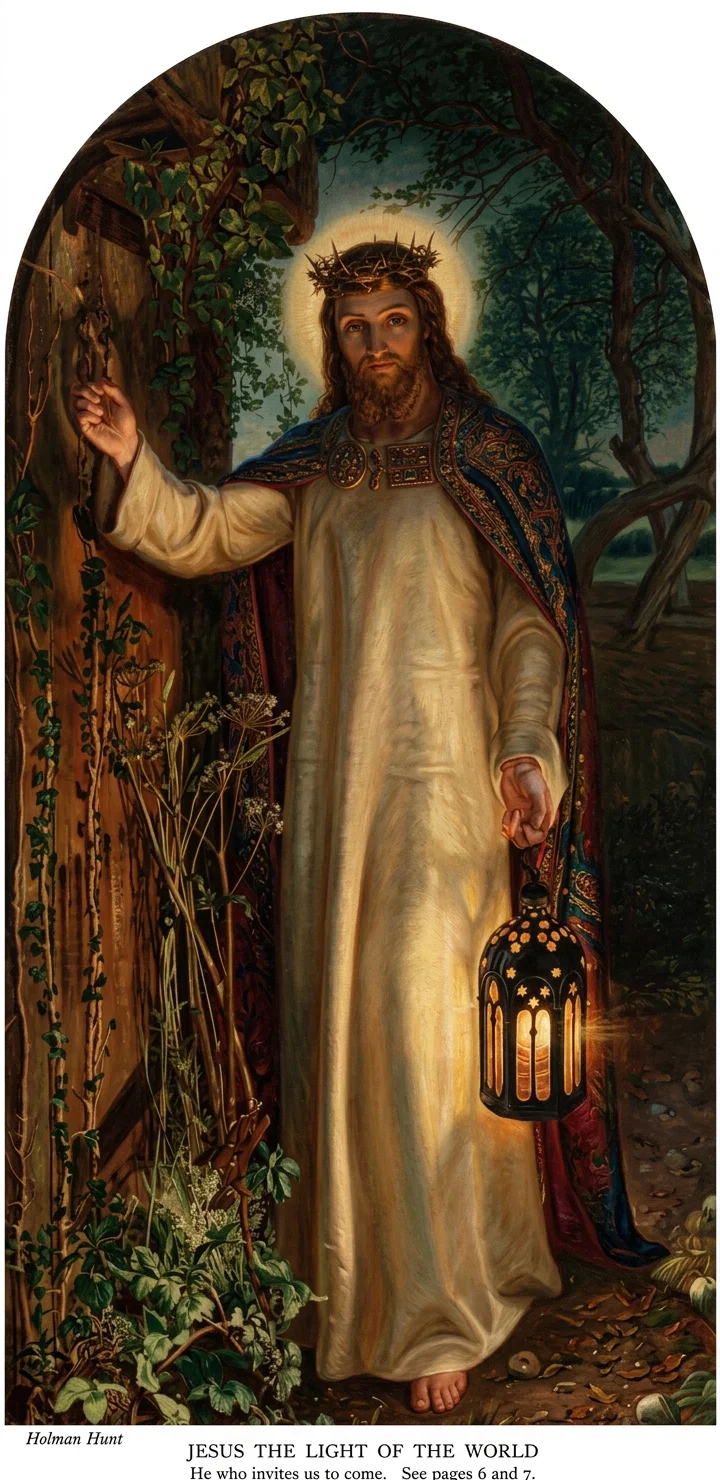
Holman Hunt JESUS THE LIGHT OF THE WORLD He who invites us to come. See pages 6 and 7.
How much more may we enjoy in life than that which we have enjoyed! In our present spiritual condition we have only a faint idea of what our life might become, of what our homes might be, if we would cultivate heavenly affections, and yield ourselves wholly to the service of God. We would live in joyful communion with God. Our human affections and sympathies are not to wane away and become extinct; but through living connection with God, our love is to deepen, our interest to become more intense, our efforts more successful in promoting the happiness of those around us. Through Jesus Christ, households are to have blissful harmony and unity, and parents are to live together in peace and love, neither speaking nor thinking evil one of another. Parents and children are to be kind, forbearing, forgiving, having their hearts softened by the grace of Christ.
The truth of heavenly origin received into the heart never makes its possessor coarse, rough, uncourteous, hard-hearted, and unsympathetic. The reception of the truth is to work a result exactly opposite to this. Its influence will encourage and strengthen the tender, finer feelings of human nature. Those who believe the truth, will reveal its influence in their daily life. They will have the mind of Christ. They will be affectionate parents, loving children, faithful friends, and agreeable associates. They will not feel that they have occasion to blush when they give expression to feelings of tenderness and sympathy to those of their own flesh and blood.
He who cherishes the softening, subduing influence of the love of God, will not be coarse and rough and unforgiving, revengeful and full of bitterness. The true Christian will make his home a type of the heavenly home, and this he can do only as he has the abiding love of Christ in his soul. Souls about us are perishing for sympathy which is never expressed. Many have a cold, stern manner, and do not hesitate to reprove, while they withhold all praise, and never give a word of commendation to brighten the pathway of those who serve them. As the heavenly home would not be a home of bliss without the presence of Christ, neither can the earthly home be a happy one without His abiding love. Let us heed the words of Christ, "If ye then be risen with Christ, seek those things which are above, where Christ sitteth on the right hand of God." If this injunction is obeyed from the heart, the life will be full of grace and peace, and our conversation will not consist simply of a set of dry phrases, but will bring happiness,peace, and joy to the members of the household. Thoughts and actions will reveal that we are in harmony with the divine will.
We shall be judged by our thoughts and words. There is need that we pray much, that all our thoughts may be brought into captivity to Jesus. We should hourly seek the grace of God, that our natural irritability of temper shall not overcome us, or our desire to have our own way make us brace ourselves against the work of God. We should educate ourselves after the divine order, that we may not tear down but build up the interests of humanity. The workers must not draw apart. They will have to meet discouragements from without; and not one who claims to be making up the breach in the law of God, building up the old waste places, restoring the foundations of many generations, should be found undoing the work that God has set His workmen to accomplish in different branches of His cause.
Cultivate confidence, love, and faith in one another. Let confidence be so thoroly grounded that your love one for another may not be easily chilled or turned aside. Cultivate good-will toward the children of God, and especially toward those whom God has sent to bear a special message to the world. Do not find fault with and cast reflections one upon another. If you see anything in the servants of God which seems to you unworthy of their high calling, let it not be a matter of discouragement to you, but let it be an incentive to reach a higher level.

SIGNS OF THE TIMES

"Even as we have been approved of God to be entrusted with the Gospel, so we speak; not as pleasing men, but God, who proveth our hearts."

The Early Christian and the Sabbath

By W. H. Bunch
THE relation sustained by the early Christian to the Sabbath of the Decalogue is a subject of absorbing interest to candid, conscientious students of both the Bible and history. The utter unreliability of nearly all the historians of that period touching this as well as all other matters of importance, makes doubly difficult the solving, from this source, at least, of any question affecting the practise of the true followers of the Saviour. Yet the diligent searcher for facts is amply rewarded for the time and the effort necessary to know definitely the attitude of those most directly influenced by Christ and His apostles to this now vital question. True Sabbath observance is dependent upon the spiritual condition of Christianity.
With the decline of spirituality, Sabbath observance suffered similarly, and finally almost ceased amid medieval darkness. It is very interesting to note that with the increase of knowledge relative to man's duty to his Maker, the Sabbath presents itself as a part of "the whole duty of man," and is one of the cardinal features of a message calling people to return to the "old paths" preparatory to the return to this earth of the Lord of the Sabbath, and our ability to greet Him with acclamations of joy.

The Sabbath in the First Century

The first clear-cut and unequivocal statement we have as to Christians observing the Sabbath, is placed in the year A.D. 31, and reads as follows: "And it was the day of the preparation, and the Sabbath drew on. And the women, who had come with Him out of Galilee, followed after, and beheld the tomb, and how His body was laid. And they returned, and prepared spices and ointments. And on the Sabbath they rested according to the commandment." Luke 23: 54-56, A.R.V.
This well-known inspired history is a record of events just following the death and burial of our Saviour. Let us notice briefly a few of the facts here presented. First, the women referred to were Christians. Second, one of them, His mother, probably knew more of His life and teachings than did even His chosen apostles. She more than any one else possible kept all His "sayings in her heart." Luke 2: 51.
From infancy to manhood and all through His ministry, she had watched and had been wonderfully influenced by His divine presence and teaching. She watched His death and the awe-inspiring scenes attending it. She, with the other women, followed Him to His place of interment, saw the arrangement of the body, and then spent the remaining hours of Friday preparing for the last service of love to One who occupied every affection of their devoted hearts. Why did they not repair at once to the tomb and anoint the body? Why wait till Sunday morning? The answer is most clearly given: "And on the Sabbath they rested according to the commandment." And the commandment says definitely, "The seventh day is the Sabbath of the Lord thy God; in it thou shalt not do any work."

Whence the Respect?

Whence came this seemingly unprecedented respect for the Sabbath, a respect which deferred for thirty-six hours an eager longing to visit the resting-place of their Lord and anoint His body with the precious ointments prepared by loving hands so long restrained by an influence transcending boundless gratitude or even parental affection? We are absolutely certain that it did not come from the example of the Jewish leaders and teachers; for these professed teachers and examples of God's truth for that age spent the sacred hours of that same Sabbath demanding of Pilate a guard, which they secured, and in placing it and sealing and making sure the tomb. Matt. 27: 62-66.
I again ask, From whom did those Christians receive these principles of Sabbath observance, from Jesus, or from the Jews?
Here we are presented with a marked reformation in relation to practises long formally adhered to by God's professed people, and for fully a century following this event Christianity was considered as nothing more than a reformed sect of Judaism.

Throughout the Empire

About the year A.D. 61 we get the following glimpse of the Christians in Rome, and so far as information is obtainable conditions were the same throughout the empire: "They wore no distinctive garb like the professors of philosophy; they continued to dwell in the midst of their unconverted countrymen, frequented their synagogs, and respected their Sabbaths. . . . Before Saint Paul came among them they can hardly have had a ministry, nor can we speak with certainty of any definite provision being made even by him at Rome for this distinctive badge of an independent religion. Christianity with them was eminently a doctrine rather than a ceremonial." —"History of the Romans," Merivale, volume 6, chapter 54, page 218.
This from the historian accords exactly with the inspired record as given in the Acts of the Apostles: "And Paul, as his custom was, went in unto them, and for three Sabbath days reasoned with them from the Scriptures." Acts 17: 2.

The Romans Classed Jews and Christians Together

The apostles and their fellow Christians had the same access to and the same privilege to use the synagogs as had other sects of the Jews. Merivale, in the chapter referred to above, shows clearly that the Jews and the Christians were considered by the Romans as one and the same people. Note the following:
"On the Christians, regarded as a remnant or revival of Judaism, Tacitus, it may be supposed, bestowed all the bitterness which a terrible war had engendered in Roman breasts against everything Jewish." "It should be noticed, to show how readily Tacitus might confound the Jews and the Christians, that he characterizes both in precisely the same remarkable terms."—Page 221.
Since Tacitus did most of his writing in the first two decades of the second century, it is manifestly evident that he still saw nothing in their observance that would justify his considering them as a separate people. In volume 6, "History of the Romans," the point is taken and clearly maintained that the so-called early persecutions of the Christians were in fact directed against the Jews, and only affected the Christians by their similarity of religious practises. In volume 7, page 488, this fact is thus briefly stated: "The first persecution of the Christians under Nero I have ascribed to popular indignation at the unruly temper of the Jews with whom they were at first confounded and by whom they were discovered and denounced."

The Sabbath a Distinguishing Mark

To show that the Sabbath especially distinguished the Jews in Rome as elsewhere from all other religionists, note conditions at an earlier date, before the charge of burning Rome and the Jewish war so embittered the Romans against them:
The first Cæsars secured to them the free exercise of their religion, countenanced their assemblies, made gifts to their temples, and even admitted them along with the citizens of the republic to a share in the largesses of corn; and if the distribution took place on their Sabbath, the Jews were allowed to apply for their share on the day following. The mysteriousness of their belief, or rather, perhaps, the earnestness of its devotees, exercised an extraordinary influence on the Roman mind. Amidst many public expressions of hatred and disgust, knights and senators still turned towards it with curiosity, interest, and awe. In Palestine rude centurions lowered their ensigns before its symbols, or built synagogs for its worshipers. In Rome thename of its first Expounder was held in honor, its sacred books were not unknown, the glorious imagery of their poetry was studied and reproduced. Men and women, the latter doubtless the most numerous, crowded its place of meeting, observed its holy days, and respected its antique traditions.—Volume 6, chapter 54, pages 204, 205.

But One Conclusion as to the Day

Since the Romans were so familiar with the Jewish faith and practise, and since they could not distinguish between Jew and Christian, but one conclusion can be reached by the candid student as to the attitude of the latter to the seventh-day Sabbath.
Heathen, Jews, and Christians alike looked upon Christianity as simply one of the many sects into which Judaism was divided. A careful study of the history of the first century will amply sustain the foregoing statement, while the following brief quotations leave but little if any doubt as to its truthfulness:
At first there would be no question in any quarter of the abandonment of ancient rites and usages. If a few more ardent or more tender spirits were at once captivated by the first shadowing forth of true Christian liberty, they would not dream as yet of seceding from the rest on matters of religious discipline.—Id., page 211.
Under date A.D. 81 this statement is made:
Many citizens of every rank had more or less openly addicted themselves to Jewish usages and tenets, and when a Jewish sect ventured to transfer its obedience from the law of Moses to the Gospel of Jesus Christ, the number of its adherents in the capital of the empire would seem to have embraced Jews, Greeks, and Romans in nearly equal proportions. Between these two branches of the same stem there reigned a deep antagonism, in which the government and the mass at least of the Roman people took no interest. When the jealousy of the government was excited against the Jews, indignant both at their turbulence and their proselyting spirit, they might involve the Christians in the common charge, or might, perhaps, divert it from themselves upon their rivals. When, however, after the great Jewish war, that jealousy was converted into settled hostility, both the Jews and the Christians would be placed under the same ban, and if the sword was retained in its scabbard, they would be sternly forbidden to exercise their spiritual influence upon the citizens around them or receive converts from the national religion into their ranks. Their exemption at this period from actual persecution might be secured by the demand that was made upon them for tribute. Both Jews and Christians undistinguished by the Roman government, were required to pay the double drachma, according to Vespasian's enactment, and if the Christian exclaimed against being thus confounded with a religion which they really renounced, those at least among them who were of Jewish extraction would be traced by the national token of circumcision.—Volume 7, chapter 67, pages 123, 124.
Just following the above quotation we are told that those claiming to be Christians, to avoid the penalties of Vespasian's enactment, were required to uncover, and their connection with Judaism was determined by the fact of their being or not being circumcised. If the Christians of that time were not observers of the Sabbath, would they have been thus closely confounded with the Jews? At the present time, would any one suggest the idea that Christianity is a sect of the Jews, or that the only way to disprove such a relation is by the rite of circumcision?
(To be concluded next week)

The Storms of Life

I WAS standing once with a friend on Staten Island, and he called my attention to a great storm-cloud gathering in its fury. When the lightnings began to flash and the thunders began to roll, we watched every little sailboat and rowboat and fishing-smack come hurrying to the shore, and just as the storm was bursting in its fury we saw a great old ocean steamer move out from the shore and steam out to sea right in the face of the storm. We saw her ride out to sea in safety. When the storms of life come upon us, the little fellows seek earthly shelters; but the Christian goes out on the bosom of God's love and mercy. The storms we can safely face are determined by the strength of our Christian character.—Sam Jones.

Bread upon the Waters

By Elizabeth Miller
WHAT did Jesus do when on earth? Did He go forth among His people as a great, proud, selfish king, thinking only of himself and slighting others? He "went about doing good." He threw out His good influence to those about Him; He gave of His best to others; He helped and healed them; He moved quietly among them as their friend and helper.
He preached to the multitudes in parables from the ship, on the mountainside. Wherever He found opportunity, He spoke, and they crowded round Him and listened. He cast His bread upon the waters, and many were converted, and that bread was found and returned to Him.
He met the woman of Samaria at the well, and seeing she was in need of water, spoke to her of the living water, of which if she drank, she would never thirst. Thus He cast His bread upon the waters, and she was made to believe.
Nicodemus came to Him by night, and asked what he must do to be saved. Christ in all patience told him he must be born again, born of the Spirit. Here He again cast His bread upon the waters, as He explained to Nicodemus, and helped him to understand and believe.
The rich young ruler asked what he must do to be saved. Christ told him to give to his needy brother a portion of his riches—to cast his bread upon the waters.
The Levite, seeing the poor beggar suffering by the roadside, left him, and passed by on the other side. The good Samaritan came that way, and stopped and helped him, and did him much good. He cast his bread upon the waters in giving of his kindness to others.
Then what else did Jesus do?—He healed a man sick of the palsy; He cleansed the leper; He raised Lazarus from the dead; He made the blind see and the lame walk. He turned water into wine; and out of the five loaves and two fishes He fed the great multitude of five thousand. He was continually casting bread upon the waters. The multitudes, seeing His great power and influence, began to believe on Him, and that bread returned to Him.
When Jesus sent His disciples forth into the world to preach, what did He tell them to do?—To go forth into the world and preach—to cast their bread upon the waters. He had helped others, and He wanted them to help others. He commanded them, as He commands us, "Go, and do thou likewise."
To cast our bread upon the waters, means to visit the sick neighbor, to feed the hungry at our door. If any thirsts, let us give him to drink. If we find any in need ofclothing, let us clothe him; for Jesus says, "Ye have the poor always with you; but Me ye have not."
With the sinner let us be patient and long-suffering and merciful. One word, or look, or smile that we might give to that poor sinner, might change that whole life for better. Remember the dying thief. How merciful Jesus was when He told him, "Thou shalt be with Me in Paradise"!
Why did Jesus, who was divine, go down there to the house of Simon the sinner and dine with him? Why was Jesus so humble?—Simply because He had a purpose. He was seeking for lost souls. He was friendly with them that He might save them. He cast His bread upon the waters, and saved many sinners.
When Christ gave Himself to suffer on the cross for sinners, He was casting bread upon the waters, and this bread returns to Him daily.
When we send our money to the mission field, we are casting bread upon the waters, but we know it will return to us after many days.
The missionaries who go forth into the foreign fields, make a great sacrifice. They give their lives for others. They cast their bread upon the waters; but they shall find it after many days, for great is their reward in heaven. Christ says, "Whosoever will lose his life for My sake shall find it." Then if we lose our life and our time for Him in this world, we shall find it; and when it returns to us it shall be life eternal.
We are sent into this world as God's messengers. We are here on business for Him. Our mission is that of Christ Himself when He was on earth, "not to be ministered unto, but to minister." "I shall pass through this world but once. Any good, therefore, that I can do, or any kindness that I can show to any human being, let me do it now. Let me not defer nor neglect it, for I shall not pass this way again."

Betrayed by Brothers

By Delwin Rees Buckner
Bones, scarred and sun-bleached, streak the burned, blazed sand, Each shivering skeleton a gruesome grave, Whose pale, wind-weared, fragile fragments pave The lean, parched path that leads to Pharaoh's land, O'er which a money-chinking merchant band Lash on a lagging, half-nude Hebrew slave, Loud chuckling at the paltry price they gave Into each brother's base, perfidious hand. Cruel, soulless brothers! As they stilly stare In glutted glee upon the ruby blood That splashes from the throat-embedded knife On Joseph's coat, they nothing are aware That some day he will furnish them with food, And be the savior of their famished life.
Continue reading: A Gathering and a Supper—No. 3