Your ShelfYour Projects

Review and Herald, Vol. 92, No. 16.

The Advent Review and Sabbath Herald

Review and Herald

Apr 1, 1915

Review and Herald Publishing Association · Takoma Park Station, Washington, D. C. · Apr 1, 1915

The Advent Review and Sabbath Herald

Vol. 92 Takoma Park Station, Washington, D. C., Thursday, April 1, 1915 No. 16

Eternal Springtime

Worthie Harris Holden
Spring, with its beauty, its song, and its mirth, Waking the joys of the jubilant earth, Heralds the gladness that waits us for aye, Dwelling in heaven's all-glorious day.
Banished forever this winter of woe, Exiled the chill of its ice and its snow, Free from the sorrow, the sin, and the care, Springtime eternal will bide over there.
Heaven holds all that's worth while and is true,— Pleasures enduring the long ages through. Work then today, for tomorrow ye rest, Bosomed in rapturous joy of the blest.
Portland, Oregon.

THE WORK AND THE WORKERS

REMEMBER you get a year's subscription free if you send in four yearly subscriptions for the Liberty Magazine, with $1.00. Single subscription is 35 cents.
THAT the Liberty Magazine is molding public sentiment among officials in high places has been made very apparent lately. Two judges of State supreme courts who have voluntarily subscribed for the Liberty Magazine, and have expressed their thanks for its visits in the past, have declared the Sunday laws in their States unconstitutional. Leading citizens of Prince Georges County, Maryland, have appealed to the Religious Liberty Department to assist them in launching a campaign in the State of Maryland for the repeal of the Sunday blue laws. Six Sunday bills before Congress and scores of Sunday bills before the State legislatures have been defeated by men who are constant readers of the Liberty Magazine and stanch supporters of our principles. The editor is receiving most interesting letters from judges, lawyers, senators, representatives, and ministers, which express high appreciation of the principles advocated in the journal.
DURING the first twelve days of the March Protestant Magazine campaign, 18,625 copies of this great "Congressional Free Press Hearing" number were sent out.
FOR 15 cents in stamps the publishers will mail 10 copies of the Free Press Extra of the Protestant Magazine to as many different addresses. Get your church missionary society to raise $15.00 to have this Extra mailed by the publishers to 1,000 legislators, Congressmen, judges, editors, attorneys, councilmen, teachers, and other molders of public opinion. Help to teach the teachers of men.
A PROMINENT attorney of Oakland, Cal., writes the following illuminating letter to the Protestant Magazine:
"I have been receiving the Protestant Magazine for the last four months, and have occasionally glanced it over, and I herewith request that you discontinue sending it to me. Inclosed you will find stamped and addressed envelope, in which I hope you will inclose the name and address of the person who sent in the subscription for me. I am surprised, at this advanced stage of development, that one religion would use a magazine for the main purpose of condemning another by the publication of articles which appeal to and have their force with the ignorant and uninformed. Discontinue sending the magazine to me at once, and kindly send me the name of the person who sent in the subscription for me."
It is needless to say that we HAVE NOT sent this Roman Catholic gentleman the name and address of the giver of this subscription. We always forward information of this kind to those donating the subscription, and leave it to them for disposition. So do not hesitate to send in subscriptions for either Romanists or Protestants. Five for six months will cost you only $1.50.
THE full report of the hearing on the postal bills printed in the March issue of the Protestant Magazine has proved to be very interesting to many readers. Elder J. W. Christian, field evangelist of the Central Union Conference, reports his experience as follows:
"I received the Protestant Magazine the evening after the Sabbath and sat down to read. I was so interested in its contents that I did not lay the magazine down until I had read it from cover to cover. May the Lord richly bless you in the open warfare you are waging against the efforts to deny us our liberties and rights."
EDITOR D. S. PHELAN, of the Western Watchman (Roman Catholic), says in his issue of February 25: "The bill introduced in Congress by Mr. Fitzgerald . . . needs careful study; for, if enforced, it would exclude the Watchman from the mails. We have love, sympathy, and respect for Protestants, but only withering scorn for their religion." In his paper for Dec. 24, 1908, however, he said: "The church has persecuted. Only a tyro in church history will deny that. . . . We have always defended the persecution of the Huguenots, and the Spanish Inquisition. . . . When she thinks it good to use physical force, she will use it. . . . But will the Catholic Church give bond that she will not persecute at all? Will she guarantee absolute freedom and equality of all churches and all faiths? The Catholic Church gives no bonds for her good behavior." Should not the citizens of the United States read and circulate the Protestant Magazine? Send 25 cents for 5 copies of the March number, or $1.00 for 20, or $2.00 for 50.

THE WORLD'S CRISIS

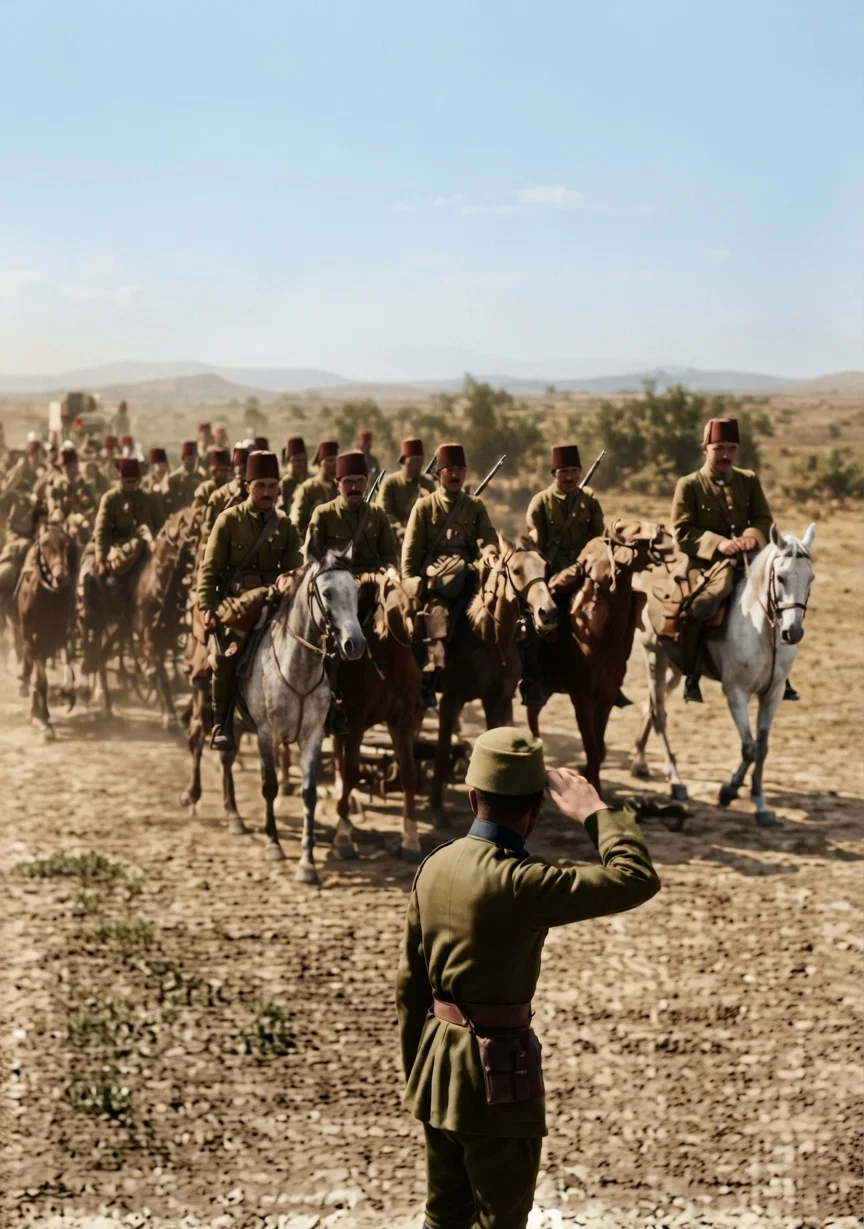
TURKISH CAVALRY ON THE MARCH
"The World's Crisis" was published to meet a special issue produced by the greatest war in the history of the world. It gives a careful consideration of the Eastern Question and the fundamentals of our faith, and bristles with illustrations of war preparations and scenes at the front, as well as Bible pictures.
The demand for information on the prophecies, and the interest manifested in the teachings of Seventh-day Adventists since the beginning of the hostilities, furnish the best opportunities for missionary activity ever presented to our people.
The fact that about 100,000 copies of this book were distributed during the first two months of its sale indicates the favor with which it is received. Men, women, and children who never had experience in the sale of literature are disposing of from 5 to 100 copies a day. In fact, the unprecedented reports which are coming in from all parts of the field indicate success never even anticipated in our book work.
The book is printed on heavy paper, has an attractive cover design, and contains 128 pages. Price, 25 cents. Subscription book discounts.

Honor Due to God

Two Signs of Divine Sovereignty

GOD did not create this world, assign it an orbit, place man upon it, and then leave the earth to itself, and leave man to follow the inclinations of his own unrestrained and untutored will. God is not only the author of all things, but he is likewise the supreme ruler, "a great King over all the earth." Ps. 47: 2.
When the earth was called into being, the Lord set apart the seventh day as the memorial of his power to create. By keeping that day, man would be preserved from falling into idolatry, and would recognize God's sovereignty, especially as to time. Says the psalmist: "I trusted in thee, O Lord: I said, Thou art my God. My times are in thy hand." Ps. 31: 14, 15.
It is true we are told that "the earth hath he given to the children of men;" but that this gift was not made in a way nor to such an extent as to make man independent of the Creator, is further evident from the fact that in the garden of Eden the Lord reserved to himself one tree, "the tree of the knowledge of good and evil." By respecting this tree and the prohibition against partaking of its fruit, or even touching it, our first parents were to acknowledge God's ownership, not only of that particular tree, but of themselves and the earth. The principle is well illustrated by a bit of colonial history.
In Harper's "Encyclopedia of United States History," article "Baltimore," we find this statement concerning the grant of Maryland to Cecil Calvert: "Entire exemption from [Royal] taxation was conceded to the colonists." But "as an acknowledgment that the original title to the land was still in the possession of the crown, the proprietor was required to pay to the king the tribute of two Indian arrows" annually.
Intrinsically the two Indian arrows were of only infinitesimal value, but a mighty principle was involved. It was not a question of the value of the tribute, nor of the king's need of the arrows, nor of his ability to turn them to account, but was entirely a question of the recognition of the right of the crown to exact tribute at all. As long as the two arrows were paid annually to the king, his sovereignty was acknowledged; but as soon as such payment was withheld, either wantonly or through neglect, there was a denial of the sovereignty that exacted them.
In like manner when God's tree was violated, his sovereignty was challenged; but it was not surrendered. Man, the sinner, the rebel, was expelled from the garden, and was sent forth to till the ground whence he was taken. Naturally he carried with him the knowledge of the Sabbath; but the tree of the knowledge of good and evil he could not take with him, except as a memory. Men could therefore no longer acknowledge God's continued ownership by refraining their hands from that tree. Therefore God gave them another means by which to show their loyalty to their Creator as proprietor; namely, the payment of a tithe of their increase.
As the tithe takes the place of the tree of the knowledge of good and evil, to withhold it is to deny God's right to exact it; in other words, to deny his sovereignty, just as to have withheld the two arrows would have been a denial of the sovereignty of the king of England by Lord Baltimore.
Primarily the tithe stands for God's ownership, and for his right to rule. It is not a question of God's need, nor of his ability to turn the tithe to account, but wholly of his right to require the payment of the tithe.
With the entrance of sin came the necessity of a system of sacrificial worship, and after men began to multiply, the further necessity of a ministry, or priesthood. But even when there was no priesthood of which we have any record, no ministry to be supported, there was, in some instances at least; a recognition of God's ownership by the payment or setting apart of the tithe as sacred to his service.
In Gen. 14: 18-20 we learn that Abraham paid tithes to "Melchizedek king of Salem," and "priest of the most high God," and this under peculiar and interesting circumstances. Abraham was returning from his rescue of Lot, laden with the spoils of war. Melchizedek met him, set forth bread and wine for his refreshment and the refreshment of those who were with him, and blessed him, saying: "Blessed be Abram of the most high God, possessor of heaven and earth: and blessed be the most high God, which hath delivered thine enemies into thy hand." And Abraham "gave him tithes of all."
This payment was not made because of Melchizedek's need, but because it was due to the God at whose altar he ministered. Here, then, was a most striking recognition of divine ownership, and of the Creator's abiding sovereignty.
At Bethel, apart from any priest or priesthood, so far as we know, "Jacob vowed a vow, saying, If God will be with me, and will keep me in this way that I go, and will give me bread to eat, and raiment to put on, so that I come again to my father's house in peace; then shall the Lord be my God: and this stone, which I have set for a pillar, shall be God's house: and of all that thou shalt give me I will surely give the tenth unto thee." Gen. 28: 20-22. How or to whom Jacob paid this tithe we are not told; but the fact remains that he recognized the obligation and pledged compliance therewith.
The book of Genesis is a very brief history of the earth for more than two thousand years. The surprising thing is not that it tells so little, but that it contains so much. We are told of God's rest at the close of the creation week, but no further mention is directly made of the Sabbath until we come to the fifth of Exodus. The frequent recurrence, however, of the number seven, and the mention of weeks of seven years, afford unmistakable evidence that the people of that day were familiar as well with the week of seven days.
We learn also that the first thing Moses did when God sent him to lead the children of Israel out of Egypt was to call them back again to the Sabbath of their fathers, which their Egyptian taskmasters had not permitted them to observe. Thus we find Pharaoh complaining to Moses in Ex. 5: 5: "Behold, the people of the land now are many, and ye make them rest [shabath] from their burdens." Literally Pharaoh charged Moses with having made the people to keep Sabbath. Young's Analytical Concordance defines shabath thus: "To cease, rest, keep Sabbath." Therefore what Moses did was to restore to the people the well-nigh forgotten Sabbath. A little later, when the law was given from Sinai and the tabernacle service was established, thepractice of devoting the tithe to the service of God in recognition of his sovereignty and of the further honor due to him as owner of all things, was also restored to the people.
Thus we see that these two signs of loyalty are very closely connected. The one is a memorial of Jehovah as Creator, the other an acknowledgment of his continued proprietorship; or, to use the phraseology of the historian as nearly as may be, we might say, the payment of the tithe is an acknowledgment that the original title to the earth is still in possession of the Crown of the universe, and that man holds it only as a tenant at will.
In the law given at Sinai we find embosomed the words, "The seventh day is the Sabbath of the Lord thy God." The Lord speaking through the prophet in the fifty-eighth of Isaiah, styles the Sabbath, "My holy day." In Eze. 20: 12 he declared the Sabbath to be the sign of his sanctifying or creative power; and again in verse 20 he sets it forth as the sign that he is God; in other words, it is the symbol of his right to rule as Creator; and those who keep it thereby acknowledge him and march under his banner.
Coming to the New Testament, we find the Saviour declaring himself "Lord also of the Sabbath day." Mark 2: 28. And in Rev. 1: 10, John, speaking by inspiration, tells us that he "was in the Spirit on the Lord's day," which could be none other than the "Sabbath of the Lord." Thus the Sabbath runs not only all through the Old Testament, but in like manner all through the New Testament. And whether in the Old or in the New, it is the badge, or sign, of creative power; for, as the apostle says in 2 Cor. 4: 6, the same God "who commanded the light to shine out of darkness, hath shined in our hearts, to give the light of the knowledge of the glory of God in the face of Jesus Christ."
In like manner, when the Creator restored to his people whom he had led out of Egypt, the original forms of divine worship given after the fall to our first parents at the gate of the garden of Eden, he connected with that worship the payment of the tithe as at once a recognition of his proprietorship, and a means of sustaining the priests, his ministers; hence the solemn and sweeping declaration: "All the tithe of the land, whether of the seed of the land, or of the fruit of the tree, is the Lord's: it is holy unto the Lord." Lev. 27: 30.
True, the law of the tithe is not one of the original "ten words" spoken from Sinai; but, as we learn from Mal. 3: 8, it is of moral obligation, since to withhold the tithe is robbery, and that not of man, but of God.
As the Sabbath was brought over into the New Testament, not as something either new or reenacted, but as a well-known moral institution, accepted as a matter of course, so we find tithing also brought over and made a part of the gospel system.
Speaking of the practice of the scribes and Pharisees in tithing common garden herbs, "mint and anise and cummin," while neglecting "judgment, mercy, and faith," our Lord said, "These ought ye to have done, and not to leave the other undone." Matt. 23: 23. In paying tithe even upon these small things, they were doing no more than their duty, discharging a moral obligation in giving to God his own; but faithfulness in this was no excuse for the neglect of still weightier matters.
In connection with the church at Jerusalem we find no mention of tithe paying, since the believers there gave not only a tithe, but after giving themselves they gave all that they had to the Lord; and this was true to quite an extent of many other of the earlier congregations of Christians.
But in 1 Cor. 9: 7-14, we find the apostle Paul discussing this very question; namely, the support of the gospel minister; and after showing the reasonableness of the arrangement, he says: "Do ye not know that they which minister about holy things live of the things of the temple [that is, of the tithe]? and they which wait at the altar are partakers with the altar? Even so hath the Lord ordained that they which preach the gospel should live of the gospel."
"Even so" means in the same way. As during the Jewish age the priests of the Levitical system lived from the tithe which their brethren paid into the temple treasury, so the gospel ministers in the Christian dispensation are to live from the tithe which their brethren pay into the Lord's treasury.
But perhaps the plainest, most pointed scripture, at once inculcating the duty and emphasizing the privilege of honoring God by the payment of the tithe in the Christian dispensation, is the third chapter of Malachi. This chapter is, as all readily admit, a prophecy, not of the Levitical but of the Christian system. It opens with a reference to the message of John the Baptist, and closes with the work of the investigative judgment, which, as the reader knows, determines who from among both the dead and the living shall be changed to immortality and be caught up to meet the Lord in the air at his second coming.
Between the first and last verses of this chapter we have the work of Christ himself in his three years and a half of earthly ministry, and the call to repentance preached first by John, then by our Lord himself, and finally by his ministers from the sending forth of the seventy down until the last gospel invitation shall be given.
Though this scripture is phrased in the language of the Old Testament, speaking of "Judah," of "Levi," of "Jerusalem," and of "Jacob," we know that "he is not a Jew, which is one outwardly; neither is that circumcision, which is outward in the flesh: but he is a Jew, which is one inwardly; and circumcision is that of the heart;" for "if ye be Christ's, then are ye Abraham's seed, and heirs according to the promise." Rom. 2: 28, 29; Gal. 3: 29.
Except for the work of John, the scene of this third of Malachi is laid in the new dispensation, and the repentance called for is in view of the second coming of the Lord and the final judgment. Yet one of the chief sins charged against God's people, and of which they are to repent, is withholding the Lord's tithe: "Return unto me, and I will return unto you, saith the Lord of hosts. But ye said, Wherein shall we return? Will a man rob God? Yet ye have robbed me. But ye say, Wherein have we robbed thee? In tithes and offerings. . . . Bring ye all the tithes into the storehouse, . . . and prove me now herewith, saith the Lord of hosts, if I will not open you the windows of heaven, and pour you out a blessing, that there shall not be room enough to receive it." Mal. 3: 7-10.
Following the text just quoted is an enumeration of the promised blessings and a summary of the weak defense made by some, of their wrong course in withholding tithes and offerings from the Lord's treasury. Then comes the gathering of God's people in preparation for the last great crisis; God's acceptance of their worship, and the coming of the Lord to make up his jewels. A most precious chapter, filled with most precious promises and leading up to the grand consummation of the Christian's hope!
May both reader and writer be among those who shall at last hear the welcome words, "Well done, good and faithful servant; thou hast been faithful over a few things, I will make thee ruler over many things: enter thou into the joy of thy Lord." But can we hope ever to hear this welcome plaudit if we refuse or even neglect to render to God the honor due to him both as Creator and as proprietor of all things?
"He that is faithful in that which is least is faithful also in much: and he that is unjust in the least is unjust also in much. If therefore ye have not been faithful in the unrighteous mammon, who will commit to your trust the true riches? And if ye have not been faithful in that which is another man's, who shall give you that which is your own? No servant can serve two masters: for either he will hate the one, and love the other; or else he will hold to the one, and despise the other. Ye cannot serve God and mammon." Luke 16: 10-13.

The Age-to-Come Doctrine

No. 4

Extent and Power of the New Covenant

IN order to maintain the theory of a second probation following Christ's second coming, Pastor Russell denies the plain statement of 2 Peter 3:10, that in connection with the Lord's coming the earth and all its contents will be "burned up." The ground of his denial is that, according to Scripture, the earth must stand forever. See "Studies in the Scriptures," Series One, page 69. This statement of Peter, he declares, is buta symbolism, referring simply to the customs and habits of present society, which are to give way to a new order of things, even to a society reorganized in harmony with earth's new Prince—the Lord Christ.
It would seem that ardor to maintain a peculiar theory has, in this case, blinded the mind to the general trend of the apostle's view; for in the chapter cited he expressly states that the very elements composing the earth are to be "melted" in the last-day fires (verse 12), but that notwithstanding this, new heavens and a new earth are to appear, in which righteousness will dwell. Here the moral and physical are classified as different. The physical elements of earth, he says, are doomed to give way to new and untainted constituents, in which righteousness, the moral principle, may forever dwell. Verse 13. Certainly, in the scripture under consideration, unerring inspiration could not have stated the matter clearer to give the thought of an exchange of material worlds.
The words of the revelator, also, entirely agree with the plain language of Peter. He says that he saw a new heaven and a new earth following the first elements, which had been consumed. In proof of his reference to material things, he adds, "And there was no more sea." Rev. 21:1. This, too, is in harmony with the voice of the prophets. The Lord, through Zephaniah, has said, "I will utterly consume all things from off the face of the land." Zeph. 1:2, margin. That this reference is to the second coming of Christ is revealed in verses 14-18. The same sentiment is uttered by Joel, in the second chapter of his book. Jeremiah, also, in describing that time, says that the earth was seen to be "without form, and void," and all the cities "broken down at the presence of the Lord." He then adds, "The whole land shall be desolate; yet will I not make a full end." Jer. 4:19-27.
Thus the earth is once more to be reduced to chaos, as at the beginning, yet that is not to be its "full end." But as the first formless and empty creation was changed by the Spirit of God into order and beauty (Gen. 1:2), so out of the molten elements of the old earth (2 Peter 3:10-13) there will come the renewed residence of righteous inhabitants. See also Isa. 65:17-19. So while the earth is to abide forever (Eccl. 1:4), it must undergo a cleansing from the curse of sin, which will constitute it a "new earth," fit for the redeemed to dwell in, as was at first intended.
God's arrangements are all after this order, to the end that his eternal purpose may not be thwarted. Likewise the "new covenant" is but the renewal, through Christ, of that covenant made at the beginning in man's behalf, and is defined in Bible terms as the "everlasting covenant." So when Christ died for all, he offered in behalf of "every man" the blood of the everlasting covenant (Heb. 13:20), which was designed to cover the needs of the most remote individual.
This covenant was more or less intelligently known to each generation from the beginning. Had there not been some comprehended arrangement of obedience and salvation, no condemnation could have followed any deviation from God's will. Heaven never put forth more than one test of morality, and that one is yet, as it ever has been, the law of Jehovah. Rom. 3:20. Without this law, said the apostle, "I had not known sin." Rom. 7:7. Christ, who is the image and representative of God, being the same yesterday, today, and forever (Heb. 12:8), could never have held Adam as a sinner needing atonement, except he had been made fully aware of God's standard of unity with the divine.
This standard, too, must have been according to some well-defined covenant between the Father and the Son, for the regulation of the creature's conduct. In fact, this covenant must also have been ratified by the promise of Christ's offering for the redemption of forfeited life, even before the first man became a sinner, and thus lost his hold on his great life gift. In accordance with this excessive need, Christ became a "Lamb slain from the foundation of the world." Rev. 13:8. But even this arrangement could not have been effected without a previous agreement between the Father and the Son. Such a covenant was actually consummated "before the foundation of the world," in which Christ, as a Lamb without blemish, was foreordained to die for man. 1 Peter 1:19, 20. So "in the fullness of time" he was "made of a woman" and under the law, to taste death, unto redemption, for every one who was under the law. Gal. 4:4, 5.
Father Adam, with all others, was included in this wonderful provision, and this fact is evidence that he was eligible to all the blessings of that everlasting covenant previously perfected between the Father and his Son. Therefore the terms of perpetual life, as well as the consequence of disobedience, must have been clearly set before the first pair in Eden. So Adam accepted the conditions and responsibility of Edenic life, fully understanding the stipulations under which he might continue therein or be subjected to death. Gen. 2:15-17. In other words, he entered upon his career under the terms of the everlasting covenant, which had been ratified and sealed by the promise of Christ's offered blood, which was to be given in "due time." 1 Tim. 2:5, 6.
Speaking later of Israel's human tendency to sin, though having been planted the "choicest vine" and closely hedged about (Isa. 5:1-4), the Lord says that "they like men ['like Adam,' margin] have transgressed the covenant." Hosea 6:7. But though Adam so transgressed, the covenant itself was not made void. However, as earth's inhabitants increased, they became so corrupt that every imagination of the mind was only evil, and God said that his Spirit would soon cease to strive with them. Gen. 6:3, 5. But he called Noah, and after reminding him of the terrible condition of things, commissioned him to build an ark in which to save himself and family. The threatened flood having passed, God said to Noah: "I will establish my covenant with you; . . . I do set my bow in the cloud, . . . and I will look upon it, that I may remember the everlasting covenant between God and every living creature." Gen. 9:11-16.
In time corruption again poured into human hearts, beclouding the condition and promises of the everlasting covenant, when it became necessary again to renew that arrangement with humanity. To this end Abraham was called, under Christ, to become the head of God's people on the earth, as was Adam in the beginning (Rom. 4:11-13); and this is the way it was done: God said to him, "I will establish my covenant between me and thee and thy seed after thee in their generations for an everlasting covenant, to be a God unto thee, and to thy seed after thee." Gen. 17:7.
In view of this, what folly to base an argument for a post-mortem probation on the supposition that the people of past ages had no benefit from any saving arrangement. The spilling of Christ's blood was but the renewal and confirmation of the same everlasting covenant established with Abraham, and it was done by him as the "Seed of Abraham," in whom and to whom the promises were made. The covenant was renewed in Christ as a repetition of its renewal in Noah and Abraham, for one reason, because its provisions had been lost sight of through the hardness of heart; but for another and still greater reason, that Christ was the "Seed" to whom the promise of that covenant was made. Gal. 3:16, 17. Whoever, therefore, really unites himself to Christ, being born again through his Spirit, becomes the seed of Abraham, and heir according to the same promise given to Abraham and his seed. Gal. 3:29. This certainly establishes the fact that everybody in past ages had the opportunity to lay hold of the one common plan of salvation if he chose to do so. The provision was made for those people, and the fact that some did not accept it only reveals that they are not now to be considered in some special arrangement for their willful neglect.
Glendale, Cal.

The Voice of Faithful Warning

THE accession of Ahaz to the throne brought Isaiah and his associates face to face with conditions more appalling than any that had hitherto existed in the realm of Judah. Many who had formerly withstood the seductive influence of idolatrous practices, were now being persuaded to take part in the worship of heathen deities. Princes in Israel were proving untrue to their trust; false prophets were arising with messages to lead astray; even some of the priests were teaching for hire. Yet the leaders in apostasy still kept up the forms ofdivine worship, and claimed to be numbered among the people of God.
The prophet Micah, who bore his testimony during those troublous times, declared that sinners in Zion, while claiming to "lean upon the Lord," and blasphemously boasting, "Is not the Lord among us? none evil can come upon us," continued to "build up Zion with blood, and Jerusalem with iniquity." Micah 3:11, 10.
Against these evils the prophet Isaiah lifted his voice in stern rebuke: "Hear the word of the Lord, ye rulers of Sodom; give ear unto the law of our God, ye people of Gomorrah. To what purpose is the multitude of your sacrifices unto me? saith the Lord. . . . When ye come to appear before me, who hath required this at your hand, to tread my courts? . . . Your new moons and your appointed feasts my soul hateth: they are a trouble unto me; I am weary to bear them. And when ye spread forth your hands, I will hide mine eyes from you: yea, when ye make many prayers, I will not hear." Isa. 1:10-15.
Inspiration declares, "The sacrifice of the wicked is abomination: how much more, when he bringeth it with a wicked mind?" Prov. 21:27. The God of heaven is "of purer eyes than to behold evil," and cannot "look on iniquity." Hab. 1:13. It is not because he is unwilling to forgive, that he turns from the transgressor; it is because the sinner refuses to make use of the abundant provisions of grace, that God is unable to deliver from sin. "The Lord's hand is not shortened, that it cannot save; neither his ear heavy, that it cannot hear: but your iniquities have separated between you and your God, and your sins have hid his face from you, that he will not hear." Isa. 59:1, 2.
Solomon had written, "Woe to thee, O land, when thy king is a child!" Eccl. 10:16. Thus it was with the land of Judah. Through continued transgression, her rulers had become as children. Isaiah called the attention of the people to the weakness of their position among the nations of earth; and he showed that this was the result of wickedness in high places. "Behold," he said, "the Lord, the Lord of hosts, doth take away from Jerusalem and from Judah the stay and the staff, the whole stay of bread, and the whole stay of water, the mighty man, and the man of war, the judge, and the prophet, and the prudent, and the ancient, the captain of fifty, and the honorable man, and the counselor, and the cunning artificer, and the eloquent orator. And I will give children to be their princes, and babes shall rule over them. . . . For Jerusalem is ruined, and Judah is fallen: because their tongue and their doings are against the Lord, to provoke the eyes of his glory." Isa. 3:1-8.
"They which lead thee," the prophet continued, "cause thee to err, and destroy the way of thy paths." Verse 12. During the reign of Ahaz this was literally true: for of him it is written: "He walked in the ways of the kings of Israel, and made also molten images for Baalim. Moreover he burnt incense in the valley of the son of Hinnom;" "yea, and made his son to pass through the fire, according to the abominations of the heathen, whom the Lord cast out from before the children of Israel. And he sacrificed and burnt incense in the high places, and on the hills, and under every green tree." 2 Chron. 28:2, 3; 2 Kings 16:3, 4.
This was indeed a time of great peril for the chosen nation. Only a few short years, and the ten tribes of the kingdom of Israel were to be scattered among the nations of heathendom. And in the kingdom of Judah also the outlook was dark. The forces for good were rapidly diminishing, the forces for evil multiplying. The prophet Micah, viewing the situation, was constrained to exclaim: "The good man is perished out of the earth; and there is none upright among men." "The best of them is as a brier: the most upright is sharper than a thorn hedge." Micah 7:2, 4. "Except the Lord of hosts had left unto us a very small remnant," declared Isaiah, "we should have been as Sodom, and we should have been like unto Gomorrah." Isa. 1:9.
In every age, for the sake of those who have remained true, as well as because of his infinite love for the erring, God has borne long with the rebellious, and has urged them to forsake their course of evil, and return to him. "Precept upon precept; line upon line; . . . here a little, and there a little" (Isa. 28:10), through men of his appointment, he has taught transgressors the way of righteousness.
And thus it was during the reign of Ahaz. Invitation upon invitation was sent to erring Israel to return to their allegiance to Jehovah. Tender were the pleadings of the prophets; and as they stood before the people, earnestly exhorting to repentance and reformation, their words bore fruit to the glory of God.
Through Micah came the wonderful appeal: "Hear ye now what the Lord saith; Arise, contend thou before the mountains, and let the hills hear thy voice. Hear ye, O mountains, the Lord's controversy, and ye strong foundations of the earth: for the Lord hath a controversy with his people, and he will plead with Israel.
"O my people, what have I done unto thee? and wherein have I wearied thee? testify against me. For I brought thee up out of the land of Egypt, and redeemed thee out of the house of servants; and I sent before thee Moses, Aaron, and Miriam.
"O my people, remember now what Balak king of Moab consulted, and what Balaam the son of Beor answered him from Shittim unto Gilgal; that ye may know the righteousness of the Lord." Micah 6:1-5.
The God whom we serve is long-suffering: "his compassions fail not." Lam. 3:22. Throughout the period of probationary time his Spirit is entreating men to accept the gift of life. "As I live, saith the Lord God, I have no pleasure in the death of the wicked: but that the wicked turn from his way and live: turn ye, turn ye from your evil ways; for why will ye die?" Eze. 33:11. It is Satan's special device to lead man into sin, and then leave him there, helpless and hopeless, fearing to seek for pardon. But God invites, "Let him take hold of my strength, that he may make peace with me; and he shall make peace with me." Isa. 27:5. In Christ every provision has been made, every encouragement offered.
In the days of apostasy in Judah and Israel, many were inquiring, "Wherewith shall I come before the Lord, and bow myself before the high God? shall I come before him with burnt offerings, with calves of a year old? Will the Lord be pleased with thousands of rams, or with ten thousands of rivers of oil." The answer is plain and positive: "He hath showed thee, O man, what is good; and what doth the Lord require of thee, but to do justly, and to love mercy, and to walk humbly with thy God?" Micah 6:6-8.
In urging the value of practical godliness, the prophet was only repeating the counsel given Israel centuries before. Through Moses, as they were about to enter the Promised Land, the word of the Lord had been: "And now, Israel, what doth the Lord thy God require of thee, but to fear the Lord thy God, to walk in all his ways, and to love him, and to serve the Lord thy God with all thy heart and with all thy soul, to keep the commandments of the Lord, and his statutes, which I command thee this day for thy good?" Deut. 10:12, 13.
From age to age these counsels were repeated by the servants of Jehovah to those who were in danger of falling into habits of formalism, and of forgetting to show mercy. When Christ himself, during his earthly ministry, was approached by a lawyer with the question, "Master, which is the great commandment in the law?" Jesus said to him, "Thou shalt love the Lord thy God with all thy heart, and with all thy soul, and with all thy mind. This is the first and great commandment. And the second is like unto it, Thou shalt love thy neighbor as thyself. On these two commandments hang all the law and the prophets." Matt. 22:36-40.
These plain utterances of the prophets and of the Master himself should be received by us as the voice of God to every soul. We should lose no opportunity of performing deeds of mercy, of tender forethought and Christian courtesy, for the burdened and the oppressed. If we can do no more, we may speak words of courage and hope to those who are unacquainted with God, and who can be approached most easily by the avenue of sympathy and love.
(To be concluded)
Continue reading: The Spiritual Plot of Life