INTENSITY is taking hold of all enterprises. The age is one of rapid development, with a correspondingly rapid decay. We are hastening into a different existence at a rate greater than that at which the earth speeds its ceaseless track around the sun. Men feel the pressure, and with startled feelings ask, Whither are we tending? A future life must be one of progress. The thought of an eternity of rest, as conceived and sung years ago, fails to meet with approbation from those who in this life have found pleasure in the pursuit of knowledge.
Our God is a God of infinite truth, and His nature offers opportunity for endless ages of development. We shall grow up into that full stature not suddenly, but in all probability in some gradual way, as we develop here, except that traces of sin and all drawbacks to perfect maturity will then be removed.
If our mental culture shall be carried on in the future life, and the scattered threads shall then be gathered to begin where progress ceases here, it offers to us a grand incentive to begin aright a course of training on earth which will continue throughout eternity. Should you consider the idea visionary, remember only that it was for such a reason that the Master Artist placed in man's hand that key to divine work—His Word—and so profusely illustrated all His doings in the great picture presented in nature. Coming to these two sources, the divine Word and divine works,—the Bible and nature—we have the means of unlocking heaven's storehouse of wisdom.
From time immemorial man's attention has been called to these same two sources for his knowledge of those things which elevate and uplift. One of three things has always been the result: Either man, taking nature alone, has fallen into pantheism, and, holding the created so near his eye, has been blinded to the Creator; or, casting aside nature and the Word, has drifted, like the bark on the wide ocean without compass, whither he knew not, darkness unutterable being the result; or, as has been done for a short time at widely-separated periods of earth's history, the Bible and nature, with God's Word as the interpreter, have been placed in proper settings, raising men from degradation to life everlasting.
It is toward this latter course that minds are now turning. I would not say that all who now feel the need of improved methods realize where the irrepressible strivings of the heart would lead them, but efforts are now on foot, which, if rightly directed, will surely lead to a reconstruction of the entire system of education.
Christ is spoken of by the prophet Haggai as the 'Desire of all nations.' Men long for relief, and could they but know it, that longing is a call to the Saviour's side. Pride keeps them from Him, for say they, 'Is not this Jesus of whom they speak, the son of Joseph, the carpenter, whom we all know?'
So in educational circles a pressure is being brought to bear which, yielded to, will place man on a road which leads to methods of education as eternal as the throne of God. Take heed lest they be treated as the Christ. Presumption, do you think? There is often but a line between faith and presumption; while warned against the one, we are exhorted to exercise the other.
The history of education shows that when faith has been the guiding star, national progress and intellectual growth have been the result. We beat like restless waves against difficulties which can be easily overcome by using proper methods.
Of late there has been a strong movement toward correlation of various branches in order to so bring subjects before the minds of children that their utility may be seen. Thus, Jackman is the author of an excellent work on nature study, adapting his object lessons to the seasons, developing his mathematics from the contemplation of natural phenomena, and leading the children to put into use known facts. Institutes are held to promote such methods, and much has been and is being done, but is it satisfactory? Has the secret been solved, or is there a hidden mystery yet to be revealed, which, when seen, will put life and power into that which is now but form?
Adam, when formed of clay, a perfect physique, lay before the Master Artist; the face, the limbs, every organ, ready for use; but gazing on it, Heaven saw no life. 'Twas but a useless thing, a piece of crumbling earth. God breathed into its nostrils. O wondrous change! a pulse-beat, an active brain, a being capable of following the dictates of his Maker! Angelic hosts forgot the form in admiration of the power.
But breathe the same Spirit into education, and the results will be no less wonderful. Those dead forms burst into life and breathe the spirit of divinity. Is the ideal too high? It is none other than that offered man, and which must be followed to reach perfection.
What a sense of disappointment one feels in turning to the situation as it is to-day. The wealthy boast of the genteel culture which their daughters receive; their sons are leading men in some university baseball team or yachting crew. They come from school with a large amount of theoretical Greek, Latin, and higher mathematics, and prove to their indulgent fathers that, although they may be incapable of amassing wealth, they are without doubt capable of using to no purpose what someone else has hoarded. There are the poor who send their children to the public schools just long enough to satisfy the city ordinances, and then crowd them into the shops and factories. With them the anxiety seems to be to evade, if possible, compulsory education.
Then there are the great masses of the population whose children attend school, pass through the grammar grades, and in ever-decreasing numbers the high schools. Such pushing, crowding, and cramming of small brains and straining of feeble nerves is throwing upon the world a mass of suffering humanity. Professing wisdom, how little they know of the simple principles of daily life and health.
Again we find the class who pose as educators. These see the defects of the present system, and anxiously strive to modify or animate existing methods. For all there is but one remedy, one satisfying balm.
People boast that the nineteenth century is progressive, and so it is. Hence to this age is6offered the opportunity of a return to Edenic principles of life and education. It is a century when history is being rapidly made; when principles of government once held sacred, and for which men fought and died, are being relinquished with scarcely a struggle. The very foundation upon which Protestantism was based has gradually crumbled, until to-day boasted liberty of conscience is a thing of the past. The decline has been a gradual one, but was not the natural result of the weakness introduced in the early days of our national history? The exceeding close relationship existing between the school system and the governmental status is clearly perceptible when a few years ago the principles of Protestantism so sacredly cherished by the fathers of the nation were repudiated and we took our stand as an avowed Christian nation contrary to the spirit of the Constitution. At that very time the prominent educational question was whether or no the Bible should be used in the public schools and the advisability of employing Catholic instructors; also the appropriation of public money for parochial schools. The question was waived, not settled; but the matter does not end here.
A few years later and as a nation we repudiate the very principles of republicanism, and to-day lay ourselves open to all sorts of taunts regarding imperialism. Positions assumed during the late wars make it impossible to deny the charge, and the United States now vies with England and Germany as one of the 'kings of the East.'
The change in public sentiment was perhaps first registered in the public schools. Before the notes of war were sounded, the children were marshaled to the beat of the drum. Military drills were taught, flag salutes insisted upon. Parents smiled at the enthusiasm and patriotism awakened in the heart of the small boy. These things deserved serious rebuke, as they denoted most decided changes in the spirit and life of the public-school system. Protestantism and republicanism are twin sisters, brought forth with great travail of soul, and so delicately constructed, so sensitive to change, that the life is apt to depart while admirers are gazing at the form. Our system of education is so closely connected with these, that should this fountain cease to send forth living principles, the governmental stream is necessarily turbid. As waters can not rise above the level of their source, so we find national history held in check by that spring of life in the mountains of pure thought which takes form in the system of instruction held by men.
There have been times when this fountain-head was suddenly swollen as by a cloud-burst, and immediately the effect was felt throughout the length of the land. Those periods of national prosperity to which we point with pride, would, if critically examined, reveal the development of some dormant principle of educational truth which, springing into life, gave its followers power to work national reform.
The sudden bursting of all nature into life after a season of bleak winds, snow-clad hills and barren boughs, is no more refreshing than would be a rush of new life into our nation. Occasionally, startling revelations of national decay cause us to start back, holding up our hands in horror, and cry to be taken from the scene; but concealment now is not a sign of cure.
We remember with sorrow the stealthy tread of iniquity as it crept into the early church. Many awoke to find themselves in the clutches of the Papacy. They stretched every nerve to renew the life, and ofttimes dreaming of freedom, made extraordinary strides toward progress. Nevertheless, the chain was around them; each struggle but tightened its hold.
To-day the world feels the need of better methods; more practical instruction for the masses; more of nature for the children. These and a thousand other needs urge our educators forward. And it is true we need these; that is, we need the life and truth toward which these are reaching, but the mere effort will prove as futile, as far as results are concerned, as applying stimulants to the human body when life is gone. The things in themselves are all right, but they can not impart life. These are props, as it were, which for a time support the broken branches of a tree; they can not cause new growth, and but a wind is necessary to show the actual condition.
In the face of it all, what shall be done for the children? The question is imperative, especially to every Christian. An eternity ahead, and but a brief space in which to prepare for that endless progress. Characters must be formed. A separation will take place, and those who reflect the image of God will stand opposed by those who cling to earth and earthly methods. There is but one safe guide, the eternal Word. So closely are national prosperity, individual spiritual growth, and the principles of education connected, that life imparted to the latter causes activity all along the line. 'Consider what I say, and the Lord give thee understanding in all things.'
E. A. SUTHERLAND.
VICTORY!
"Now thanks be unto God who always leads us forth to triumph with the Anointed One, and who diffuses by us the fragrance of the knowledge of Him in every place." 2 Cor. 2:14. (Literal translation.)
When you are forgotten or neglected, or purposely set at naught, and you smile inwardly, glorying in the insult or the oversight, because thereby counted worthy to suffer with Christ—that is victory.
When your good is evil spoken of, when your wishes are crossed, your taste offended, your advice disregarded, your opinions ridiculed, and you take it all in patient, loving silence—that is victory.
When you are content with any food, any raiment, any climate, any society, any solitude, any interruption by the will of God—that is victory.
When you can lovingly and patiently bear with any disorder, any irregularity, any unpunctuality, or any annoyance—that is victory.
When you never care to refer to yourself in conversation, or to record your own good works, or to itch after commendation; when you can truly love to be unknown—that is victory.
When death and life are both alike to you through Christ, and to do His perfect will you delight not more in one than in the other —that is victory; for, through Him you may be able to say, "Christ shall be magnified in my body, whether it be by life, or by death." Phil. 1:20; 1 Cor. 15:54.
When you can "most gladly take pleasure in infirmities, in reproaches, in necessities, in persecutions, in distresses for Christ's sake"—that is victory.
"In all these things we are more than conquerors through Him that loved us." Rom. 8:37.—Anon.
THE TEMPLE OF KNOWLEDGE.
By Ruth
An Allegory.
(Continued from SIGNS of June 21.)
ON the door of the Temple of Truth was inscribed, "Knock, and it shall be opened unto you." As the soul stood on the threshold of his Father's house, after those weary years of wasted life, tho he felt the thrilling assurance of forgiveness and acceptance, and the sustaining power of Love, Faith, and Hope, yet he trembled. Under an overwhelming sense of his unworthiness of this gracious favor and pardon, he sank on his knees, and bursting tears of remorseful contrition wet the threshold of Mercy.
Long years ago, in his early youth, the Saviour had knocked at his door, with tender, yearning love, pleading, "Son, give Me thine heart," and "attend unto My words." O, if he had only done so then, in the dew of his youth, when his heart was fresh and tender—if he had hearkened to that voice of love and had grown up in the instruction of Wisdom, how different it would all have been! But he had grieved away that gentle Spirit; he had chosen the pleasing baubles of earth—worldly honors and pleasure, self-love and selfish lovers.
Now it is he that is knocking for admission, a wretched outcast suppliant, yearning for the heart of that Friend whose love, in spite of his waywardness, had followed him all these years. It had let him have his way to prove to him the hollowness of all knowledge and science that is not based on the Rock of Eternal Truth, and has not its source in the Author of all science and every organic law; to prove to his heart how unstable and unsatisfying is every earthly love that has self for its center and selfish interests for its circumference. To show him the real purpose of the enemy of his soul, and to unmask his hypocrisy and treachery, he had been left to entangle himself hopelessly in the toils of sin, hate and death, that he might learn to prize the precious boon of love, life and the safety of the sheltering wings. Ps. 36:7; Matt. 23:37; Ps. 57:1; 61:4. He had been given the unguided rein till he should learn from his own self-ruin to "stay upon his God," and to distrust the "arm of flesh;" for it is written, "Cursed be the man that trusteth in man, and maketh flesh his arm, and whose heart departeth from the Lord;" but "blessed is the man that trusteth in the Lord, and whose hope the Lord is." Jer. 17:5, 7.
With the psalmist he could truly say, "It is good for me that I have been afflicted;" for "now have I kept Thy word." Disappointed, wounded, betrayed, mocked, bruised, and broken, his soul has returned to the faithful, waiting Father-heart, and pours out its contrite sorrows on the loving Saviour's bosom—no, not on, but in; for the great Door (John 10:9) opens, and the nail-pierced hands draw him into the warm, calm haven of the divine heart, and under the brooding wings of love and power. O perfect rest and safety! O heavenly joy, and peace that "passeth knowledge," which the world can not give nor ever take away!
And who can ever tell the joy of the great Shepherd-heart as He brings home to His own blood-bought heritage the weary, world-sick one? "I say unto you, There is joy in the presence of the angels of God over one sinner that repenteth." The happy soul felt the sublime thrill and fellowship of these heavenly rejoicings, and it made him feel akin to the angels. He felt, as never before, the honor, the glory, and blessing of "the high calling of God in Christ Jesus." He went down into the symbolic grave, dying to earth and self and sin. He rose in new-created life; and bowed at the altar of consecration. Going down into that cleansing flood, he felt all his self-righteousnesses, like "filthy rags," slipping away from him. How he abhors them now—the old self-praise, self-honors, and self-love. Isa. 64:6. And when he arose to receive new life, empty, naked, blind, and helpless as an infant, he was clothed with a "change of raiment" from the Lord's hand,—raiment, pure and clean, even the righteousness of God which is by faith in Christ Jesus; the garment of humility, meekness, gentleness, patience, chastity, loyalty, and faithful love; the spotless robe of true nobility and royalty, which every son and daughter of the King must wear. Zech. 3:4; Rev. 19:8; Matt. 22:11-14.
And now begins new life—one hope, one aim, one joy, to serve his one true Master.
O precious love and service sweet
If only to sit at the Master's feet.
"For I had rather be a doorkeeper in the house of my God, than to dwell in the tents of wickedness."
The holy Comforter led him to an inner sanctuary, where, from its far source, the Fountain-head, springs a natural fountain of "living water," unprofaned by any tool of art. There he slaked his parching thirst. Again and yet again, to rapturous "fulness," he drank of the pure, clear waters of unadulterated7truth, and cried, "Never shall I crave again the soul-cursing, brain-maddening draught of the world's intoxicating cup." Rev. 22:17; John 4:14.
There, too, as "a new-born babe" he daily fed on "the sincere milk of the Word," growing thereby "in grace and in the knowledge of our Lord and Saviour."
Here was broken daily the bread of life, as it is written, "The Bread of God is He which cometh down from heaven, and giveth life unto the world." "I am the Living Bread which came down from heaven. If any man eat of this bread, he shall live forever; and the bread that I will give is My flesh, which I will give for the life of the world." John 6:33, 51; Luke 4:4.
Then the Comforter, which is the Spirit of truth, took him into the great symbolic "school"-room, where God's minor "heirs" receive their education in "the first principles of the oracles of God." John 14:16, 17, 26. In this hall of truth he saw in the realistic "letter"-al types, the perishable symbols of the great enduring "spirit"-ual truths of God. Ps. 119:142, 152, 160; Isa. 51:6, 7.
Here he saw the smitten Rock (Isa. 53; 32:2; 25:4) in a desert and weary land, from whose heart burst forth the living waters in abundant streams (Ex. 17:6; John 19:34), and under whose "shadow" the fainting pilgrims find "refuge," "rest," and "comfort."
Here he saw the Living Vine. John 15; Ps. 80:8-11. Christ in Abraham, by faith, is the trunk, and Christ in every child of God, by faith, the branches, the vital spiritual Christ-life flowing through all, and to all, from its eternal Root, the Source of all spiritual life. Rev. 22:16; John 1:4. He saw branches rich with abundant fruitage abiding steadfast in the Vine, and others, losing their connection with the living Source, were withered, bare, and fruitless, tho tenaciously clinging to their place. John 15:6. He saw the Husbandman with His sharp pruning-hook of affliction (Isa. 48:10; 1 Peter 1:6, 7; Zech 13:9), pruning and purging the good branches, that they might bear more and rarer fruitage, and lopping off the dead, hypocritical branches, which His servants gathered in bundles for the great burning (Matt 13:37-42; 3:10, 12).
Here he read, in the typical laws for the cleansing of all "literal" uncleanness, God's horror of "spiritual" contamination, and His holy "jealousy" over His children, that they should keep themselves "unspotted" from the corruptions of any compromise with the enemy.
Here he saw the earthly tabernacle with its ordinances and priestly ministrations, a fitting type of the "pattern," the heavenly tabernacle "not made with hands," "which the Lord pitched, and not man." Hebrews 7; 8; 9.
Here he saw hung up living chart lessons of sin of every type, form, and color, "for our admonition" and warning "upon whom the ends of the world are come."
Here was a portrayal of the seduction of Eve, and underneath this inscription, "Without faith it is impossible to please God."
Here was the fall of King David, a man after God's "own heart," and the admonition written, "Let him that thinketh he standeth take heed lest he fall."
Here, as companion-pieces, were "Jacob the Supplanter" and Jacob the Wrestler."
Here he beheld the presumptuous Tower of Babel, towering heaven-ward with highest aspirations, man-named "gate-of-heaven," but God-confounded "Babel." And under this the legends, God's warning to the modern Babylon of man-made salvation: "Other foundation can no man lay than that is laid, which is Jesus Christ." 1 Cor. 3:11. "There is none other name under heaven given among men, whereby we must be saved." Acts 4:12.
Then the Spirit took the soul up into an exceeding great and high mountain called Pisgah, or the Mountain of Revelation. There, spread out before him like a map, was the prophetic history of the nations, and running through all, like a living vine, the history of the church of God. Here he read at a glance the symbolic record of the rise and fall of kings, dynasties, and nations. Like a great wheel he saw all lines of prophecy converging toward one focal point—the great day of God—and the great tides of human passion and endeavor all setting in toward that awful climax, the outpouring of His wrath.
He beheld the dying agonies of a world in travail. Rom. 8:20-22. He saw the awful throes and convulsions of the last stage of "the mystery of iniquity," which, like a fell disease, has run its full course in the earth.
Hark to the muttering of the tempest! See that thick war-cloud hovering in the eastern sky, threatening to engulf the world in awful carnage! Isa. 13:4, 5; 34:1-10. Is this the "millennial dawn" of "peace," the work of the "arbitration" league of nations?
"Go lay to earth a listening ear,
The tread of armed millions hear."
See the genius of the nineteenth century expending her splendid ingenuity and resources in forging hellish implements of dire destruction. See the jealous powers of earth eyeing each other with mutual distrust and burning hatred, hedging themselves about with serried ranks on ranks of trained human armor and bristling death-bolts of appalling power. See on the outposts the great navies of the nations, each individual giant ship of itself a fearful engine of destruction, a destroyer of destroyers,—fitting implements, these, in the plan of the great destroyer to accomplish his infernal purposes.
And what will ye do in the end thereof? God has revealed even this to His servants by the "light" of His "sure Word of prophecy." His prophetic eye, looking down the ages, saw the "end" from "the beginning," and mapped out with unerring accuracy the destinies of nations and the last great overthrow. Daniel 2:28, 31-35, 44, 45. O wonderful, wonderful foreknowledge of God! "Such knowledge is too wonderful for me; it is high, I can not attain unto it."
And this is the challenge that the Lord Jehovah has flung down in the arena of the World's Babylon of so-called Truth:—
"Produce your cause, saith the Lord; bring forth your strong reasons, saith the King of Jacob. Let them bring them forth, and show us what shall happen; let them show the former things, what they be, that we may consider them, and know the latter end of them; or declare us things for to come. Show the things that are to come hereafter, that we may know that ye are gods; yea, do good, or do evil, that we may be dismayed, and behold it together. Behold, ye are of nothing, and your work of naught; an abomination is he that chooseth you." Isa. 41:21-24.
And again the challenge rings down the ages to every people, language, nation, and creed:—
"Bring forth the blind people that have eyes, and the deaf that have ears. Let all the nations be gathered together, and let the people be assembled. Who among them can declare this, and show us former things? Let them bring forth their witnesses, that they may be justified; or let them hear, and say, It is truth. Ye are My witnesses, saith the Lord, and My servant whom I have chosen; that ye may know and believe Me, and understand that I am He; before Me there was no God formed, neither shall there be after Me. I, even I, am the Lord; and beside Me there is no Saviour." Isa. 43:8-11.
Thus far the challenge has met no open response. Spiritualism has its clairvoyants, and the world its soothsayers; but what founder of any religion or creed has ever foretold the birth and destinies of nations hundreds, yea thousands, of years before they had any existence? and where are such prophecies found, save in the Word of God?
Awed by the sublime power and wisdom in all he had seen, and thrilled with the spirit of the "last times," and the fast-thickening "signs" of the glory soon to be revealed, the soul descended the Mount of Revelation, and was forthwith taken to the armory, where the Lord's "soldiers" were arming themselves for the fray.
And this was the charge of their Captain, as He armed them, and sent them forth as "lambs among wolves," to show forth the praises of Him who had called them to be soldiers:—
"Put on the whole armor of God, that ye may be able to stand against the wiles of the devil. For we wrestle not against flesh and blood, but against principalities, against powers, against the rulers of the darkness of this world, against spiritual wickedness in high places." Eph. 6:11, 12.
O, what a contrast to the hot death-bolts of the prince of darkness is the beautiful armor of light of Eph. 6:13-17 with which Jesus furnishes His church, His beloved, as He sends her forth to shine with His pure "light" amidst the chaotic darkness of the false illuminations of Vanity Fair! Matt. 6:23. She is to "be blameless and harmless . . . in the midst of a crooked and perverse generation." Phil. 2:15, R.V. RUTH.
HUMILITY.
By Mrs. Alice Banks
I COME, a weary prodigal
No more from Thee to stray;
I would that Thou, O Lord, just now
Wouldst take my sins away.
O, wash me, cleanse me, make me clean,
Change this vile heart of mine;
For I would ever be, dear Lord,
A humble child of Thine.
Yes, rid me of these filthy rags,
This soul-defiling dress,
And put on me the snow-white robe
Of Christ's own righteousness.
MRS. ALICE BANKS.
Bancroft, Mich.
QUESTION CORNER
951. Lucifer first fell from heaven when he was first cast out. 2 Peter 2:4. He was cast down again when conquered by Jesus. Luke 10:18; Rev. 12:9. But the full application of Isa. 14:12-20 evidently takes in his whole career till he is utterly destroyed.
952. (J. C. B.) All die.—While 1 Cor. 15:22 states that "as in Adam all die," and 1 Cor. 15:51, 52 declares that all shall not sleep, there is no contradiction. All are mortal, subject to death through Adam. The man who is translated does not live forever of himself. Of himself, a descendant of Adam, he would die. He lives as truly by the grace and power of Christ alone as does the man raised from the dead. Moreover, the man who is translated to immortality dies with Christ. He gives up his life to God.
953. (Elbe.) 2 Thess. 1:9.—The text reads, "Who shall suffer punishment, even eternal destruction from the face of the Lord and the glory of His might." R.V. But the glory of God's might will in that day fill heaven and earth; and the only way that a person can be banished from His presence and glory is to be destroyed, brought "to naught with the manifestation of His coming." 2 Thess. 2:8, R.V.
954. (A Reader.) The Holy Spirit.—Yes; the church ought to be baptized with the Holy Ghost to-day. God is waiting to pour out the latter rain in abundance upon His people. When that time comes, when God's people seek His Spirit and power for service, to do His will in His way, not as they will, then power will be given, and Mark 16:17, 18 will be plenarily fulfilled.
955. (G. L. Z.) "Sabbath days."—The "sabbath days" of Col. 2:14 were the yearly or annual sabbaths, shadows pointing forward to Christ, the substance. See following verses. But it is true in all things that God has not made man judge.
956. Lost Time.—No days have slipped out of the week in any of the changes of the calendar. Those changes had no reference to the day of the week, but to the day of the month. Russia has been out with the world for three hundred years in the matter of the calendar, but her week is the same. Who ever heard of a whole neighborhood losing track of the days of the week? And then to think of towns, counties, countries, the world! No; the day of the week comes to us in unbroken succession from Eden.
957. (J. E. G.) John 20:23.—Jesus entrusted to His apostles and ministers for all time the treasure of His Word—which is Spirit and life. That Word lays down the conditions of the forgiveness and acceptance of God. The ministers of Christ were to proclaim that Word. Accepted, it is forgiveness; rejected, and man retains his sin. So Jeremiah was set over the nations to destroy and to establish. Jer. 1:10. Only by the ministration of the Word of God in the Spirit of Christ do the servants of Christ absolve from sin.
THE MORNING COMETH.
Ho! watchman, standing on thy tower,
As years sweep onward in their flight,
What signs in heaven attract thy sight,
Predictive of the coming hour,
When earth shall see the reign of right?
What of the night? What of the night?
And pointing to the dim, gray light
Just struggling up the eastern sky,
A promise and a prophecy
That day shall chase the dark that gloometh
O'er heaven to hide it from our eye.
The watchman saith, "The morning cometh!"
And angels sing, "The morning cometh!"
And earth repeats, "The morning cometh!"
And "God be thanked!" our hearts reply.
—Selected.
PHILIPPINE NOTES.
[Gathered largely from an article in the June Cosmopolitan by Robert Lawrence Packard.]
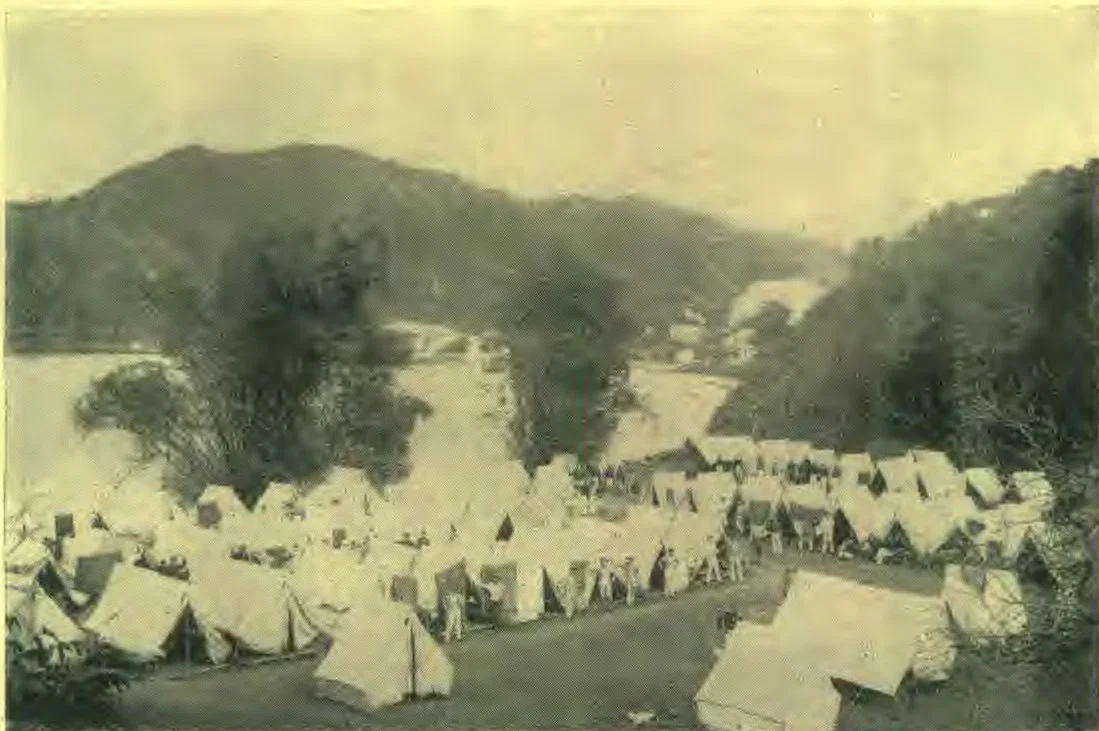
The above is a good illustration of the beautiful scenery in the Philippines. The particular island is Corregidor. The tents are those of the Tenth Pennsylvania Volunteers. Had indeed it is that sin has marred God's fair creation; since the blood of Abel was shed by Cain man has marred against his fellow. Sadder than all else are wars of ambition and conquest, undertaken in the name of humanity. The view is from a photo furnished by Mrs. Wood, of this city, whose husband is a physician connected with the hospital corps of the army.
THE two most civilized tribes in the Philippines are the Tagals and Visayas, numbering between three million and four million, about one-half of the entire population. The nominally Christian natives number about six million, and are largely under the Augustine, Franciscan, Dominican, and Recollect orders in the Roman Church. The Jesuits and secular clergy have charge of only about one million.
The Filipinos first appeared in history in 1509, when the Portuguese, who were then "expanding"—i. e., capturing or burning cities and killing natives by thousands—in the East, found vessels from the islands on their arrival at Malacca in that year. That busy port was the great mart for eastern merchandise. The Filipinos were, therefore, traders in those early days, as, indeed, they had been for a long time previously. The islands themselves were discovered by Magellan in 1521, and he lost his life there. Their present name was given them by the conquistador Legaspi, in 1564, in honor of Philip II., then Prince of the Asturias. At this time the Filipinos were living in villages as they do now. They had no kings, properly speaking, but in each village community there were certain individuals who were distinguished by birth or personal qualities, who could declare war and decide other matters, and had the title of raja, which was often hereditary.
There are three classes in the community, nobles, plebeians, and slaves. These have continued from a remote past to the present. This organization has been maintained by annual elections.
The Filipinos possessed an alphabet and knew the art of reading and writing before Columbus was born. Schools were maintained in every village.
The best educated among the Filipinos are those who have studied at the university of Santo Tomas, in Manila, and have become lawyers, some of whom are worthy to be compared to the most celebrated advocates of Spain.
There may be in the neighborhood of 10,000 Spanish civilians in the islands, and ten times as many Chinese. Some of the natives have written creditable poems, and several have acquired celebrity in Europe as artists, linguists, and in literature, as, for instance, Dr. Rizal, who was shot in Manila, 1897.
Naturally the Tagals are a cheerful and peace-loving people, disposed to enjoyment. They are natural musicians, every village having one or more bands. The music they select is usually of a superior kind.
The religious orders have gradually usurped the position once held in each village by the native chiefs, and they have become possessed of vast estates. Their rapacity, more than anything else, brought about the uprising which began in 1896.
In early times the monks protected the natives from the government officials by admitting them to the religious orders, but when the orders were abolished in Spain, the Spanish priests flocked to the islands in such numbers that natives were excluded from the ranks of the clergy. These European monks have used their positions to amass wealth, having millions in deposit in foreign banks. The Spanish Government feared that this wealth might be used to aid the Carlists. Greed and extortion and oppression lost the Philippines to Spain.
But there is a large missionary field for the true ambassador of Christ. The natives are religious, but not Christians. Who will carry them the Gospel of Christ?
OPPORTUNITY IN MISSION WORK.
We are living in the last days. Writing to the Christians of this time, whether he knew it or not, the apostle Paul said, “And that knowing the time, that now it is high time to awake out of sleep.” Again he points out the duty of “redeeming the time, because the days are evil.” The Revision has, “Knowing the season,” special time; and the margin of Eph. 5: 16 is, “Buying up the opportunity.”
And now is the time for God’s people to drop the old, antiquated methods of a worldly Christianity, and buy up the opportunities which God’s providence is placing before them.
Upon this matter of opportunity, Bishop Thoburn, of the M. E. Church, writing from Manila, under date of April 14, to the Christian Advocate, says:—
Indeed one-half the secret of success in doing God’s work is to learn how to recognize and interpret opportunities. Opportunity, in fact, is one of God’s messengers, and while it is easy for us to be mistaken, and while, no doubt, the best of us are prone to put our own interpretation upon events which are less opportune than they seem, yet, on the other hand, we are still more prone to neglect to study the events which God puts plainly before our eyes. Jesus taught His disciples that it was the duty of those who had eyes, to use them for the purpose of seeing. It is much to be feared that the modern church of Christ has not given due heed to this most important lesson.
A panorama of great events is passing before the Christian world to-day, and yet millions upon millions who have the overwhelming spectacle in full view before their very eyes seem unconscious of the mighty march. They hear all manner of sounds around them, and yet the tread of the passing millions or myriads seems to fall upon ears that are wholly deaf to unaccustomed sounds. Would to God that all who bear the name of Jesus Christ would rouse themselves from sleep, or from the state of semi-lethargy, which is often more fatal than sleep, and use both the power of seeing and hearing which God has given them, by giving due heed to the startling lessons which He is setting before them.