IN letters of gold, in earth's temple of fame, the name of Roger Williams is written. Yet this alone is only a doubtful honor, for oftentimes have men and women revered those whose spirits have not been of that deep untainted purity and lofty moral integrity which alone should command our admiration.
Many a one has been accounted great rather for what he did than for what he was. But on the wonderful leaves of the ledger of life are chronicled only the names of those who, in loyalty to God, in unselfish devotion to divine principle and to the welfare of fallen humanity, have stood unshaken midst the storms of earth.
'Tis not for these poor eyes of ours, bedimmed by the mists of sin, to pierce the vail which hides the great unseen and peer into the depths beyond. We see through a glass darkly now. Yet our bosoms swell with a sacred joy when we read of the grand lives of the great and good of days gone by; we can not help but believe that their "names are written in heaven."
No kindlier soul than Roger Williams ever lived. Young in life he became wedded to principles which were then universally tabooed. Possessed of a well-stored and active mind; he was not a man to hide his light beneath a bushel. A stranger to fear, his life was one long scene of strife and turmoil. Misunderstood, maligned and persecuted, he has outshone many another reformer, in that never for a moment does he seem to have forgotten the divine injunction of the blessed Master: "Love your enemies, bless them that curse you, do good to them that hate you, and pray for them which despitefully use you, and persecute you." And the very ones who persecuted the noble Williams were the ones whom he interposed to save from the dread tomahawk of the cruel red man.
Roger Williams was a great preacher, and he was a great statesman. His simple honesty and sincerity won the hearts of the savage redskins, and he became the peacemaker between them and the Puritans of Massachusetts Bay. He was also an author, and through his writings, he, being dead, still speaketh. They may lack veneer and polish, but the principles which he enunciated are sound. They were not principles which Williams had created, for man can not create principles,—they are eternal. They come forth from the bosom of the Father, and are revealed to the pure in heart.
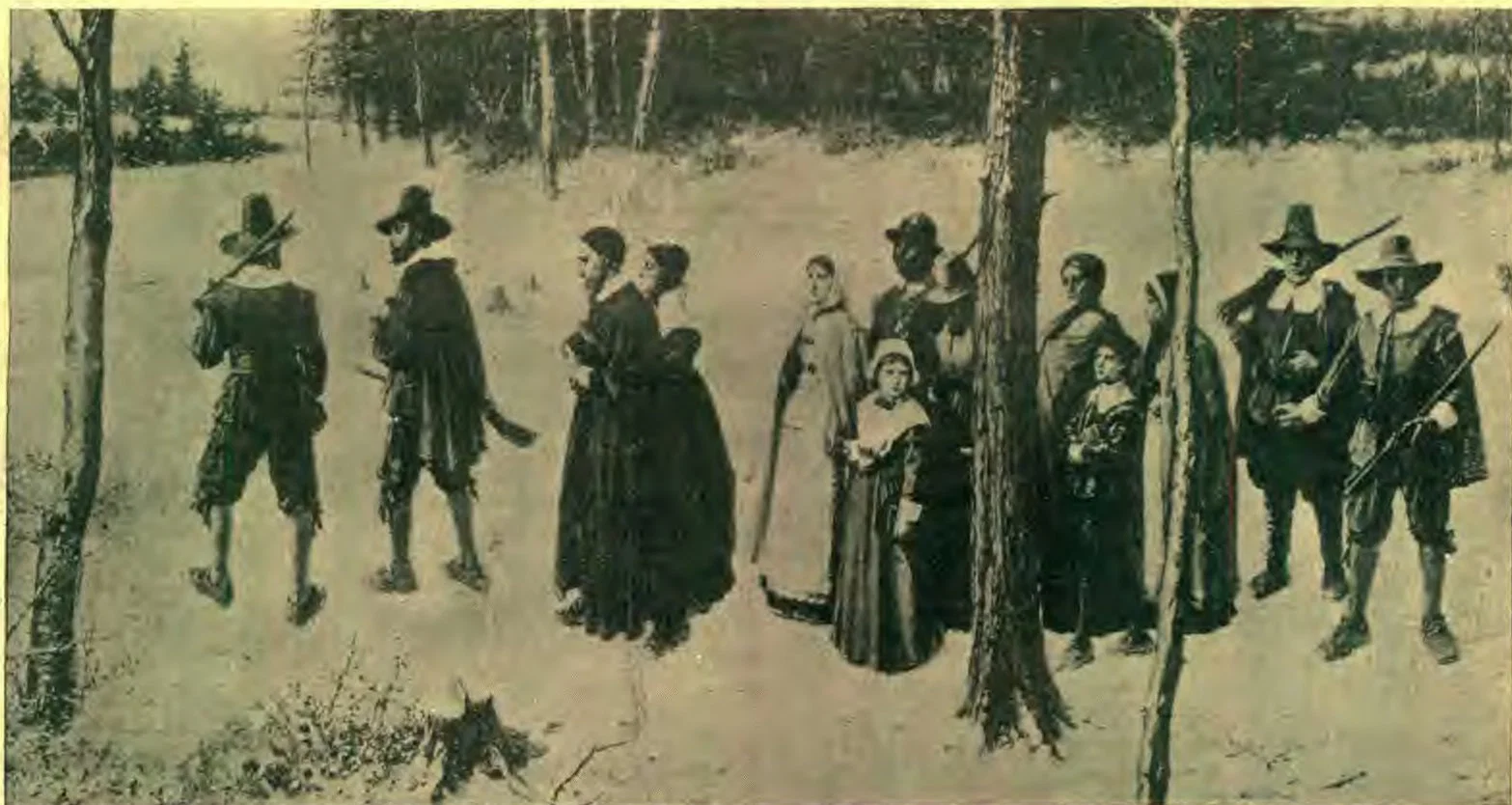
PURITANS GOING TO CHURCH IN THE DAYS OF ROGER WILLIAMS.
And the founder of Rhode Island was pure in heart. Ambition never tainted his nature. His inspirations in life were drawn, not from the clouds, but from the purest of all sources—God and the sufferings of men. He cared absolutely nothing for honors or rewards. He never strove for glory or position. Malice.ne'er sat in his soul. Revenge and enmity never embittered his heart.
Roger Williams was not the first to discover the principles of religious liberty. Wickliffe, Luther, and others had taught them long before. But he was the first to proclaim liberty of conscience in the New World, and for this he was forced to leave the colony of Massachusetts Bay. But triumphantly, tho as an exile, he carried his precious truth to the shores of Narragansett, and there he established for it a sanctuary—the State of Rhode Island.
To Williams belongs the honor of being the first to bring forth and build up a political edifice having "soul-liberty" as one of its basal, fundamental, and organic principles. The world looked on and sneered. It was everywhere prophesied that his "experiment" would end in an unsightly explosion of anarchy or burn to an ash in the fierce fires of a medley of fanaticism.
The silent artillery of time has laid both Roger Williams and his mockers in the cold cradle of the grave; but the verdict of history, which is seldom unjust, is rendered in favor of the sturdy Welshman, who—
"Gave soul-liberty her guardian State."
Liberty of conscience, first introduced into legislation by Williams, has spread all over the Union, from the storm-clad Atlantic to the peace-mantled Pacific. His institutions "have superseded the aristocratic commencements of Carolina and New York, the high church party in Virginia, the theocracy in Massachusetts, and the monarchy throughout America; they have given laws to one-quarter of the globe, and, dreaded for their moral influence, they stand in the background of every democratic struggle in Europe."
Amid the gray mountains of Wales the2subject of our story was born; and the tall peaks of Snowdon stood as sentinels watching over the frail infant who one day was destined to exercise such a powerful influence upon the world. If climate and country wield a power as potent as the parental over the mind of a child, the crags and precipices of his native land undoubtedly contributed their share to the lofty and massive character of Williams.
Of the early life of this remarkable man, little is known. Upon not very certain evidence, it is stated that his nativity occurred somewhere about the year 1607.
While Roger was yet a boy, the famous Sir Edward Coke, the greatest British jurist of his time, took a lively interest in the lad. We learn from Mrs. Sadleir, Sir Edward's daughter, in a note, attached by her to a letter which Roger had written her:—
This Roger Williams, when he was a youth, would, in a shorthand, take sermons and speeches in the Star Chamber, and present them to my dear father. He seeing so hopeful a youth, took such a liking to him that he sent him into Sutton's Hospital, and he was the second that was placed there.
Sutton's Hospital is the older name of the great Charter House School, so famous even at the present day.
Four years after the Pilgrim Fathers disembarked at Plymouth Rock, viz., in 1620, Williams entered Cambridge University as a student of Pembroke College. Here are still to be seen the entries which he made in his own peculiar handwriting. He showed great proficiency in his studies, and we know him to have been versed in five languages besides his own—French, Dutch, Latin, Greek, and Hebrew. He continued at Pembroke College until he graduated and took his degree.
That Roger Williams associated with men and women of gentle birth is evident. Two letters are still extant addressed by him to Lady Barrington, daughter of Sir Henry Cromwell, and aunt to the Protector. The latter bears date of May 2, 1629. At the time they were written he was chaplain to Sir William Masham, of Otes, in Essex. These letters speak of his affection for Lady Barrington's niece, and give evidence of a proposal of marriage. In them he tells of his financial status and prospects, and how that by reason of a "tender conscience" he has not made the advancement in honor and preferment which he otherwise might. From what he here states it is clear that the Gospel ministry was his choice as a calling in life.
After leaving College he appears to have commenced the study of law under the guidance of his generous patron Sir Edward Coke. But God had a greater mission for this humble child than that of advocate or judge,—of bar or bench. When near the close of his life he tells us:—
From my childhood, now about threescore years, the Father of lights and mercies touched my soul with a love for Himself, to His Only-begotten, the true Lord Jesus, and to His Holy Scriptures.
At the time of which I write, the bigoted and intolerant Archbishop Laud stood at the head of affairs in the Church of England. The spirituality of that body was at a low ebb. The soul thirst of Williams could not be slaked by the murky waters of such a marsh of spiritual malaria. The sacred longings of his heart were drawn out after something purer, holier and better. The holiest passions of his soul were toward his God. He longed for a religion which would really satisfy, and which would not require sword and spear to support it.
This is what led Williams while yet young to ally himself to the straitest sect of the Puritans.
His religion was of no effeminate or plastic type. There is a grandeur and massiveness about it which at once attracts us. Through the dark forests of medieval doctrine he must blaze the path of liberty of conscience, not alone for himself, but for millions yet unborn. His task was to lay the very foundation stones for that system of separation of church and State which we hold so dear. Beyond the broad seas it was to be his lot to bear aloft the banner which the Master unfurled in Judea, and on which is emblazoned the sacred scripture, which, like a scarlet stream from Calvary, has ever flowed as a mighty barrier between the minority "of tender conscience" and the majority straining in the leashes to persecute:—
"Render therefore unto Cæsar the things which are Cæsar's; and unto God the things that are God's."
The road which Roger trod was rough; but he smoothed the path for tens of thousands yet to live. Long years have rolled away, and the humble author of our liberties is but little thought of now. Morning by morning and night by night, from thousands of quiet hearth-stones and unnumbered family altars, husbands, wives, and tender children, peacefully and unmolested, lift up their voices in the prayers of near a thousand different faiths without the faintest fear of persecution dire. Had it not been for Roger Williams, had it not been for the great battle he fought and won, these might have sat with bated breath, dreading the sound of every footfall, least it should prove to be an emissary of the established creed, coming to drag them off to dungeon drear. And the streaming standard of soul-liberty which first floated upon the breezes of Providence will be the battle-flag of God's own true church to the very last,—till from the great bell tower of time shall toll the hour of eternity.
PERCY T. MAGAN.
UNBELIEVING ISRAEL.
By Mrs. E. G. White
THERE are many who have received the idea that the Jewish age was one of darkness, superstition, and ignorance, that repentance and faith and divine enlightenment were reserved for the Gospel dispensation, that these had no part in the Hebrew religion, which, they claim, consisted only in forms and ceremonies. A greater deception than this could not exist. The Hebrew nation was taken into close relation to God, as a peculiar people, a holy nation. The Lord gave to Israel evidences of His presence, that they might fear His name and obey His voice, and that they might know that He was leading them to the promised land. The power of God, which was revealed in so remarkable a manner in their deliverance from Egypt, was seen from time to time through all their journeyings.
And in these manifestations and revelations God was uplifting Israel from a demoralized condition. Great changes were to be wrought in this disorganized people; for oppression and servitude and idolatrous association had molded their habits, their appetites, and their characters.
The Lord had promised Israel that if they would obey His commandments, He would supply their necessities by His miraculous power. But the Hebrews were not willing to submit to the directions and restrictions of the Lord. They wanted their own way. They desired to follow the leadings of their own minds and be controlled by their own judgment.
The Lord heard their murmurings, and the divine presence was revealed in so remarkable a manner that they were afraid. A voice was heard from the glory, bidding Moses and Aaron draw near to the cloudy pillar where Christ was enshrouded. And the Lord talked with Moses and Aaron, and the Israelites heard His voice telling them that He had heard their murmurings. They heard Him promise that they should have what their appetites craved,—bread in the morning, and flesh in the evening. In all His dealings with them, God was seeking to teach His people that it was not Moses with whom they were finding fault, but that their murmurings were directed against their divine Leader.
The Christian world, who to-day look upon the Jewish nation as under the curse of God, should inquire, Why did the Lord let His judgments fall upon Israel in so signal a manner?—It was because they had rejected the great light given to them since the day of their deliverance from Egyptian bondage. It was because God revealed to them His will by prophets and by holy men, and they walked in their own ways.
Their calamities did not come because they kept the law of God, but because they disregarded that law. God had told them that if they did not obey His commandments, He could not keep His covenant with them. The history of the Israelites is portrayed for our warning. They had great light and exalted privileges; yet they did not live up to that light nor appreciate their advantages, and their light became darkness. They walked in the light of their own eyes, instead of following the leadings of God. Their history is given for the benefit of those who live in these last days, that we may avoid following the same example of unbelief. The apostle Paul says: “We ought to give the more earnest heed to the things which we have heard, lest at any time we should let them slip. For if the word spoken by angels was steadfast, and every transgression and disobedience received a just recompense of reward, how shall we escape, if we neglect so great salvation; which at the first began to be spoken by the Lord,3and was confirmed unto us by them that heard Him?”
In these last days God has brought to His people a knowledge of His law. A flood of light has been poured upon the New Testament, revealing the truths of the Old. God has brought out from the world and from the church a people whom He has made the depositaries of His law. They are to teach that that law must be obeyed if men would enter into life. To those who keep His commandments He will be a pillar of cloud by day, and a pillar of fire by night, to lighten and lead the way in the path cast up for the ransomed of the Lord to walk in.
In keeping the commandments, we have the assurance that there is great reward, and no earthly consideration should induce Christians to refuse to lift the cross in keeping all of God's commandments. Riches, ease, pleasure, ambition, and worldly honors are as dross that will perish in the fires of the last days. “The fear of the Lord is the beginning of wisdom.” Better far obtain a knowledge of God's will through an understanding of His word than have the praise of men and the honor of the world.
There is a great similarity between our history and that of the children of Israel. God led His people from Egypt into the wilderness, where they could keep His law and obey His voice. The Egyptians, who had no regard for the Lord, were encamped close by them; yet what was to the Israelites a great flood of light, illuminating the whole camp, and shedding brightness upon the path before them, was to the hosts of Pharaoh a wall of clouds, making blacker the darkness of the night. To us as a people has been committed the law of God. To those who obey them, the commandments of God are as a pillar of fire, lighting and leading the way to eternal salvation. But to those who disregard them they are as the clouds of night.
“Go forward,” God said to Israel, when the flowing waters of the Red Sea blocked their passage as they moved out in the path which Providence had indicated. As they placed their feet in the waters of the sea, they did what the Lord required of them. They did not see what God would do next. They did not see the broad path opened for them by the power of God until they manifested their faith by moving forward. And then God's power was revealed. The waters on either side were piled up like a wall, leaving an open path before them.
The voice of God bidding His faithful ones go forward, frequently tries their faith to the uttermost; but we must not seek for some object upon which to hang our doubts and unbelief. If we wait until every shadow of uncertainty is removed, we shall never plant our feet upon the platform of eternal truth. Those who will not follow the light because some things are not entirely clear to their understanding, will never believe the truth. Faith is not certainty; it is “the substance of things hoped for; the evidence of things not seen.”
God will do marvelous things for those who trust in Him. It is because His professed people trust so much to their own wisdom, and do not give the Lord an opportunity to reveal His power in their behalf, that they have not more strength. He will help His believing children in every emergency, if they will place their entire confidence in Him. He will work mightily for a faithful people who obey His word without questioning or doubt.
MRS. E. G. WHITE.
COULD WE BUT SEE AS THE HOLIEST SEES.
By Hope Onslow
COULD we but see as the Holiest sees
The heart of the one we blame,
Know all the strife and the mysteries,
Measure his wo and shame,
Go through the fire of his sore ordeal,
Take his turn on the polishing wheel,
Have his inheritance, ah! it is clear
Our blame would be melted to sympathy's tear,
And from compassion, a prayer would arise
For the soul that we know not to-day, and despise.
He who could see as the Holiest sees,
Saw there was need of love's plan;
Fathomed the depths of our life's mysteries—
Bearing the nature of man.
Every heart's sorrow, every heart's sin—
O, the great heart of our Lord took it in!
And would not blame or condemn, till for loss
Love poured out its life on Calvary's cross.
Shall Christ's compassion teach us to be slow
In condemning a soul that we never can know?
How can the Holiest, loving in heaven
Look upon us in our pride,
That we can lightly condemn one, when even
Christ still refrains, though He died?
Better for us that we pray for His Spirit,
Better for us that we count our demerit,
Better for us that we longingly stand,
With a Christlike compassion, and a help-reaching
hand.
HOPE ONSLOW.
SOUL IN THE NEW TESTAMENT.
By Wm. Penniman
BAGSTER'S Analytical Greek Lexicon defines the Greek word psuche, rendered "soul," as "breath; the principle of animal life; Matt. 2:20; an inanimate being, 1 Cor. 15:45; a human individual, soul, Acts 2:41; the immaterial soul, Matt. 10:28; the soul as the seat of religious and moral sentiment, Matt. 11:28; the soul as a seat of feeling, Matt. 12:18; the soul, the inner self, Luke 12:19."
In all of these texts the word psuche, or its variations, is used, and the word "soul" in the New Testament is invariably from the same Greek word.
It will be noticed when we speak of Matt. 10:28 that Bagster puts the theological soul into this text.
The words psuche and nepesh correspond in meaning. Psuche is rendered soul in the New Testament fifty-nine times. We read (Matt. 6:25): "Take no thought for your life" (psuchen). "Whosoever will lose his life [psuchen] for My sake shall find it." Matt. 16:25. "The Son of man came . . . to give His life [psuchen] a ransom for many." Matt. 20:28.
Isaiah says: "He hath poured out His soul [nepesh] unto death." Isa. 53:12. Thus it is plain that Christ fulfilled this prediction in rendering up His life, or, as the prophet has it, "His soul unto death." "Is it lawful . . . to save life, or to kill?" Mark 3:4. Hazarded their lives for their brethren. Acts 15:26. "Trouble not yourselves; for his life [psuchen] is in him." Acts 20:10. "Hereby perceive we the love of God, because He laid down His life [psuchen] for us; and we ought to lay down our lives [psuchen] for the brethren." 1 John 3:16. "And the third part of the creatures which were in the sea, and had life [psuchen], died." Rev. 8:9. Render the word psuche, soul in all these texts, and the sense will be just as good, or just the same, as to render it life, providing we take the Bible meaning of the word "soul." The objector says: "Did men hazard their souls, or can any one lay down his soul for the brethren? This is strange, and dreadful." It certainly would be dreadful to think of laying down our immortal souls, but taking the true meaning of life, all is plain.
"But God said unto him, Thou fool, this night thy soul [psuchen] shall be required of thee." Luke 12:20. In verse 22 of this chapter the same word is translated life. "Take no thought for your life [psuchen], what ye shall eat," etc. Why should not the same word be translated life in verse 20? Is not the meaning in substance the same? Thou shalt die to-night. Riches are of no use to a dead man. "For what is a man profited, if he shall gain the whole world, and lose his own soul [life, psuchen]? or what shall a man give in exchange for his soul [life, psuchen]?" Matt. 16:26. In the words immediately preceding this, the word "life" is used twice, and it is so rendered from the same word, translated soul in the text first quoted. "For whosoever will save his life [psuchen] shall lose it; and whosoever will lose his life [psuchen] for My sake shall find it." It is no wonder the translators did not render it soul, as it would certainly read strange to them according to their ideas of soul. "For whosoever shall lose his soul for My sake shall find it." It is plain that in the texts last quoted the word "soul" as life is used to denote personality. The parallel passage in Luke 9:25 freely proves this, as follows: "For what is a man advantaged, if he gain the whole world, and lose himself, or be cast away?" We read (Rev. 6:9): "I saw under the altar the souls [psuchen] of them that were slain," etc.
Now its meaning is similar to that in the last quoted, simply meaning the martyrs or these persons used by personification. Matt. 10:28 plainly teaches what man can destroy and what he can not; man can kill the body but he can not kill the life; that is, the eternal life which is the reward of the righteous, and which will be given at the resurrection of the just. See Luke 14:14. On the other hand God only can destroy that life, or soul, or being, forever, as He will do in the second death (Rev. 20:14) unto those who are unworthy of eternal life.
It will be seen that in the parallel words in Luke the word "soul" does not occur. "And I say unto you, My friends, be not afraid of them that kill the body, and after that have no more that they can do. But I will forewarn you whom ye shall fear; fear Him, which after He hath killed hath power to cast into hell; yea, I say unto you, Fear Him." Luke 12:4, 5.
One object in dwelling so much on definitions and quoting so many texts in respect to the soul is to prove its destructibility; for, according to many modern theologians, God Himself can not destroy the "immaterial" and therefore "immortal soul," and if He can not, and does not, then the punishment of the wicked will be suffering forever. The words "immortal soul" are not found in the Bible. "God only hath immortality." 1 Tim. 6:16. If God only has it, then man has it not, and never will have till he puts it on at the resurrection of the just. 1 Cor. 15:53.
Why should we seek for a thing which we already have? We exhort the reader, in the language of Scripture (Rom. 2:7), to "seek for glory and power and immortality."
WM. PENNIMAN.
Woodburn, Ill.
Delivered From All My Fears
"I sought the Lord, and He heard me, and delivered me from all my fears."
PANDITA RAMABAI ON CHRISTIAN SCIENCE.
PANDITA RAMABAI is well known to every friend of Indian missions. She was born and reared in India in the religion of Buddha. A few years ago she visited America, and came in contact with Christian Science. This is what she said of that cult, as told in the record of Christian Work :—
On my arrival in New York I was told that a new philosophy was being taught in the United States, and had already many disciples. The philosophy was called Christian Science, and when I asked what its teaching was I recognized it as being the same philosophy that has been taught among my people for four thousand years. It has ruined millions of lives and caused immeasurable suffering and sorrow in my land, for it is based on selfishness, and knows no sympathy or compassion. But what shocked me most has been the report that there are women in America who are not deceived by the name of Christian Science, but are confessedly studying and adopting the philosophy of the Hindus. As I was born and educated in the philosophy, having taken my degree of Pandita in it, I am acquainted with both its literature and its influence upon my people; and I want to witness to its degradation.
The "grandeur and beauty" of that philosophy must be judged by its fruits. You are a people of feeling. Everything is real. You feel that when other people are starving you ought to give them something to eat, but out in India they do not feel that. Men do not feel any sympathy for others.
. . . In our late famine our philosophers felt no compassion for sufferers, and did not help the needy. For why should they help when they claimed the suffering was not real, neither were the dying children real? The first result, then, of the philosophy is the basest cruelty and selfishness, no compassion for sufferers, and supreme egotism.
Taste and See That the Lord Is Good
“O TASTE and see that the Lord is good; blessed is the man that trusteth in Him.”
Man’s Nature and Destiny
*For a full and clear exposition of this text see "Here and Hereafter, or Man's Nature and Destiny," pp. 130-137.
DISTINCTION BETWEEN SOCIETY AND THE STATE.
By A. T. Jones
Apostasy—Babylon and Assyria.
“T<type>HE</type> first of all the commandments is, Hear, O Israel; The Lord our God is one Lord; and thou shalt love the Lord thy God with all thy heart, and with all thy soul, and with all thy mind, and with all thy strength.”
“And the second is like, namely this, Thou shalt love thy neighbor as thyself.
“There is none other commandment greater than these.”
“On these two commandments hang all the law and the prophets.”
It is certain that if these two commandments had always been observed by all men, there never could have been a State on the earth.
There would have been government, but no State. The government would have been altogether the government of God; He, the only King, the only Governor, on earth even as in heaven.
There would have been society, but no State. Because, men loving God with all the heart, and all the soul, and all the mind, and all the strength, and their neighbors as themselves, the will of God would have been done on earth even as in heaven. All would have been one united, harmonious, happy, holy family.
There is an essential distinction between society and the State.
Society is the union which exists between men, without distinction of frontiers—without exterior restraint—and for the sole reason that they are men.
The civil society or State is an assemblage of men subject to a common authority, to common laws,—that is to say, a society whose members may be constrained by public force to respect their reciprocal rights. Two necessary elements enter into the idea of the State: laws and force.—Janet, “Elements of Morals,” p. 143.
This distinction, however, tho clear and easily evident, is seldom recognized. Indeed, it is not recognized at all by those who are anxious to secure the union of religion and the State in the United States.
But men did not observe these two “first of all the commandments.” They would not love God with all their heart; they would not love their neighbors as themselves. They rejected God as their only ruler, their only sovereign, and became ambitious to rule over one another. And thus originated politics and the State.
The Scripture outlines the story of this: “When they knew God, they glorified Him not as God, neither were thankful, but became vain in their imaginations, and their foolish heart was darkened. Professing themselves to be wise, they became fools, and changed the glory of the uncorruptible God into an image made like to corruptible man, and to birds, and four-footed beasts, and creeping things.” “And even as they did not like to retain God in their knowledge, God gave them over to a reprobate mind.” Rom. 1:21–25, 28.
Note, that at the first, men did know God. But they chose not to glorify Him, not to honor Him, not to give Him the first place in all their thoughts and actions. Knowing God, they did not like to retain Him in their knowledge.
The next step was that they became vain in their own imaginations. They professed themselves to be wise, of themselves. The consequence was that they became fools; and their foolish heart was darkened.
In their vain imaginations they made gods of their own. And then to assist themselves in their worship, they made images of the gods which they had imagined.
The image was always the outward, tangible, form of the god which they had already conceived in the imagination. Imagining is simply mental image-ing. The outward form of the god, whether it be the shining sun in the heavens or a hideously-shaped block of wood or stone, is only the outward form of the image-ing that has already been performed in the imagination.
Thus, from the knowledge of the true God, they went to the worship of false gods. From the light, they went into darkness. From righteousness, they went to wickedness.
This is the truth. And the records of the earliest nations witnessed to it. The earliest records—those of the plain of Shinar—witness that the people at first had a knowledge of the true God. The records of the next two of the earliest nations, Egypt and Assyria, bear witness to this same thing.
In all these places the earliest records testify that the gods were their first rulers and the real kings; while men, in the places of authority, were but the servants, the viceroys, of the gods who were held to be the real kings.
For instance, one of the earliest records from Shinar runs thus: “To [the god] Ninridu, his King, for the preservation of Idadu, viceroy of Ridu, the servant, the delight of Ninridu.” Another: “To [the god] Ninip the King, his King, Gudea, viceroy of [the god] Zirgulla, his house built.” Another: “To Nana, the lady, lady splendid, his lady, Gudea, viceroy of Zirgulla, . . . raised.”—Empires of the Bible, p. 50.
These are not only the earliest of the records that have been found in that land, but they themselves show that they are of the earliest records that were made in that land. And they clearly testify of a time when there were no kings amongst men. The gods were the kings; and the men in authority claimed only to be the viceroys of the gods who were held to be the real kings.
And all this testifies of a time further back, when the people knew and recognized God as the only king and rightful ruler of men. They show also that this knowledge of God was so recent, and still so strong upon the minds of the people, that men who stood in places of authority had not the boldness to assume the title of king, even tho they held the power.
The records of Egypt and Assyria testify precisely to these same things. And at that time also, there was no State. There was society.
There came a time, however, when even this lingering knowledge of God as king and the only rightful ruler, was cast off; and the man assumed the full title and prerogatives of king, himself.
The first man to do this was Nimrod. Nimrod was the first man in the world who had the boldness to take to himself the title and prerogative of king, in the face of the yet lingering idea of God as king. And the name which he bears, itself testifies to the fact that his action in this, was considered by men and also by the Lord, as precisely the bold thing which is here indicated. The word “Nimrod” “signifies rebellion, supercilious contempt, and is equivalent to ‘the extremely impious rebel.’”
The Bible record of Nimrod is that “he began to be a mighty one in the earth.” Another translation reads: “Cush begat Nimrod, who was the first to be a despot on the earth. He was an overbearing tyrant in Jehovah’s sight; wherefore the saying, Even as Nimrod, the overbearing tyrant in Jehovah’s sight.” Gen. 10:8, 9.
That is, Nimrod was the first one to establish the might, the power, the authority, of human government, in the form of an organized State. He was the first man to assert the power and prerogatives, and assume the title, of king over men. “And the beginning of his kingdom was Babel, and Erech, and Accad, and Calneh, in the land of Shinar.”
Consequently: “With the setting up of Nimrod’s kingdom, the entire ancient world entered a new historical phase. The oriental tradition which makes that warrior the first man who wore a kingly crown, points to a fact more significant than the assumption of a new ornament of dress, or even the conquest of a province. His reign introduced to the world a new system of relations between the governor and the governed. The authority of former rulers rested upon the feeling of kindred; and the ascendancy of the chief was an image of parental control. Nimrod, on the contrary, was a sovereign of territory, and of men just so far as they were its inhabitants, and irrespective of personal ties. Hitherto there had been tribes—enlarged families—society: now there was a nation, a political community—THE STATE. The political and social history of the world henceforth are distinct, if not divergent.”—Empires of the Bible, p. 51.
Such was the true origin of the State. The State was, and is, the result of the apostasy of men from God. Such only could possibly be its origin; for if all men had always observed the two “first of all the commandments,” it would have been impossible for there ever to be any State. There could have been no human authority exercised. All would have been equally subject to God; He would have been the only Sovereign.
Before Nimrod there was society. Respect of the rights of persons and of their property was maintained. It was only when the apostasy grew, and men got farther and farther from God, that the monarchical idea was established and personified in Nimrod.
Let no one misunderstand. This is not to say, nor even to imply, that there should now be no human government, that there should be no State, nor even that there should be no monarchy. It is simply to say that which is the truth, that if there never had been any apostasy from God, there never could have been on earth a State, nor any human government.
It is true that these things are the consequences of the apostasy from God. But men having apostatised from God, these things all, even to such monarchy as that of Nimrod or of Nero, became necessary, just in proportion to the degree of apostasy.
It is better that there should be a government, bad as it may be, than that there should be no government at all. Even such a government as Nimrod’s or Nero’s is better than none at all. But without apostasy there could never have been any human government at all; and without the apostasy having gone to a fearful5length, there never could have been any such government as Nimrod’s or Nero’s.
Nimrod’s example was eagerly followed by all the nations around, until they were all absorbed in it. Society had passed away, and only States remained; and these universally idolatrous. In all that region, only Abraham believed God; even his own parents being idolaters. “They served other gods.”
God chose Abraham then to be the father of all them that believe God; the father of all who will have God alone to be their God. Abraham represented then the religion of God, the beginning of the church of God.
And from that State God separated Abraham. He said to Abraham, “Get thee out of thy country, and from thy kindred, and from thy father’s house, into a land that I will show thee.”
And in thus separating Abraham from that State, from his country, God taught the people then, and through all time, the separation of religion and the State, the separation of Church and State.
And it must not be forgotten that in the case of Abraham, this universal example, the separation of religion and the State was the separation of the individual believer from the State. And as Abraham was at that time the church, and he was separated from the State, in this it is plainly taught that the true separation of Church and State is in the separation of the individual church-member from the State. Besides, it is perfectly plain in itself that where the same individual is a member of the Church and of the State at the same time there is at once in him a union of Church and State.