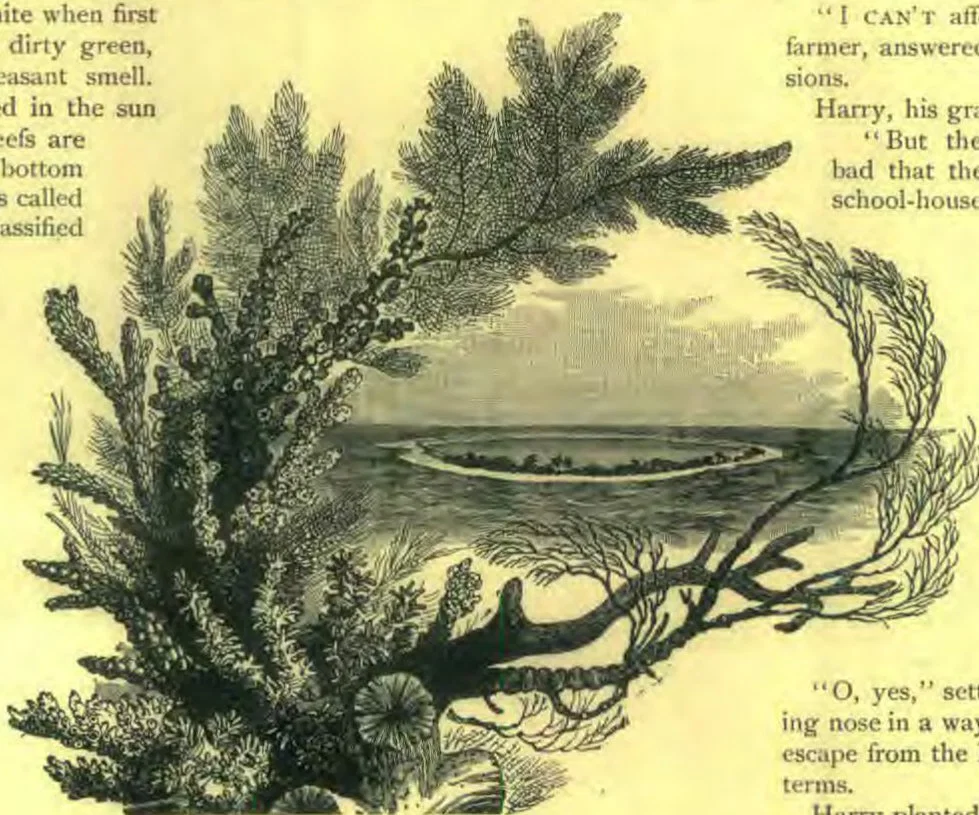
AMONG the many interesting features of the South Sea islands, among which we have visited in the missionary ship Pitcairn, are the coral reefs which are found around most of these islands. Pitcairn Island, in longitude 130 degrees west, and latitude 25 degrees south, has no reefs surrounding it, though there may be found here and there little detached masses of coral clinging to the rocks. Probably many of the people in the United States have never seen coral, though some may have been privileged to see little pieces in curio stores, for which exorbitant prices are charged. These pieces are not clean and white when first taken from the reefs, but have a dirty green, slimy appearance, with an unpleasant smell. They must be cleaned, then placed in the sun to be bleached. These coral reefs are built up by slow degrees from the bottom of the sea by little living creatures called coral polyps. They are usually classified as follows: Fringing reefs, barrier reefs, and atolls or ring reefs. The first named are found close to shore, in comparatively shallow water, with no lagoon, or deep channel, between them and the land. At high tide a few inches or feet of water covers them, but at low tide they may be nearly or quite uncovered. It was on such reefs as these that several United States and German men-of-war were driven, in the terrible hurricane in the harbor of Apia, Samoa, ten years ago. One of them, a splendid German ship, was lifted bodily by the force of the seas, and thrown upon the reef, where its great iron skeleton remains high and dry at low tide. Barrier reefs differ from the former in that they are usually found at a greater distance from the land, and have a lagoon, or deep water channel, between them and the shore.
Those which I have seen vary in their distance from the shore, from 40 rods to many miles. At Aitutaki, in the Hervey Island Group, the reef on the south side of the island is 7 miles from shore.
The great barrier reef off the northeast coast of Australia, is 20 or 30 miles from land.
The depth of water on the seaward side of the barrier reef is usually very great. Where there is a stream of fresh water running into the sea, there is generally found an opening in the reef, as the polyps do not work in fresh water.
These openings are wide enough in some reefs to admit ships into the safe harbor formed by this natural breakwater. In some cases, the reef extends entirely around two islands. Such a reef encircles Raiatea and Tahaa in the Society Group, forming a large and safe harbor between the two islands. The reef that surrounds the island of Mangaia, in the Hervey Group, has no opening whatever, and the shore can be reached with canoes only by “jumping the reef.” This is accomplished by getting onto one of the great swelling waves as it dashes on the reef with a terrific roar, and
being carried clear over the reef into the quiet waters within. None but natives who have spent their lives in such employment can make the hazardous trip without the almost absolute certainty of being wrecked.
The atoll is built up from the bottom of the sea in a circular or oval form, with a lagoon of deep water within, but no land. In process of time the reef becomes covered with soil and vegetation, the coconut being the tree usually grown. On some of the atolls, little islands are formed at varying distances from one another, around the whole circle of the reef. This is the case at Palmerston Island, between Rarotonga and Samoa, which we passed May 10. Being to the leeward of the island, we could not make a landing, but could see 4 islands in the large circle of the atoll, all of them covered with coconut trees. A few families live on the one inhabited island of this reef, to take care of the nuts.
While the pieces of coral usually seen in the curio stores are very pretty, it must not be supposed that the mass of coral of which these coral islands are formed, is equally fine. It is only on that part of the island where the coral polyps are at work that the beautiful live coral is found. The greater part of the reef is composed of the dead coral, which becomes cemented together in great ledges, and in some islands is quarried out by the natives and sawed into blocks for house building, or is burned into lime. At Mangareva, in the Gambier Group, 300 miles northwest of Pitcairn Island, I saw a Catholic church building, about 80x200 feet in size, built entirely of blocks of coral, with great pillars of the same material upholding its vaulted roof. A most beautiful sight is the forest of coral that may be seen in the lagoon when the water is quiet, by looking over the side of the canoe, down, down, many feet where fishes of all shapes, sizes, and colors are seen darting in and out of these submarine groves. Not all corals, however, take the form of branches. At Samoa I saw what was in my opinion the most beautiful of all these forma-
tions, the leaf coral. This is formed in the shape of a bunch of white leaves. Being very thin and fragile, it is almost impossible to transport it without breakage.
Then there is the brain coral, as it is commonly called, having the shape and appearance of a human brain. Sometimes the coral workers build a little white tree, five or six inches high, on the outside of a large pearl shell. These are quite rare. Red coral is found in a few of the islands, the branches being much smaller than that of the white. As we see all these wonderful creations, we can appreciate the words of David: “They that go down to the sea in ships, that do business in great waters; these see the works of the Lord, and His wonders in the deep.” Ps. 107: 23, 24.
E. H. GATES.
At sea, near Samoa, May, 1899.
A VALUABLE HINT AS WELL AS POTATO.
"I CAN'T afford it," John Hale, the rich farmer, answered when asked to give to missions.
Harry, his grandson, was grieved.
"But the poor heathen; is it not too bad that they can not have churches and school-houses and books?"
"What do you know about the heathen? Would you wish me to give away my hard earnings? I tell you I can not afford it."
"If you do not feel able to give money, will you give a potato?"
"A potato!" ejaculated Mr. Hale, looking up from his paper.
"Yes, sir; and land enough to plant it in, and what it produces in four years?"
"O, yes," setting his glasses on his calculating nose in a way that showed he was glad to escape from the lad's persecution on such cheap terms.
Harry planted the potato, and it rewarded him the first year by producing thirteen; these the following season became a peck; the next season, seven and a half bushels; and when the fourth harvest came, the potatoes had increased to seventy bushels; and when sold, the amount realized was, with a glad heart, put into the treasury of the Lord. Even the aged farmer exclaimed: "Why, I did not feel that donation in the least. And, Harry, I've been thinking that if there were a little missionary like you in every house, and each one got a potato or something else as productive, for the cause, there would be quite a large sum gathered."
Little reader, will you be that missionary at home?—Gospel in all Lands.
What?
By C. F. Ladd
In one of the European galleries there hangs a small picture of the crucifixion. On the frame are written the words—
“I did this for thee;
What art thou doing for Me?”
What, indeed?
Reader, what are you doing for Jesus? He suffered for you; He died for you. Think of Him as hung on Calvary's cross. O, the awful agony; and this for you. Are you doing anything for Him? Did He die in vain for you? May God help you to realize the need of action, the necessity of being up and a-doing.
C. F. LADD.
2 "Now the feast of the Jews, the Feast of Tabernacles, was at hand. 3 His brethren therefore said unto Him, Depart hence, and go into Judea, that Thy disciples also may behold Thy 4 works which Thou doest. For no man doeth anything in secret, and himself seeketh to be known openly. If Thou 5 doest these things, manifest Thyself to the world. For even 6 His brethren did not believe on Him. Jesus therefore saith unto them, My time is not yet come; but your time is alway 7 ready. The world cannot hate you; but Me it hateth, because 8 I testify of it, that its works are evil. Go ye up unto the feast; I go not up yet unto this feast; because My time is not yet 9 fulfilled. And having said these things unto them He abode still in Galilee.
10 "But when His brethren were gone up unto the feast, then 11 went He also up, not publicly, but as it were in secret. The 12 Jews therefore sought Him at the feast, and said, Where is He? And there was much murmuring among the multitudes 13 concerning Him; some said, He is a good Man; others said, Not so, but He leadeth the multitude astray. Howbeit no man spake openly of Him for fear of the Jews."
51 "And it came to pass, when the days were wellnigh come that He should be received up, He steadfastly set His face to 52 go to Jerusalem, and sent messengers before His face; and they went, and entered into a village of the Samaritans, to 53 make ready for Him. And they did not receive Him, because 54 His face was as tho He were going to Jerusalem. And when His disciples James and John saw this, they said, Lord, wilt 55 Thou that we bid fire to come down from heaven, and consume them? But He turned, and rebuked them. And they 56 went to another village."
14 "But when it was now the midst of the feast Jesus went up 15 into the temple, and taught. The Jews therefore marveled, saying, How knoweth this Man letters, having never learned? 16 Jesus therefore answered them, and said, My teaching is not 17 Mine, but His that sent Me. If any man willeth to do His will, he shall know of the teaching, whether it be of God, or 18 whether I speak from Myself. He that speaketh from himself seeketh his own glory; but He that seeketh the glory of Him that sent Him, the same is true, and no unrighteousness is in 19 Him. Did not Moses give you the law, and yet none of you doeth the law? Why seek ye to kill Me? The multitude answered, 20 Thou hast a devil; who seeketh to kill Thee? Jesus answered 21 and said unto them, I did one work, and ye all marvel. For this cause hath Moses given you circumcision (not that it is of Moses, but of the fathers); and on the Sabbath ye circumcise 22 a man. If a man receiveth circumcision on the Sabbath, that the law of Moses may not be broken; are ye wroth with Me, because I made a man every whit whole on the Sabbath? 23 Judge not according to appearance, but judge righteous judgment.
24 "Some therefore of them of Jerusalem said, Is not this He 25 whom they seek to kill? And lo, He speaketh openly, and 26 they say nothing unto Him. Can it be that the rulers indeed 27 know that this is the Christ? Howbeit we know this Man whence He is; but when the Christ cometh, no one knoweth 28 whence He is. Jesus therefore cried in the temple, teaching and saying, Ye both know Me, and know whence I am: and I am not come of Myself, but He that sent Me is true, whom ye 29 know not. I know Him; because I am from Him, and He 30 sent Me. They sought therefore to take Him; and no man laid his hand on Him, because His hour was not yet come. 31 But of the multitude many believed on Him; and they said, When the Christ shall come, will He do more signs than those 32 which this Man hath done? The Pharisees heard the multitude murmuring these things concerning Him; and the chief 33 priests and the Pharisees sent officers to take Him. Jesus therefore said, Yet a little while am I with you, and I go unto 34 Him that sent Me. Ye shall seek Me, and shall not find Me; 35 and where I am, ye can not come. The Jews therefore said among themselves, Whither will this Man go that we shall not find Him? will He go unto the Dispersion among the Greeks, 36 and teach the Greeks? What is this word that He said, Ye shall seek Me, and shall not find Me; and where I am, ye can not come?
37 "Now on the last day, the great day of the feast, Jesus stood and cried, saying, If any man thirst, let him come unto 38 Me and drink. He that believeth on Me, as the scripture hath said, out of his belly shall flow rivers of living water. 39 But this spake He of the Spirit, which they that believed on Him were to receive; for the Spirit was not yet given; because 40 Jesus was not yet glorified. Some of the multitude therefore, when they heard these words said, This is of a truth the 41 prophet. Others said, This is the Christ. But some said, 42 What, doth the Christ come out of Galilee? Hath not the scripture said that the Christ cometh of the seed of David, and 43 from Bethlehem, the village where David was? So there 44 arose a division in the multitude because of Him. And some
of them would have taken Him; but no man laid hands on Him.
45 "The officers therefore came to the chief priests and Pharisees; and they said unto them, Why did ye not bring Him? 46 The officers answered, Never man so spake. The Pharisees 47 therefore answered them, Are ye also led astray? Hath any 48 of the rulers believed on Him, or of the Pharisees? But this 49 multitude which knoweth not the law are accursed. Nicodemus saith unto them (he that came to Him before, being one 50 of them), Doth our law judge a man, except it first hear from 51 himself and know what he doeth? They answered and said unto him, Art thou also of Galilee? Search, and see that out of Galilee ariseth no prophet.
52 "[And they went every man unto his own house; but Jesus went unto the mount of Olives.]"
NOTE.—The texts inclosed in marks of parentheses, while not essential to the lesson study, will be found to throw much light upon the lesson, and are suggested for those who wish to study further.
SUGGESTIVE QUESTIONS.
1. During His temporary rest in Capernaum, who came to see Jesus? What did they urge Him to do? John 7:2-5. Note 1. (Ps. 69:8.)
2. What reply did Jesus make to their entreaty? Verses 6-9.
3. When and how did He leave Capernaum? Verse 10. Note 2.
4. As soon as the feast opened what general inquiry was instituted? With what result? Verses 11-13.
5. When Jesus determined to go to the feast, what did He do? Where did they go? Luke 9:51, 52. (Acts 20:24.)
6. What success did the messengers meet? Verse 53. (John 4:9.)
7. In what suggestion did the spirit of resentment in James and John manifest itself? Verse 54. (2 Kings 1:10-12.)
8. What did Jesus say to the misguided disciples? Vs. 55, 56.
9. At what time did Jesus appear at the feast? In what way? John 7:14.
10. What answer did the Saviour make to the expressed wonder of the Jews at His profound knowledge? Verses 15-19. Note 3. (John 5:41-44.)
11. What charge was then made against Jesus? Verse 20. Note 4. (Matt. 12:23, 24.)
12. How did the Lord reveal their inconsistency of doctrine? Verses 21-24. (Lev. 12:3; Gen. 17:10.)
13. What questions did these bold words of Christ arouse among the common people? Verses 25-27.
14. State the points of discourse then given by Jesus at the feast, and their result. Verses 28-44. (Rom. 3:4.)
15. Give the conversation that took place between the temple officers sent to arrest Jesus, and the Pharisees, when the former returned without having secured their prisoner. Verses 32, 45-52. (Matt. 7:29; 1 Cor. 1:26; Deut. 1:17; Isa. 9:1, 2.)
16. As the people then retired, where did Jesus go? Verse 53; 8:1.
Side Lights.—"Desire of Ages," chapters 49, 50. "Spirit of Prophecy," vol. 2, chapter 29.
NOTES.
1. These "brethren" were probably the relatives from Nazareth, who had called at Capernaum on their way to the feast at Jerusalem, hoping to have Jesus there join their caravan.
2. It would not do to journey to the feast amid a crowd, as such a course might precipitate a popular movement against Him, and prematurely destroy His life. He would wait for a quiet discussion concerning Him to settle personal convictions with each, before showing Himself openly.
3. The closing expression of verse 19 makes it evident that the question of the Jews in verse 15 was one intended to excite doubt and suspicion in the popular mind against Christ and His teaching. It is also evident from the further answer of Christ that they had even charged Him with being a violator of the law, by referring to His healing a man on the Sabbath day at the Passover a few months earlier. See chap. 5:1-9. The Feast of Tabernacles was at the end of September or early in October, while the Passover came the last of March, or the first of April.
4. It is a remarkable fact that the Jews have never attempted to deny the reality of the miracles which Jesus wrought. All they can say is that He did the work by the power of Beelzebub.
HE
W
PACIFI
INTERNATIONAL SERIES
THE SUNDAY SCHOOL
[[FIGURE]]
LESSON VI.—SUNDAY, AUGUST 6, 1899.
THE NEW HEART.
NOTE.—This portion of the prophecy of Ezekiel was written during the exile in Babylon. In that portion of the chapter preceding the lesson the people are reminded of their apostasy, on account of which they had been humiliated, and then follow promises of deliverance—not for their sakes, but for God's holy name's sake, which they had profaned among the heathen.
25 "And I will sprinkle clean water upon you, and ye shall be clean; from all your filthiness, and from all your idols, will I cleanse you. 26 A new heart also will I give you, and a new spirit will I put within you; and I will take away the stony heart out of your flesh, and I will give you an heart of flesh. 27 And I will put My Spirit within you, and cause you to walk in My statutes, and ye shall keep My judgments, and do them. 28 And ye shall dwell in the land that I gave to your fathers; and 29 ye shall be My people, and I will be your God. And I will save you from all your uncleanness; and I will call for the 30 corn, and will multiply it, and lay no famine upon you. And I will multiply the fruit of the tree, and the increase of the field, that ye shall receive no more the reproach of famine among 31 the nations. Then shall ye remember your evil ways, and your 32 doings that were not good; and ye shall loathe yourselves in your own sight for your iniquities and for your abominations. 33 Not for your sake do I this, saith the Lord God, be it known unto you; be ashamed and confounded for your ways, O house of Israel. Thus saith the Lord God; In the day that I cleanse you from all your iniquities, I will cause the cities to 34 be inhabited, and the waste places shall be builded. And the 35 land that was desolate shall be tilled, whereas it was a desolation in the sight of all that passed by. And they shall say, This land that was desolate is become like the garden of Eden; and the waste and desolate and ruined cities are fenced and 36 inhabited. Then the nations that are left round about you shall know that I the Lord have builded the ruined places, and planted that which was desolate; I the Lord have spoken it, and I will do it."
Golden Text: "A new heart also will I give you." Verse 26.
SUGGESTIVE QUESTIONS.
(1) During what time was this portion of the prophecy of Ezekiel written? See introductory note. (2) What promise was made to Israel? V. 25. Note 1. (3) With what would the Lord endow them? V. 26. Note 2. (4) Whose Spirit would He put within them? And what effect would this have upon them? V. 27. Note 3. (5) Then what special blessing would be added? V. 28. Note 4. (6) From what did God promise to save them? What promise did He make concerning the corn? V. 29. Note 4. (7) What other products would be multiplied to them? Why? V. 30. Note 5. (8) In face of all these blessings, how would they regard themselves? V. 31. (9) What further self-humiliation does the Lord urge upon them? V. 32. Note 6. (10) After cleansing them, what would He cause them to do? V. 33. (11) And what should be done to the long-desolate land? V. 34. (12) Then what would other people say? V. 35. (13) From this great change what would the heathen know? How sure was this promise? V. 36. Rom. 4:20, 21. Note 7.
NOTES.
1. "Sprinkle clean water."—The sprinkling of clean water as a symbol of cleansing was familiar to the Jews, as it was a prominent feature of their ceremonial system. See Lev. 14:1-9, 33-53. "From all your filthiness."—Sin is soul-filthiness, defiling, repulsive. "And from your idols."—After the exile the Israelites never again fell into the heathen forms of idolatry. The seventy years of chastisement by means of servitude to a heathen nation effectually eradicated the tendency to idol worship and its attendant orgies. All these are new covenant blessings through faith.
2. "A new heart."—A new spirit or motive; referring also to the new birth; a mind susceptible to being taught of God.
3. "My Spirit within you."—After receiving a new heart, there is opportunity for the Holy Spirit to do its office work, and guide the life of the one so endowed. "Cause you to walk," etc.—The reception of the Holy Spirit is essential to a life of obedience to God's law. No one can of himself keep the commandments of God. "Without Me ye can do nothing," says Christ. John 15:5. "The carnal mind is enmity against God; for it is not subject to the law of God, neither indeed can be. So then they that are in the flesh can not please God. But ye are not in the flesh, but in the Spirit, if so be that the Spirit of God dwell in you." Rom. 8:7-9.
4. "Ye shall dwell in the land."—It must be remembered that this promise, as all the promises of a temporal nature in this lesson, has reference to the return to Palestine after the seventy years of servitude in Babylon. But its plenary fulfilment will be realized in the new earth, when all the Israel of God is saved. See Revelation 21, 22.14
5. "Reproach of famine."—Famine in Israel was a reproach, as it showed to the heathen that the people had offended their God and were under His chastisement. There could be no famine as long as they were faithful to Him; for His promise is that "the meek shall eat and be satisfied" (Ps. 22:26); "Trust in the Lord, and do good; so shalt thou dwell in the land, and verily thou shalt be fed" (Ps. 37:3).
6. "Not for your sake."—They were not to presume upon their blessings as tho they deserved them in any way. God's grace is always unmerited favor. The more we receive from Him, the more we should be ashamed and be humble in mind because of our unworthiness.
7. The heathen should know God.—Here was the secret of God's purpose in all His dealings with Israel, that the heathen might learn of Him. So it ever has been, and ever will be while probation lasts. God's purpose is that His name shall be magnified before the world. Of Christ the prophet says, "He will magnify the law, and make it honorable." Isa. 42:21. Jesus says to His disciples, "Ye shall be witnesses unto Me . . . unto the uttermost part of the earth" (Acts 1:8); and the grand purpose is set forth in His prayer, "That they all may be one; as Thou, Father, art in Me, and I in Thee, that they also may be one in Us; that the world may believe that Thou hast sent Me" (John 17:21).
Wonders OF THE 19TH CENTURY
Is a 32-page tract. Its object is to recount and describe some of the principal inventions of this closing century, and to show their significance.
It contains fifteen illustrations. Is an easy seller. Price, 5c each or $2.00 per 100.
PACIFIC PRESS PUBLISHING CO., Oakland, Cal.
New York City Kansas City, Mo.
NEWS AND NOTES
—Bishop Newman, a leading personage in the M. E. Church, and a former prominent pastor at Washington, D. C., died in Saratoga, N. Y., on the 5th inst.
—A curious freak of a whirlwind occurred in Carson Valley, Nev., on the 5th inst. Passing over the chimney of a dwelling-house, it sucked up the fire from below, which was dropped on the roof, setting fire to the building.
—Dr. Berillon, a French physician, advises the use of hypnotism in the management of children. It is evident, however, that some evil influence akin to hypnotism is already playing a too prominent part in their mismanagement. The Lord's direction in regard to child-training is for the parents to teach them the law of God. See Deut. 6:4–9.
—A London press despatch says that 'the government is manufacturing a new bullet which is more deadly than 'dum dum.' The projectile has a soft metal point, which expands with friction caused by its flight. It is stated that 200,000,000 rounds of this bullet are already in stock.' This does not look much like a cessation of war preparations, or a very strong faith in the current efforts to secure universal peace.
—Mr. Ostergren, of New York, claims to have demonstrated that liquid air can be made at a cost of two cents a gallon. An exhibit before some scientists recently had the appearance of clear water, with a temperature of 400 degrees below zero. The first gallon of liquid air ever made cost $2,500. If Mr. Ostergren's claim be true, and there seems to be no doubt of it, liquid air will soon supersede ice as a refrigerator.
—It is said that the reversion of public sentiment in France in favor of Captain Dreyfus, of exile fame, is going still further, involving hostility to several army officers and to the alliance with Russia. There was recently a significant exchange of compliments between the president and the German emperor, and it has come to be an open question whether it is not better policy to be on friendly terms with England than Russia
—Judging by the common manner of commemorating the signing of the Declaration of Independence on the Fourth of July, one might imagine that American institutions were based on gunpowder. Nothing could more significantly point to a short, brilliant career and a sudden collapse. The conspicuous sky-rocket, that goes up with a flash, soon comes down a blackened stick. And every year brings new inventions of more dangerous gunpowder contrivances, with which to familiarize the children of 'this Christian nation' with engines of death.
—Dr. Wachdorfer, who is now in jail in San Francisco, charged with murder, is an abject victim of morphine and cocaine. Although a skilled physician, well knowing the result of the use of these drugs, he allowed himself to be drawn into the vortex. It is the old story of first using as a gentle stimulant when weary of mind or body, and finally becoming a slave to the habit. How many who are just beginning will heed the lesson?
—The people of the United States were boiling over with exuberance on the Fourth of July, while the people of Spain were in mourning for their dead soldiers who lost their lives at Santiago de Cuba July 4, 1898. Why the jollification in the United States? —Patriotism. Why the requiem masses in Spain? —Patriotism. What is patriotism? The desire to kill an enemy, with great glee if successful, and chagrin if defeated? Christianity says, 'If thine enemy hunger, feed him; if he thirst, give him drink.'
—The rioting in Spain, mentioned last week, was continuing as late as the 6th inst., at least in Barcelona. It is significant that, in a Catholic country, Catholic rioters should direct their destructive energies toward the institutions of their own church, and against the priests. It is significant because in the last days, when all the world shall be wondering after that power (Rev. 13:3), there will come a sudden reaction, and nations which have sustained her will 'eat her flesh and burn her with fire' (chapter 17).
—A reported wide-spread animosity toward 'the church' (Roman, of course) in Mexico has somewhat startled the Vatican, and investigation is the result. The archbishop has been obliged to admit that grave scandals have occurred in several provinces by the indiscriminate sale of indulgences, and other illicit methods of the clergy to increase the income of the churches. It is an indication that even Rome is feeling the pressure of the light of truth in the last days, or such things would be deemed a matter of course, as in days of yore.
—Who knows but this night his soul shall be required of him, and his life account be closed? A young man of Norristown, Pa., who had just inherited $250,000, and was studying for the ministry, suddenly fell, and died in a few minutes, June 23. He was returning from a church entertainment, and challenged a young lady for a footrace, he to run backward and she forward. He had run but a little distance when he fell. Physicians say his death was due to apoplexy, caused by the exertion of running in an unnatural way. Millions of people are killing themselves spiritually by running the wrong way.
—'I. H. N.' is profusely displayed in certain religious circles. It stands for the words 'In His name,' and is the pretense of many deeds which He never will acknowledge. For instance, a woman who claims to be a traveling missionary is charged with forging the name of Helen Gould to a note for $20,000, which she presented at a bank in Providence. The Lord has told us of other things that will be done in His name. 'Many will say to Me in that day, Lord, Lord, have we not prophesied in Thy name? and in Thy name have cast out devils? and in Thy name done many wonderful works? And then will I profess unto them, I never knew you, depart from Me, ye that work iniquity.' Matt. 7:22, 23.
—The throne of little Belgium is apparently tottering, owing to a demand for an extended franchise. But republicanism has nothing to brag of, as the greatest republic of modern times is fast going over to at least mimic monarchy. The reversion began with the militarism bequeathed by the Civil War; then followed mushroom fortunes, and the accumulation of wealth in the hands of a few, and the aping of foreign nabobs by wealthy Americans. All these combined to bring on moral weakness and declension, preparing the people for the setting up of an image to that system of religious despotism which assumed the control of government when the strongest and most extensive power the world ever knew was a monarchy.
—'Without natural affection' is one of the characteristics of 'the last days.' See 2 Tim. 3:1–7. This is especially manifest in the ever-increasing disregard of the marriage vows. The growing mania for divorce on trivial grounds, permitted by the civil law, and therefore deemed proper, illustrates the want of 'natural affection' that should exist before the formal marriage vow is taken, and therefore should be a marked feature of the closest relationship known to the human race, excepting only that of the disciple to Christ. The deliberate murder of a man by his wife, in San Francisco, June 28, is a striking illustration of the spirit of the times. The woman was wasting away by disease, and her husband had lavished his unnatural affection upon another woman, neglecting his afflicted wife and young daughter, until the outraged wife gave way to revenge and shot him to death. The coroner's jury rendered a verdict of 'justifiable homicide.' Such is the world's idea of justice, an idea that lies at the bottom of the lynching mania. But God says, 'Vengeance is Mine; I will repay.' Rom. 12:19. 'Can ye not discern the signs of the times?'
—One of the speakers at the recent meeting of the Association of Agricultural Colleges and Societies, held in San Francisco, said, in referring to adulterated flour: 'Another adulterant for wheat flour requires only a brief notice, for it can only be short-lived. This material is prepared and shipped in some quantity from Greensboro, N. C., under the name of mineraline. It is nothing but ground rock of the felspathic class, and its food value nil. Yet the party making this stuff seems to find quite a market for it. A friend in Greensboro, one year ago, wrote me that this party held an order for one hundred and fifty tons of mineraline to be shipped to Tennessee to mix with flour, and was shipping car lots to northeastern cities for the same purpose. In olden times the question arose, 'If a son ask his father for bread, will he give him a stone?' This question seems to have found an affirmative answer in North Carolina.'
—Permanent peace among the nations of earth is, in the language of a once noted politician, 'an iridescent dream.' While the 'Peace Conference' of the great nations is in session, the governments of the United States and Great Britain, which have recently been embracing each other in quasi-alliance, are now at swords points through Canada over the possession of a narrow strip of land between Alaska and Canada. And Italy has just out-generated Russia by occupying the island of Raheita, in the Red Sea, which the czar was preparing to seize. All the nations would like to have peace, but each one would fain gain some decided advantage before agreeing to forego further preparations for war. The prevalent peace talk is clearly 'saying, Peace, peace; when there is no peace.' Jer. 6:14; 8:11. And the apostle Paul gives this as an indication that the day of the Lord is near: 'For when they shall say, Peace and safety, then sudden destruction cometh upon them.' 1 Thess. 5:2, 3.