Your ShelfYour Projects

Signs of the Times, Vol. 22, No. 11.

A Consuming Fire

Signs of the Times

Mar 12, 1896

Pacific Press Publishing Company · Oakland, California · Mar 12, 1896

A Consuming Fire
We read in Heb. 12:29 the statement that “our God is a consuming fire.” It is quoted from Deut. 4:24, “For the Lord thy God is a consuming fire, even a jealous God.” The Revised Version reads, “For the Lord thy God is a devouring fire, a jealous God.”

A Warning

By the context in both places it will be seen to have somewhat the character of a danger signal against sin. “Take heed” that ye sin not, that ye serve him “acceptably, with reverence and godly fear, for our God is a consuming fire.” The thought is that those who do not heed the warning will be consumed by him. It is said of the presence of the Lord on Mount Sinai, “The sight of the glory of the Lord was like devouring fire on the top of the mount in the sight of the children of Israel” (Ex. 24:17); and the people, in their self-condemnation, said, “This great fire will consume us” (Deut. 5:25). And yet twice Moses lived for forty days in the midst of that glory, without material food, talking with God as a man talketh to his friend, and lived. Why? and why a consuming fire to the people?

God’s Presence Consumes Sin

The reason of it all is found in the moral condition of the two classes. It is God’s nature to consume sin. “Thou art of purer eyes than to behold evil, and canst not look on iniquity,” says Habbakuk. “For thou art not a God that hath pleasure in wickedness; neither shall evil dwell with thee,” says David. Sin—evil, wickedness, iniquity—is antagonistic to God’s nature, and perishes in the presence of his glory. God’s nature is absolute righteousness and perfection. In him is “no variableness, neither shadow of turning.” He is absolute righteousness. His laws of operation or working are all right and perfect. He can act in no other way, because he can not prove false to his essential nature. Sin, or iniquity, is the perversion of God’s righteousness, the perverting of the life, the law, the blessings of God, to selfish and wrong purposes. The nature of God being to do right always, must also be to right wrong, and destroy the principle which perverts the good. And therefore to all sin, to all perversion of good, “our God is a consuming fire.”

The Lord’s Desire

As concerns the sinner (and “all have sinned and come short of the glory of God”), God desires that the sin shall be consumed and the sinner “saved to sin no more.” He gave his Son to save them from their sins. Christ gave himself to save men from all iniquity, and purify a people unto himself. (See Matt. 1:21; Titus 2:14.) All that he asks of man is to renounce the sin, the selfishness, the iniquity, and choose God for all that God wants to be to him through Christ—“wisdom, and righteousness, and sanctification, and redemption.” 1 Cor. 1:30. This is acceptable confession; this is genuine faith. And it is this that makes the soul like God.

How Is the Sin Taken Away?

By Christ’s presence. So Mount Sinai was holy because of God’s presence. (Ex. 19:23.) God dwelt among Israel and sanctified them by his presence. (Ex. 29:43, margin.) Says Moses: “For wherein shall it be known here that I and thy people have found grace in thy sight? is it not in that thou goest with us? So shall we be separated, I and thy people, from all the people that are upon the face of the earth.” Ex. 33:16. And therefore God calls them “a holy people,” made holy by his indwelling presence, which had purged away the sin. So also we read again: “Know ye not that ye are the temple of God, and that the Spirit of God dwelleth in you? . . . For the temple of God is holy, which temple ye are.” 1 Cor. 3:16, 17. It is God by his presence through his Spirit and word which purges away the sin and makes holy the sinner.

An Illustration

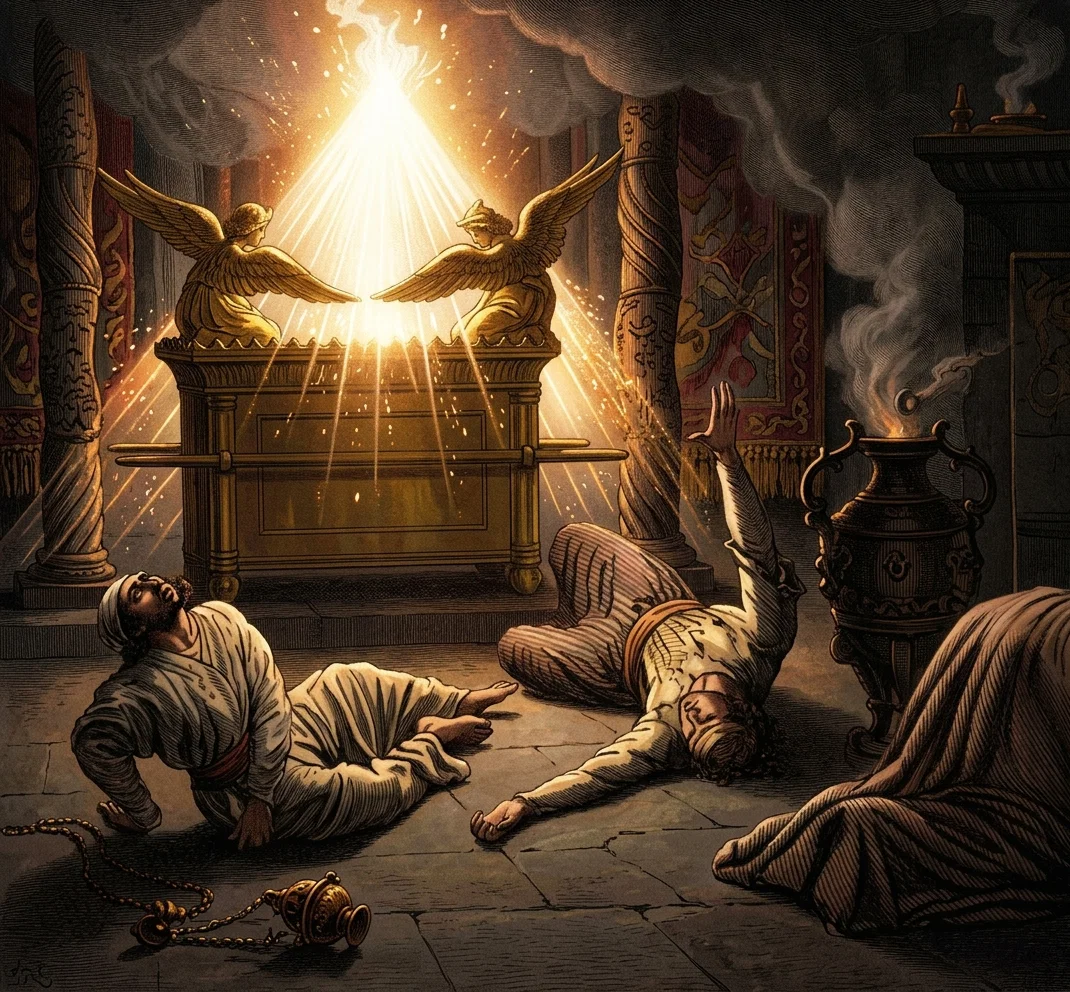
An illustration of how God consumes the sin of the penitent is given in Lev. 9:15-24. The offerings in behalf of the people represented the sins of the people. They had in figure transferred their sins by confession to the innocent beast. That beast became in type their sin. They had yielded it up to God, placed it through the priest upon God’s altar. All this of course was by faith in the coming Lamb of God, “who was made to be sin for us.” 2 Cor. 5:21. How did God regard this sin offering? Let the record state: “And there came a fire out from before the Lord, and consumed upon the altar the burnt offering and the fat; which when all the people saw, they shouted, and fell on their faces.” The sin was consumed, and the people were cleansed and saved. But in the next chapter we read a different story. Nadab and Abihu transgressed God’s law, deliberately, presumptuously. They not only sinned, but they did it in a way to show that they identified themselves with the sin, and thus became sin. The result was: “And there went out fire from the Lord, and devoured them, and they died before the Lord.” In the one case sin was renounced and confessed and laid upon the offering, and the sin was consumed; in the other, the men identified themselves with sin, went into the presence of God, which consumes sin, and were devoured with the sin they had chosen.

Moses and Israel

These illustrations show why Moses could endure continually God’s presence, and why the children of Israel feared, and drew afar off, and prayed that God might not speak to them any more. If God’s presence had been dwelling within, they would not have been afraid of his presenceon the mount. If there had not been unconfessed sins cherished in the heart, they would have cherished the presence of God. Moses knew God’s presence in his own life and experience; and instead of going away from God, and seeking to hide from his presence, stop his ears from his voice, and seek to shut his eyes from the manifold brightness, he pleaded with humble boldness, “I beseech thee, show me thy glory.” Ex. 33:18. And God more graciously revealed himself to his servant. And the glory of Moses’ face when he came down from the mount was but the forthshining of the glory within, which had purged away all known iniquity.

THE CLOSE OF PROBATION.

THE word “probation” is not found in the Bible. It is defined, “Any proceeding designed to ascertain or test character; examination; trial.”—Standard. We therefore have in the Scriptures words akin to probation: “The trial of your faith,” “the fiery trial which is to try you,” “every man’s work shall be tried.” We have also the word “reprobate,” one rejected after trial. The time of man’s probation, therefore, is the time of his development or trial of character, that which will reveal his choice under test. The close of probation will be when the trial is ended and character is forever decided for good or ill. It is therefore evident that in the day of probation or trial there is hope for man; but when that day is closed, there is no more room for hope. That bright star is forever eclipsed to the reprobate. In fact, he will have so fixed his character that future trial would be useless.
“God is love;” and when man fell, God’s love was not exhausted. He gave man a new trial. The resources of Infinite Love were employed to bring him back to holiness. As sin abounded, God’s wondrous grace did much more abound. He so loved the world as to give “his only-begotten Son,” “the Son of his love,” that he might win man from sin to holiness.
But love could not coerce, compel, or force the will of man. To do this would be to make man a mere machine, an automaton. His service would be a forced service, repugnant to himself and repulsive to God. The only service acceptable to God is willing, loving service. The only service which will or can bring joy to man is willing service, the service of love. All this is met in man’s freedom of choice freely given of God. The message of God to man is ever, “I have set before you life and death, blessing and cursing; therefore choose life, that both thou and thy seed may live.” Deut. 30:19. To this both heaven and earth are witnesses; and Infinite Love will do all that love can do to win man back to righteousness and life. But it must be evident to all that when God has done all that can be done—purchased eternal salvation and offered it full and free—and man rejects it, his inevitable doom is the death which he has chosen by choosing sin.
One other thought in this connection: God’s law “was ordained to life.” Rom. 7:10. If man had believed God, walking in his law faithfully, it would have developed in man a righteous character, upon which God would have eventually set the seal of immortality. But man transgressed the living law of God, and the law works out wrath (Rom. 4:15), which culminates, if unchecked, in the extinction of both sin and sinner (Rom. 6:23; James 1:15). But all have sinned, and in all the law works wrath, or death. But in wrath God remembers mercy. This wrath worked out in man by God’s law, solely because of man’s transgression (Rom. 7:10–14), is represented as a cup of red wine in the Lord’s hand, from which he pours out upon the earth:—
“For in the hand of the Lord there is a cup, and the wine is red; it is full of mixture; and he poureth out of the same; but the dregs thereof, all the wicked of the earth shall wring them out, and drink them.” Ps. 75:8.
The mixture of which it is full is God’s wondrous mercy, in answer to the prayer inspired in behalf of humanity by his own Spirit: “In wrath remember mercy.” Mercy abounds, and is freely poured out upon the children of men. And in his love and mercy he has provided a way, through the life and death of Jesus Christ, whereby the law may again work life in man. In the time of man’s trial, or probation, God seeks to win man back to that submission to his plan, to his holy law, to the life of Jesus Christ.
This period of probation is generally regarded to be about six thousand years, during which time the Gospel, the message of God’s love and power, is proclaimed to sinful man. At the close of this period comes, as must come to every work of trial, the judgment, the examination of cases, the passing of sentence, the execution of sentence. See 1 Chron. 16:23–34; Rev. 14:6, 7. The period of probation, or trial, during which time God offers life to man, and the time of wrath, in which sinful man will find no mercy, are thus spoken of in the word of God:—
“To-day if ye will hear his voice, harden not your hearts.” Heb. 3:7, 8.
“I have heard thee in a time accepted, and in the day of salvation have I succored thee; behold, now is the accepted time; behold, now is the day of salvation.” 2 Cor. 6:2; Isa. 49:8.
“The day of the Lord cometh, cruel both with wrath and fierce anger, to lay the land desolate; and he shall destroy the sinners thereof out of it.” Isa. 13:9.
“Shall not the day of the Lord [on this earth] be darkness, and not light? even very dark, and no brightness in it?” Amos 5:20.
“That day is a day of wrath, a day of trouble and distress, a day of wasteness and desolation, a day of darkness and gloominess, a day of clouds and thick darkness.” See Zeph. 1:14–18.
“Day of judgment and perdition of ungodly men.” 2 Peter 3:7.
Therefore the Lord entreats his people, the purchase of his blood:—
“Gather yourselves together [to the standard erected by the Lord, Isa. 62:10; 59:19], yea, gather together, O nation not desirous; before the decree bring forth, before the day [of probation or salvation] pass as the chaff, before the fierce anger of the Lord come upon you, before the day of the Lord’s anger come upon you. Seek ye the Lord, all ye meek of the earth, which have wrought his judgment; seek righteousness, seek meekness; it may be ye shall be hid in the day of the Lord’s anger.” Zeph. 2:1–3, margin.
He entreats man to accept and receive of his mercy, to take him for what he is—a God full of compassion. He declares that “he delighteth in mercy,” and “taketh pleasure” in those that hope in his mercy. He has wrath only against sin. But when the sinner rejects every manifestation and appeal that a God of infinite love can make, he is left to wrath, the dregs of the red cup, which he has chosen instead of mercy. God desired him to quaff the mercy and righteousness and life; the wicked choose the dregs of the cup—sin, wrath, death.
It will be seen by the above texts that now is the acceptable time, the day of salvation. When that closes by God’s decree, then will begin that day of gloominess, darkness, wrath, in which are no gleams of hope; and from Zeph. 2:1–3, quoted above, a decree marksthat time or point in the world’s history. In individual cases it has always occurred when man for the last time exhausted God’s love, and utterly rejected his pleading. But before Christ comes, truth will be made so clear under the glory of the last message (Rev. 18:1–4), love will plead so strong, the power of God’s Spirit will be so clearly manifest in opposition to Satan, and against the confederacies of earth, that multitudes now in the valley of decision (Joel 3:13, 14) will then decide at once and forever, just as many are deciding to-day, for or against God. Then his decree will go forth:—
“He that is unjust, let him be unjust still; and he which is filthy, let him be filthy still; and he that is righteous, let him be righteous still; and he that is holy, let him be holy still. And, behold, I come quickly; and my reward is with me, to give every man according as his work shall be.” Rev. 22:11, 12.
The Judge has decided. Every soul by acceptance or rejection of God’s mercy has forever fixed his own destiny. The Spirit of grace has forever withdrawn its pleadings from those who despised them. Then it is that the day of wrath, “with no brightness in it,” begins. Then it is that “the Lord shall rise up as in Mount Perazim, he shall be wroth as in the valley of Gibeon, that he may do his work, his strange work; and bring to pass his act, his strange act.” Isa. 28:21. Never before has wrath which the sinner has chosen fallen without the mercy which he had not chosen. God seemingly does not act like himself; but let it be remembered that it is wrath against sin, with which sinful man at that time will have forever identified himself, and must in consequence perish with it. His destruction becomes therefore a manifestation of infinite love; for if man can not be won from sin to righteousness, and rejects the very mercy which has brought him all the happiness he has ever known, it is mercy indeed to terminate that existence which delights only in sin. But ere he does that, God faithfully warns and pleads: “Now therefore be ye not mockers, lest your bands be made strong; for I have heard from the Lord God of hosts a consumption, even determined upon the whole earth.” Isa. 28:22.

The Seven Last Plagues.

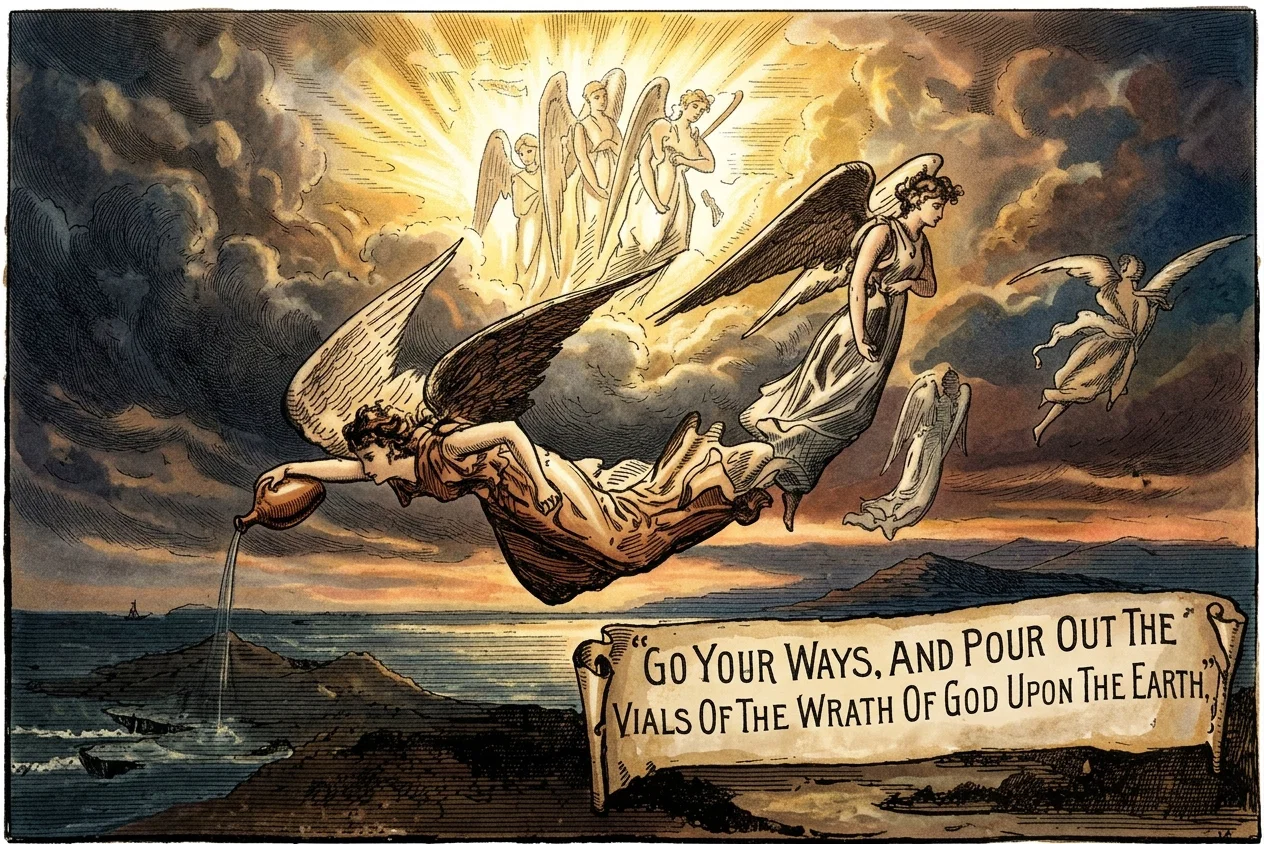
This wrath will be visited upon the world in the seven last plagues, mentioned and described in Rev. 14:9–11; 15:5–8; 16 entire, and other scriptures. That this is evident one consideration will clearly show. That period in which the judgment will be executed, as the scriptures quoted above demonstrate, is the day of wrath unmixed with mercy. This is what the last generation is warned against. See Rev. 14:9–11. But it is expressly said that in these “seven last plagues” “is filled up the wrath of God.” Rev. 15:1. “Seven angels having seven plagues, which are the last, for in them is finished the wrath of God.” R. V. “Seven messengers, having seven plagues, the last; because IN THEM was ended the wrath of God.”—Rotherham. “Seven angels, having seven plagues, the last in order, because with them the wrath of God is consummated.”—Murdock’s Syriac. “Because in these was completed the wrath of God.”—Young. The wrath of the great day of God’s wrath is all contained in the wrath of the seven plagues.
The pouring out of these plagues seems to occupy a comparatively short space of time, perhaps a year (Rev. 18:8; Isa. 34:8); but their effect continues throughout the great day of God’s wrath, culminating in the everlasting destruction of all sin and those who have identified themselves with sin, at the close of the thousand years. See Rev. 20:7–15; Zech. 14:12.) The terrible working of sin would long ago, as a lesson of destruction, have swept out of existence all life upon the earth had not God’s mercy interposed. But when the plagues are poured out, the power to sustain and shield and prevent is withdrawn, and the agencies of destruction are allowed to work their own way, and especially and first upon those who have chosen evil in the face of great light; and when the last bowl of wrath is poured out, and the agencies of destruction are allowed free course, then will be said in heaven, “It is done.”
Now men boast their own might, their own innate goodness and inherent immortality, their power by education and science to evolve higher organizations, and to do this, if not apart from God, at the most with little assistance from him. To man they give the glory. A constantly and wonderfully developing science will lead them to believe, as some already do, that man holds the power of life or death in his own hands, and therefore glory is given to men, while the Gospel of Jesus Christ is denied or belittled. But when God withdraws his mercy from a world which has rejected it, when the angels are bidden to release the fearful workings of sin and death, man will be left to his own choosing; and it will then be demonstrated to a faithful universe that man apart from God has not even the power or desire to repent, that he may give God glory. See Rev. 16:9.
But, reader, Mercy still pleads in tones of infinite love, Come to Christ, the only Saviour. God still sends his thrillingly solemn warning messages to the world, especially set forth in Rev. 14:6–14. Still the Lord of heaven and earth declares and pleads, and will you not hear him? “As I live, saith the Lord God, I have no pleasure in the death of the wicked; but that the wicked turn from his way and live; turn ye, turn ye from your evil ways; for WHY WILL YE DIE?” “BEHOLD, NOW IS THE ACCEPTED TIME; behold, NOW IS THE DAY OF SALVATION.”

The Brightness of His Coming.

When Christ comes the second time, in his own glory and the glory of the Father, there will still be the two classes,—those whose sins have been purged away by the glory of the indwelling Christ, and those who identify themselves with sin by choosing that instead of God’s holiness. Christ will then come into his own dominion, which he created and redeemed from sin. His glorious presence will be manifest. Those who have identified themselves with sin by deliberate choice will be destroyed by “the brightness of his coming” (2 Thess. 2:8), “the forthshining of his presence;” while those who have chosen his holiness—his presence within, in the place of sin—will look up and with gladness exclaim, “Lo, this is our God; we have waited for him, and he will save us: this is the Lord; we have waited for him, we will be glad and rejoice in his salvation” (Isa. 25:9). Then to the wicked our God will be a consuming fire. But the righteous will be unharmed. (See Isa. 33:14, 15.) The subject is a fruitful one for study; we will not pursue it farther now. Yet, reader, let us beseech you by the mercies of God that you let Christ’s presence into your heart, that the sin may be consumed now, so that when the heavens may reveal his glory, you will not be consumed with the sin. He died and lives that he may take away your sins; will you not let him do this?

The Golden Rule

The Golden Rule absolutely forbids enforcing upon others any religious dogma, rite, or institution. It reads:—
“Whatsoever ye would that men should do to you, do ye even so to them.” Matt. 7:12.
This does not mean—as it is generally practiced—Whatever ye would that men should do to you, do ye not so to them. It means what it says. It means that if we would not that the idolater should force his religion upon us, we should not force ours upon him. If we would not have the Roman Catholic compel us to adore the host and bow to the pope, we should not seek to compel him to do what we believe to be right. If we would not have the Jew compel us to observe the day which he holds to be the Sabbath if he were in the majority, according to the teaching of Christ we should not demand that he should observe the day that we hold as sacred. To compel or coerce any one in the matter of religious observances, institutions, or practices, is contrary to the Golden Rule, and is therefore unchristian.

The Free Gift:

In the portion of the fifth chapter that we have already studied, we learned of the wonderful love of God, so great that he gave himself for his enemies, in order that they might be reconciled to him; and that, as in the death of Christ we receive the life of God, and are thereby one with him, so by the continuation of that life in us we are saved from sin. Without any further review, we may proceed with the following verses, which present

A Series of Contrasts.

“Wherefore, as by one man sin entered into the world, and death by sin; and so death passed upon all men, for that all have sinned: (for until the law sin was in the world; but sin is not imputed when there is no law. Nevertheless death reigned from Adam to Moses, even over them that had not sinned after the similitude of Adam’s transgression, who is the figure of Him that was to come. But not as the offense, so also is the free gift; for if through the offense of one many be dead, much more the grace of God, and the gift by grace, which is by one man, Jesus Christ, hath abounded unto many. And not as it was by one that sinned, so is the gift; for the judgment was by one to condemnation, but the free gift is of many offenses unto justification. For if by one man’s offense death reigned by one; much more they which receive abundance of grace and of the gift of righteousness shall reign in life by one, Jesus Christ.) Therefore as by the offense of one judgment came upon all men to condemnation; even so by the righteousness of one the free gift came upon all men unto justification of life. For as by one man’s disobedience many were made sinners, so by the obedience of one shall many be made righteous.” Rom. 5:12–19.

Questioning the Text.

How did sin enter into the world?
“By one man sin entered into the world.”
What did sin bring with it?
“And death by sin.”
Upon how many did sentence of death pass?
“And so death passed upon all men.”
Why?
“For that all have sinned.”
What then was the fruit of that first offense?
“By the offense of one judgment came upon all men to condemnation.”
But what else comes just as extensively?
“The free gift came upon all men unto justification of life.”
By what means did it come?
“By the righteousness of one.”
How only does righteousness come?
“By the obedience of one.”
Joy in God.—The eleventh verse shouldhave been included in last week’s lesson, as the thought is the same as in the preceding verses. By the same life by which we receive the reconciliation and salvation, “we also joy in God.” Christ’s life is a joyous life. When David had fallen, he prayed, “Restore unto me the joy of thy salvation; and uphold me with thy free Spirit.” Ps. 51:12. The brightness of the heavens, the beauty of the infinite variety of flowers with which God clothes the earth, and the glad songs of the birds, all indicate that God delights in joy and beauty. Brightness and song are but the natural expressions of his life. “Let them also that love thy name be joyful in thee.” Ps. 5:11.
There is probably no passage in Romans more difficult to understand than verses 12–19 of this fifth chapter. The reason is that there is so long a parenthesis in the midst of the main statement, and there is so much repetition of the same form of expression. There is really no greatly involved argument. We shall not in this study attempt to deal with every particular, but will note the main thought running through the whole, so that the reader can read and study it more satisfactorily for himself.
First Principles.—It will be seen from verse 12 that the apostle goes back to the very beginning. “By one man sin entered into the world, and death by sin; and so death passed upon all men, for that all have sinned.” There can never be any presentation of the Gospel, if these facts are ignored. The story of the fall of man must be as literally true as the story of the cross; for the latter depends entirely upon the former.
Death by Sin.—Death came by sin, because sin is death. Sin, when it is full grown, bringeth forth death. See James 1:15. “To be carnally minded is death.” Rom. 8:6. “The sting of death is sin.” 1 Cor. 15:56. There could be no death if there were no sin. Sin carries death in its bosom. So it was not an arbitrary act on the part of God that death came upon men because of sin. It could not possibly be otherwise.
Righteousness and Life.—“To be spiritually minded is life and peace.” Rom. 8:6. “There is none good but one, that is, God.” Matt. 19:17. He is goodness itself. Goodness is his life. Righteousness is simply God’s way. Therefore righteousness is life. It is not merely a conception of what is right, but it is the right thing itself. Righteousness is active. As sin and death are inseparable, so are righteousness and life. “See, I have set before thee this day life and good, and death and evil.” Deut. 30:15.
Death Passed upon All Men.—Note the justice here. Death passed upon all men, “for that all have sinned.” “The soul that sinneth, it shall die. The son shall not bear the iniquity of the father, neither shall the father bear the iniquity of the son; the righteousness of the righteous shall be upon him, and the wickedness of the wicked shall be upon him.” Eze. 18:20. And this is also a necessary consequence of the fact that sin contains death in it, and that death can not come in any other way than by sin.
The Conclusion.—It will be noticed that the twelfth verse begins a proposition that is not completed. Verses 13–17 are parenthetical; we must pass on to the eighteenth verse to find the conclusion. But as the mind would naturally lose the first part of the statement, on account of the long parenthesis, the apostle repeats the substance of it, so that we may perceive the force of the conclusion. So the first part of verse 18 is parallel to verse 12. “As by one man sin entered into the world, and death by sin; and so death passed upon all men, for that all have sinned,” is paralleled by, “As by the offense of one judgment came upon all men to condemnation.” The conclusion is, “Even so by the righteousness of One the free gift came upon all men unto justification of life.”
The Reign of Death.—“Death reigned from Adam to Moses.” That does not imply that it did not reign just as much afterwards. But the point is that Moses stands for the giving of the law; “for the law was given by Moses.” John 1:17. Now since death reigns through sin, and sin is not imputed when there is no law, it is evident from the statement that “death reigned from Adam to Moses,” that the law was in the world just as much before Sinai as it was after the law was spoken from it. “The sting of death is sin; and the strength of sin is the law.” 1 Cor. 15:56. There can be no sin imputed when there is no law; but wherever there is sin, there death reigns.
Adam a Figure.—“Death reigned from Adam to Moses, even over them that had not sinned after the similitude of Adam’s transgression, who is the figure of Him that was to come.” How is Adam a figure of Him that was to come, namely, Christ?—Just as the following verses indicate. That is, Adam was a figure of Christ in that his action involved many besides himself. It is evident that Adam could not give his descendants any higher nature than he had himself. So Adam’s sin made it inevitable that all his descendants should be born with sinful natures. Sentence of death, however, does not pass on them for that, but because they have sinned.
A Figure by Contrast.—Adam is a figure of Christ, but only by contrast. “Not as the offense, so also is the free gift.” Through the offense of one many are dead; but through the righteousness of One, many receive life. “The judgment was by one to condemnation, but the free gift is of many offenses unto justification.” “For if by one man’s offense death reigned by one; much more they which receive abundance of grace and of the gift of righteousness shall reign in life by One, Jesus Christ.” It will be seen that there is contrast all the way through. Everything that came through Adam’s fall is undone in Christ; or, better still, all that was lost in Adam is restored in Christ.
“Much More.”—This might be taken as the key-note of this chapter. Not only is everything that is lost in Adam restored in Christ, but “much more.” “If, when we were enemies, we were reconciled to God by the death of his Son; much more, being reconciled, we shall be saved by his life.” And there is no chance of finding fault with the inevitable fact that we are inheritors of a sinful nature through Adam. We can not complain that we are unjustly dealt with. It is true that we are not to blame for having a sinful nature, and the Lord recognizes the fact. So he provides that just as in Adam we were made partakers of a sinful nature, even so in Christ we shall be made partakers of the divine nature. But “much more.” “For if by one man’s offense death reigned by one; much more they which receive abundance of grace and of the gift of righteousness shall reign in life by One, Jesus Christ.” That is, the life of which we are made partakers in Christ is much stronger for righteousness than the life which we received from Adam is for unrighteousness. God does not do things by halves. He gives “abundance of grace.”
The Condemnation.—“Death passed upon all men;” or, as stated later, “judgment came upon all men to condemnation.” “The wages of sin is death.” Rom. 6:23. All have sinned, and, therefore, all are in condemnation. There has not a man lived on earth over whom death has not reigned, nor will there be until the end of the world. Enoch and Elijah, as well as those who shall be translated when the Lord comes, are no exceptions. There are no exceptions, for the Scripture says that “death passed upon all men.” For the reign of death is simply the reign of sin. “Elias was a man of like passions with us.” Enoch was righteous only by faith; his nature was as sinful as that of any other man. So that death reigned over them as well as over any others. For be it remembered that this present going into the grave, which we so often see, is not the punishment of sin. It is simply the evidence of our mortality. Good and bad alike die. This is not the condemnation, because men die rejoicing in the Lord, and even singing songs of triumph.
“Justification of Life.”—“By the righteousness of One the free gift came upon all men unto justification of life.” There is no exception here. As the condemnation came upon all, so the justification comes upon all. Christ has tasted death for every man. He has given himself for all. Nay, he has given himself to every man. The free gift has come upon all. The fact that it is a free gift is evidence that there is no exception. If it came upon only those who have some special qualification, then it would not be a free gift. It is a fact, therefore, plainly stated in the Bible, that the gift of righteousness and life in Christ has come to every man on earth. There is not the slightest reason whyevery man that has ever lived should not be saved unto eternal life, except that they would not have it. So many spurn the gift offered so freely.

Let Christ Draw.

The language of love is the language of persuasion. Christ’s minister is not divided, a minister of the Gospel and a minister of politics or law. He is to know only Christ and him crucified. And if he is a true minister of Christ, as he sees the certain doom which awaits the impenitent in consequence of sin, he will say, with Paul, “Knowing therefore the terror of the Lord, we persuade men.” 2 Cor. 5: 11. The language of the Gospel, of the ambassador of Christ, is “entreat,” “beseech,” “pray,” and the constraining power is the love of Christ. See 2 Cor. 5: 20, 14; 6: 1; Rom. 12: 1. But Sunday laws and all other religious measures are against all these principles, against this spirit, against the whole genius of Christianity. Jesus said, “And I, if I be lifted up, will draw all men unto me.” His power to draw is as great now as it was 1,800 years ago if his professed servants will but lift him up. Let Christ be seen in his greatness and glory, in his purity and loveliness, as he was before the world was. Let him be seen in his humiliation, his labor, his suffering, his death, the climax of the evidence of his love. Let him be seen as the great High Priest, still divine and human, the One able to help the lowest sinner out of the lowest slums of iniquity to a life of purity in Christ Jesus. Lift him up in all his fullness, in his glory and beauty and love. Labor in his Spirit, as he labored, and Christ in his love will draw the multitude. There need be no demand for civil law to protect what is Christ’s. He can not be destroyed, nor can his; and therefore if a so-called Christian or church institution can not stand in its own intrinsic merit, by the spiritual power of Christ behind it, it deserves to die. This is not politics, but it is Christianity.
Continue reading: Question Corner