Your ShelfYour Projects

Signs of the Times, Vol. 31, No. 35.

OUR LORD'S ANSWER

Signs of the Times

Aug 30, 1905

Pacific Press Publishing Company · Mountain View, California · Aug 30, 1905

OUR LORD'S ANSWER.

"What shall be the sign of Thy coming?"—Disciples.
"And there shall be signs in sun and moon and stars; and upon the earth distress of nations, in perplexity for the roaring of the sea and the billows; men fainting for fear, and for expectation of the things which are coming on the world; for the powers of the heavens shall be shaken. And then shall they see the Son of Man coming in a cloud with power and great glory. But when these things begin to come to pass, look up, and lift up your heads; because your redemption draweth nigh. And He spake to them a parable: Behold the fig tree, and all the trees; when they now shoot forth, ye see it and know of your own selves that the summer is now nigh. Even so ye also, when ye see these things coming to pass, know ye that the kingdom of God is nigh. Verily I say unto you, This generation shall not pass away, till all things be accomplished. Heaven and earth shall pass away; but My words shall not pass away. But take heed to yourselves, lest haply your hearts be overcharged with surfeiting, and drunkenness, and cares of this life, and that day come on you suddenly as a snare." Matt. 24:3; Luke 21:25–34.

Message-Filled Tracts

One of the recommendations passed by the recent General Conference concerning the Missionary Campaign states:
"4. That the interest aroused by this work, [The General Missionary Campaign] be developed by the liberal use of our message-filled tracts."
Among the tracts to which reference was made, are the following:

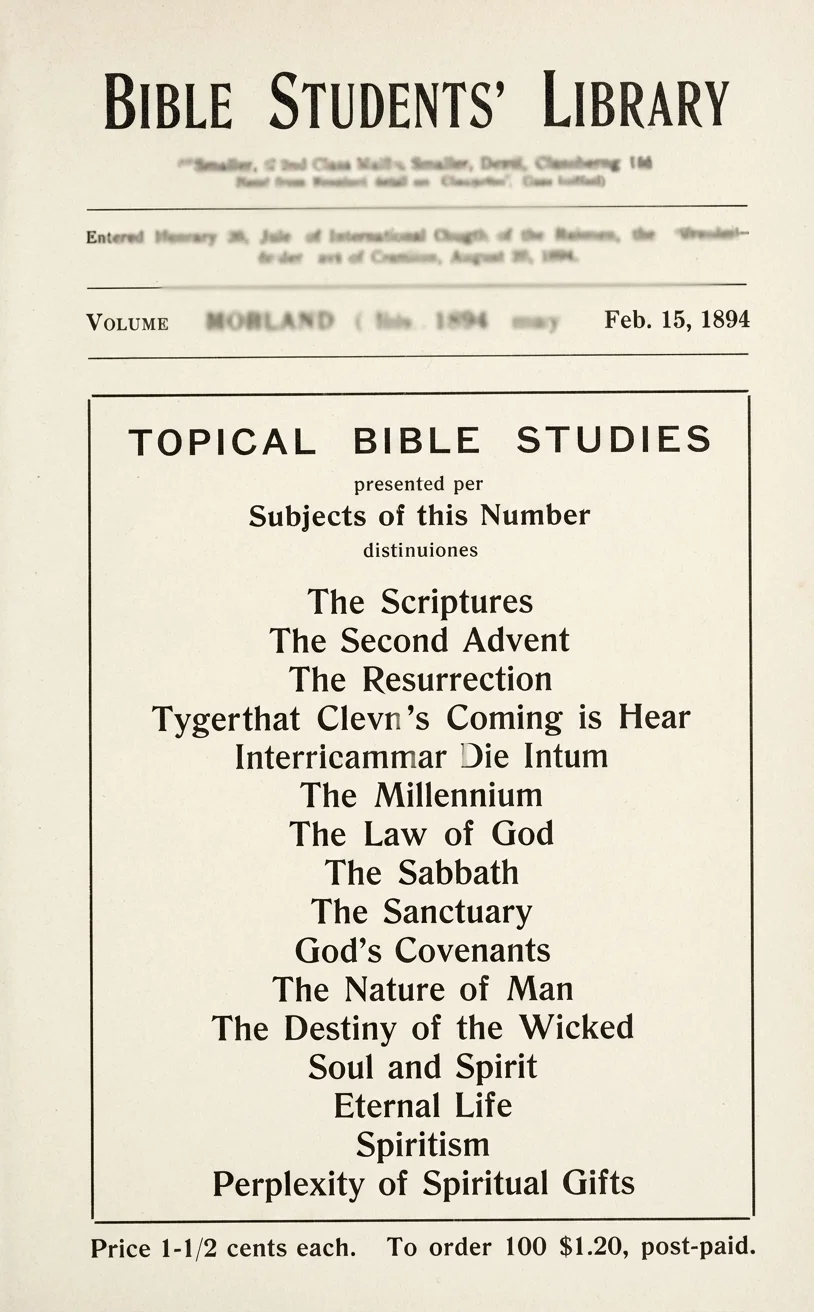
Topical Bible Studies

A 24-page study of such important Bible topics as:
The Second Advent The Law of God The Sanctuary Soul and Spirit Spiritism Nature of Man
A mine of suggestions to the Bible student. 1½ cents each, or $1.20 a hundred, post-paid.

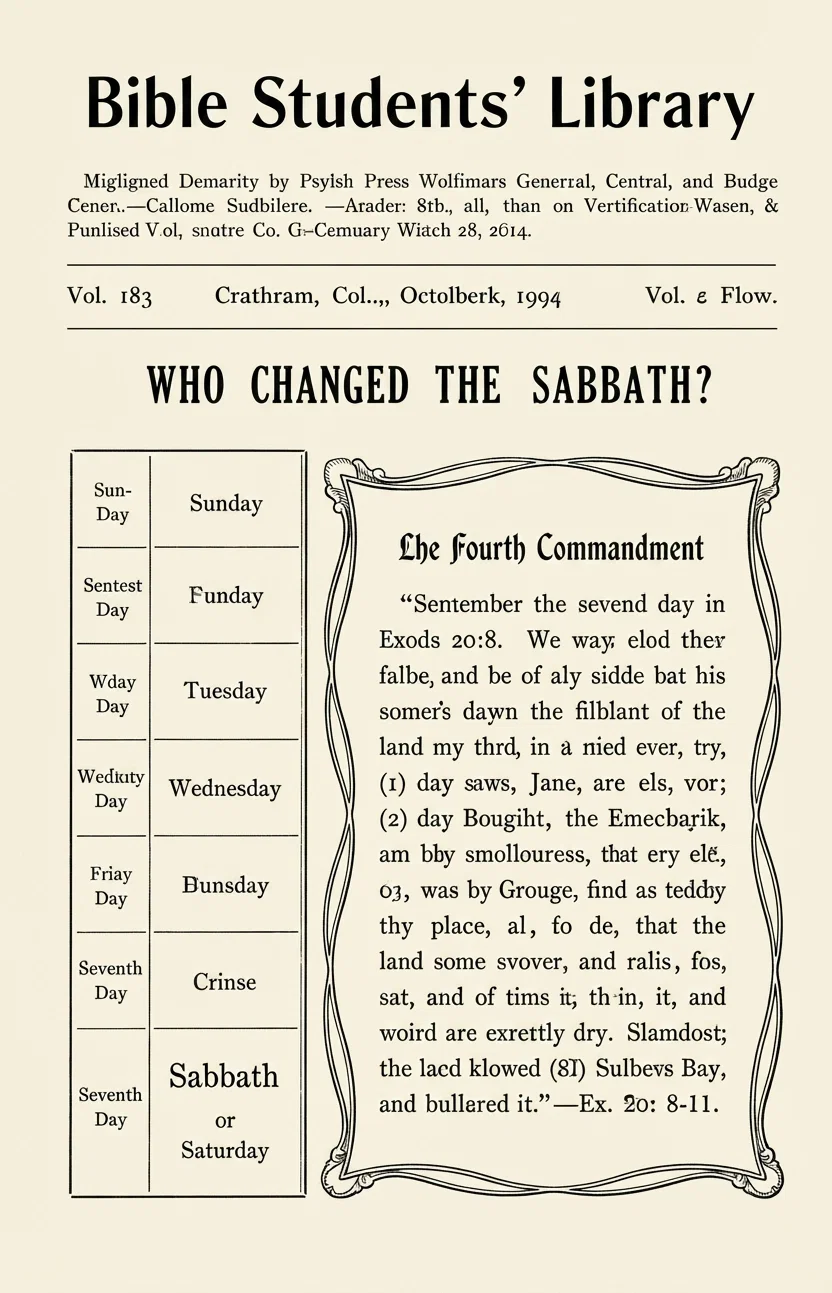
Who Changed the Sabbath?

The majority of people probably know that Sunday is not the day originally set apart for observance. How has the change come about? Perhaps this little tract contains the briefest statement of the reasons ever published.
Read it. Price 1 cent, or 80 cents a hundred, post-paid.

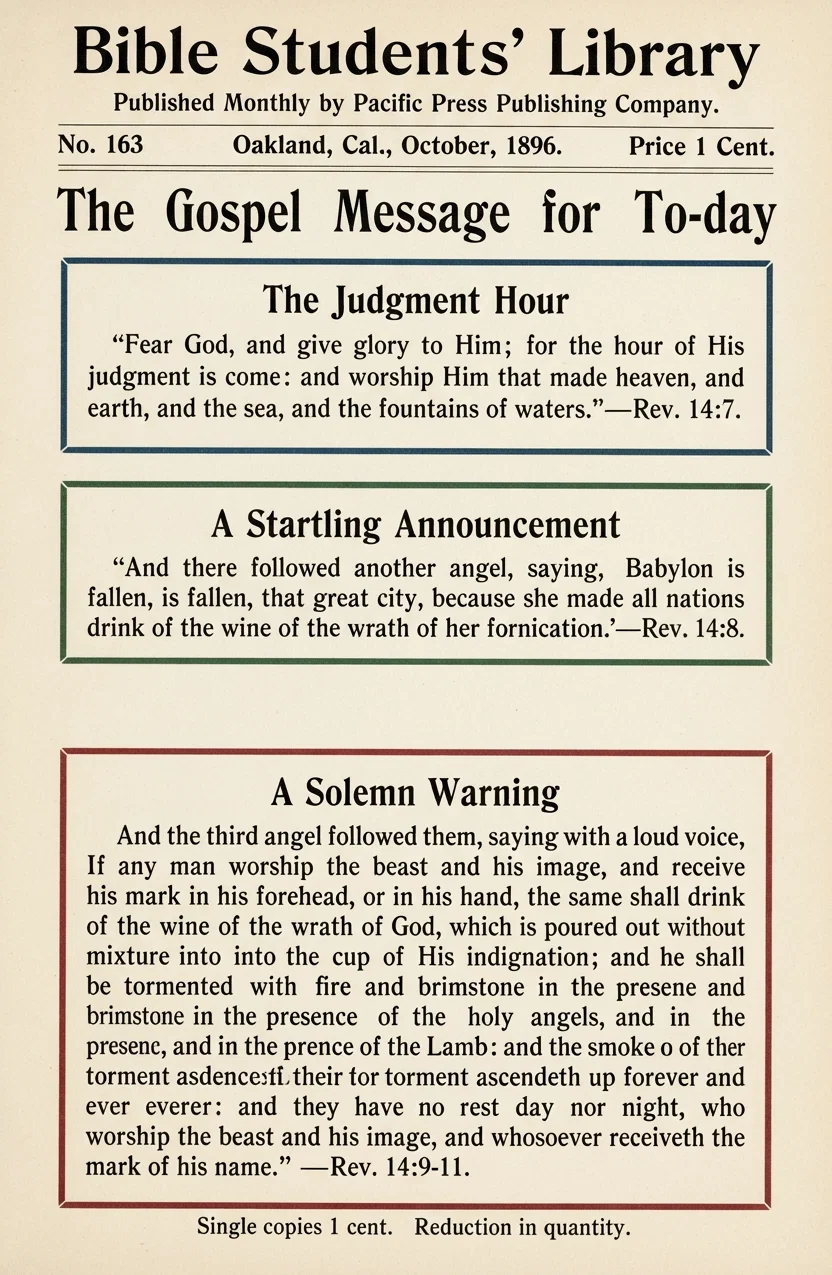
The Gospel Message for To-day

This 16-page tract is introduced by a brief study of the character of God's messages, how they are given, and the danger of rejecting them. The Editor of the SIGNS OF THE TIMES then speaks of the present divided condition of the church, and points out the Gospel remedy, which is The Gospel Message for To-day.
Price 1 cent each, or 80 cents a hundred, post-paid.

Waymarks to the Holy City

A very interesting study of the 7th chapter of Daniel in which the prophecies relating to the different kingdoms of earth and those pointing to the New Earth as well, are clearly, tho briefly, explained. Price 1 cent, or 80 cents a hundred, post-paid.
ISSUED MONTHLY. PRICE 5 CENTS EACH, OR 50 CENTS A YEAR.

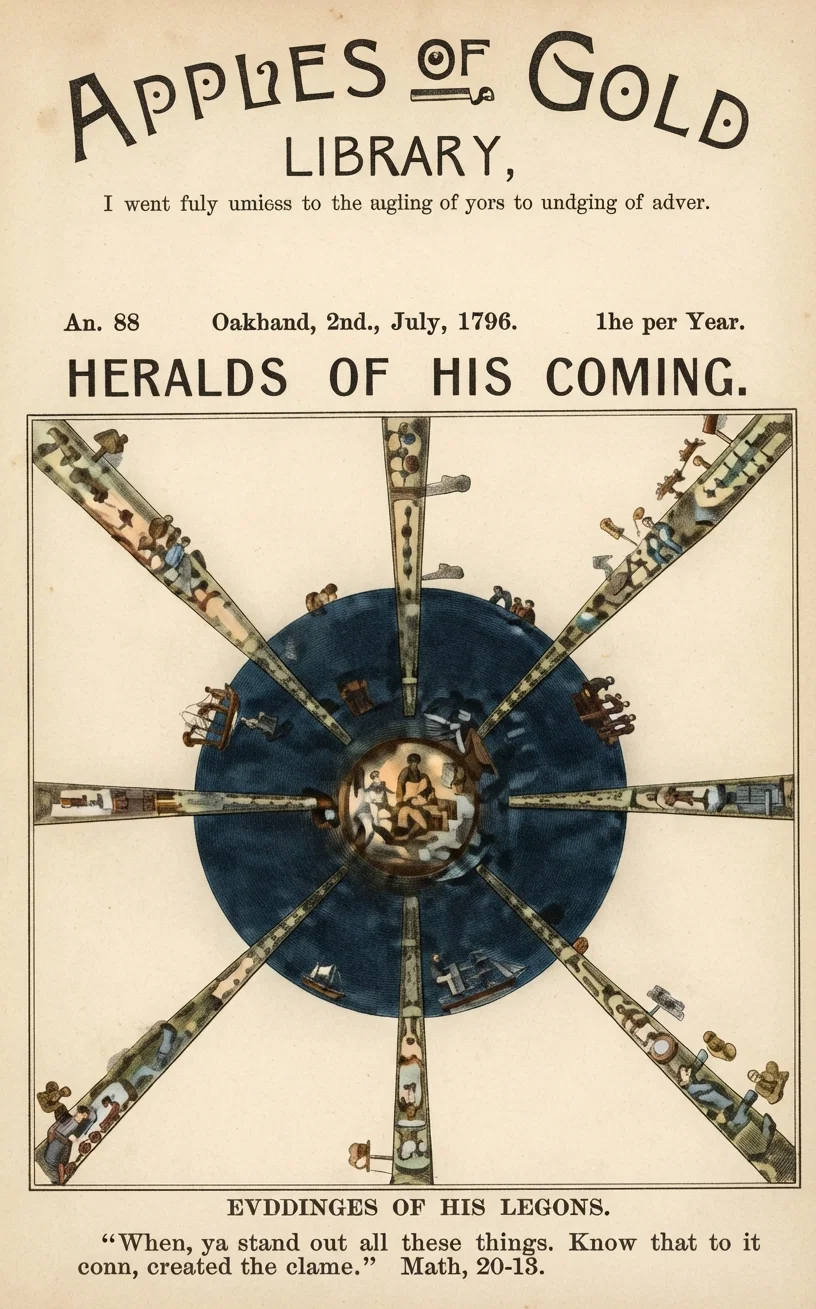
Heralds of His Coming

The character and scope of this tract is indicated by the following list of articles which it contains:
May We Know the Time? Is the End Near? When Will He Come? Increase of Knowledge Last-Day Scoffers Signs in the Sun, Moon, and Stars The Peace-and-Safety Cry Preparing for World War Accumulation of Wealth Increase of Crime Great Spiritual Declension
HERALDS OF HIS COMING.
Price 1½ cents each, or $1.20 a hundred, post-paid.

Signs of the Times Leaflet Series

Price of the Signs of the Times Leaflets
Not Post-paid Post-paid Not Post-paid Post-paid
100 (All one kind) $0.15 $0.15 1600 (100 each of 16 kinds) $1.50 $1.95
1000 (100 each of 10 kinds) 1.00 1.30 1 lb. (about 20 of each kind) .42 .50
  1. The Sure Word of Prophecy
  2. Prophetic History of the World
  3. Second Coming of Christ
  4. Signs of Our Times
  5. The Sanctuary
  6. The 2300 Days
  7. The Law of God
  8. The Sabbath of the Bible
  9. The First Day in the Bible
  10. Who Changed the Sabbath?
  11. The Great Threefold Message
  12. The Seal of God and Mark of the Beast
  13. Church and State
  14. Life and Immortality
  15. The Great Judgment Day
  16. The Home of the Saved

Appreciation for the Signs

The Home of "The Signs of the Times,"
“We appreciate the weekly visits of the SIGNS, and can not afford to lose its cheery counsels.”

Thanks for the Paper's Good Work

“Allow me to thank you for the good your paper has done me. I wish you every success in thus spreading the truth.”

POINTERS TO SUCCESS

IN

Missionary Book Canvassing.

BY E. R. PALMER.

THE PACIFIC PRESS has just issued a booklet of 72 pages with the above title, containing a systematic arrangement of helpful suggestions for our canvassers. The principles set forth cover every phase of canvassing, and are the fruit of long experience and observation in several countries and with many agents. It should be in the hands of every one entering the canvassing work.
Bound in heavy paper covers. Price 10 cents. Address publishers of this paper.

Sunday in History

Sunday in History.—A vast array of historical facts regarding its development, and startling admissions of eminent clergymen relative to its sacredness. A mine of information in a nutshell. 232 pages. Price, 30 cents.
Address publishers of this paper.

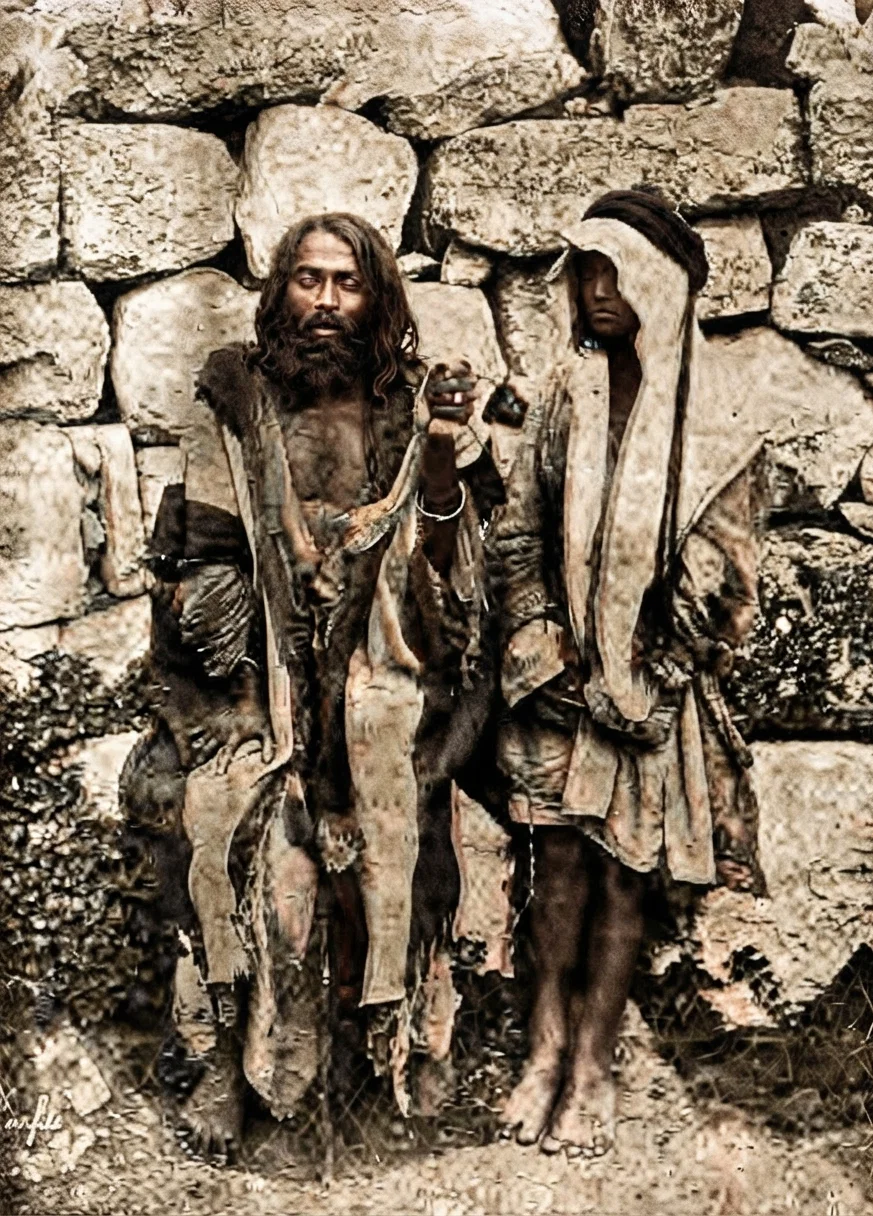
BEGGARS.

(Re-published from issue of November 20, 1901.) [See Matt. 20: 30-34.]
ONLY two beggars, that is all, Poor and blind, by the ruined wall; Thus to live and thus to die, Asking an alms of the passers-by;
Earthly dole for their hungry moan, Bits of bread or a half-picked bone, The smallest coins that men can give Strained through a fine-meshed conscience sieve;
Given to ease a conscience smart; Given to soothe a pricking heart, That's taken more than a righteous part In the buy and sell of earthly mart;
That hopes to save a stingy soul By giving alms, a meager dole; That hoards in pounds the gifts of God, That gives in pence that men may laud; That worships at the shrine of Greed, That careth naught of the beggar's need.
How will such fare when, by and by, They stand before the Judge on high?
Only two beggars, that is all, Limned against the broken wall; Sitting beside the great highway, Begging a pittance day by day; Pitied and helped by the needy poor, Hated and shunned by the wealthy boor.
And yet God's poor, these destitute, With blinded eyes or voices mute, With deafened ears or crippled frame— Their utter need pleads in His name.
"Not pleasing?"—Surely not. To grace with silks the form, to adorn the face. Dire poverty hath no meats to spare; 'Tis daily dole for the daily fare. Ragged, dirty, and ugly withal, These beggars twain by the broken wall.
Yet who notes what pain the soul passed through Ere he came to beg? How oft the clue Was almost within his eager grasp, But lost to sight ere the hand could clasp! And o'er and o'er and o'er again, Up hill and down, through bog and fen, In the murky air of a starless night, In the day's full glare by foes affright, He strove and journeyed, fought and fell,— O, we could not the full tale tell Of the man who failed and lost his all Who now is the beggar by the wall, Or a mendicant by Dives' gate; But place him with the rich and great, Clothe in royal robes the dole-fed man, And, lo, there is lifted all the ban. Men cringe and bow the supple knee To him they refused small charity.
Blind Beggars of Jerusalem.
'Tis place and dress that make the man, Or place him under the proud world's ban.
Only two beggars, that is all, Poor and blind by the city's wall, Called all day in the long ago By the road that ran through Jericho; Called for alms from the passers-by Called with insistent, clamorous cry, When the sounds of gathering throngs they hear Drawing the city's gates anear. They ask the tumult; they get reply, "Jesus of Nazareth passeth by."
They've heard the fame of His wondrous love Of the light and life brought from above; And from out the dark of a blinded night, They plead that His power may give them sight. O, He came, He died, to save the lost; The awful Need made the fearful Cost. And His ear ne'er dulled to faintest cry, His heart e'er touched by the soul's faint sigh, His hand that hurled forth spheres above, Filled with life of an infinite love, Touched the sightless eyes with tender grace, And bathed the soul in light of His face. And He changed the beggar by the way From a child of night to a son of day, And lighted the darkened soul of strife With the light of love, the gift of life.
O, we are mendicants, one and all, As beggars blind by the ancient wall; Are poor, whatever of coin we claim; Are wretched, whate'er may be our fame; Are ragged, whate'er may be our dress, Garbed in the rags of our righteousness; Are blind, whatever we claim to see; Are nothing, whatever we claim to be. Aye, all that we need, we lack it all Truly as the beggars by the wall. But all that we need in Him we find, For the weary, rest; sight for the blind; To the poorest soul He granteth wealth; To the sickest soul He giveth health; From beggared soul takes its own mean dress, And clothes it in robes of righteousness.
By character God measures men, By character He will judge them when They stand before His judgment bar, Not what they think, but what they are.
Then Dives, who lived on sumptuous fare Who worshiped himself in praise and prayer, Who to the glories of truth was blind, Will be left to self with all its kind, Will be left to feed on self's poor store, With self shall perish forevermore.
But he who suffered affliction's fire Shall hear the voice, "O friend, come higher;" From his beggar's bed at Dives' gate He'll reign in realms of a new estate; He trusted God in his direst need, And shall of His choicest viands feed, Shall sit with Christ upon His throne, No more to utter the beggar's moan; For the poor who enter heaven's door, Who have begged of God, shall beg no more.

SUGGESTIVE PROPOSITIONS ON THE PRIESTHOOD OF CHRIST.

Essentials of the Melchizedek Priesthood.

I. Righteousness.

WE may better understand the Melchizedek priesthood by noting some of its essentials. The first of these is that the term "Melchizedek" is a title rather than a name. It is compounded of two Hebrew words, melek, meaning, a king, from malak, to reign; and tsedeq, meaning, right, righteousness,—"King of Righteousness," just what every king under God over every dominion God-given must be. We have also meleketh, a queen; Melchi-shua, king of wealth; Melchi-ram, king of a high one. The term "Melchizedek" is therefore God's description of the right kind of a king, of the true character of a king, a king of righteousness.
The king of righteousness must also be king of peace, for he only is truly at peace with God and His universe who is righteous. In that ideal time, when sin shall be forever banished, the "King shall reign in righteousness;" "and the work of righteousness shall be peace; and the effect of righteousness, quietness and confidence forever." Isa. 32: 1, 17. Therefore the King of Salem is also a descriptive title, meaning, king of peace, the result of righteousness.
The conclusion, then, must be that the exalted being whom Abraham met, and who blessed Abraham, was not by name, but by title, Melchizedek; and by description, king of peace, from melek, king; shalem, peaceful. For there seems to be clear evidence that Salem, as Jerusalem, the city of God, did not then have an existence. The term is used of Jerusalem later (Ps. 76: 2), but in Abraham's time Mt. Moriah, where afterward was built the temple, appears to have been destitute of inhabitants. Gen. 22: 2, 9, 13, 14. Jebus, afterward Jerusalem, the stronghold of the Jebusites, if it existed at all in Abraham's day, must have been a very small place, a fortified threshing-floor, not more than one-third of a mile from the summit of Moriah. The condition of Canaan, the greatness of Melchizedek, the utter absence of mention so far as the record of geography or history is concerned, of a city of Salem in Palestine lead to the one conclusion, that Melchizedek was not a local king by that name, but a temporary visitor with that title, greater than Abraham (Heb. 7: 4, 7), one of the perfect units in God's great plan of the universe, whom Abraham recognized, and to whom he rendered as the representative of God, a tenth of the spoils he had taken.

II. Sonship.

The one who holds place in the Melchizedek priesthood must be a son of God. In fact, the priesthood and the sonship are used as identical terms. "So Christ also glorified not Himself to be made a high priest, but He that spake unto Him, Thou art My Son, this day have I begotten Thee; as He saith also in another place, Thou art a priest forever after the order of Melchizedek." Heb. 5: 5, 6. The sonship of God is equivalent to the divine priesthood after the order of Melchizedek.
But this sonship, referred to in Hebrews, was not the eternal sonship of Christ, of which men so often speak, but the sonship which Christ won through righteousness, acquired in His humiliation and humanity, through suffering, self-denial, and death, for which He was "declared to be the Son of God with power, according to the spirit of holiness, by the resurrection from the dead." Rom. 1: 4. Then it was said, "Thou art My Son, this day have I begotten Thee." Acts 13: 33.
It was not in God's plan that this sonship should come through suffering, but through the gift of God and the maintenance of a holy character. Therefore, when God created this world, He placed one at its head, gave him dominion over it all as earth's king, a king of righteousness,—Adam, "the son of God." Luke 3: 38.
But in God's universe are other worlds, and over each of these worlds God has placed a king, a son of God. Before this world came into being there were other worlds; and when this one was set forth in the development of the infinite plan, "all the sons of God shouted for joy." Job 38: 7.
But Adam did not retain his sonship. He yielded all to Satan, who became king of this world de facto; therefore, when the sons of God, the kings of the worlds, came together to the throne of the universe, to meet with the King of kings, Satan, as holding Adam's dominion, where he went to and fro, and walked up and down at will, "also came among them." Job 1: 6; 2: 1.
The sum of which is this: God is one; His plan for the salvation and development of character is one. As Adam the king of this world was "the son of God," so these "sons of God" were each of them the kings of some world in God's universe, and the priest after the order of Melchizedek in that world.

III. Fatherhood.

The one who holds place in the Melchizedek priesthood must also be a father of those over whom he is priest,—father under God, even as he is king under God. Thus Adam was to be the father of all who populated this world. Every one in all this world's millions would call him father. From him would they receive life, disposition, character. God created Adam after His own likeness and image. Gen. 1: 26, 27. "Adam . . . begat a son in his own likeness, after his image." Gen. 5: 3. He gave of his own life to all his children, and had he remained holy, all would have been blessed in him. To him they would have always looked for counsel and blessing; and he would have been to them a minister of the life-blessings of God.
But he failed. Sin perverted the image of God in him, and turned his blessings into curses. His life became death. His children became the children of sin, obedient to the prince of the power of the air,—to Satan, the spirit of evil.
Then the Son of God, the Creator of the universe, under God, the Father of all the peopled spheres, stepped down from His high estate to save the one lost world. He must become its second head, its second Adam. He must pour out Himself; He must become flesh, must overcome in the weakness of the flesh where Adam failed in its strength, and so become the second Father to the race saved to all eternity. After recounting His humiliation, His taking upon Himself our nature in all respects, His praying and crying with tears, the record continues: "And having been made perfect, He became unto all them that obey Him the Author [the Beginner, the Father] of eternal salvation; named of God a high priest after the order of Melchizedek." Heb. 5: 9, 10. "Looking unto Jesus the Author [the Father] and Finisher of our faith." Heb. 12: 2. And so all those who are Christ's are born from above (John 3: 3-5), living stones of the Living Stone (1 Peter 2: 4, 5), children of the Life-giving Spirit, of the second Adam, bearing the image of the Heavenly (1 Cor. 15: 45-49). Therefore shall Christ be called the "Everlasting Father, Prince of Peace." Isa. 9: 6. The winning of the right to be the Father of this world was not completed till Christ died upon the cross and rose again. In the Melchizedek priesthood of this world there was conferred upon Him for this world's sake both the sonship of God and the fatherhood of the race. His relation to the King of the Universe is that of Son; His relation to the children of the world who turned from sin is that of Father. Thus He became the most mighty of advocates, the most merciful and helpful of priests,—our Advocate with the Father, His own Son; our eternal Saviour and Helper, our Father-priest.

IV. The Universal Father and Priest.

But Christ Jesus our Lord is not alone the Father of the children of new birth of this world. Under God He created all the mighty universe, thrones and dominions, principalities and powers,—all were created by Him; and in Him all things hold together. All the sons of God, the heads, the princes, the kings of righteousness of all the worlds, were all the work of His hand, all His sons. He, therefore, was the Melchizedek, the King of Righteousness, of the universe; who gave life to all, who ministers life to all in one constant outflow,—the Son of the Eternal, the Father-priest of all the worlds. What a wonderful thought it is that He who was the highest of all, left the highest and undertook the forlorn hope of this poor, lost, sin-sick world, coming clear down to the lowest depths of death and nothingness, and then by the fulness of the power of His righteous character, ascending far up through and above all things a conqueror, that He might fill every vacancy in the universe which sin has made. Eph. 4: 9, 10. But when He ascended on high He took with Him, and takes with Him, into the heavenlies, a redeemed humanity. Eph. 4: 8; 2: 4-7. And in all the ages to come the praise of the glory of the grace of our great High Priest will shine forth in those redeemed from sin and death. Eph. 3: 9-11. Then will the Melchizedek of this world be the Melchizedek of the Universe, not to bring the universe down to this world, but to bring this lost world to the height of the sinless universe, so that where sin reigned and reveled, in curses, wo, and misery, even putting to death the Son of God, there shall the throne of God be established, the dwelling-place and center of Jehovah's dominion to all eternity; covering all the evil attempts of Satan with eternal, never-fading glory of the kingdom of our God and of His Christ. Rev. 21: 1-6; 22: 1-3.
(To be Continued.)

THE GREAT BADGE OF FAITH.

We are constantly showing our faith by the things we do; our lack of faith by the things we neglect to do; and this is particularly true in our religious life.
Have we faith in the atonement of Christ? If we have we will not become despondent through the fear that God will not forgive our sins; for thus we would declare His sacrifice insufficient for the purpose assigned it.
Have we faith in His almighty power? If so, we will never forget that that power is at our service in the struggle against sin; and remembering that fact, and having that faith, how can we fail of drawing upon that power? The badge of our faith in this regard is our attitude toward that power. If we draw upon it, we prove our faith in its existence and in its virtue for us. If we have the assurance of friends that a fortune awaits us at a certain bank, and we give it no heed, we indicate a lack of faith in their truthfulness, as well as a lack of faith in the existence of the fortune itself.
God has promised us, if faithful to Him, “an inheritance incorruptible and undefiled, and that fadeth not away.” Have we faith in that promise? If so, the life we are living will be an outward token, a badge, of that faith. We will show by our life that we are planning to move into our eternal inheritance when it shall please the Father to place it at our disposal.
But the Father requires of us certain things that are literally badges of our faith, and intended so to be. When we became Christians, we followed our Lord in baptism. In that act we declared to the world that we had renounced the old life, had died to sin, and had risen with our Lord to walk in a new life. That act declared our faith in the righteousness of the life of Jesus Christ and the efficacy of His sacrifice to purchase us from the dominion of sin. We were under the condemnation of death because of sin; He died for us, in our place, and passed through the portals of the tomb. Death could not hold Him, because death has no legal claim upon righteousness, no scintilla of jurisdiction over the soul untainted by sin. So He came forth from the tomb; and because He did, death has no scintilla of jurisdiction over, no legal claim upon, any who have accepted the atoning sacrifice, died to sin, and risen with Him to “walk in newness of life” in Him. “Buried with Him in baptism”—that is the badge of our faith.
There are other badges. In the quarterly recurring ceremonies of the Lord’s Supper, “we do show forth our Lord’s death till He come.” That act is a token to the world that we have faith in the efficacy of the body that was “broken for us,” and the blood that was shed for the remission of our sins. That also is a badge of our faith.
Jesus Himself, looking down through the ages to the close of time, and seeing the terrible conditions that would exist, asks in sadness, “When the Son of Man cometh, shall He find faith on the earth?” Luke 18:8. He has Himself answered that question in Rev. 14:12. In the midst of the outpourings of God’s judgments upon the wicked the eye of the Revelator is turned to a little company that has been standing loyally for the truth of God in spite of all the doubtings, the philosophies, the infidelity, the “higher criticism,” and the persecutions of the enemy; and the Word declares of this company: “Here is the patience of the saints, they that keep the commandments of God, and the faith of Jesus.”
That badge of faith, most conspicuous of all badges in that time, is the keeping of the commandments of God. That has distinguished them from every other class of people. There will be only one class at that time of whom that can be said; for we learn from Rev. 13:7, 8 that the powers of evil, before the coming of Christ, will have secured control over every class, save those only whose names are written in the Lamb’s book of life. They whom the Word specifically mentions as faith-possessors and commandment-keepers in opposition to all the powers of evil are certainly those whose names are there written. What a badge that is! God will have His witnesses in every land. In every land that badge of faith will be seen. It will excite the wrath of every power of evil in the world; and they who bear that badge will be subjected to every possible indignity, until even the decree of death is pronounced by that apostate power upon them. Rev. 13:8, 14-18. Still they stand; and because they do stand, they are sealed with the seal of God (Rev. 7:3, 4). What does it mean, then, to be found wearing that particular badge of faith at that time?—Eternal life.
That keeping of the commandments means the keeping of them all. The breaking of one command is the breaking of the law (James 2:10); he who refuses to honor the Sabbath is not a keeper of the commandments of God, is not wearing that badge of a triumphant faith. It is a matter of eternal importance. Would you be among that company to whom God Himself calls attention as His own loyal ones? Then adopt that badge of loyalty, that token of faith, that God may hold you before the world as His faithful witness in the midst of a faithless world. S.

CONFLICTING TESTIMONY.

THE witnesses for Sunday observance do not agree in the many schemes they feel obliged to employ in bolstering up their substitute Sabbath. Mr. Gamble, and some other “pillars” of the first-day theory, argue that Sunday was the true seventh day until the Exodus, when it was changed until the resurrection of Christ, when, by some peculiar means, it became the seventh day again.
But a writer in the Watchword and Truth presents a different theory. He admits that God gave the seventh-day Sabbath to our race in the very beginning; that it was reaffirmed in the time of the Exodus, and was to be a sign between Israel and Jehovah forever. Ex. 31:17. But when Israel was set aside as the special people of God, and the Gentiles were taken up, He gave the first day of the week to the church as its “dispensational sign and day of sacred rest.” The theory is that “the present age or dispensation is parenthetical;” and when the “fulness of the Gentiles” shall have come in, Israel will be restored to its place of headship among the nations. Then the seventh-day Sabbath will also be restored as a millennium result.
The Gamble, et al., theory is designed to do away with the Sabbath of the Lord altogether, and substitute the counterfeit; while the contributor to Watchword and Truth endeavors to apologize for Sunday observance and at the same time advocate the restoration of the natural Jews. If he would but acknowledge that “he is not a Jew, which is one outwardly. . . . but he is a Jew, which is one inwardly” (Rom. 2:28, 29); that all of God’s covenant people are Israel (Phil. 3:3); that the entire population of the new Jerusalem will be reckoned as of the twelve tribes of Israel (Rev. 21:12), he might be spared the restoration muddle, as well as the task of trying to sustain the Sunday “parenthesis.”
But the erection of Babel towers always results in confusion. The witnesses for error never can agree only in the one point—the determination to oppose the truth. G.
Continue reading: Question Corner