Pacific Press Publishing Company · Oakland, California · Dec 1, 1898
“PEACE, BE STILL.”
By John Orr
Scarcely anything so fully stirs a tempest within the human breast as being held under false accusation. To protest one’s innocence at such a time is held to be just and meritorious. Indeed, the silence of one who is charged with wrong and holds his peace, is usually construed as evidence of his guilt, regardless of his former standing or present profession.
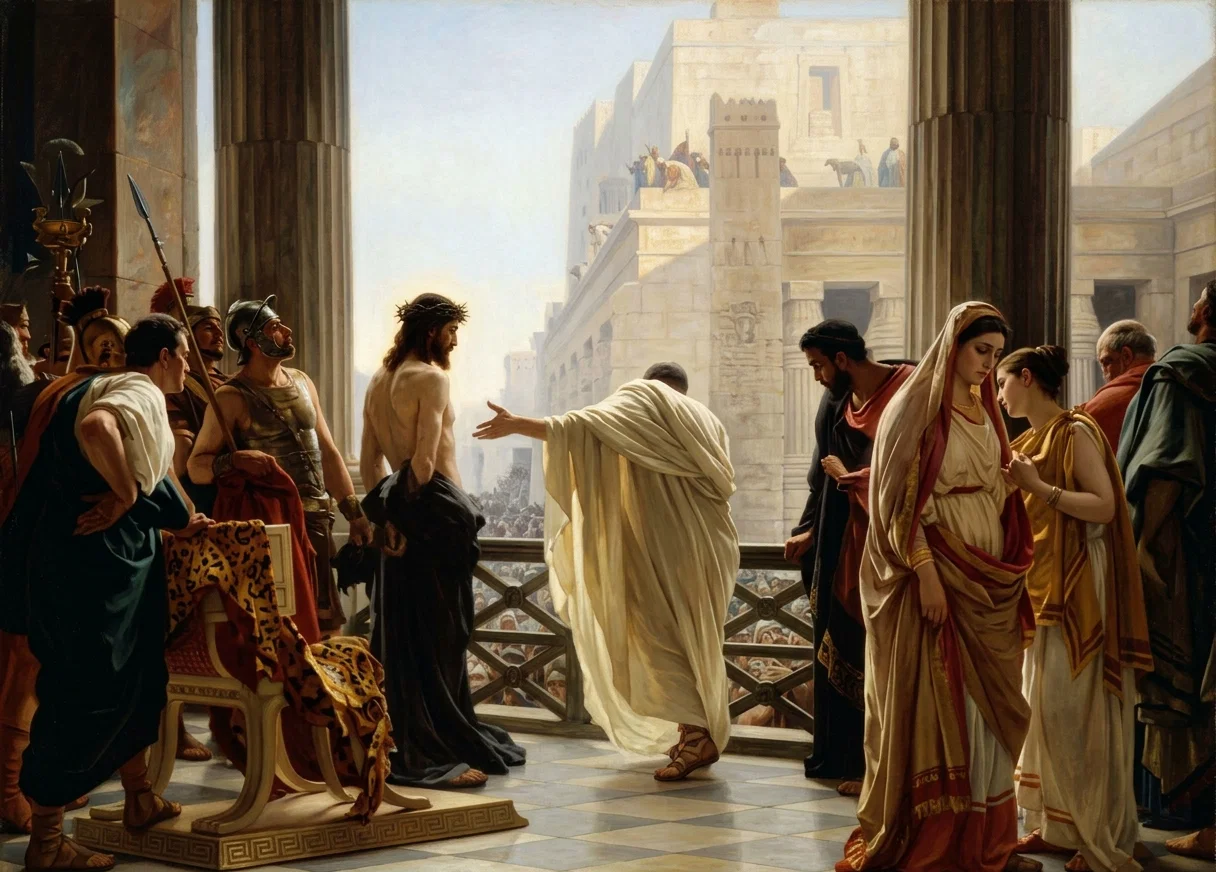
“BEHOLD THE MAN.” PILATE PRESENTING CHRIST BEFORE THE MULTITUDE.
But one’s silence under such circumstances is not certain evidence of guilt. On the other hand, it is more likely to be the opposite, for the reason that a guilty person works in his own interest, and is the more likely one to attempt his own defense. It requires great control of the human passion, however, to keep entirely calm and quiet under what one knows to be a false charge, brought against him through prejudice and pique.
The example of Christ in this respect is worthy of careful study. The Jews having secured His person through the treachery of a professed follower, were determined to find charges against Him serious enough to warrant them in putting Him to death. Their long-continued system of putting spies to watch Him for some traitorous word had failed. Even false witnesses were hired to testify against Him before the tribunal of the high priest, but their testimony did not agree. Two witnesses must be found who would testify to something in His past life that would condemn Him; for His condemnation was already determined upon.
At last one was found who said that he had heard Jesus say that if the temple at Jerusalem were pulled down He could build it up in three days. Others agreed that something of this sort had been said. But this was not enough; and so the wily Jewish priest, hoping to see Jesus commit Himself to some statement which might be labeled a civil offense, put Him under oath, and then demanded that he should state, as before the living God, whether or not He claimed to be the Son of the Most High.
Silent up to this moment, Jesus could do no less than answer truthfully. Hearing His answer, the priest declared that no further evidence of guilt was necessary. The next step was to take the case before the Roman tribunal to have the judgment of the high priest confirmed. Pilate, the “Javelin-man,” had his official seat elevated to its accustomed place, high above the crowd. This spot was in front of the judgment hall, and known as “The Pavement,” because of being laid with a mosaic of colored stones hewn out of costly marble.
Set down on this tessellated floor was the ivory chair of the procurator.
Up the steps of this tribunal Christ was led by the priests and elders of the Jews. As Roman law knew no condemnation but for cause, Pilate demanded to know the nature of Christ’s offense. The Roman judge had probably heard much about Christ and His work, and so from the first understood that from envy the Jews were delivering Jesus to the Roman judgment-seat. Altho his nature was heartlessly cruel, Pilate seemed willing from the outset to release Christ from the power of Rome’s enemies, the Jews. As charge after charge was brought against Jesus, Pilate marveled that He made no attempt to vindicate Himself. Taking Christ inside the palace,2Pilate asked Him privately concerning the charges brought against Him. The Saviour there candidly stated who He was and His mission to earth. He was then brought out before the crowd, and the verdict rendered that no fault could be found with Him.
Upon this the mob below became furious in their demands for the life of Christ. Thinking to appease them Pilate gave orders to have the divine prisoner stripped to the waist and scourged, after which His lacerated and crippled form was presented before them with the pathetic appeal, “Behold the man.” But again from the court-yard below came the railing laugh, and the brutal demand for His crucifixion. Amid all the tumult of the hour no complaint escaped the lips of Christ; not even a murmur was heard. Under the circumstances He might have appealed to the honor, the compassion, or the pity of the people in a way to touch the hardest heart. But He was calmly silent, not because He was crushed with sorrow, but because He had risen to the serene joy of a conqueror.
But the determination of His tormentors was to be carried out at all hazards, and, altho no word of censure or retaliation escaped the lips of the divine Prisoner, He was finally brought to His death, as He had lived, with His mind under full control, a shining example to all His professed followers when suffering unjustly.
JOHN ORR.
WALKING WITH GOD.
By Irving E. Baker
As in the Scriptures we study the lives of holy men, we are apt to think that somehow their experience was different from ours, and that there was something in their lives which it is impossible for us to attain to. Let us take the record of two whose lives seem to have been most nearly perfect, and see how they became what they were; and we shall find that all who are finally saved will attain righteousness in the same way.
We read of Enoch, “And Enoch walked with God; and he was not; for God took him.” Gen. 5:24. Comparing this with Heb. 11:5, we find by what means Enoch was able to walk with God: “By faith Enoch was translated that he should not see death; and was not found, because God had translated him; for before his translation he had this testimony, that he pleased God.”
Comparing 1 Cor. 15:51 with 1 Thess. 4:17, it is seen that there will be a class living on the earth at the second coming of Christ who will be translated as Enoch was. The testimony of the Scriptures shows that we are living in the time when that event is near, and so it becomes a personal question, How shall I live that I may be among that number? The record says, “By faith Enoch was translated.” That we also must live by faith is evident from Heb. 10:38, “Now the just shall live by faith.” “Without faith it is impossible to please Him.” Heb. 11:6. Enoch “by faith” had the testimony while living on the earth “that he pleased God.” So may we by the same faith.
Of Noah it is said, “Noah walked with God.” Gen. 6:9. “By faith Noah, being warned of God of things not seen as yet, moved with fear, prepared an ark to the saving of his house; by the which he condemned the world, and became heir of the righteousness which is by faith.” Heb. 11:7.
Noah’s work also is a parallel to the last message of warning which is now going to the world. See Matt. 24:37–39. He walked with God by faith, and warned the world of the coming Flood. But while telling the people of the destruction at hand, “moved with fear,” he “prepared an ark to the saving of his house,” and in so doing “he condemned the world.” And not only that, but he “became heir of the righteousness which is by faith.”
Do we desire to walk with God? Will our holy lives condemn the world? Do we want to save our households? Are we preachers of righteousness? Then let us have the living faith of Noah. Let us not only believe the truth and talk it to others, but let our daily lives be a living demonstration of the truthfulness of the message we proclaim. So shall we walk with God, and become heirs “of the righteousness which is by faith.”
“Dear Father, at Thy word
I lift my trembling hand,
And clasp the one that’s offered me;
How precious Thy command!
“And, walking at Thy side,
How can I go astray?
Thy law within my heart
Shall keep me in the way.”
IRVING E. BAKER.
Bastrop, La.
THE OUTPOURING OF THE SPIRIT.
By Ellen G. White
During the Jewish economy, the influence of God’s Spirit had been seen in a marked manner, but not in full. For ages prayers had been offered for the fulfilment of God’s promise to impart His Spirit, and not one of these earnest supplications had been forgotten.
Christ determined that when He ascended from this earth He would bestow a gift on those who had believed on Him and those who should believe on Him. What gift could He bestow rich enough to signalize and grace His ascension to the mediatorial throne? It must be worthy of His greatness and His royalty. He determined to give His representative, the third person of the Godhead. This gift could not be excelled. He would give all gifts in one, and therefore the divine Spirit, converting, enlightening, sanctifying, would be His donation.
Standing near His trial, condemnation, and crucifixion, Christ said: “I tell you the truth: It is expedient for you that I go away; for if I go not away, the Comforter will not come unto you; but if I depart, I will send Him unto you. And when He is come, He will reprove the world of sin, and of righteousness, and of judgment.” “I will not leave you comfortless: I will come to you.” “I will pray the Father, and He shall give you another Comforter, that He may abide with you forever; even the Spirit of truth, whom the world can not receive, because it seeth Him not, neither knoweth Him; but ye know Him; for He dwelleth with you, and shall be in you.”
This is a wonderful announcement. Christ longed to be in a position where He could accomplish the most important work by few and simple means. The plan of redemption is comprehensive; but its parts are few, and each part depends on the other, while all work together with the utmost simplicity and in entire harmony. Christ is represented by the Holy Spirit; and when this Spirit is appreciated, when those controlled by the Spirit communicate to others the energy with which they are imbued, an invisible chord is touched which electrifies the whole. Would that we could all understand how boundless are the divine resources!
But the time had now come. The Spirit had been waiting for the crucifixion, resurrection, and ascension of Christ. For ten days the disciples offered their petitions for the outpouring of the Spirit, and Christ in heaven added His intercession. This was the occasion of His ascension and inauguration, a jubilee in heaven. He had ascended on high, leading captivity captive, and He now claimed the gift of the Spirit, that He might pour it out upon His disciples.
The Spirit was given as Christ had promised, and like a rushing mighty wind it fell upon those assembled, filling the whole house. It came with a fulness and power, as if for ages it had been restrained, but was now being poured forth upon the church, to be communicated to the world.
What followed this outpouring?—Thousands were converted in a day. In Christ’s day many heard the Gospel, but they did not become sufficiently interested to search for the pearl of great price. But on the day of Pentecost three thousand were converted by the preaching of the Gospel. A wonderful communication was made that day between heaven and earth. Those who witnessed this scene had recently witnessed in the same city the crucifixion of the world’s Redeemer. But how little those who beheld Him hanging on the cross understood what His death meant! How few realized that “God so loved the world, that He gave His only-begotten Son, that whosoever believeth in Him should not perish, but have everlasting life!”
On the day of Pentecost, Christ’s witnesses proclaimed the truth, telling men the wonderful news of salvation through Christ. And as a flaming two-edged sword the truth flashed conviction into human hearts. Men were brought under Christ’s control. The glad tidings were carried to the uttermost bounds of the inhabited world. The church beheld converts flocking to her from all directions. The altar of the cross, which sanctifies the gift, was rebuilt. Believers were reconverted. Sinners united with Christians in seeking the pearl of great price. The prophecy was fulfilled, the weak “shall be as David,” and David “as the angel of the Lord.” Every Christian saw in his brother the divine similitude of benevolence and love. One interest prevailed. One object swallowed up all others. Every pulse beat in healthy concert. The only ambition of the believers was to see who could reveal most perfectly the likeness of Christ’s character, who could do the most for the enlargement of His kingdom. “The multitude of them that believed were of one heart and of one soul.” The Spirit of Christ animated the whole congregation; for they had found the pearl of great price.
MRS. E. G. WHITE.
TRANSFORMATION
By Dean Farrar
If we make this world, as far as we are concerned, a world wherein dwelleth righteousness, so far do we anticipate the fruition of the new world, the New Jerusalem. Let us aim at this tranquil, this sober happiness of quiet and confidence, and peace in God. This is no chimera. The possibility of winning this is no illusion. In our patience let us possess, let us acquire, our souls. The world will still be the world. There will still be the pestilence which walketh in darkness, and the arrow that flieth in the noonday. The animalism of brutal passions will still crowd our streets with the infamy of its victims and the wretchedness which dogs their heels. There will still be envy, and hatred, and malice, and lies, and sickness, and poverty, and death; but the world in which our inmost souls shall live and move and have their being will even in this life become an anticipated fruition of the new heaven and the new earth. The outer world may still continue for many a long year . . . to grope in3Egyptian darkness, in darkness which may be felt; but our souls, like the children of Israel in Goshen, may have light in their dwellings. For God is light, and he who dwelleth in God dwelleth in light; and where God’s light is, there is wisdom and safety, and a peace which the world does not even attempt to give, and which, happily, neither its malice, nor its wickedness, nor its misfortunes, can ever take away.—Dean Farrar.
Chapter I : 6–10.
By Ellet Joseph Waggoner
Only One Gospel.
Having in our minds the opening words of the Epistle to the Galatians, we will proceed directly to the subject matter of it. The apostle at once comes to the point, saying:—
“I marvel that ye are so soon removed from Him that called you into the grace of Christ unto another Gospel; which is not another; but there be some that trouble you, and would pervert the Gospel of Christ. But tho we, or an angel from heaven, preach any other Gospel unto you than that which we have preached unto you, let him be accursed. As we said before, so say I now again, If any man preach any other Gospel unto you than that ye have received, let him be accursed. For do I now persuade men, or God? or do I seek to please men? for if I yet please men, I should not be the servant of Christ. But I certify you, brethren, that the Gospel which was preached of me is not after man. For I neither received it of man, neither was I taught it, but by the revelation of Jesus Christ.” Gal. 1:6–12.
A careful consideration of exactly what is said in these first verses in Galatians, will save the student much trouble and confusion later on. It is here that we learn the subject of the epistle. We saw last week that the introduction, the salutation, embraced the whole Gospel; surely such an introduction could lead to nothing else but a setting forth of the Gospel. In the verses that constitute this week’s lesson, we find this emphasized. Let us study them closely.
Who Calls Men?—“God is faithful, by whom ye were called unto the fellowship of His Son Jesus Christ our Lord.” 1 Cor. 1:9. “The God of all grace, who hath called us unto His eternal glory by Christ Jesus,” etc. 1 Peter 5:10. “The promise is unto you, and to your children, and to all that are afar off, even as many as the Lord our God shall call.” Acts 2:39. Those that are near, and those that are afar off, include all that are in the world; therefore God calls everybody. Not all come, however. “The very God of peace sanctify you wholly; and I pray God your whole spirit and soul and body be preserved blameless unto the coming of our Lord Jesus Christ. Faithful is He that calleth you, who also will do it.” 1 Thess. 5:23, 24. It is God who calls men.
Separating from God.—Since the Galatian brethren were separating from Him that had called them, and as God is the one who graciously calls men, it is evident that they were separating from God. Thus we see that it was no slight thing that called forth this epistle. Paul’s brethren were in mortal danger, and he could not spend time on compliments, but must needs get at once to the subject, and present it in as clear and direct terms as possible.
It may be well in passing to note an opinion that sometimes obtains on account of hasty reading, namely, that Paul referred to himself as the one who had called the Galatian brethren, and from whom they were removing. A little thought should convince anybody of the fallacy of this idea. First, consider the positive evidence, a little of which is already noted, that it is God who calls. Remember also that it was Paul himself who said that the apostasy would be the result of men’s seeking to draw away disciples after themselves (Acts 20:30), and he as the servant of Christ would be the last man to draw people to himself. It is true that God uses agents, of whom Paul was one, to call men, but it is God, nevertheless, that calls. “God was in Christ, reconciling the world unto Himself;” we are ambassadors for Christ, so that now it is God beseeching men by us instead of by Christ, to be reconciled to Himself.
It is a small matter to be joined to or separated from men, but a matter of vital importance to be joined to God. Many seem to think that everything depends on being joined to this or that body of religious people; if they are only “members in good standing” in this or that church, they feel secure. But the only thing worth considering is, Am I joined to the Lord, and walking in His truth? If one is joined to the Lord, he will very soon find his place among God’s people, for those who are not God’s people will not have a zealous, consistent follower of God among them very long. See Isa. 66:5; John 9:22, 33, 34; 15:18–21; 16:1–3; 2 Tim. 3:1–5, 12. When Barnabas went to Antioch, he exhorted the brethren that with purpose of heart they would “cleave unto the Lord.” Acts 12:22, 23. That was all that was necessary. If we do that, we shall certainly be with God’s own people.
Another Gospel.—The Gospel is “the power of God unto salvation, to every one that believeth.” Rom. 1:16. God Himself is the power, so that separation from God means separation from the Gospel of Christ, who is the power of God. Nothing can be called a gospel unless it professes to give salvation. That which professes to offer nothing but death, can not be called a gospel. “Gospel” means “joyful news,” “good tidings;” and a promise of death does not answer that description. In order for any false doctrine to pass as the Gospel, it must pretend to be the way of life; otherwise it could not deceive men. It is evident, therefore, that the Galatians were being seduced from God by something that promised them life and salvation. The question consequently would be, “Which is the true Gospel? is it the one that Paul preached? or the one the other men set forth?” Therefore again we see that this epistle must be an emphatic presentation of the true Gospel as distinguished from every false gospel.
No Other Gospel.—Just as Jesus Christ is the only power of God, and there is no other name than that of Jesus given among men whereby salvation can be obtained, so there can be only one Gospel. A sham is nothing. A mask is not a man. So this other gospel, to which the Galatian brethren were being enticed, was only a perverted gospel, a counterfeit, a sham, and no real gospel at all. Some versions give verses 6 and 7 thus: “I marvel that ye are so soon removed . . . unto another gospel, altho there is not any other.” Since there is no other gospel now, there never could have been any other, for God changes not. So the Gospel which Paul preached to the Galatians, as well as to the Corinthians,—“Jesus Christ and Him crucified,”—was the Gospel that was preached by Enoch, Noah, Abraham, Moses, and Isaiah.
“Accursed.”—If any man, or even an angel from heaven, should preach any other gospel than that which Paul preached, he would bring himself under a curse. There are not two standards of right and wrong. That which will bring a curse to-day would have produced the same result five thousand years ago. Thus we find that the way of salvation has been exactly the same in every age. The Gospel was preached to Abraham (Gal. 3:8), and the prophets preached the Gospel (1 Peter 1:11, 12). But if the Gospel preached by756them had been different from that preached by Paul, they would have been accursed.
But why should one be accursed for preaching a different gospel?—Because he is the means of fastening others in the curse. “Cursed be he that maketh the blind to wander out of the way.” Deut. 26:18. If this be so of the one who causes a physically blind man to stumble, how much more must it apply to one who causes a soul to stumble to its eternal ruin! To delude people with a false hope of salvation,—to cause them to put their trust in that which can by no means deliver them,—what could possibly be more wicked? It is to lead people to build their house over the bottomless pit. Well might the apostle deliberately reiterate his anathema. And here again we see the gravity of the situation that called forth this epistle. The Galatian brethren, having been led astray by accursed teachers, were themselves in danger of damnation.
“An Angel from Heaven.”—But is there any danger, any possibility, that an angel from heaven would preach any other than the one, true Gospel?—Most assuredly, altho it would not be an angel recently come from heaven. We read of “the angels that sinned” (2 Peter 2:4), and “kept not their first estate, but left their own habitation” (Jude 6), and that the habitation from which they were cast was heaven. Rev. 12:7–9. Now “Satan himself is transformed into an angel of light. Therefore it is no great thing if his ministers also be transformed as the ministers of righteousness.” 2 Cor. 11:14, 15. It is they who come professing to be the spirits of the departed, bringing messages fresh from the realms above (where the departed are not), and preaching invariably “another gospel” than the Gospel of Jesus Christ. Beware of them. “Beloved, believe not every spirit, but try the spirits whether they are of God.” 1 John 4:1. “To the law and to the testimony; if they speak not according to this Word, it is because there is no light in them.” Isa. 8:20.
Not Men-Pleasers.—The apostle Paul exhorts servants to be obedient to their “masters according to the flesh; not with eye-service, as men-pleasers; but with singleness of heart, fearing God.” Col. 3:22. How much more then should it apply to those who are preaching the Gospel! So Paul declares that he is not seeking to persuade, to conciliate, to gain the favor of, or to please men, but God. The Lord alone is his Master. “We are ambassadors for Christ,” and this is true of every Christian to the extent of the ability that God has given him. The position of an ambassador was thus very concisely put by a daily paper, in connection with a circumstance that occurred about two years ago:—
The fundamental basis of the influence and authority of any ambassador is the universal knowledge that he personally is absolutely beyond the reach of praise or blame, of loss or gain, of reward or punishment, in the foreign country where he represents his own. To his sovereign alone, through an official channel, and to no other human being, may a diplomatist look for recompense or fear rebuke.
This is pre-eminently true of Christ’s ambassador. To Him, and to no human being, are they answerable. To please Him is their sole business. As soon as they seek to please men, they cease to serve Him.
Unbounded Freedom.—“He that is called in the Lord, being a servant, is the Lord’s freeman.” 1 Cor. 7:22. Paul, “an ambassador in bonds,” desired the prayers of his brethren, that utterance might be given him, that he might open his mouth boldly, to make known the mystery of the Gospel. Eph. 6:19, 20. He who recognizes his relation to Christ as ambassador, is absolutely free. He need fear no man. Nay, it is impossible for him to fear man, since he knows the infinite power that sustains him. He can proclaim the Gospel as boldly before kings as before peasants. How can he fear kings, when he serves the King of kings? And if he does present his message in the presence of God and the angels, how can he fear the face of any man? Such holy boldness is worth untold worlds.
Not of Man.—Paul declared that he did not receive the Gospel from any man, but that it came to him directly from Christ. In the account of his conversion (Acts 9:1–22; 22:10), we see that a man was sent to Paul with a message from the Lord; nevertheless, it is true that Paul did not receive the Gospel from man. If he had, then he would have been a servant of men. But as he was sent, not by any man, but Jesus Christ and God, who raised him from the dead (Gal. 1:1), so he carried only the message which the Lord Himself gave him. Note how he repeats that what he tells he received of the Lord. 1 Cor. 11:23; 1 Thess. 4:15. “The things that I write unto you are the commandments of the Lord.” 1 Cor. 14:37. That was the secret of his boldness. He had no doubts about his message, as he must have had if he had received it from man.
We may have this same confidence, and indeed must have it if we are Christ’s servants. If we receive the Gospel from men, then we are not sure of our ground. Not but what God employs human agents, for the Gospel is committed to men, but, no matter whose form we see, no matter what man God uses, we must recognize God’s voice, and receive the message fresh from Him, else we have no assurance of its correctness. We need not depend on any man or any church to substantiate the Word of God, or for our knowledge that this or that is or is not His Word. “Ye have an unction from the Holy One, and ye know all things.” “These things have I written unto you concerning them that seduce you. But the anointing which ye have received of Him abideth in you, and ye need not that any man teach you; but as the same anointing teacheth you of all things, and is truth, and is no lie, and even as it hath taught you, ye shall abide in Him.” 1 John 2:20, 26, 27. Even tho a man has truth, and if he has received it through some man as the instrument of the Spirit, if he traces his reception of it to that man, or his mind runs to that man and to what he said, as assurance for what he holds, he has not yet the truth as he ought to have it. When a man recognizes the voice of God in a truth that he hears, and receives it as coming directly from the Lord, then it is his own, and he knows it for a certainty. He is then free from man.
The Revelation of Jesus Christ.—Note that it is not simply a revelation from Jesus Christ, but the “revelation of Jesus Christ.” It was not simply that Christ told Paul something, but Christ Himself revealed Himself to Paul, and in him; and He is the truth. That this is what is meant here may be seen from verse 16, where we read that God revealed His Son in Paul, that he might preach Him among the heathen. So we read: “We know that the Son of God is come, and hath given us an understanding, that we may know Him that is true, and we are in Him that is true, even in His Son Jesus Christ. This is the true God, and eternal life.” 1 John 5:20. The mystery of the Gospel is Christ in the believer, the hope of glory. Col. 1:25–27. Thus it is that every Christian not only may but must be as sure of the Gospel which he believes, and which he makes known to others, as the apostle Paul was. Thank God that He has not left us to follow “cunningly-devised fables.”
E. J. Waggoner.
GENUINENESS OF OUR INSPIRED BOOKS.
THE Christian may rest in perfect assurance, and on evidence of the highest and most incontestable character, that the books of the Bible, which claim to be the inspired revelation of God to man, are the genuine writings of the men whose names they bear. No ancient writings have one-quarter of the proof which the manuscripts of the Holy Scriptures can claim. The writings, for instance, of Herodotus have been found in less than twenty manuscript copies in various ancient libraries, evidently about eight hundred years old; and yet scholars accept without question their genuineness. But we find no less than six hundred manuscript copies of the Greek New Testament, some of them more than sixteen hundred years old; and more than twice as many of the Hebrew Scriptures—nearly two thousand in all—and these not eight hundred years old. These have not been found in one place, or under circumstances which could render it possible for them to have been designedly copied from each other, but some of them are from the Vatican, some from Alexandria, some from Mount Sinai, some from Syria. Some of these were written in the tenth century, some in the ninth, some in the eighth, some as early as the third and fourth, and some of the Hebrew copies are evidently older than the Christian era.
All these manuscripts substantially agree, although they have never met before, and it is manifest that they must have been copied from a still more ancient volume. We find also numerous editions of the same old volume in various languages. From Russia comes a Slavonic version 1,000 years old. From Egypt comes a Coptic version 1,200 years old. From Ethiopia comes an Ethiopic version 1,300 years old. From Persia comes an Armenian version over 1,000 years old. From Italy comes the Latin or Vulgate version, 1,400 years old. From Africa comes the Hexapla of Origen, 1,500 years old. From Syria comes the Peshito, or Syriac version, 1,800 years old. From Rabbinical libraries there came the Targums, or Paraphrases of the Bible, still older. From Alexandria comes the old Septuagint or Greek version of the Old Testament, 285 years older than the Christian era.
All these manuscripts substantially agree. The first volume contains the same thirty-nine books written by the same twenty-nine authors, whose lives covered a period of 1,000 years. The second volume contains the same twenty-seven books, written by the same ten men. The variations between the different copies are so slight as not to affect any essential fact or doctrine. Where in all literature is there a parallel to such a volume? Who can doubt that these ancient writings are what they claim to be, the veritable writings of Moses and David, Isaiah and Ezra, Paul and John, Matthew and Peter?—Christian Work.
Misfortune and Providence
By Mme. Swetchine
MISFORTUNE has few riddles for those who believe that the sole design of Providence is the perfecting of mankind.—Mme. Swetchine.