PRIOR to 1850 California was an obscure portion of the western hemisphere. A few Englishmen and Americans had wandered thither between the years 1810 and 1830; and at the latter date there were thought to be 500 foreigners on the west side of the Sierra Nevada Mountains. However, upon the discovery of gold at the old Sutter mill, on the American River, early in 1848, thousands of migrators found their way to the gold-fields of the Pacific slope.
The peculiar location of California, with no overland public conveyance, so isolated the first settlers of the State, that their relation to the eastern portion of the country was much the same as the whole American continent sustained for some generations to the countries of Europe. They therefore were an independent, happy, liberty-loving people, care-free about the religious faith or practice of their neighbors. All they asked or offered was justice between man and man, and good fellowship throughout the various communities.
But in time many wealth seekers came who, having been affiliated with religious societies in their eastern homes, soon conceived the idea of regulating society after the manner of their earlier associations. In such attempt they met an element at variance with their notion of a general weekly rest, and therefore set about to establish their ideal by civil law. This they succeeded in bringing about in 1858, but were doomed to disappointment in the results it secured. Instead of producing peace and quietness in the various settlements, bitterness and discontent abounded.
A Political Question
In fact the question of enforced Sunday observance became one of the great political issues of the times, and sentiment for and against the case became more pronounced and intense until the two great political parties made it a point in dispute at the November election of 1882. The Republican Party, which had till that time held the State governorship, inserted a plank in its platform, pledging itself to maintain the Sunday law.
The Democratic convention meeting in San Jose pledged that party “to oppose the enactment of all Sunday laws,” and it also definitely demanded “the repeal of those laws” then existing. The introduction of such a plank in the party platform, at such a time, when the party was so anxious to win the governorship for General George Stoneman, the champion of Democratic faith for that year, threw the convention into consternation. Mr. Outram, of Alameda, pleaded that it would cost them the church vote, and throw a firebrand into their ranks.
A “Living Issue”
Replying to this, Judge Terry called the question a “living issue,” and declared himself tired of hearing it said that the Democratic Party were too great cowards to meet it openly. It involved, he said, principles higher than any other embraced in the platform, in that it involved obedience to the Federal and State unions, which he believed had been violated by the maintenance of the Sunday law of the State. Referring to the position of the courts on the point that the enforcement of a “religious holiday” was but a “police regulation,” to restrain men from premature failing health from overwork, he said that it was “a parcel of nonsense put by the judges.”
Mr. Whipple, of Sonoma, characterized the Sunday law as “sumptuary legislation,” and averred that it was a “firebrand” as it then stood, and he advocated the nomination of good men for the legislature, that the whole matter might be properly tested by the people. Said he, “Let the Democratic Party stand where it always has been—an opponent to too much government, and against everything that hampers the just liberties of the citizens.”
Mr. Grady, of Fresno, said that the no-Sunday plank was “calculated to establish the grand principles that the Democratic Party ought always to adhere to—that a man has a right to worship God according to the dictates of his own conscience. . . . We can not drive people to the worship of God, and it ought not to be done in that way.”
Sunday Law Abolished
The resolution to abolish the Sunday law from the statutes, was by vote made a plank of the Democratic platform by an overwhelming majority; and in the election following, General Stoneman was elected governor, with a Democratic legislature, which was the first Democratic administration the State ever had. One of the first bills to be acted on favorably in the ensuing legislature, which convened in January, 1883, was the one which abolished the Sunday law of the State.
It is well to refer here to a point on which some question might arise, which is this: Were not the men in the San Jose convention who advocated the repeal of the State Sunday law all non-religious?—Far from it. A number of those who stood for the repeal acknowledged themselves church-members, but endorsed the justice of the principles which their advocacy represented. To this day there are good, loyal church-members with the same generous leaning toward the granting of equal rights to all, who would regret to see the statutes of the State burdened with any such religious legislation, because they believe that religious observances should be regulated alone by individual conscience, and not by civil legislation.
The Law Not Needed
But was Sunday any less regarded following the repeal of the Sunday law in 1883? On this point it will be well to listen to what the Rev. W. F. Crafts, of Washington, D. C., general superintendent of the International Reform Bureau, said in his book on Sunday laws, published in 1885, only two years after the repeal of the Sunday law. On page 94, the author says:6“Both laymen and ministers say that even in California the Sabbath is, on the whole, better observed, and Christian services better attended, than five years ago.”
Let all think for a little what this statement from one of the chief Sunday law promoters means. He said in 1885, that Sunday, by general concession, was better observed, and Christian services were better attended, than five years before—that is, three years before the Sunday law was repealed. This, too, was acknowledged by “both laymen and ministers,” after an experience both with a Sunday law and without it. If, then, Sunday was better observed, and Christian services were better attended, without a Sunday law than with one, why (Continued on page 11)
Religious Liberty in California
(Continued from page 5) ask for, and fasten upon the people, a law compelling them to observe the Sunday whether they desire to do so or not? Why not, instead, let each have Christian liberty to act as he chooses in the matter, and then answer to God for his conduct, before whom his case can be righteously judged?
A Comparison
From the time of the repeal of the Sunday law until the present time, there has been a growing respect for Sunday by most citizens of California, notwithstanding the absence of a statute demanding its observance. Other States of the American Union have Sunday laws; but have these enactments elevated those States above California in moral station? Pennsylvania has carried on her statute-books a most rigid Sunday law for more than a century; but has this preserved inviolate the integrity of her citizens? Let the corrupt history of some of her leading politicians and cities answer. New York is another illustration to the purpose, where, in spite of the enforcement of Sunday laws, Tammany politics of the foulest kind have systematically robbed the citizens of that commonwealth seven days of every week. San Francisco in its most degraded condition was not so low in morals as have been some of the Sunday-rest cities of the puritanical East.
Neither Uncivil nor Irreligious
But why attempt to prevent those so disposed from working on Sunday? If any number in a given community should do business in a regular, peaceable way on Sunday, that does not in any way trench on the rights of those who desire to rest or to attend church services. There is nothing uncivil in the act of plowing, or sowing grain, or gathering fruit, or even riding on trains, or playing ball, on those days termed “working days.” What, then, can make such acts uncivil when performed on Sunday? Who
is willing to risk an answer? Being perfectly civil and proper acts on other days, they certainly can not be uncivil on Sunday, because there is not even a shadow of uncivility in any one of these acts.
Such things are not so much as irreligious. Religious people of every degree do all these things on other days than Sunday, and still remain very pious. Then what can have entered into these deeds when done on Sunday to make them irreligious or uncivil? The answer to these questions must of necessity be limited to a single proposition, and that is that a certain portion of the people, while not regarding these acts uncivil, or irreligious of themselves, yet because they regard Sunday as a religious day, believe—simply believe—that it is wrong to work on that day, but that the day should rather be devoted to rest and worship. Evade the point as one may, this is the only reason why a law is asked for to forbid such things.
A New Effort
This is to ask for a law to compel conformity to religious views and observances. It is the clergy of the State who have agitated this question almost constantly since the repeal of the Sunday law in 1883. Time and again they have been defeated before the legislature, but now having the advantage of the initiative, referendum, and recall, they insist on having a Sunday measure placed on the ballot to be voted upon at the next general election, hoping that the people will do for them what their legislative representatives have so sturdily refused to do.
That their demand is for a religious law, is seen in the fact that they propose to exempt from its demands and penalties those who religiously observe another day for the Sabbath. If they deny that their demand is a religious one, why do they propose to exempt some from the law's operation through a religious test? If such a law obtain, and a person be found working on Sunday, his right to do so will be disputed under the law. Should he claim the benefit of the exemption, the burden of proof would rest on him to prove that he religiously and regularly rested on another day. This, too, must be done to the satisfaction of a court of justice, and thus to that court would be given jurisdiction over religious observances and professions.
Toleration Not Liberty
Besides, such exemption for seventh-day observers would at most be mere toleration, which is not full religious liberty as guaranteed by the Federal Constitution and the fundamental law of California. When the Constitution, or any of the laws it sustains, enter the realm of conscience, a union of Church and State has been, to all intents and purposes, consummated. If only civil results were expected from such laws, why exempt any from the penalties of the law, on the ground of conscientious belief? When every one, without exception, is required only to “render unto Caesar the things that are Caesar's,” and are left with their conscience, to “render unto God the things that are God's,” then the people will cease to demand laws in behalf of religious practises, and the church will no longer plead for civil power by which to enforce its ordinances and decrees upon unwilling citizens.
J. O. CORLISS.
Freedom
By James Russell Lowell
We are not free: doth Freedom, then, consist
In musing with our faces toward the past,
While petty cares, and crawling interests, twist
Their spider-threads about us, which at last
Grow strong as iron chains, to cramp and bind
In formal narrowness heart, soul, and mind?
Freedom is re-created year by year,
In hearts wide open on the Godward side,
In souls calm-cadenced as the whirling sphere,
In minds that sway the future like a tide.
No broadest creeds can hold her, and no codes;
She chooses men for her august abodes,
Building them fair and fronting to the dawn;
Yet, when we seek her, we but find a few
Light footprints, leading mornward through the dew:
Before the day had risen, she was gone.
— James Russell Lowell.
FROM THE CONSTITUTION OF THE UNITED STATES
NO RELIGIOUS TEST shall ever be required as a qualification to any office or public trust under the United States.—Art. VI, Sec. 1.
Congress shall make no law respecting an ESTABLISHMENT OF RELIGION, or PROHIBITING the FREE EXERCISE THEREOF, or abridging the freedom of speech or of the press; or the right of the people peaceably to assemble, and to petition the Government for a redress of grievances.—Amendments, Art. I.
No State shall make or enforce any law which shall ABRIDGE THE PRIVILEGES or IMMUNITIES OF CITIZENS OF THE UNITED STATES; nor shall any State deprive any person of LIFE, LIBERTY, OR PROPERTY, without DUE PROCESS OF LAW, nor deny to any person within its jurisdiction the EQUAL PROTECTION OF THE LAWS.—Amendments, Art. XIV, Sec. 1.
FROM THE CONSTITUTION OF CALIFORNIA
All men are by nature free and independent, and have certain inalienable rights, among which are those of enjoyment and defending life and liberty; acquiring, possessing, and protecting property; and pursuing and obtaining safety and happiness. —Art. I, Sec. 1.
The FREE EXERCISE AND ENJOYMENT OF RELIGIOUS PROFESSION AND WORSHIP, without DISCRIMINATION or PREFERENCE, shall FOREVER BE ALLOWED in this State; and no person shall be rendered incompetent to be a witness on account of his opinions on matters of religious belief; but the liberty of conscience hereby secured shall not be so construed as to excuse acts of licentiousness, or justify practises inconsistent with the peace or safety of this State.—Art. I, Sec. 4.
The State of California is an inseparable part of the American Union, and the Constitution of the United States is the supreme law of the land.—Art. I, Sec. 3.
Two Great Charters
By Charles Miles Snow
By Charles Miles Snow, Editor of "Liberty"
MAGNA CHARTA and the Declaration of Independence mark the beginning of two of the most important epochs in the history of the world. The Declaration of Independence is a true lineal descendant of Magna Charta, and the events which took place at Runnymede in 1215 were the logical precursors of Bunker Hill and Yorktown.
Centuries of oppression of the English people, the denial of their rights and the confiscation of their property at the whim of their rulers, had kindled in their souls a smoldering fire which needed but a stiffer breeze to fan it into flame. That breeze began to blow when John Lackland came to the throne of England as King John. Had he been as wise and far-seeing as he was ingenious and self-serving, he might have read in the eyes of his people the doom of unrestrained royal prerogatives. Already, at the time of his accession to the throne, the people had attained to a limited degree of representation. The "first faint glimmerings of parliamentary representation" were seen in the reign of Richard I (1189-1199), the immediate predecessor of King John. "Chosen bodies of knights, or other lawful men, acting in characters which become more and more distinctly representative, were summoned for every kind of purpose," says the historian. ("Historians' History of the World," volume 18, page 328.) It is not clear that they were always elected by the people; and yet, whether appointed or elected, it was recognized that they represented the people, and the various parts of the realm, and that, in their persons, the people laid their wishes before the sovereign. A chosen body of knights had authority to assess taxes, and the next step in the march toward liberty and equality was the acquisition by this body of men of the right to vote the taxes or to refuse so to do.
In 1213 another step was taken when the sheriffs were empowered to summon four discreet men from each shire to come and speak with the king concerning the affairs of the realm. And it may be justly inferred that this step was not taken on the initiative of the king; for the king now was John Lackland, and the events of Runnymede were only two years in the future. Out of this grew the English Parliament—and representative government. "From this era," says Hallam, "a new soul was infused into the people of England." As the acts of the king could no longer be governed merely by his arbitrary will, and as even he, the king, must have regard to the rights of the people, he was brought down nearer to the plane upon which they lived, and they were correspondingly elevated; or rather, they came nearer to the real enjoyment of that which was justly theirs. That document (Magna Charta) became, in the language of another, "the keystone of English liberty, so that all that has since been obtained is little more than confirmation or commentary."—Hallam.
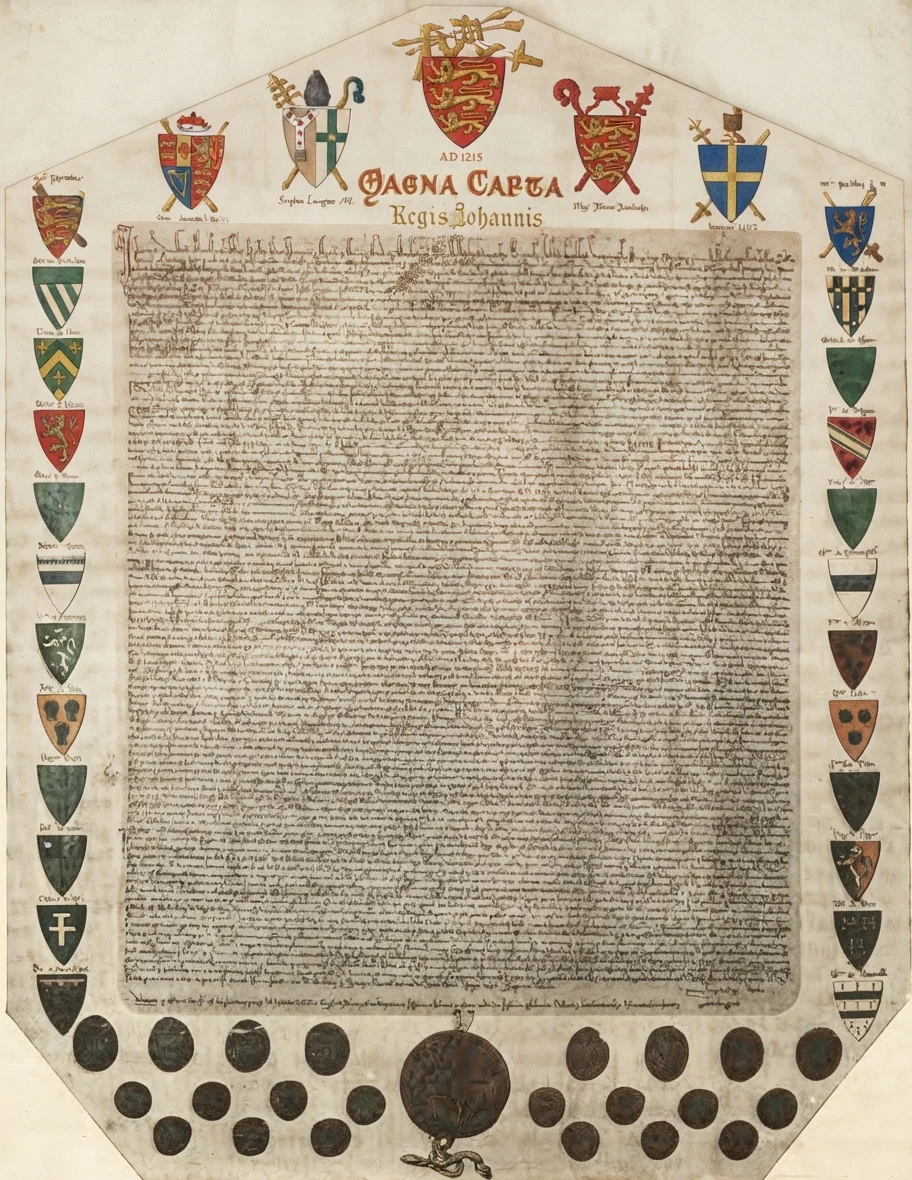
A photo reproduction of the Magna Charta, the copy of which is taken from the original document in the British Museum. The shields at top and side are of the barons, and at the bottom are the seals of the king's securities.
While Magna Charta did not guarantee the equality of all men, it was a long step toward that goal, and in it slumbered the principles of the Declaration of Independence and the Constitution of the United States. And inasmuch as the religious liberty which Americans enjoy to-day, temporally speaking, grew out of that Declaration and that Constitution, we may say that our religious as well as our civil liberties were, in a measure, bound up in that ancient British document. It is true that a considerable portion of the people, the villains and serfs, had little or no participation in the rights which it asserted, but "the very assertion hastened the period when all should be equal before the law." So also the righteous principles of the Declaration of Independence and of the national Constitution did not prevent in America the slavery of a race; but the very assertion of those principles did finally crystallize into the thirteenth amendment to the Constitution. By a study of the acts which Magna Charta condemned, we may learn something of the oppressions of the people before the time of King John.
We summarize some of the more important concessions:
The ruler had required of his vassals that they render a certain amount of service in his armies at their own charges. This, Magna Charta practically abolished.
Courts of common pleas were to be established in certain definite places for the more speedy and convenient adjustment of difficulties, and were not required to follow the king's court.
A freeman could no longer be arbitrarily fined at the discretion of a judge, and no amerciament (fine imposed at the discretion of the court) could be imposed upon any one save upon the oath of honest men of the neighborhood.
Earls and barons could be amerced only by a jury of their peers, and this must be in harmony with the degree of their offense.
No constable or bailiff of the king must take corn, horses, carts, carriages, timber, or other chattels from any man without paying him for them.
No bailiff was to be permitted to bring any man to trial upon his own testimony or without credible witnesses.
No freeman must be taken, or imprisoned, or disseized, or outlawed, or banished, or in any way destroyed, save by the lawful judgment of his peers, or by the law of the land.
Justice was not to be sold to any man, nor was it to be denied to any man.
Whatever the king had taken without right, was to be returned to the owners.
In addition to all this, a court of five and twenty barons was appointed with authority even to call the king to account for infractions of the law, and, if necessary, take his property to satisfy justice.
The last section of the charter opens with this declaration: "Wherefore we will and firmly enjoin, that the Church of England be free."7Notwithstanding King John had sworn that all things contained in Magna Charta should be observed "on our part as on the part of the barons," "in good faith and without evil intent," yet the ink of his signature was hardly dry before he was plotting its revocation with the aid of foreign mercenaries. The pope excommunicated the barons for inducing the king to sign it, and declared they were "worse than the Saracens for molesting a vassal of the holy see." A second sentence of excommunication was promulgated on December 16 of the same year, and the city of London was laid under interdict. This interference of the pope in the temporal affairs of the kingdom was deeply resented by the people. It is recorded that the citizens of London despised the interdict, and boldly asserted that the pontiff had no right to intermeddle in their worldly concerns. In spite of the interdict, they kept open their churches, rang their bells, and celebrated their Christmas with unusual festivity. When the barons appealed to France for aid against their perjured king, the pope's special envoy threatened the king of France with instant excommunication if he should take up arms against King John and in favor of the barons who were fighting for the principles of Magna Charta. This threat did not deter the king of France from entering upon the undertaking. The sudden death of King John on October 18, 1216, the accession of his son Henry III to the throne, and the defeat of the French prince the following year, left Magna Charta still in force and England still under her own king. The people had chosen rather to live as subjects of a foreign prince, with their rights guaranteed, than to live under their own king, with their rights trampled under his feet. But with the tyrant out of the way, and a king on the throne who would abide by the principles of Magna Charta, they rallied against the French prince who sought the throne of England, and forced him out of the country.
Imperfect and transitory as many of its provisions were, the influence for good which Magna Charta has exerted upon the world is beyond the power of man to compute. It has had a mighty influence in more nations than one. Slavery, serfdom, involuntary servitude, and legal distinction between classes, have melted away before its influence; and mankind to-day throughout the world is enjoying rights and privileges, immunities and guarantees, that would be still unrealized but for that memorable document.
Another Charter of Freedom
An oppressive king riding ruthlessly over the rights of his subjects, hastened the day when those subjects rose up on their own behalf to insist upon a recognition of the rights of man. That was the birth of Magna Charta.
But another day came when another king refused to recognize the rights of his own subjects across the sea. That king was George III, and those subjects were the people of the American colonies.
The barons and people of England had suffered through arbitrary taxation on the part of the king, and they abolished it in the adoption of Magna Charta, and obtained a measure of representation. The American colonists also suffered under an unjust and arbitrary system of taxation, and representation in the legislative body was denied them. When they came to a place where they felt free to express their opinion of that condition, they called it "taxation without representation," and declared it to be "tyranny." We find these two great charters to be at the same time a protest against tyranny and a provision for protection from tyrannical rulers. The recitation of the wrongs complained of in the Declaration of Independence, and the enumeration of the rights demanded in the Magna Charta, show unmistakably that they were born out of the same conditions, that the same stress of tyranny was urging the people out into the light of liberty.
As the acts of King John and his predecessors fanned into a flame the smoldering discontent of his people, and produced the conditions which made Magna Charta inevitable, so the acts of George III against the British people in America fanned into a flame the discontent of the colonists, and produced the conditions which made inevitable the Declaration of Independence and the establishment of a new nation. Magna Charta was the British people's declaration of independence, and the American Declaration of Independence and national Constitution compose America's magna charta.
These documents are not for these two nations alone. They are as applicable in one part of the world as another, and are really doing their work wherever nations exist. The American document declares that "all men are created equal; that they are endowed by their Creator with certain unalienable rights." The British document does not make this declaration in words; but it does emphasize the fact, nevertheless, and specifies requirements which prove it. The American document declares that governments derive "their just powers from the consent of the governed." The British document does not state that fact, but it incorporates the idea and acts upon it vigorously.
It is not too much to say that the equality and liberty of the individual, almost universally recognized to-day throughout Christendom, has come as a result of the principles enunciated in those immortal documents. It was 561 years from Magna Charta to the Declaration of Independence; but the world had made more progress during those 561 years than during the 1,200 years which preceded that date. It has been 136 years from the signing of the Declaration of Independence to the present time; but the world has made more progress during these 136 years than during the 1776 years which preceded the signing of that document.
With the civil liberty which those documents brought, there was bound to come in time liberty in matters of faith. The one was involved in the other and could not long exist without the other. With the mind of man imprisoned behind the bars of a State religion, eking out a miserable existence under the thrallom of a spiritual tyranny, progress and development were impossible. With those handicaps shattered and the mind and soul free, there is light and life and progress for the race. We can not too greatly esteem the principles enunciated in those two great charters, or place too high a value upon the liberties which they guarantee.
C. M. SNOW.
FROM AMERICA'S CHARTER OF LIBERTY
We hold these truths to be self-evident: that all men are created equal; that they are endowed by their Creator with certain unalienable rights; that among these are life, liberty, and the pursuit of happiness; that, to secure these rights, governments are instituted among men, deriving their just powers from the consent of the governed.—Declaration of Independence.
EQUAL FREEDOM TO ALL
By James Madison
James Madison, Memorial to Virginia
Whilst we assert for ourselves a freedom to embrace, to profess, and to observe, the religion which we believe to be of divine origin, WE CAN NOT DENY AN EQUAL FREEDOM TO THEM WHOSE MINDS HAVE NOT YET YIELDED TO THE EVIDENCE WHICH HAS CONVINCED US. If this freedom be abused, it is an offense against God, not against man. To God, therefore, not to man, must an account of it be rendered.
Magna Charta
Opening paragraph of the great charter of English liberty, granted by King John at Runnymede, June 15, A.D. 1215, taken from "Select Historical Documents of the Middle Ages," as translated from "Stubbs's Charters" by Ernest F. Henderson, A.B. (Trinity College, Conn.), A.M. (Harvard), Ph.D. (Berlin).
John, by the grace of God king of England, lord of Ireland, duke of Normandy and Aquitaine, count of Anjou: to the archbishops, bishops, abbots, earls, barons, justices, foresters, sheriffs, provosts, serving men, and to all his bailiffs and faithful subjects, greeting. Know that we, by the will of God and for the safety of our soul, and of the souls of all our predecessors and our heirs, to the honor of God and for the exalting of the holy church and the bettering of our realm: by the counsel of our venerable fathers Stephen archbishop of Canterbury, primate of all England and cardinal of the holy Roman Church; of Henry archbishop of Dublin; of the bishops William of London, Peter of Winchester, Jocelin of Bath and Glastonbury, Hugo of Lincoln, Walter of Worcester, William of Coventry, and Benedict of Rochester; of Master Pandulf, subdeacon and of the household of the lord pope; of Brother Aymeric, master of the knights of the Temple in England; and of the noble men, William Marshall earl of Pembroke, William earl of Salisbury, William earl of Warren, William earl of Arundel, Alan de Galway constable of Scotland, Warin son of Gerold, Peter son of Herbert, Hubert de Burgh seneschal of Poictiers, Hugo de Neville, Matthew son of Herbert, Thomas Basset, Alan Basset, Philip d'Aubigni, Robert de Roppelay, John Marshall, John son of Hugo, and others of our faithful subjects.
OBJECT OF GOVERNMENT
United States Senate Report on Sunday Mails, 1829
The proper object of government is to protect all persons in the enjoyment of their religious as well as civil rights, and not to determine for any whether they shall esteem one day above another, or esteem all days alike holy.
EXERCISE OF RELIGION
From Virginia Bill of Rights
That religion, or the duty we owe to our Creator, and the manner of discharging it, can be directed only by reason and conviction, not by force or violence; and, therefore, all men are equally entitled to the free exercise of religion according to the dictates of conscience.