Questioner.—“Why do you make so much of the subject of liberty?”
Answer.—Because liberty is the natural and most desirable condition of life. As regards itself, every created being loves liberty, and is naturally restive and unhappy under restraint. The Bible has much to say on the subject of liberty, and speaks of “the glorious liberty of the sons of God.”
Questioner.—“What is the opposite of liberty?”
Answer.—Bondage, servitude, slavery, intolerance, persecution, and oppression.
Questioner.—“Did God intend that this condition of things should exist in the world?”
Answer.—No; God is everywhere in the Bible represented as opposed to bondage, slavery, and oppression. He sent His Son into the world to set men free, and to all believers in Christ comes the exhortation, “Stand fast therefore in the liberty wherewith Christ hath made us free.”
Questioner.—“What then brought about all the bondage and oppression that have been in the world?”
Answer.—In a word, sin. Sin is a violation of right principles; an infraction of the rules of right and justice; a transgression of the royal law, “the law of liberty.” Sin means selfishness, and selfishness is responsible for all the intolerance and oppression there have been in the world. To the extent, therefore, that sin is eradicated or subdued, intolerance and oppression cease.
Questioner.—“What is the cure or antidote for sin?”
Answer.—The Gospel. The Gospel is the power of God unto salvation from sin. It is the antidote for sin. It crucifies self, and thus uproots and destroys selfishness. In the place of selfishness the Gospel implants in the soul the principle of love,—supreme love to God, and equal love to fellow men. The Golden Rule becomes the governing rule of conduct, and equality of rights an axiomatic law and a universally recognized principle.
The old Ephrata Press, owned by German Seventh-day Baptists, on which the Declaration was printed
Questioner.—“Where has there been the most liberty?”
Answer.—Where the Gospel has been most accepted.
Questioner.—“How, then, do you account for the fact that where there has been the greatest profession of Christianity, there has been the most persecution and oppression?”
Answer.—This has been well answered by the following from the Christian Oracle of July 20, 1893: “Civil liberty springs from religious freedom. Christianity tends to make men gentle and obedient, patient and forbearing, willing to concede to all their just rights; and it employs persuasion and truth to accomplish its ends. But A PERVERTED CHRISTIANITY stirs up envy and rivalry among the clergy, who contend for precedence and power. Under such influences, they impose shackles upon men’s minds by decrees of councils; they abridge the rights of private judgment, make civil government the subservient instrument of spiritual tyranny, and thus destroy civil liberty.
“It should be remembered that these efforts to make the State subservient to the interests of the church, have always proceeded from the clergy and from politicians, and not from the people. At the same time it is remarkable with what readiness the people often fall in with the propositions of their religious leaders. People seem to forget that Christ’s kingdom is not of this world, that the weapons of our warfare are not carnal, and that neither Christ nor His apostles ever once appealed to Caesar for power to enforce or protect anything that belonged to the kingdom of Christ.”
It is not Christianity, but the perversion of Christianity, therefore, that is responsible for the persecution in so-called Christian lands. Christianity never persecutes. It restores to man the character of God, and recognizes in all their God-given rights.
Questioner.—“What is a right?”
Answer.—A right is a just claim. We have a right to whatever has been given us of God. We have a right to what we have acquired by honest toil or by other lawful means, because we are justly entitled freely to use and enjoy it. We have a right to our lives, and to our freedom,—freedom to do whatever we think necessary for our sustenance, safety, and happiness, provided in the exercise of this right we do not trespass upon the equal rights of others; because it would be unjust to deprive us of our lives or freedom.
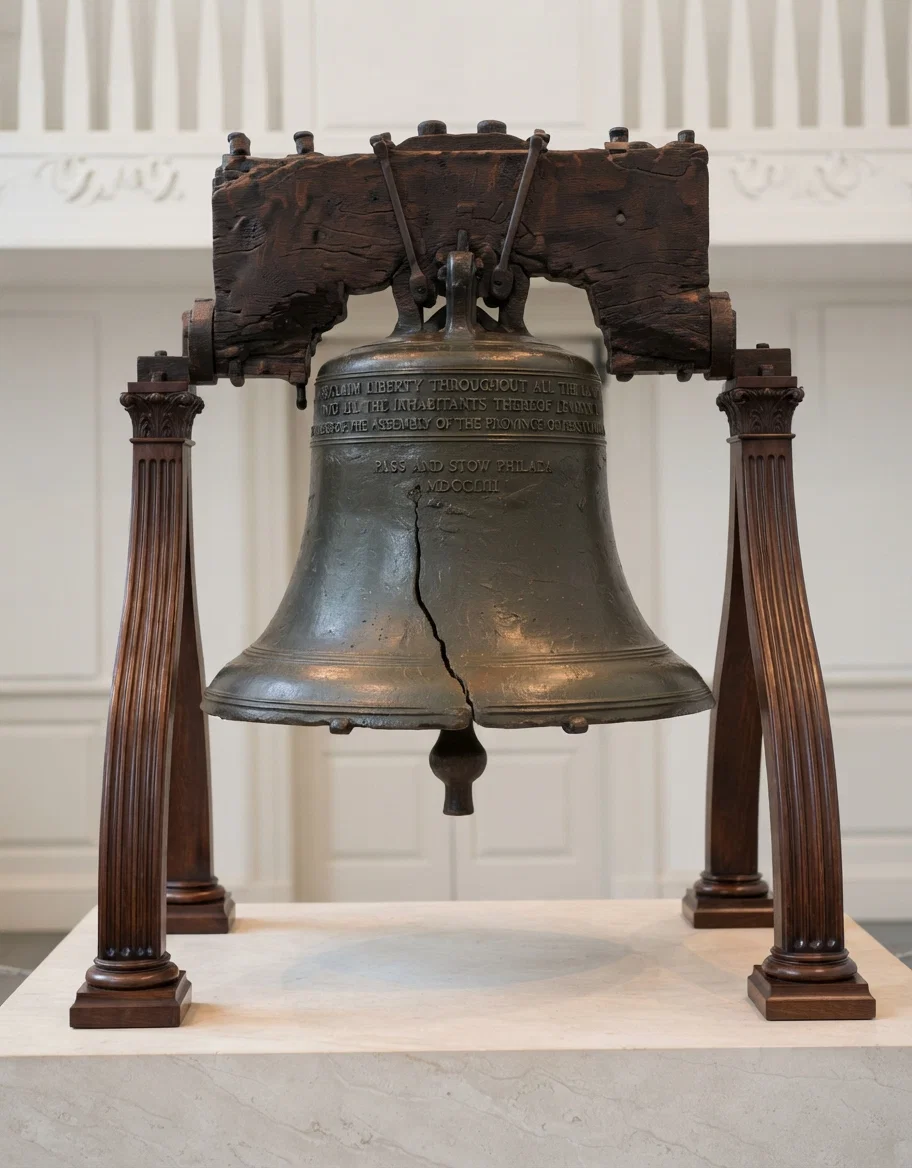
The old Liberty Bell, cast by Pass & Storr, Philadelphia, 1753; weight 2,080 pounds. Its very making seemed to be prophetic of the results of the Revolution that followed. It bore the inscription, “Proclaim liberty throughout all the land unto all the inhabitants thereof,” from Lev. 25:10. It was cracked July 8, 1835, while being tolled in memory of Chief Justice John Marshall. It is now in Independence Hall.
Questioner.—“What have you to say regarding the equality of rights?”
Answer.—All men in society have the same rights. This fact is recognized in the opening words of the Declaration of Independence: “We hold these truths to be self-evident, that all men are created equal; that they are endowed by the Creator with certain unalienable rights; that among these are life, liberty, and the pursuit of happiness.” Christ taught this same truth when He said to His disciples, “All ye are brethren.”
Questioner.—“How would you define religious rights?”
Answer.—Religious rights consist in the right to worship God in whatever way one thinks best, and to make known and maintain his religious beliefs. They are indicated and safeguarded in Jefferson’s “Bill for Establishing Religious Freedom,” which passed the Virginia Assembly December 16, 1785, in the following words: “All men shall be free to profess, and by argument to maintain, their opinion in matters of religion.” Every State constitution in the United States recognizes these rights.
Questioner.—“Is religious liberty confined to the right to choose among the different religions, or does it involve the right not to be religious at all if one so elects?”
Answer.—So far as civil government or the right to use coercion in religion is concerned, a man has the same right not to be religious that he has to be religious. To say that a man may be free to choose his own religion, but that he must choose some religion, is a denial of the principle of religious liberty. The power that would have9a right to compel one to profess some religion, would have the same right to say what religion he must profess.
Questioner.—“To whom, then, is one responsible in matters of religion?”
Answer.—To God, and to God alone. To this truth the Bible abundantly testifies, “Who art thou that judgest another man’s servant! to his own master he standeth or falleth. . . . So then every one of us shall give account of himself to God.” Rom. 14: 4, 12. The memorial of the presbytery of Hanover to the General Assembly of Virginia, dated April 15, 1777, recognizes this great truth in these words: “The duty which we owe our Creator, and the manner of discharging it, can only be directed by reason and conviction, and is nowhere cognizable but at the tribunal of the universal Judge.”
Questioner.—“What is liberty?”
Answer.—“Liberty,” according to Andrew W. Young’s “Government Class Book,” page 15, “is the being free to exercise and enjoy our rights, and is called natural, political, civil, or religious, according to the particular class of rights referred to.”
Questioner.—“How would you define personal liberty?”
Answer.—Personal liberty consists in the freedom to exercise and enjoy personal rights—the rights of “life, liberty, and the pursuit of happiness.” Illustrating this liberty, Mr. Young says: “Every person has the right to go wherever he pleases, free from restraint on the part of others. If any one restrains him of his liberty even for a very short period or without violence, as by locking him in a room, he may recover damages. This is one of our most valued rights, and is forfeited only by crime.”
Questioner.—“What, then, is religious liberty?”
Answer.—From the standpoint of civil government, religious liberty is freedom in matters of religious opinion and worship. This need not be confounded with that soul liberty, or freedom from condemnation and sin, which the Gospel, or religion itself, brings. Religious liberty not only implies the absence of laws interfering with this freedom in matters of religious opinion and worship, but requires protection in the exercise and enjoyment of religious rights. “To protect liberty of conscience,” it has been well said, “is the duty of the State, and this is the limit of its authority in matters of religion.” In prohibiting Congress from making any law “respecting an establishment of religion, or prohibiting the free exercise thereof,” the Constitution of the United States recognizes the right and justice of religious liberty, or freedom in matters of religion. This, with the similar prohibitions in the State constitutions, stamps this country as a land of religious liberty.
The house where Thomas Jefferson lived, who is said to have written the great Declaration
Religious legislation in the United States, therefore, is unconstitutional, as well as unchristian and tyrannous.
W. A. COLGORD.
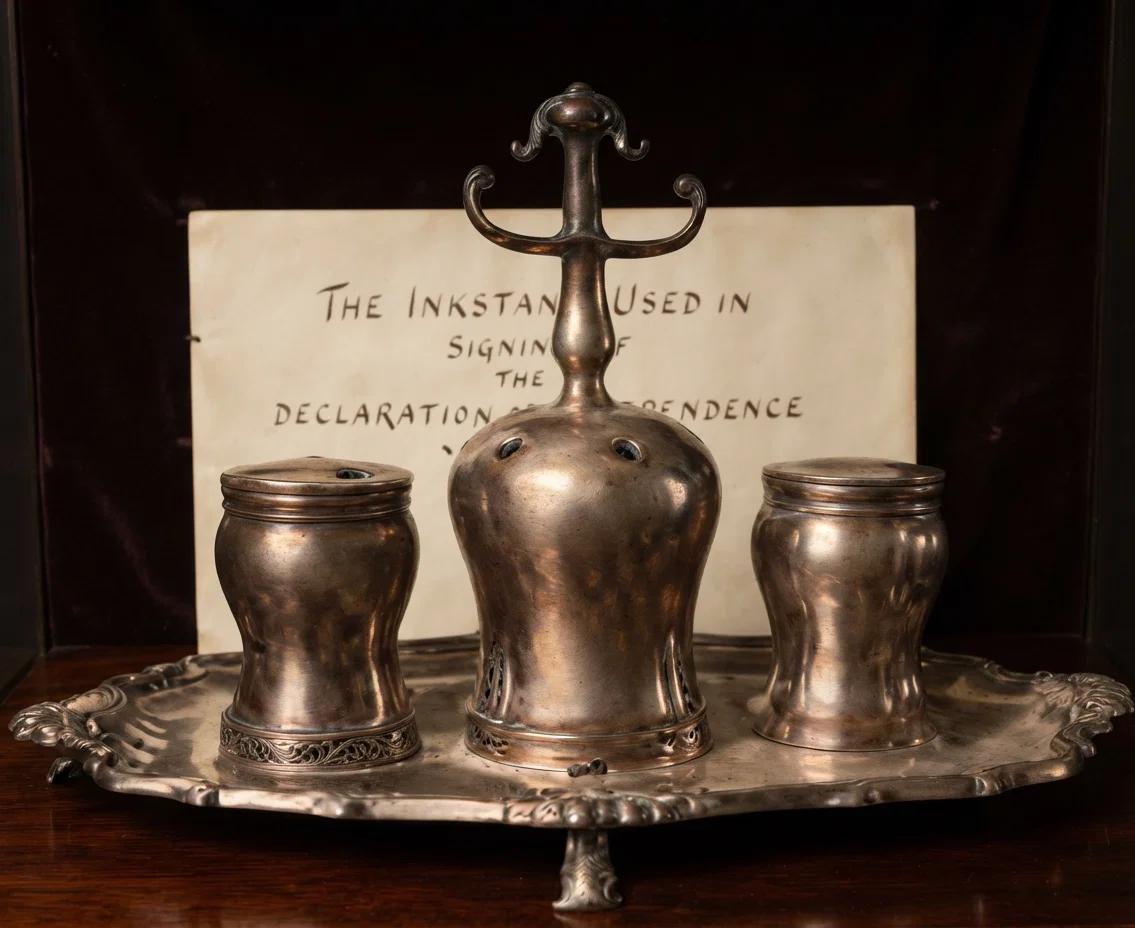
The inkstand used in the signing of the Declaration of Independence
The Old Witch House, Salem, Massachusetts, now a pharmacy. Here Roger Williams lived; here men and women were tried and condemned for witchcraft. See note on last page.
Evil Principles, Not Evil Men
By George W. Rine
By George W. Rine, M.A.
HISTORY attests nothing more fully than the strange fact that not infrequently some of the best of men espouse and champion principles essentially pernicious in their outworking. Prominent among these vicious principles that have had, and still have, some of the most virtuous of men for their sponsors and advocates, is that of the enforcement of religious dogmas by civil pains and penalties.
Until the latter half of the eighteenth century the vast majority of men were obsessed with the delusion that the tenets of religion should be written into the civil codes of the State. Altho this hoary delusion was almost entirely dissipated into limbo by those grand manifestoes, the Declaration of Independence, the Constitution of the United States, and that similar French charter of human liberty, "the Rights of Man," there are not a few persons of undoubted probity who, in our day of light and knowledge, are still the victims of the same world-old obsession. It has been said that human life teems with paradoxes; and surely one of the most inscrutable of these is, that so often very good men are found identified with very bad causes.
It is therefore urgently important to remember that those who, in keeping with the teachings of the New Testament and with the genius of the American Constitution, antagonize the efforts of misguided men to promote religious legislation, are in no wise hostile to those men, but to the unchristian and uncivil principles for which they stand. Hence those of us who love and work for religious and civil liberty are not warring against men, but against a dangerous and therefore pernicious propaganda.
A Notable Pagan Example
One of the most upright and exemplary emperors that ancient Rome ever had was Marcus Aurelius. His studies and his writings won for him the title of "philosopher." His famous literary work, "Meditations," breathes the finest and loftiest sentiments of devotion and benevolence, and makes the nearest approach to the spirit of Christianity, of all the literature of pagan antiquity. He personally prosecuted not a few benevolent enterprises. But some of the wars of his reign drew after them a series of terrible calamities. The superstitious people believed that it was the Christian cult that had called down upon the nation the wrath of the gods. Accordingly, Aurelius permitted one of the most cruel and bloody persecutions to be instituted against the Christians that can be found in the annals of Christian martyrdom. The famous Christian bishops, Justin Martyr and Polycarp, were among the victims of that "good" emperor’s wholesale judicial massacre.
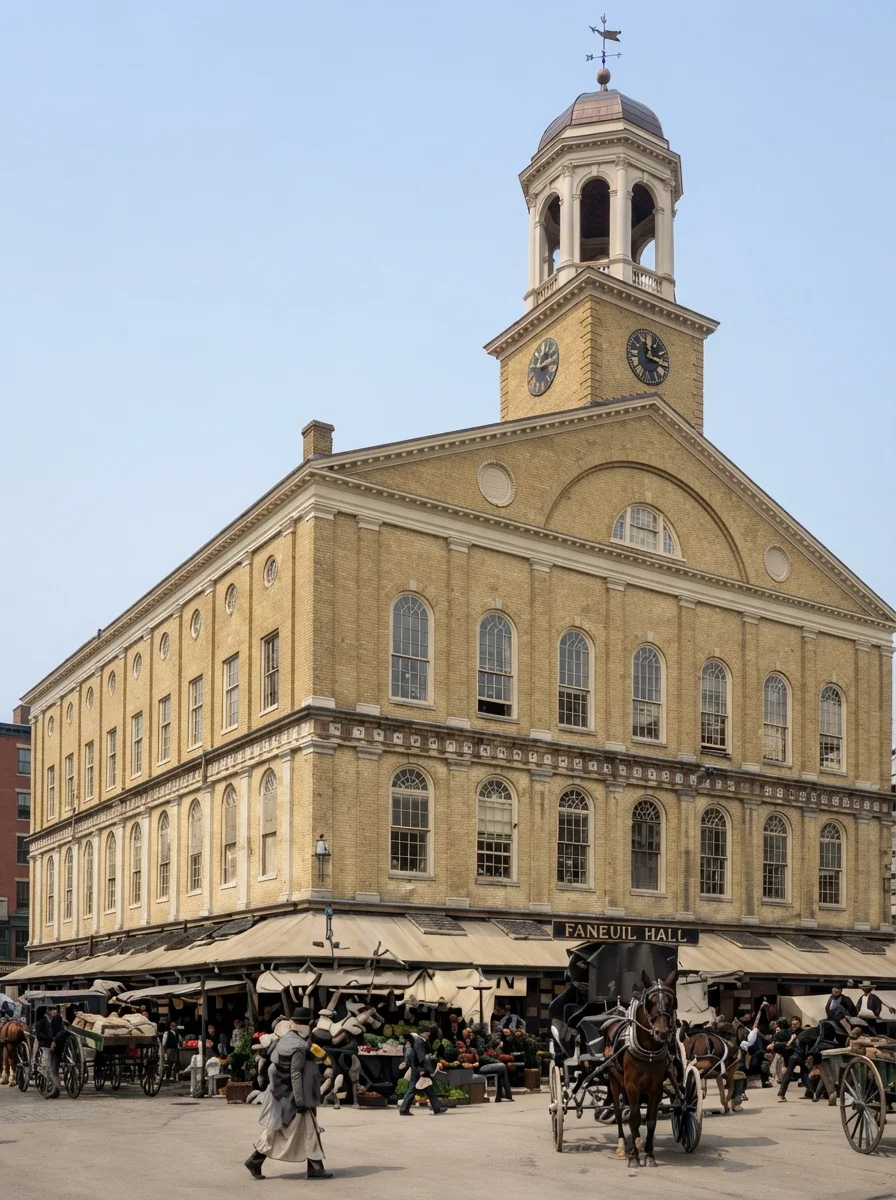
Faneuil Hall, where public meetings and discussions of great moment were held previous to and during the Revolution; called “the Cradle of Liberty.”
A Catholic Example
Mary Tudor, the Catholic queen of England, 1553 to 1558, was scrupulously punctilious in the observance of all the rites of her faith. She could not have been more rigidly regular in her eating and sleeping than she was in the hearing of mass, the worshiping of the Virgin, and in attendance at the confessional. Yet during her reign of only five years, more than three hundred men, women, and even children, were burned to death for no offense other than that they were, by virtue of conscience, Protestants. Now, it was not wanton cruelty that prompted the "Bloody Mary" to the commission of those awful atrocities; no, it was religious bigotry. Mary was sternly virtuous and almost ascetically religious, yet she was the victim of the most cruel and unchristian delusions to which the human heart is susceptible.
In Protestant Ranks
History affords no example of a more austerely religious man than was John Calvin. His name has come down to us as a synonym10of robust virtue and virile godliness. And yet it was at the instigation of John Calvin that the scholarly Michael Servetus was burned at the stake, in Geneva, October 27, 1553. The offense (?) in expiation of which Servetus was forced to give his life, was his disagreement with Calvin as to the nature of the Trinity. Nobody doubts that Calvin was a good man; but who can believe that the immolation of Servetus was a good deed?
Perhaps no people ever lived who surpassed the Puritan settlers of New England in robustness of character, in depth and fervor of religious conviction, or in moral prowess and initiative. The Puritan ministers who came to the New World were not only among the most ardently religious men of their age, but among the most learned as well. But it was these same uncompromising saints that, especially in Massachusetts, erected a rock-ribbed theocracy, to the end that they might dominate the religious as well as the political life of the people. They erroneously believed it to be their duty not to brook any religious opinions which might be in the least unlike their own. Persons who held such opinions were deemed inimical to the established religio-political order, and were, accordingly, promptly punished with banishment from the colony, and in some cases the penalties of whipping, cropping of ears, and confiscation of property were added.
Not only was citizenship based upon church-membership, but the Bible was the only law book recognized by the priest-controlled courts. As the ministers were considered the infallible interpreters of the Bible, all offenders against their interpretation were adjudged to be not only sinners but criminals, and their offenses ranged from those who wore long hair to such as dealt in witchcraft and sorcery. We all know the pitiless rigor with which Anne Hutchinson was banished to the savage wilds of Rhode Island simply because she alleged that the regular ministers and their followers were under a covenant of works while she and her followers were under a covenant of grace.
Criminals by Law
The Anabaptists, or Baptists, made their appearance in Massachusetts soon after the banishment of Anne Hutchinson. They were promptly seized by the Puritan rulers, and whipped, fined, imprisoned, and they barely escaped with their lives. The cruel banishment of the celebrated Roger Williams was prompted by the simple fact that he denied the right of magistrates to punish for the violation of the first table of the Decalogue, and denied the existence of any warrant in the New Testament for the union of Church and State.
Finally the Friends (Quakers) found their way to the Puritan colonies of Massachusetts, and began to teach their peculiar tenets. As they persisted in teaching their faith, they were banished, but promptly returned. Driven to exasperation, the Puritan authorities passed a law pronouncing the death penalty upon all Quakers who, having been once banished, had the temerity to return to the colonies. A number of exiled Quakers returned, and four of their leaders were actually hanged.
Among those austere and apparently merciless inquisitors were such notables as Governors Endicott, Winthrop, and Winslow.
They were as famous for their moral depth and fervor as they were for their intellectual culture. In short, they were pre-eminently good men. Yet they cherished the terrible delusion that they were doing God's service when they persecuted even to the limit of inflicting death upon such as dissented from their own religious opinions and practises.
A Bible Example
Before his conversion to the cause and faith of Christ, the apostle Paul was an ardent devotee of the antichristian theory of law-enforced religion. It was with all an inquisitor's zest that he devoted himself to the business of persecuting the followers of the despised Nazarene. He was conspicuous among those who shed the blood of the first Christian martyr. In the pride of his Pharisee's heart he conceives the idea to reverse the maxim of the crucified Jesus, and go into all the world and suppress the Gospel in every creature. We know how relentlessly he prosecuted his cruel and inhuman mission. He was "exceedingly mad" against the Christians, and when they were put to death he gave his voice against them. And when he finds in Jerusalem no fuel to feed the martyr's fire, he applies to the high priest for authority to go to Damascus to make havoc of the little Christian band that worshiped there. How his Christless mission was arrested by the intervention of the saving mercy of God, is well known.
Now, the point to be noted is, that Paul had been thoroly conscientious as an inquisitor and persecutor. Long after he had found Christ he bore the following testimony as to the motives that had actuated him in his bitter warfare against the church of Christ: "I verily thought with myself, that I ought to do many things contrary to the name of Jesus of Nazareth." In fighting against the cause of Jesus, Paul thought himself in the line of duty. He was genuinely scrupulous. Touching the law he was blameless. No man took his place more regularly in the temple, or observed the Sabbath with more scrupulous care, than Paul. No one could have surpassed him in religiousness. Yet in the face of all this, he had been fighting against God, he had been a "blasphemer and a persecutor," according to his own subsequent testimony. But as he had persecuted "ignorantly in unbelief," he "obtained mercy."
The True Principle
Yet it was our Lord Himself, the founder and fountain of our holy religion, who declared unequivocally, "If any man hear My words, and believe not, I judge him not: for I came not to judge the world, but to save the world." Again He said, "I, if I be lifted up [upon the cross], . . . will draw all men unto Myself." He would not coerce or drive men to God, but by the irresistible wooing of His love, expressed in the tragedy of Calvary, He would draw sinners to Himself, the fountain of cleansing.
It was the Master's beloved disciple who wrote, "Whosoever will, let him take the water of life freely." There is no love of power in the Gospel of Christ, but it throbs and brims with the power of love. It is the uniform testimony of Holy Writ that the only weapon admissible in the Christian warfare is the "sword of the Spirit, which is the Word of God."
Hence those of us who labor and contend for the complete separation of religion and politics, for the principle that religious belief and practise are matters that concern only the individual and his God, are in no wise antagonizing men, but principles — principles hostile to the whole tenor of the Christian faith as enunciated in the Christian Scriptures. GEORGE W. RINE.
The Moral Warfare
By John Greenleaf Whittier
When Freedom, on her natal day,
Within her war-rocked cradle lay,
An iron race around her stood,
Baptized her infant brow in blood;
And, through the storm which round her swept,
Their constant ward and watching kept.
Then, where our quiet herds repose,
The roar of baleful battle rose,
And brethren of a common tongue
To mortal strife as tigers sprung,
And every gift on Freedom’s shrine
Was man for beast, and blood for wine!
Our fathers to their graves have gone;
Their strife is past,—their triumph won;
But sterner trials wait the race
Which rises in their honored place,—
A moral warfare with the crime
And folly of an evil time.
So let it be. In God’s own might
We gird us for the coming fight,
And, strong in Him whose cause is ours
In conflict with unholy powers,
We grasp the weapons He has given,—
The light, the truth, and love of heaven.
— Whittier.
God's Love Unmeasured
By Ellen G. White
By Mrs. E. G. White
WALK while ye have the light, lest darkness come upon you: for he that walketh in darkness knoweth not whither he goeth." From Christ, the Sun of Righteousness, beam forth rays of life and light. Would you have Jesus lift upon you the health and light of His countenance? Then turn your face toward Him, and look and live. Talk of Jesus; dwell on His matchless charms; eat of the bread of life; take of the water of life freely. Do you desire to love God supremely and your fellow men as Jesus loved them? Keep your heart in meditation upon the spotless character of Christ. His divine heart was moved with compassion and love for suffering humanity. His love can not be fathomed, except as we take in the sacrifice made on Calvary. Through the renunciation of all selfishness, we need to be able to comprehend what is the height and depth and length and breadth of the love of God, which passeth knowledge.
If we constantly cherish the love of Christ, we shall have the love that can not be repressed. We shall love the atmosphere of light and love and truth and righteousness. We shall be constantly inquiring after truth; and, knowing that there is such a wealth of precious ore of truth to be found, we shall not grasp for thorns and thistles. Humbly and sincerely we shall search after divine knowledge, realizing that all we can carry with us to heaven is that which is akin to heaven. We shall know that it is very poor policy to be cultivating ourselves in the art of seeing everything that is objectionable, for all the knowledge of God that we can here obtain we shall carry with us to heaven. We can safely cultivate purity, love, and devotion to God and our Redeemer. The love of11God must be planted in the heart in this life, and it will enable us to have happiness, and joy, and peace, because the kingdom of heaven will be set up in our hearts. Heaven is to begin on earth. The Word of God will reveal to us whatsoever is real and abiding, and these permanent excellencies will find a place in our hearts, so that we may now have within us the perfection of heaven.
The Passport to the Kingdom
What is it that will gain us an entrance into the kingdom of God?—A character after the likeness of that of Jesus Christ. The Lord God has given to the world all opportunity, all privilege, the grace of the Holy Spirit, the gift of Jesus Christ, in order that we might have a character like that of our Lord, and find abundant entrance into the kingdom of God. Christ's mission to the world made it evident that the human race was standing upon the menace of incensed justice, on the verge of eternal ruin, in helplessness and ignorance. To our help Jesus came, bringing the fullest assurance of relief. What has the Father done?—"God so loved the world, that He gave His only-begotten Son, that whosoever believeth in Him should not perish, but have everlasting life."
Since God has given the greatest gift in His power, we are to render to Him our whole heart. He has poured out to the world the treasures of heaven, giving with such largeness that there is nothing more to bestow, no reserve grace or power or glory, and we are to respond to this love by rendering willing service to Jesus, who has died for us on Calvary's cross.
At the time when sin had become a science, when the hostility of man was most violent against Heaven, when rebellion struck its roots deep into the human heart, when vice was consecrated as a part of religion, when Satan exulted in the idea that he had led men to such a state of evil that God would destroy the world, Jesus was sent into the world, not to condemn it, but, amazing grace! to save the world. The unfallen worlds watched with intense interest to see Jehovah arise and sweep away the inhabitants of the earth, and Satan boasted that if God did do this, he would complete his plans and secure for himself the allegiance of unfallen worlds. He had arguments ready by which to cast blame upon God, and to spread his rebellion to the worlds above; but at this crisis, instead of destroying the world, God sent His Son to save it. The apostle caught a glimpse of the plan, and he kindled into inspiration upon the great theme. Language can not express his conception, but ever falls below the reality. John exclaims: "Behold, what manner of love the Father hath bestowed upon us, that we should be called the sons of God: therefore the world knoweth us not, because it knew Him not."
Before the coming of Christ to the world evidences abundant had been given that God loved the human race. But in the gift of Christ to a race so undeserving was demonstrated the love of God beyond all dispute. This gift outweighed all else, showed that His love could not be measured. We have no line to measure it, no plummet by which to sound its depths, no chain by which to encompass it, no standard with which to compare it. All we can say is that "God so loved the world, that He gave His only-begotten Son, that whosoever believeth in Him should not perish, but have everlasting life."
Jesus said, "Therefore doth My Father love Me, because I lay down My life." He gave His life for the sheep. The only-begotten Son of God accepts all the liabilities that fall upon the transgressor of the law, and vindicates its unchangeable and holy character. The death of Christ removes every argument that Satan could bring against the precepts of Jehovah. Satan has declared that men could not enter the kingdom of heaven unless the law was abolished, and a way devised by which transgressors could be reinstated into the favor of God, and made heirs of heaven. He made the claim that the law must be changed, that the reins of government must be slackened in heaven, that sin must be tolerated, and sinners pitied and saved in their sins. But every such plea was cast aside when Christ died as a substitute for the sinner. He who was made equal with God bore the sin of the transgressor, and thereby made a channel whereby the love of God could be communicated to a fallen world, and His grace and power imparted to those who came to Christ in penitence for their sin.
Teach Me the Truth
By Frances Green
Frances Green, in "Friends' Intelligencer"
Teach me the truth, Lord, tho it put to flight
My cherished dreams and fondest fancy's play.
Give me to know the darkness from the light,
The night from day.
Teach me the truth, Lord, tho my heart may break
In casting out the falsehood for the true.
Help me to take my shattered life and make
Its actions new.
Teach me the truth, Lord, tho my feet may fear
The rocky path that opens out to me.
Rough it may be, but let the way be clear
That leads to Thee.
Teach me the truth, Lord, when false creeds decay,
When man-made dogmas vanish with the night.
Then, Lord, on Thee my darkened soul shall stay,
Thou Living Light.
Labor Conflict and the Last Days
A strike of the Corset Workers' Union has been in progress in Kalamazoo, Michigan, since March 1. The union had picketed the factory against which they had the grievance, and Judge F. E. Knappen issued an injunction forbidding it. The strikers and their sympathizers defied the injunction, and nine arrests have been made, and half a dozen others have been cited to appear before the court. Their trial was set for May 6, and on the day previous a mass-meeting was called that was largely attended. In this meeting Judge Knappen was very bitterly denounced for the course he was pursuing. This is only one of the many occurrences which show the bitter spirit that is growing so violent between the employing class and those who are employed. The prophecies of God's Word show that we have reached the last days, and these same prophecies tell of the "perilous times" that are just before us. The violence that we see breaking out all over the world will become stronger and stronger, and more and more bitter. Men are teaching and theorizing differently from this statement; but you watch the developments, and compare them with what God has predicted. We will soon see who is right, Jehovah or the speculative teachers among men
Class Legislation
IT is a deadly poison, which these reform organizations are injecting into our Government and body politic. It is deranging and perverting every just principle of liberty and humanity. It is sacrificing man to institutions, principles of right to popular prejudices, right or wrong. That government which in its laws exalts institutions at the expense of human rights, will always and forever be guilty of class legislation, and will be the shuttlecock of class prejudices, traditions, bickerings, strifes, jealousies, leading to eventual ruin. For instance, the so-called "American Sunday" is a class institution, and nothing else. It is a religious class institution. So is any Sabbath from its human side. People may observe it who will, but they have neither human nor divine right to say that he must observe or honor it who elects otherwise. Nay, more, but majorities even have no right to say that he must honor it who elects so to do. The honor or observance is elective; the right of choice is universal, vested in the individual, and dominant over all civil authority whatsoever. The observance or non-observance of the institution is a matter of conscience between the individual and the being he may call God, but it is not a matter with which the State has any right to interfere, except to guard the equal rights of all her citizens and subjects.
"The Survival of the Fittest"
By Editor
LAWS for the protection of human rights are necessary; but class institutions, among which are all religious days and dogmas, must depend for their existence and promotion on the loyalty, devotion, and zeal of their adherents. If they are worthy to live, if they are of benefit to the human race, if there is back of them real intrinsic worth, their value will be recognized, and they will be perpetuated in the hearts and lives of their constant and multiplying constituency. But if these institutions can not be thus maintained by their inherent worth, they deserve to die. And above all other classes, Christians should recognize this fact and endorse this sentiment.
Jesus Christ declares, "Every plant, which My heavenly Father hath not planted, shall be rooted up." Matt. 15: 13. Men may bolster up Sunday by tradition and false teaching, they may put behind it all the combined power of civil government; but if it is not of God, it will surely perish, and may include in its destruction those who thus identify themselves with it. But if it be of God, let its religious friends look to Him with the calm faith of an Elijah. The Rock, and all built upon it, will endure. All the storms of infidelity may break upon it, but the waves and winds will prove to be but spray, which will whiten, harden, and polish the Rock.
We leave these queries with those of our readers who hold to the Sunday institution: Is not the appeal to civil law a tacit confession that they know that the Sunday is not of Christ, that it is not of God's planting? Or if they believe it to be of God, does not their appeal to civil law show that they have lost faith in the "all power" of the Gospel?