Your ShelfYour Projects

Signs of the Times, Vol. 39, No. 20.

Christianity and Earthly Power
Earlier text: To the Individual

San Diego Labor Troubles

San Diego and Her Troubles.—We get reports of both sides from San Diego. Two gentlemen enter earnest protest, declaring that our report of the troubles there does San Diego great injustice. Our report was gathered from three sources: reports from political and class papers, from a temperate speech by a labor-unionist, and from conversations with reputable gentlemen who were eye-witnesses.
One writes us that our report was substantially correct. It was certainly a mild statement compared with some reports we read. Both of our critics admit that there may have been unnecessary violence, but seem to think it justified by the contumacy of the men who defied the city ordinance. For defiance of proper city ordinances we have no defense to make. Even tho the ordinance were unconstitutional, it brought hardship upon none, and applied to all classes equally, and should not have been resisted. But in view of the disagreements, we thought we would wait the report of Mr. Weinstock, Governor Johnson's representative; but one of our critics intimates that this will amount to nothing, as Mr. Weinstock had no authority to secure testimony. Out of this trouble have grown, we understand, several suits at law. We will wait for the determination of the courts. In the meantime let us say: If we have misrepresented San Diego authorities, we are sorry. It certainly was not our purpose to lead influence in the lightest way to lawlessness or injustice or anarchy. We are making no plea for any class; we do not believe in lawlessness, anarchy, or treason; we have no prejudice against San Diego; we do believe in free speech, a boon of inestimable value, and fundamental to free government. We hope that in the settlement of the question in court, justice will be done.

Roger Williams and Witchcraft

THERE is a connection between the two. On another page is a picture of a modest little pharmacy in the city of Salem, Massachusetts. It is noted as the place where persons were charged with witchcraft, and from which they went forth to Gallows Hill for execution. Salem invited this persecution when she rejected the principles that would have saved her from it. In 1633 Roger Williams came to Salem for the second time, and the next year he was settled as pastor over the church in Salem. He was distinguished as an eloquent preacher and a ripe scholar, but he held the heresy that "he denied the right of magistrates to inflict punishment for Sabbath-breaking, or 'any other offense that was a breach of the first table.'" Another heresy was that he maintained that the land belonged to the Indians, and not to the king of England. He maintained "that 'no human power had the right to intermeddle in matters of conscience; and that neither Church nor State, neither bishop nor king, may prescribe the smallest iota of religious faith.' For this, he maintained, 'man is responsible to God alone.'"
In 1635 he was summoned before the general court at Boston, and was told to quit the colony within six weeks; but learning that many repaired to his house for religious instruction (by the way, it was the house which stood where the old witch house now stands, in which latter is some of the very wall of the former), the colony concluded to send him at once to England, especially as they learned that he, with others, thought of founding a colony upon Narragansett Bay, in which the principle of religious toleration should be strictly upheld. This was in July or August, 1635, that he was driven out.
When, Salem drove him out, they drove out the principles of liberty. Intolerance grew worse; and in 1692, fifty-seven years later, innocent men and women were put to death in Salem, many times on mere suspicion and accusation, as witches. If Roger Williams had been allowed to remain, and his principles to dominate, the black disgrace of witchcraft would never have stained America's record. He believed in toleration for others; and true to that principle, when that restless agitator Samuel Gorton began his work in Salem, and a movement was started to expel him, Roger Williams opposed it. The same great principles are worthy of thought to-day.

Contained in This Issue

Question Corner .................................................. PAGE
3751—For Weal or Wo; 3752—Bywords; 3753—Eating and Selling; 3754—Getting Mail on the Sabbath; 3755—Marrying in the World to Come; 3756—The Return of the Jews; 3757—Angels Who Fell; 3758—After the Likeness of God ............................................. 2
Our Bible Band .................................................... 2
General
The Individual—His God-Given Rights ............................... 3
Religious Liberty in California History—Early Days ................ 5
Two Great Charters ................................................ 6
Liberty—A Most Valued Right ....................................... 8
Evil Principles, Not Evil Men ..................................... 9
God's Love Unmeasured ............................................. 10
Editorial
"The Survival of the Fittest" ..................................... 12
Class Legislation ................................................. 12
To the Individual ................................................. 12
Are Americans Degenerating? ....................................... 12
Notes ............................................................. 12, 16
Home and Fireside
Love in the Home .................................................. 13
Poetry
Do Thy Duty ....................................................... 4
May Such a Life Be Mine! .......................................... 4
Freedom ........................................................... 5
The Moral Warfare ................................................. 9
Teach Me the Truth ................................................ 10
Loss of the Titanic ............................................... 13

Bible Authority and Version Policy

Our authority is the Bible, the Holy Scriptures of the Old and New Testaments. When the Common ("King James" or "Authorized") Version or the American Standard Revised Version is used, the version will not generally be designated in reference. Any Bible quotation in this paper, therefore, differing from the Common Version, unless otherwise indicated, will be almost invariably from the American Standard edition of the Revised Bible, copyright 1910, by Thomas Nelson & Sons.
For further particulars, subscription rates, etc., see page 15.

"The Wrath of Man Shall Praise Thee"

THIS text is well illustrated by a cheering letter from China. It was thought that the war over there would greatly hinder missions, and in some respects it seemed to hinder seriously. Nearly all missionaries were called from their stations to Shanghai, or some neutral port, during the war. But an enthusiastic letter from our mission treasurer, in Shanghai, gives us this cheering news:
"It would do your heart good to be with us just now. The war came on suddenly, and seemed unceremoniously to put an end to our work. As suddenly we find the doors reopened, and our force enabled to resume their work. To our great joy, we find that in place of the work's having been stopped, God had been carrying it on for us. In one place a whole church company had been added, and in others many had decided to obey the truth.
"When the revolution broke on us, we were publishing 34,000 copies of the Signs each issue; to-day our orders run over 40,000. Does this sound like the loud cry to you? What would you think of going to one of our primary schools in the country and expecting there to find the material for your canvassers, then, having selected your material, sending them out without a day's training, to prosecute a vigorous campaign in the field? Brother Wilcox, this is what China is doing to-day. Is God in the success that is attending us? The millions of the Far East are standing in bold relief to-day, the sunset of time for a background, pleading with the West for talented men who have won success in the field, to come and speed the message. The appeal may be mute when it crosses the sea to you, but it is loud, clear, and inspiring as it daily comes to us with its burden of waiting hope long deferred."
A consignment of paper costing $1,500 gold is just in; presses, we are told, are running day and night. 65,000 of the June issue of their magazine will be printed in Mandarin, and 40,000 in Wen-li, and the July edition promises fully as much, or more. In the early autumn an edition of "Bible Readings," a book of over 600 pages, will be published, and other books will follow. Truly it is cheering. May God abundantly bless our workers in China and the other great fields of the Orient, and may He roll the burden upon strong young hearts to heed the call of these fields.

Usurping Divine Authority.

To assume the control of conscience—and all religious legislation enters that domain—is to usurp the authority of God, is to put the human in place of the divine. Now A may be in the right and B in the wrong in a religious controversy; but what authority has either to decide for the other? or what right or authority has the civil tribunal to determine the issue? Each and both are responsible to God alone for conscience and religious conviction. God, the spiritual One, is the Judge. Whoso therefore assumes the judgeship in a religious controversy under penalty of law usurps the place of God. Even the Christ came not to judge, but to save; and He then declared, "If any man hear My words, and believe not, I judge him not." The word of truth will judge in the last day. See John 12:47, 48.

Government Justice and Public Respect

Respect for government is secured by even-handed justice to all classes rather than by hasty and severe repression of some particular class. When government functions are used to support and promote wealth, when predatory and wealthy free-booters prey undisturbed upon the mass of the people, government is bound to lose the respect of the classes oppressed. Then the flag of the country is made to stand for that sort of thing, and is bound to become a matter of jest and jeer, of contumely and contempt. Who is responsible, the men who may be counted anarchists because of excited and indignant remarks regarding the symbol of the nation's principles, or those who invite such remarks by the acts of anarchy or utter lawlessness winked at by the government? These are questions which are worthy of more than ordinary consideration.

Socialism Cannot Save the World

If Socialism could convict men of sin, if it could enforce effectual repentance, if it could regenerate the soul of men and change the selfish heart, there would be hope that it would save the world. But no ism can do any of these things. It may change one dead form for another, but it can not give life. Men will possess the same hates and loves, desires and ambitions, passions and lusts, as they do now, and the natural heart of man will find channels enough to keep alive the same kind of wickedness and rebellion in this rough old world. And after that, after the failure of all human schemes and devices of government, will come the everlasting kingdom of Christ, based in everlasting righteousness over subjects in whose hearts is written God's law.

Human Government and Religious Tyranny

Human government is a device not to protect the many against the few, but the few against the many; not to protect the strong against the weak, but the weak against the strong. Religious tyranny always puts it the other way.

Correction: The One Lost Sheep

In the article "The One Lost Sheep," which appeared in the SIGNS of April 16, the little stanza of poetry at the close should have been enclosed in quotation marks. It was taken from a poem by Delwin Rees Buckner.

Principles, Not Personalities

An evil principle put in effect by a good and intelligent man is more potent in its harm than its exercise by a bad man; for the moral influence of the good man will weigh in favor of all he advocates. A reliable business man could pass a counterfeit note without suspicion, whereas a strange, depraved looking person would be suspected under the most favorable circumstances. Principles and measures should be weighed and accepted because of their intrinsic worth, not because advocated by men however high in position or in the estimation of their fellows. Read the article in another column on this subject, by Professor Rine.
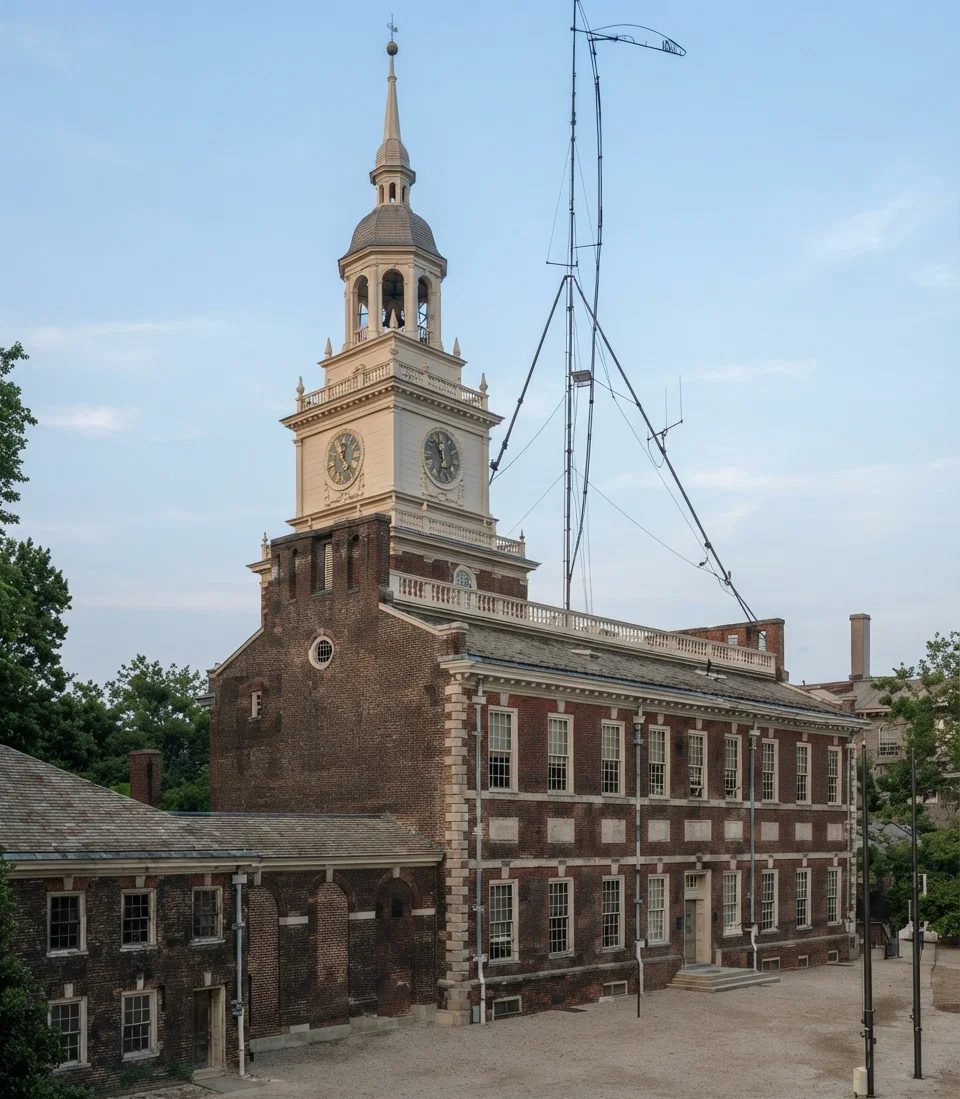
Independence Hall, Philadelphia, where the Declaration of Independence was signed

You have reached the end of this edition.

Signs of the Times · May 21, 1912