At the Tamil Christian Church, South India, Sabbath, Dec. 28, 1907
GEO. F. ENOCH
PROMPTLY at 3 A. M., long before sunrise, we were aroused from our slumbers by a sound unlike any we had ever heard. We soon remembered, however, that we had been told the night before that the first signal for the Sabbath day's services would be the “blowing of trumpets” at 3 A. M. This would be the signal for all Sabbath-keeping families to arise and prepare for the day's services.
Brethren J. L. Shaw and J. S. James, and the writer, rubbed from their eyes the sleep that was reluctant to go, and prepared themselves for the service that was to begin promptly at 4:30.
As soon as we were able to examine the instruments from which the warning signal was given, we were pointed to the Bible, and a few verses received new emphasis in our minds. “And the Lord spake unto Moses, saying, Make thee two trumpets of silver; of a whole piece shalt thou make them: that thou mayest use them for the calling of the assembly, and for the journeying of the camp.” Num. 10:1, 2. One trumpet was to be blown to call the elders, and two to assemble the camp. So at the very beginning of the day's services we were reminded forcibly of the anxiety of these people to have all parts of their service in harmony with the Word of God.
The two trumpets here used were about four feet long, beaten out of solid silver, fitted with a mouthpiece similar to one found on a tenor horn in a modern brass band. We were told that these trumpets could be heard four miles.
As we left the street to enter the church building, we found ourselves in15a wide, high porch, with tall columns of palmyra palm upholding the roof. This porch proved to be the place where we were to remove our shoes.
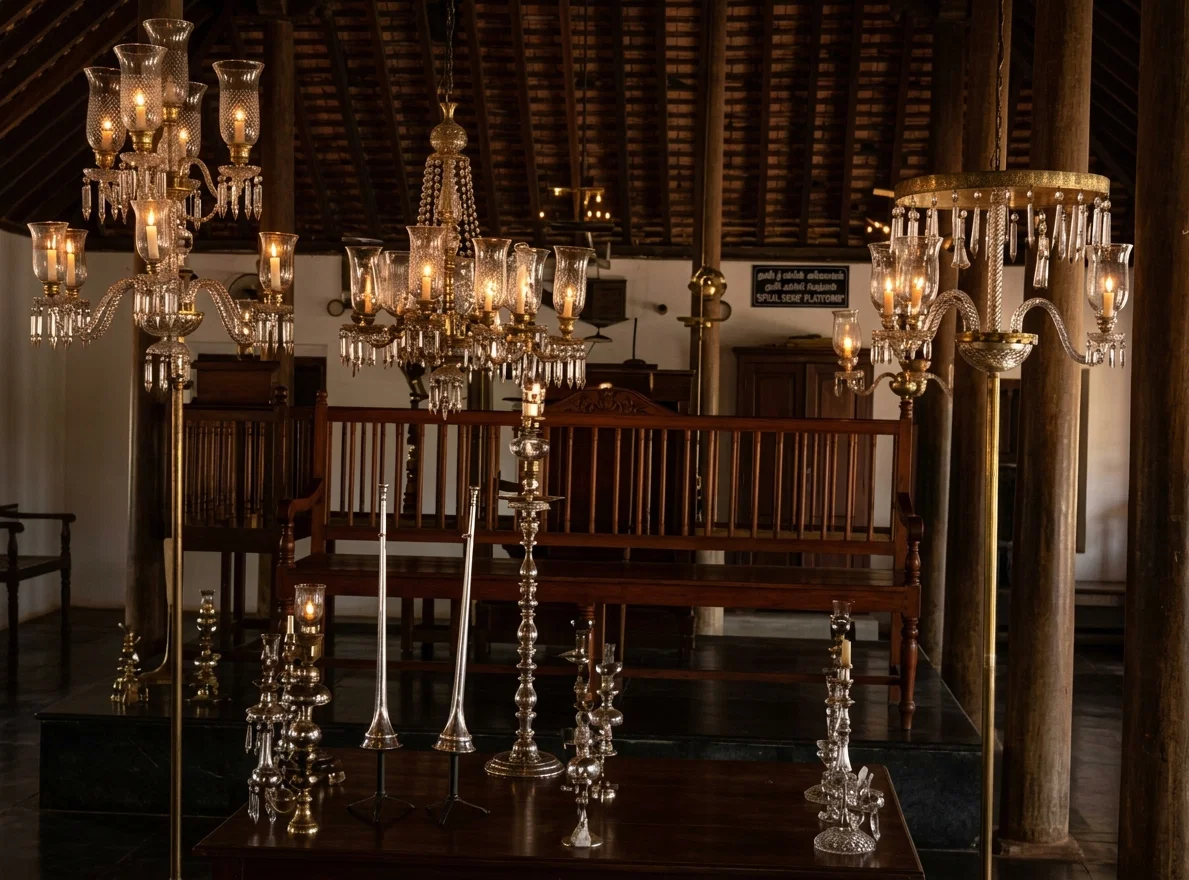
SPEAKERS' PLATFORM IN THE TAMIL CHURCH
We had inquired diligently beforehand as to the real purport of this rule. We learned that from the Scripture these people had derived a sense of great sacredness concerning their place of worship. They believe that in the same way that God descended and honored the worshipers by his presence in the sanctuary of old, even so at times now he descends among those who worship him in spirit and in truth, and honors them with his presence. They also read such scriptures as Ex. 3:5; Joshua 5:15; Acts 7:33. We also learned that the removing of the shoes from the feet means about the same to the Oriental as the removing of the hat does to those from the Occident.
So after counseling together, we decided that we would lay before the people the matter as we saw it, explaining that while it was not the custom for us to do so in our churches, yet in accordance with their custom we would do so at this time. They seemed to understand the situation, and thanked us most heartily for our kindness, which brought them great relief.
The three of us will never forget the impressions received as we entered the well-lighted church. Toward the front was a platform about three feet high, encircled with a hand rail. On the top of this platform was an ordinary table, and two large candlesticks of beaten brass, burning seven tapers each. Behind the table stood the preacher of the morning, on either side of the table, seated on the floor, was a choir of about twenty boys between the ages of ten and twelve, who were lustily singing a hymn of praise in Tamil, led by an orchestra of four violins. During the service the leader of the orchestra proved abundantly that he had special ability in
this line. But his dress, while entirely conventional here, would hardly be considered so in Western countries. He did not have a stitch of clothing from his waist up or from his knees down.
As we entered, on our immediate right, extending nearly to the pulpit, seated on the floor in true Oriental style, was a company of more than two hundred women. They were dressed with clean clothes, very simply, with the exception of the jewelry which they wore in quite large quantities. We were struck with the visible touch of the feminine hand, as we looked over the crowd of heads reverently bowed, and noticed the graceful and modest draping of their simple garments, composed for
the most part of but two or three pieces. On the right hand, extending quite around and behind the pulpit, were an almost equal number of men. We afterward learned that many of the men were away from home, in Ceylon and other places, trading. Here and there among the women was one dressed in pure white. These were widows, who are not allowed to remarry unless they have no children, when they are allowed to marry their husband's brother, or the nearest of kin. Usually these widows have estate enough to keep them. Otherwise they are well looked after by near relatives, or lacking them, by the congregation.
As we approached the front, we were surprised to see a group of about one hundred little girls, seated on the floor immediately in front of the women, and extending along the side of the church. And just beyond, reaching around behind and beneath the pulpit, was an equal number of little boys, surprisingly quiet, but with their bright, keen little eyes fixed on the three white sahibs coming up the aisle. The morning service was opened by all chanting in concert, standing, the eighteenth and nineteenth verses of the seventy-second psalm. After
kneeling in silent prayer for a moment, all arose and chanted the forty-seventh psalm, the preacher for the day and a leading male singer chanting a verse, then the entire congregation repeating the same, led by the orchestra and choir.
The chanting of these psalms seemed marvelous to us, the congregation of more than five hundred voices keeping almost perfectly in unison. Even the children joined in the chants, and it seemed almost painful to watch their faces as they strove to reach the highest strains. My readers can scarcely imagine the effect of more than five hundred voices, in so small a building, each chanting lustily to the utmost of his ability. The nearly perfect unison seemed marvelous, and we could easily follow the tunes of the chant, yet each of us agreed that he had never before so fully appreciated the meaning of the psalm which says, ‘Make a joyful noise unto the Lord.’
At the completion of the psalm, two chapters were read, one from the Old and one from the New Testament. The lessons for this service were found in Proverbs 25 and Luke 1. Following the Scripture reading, the one hundred forty-eighth psalm was chanted. The music was very appropriate to the genius of the psalm, and one could feel that the people were expressing great joy for the manifold blessings of God.
The sermon followed. On account of the extreme Jewish setting of the ritual, we thought best to go back to the beginning and establish the fact that Jesus was Creator, and that the law and the Sabbath were from the beginning. The writer spoke concerning creation, using the following texts: John 1:1-14; 17:5; 1 Cor. 8:6; Heb. 1:1-3; Genesis 1; Ps. 33:6, 9; Rom. 4:17; Gen. 2:1-3.
At the close of the sermon came a very interesting part of the service. On a table in front of the pulpit were twenty-eight heaps of money brought in by different individuals. Immediately in front of the table were thirty-seven offerings, consisting of eggs, and the produce of their fields, for the most part in neat little baskets. In these baskets were such things as rice, dahl (lentils), pumpkins, etc.
As soon as the sermon was ended, the steward of the church stepped forward and counted each heap of money, holding it up and calling out the amount. The donor would then arise from his place in the congregation and acknowledge the offering. If no one responded, the offering was set aside, and would not go into the treasury until the donor was known.
During this part of the ceremony there came what proved to be a most interesting diversion. When one offering of about one and one-half cents was announced, it was claimed by a man seated near us. The acknowledgment was scarcely out of his mouth when Teacher Abraham, one of the leaders of the congregation, was upon his feet with a series of questions. He and the preacher in the pulpit held a most animated conversation for a few minutes with the donor, whereupon the steward rejected the donation, passing it to another table. Then the donor stood, and made a most earnest explanation before the entire congregation, which proved satisfactory, as the steward then took the money and placed it with the accepted offerings.16
Our interpreter explained to us that the donor was accused of getting this money by breaking the Sabbath. The money was a portion realized from the sale of a fowl, which the leaders had been informed was sold on the Sabbath, and they absolutely refused to receive such tainted money. The final acceptance was only after the donor had solemnly assured them that the fowl had been sold after sundown the previous Sabbath.
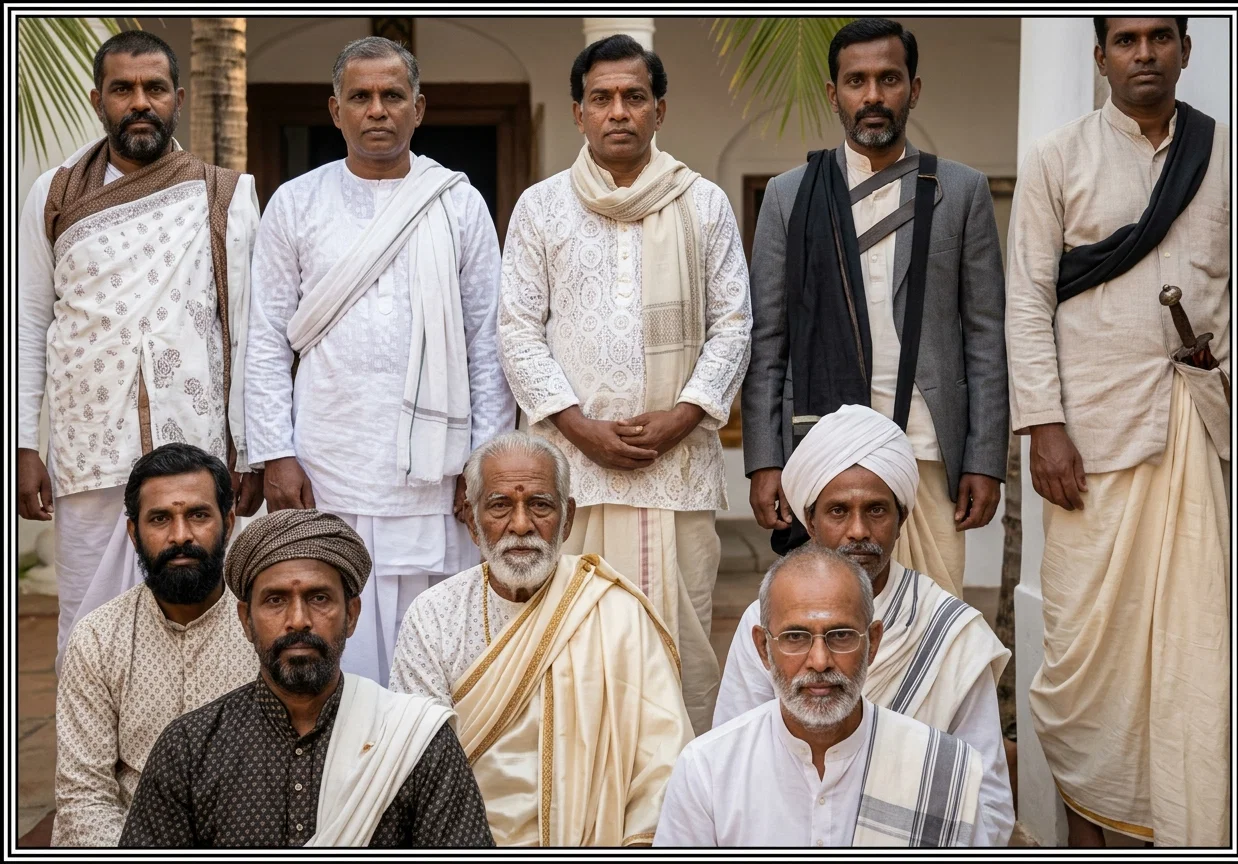
ELDERS AND LEADERS OF THE SABBATH-KEEPING TAMILS
It is worthy to note that the children were well represented among these donors. These offerings for the most part were called “first-fruits.”
There were also among them offerings made as an expression of gratitude to God, for some blessing, such as deliverance from sickness, a safe return from a long journey, etc. The accepted money was then placed in the treasure box, made of beaten brass, well padlocked. During the services the usual receptacle for this treasure box was a stone pillar near the door, where the faithful could drop
in their offerings on certain occasions. The steward explained that this box was similar to the one of which Jesus spoke when he tells of the widow who dropped in two mites. After the offerings had been received, the fifth psalm was chanted, after which the entire congregation in unison repeated, while standing, the Lord's prayer, closing with two Amens. Then while the congregation knelt, the leader in the pulpit prayed most earnestly in Tamil, after which the benediction was pronounced, the meeting closing exactly as described in Neh. 8:6.
At 10:30 came the second service of the day, which was very similar to the first, with the addition of the repeating of the ten commandments responsively.
Thinking that it will be of interest to our people generally to know the variety of psalms used, as well as the order of the service, I give below the program of the other two services:—
At 10:30 A. M.,—(1) Choir boys chant the one hundredth psalm. (2) Prayer, repeating in unison Ps. 72:18, 19. (3) Chant, Psalm 19. (4) Repeating the ten commandments responsively. (5) Scripture reading, Proverbs 26 and Luke 2.
It is interesting to note how strictly the children were kept in order. Imagine more than one hundred children, aroused
at three in the morning, and made to attend three services of one and one-half hours each. This was more remarkable as there seemed an evident desire that everybody should go to church in harmony with Joel 2:16. This good order was not kept without some effort, which, however, was very quietly but effectively carried out, by a monitor who walked around among the boys with a very serviceable-looking whip, which he would occasionally hit against the floor. But we did not see it get any nearer to any of the children.
As we were sitting in that church, after the services here outlined, at the close of one of the most interesting Sabbaths of our lives, looking into the faces of those earnest worshipers, our hearts were overwhelmed with the task that lies before us in leading these people out into the full light of the third angel's message. This is only one of five similar churches, and some over in Ceylon besides. As we realized something of the tremendous task, and our own frailty, separated as we are from them by India's most difficult language, the tears could not be restrained.
Brethren and sisters, pray for us, that
we may be given quickly the language of this people, that we may be humble and filled with the spirit of Jesus, that the enemy may in no way bring in anything that will hinder these dear souls from uniting fully with us, and that we may in every way through Jesus be equal to the task that lies before us.
Is Islam Waning?
Under this title Dr. S. M. Zwemer contributes to the Christian Intelligencer of Dec. 18, 1907, information of quite unusual importance. It seems that, unbeknown to the Christian world, conferences of Mohammedans have been held to discuss the decay of Islam. The first of these conferences was held in 1899, at Mecca. A little book recently published, and already carried to its second edition, contains the minutes of this meeting. Twenty-three leading Moslems from every nation under heaven met for this conference, and for two solid weeks discussed the reasons for the decline of their religion, and the means by which the tendency could be checked and new life imparted to the faith. The doctors disagreed as to the remedy, but they unitedly declared that there were no less than fifty-eight reasons for the dangerous condition of the patient. Some of the reasons given were: the doctrine of fatalism; ascetic practises; the opposition of science; the rejection of religious liberty; Ottoman rule; neglected education; inactivity due to the hopelessness of the case.
Word has just come that a second conference, similar to that at Mecca, was held in the Grand Continental Hotel of Cairo last November. All the learned sheiks, pashas, and beys were present, together with editors, judges, lawyers, and other notables, Christian as well as Moslem. A distinguished Moslem from Russia seems to have been the leading speaker. His theme was, “The Causes of the Decay of Islam.” In the course of his address he called upon Moslems to arise from their lethargy, open schools, and teach all the children (how untrue to Islam!) that they may be able to meet the demands of the new age, and urged the holding of a Panislamic congress to consider the cause of the loss of Moslem influence and power in the world. A committee was appointed with power to call such a congress. Commenting on these facts which he reports, Dr. Zwemer says it is clear that Islam is beginning to waver. The mass of Mohammedans who are full of fanatical zeal, and who read with perfect confidence the wild boasts of the Constantinople press, may still think that Islam is sweeping the world and holds in itself the welfare of all nations and peoples, but those who live under Christian rule in Algeria, Egypt, and India disagree with this estimate of their religion and its prospects. And indeed there is no doubt that Islam is a hopeless cause when it stands face to face with the open Bible and modern civilization. — The Missionary Herald.
A Profitable Union Meeting
By K. C. RUSSELL
A UNION meeting for all the Seventh-day Adventists in the District of Columbia was held in Pythian Temple, Sabbath, February 29. It was an occasion long to be remembered, because of the presence of God's Spirit and the Christian fellowship which was enjoyed by those in attendance. The hall, with a seating capacity of over five hundred persons, was filled with our people.
There are in the District of Columbia five organized churches, and one company of Sabbath-keepers that has not yet been organized. These churches are known as the First Church of Seventh-day Adventists, located on Eighth Street, N. E.; the Memorial Church, Cor. M and Twelfth Streets, N. W.; the Takoma Park Church; the Sanitarium and Seminary Church; and the Fifth Church of Seventh-day Adventists, located at present at Cor. Twelfth and R Streets, N. W., besides a company of Sabbath-keepers in Georgetown.
Extra street-cars were provided to convey our people from Takoma Park, with the students from the Foreign Mission Seminary. There were both forenoon and afternoon sessions. One important feature of the forenoon session was the reports which were rendered by the superintendents of the six different Sabbath-schools in the District. The following topics were presented by the respective superintendents: “How May a Teacher Lead His Younger Pupils to Decide to Be Christians?” “How to Secure Prompt Attendance at Sabbath-school,” “The Importance of a Systematic Study of the Sabbath-school Lesson,” “Relation of the Sabbath-school to the Foreign Fields,” “Five Common Mistakes Made by Superintendents and Teachers.”
Elder G. B. Thompson presented some interesting statistics regarding the growth of the Sabbath-school work, and the great possibilities in giving the message to other countries by devoting all Sabbath-school donations to the mission work.
Elder A. G. Daniells gave an interesting address on the world-wide mission field, after which an intermission was taken for lunch.
At 3 P. M., Prof. W. W. Prescott delivered an excellent sermon, in which he emphasized the importance of keeping in memory the fundamental truths which have made us what we are. It was clearly shown that all the time periods in the Bible have been fulfilled, and we are now living where the work of God can be quickly brought to a close. We were earnestly exhorted to seek for that oneness with Christ in which his life and character may be reflected in ours.
Following this sermon there was a lively social meeting, in which a large number participated. Many expressed themselves with reference to the remarkable growth of the work in the District of Columbia within the past few years. If the Lord has wrought so marvelously with the limited facilities which we have had heretofore, what may we not expect with the influence and aid of our institutions in planting the truth in this great center?
The annual meeting of the District of Columbia constituency was held in Takoma Park the following day, Sunday, March 1. This meeting is similar in character to a session of a local conference. The meeting was one of intense interest, and gave new inspiration and courage to the representatives of the work in the District of Columbia.
Plans were laid for more aggressive work with our literature in this territory, which will embrace the sale of both our large and our small subscription books, and also our periodicals.
The tithe on hand in the District, Dec. 31, 1907, amounting to $3,484.88, was voted to the mission fund.
The future of our work in the District of Columbia was never brighter, and we believe that with the increase which we have had in our church-membership, and the influence of our institutions, the work may be carried on with vigor and success in this important center.
K. C. RUSSELL.
Trinidad, West Indies
By S. A. WELLMAN
DURING the past month, since the meeting of the West Indian Union Conference Committee at this place in December, it has been the writer's privilege to be much among the country churches of this island, holding the quarterly services and annual meetings. A privilege indeed it has been. As we have met together, harmony has prevailed, and with the celebration of the ordinances and the partaking of the Lord's supper has come in an influence from the Master that has made the after-meetings and the business sessions of the churches seasons of continued blessings. We are thankful for this, and feel sure that the blessing of the Lord will follow these churches during the year.
An evidence that the Lord has been working among them lies in the fact that at several places there are others accepting the faith, and a number of these have signified their wish to be baptized. Where there are additions to the fold, and the Lord is calling such as must be saved, there is of a surety an abiding Presence.
Excellent interests are reported in unentered portions of the country, and we plan to begin operations with the tent at the town of Arouca during the second week of February. We hope, ere the dry season is over, to answer at least one more call out of the many that have come to us.
At the first session of the legislative council for the island this year a petition for the Sunday closing of shops of all classes was presented by the Portuguese shopkeepers. As this would affect one or two of our people, and would be an entering wedge for further legislation, it was deemed best to meet the issue by presenting the principles connected with the question, for the consideration of the public. This was done through correspondence in the public press and by the publication of a small, sixteen-page paper entitled "Liberty." Three thousand of these were sold throughout Trinidad, and the minds of the people have been awakened to the meaning and final outcome of these things. Copies were also sent to the governor and to members of the legislative council. The governor very kindly thanked us for the copy sent.
What the outcome of this present agitation will be, we know not. There has been some bitter animosity shown, and from all quarters, both Catholic and Protestant, there has been considerable opposition to the truths presented; yet many have been kind in their attitude on the question, and a large number are convinced of the trend of these agitations.
On the whole, the work in Trinidad has opened well for the new year, and it promises to be full of blessing, hard work, and results for the kingdom. For this we are thankful to God, and have set our faces to go forward with the last message. S. A. WELLMAN.
Two Important Meetings
By I. D. Richardson
The first two canvassers' institutes of the Columbia Union Conference for 1908 are now in the past, and good reports are coming in from those who were in attendance at the first one, which was held February 1-15, at Parkersburg, W. Va.
West Virginia had no State agent to work up the institute, but the untiring labors of the president, Elder J. M. Rees, brought together a company of consecrated men, all of whom feel a great burden for the success of the canvassing work in that field.
All present took a deep interest in the instruction given. Two classes a day were conducted in practical canvassing, and one in the theory and art of canvassing. The commercial phase of the work received due attention, while Testimony and Bible studies were conducted daily, making clear the missionary side of the work. All agreed that this was by far the more important.
In view of the fact that our canvassers have to meet the health reform and diet question, as probably no other workers do, this subject was studied carefully from the Testimonies. All the experienced canvassers agreed that it was possible to live good health reform as far as a flesh diet is concerned, and they resolved that they as well as other workers should bring their lives into harmony with health reform principles.
The Chesapeake institute was held February 15-29, at Baltimore, Md. Brother G. H. Clark, the State agent, had labored for weeks among the churches, and had a good company of canvassers present to begin the institute on time. We were pleased to see some of our sisters present at this institute, and also some of our colored brethren.
A spirit of consecration and devotion prevailed throughout this institute, as well as the one held in West Virginia. Never before had I attended two institutes where all seemed to have such a deep realization of the great responsibility resting upon them. It was expressed18by several that the institute had proved a great blessing to the churches in Baltimore. We believe that some of the brethren in Baltimore will soon enter the work.
At both institutes we closed with a short consecration meeting, and all expressed themselves as having determined to do faithful work, putting in full time (forty hours a week). Each one, I think, felt that he should induce some one else to enter the work this year, and thus double our numbers. Never did the future look brighter for the canvassing work.
I. D. RICHARDSON,
General Agent.
Costa Rica, Central America
By H. Louie Mignott
ANOTHER year has dawned upon our work in this part of the great harvest-field. I was not able to do much during the past year; yet I am truly thankful to my Heavenly Father for the little that I was able to accomplish through his help. There has been an addition of forty-two souls to the fold of the Master during the past year. Of this number twenty-six have been baptized. The outlook is still good. There are more calls than I can attend to. There is an unseen power that is working on the minds of the people, which is making them anxious to hear something about Jehovah's message for this time. Even among the Protestant ministers there has been a kindlier feeling toward us. I have been sending Liberty to nearly all of them. One is now reading Life and Health, which he asked me to exchange for his monthly church paper. Another, to whom I have been sending tracts, writes me a kindly note.
Since my return from the session of the West Caribbean Conference, I have been traveling around and holding a few meetings. I held two meetings at Jimenez; at the close of the last, two men signified their desire to walk in the way of the Lord. I also visited Luacimo, the place in which we were holding meetings last March when we were compelled to leave to prepare lumber for the erection of our church building at Pacuarito. We can rejoice that one at this place has begun to obey the Lord. The people were all glad to see me, and are anxious to know when I will return to hold another series of meetings. I have been visiting and holding Bible studies with them. They are very willing to listen to the Word of God. One woman, as I entered her house, handed me her Bible, and asked me to give her some light on the second chapter of Joel. I was glad of the opportunity. She became very much interested. I find other openings for Bible work.
More could have been accomplished here, but I have to labor under great disadvantages. If I had a tent in which the people could assemble to listen to the message for this time, there would be greater accessions to the truth. We can not hold meetings in the open air, owing to the inclement weather. Large rooms are not obtainable here, either. We are laying plans to buy a tent, and we are very confident that there will be an abundant harvest of souls in this field from such an effort.
We need more workers here to help gather the harvest. The other Protestant organizations have quite a corps of laborers. There are eleven Protestant ministers, and a small army of helpers here. They have churches in all parts of the country, and by this means they are able to hold their own. We need help. The Spaniards here need to hear the message. Among them there is only one laborer. There are some twenty-five thousand West Indians, scattered all over the hundreds of farms. They must also hear the truth of God.
“Brethren, pray for us, that the word of the Lord may have free course, and be glorified, even as it is with you.”
H. LOUIE MIGNOTT.
The Work in Eastern North Carolina
By W. E. Carter
We have had a burden for this field for a long time because of our acquaintance on the coast, I having sailed a vessel from Norfolk into these waters for more than ten years. Last spring we disposed of our business in Raleigh, N. C., and went to Hampton, Va., with a view to procuring a suitable vessel for this special work. My family and myself canvassed in Hampton until September 18, then we secured a small sailing-vessel, and soon after came through the Albemarle Sound and the Chesapeake Canal to North Carolina.
There were three on board, my wife and oldest son and myself. We visited some of the towns bordering on the Albemarle Sound and its tributaries, placing quite a number of our books in the hands of the people, and distributing a great deal of literature, of which we had a good supply, through the kindness of our friends in Washington, Hampton, and elsewhere. When the weather became cold and rough, my wife went home to Raleigh, and my son and I came farther south with our boat.
In looking at the map of North Carolina, we find that the State is nearly or quite two hundred miles north and south on the coast line. I can not find that any work has been done with our literature east of Newbern, which is about forty miles from Pamlico Sound. The Sound is forty miles wide, and contains many islands, which are settled with small hamlets and towns. There is a settlement on Cape Hatteras of about eight hundred persons, and twenty miles farther south, at Ocricoke, there are nearly as many more. From these sounds there are bays and rivers reaching into the land. In fact, it is a land of many waters. The main shore-lines have numerous small settlements of farmers and fishermen. Few, if any, have ever heard of a Seventh-day Adventist.
A word as to the difficult part of that field. The little hamlets and small towns are scattered, with only private transportation between places. Many of the people are illiterate, and shy of strangers. The drinking water is not good, and much sickness prevails in this low country. Our canvassers have done much in the upper part of the State, but the extreme eastern part is practically untouched. The only successful way of working this territory will be by boat. The gas boat has been introduced into these waters quite extensively. Most of the people we meet are kind, and we have many good talks on the Bible. We are sowing some seed, and have opportunity to give out literature to a class of boatmen who seem to appreciate what we give them to read.
This time of year we can not sell many books, as spring fishery has not begun yet. There seems to be a great scarcity of money on account of crop failure for two successive years. If any of our people are interested in this field, and will send us copies of the Signs, Watchman, Life and Health, and tracts which contain parts of the message, we will use them to the best possible advantage.
We meet and talk with many ministers, and find some interested. Surely, the Lord has a people in this part of the State who will see the light of truth and obey. Now is the time to work; but to do effective work we need a gas boat and a tent. I wish some of our more experienced workers would become interested in this work. Active work could be done at least eight months of the year along the coast, and the rest of the time could be occupied with work up the rivers.
This is a poor country, and from a financial standpoint would not be considered at all, but we must not forget those less favored with temporal means. I believe that God has placed me in this field, and, by his help, I expect to be faithful. If any feel disposed to assist financially in procuring the necessary outfit to carry the third angel's message in these waters, I would be glad to hear from them. My address is Belhaven, N. C.
W. E. CARTER.
Malamulo Mission, Nyassaland
By JOEL C. ROGERS
It is now the fever season in the African tropics. We have received many kind letters from friends inquiring about our health. These letters we appreciate very much, and trust that our friends may not grow weary in well-doing, even if they do not receive early answers. In a place like this where one does not19see a person of his own race for many months, every letter from the home land is doubly welcome.
The terrible fever has found us, as it invariably finds the foreigner who has hard work to do here. The climate is extremely weakening, and one used to hard work in the States finds himself overdoing before he is aware of it. My wife was the first to suffer from an attack. December 10 she was in the school as usual, but was not feeling very well. The next day she was unable to sit up, and her temperature reached 104.5. From that time it went up and down for a week, when it yielded to treatment, with God's special blessing. It left her in a very weak condition, and it will be some time before her usual strength returns. This fever is indeed a terrible thing, and my wife warns me daily not to get it.
From October 26 rain has fallen almost every day. The mornings vary with fog, cloud, then a little sun. And now at one o'clock the rain is pouring down. The atmosphere is humid, steamy, and warm. It is not extremely hot, but never invigoratingly cool. Vegetation seems never to cease growing. Continual cutting of grass with hoes is required about the house to prevent everything overgrowing. We are glad that flowers grow well here. Our garden is well supplied with roses, carnations, pansies, etc. We have started three new schools with the native teachers this year. The last one is over one hundred miles farther into the heart of Africa. JOEL C. ROGERS.
Japan
By F. W. Field
Tokyo.—We have quite a nice little training-class here in Tokyo. Brethren Okohira and Kuniya are conducting regular daily classes, and about six or eight, I believe, are in regular attendance. Some of these are workers, some are just preparing for the work, and two are young men who have recently accepted the truth, and have settled in Tokyo. So we are doing what we can in the way of educational work, not waiting until we get a full-fledged school. As for myself, I am putting in good time on the language, with regular lessons with a teacher five days in the week. During the last year my time was much broken up, and my regular lessons greatly interfered with. But still I did what I could on the language. I can do considerable talking without an interpreter; but it would not be fair to say that I am preaching freely in Japanese yet. I feel sorry that my other work has taken my time as it has, so that I have not done more on the language; but I mean to keep at it as long as may be necessary till I get it.
We receive encouraging, hopeful letters from the workers in Korea. At Sunan they are busy with the school work this winter, and report a good interest.
F. W. FIELD.