Your ShelfYour Projects

Signs of the Times, Vol. 36, No. 14.

Question Corner

Signs of the Times

Apr 7, 1909

Pacific Press Publishing Association · Mountain View, California · Apr 7, 1909

Question Corner

[To Our Inquirers.— (1) The name and address of all who ask questions must accompany questions, not necessarily for publication, in token of good faith, and that we may reply by letter if thought best. All communications will be considered confidential if so desired, and no name will be published unless requested. But we have no time to give to anonymous or unsigned epistles or articles. (2) Let the questions be to the point. Do not say, “Explain Josh. 7:1-8,” but state the thing upon which help is desired. (3) Questions can not be answered immediately in this department. Sometimes it will mean a month or more of waiting. We can not reply to the same question frequently. Read answers to other questions; you may find reply to yours. (4) Members of the Bible Band will kindly enclose stamp if answer is desired by letter. Others will please enclose ten cents. This does not begin to meet expenses oftentimes. (5) “Foolish . . . questions avoid.”]

2797.— The Holy Spirit.

There is a tract in circulation here teaching that Gabriel is the Holy Ghost. Will you please tell us through the Question Corner what the Holy Ghost is? H. B. W.
First, the better term altogether, it seems to us, is the “Holy Spirit.” So is the American Standard Revised Version throughout. Some have been confused on account of the different rendering of the same Greek word, supposing that the Holy Spirit was one thing, and the Holy Ghost another; but the same word translated “Spirit” is the word translated “ghost,” and “Holy Spirit” is the better term.
Secondly. All the way through the Scriptures the Holy Spirit is represented as being the operating power of God. The Father stands for the great ruling power in the universe, the King upon the throne; the Son of God, Jesus, as the great sacrifice, the representation of the Father; one who emptied Himself that He might fill man and save him; and the Spirit, as the effectual working of God. So in the very beginning we read, “The Spirit of God brooded upon the face of the waters.” God brought cosmos out of chaos through His Spirit. Job tells us that “by His Spirit He garnished the heavens.” The psalmist tells us in speaking of the death of living creatures and their restoration, by His Spirit “they are created;” by His Spirit Christ was begotten, and by that same Spirit “He went about doing good;” and by the gift of that Spirit men are begotten again, regenerated; and by the gifts of that Spirit are they fitted for service. The Spirit, therefore, antedated all living created beings and therefore antedated the angel Gabriel. That mighty messenger of God comes filled and clothed with the Spirit of God. So among men God clothes and fills them with His Spirit. It is the Spirit that gives the message; Gabriel is the messenger that bears the message. As to the children of men, God baptizes men and fills them with His Spirit, to bear His Spirit-sent messages; but the messenger is not the Spirit, even tho he bears the message of the Spirit. The Spirit, therefore, is that element in the Godhead which carries the presence and power of God to all parts of His universe, and especially to those who have faith in God. It is the life of God—the power of God. Let us not try to define God or the Godhead too closely. Let us be content to know the great three-fold manifestation of Deity; to know that the great Jehovah is our Father; that Christ Jesus, His only begotten Son, is our Saviour and elder Brother; and that the Holy Spirit is our regenerator and the constant companion of every soul who believes in Christ Jesus. We are told to pray to the Father and pray to the Son, but we have nothing in Scripture regarding prayers to the Spirit; but we can pray to the Father or the Son; and He will send the Spirit, and is more willing to give it than earthly parents are to give good gifts unto their children.

2798.— Strivings about the Law.

Please explain “strivings about the law” in Titus 3:9. A. P.
The Revised Version reads: “But shun foolish questionings, and genealogies, and strifes, and fightings about the law; for they are unprofitable and vain.” Wherever Titus went as a young minister he would find Jews and half-converted Christians, perhaps, from the Jews, who were great sticklers for not only the law, but the traditions which had grown up around the law. These traditions were a source of endless controversy among the Jews. They were utterly unprofitable; had very little, if anything, to do with the meaning of the law itself, but were what some rabbi had said. Titus was admonished to leave all these things that were unprofitable and have nothing to do with them. The advice is good at the present time. “Preach the word” is the mission of the minister of God.

2799.— Polygamy. 2 Sam. 12:8.

Are we to understand from this that the Lord favored polygamy? J. M. J.
We are not. It is simply a general statement by the prophet that God gave him all that a king could possibly ask for, looking at it from the worldly viewpoint, and having all these things that a king of the world could ask for in the way of wives and concubines, still he went so far as to deprive a man of his only wife and be the means of the taking of the life of the man. There is nothing in the Scripture which would indicate that God favored polygamy. He did the best He could do with a people that were in darkness and surrounded by gross darkness on every side. We can read continually between the lines, so to speak, of the Scripture narrative, showing how that evil always grew out of departure from God’s original laws. Never did a man multiply wives to himself but what troubles of all sorts and kinds arose among his offspring. This reproof, however, of Nathan does not advocate anything of that sort; it simply shows that David had other things in his power that would be considered legitimate from the standpoint of a king, and there was no reason for his departing from what was right and just.

2800.— Irony. 1 Kings 22:15.

Did Micaiah in 1 Kings 22:15 speak irony when he said, “Go and prosper,” and what did he mean in verse 21 where an evil spirit said, “I will entice him”? J. M. J.
Yes, Micaiah spoke irony, that is shown by the very context. All the false prophets had prophesied prosperity. Micaiah comes and in a tone probably which imitated theirs, he tells the king, “Go up and prosper; and Jehovah will deliver it into the hand of the king.” The king knew it was irony, too, because he tells him that he wants him to say nothing but what God had said, and then the prophet tells the king just what will come to him, and the reason why it will come, because the king has set himself against God. Good spirits, good angels of God, had had no power to move the heart of the king; he had come to that place where the Lord could not win him to His truth, and so the evil spirit is permitted to go and entice him to his destruction. It were better for him and for Israel both that he should be out of the way, than to continually rebel against God and lead God’s children astray.

2801.— Death and Body of Moses.

I wish to ask for information regarding the death and resurrection of the body of Moses. J. W. C.
As intimated by our correspondent, the record of Moses’ death is given in Deut. 34:5, 6, a death at which only spiritual beings were present. The old warrior lay down and went to sleep. Those who are in a condition of death are counted as the prisoners of Satan inasmuch as death is the result of sin. Of Satan, or Lucifer, it is said that he “let not loose his prisoners to their home.” Isa. 14:17. In Jude 9 we read that there was a dispute between Michael the Archangel and the devil about the body of Moses. Michael (the meaning of which is “Who is Like God”), the Archangel (meaning the “Chief of all the Angels”), was none other than the Son of God. This we would learn by comparing Dan. 10:13, 21 with Jude 9; John 5:28; 1 Thess. 4:16. It will be seen by comparison of these texts that it is the voice of the Son of God that wakes the dead, and that this is the voice of the Archangel. The Archangel, Michael, the great Prince that stands for the children of God’s people, must therefore be Christ the Son of God. We could conceive of no reason as to why there should be a dispute over the body of Moses unless it was over its resurrection from the dead. It is Satan’s ambition to keep forever dead all those who are the children of God. It is God’s gracious promise that they shall live again. We can also readily understand that at that dispute between the devil and Michael, Michael came off conqueror, and therefore, the body of Moses was raised from the dead. As evidence of this see Mark 9:4: “And there appeared unto them Elijah with Moses; and they were talking with Jesus.” Now Elijah was translated without seeing death. He and Moses were on the Mount of Transfiguration; the one representing that class at Christ’s coming who would be raised from the dead; and the other, those who will be translated without seeing death when Christ comes. Therefore, Moses was raised from the dead,—a pledge of the resurrection for all time. Our correspondent has concluded rightly that Moses was taken to heaven. There is absolutely no proof that God gave his body to the devil as some have affirmed to you. All this is pure supposition.

2802.— The Ordaining of Elders and Deacons.

Ought elders and deacons to be ordained who do not pay tithes and contribute to the affairs of the church? A. F. A.
Tithing, of course, is not a matter of payment as entrance to a church or to office, but it is one of the ordained means which God has for supporting His cause and ought always to be voluntary; but when a whole denomination has accepted that plan for the support of its cause, surely the church officers ought to be in perfect harmony with it, and if they are not, they ought not to serve. Consistently they ought to refuse to serve, but if their conscience does not lead them to this resolve, is not sufficiently quick and active, then certainly the members of the church ought to have something to say in regard to the matter. The proper place to ordain elders and deacons is before the church itself, so that all can take part in the service and receive a blessing which always comes by right ordination.

2803.— The Creation of Man.

Is David speaking about Adam in Ps. 8:4-8? Did Adam and Eve have access to the river of the water of life? A. K.
The psalmist is speaking of man. Of course that carries us back to Adam, the first man, made a little lower than angels, crowned with glory and honor. This, of course, was before he sinned. He had access to the river that flowed out from the Garden of Eden. That must have been the River of Life. Just so long of course as he could have drunk of that River of Life before sin entered and eaten of the Tree of Life he would have lived, but he was cut off from access to both. Then, too, he was fed by the very life of God.

2804.— The Lord’s Supper.

A. K.— The Lord’s Supper will be simply celebrated in the new earth as the antitype as indicated by Matt. 26:29, just the same as the sacrifices of old were met in the fulfilment of Christ’s death on the cross. Then Jesus in the great, glorious supper of the Lamb will come forth and serve His children. Not in the same way, of course, that the supper is celebrated here,—looking forward to Christ’s coming,—but as the glorious fulfilment of all the promises of the past.

2805.— New Moon. Isa. 66:23.

The expression is there used evidently for month and is so translated in some Scriptures, that from one Sabbath to another, and from one month to another shall all flesh go up to worship the Lord of Hosts. By reference to Rev. 22:1, 2 we find that the Tree of Life bore its twelve manner of fruits every month. The children of God will come up to the city and partake of the fruit of the Tree of Life from month to month, and from Sabbath to Sabbath come before Him in spiritual worship.

The Resurrection and Its Meaning

By Abdiel
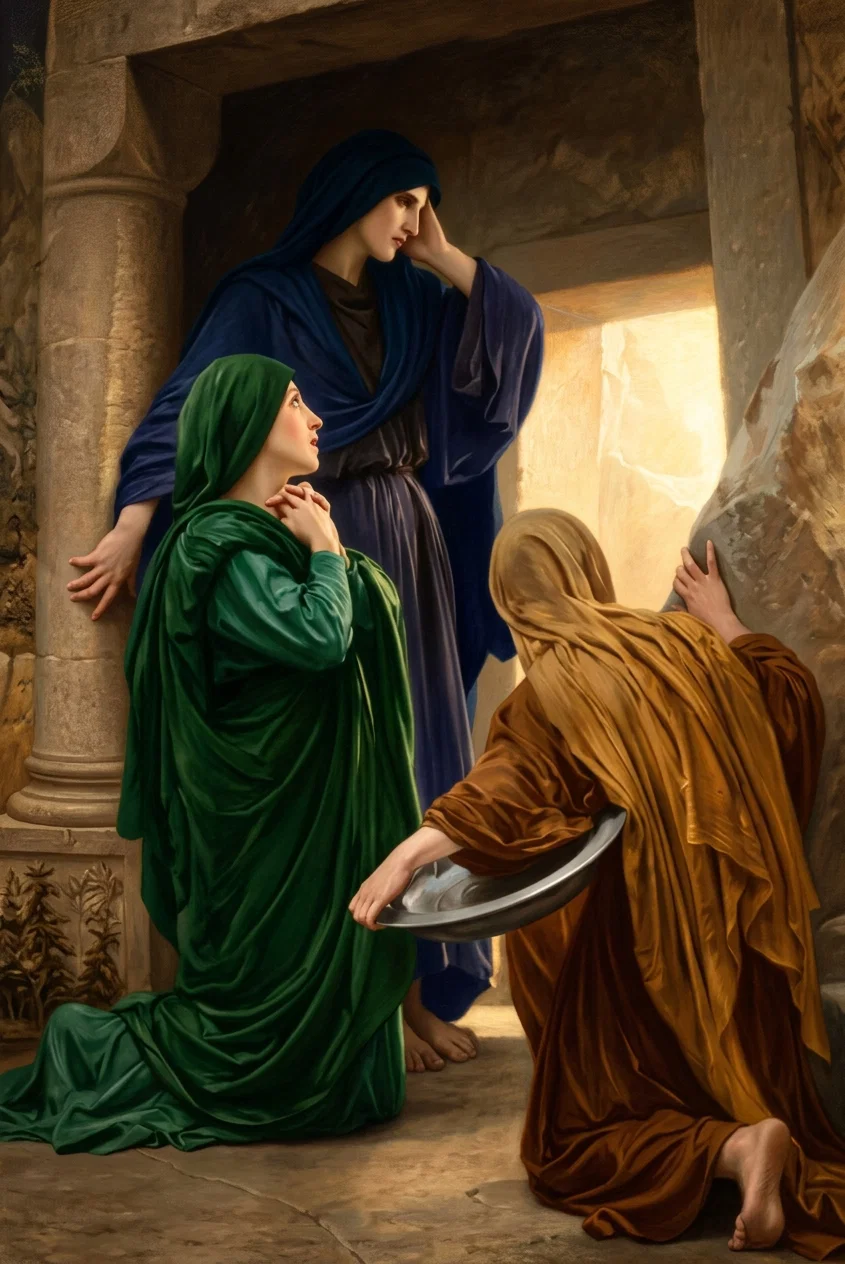
The Holy Women at the Tomb. “He is not here, for He is risen.”
The eternal Son of God came to this world. He was made flesh, and dwelt among men. He was “born of a woman, born under the law, that He might redeem them that are under the law, that we might receive the adoption of sons.” He grew to manhood through infancy, childhood and youth.
Physically, He was like other men. He walked among them. He ate and drank at their tables, sat in their circles of converse, slept in their beds, walked in their fields. He was baptized, tempted forty days, and He conquered by the word. He went about doing good, preaching the word of life, healing the sick, casting out demons, breaking the bonds of sin, and raising the dead. Finally, He died upon the cross. His hands and feet and heart were pierced. He was laid in a new rock tomb by loving hands, and the strong Roman government, by her legates, sealed the sepulcher and imprisoned Jesus of Bethlehem and Nazareth.
But they could not imprison the Prince of Life. Why?—Because He was also the Righteous One. In the ethics of human warfare “Might makes Right,” and it often seems demonstrated; but it is only temporarily. In the eternal spiritual warfare only Right is Might. Within absolute Right is the potency of eternal power, the assurance of perennial existence. He who was “made to be sin in our behalf” “did no sin, neither was guile found in His mouth.” He demonstrated the power of God above sin in the flesh. He was working out: “In the way of righteousness is life, and in the pathway thereof there is no death.” He bore sin on our behalf; on our behalf He died. But in Himself He had no sin, and therefore God raised Him up, “having loosed the pains of death; because it was not possible that He should be holden of it.” Acts 2:24. No rock-bound tomb could imprison the character of “everlasting righteousness,” thrice sealed tho’ be the prison door.
Therefore when the holy women came to anoint the hastily buried body on the morning of that first day, they found an empty tomb; but a living message of mighty import brought the angel messenger, who had been commissioned of Heaven. When, then, they came asking themselves, “Who shall roll us away the stone from the door of the tomb?” they found it rolled away, the body of Jesus gone, and a messenger of God who said: “Be not amazed: ye seek Jesus, the Nazarene,” who hath been crucified:
He Is Risen; He Is Not Here:
Behold, the place where they laid Him! But go, tell His disciples and Peter, He goeth before you into Galilee: there shall ye see Him.” Mark 16:3-7. That was the Lord’s message to His church then; it is His message to His church now. Condense it to its pith:
“He is risen; He is not here: . . . He goeth before you into Galilee; there shall ye see Him.”
“HE is risen.” The same Jesus who died; the One whom they crucified; the One whom they locked in the tomb, of Him is the message.
“He is risen.” He is not a dead Saviour or friend. He lives. He who thus rises has power over death; He is stronger than death, stronger than sin, of which death is the finished product. He is risen from the dead; the tomb holds Him no longer.
Would God the church had heeded the message. Beginning with 1096, for nearly two centuries the deluded followers of tradition, many of whom believed themselves to be sincere Christians, laid down their lives to recover that empty tomb, neither then nor since surely known. Seven times the armies of the Crusaders beat their waves of humanity against the wall of Saracen arms, to suffer defeat and destruction, in all save temporary successes. If the Roman Catholicism of Europe had but known the thrice-repeated message of Christ to His church, thousands of lives would not have been slaughtered to recover a hole in the rock, empty of the Master.
The Crusades are no more. We pity the deceived ones. But the church goes on following the same principles of perversion, seeking Christ in the ancient, musty relics and museums of antiquity, once pressed mayhap by His feet or brushed by His seamless robe, but in which He now is not. The enormous, half-truth traditions of men; the human creeds of dead hands; the crypts of traditions which make void the commandments of God; the outworn, worthless methods of medieval education; the arbitrary control of pope or council or conference or creed; the world-curse of civil interference inreligious matters, or religious interference of civil matters; the harness in which some devoted worker dragged souls into the kingdom, designed for none but him, and blessed of God perhaps despite His machinery and method,—all are become to a greater or less extent empty sepulchers in which men are seeking the Risen Christ. O, let them hear the heavenly message: “He is risen; He is not here.”
Would you find Him, soul? You have followed the vain quests so long. “I know ye seek Jesus,” is God’s message still to His blundering disciples; and “Why seek ye the living among the dead?” is still His searching question.
He is not in empty sepulchers. He goeth before you into Galilee. He is out where the slaves of sin are longing for freedom; where the souls in darkness and gloom are praying for light; where eager ears are waiting for living words instead of dead traditions; where hungry hearts are longing for the Bread of Life instead of the scientific husks of men; where sin-sick, soul-sick, body-sick men are eagerly looking for the healing word and touch of the Gospel of health and life; where His own word is given free course instead of the arbitrary authority of men. “He goeth before you” with His mighty blessed healing word in all these needy fields, to all these needy souls; there shall ye find the Risen Christ.

The Memorial of His Resurrection

IS there such a thing? Can there truly be such a thing? The Sabbath is a memorial of God’s glorious preparation of this earth for the home of man. The Passover was a memorial to Israel of their deliverance from Egypt. The Fourth of July is a memorial day of the signing of the Declaration of Independence. All these were past events. The things designed to be called to mind are in the past, altho their beneficent fruits abide still.
A Baptismal Scene in North Carolina.
But the Resurrection is a living thing. It did not occupy a day like the Sabbath, a night like the Passover. It came in a moment of time, between the night and the day, a life from above. To think of using a heathen feast—put a Christian halo on it as we will—as a memorial of our Lord’s rising again from the dead, is utterly incongruous; nay, more, is it not dishonoring and blasphemous? What is there about the old heathen, Saxon nature goddess Eostre, in name or worship, which calls to remembrance the Risen Christ? What is there about the songs and eggs and flowers and fashions and feastings and gorgings and ornate display which could possibly bring to mind the Risen Saviour? Who would or could conclude, if he knew the story of the Resurrection but did not know the Easter celebrations, that these ostentatious displays were celebrations of that event unless some one told him?
No, Bible memorial of our Lord’s rising again from the dead is not in a day, either of the week or year.
The Bible has given us an ordinance including not only the resurrection of our Saviour, but His death and burial also; namely, Christian baptism. That ordinance means more than a form of words and immersion in water. It includes this, but it is an empty rite unless it means more to the baptized.
Christian, or believer’s, baptism is the beginning act before the world of a new life; it is the divine marriage ceremony which unites before the world the believer to Jesus Christ; it is the outward profession that the believer is henceforth to be one with Jesus even as wife and husband are one. These profoundly important truths are set forth in the following scriptures:
“Know ye not, that so many of us as were baptized into Jesus Christ were baptized into HIS death [for sin, Rom. 6:10]? Therefore we are buried with Him by baptism into death; that like as Christ was raised up from the dead by the glory [goodness, righteousness, character] of the Father, even so we also should walk in NEWNESS OF LIFE. For if we have been planted together in the likeness of His death, we shall be also in the likeness of His resurrection; knowing this, that our old man is CRUCIFIED WITH HIM, that the body of sin might be destroyed, that HENCEFORTH WE SHOULD NOT SERVE SIN.” Rom. 6:3-6.
“Wherefore, my brethren, ye also are become dead to the law by the body of Christ; that ye should be MARRIED TO ANOTHER, even to Him who is raised from the dead, that WE should BRING FORTH FRUIT UNTO GOD.” Rom. 7:7.
“Ye are all the children of God by faith in Christ Jesus. For as many of you as have been BAPTIZED INTO CHRIST HAVE PUT ON CHRIST.” Gal. 3:26, 27.
“Buried WITH HIM IN BAPTISM, wherein also ye are RISEN WITH HIM through the faith of the operation [working] of God, who hath raised Him from the dead.” Col. 2:12.
Baptism, then, is the marriage ceremony by which we publicly put on Christ, take His name, and are made one with Him in death to sin, in life to righteousness. By faith, in death, in life, He is ours. “He died unto sin.” “Likewise reckon ye also yourselves to be dead indeed unto sin.” “He liveth unto God.” “Even so reckon ye also yourselves to be . . . alive unto God in Christ Jesus.”
What, then, is the sign to the world that Jesus is risen again?—It is not the celebration of the vernal festival of a heathen goddess, Christian tho we name it. It is not the observation of one day in the week, because He may have used a moment of that day in rising. It is not a mere form of baptism, altho that form be the only scriptural one. It is a new life in Christ Jesus unto God, walking in newness of life, separate from the world, one with Christ.
This is the meaning to the world of the resurrection of Christ. “I am crucified with Christ; nevertheless I live; yet not I, but Christ liveth in me.” The Resurrection should mean Christians walking above the world and sin, “trees of righteousness, the planting of the Lord, that He might be glorified.”
If this be not the lesson the church of Christ is teaching to the world, if this is not the witness she is bearing of the life of her risen Lord,—power over sin,—her mission is vain. Her elaborate rituals, her ornate trappings, her multitude of songs by paid and unconverted choirs, her aping of heathenism, her appeals to the sensuous, are all the veriest mockery. O that the church of Christ would turn to Him! O that they would, by the power of the living Christ in righteous lives, every day of the year, every day of the week, every hour and moment of every day, proclaim, “The Lord is risen indeed.” Christian friend, the question is vital. Are you a witness to the resurrection of Jesus?

Nothing Leaves Us as It Found Us

If a sheet of paper on which a key has been laid exposed for some minutes to the sunshine, be then instantaneously viewed in the dark, the key being removed, a fading specter of the key will be visible. Let this paper be put aside for many months, where nothing can disturb it, and then in darkness be laid on a plate of hot metal, the specter will again appear.
This is equally true of our minds. Every man we meet, every book we read, every picture or landscape we see, every word or tone we hear, leaves an image upon the brain. These traces, which under ordinary circumstances are invisible, never fade, but in the intense light of cerebral excitement start into prominence, just as the specter image of the key started into sight on the application of heat. It is thus with all the influences to which we are subjected.—Anon.

The Strongest Bulwark of Vice

THE strongest bulwark of vice in our world is not the iniquitous life of the abandoned sinner or the degraded outcast; it is that life which otherwise appears virtuous, honorable, noble, but in which one sin is fostered, one vice indulged.—Mrs. E. G. White.

The True Motive in Service

By Mrs. E. G. White
The words of Christ on the mount were an expression of that which had been the unspoken teaching of His life, but which the people had failed to comprehend. They could not understand how, having such great power, He neglected to use it in securing what they regarded as the chief good. Their spirit and motives and methods were the opposite of His. While they claimed to be very jealous for the honor of the law, self-glory was the real object which they sought; and Christ would make it manifest to them that the lover of self is a transgressor of the law.
But the principles cherished by the Pharisees are such as are characteristic of humanity in all ages. The spirit of Pharisaism is the spirit of human nature; and as the Saviour showed the contrast between His own spirit and methods and those of the rabbis, His teaching is equally applicable to the people of all time.
In the days of Christ the Pharisees were continually trying to earn the favor of Heaven, in order to secure the worldly honor and prosperity which they regarded as the reward of virtue. At the same time they paraded their acts of charity before the people, in order to attract their attention, and gain a reputation for sanctity.
Jesus rebuked their ostentation, declaring that God does not recognize such service, and that the flattery and admiration of the people, which they so eagerly sought, was the only reward they would ever receive.
“When thou doest alms,” He said, “let not thy left hand know what thy right hand doeth: that thine alms may be in secret: and thy Father which seeth in secret Himself shall reward thee openly.”
In those words Jesus did not teach that acts of kindness should always be kept secret. Paul the apostle, writing by the Holy Spirit, did not conceal the generous self-sacrifice of the Macedonian Christians, but told of the grace that Christ had wrought in them, and thus others were imbued with the same spirit. He also wrote to the church at Corinth and said, “Your zeal hath stirred up very many.”
Christ’s own words make His meaning plain—that in acts of charity the aim should not be to secure praise and honor from men. Real godliness never prompts an effort at display. Those who desire words of praise and flattery, and feed upon them as a sweet morsel, are Christians in name only.
By their good works, Christ’s followers are to bring glory, not to themselves, but to Him through whose grace and power they have wrought. It is through the Holy Spirit that every good work is accomplished, and the Spirit is given to glorify, not the receiver, but the Giver. When the light of Christ is shining in the soul, the lips will be filled with praise and thanksgiving to God. Your prayers, your performance of duty, your benevolence, your self-denial, will not be the theme of your thought or conversation. Jesus will be magnified, self will be hidden, and Christ will appear as all in all.
We are to give in sincerity, not to make a show of our good deeds, but from pity and love to the suffering ones. Sincerity of purpose, real kindness of heart, are the motives that Heaven values. The soul that is sincere in its love, whole-hearted in its devotion, God regards as more precious than the golden wedge of Ophir.
“His, not mine, are the gifts, and only so far can I make them. Mine as in giving I add my heart to whatever is given.”
We are not to think of reward, but of service; yet kindness shown in this spirit, will not fail of its recompense. “The Father which seeth in secret Himself shall reward you openly.” While it is true that God Himself is the great Reward that embraces every other, the soul receives and enjoys Him only as it becomes assimilated to Him in character. Only like can appreciate like. It is as we give ourselves to God for the service of humanity that He gives Himself to us.
No one can give place in his own heart and life for the stream of God’s blessings to flow to others, without receiving in himself a rich reward. The hillsides and plains that furnish a channel for the mountain stream to reach the sea, suffer no loss thereby. That which they give is repaid a hundredfold. For the stream that goes singing on its way, leaves behind its gift of verdure and fruitfulness. The grass on its banks is a fresher green, the trees have a richer verdure, the flowers are more abundant. When the earth lies bare and brown under the summer’s parching heat, a line of verdure marks the river’s course; and the plain that opened her bosom to bear the mountain’s treasure to the sea, is clothed with freshness and beauty—a witness to the recompense that God’s grace imparts to all who give themselves as a channel for its outflow to the world.
This is the blessing of those who show mercy to the poor. The prophet Isaiah says: “Is it not to deal thy bread to the hungry, and that thou bring the poor that are cast out to thy house? when thou seest the naked, that thou cover him; and that thou hide not thy face from thine own flesh? Then shall thy light break forth as the morning, and thine health shall spring forth speedily. . . . . And the Lord shall guide thee continually, and satisfy thy soul in drought; . . . . and thou shalt be like a watered garden, and like a spring of water, whose waters fail not.”
The work of beneficence is twice blessed. While he that gives to the needy blesses others, he himself is blessed in a still greater degree. The grace of Christ in the soul is developing traits of character that are the opposite of selfishness—traits that will refine, ennoble and enrich the life. Acts of kindness performed in secret will bind hearts together, and will draw them closer to the heart of Him from whom every generous impulse springs. The little attentions, the small acts of love and self-sacrifice, that flow out from the life as quietly as the fragrance from a flower,— these constitute no small share of the blessings and happiness of life. And it will be found at last that the denial of self for the good and happiness of others, however humble and uncommended here, is recognized in heaven as the token of our union with Him, the King of glory, who was rich, yet for our sake became poor.
The deeds of kindness may have been done in secret, but the result upon the character of the doer can not be hidden. If we work with whole-hearted interest as a follower of Christ, the heart will be in close sympathy with God, and the Spirit of God, moving upon our spirit, will call forth the sacred harmonies of the soul in answer to the divine touch.
He who gives increased talents to those who have made a wise improvement of the gifts entrusted to them, is pleased to acknowledge the service of His believing people in the Beloved, through whose grace and strength they have wrought. Those who have sought for the development and perfection of Christian character by exercising their faculties in good works, will, in the world to come, reap that which they have sown. The work begun upon earth will reach its consummation in that higher and holier life to endure throughout eternity.

Asking for the Spirit

You must watch unto prayer. You must keep a lookout, and see if God grants the blessing when you ask Him. People sometimes pray, and never look to see if the prayer is granted. Be careful, also, not to grieve the Spirit of God. Confess and forsake your sins. God will never lead you as one of His hidden ones, and let you into His secrets, unless you confess and forsake your sins. Do not be always confessing and never forsake, but confess and forsake, too. Make redress wherever you have committed an injury. You can not expect to get the spirit of prayer first, and then repent. You can’t fight it through so. Professors of religion, who are proud and unyielding, and justify themselves, never will force God to dwell with them.
Aim to obey perfectly the written law. In other words, have no fellowship with sin. Aim at being entirely above the world; “Be ye perfect, even as your Father in heaven is perfect.” If you sin at all, let it be your daily grief. The man who does not aim at this, means to live in sin. Such a man need not expect God’s blessing, for he is not sincere in desiring to keep all His commandments.—Charles G. Finney.

The Bible

THE Bible. A noble book! All men's book. It is our first statement of the never-ending problem of man's destiny and God's way with men on earth.—Carlyle.
Continue reading: The Great Threefold Message