Does the War in Europe Show Christianity a Failure?—Do We in Reality Have Christian Nations?—The Bible Foretells Just Such Wars as This—The Word That Predicts So Accurately Has Not Failed
By E. E. ANDROSS
IN the Literary Digest of August 29, 1914, under the heading, “Has Christianity Broken Down?” appears the following from the pen of the Rev. G. Monroe Royce, taken from the New York Evening Post:
“The actual conduct and character of the Christian nations of the world at this moment, as revealed by the state of things in Europe, strip the churches and their ministers of all spiritual significance. To put it in plain language, it seems that they are not doing what they profess to do, and what they are paid for doing, and hence there is a vast waste of money and energy. . . .
“One has a right to expect that, after nineteen hundred years of civilization calling itself Christian, the church and her ministers should have influence enough, power—downright moral and spiritual power—enough to prevent the savage, the brute instincts of mankind dominating not only kings and other rulers, but the whole body of people composing the nations of Europe. This much we have a right to insist upon; and if the combined influence of all organized Christianity can not bring about such a result, then it is, I think, perfectly fair to conclude that the church machinery has broken down, that it does not do what it professes to do, and is not worthy the support it is receiving. Of course, I am acting upon the assumption that people who support the Christian church do so with the expectation that it will not only teach the principles of Christianity as beautiful sentiments, but will insist that at least the fundamental principles of Christianity must be regarded as controlling forces by organized society, such as states.”
If it were true that the professedly Christian nations of Europe actually represented the Author of Christianity, then it might be truly said, “Christianity has broken down.” But every one who has any knowledge of the Sacred Writings, knows that the Saviour’s teachings were just the opposite of what we now see revealed in Europe.
PROCLAMATION OF PEACE
The song of the heavenly choir at the announcement of the Saviour’s birth to the shepherds on the plains of Judea was characteristic of His teaching throughout His public ministry. It was as follows: “Glory to God in the highest, and on earth peace, good will toward men.” Luke 2:14.
His work was, as was that of His forerunner, John, “to give light to them that sit in darkness and in the shadow of death, to guide our feet into the way of peace.” Luke 1:79. One of the names by which Jesus was to be known was, “the Prince of peace.” Isa. 9:6.
But since the very nations that are called “Christian,” and hence are supposed to represent the teachings of the Master, are now engaged in the most sanguinary struggle that has ever been recorded in the annals covered by the pages of history, how can their2course be harmonized with the teachings of the Saviour? It would seem that if ever nations could be expected to represent the Saviour’s teachings, it would be those now involved in this conflict.
HAVE BEEN PREPARING FOR JUST SUCH A WAR
Have not the people composing all the nations of Europe had every opportunity to receive the gospel of peace? Surely no one could say they have not. Yet for more than half a century, these very nations, with all other Christian and non-Christian nations of the world, have been putting forth almost superhuman efforts to prepare for just such a war as this.
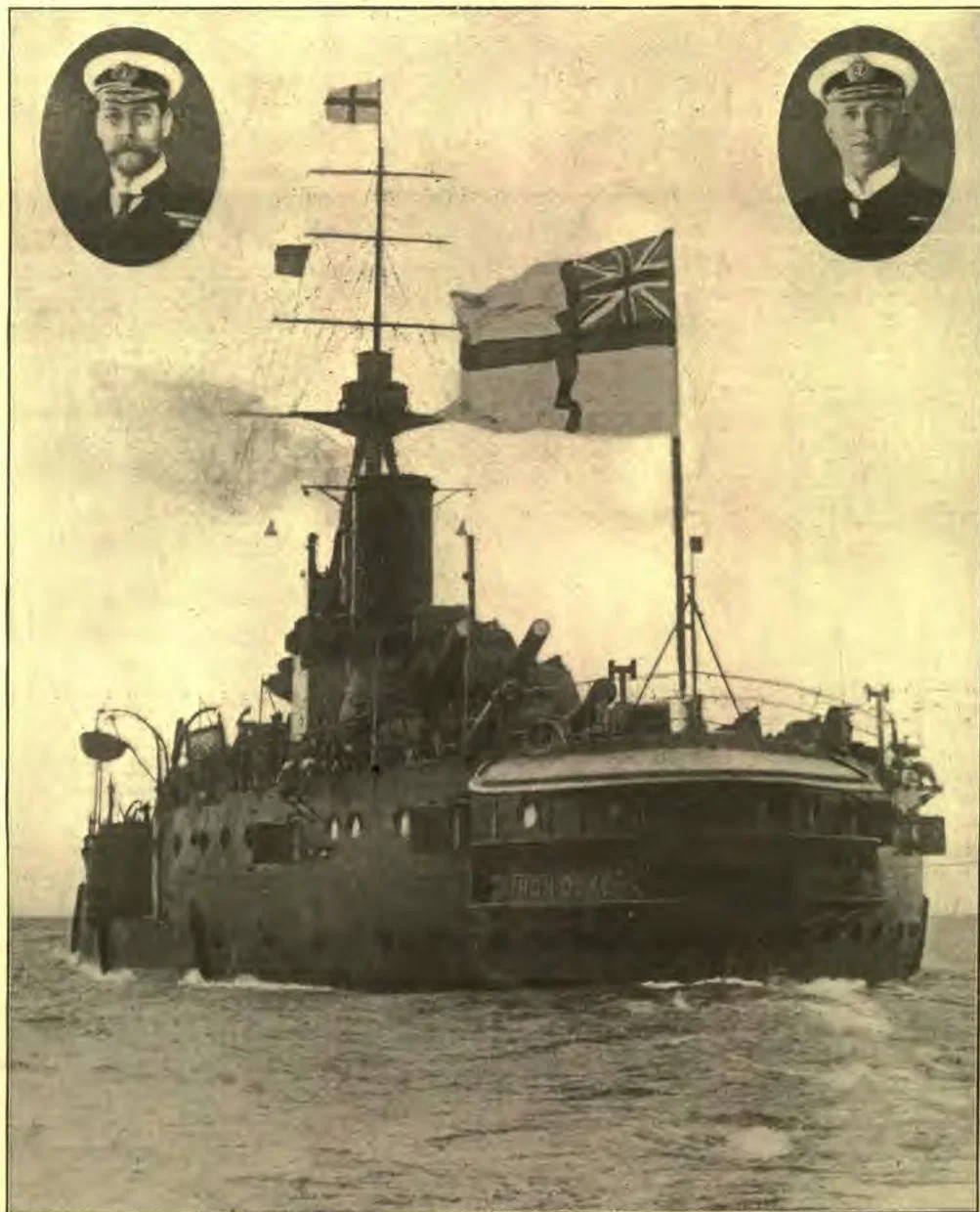
Photo by Boston Photo News Company
The gospel of Christ is not popular to-day, any more than it was when the Saviour Himself was here upon earth. The true way to life is yet straight and narrow, and “few there be that find it.” Matt. 7:13, 14. The principles of the gospel are not in harmony with the inclinations of the natural heart, and but few are willing to deny themselves, take up the cross, and follow Christ. Yet to the few who do follow Him, Jesus says, “Fear not, little flock; for it is your Father’s good pleasure to give you the kingdom.” Luke 12:32.
WHAT CAN IT MEAN?
It means simply this: Nations as such are not Christian. They may be influenced more or less by Christian principles. Christian men may occupy positions of responsibility in their councils, and thus the nations may at times be led to take a righteous course. They may, in fact, be founded upon great Christian principles, as we believe our own nation was when it undertook to guarantee to all its citizens “life, liberty, and the pursuit of happiness”; and further, when the equality of man was recognized, and when liberty of conscience was guaranteed by the fundamental law of the land.
The second paragraph of the Declaration of Independence declares that “we hold these truths to be self-evident, that all men are created equal.” The first amendment to the United States constitution protects American citizens by providing that “Congress shall make no law respecting an establishment of religion, or prohibiting the free exercise thereof.” Any or all of these things, however, do not make a nation Christian.
A TRUE CHRISTIAN
A Christian is one who, having heard the call of the Saviour, in penitence and contrition of heart turns away from his former life of sin to a life of righteousness and holiness. His past sins are all forgiven, and he is cleansed from all unrighteousness. The heart of stone is taken away, and a new heart of flesh is given, upon which is written, by the Spirit of God, Jehovah’s ten holy precepts.
If he becomes a worthy exponent of true Christianity, he must daily feed upon the word of God, and live in constant communion with his heavenly Father through his only Intercessor and Advocate, Jesus our Lord. This will lead him to labor earnestly to advance the cause of his Master in the salvation of the lost, among all people, without regard to their nationality or condition in life. Matt. 4:4; Luke 18:1; Eph. 6:18; Heb. 7:25; Acts 4:12; Matt. 28:19, 20; Col. 3:11.
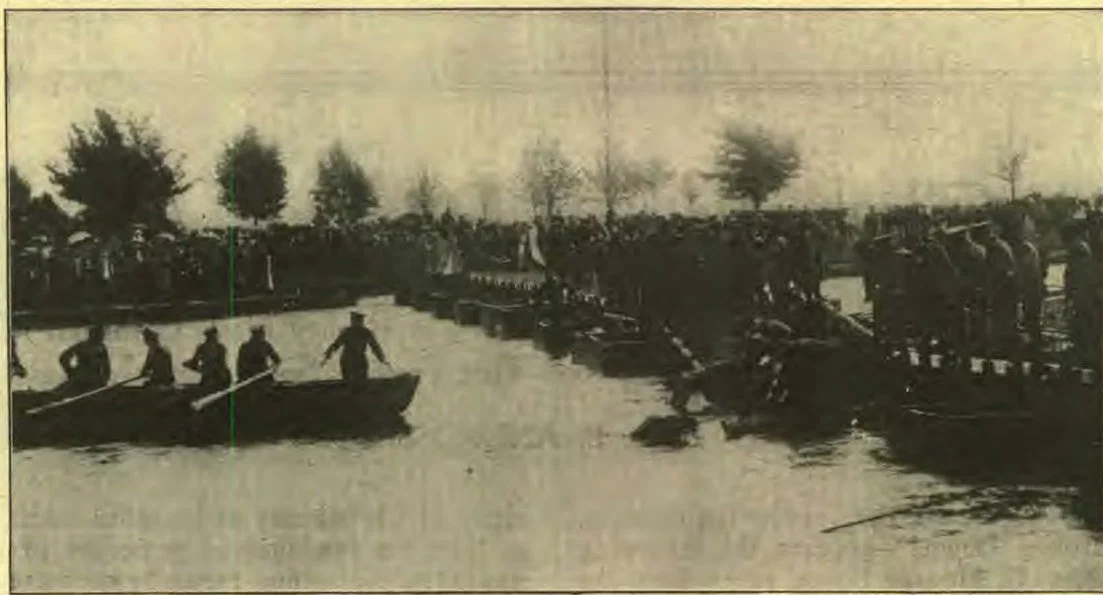
Photo by Boston Photo News Company Pontoon bridge built by British engineers. The planking in a section in the center has broken down, letting two horses fall in, and the men are trying to rescue them. These pontoons are carried with the army, so that a temporary bridge can be immediately built across a stream.
WILL NOT STRIVE FOR AN EARTHLY KINGDOM
He will not strive primarily to build up any earthly kingdom, though his life will exert a powerful influence to that end wherever he may be, and in all that is good and true. He will live in obedience to the laws of whatever government he may be in, unless in some way its laws interfere with his obedience to the law of God, in which case he must obey God first. In short, he will walk as Jesus walked. Acts 4:18-20; 5:27-29; 1 John 2:6.
No government, as such, can fulfil these requirements; therefore no government can be Christian. The salvation which Jesus came to earth to bring was for man and not for governments. His people are in this world, but are not of it. John 17:11, 16. His kingdom is neither in this world, nor of it, for He says in John 18:36: “My kingdom is not of this world: if My kingdom were of this world, then would My servants fight, that I should not be delivered to the Jews: but now is My kingdom not from hence.”
PROOF OF CHRISTIANITY’S TRIUMPH
This very condition, existing among the nations of earth, and especially the present conflict in Europe, instead of being a sign of the failure of Christianity, is one of the strongest proofs of its final triumph. More than 2,700 years ago, the Lord revealed to the prophet Joel the very conditions among the nations that have made this awful carnage possible. He said: “Proclaim ye this among the nations; prepare war; stir up the mighty men; let all the men of war draw near, let them come up. Beat your plowshares into swords, and your pruning-hooks into spears: let the weak say, I am strong.” Joel 3:9, 10, American Revised Version.
To the prophet Jeremiah, 2,500 years ago, the results of such a preparation for war were revealed, as follows: “I am pained at my very heart; my heart maketh a noise in me; I can not hold my peace, because thou hast heard, O my soul, the sound of the trumpet, the alarm of war. Destruction upon destruction is cried; for the whole land is spoiled; suddenly are my tents spoiled, and my curtains in a moment. How long shall I see the standard, and hear the sound of the trumpet?” Jer. 4:19-21.
Again, more than 1,800 years ago, the revelator saw the universality of the final struggle among the nations, to which the present conflict is perhaps but the prelude. He also saw, back of all the profession of Christianity by the rulers of the nations, the true source of their inspiration. He says: “And I saw coming out of the mouth of the dragon, and out of the mouth of the beast, and out of the mouth of the false prophet, three unclean spirits, as it were frogs: for they are spirits of demons, working signs; which go forth unto the kings of the whole world, to gather them together unto the war of the great day of God, the Almighty. (Behold, I come as a thief. Blessed is he that watcheth, and keepeth his garments, lest he walk naked, and they see his shame.) And they gathered them together into the place which is called in Hebrew Har-Magedon. And the seventh poured out his bowl upon the air; and there came forth a great voice out of the temple, from the throne, saying, It is done.” Rev. 16:13-17, American Revised Version.
THE DEVIL IS RESPONSIBLE
Instead of Christianity being responsible for the conditions now existing in Europe, this responsibility must be laid at the door of its enemy, the devil.
Who but God could have foretold, hundreds of years before it took place, all that we now see among the nations of earth? We who now live in the twentieth century of the Christian era see the fulfilment of all but the war of the great day of God, which will reach its climax in the battle of Armageddon.
To the prophet John the Lord revealed that under the sounding of the seventh or last trumpet, and just before the wrath of God would be poured out upon the ungodly, the nations would be “angry.” John’s record reads: “And the seventh angel sounded; and there were great voices in heaven, saying, The3kingdoms of this world are become the kingdoms of our Lord, and of His Christ; and He shall reign forever and ever.” “And the nations were angry, and Thy wrath is come, and the time of the dead, that they should be judged, and that Thou shouldst give reward unto Thy servants the prophets, and to the saints, and them that fear Thy name, small and great; and shouldst destroy them which destroy the earth.” Rev. 11:15, 18.
“WAKE UP THE MIGHTY MEN”
To Joel God showed that just before “the day of the Lord” the nations would prepare for war. “Multitudes, multitudes in the valley of decision: for the day of the Lord is near in the valley of decision,” says the prophet. “Proclaim ye this among the Gentiles; Prepare war, wake up the mighty men, let all the men of war draw near; let them come up: beat your plowshares into swords, and your pruning-hooks into spears: let the weak say, I am strong.” Joel 3:14, 9, 10.
To Jeremiah Jehovah made known the suddenness with which the storm would finally break. Jer. 4:19-21. To John the extent of the conflict was made known, miracle-working spirits of devils going out to the kings of the whole world, gathering them to battle. Rev. 16:14.
EXPLOSIVE SUDDENNESS
Witness the rapid succession of events in Europe from the assassination of Archduke Francis Ferdinand, heir to the throne of Austria, June 28, 1914, but more especially from July 23, when Austria sent an ultimatum to Servia, to August 4, when Great Britain declared war on Germany. In Current Opinion for September, 1914, I find the following:
“The eight days from July 28 to August 4 are not unlikely to go down into history as the most fateful since the records of mankind began to be kept. On the first of those dates, war was declared by Austria-Hungary upon Servia. On the last, war was declared by the British Empire upon Germany. In the brief period that elapsed between those dates, the long-hovering war-cloud had burst, and a cataclysm had begun that may prove second only to that which swept over the world when the Roman Empire was broken up and the long night of the Dark Ages began. On one side, in that brief time, Germany and Austria-Hungary had become arrayed in deadly conflict with Servia, Montenegro, Russia, France, Belgium, and Great Britain, with Portugal and Japan likely to be involved in some degree, and with Italy, Switzerland, Denmark, Holland, Turkey, Greece, Rumania, and Bulgaria all mobilizing their troops in fear of being drawn into the conflict.”
NONE BUT AN ALL-WISE POWER COULD DO IT
Considering the fact that the predictions of the prophets, uttered hundreds of years ago, are now so accurately fulfilling before our eyes, we must conclude that they have none other than the omniscient God for their author,—the one who sees the end from the beginning.
“All flesh is as grass, and all the glory of man as the flower of grass. The grass withereth, and the flower thereof falleth away: but the word of the Lord endureth forever.” 1 Peter 1:24, 25.
The word of God is a revelation of the gospel, hence the gospel must stand also, with the Word. Christianity is the result of the manifestation of God’s power to save the lost through the gospel, hence Christianity can not fail. That which is looked upon as the evidence of its failure is truly one of the many signs of its ultimate and speedy triumph. It has always triumphed in the heart of every one who has truly believed, and in the resurrection morning millions will hear witness to that triumph.
MAGNIFICENT CELEBRATION AND TRIUMPH
Soon there will be a most magnificent celebration of this complete and eternal triumph, when the King of kings, and Lord of lords, in infinite power and great glory shall descend to earth, shall call forth His sleeping saints, and, accompanied by all the heavenly host, shall ascend to the city of God. No such magnificence and splendor as the universe will then behold, has ever yet been witnessed in this world or in any other. Glory transcendent will emanate from our victorious Lord, and will encircle each one of His children. Crowns of glory that fade not away will be placed upon their heads, and palms of victory in their hands. Then wars shall “cease unto the end of the earth”; for the Lord shall break the bow, and cut the spear in sunder. He will also burn the chariot in the fire. Ps. 46:9. Then His scattered, torn, and bleeding people, though strangers and pilgrims here, and hated of all men, will hear the words of never-ending blessing pronounced upon them, “Come, ye blessed of My Father, inherit the kingdom prepared for you from the foundation of the world.” Matt. 25:34.
Signs of the Times
Pacific Press Publishing Association
Mountain View, California
MAKE THE BLOOD FEVERISH AND IMPURE
By Mrs. E. G. White
Stimulants and Narcotics as Related to Temperance
Tea, Coffee, and Tobacco, and Their Effects — Important Work for the Home in Promoting Health and Temperance
By MRS. E. G. WHITE
“Touch not, taste not, handle not.”
UNDER the head of stimulants and narcotics is classed a great variety of articles that, although used as food or drink, irritate the stomach, poison the blood, and excite the nerves. Their use is a positive evil. Men seek the excitement of stimulants, because, for the time, the results are agreeable. But there is always a reaction. The use of unnatural stimulants always tends to excess, and it is an active agent in promoting physical degeneration and decay.
MAKE THE BLOOD FEVERISH AND IMPURE
In this fast age, the less exciting the food, the better. Condiments are injurious in their nature. Mustard, pepper, spices, pickles, and other things of a like character, irritate the stomach and make the blood feverish and impure. The inflamed condition of the drunkard’s stomach is often pictured as illustrating the effect of alcoholic liquors. A similarly inflamed condition is produced by the use of irritating condiments. Soon ordinary food does not satisfy the appetite. The system feels a want, a craving, for something more stimulating.
TEA AND COFFEE
Tea acts as a stimulant, and, to a certain extent, produces intoxication. The action of coffee and many other popular drinks is similar. The first effect is exhilarating. The nerves of the stomach are excited; these convey irritation to the brain; and this in turn is aroused to impart increased action to the heart, and short-lived energy to the entire system. Fatigue is forgotten; the strength seems to be increased. The intellect is aroused, the imagination becomes more vivid.
Because of these results, many suppose that their tea or coffee is doing them great good. But this is a mistake. Tea and coffee do not nourish the system. Their effect is produced before there has been time for digestion and assimilation, and what seems to be strength is only nervous excitement. When the influence of the stimulant is gone, the unnatural force abates, and the result is a corresponding degree of languor and debility.
The continued use of these nerve irritants is followed by headache, wakefulness, palpitation of the heart, indigestion, trembling, and many other evils; for they wear away the life forces.
THE TOBACCO HABIT
Tobacco is a slow, insidious, but most malignant poison. In whatever form it is used, it tells upon the constitution; it is all the more dangerous because its effects are slow, and at first hardly perceptible. It excites and then paralyzes the nerves. It weakens and clouds the brain. Often it affects the nerves in a more powerful manner than does intoxicating drink. It is more subtle, and its effects are difficult to eradicate from the system. Its use excites a thirst for strong drink, and in many cases lays the foundation for the liquor habit.
A CAUSE OF PHYSICAL DEGENERACY
Among children and youth, the use of tobacco is working untold harm. The unhealthful practises of past generations affect the children and youth of to-day. Mental inability, physical weakness, disordered nerves, and unnatural cravings are transmitted as a legacy from parents to children. And the same practises, continued by the children, are increasing and perpetuating the evil results. To this cause in no small degree is owing the physical, mental, and moral deterioration which is becoming such a cause of alarm.
But what can be done to teach children and youth the evils of a practise of which parents, teachers, and ministers set them the example? Little boys, hardly emerged from babyhood, may be seen smoking their cigarettes. If one speaks to them about it, they say, “My father uses tobacco.” They point to the minister or the Sunday-school superintendent, and say, “Such a man smokes; what harm for me to do as he does?” Many workers in the temperance cause are addicted to the use of tobacco. What power can such persons have to stay the progress of intemperance?
No argument is needed to show the evil effects of intoxicants on the drunkard. The bleared, besotted wrecks of humanity — souls for whom Christ died, and over whom angels weep — are everywhere. They are a blot on our boasted civilization. They are the shame and curse and peril of every land.
Persons who have inherited an appetite for unnatural stimulants should by no means have wine, beer, or cider in their sight, or within their reach; for this keeps the temptation constantly before them. Regarding sweet cider as harmless, many have no scruples in purchasing it freely. But it remains sweet for a short time only; then fermentation begins. The sharp taste which it then acquires makes it all the more acceptable to many palates, and the user is loath to admit that it has become hard, or fermented.
Intoxication is just as really produced by wine, beer, and cider, as by stronger drinks. The use of these drinks awakens the taste for those that are stronger, and thus the liquor habit is established. Moderate drinking is the school in which men are educated for the drunkard’s career. Yet so insidious is the work of these milder stimulants that the highway to drunkenness is entered before the victim suspects his danger.
INTEMPERANCE BEGINNING IN THE HOME
Often intemperance begins in the home. By the use of rich, unhealthful food, the digestive organs are weakened, and a desire is created for food that is still more stimulating. Thus the appetite is educated to crave continually something stronger. The demand for stimulants becomes more frequent and more difficult to resist. The system becomes more or less filled with poison; and the more debilitated it becomes, the greater is the desire for these things. One step in the wrong direction prepares the way for another. Many who would not be guilty of placing on their table wine or liquor of any kind, will load their table with food which creates such a thirst for strong drink that to resist the temptation is almost impossible. Wrong habits of eating and drinking destroy the health and prepare the way for drunkenness.
There would soon be little necessity for temperance crusades, if in the youth who form and fashion society, right principles in regard to temperance could be implanted. Let parents begin a crusade against intemperance at their own firesides, in the principles they teach their children to follow from infancy, and they may hope for success.
TEACH CHILDREN TO ABHOR STIMULANTS
There is work for mothers in helping their children to form correct habits and pure tastes. Educate the appetite; teach the children to abhor stimulants. Bring your children up to have moral stamina to resist the evil that surrounds them. Teach them that they are not to be swayed by others, that they are not to yield to strong influences, but to influence others for good.
Great efforts are made to put down intemperance; but there is much effort that is not directed to the right point. The advocates of temperance reform should be awake to the evils resulting from the use of unwholesome food, condiments, tea, and coffee. We bid all temperance workers Godspeed; but we invite them to look more deeply into the cause of the evil they war against, and to be sure that they are consistent in reform.
It must be kept before the people that the right balance of the mental and moral powers depends in a great degree on the right condition of the physical system. All narcotics and unnatural stimulants that enfeeble and degrade the physical nature tend to lower the tone of the intellect and morals. Intemperance lies at the foundation of the moral depravity of the world. By the indulgence of perverted appetite, man loses his power to resist temptation.4Temperance reformers have a work to do in educating the people in these lines. Teach them that health, character, and even life, are endangered by the use of stimulants, which excite the exhausted energies to unnatural, spasmodic action.
NATURE WILL RALLY
In relation to tea, coffee, tobacco, and alcoholic drinks, the only safe course is to touch not, taste not, handle not. The tendency of tea, coffee, and similar drinks is in the same direction as that of alcoholic liquor and tobacco, and in some cases the habit is as difficult to break as it is for the drunkard to give up intoxicants. Those who attempt to leave off these stimulants will for a time feel a loss, and will suffer without them. But by persistence they will overcome the craving, and cease to feel the lack. Nature may require a little time to recover from the abuse she has suffered; but give her a chance, and she will again rally, and perform her work nobly and well.
Intemperance Begins in the Home
Often intemperance begins in the home. By the use of rich, unhealthful food, the digestive organs are weakened, and a desire is created for food that is still more stimulating. Thus the appetite is educated to crave continually something stronger. The demand for stimulants becomes more frequent and more difficult to resist. The system becomes more or less filled with poison; and the more debilitated it becomes, the greater is the desire for these things. One step in the wrong direction prepares the way for another. Many who would not be guilty of placing on their table wine or liquor of any kind, will load their table with food which creates such a thirst for strong drink that to resist the temptation is almost impossible. Wrong habits of eating and drinking destroy the health and prepare the way for drunkenness.
Christ's Example in Sabbath Observance
By William Covert
Was Lord of the Day — Therefore Was Authority on How to Observe It — Bigoted Actions of Church Rulers — The Master Exposed the Narrow Wickedness of Their Traditions
By WILLIAM COVERT
PAUL, in speaking of the greatness of Christ our Saviour, discusses the eternity of His work, the divinity of His nature, and the omnipotence of His power. Col. 1:13-20. And in verses 16 and 17 he says, "By Him [Christ] were all things created, that are in heaven, and that are in earth, visible and invisible, whether they be thrones, or dominions, or principalities, or powers: all things were created by Him, and for Him: and He is before all things, and by Him all things consist."
It was in view of what Christ is to all things, that He said, "The Son of man is Lord also of the Sabbath." Mark 2:28. By studying the context of this verse from Mark, it will be seen that the Pharisees were accusing His disciples of Sabbath-breaking because they plucked and ate grain while they were passing through a field on the Sabbath day.
THEIR EXACTING TRADITIONS
The Hebrews had changed from a loose disregard for the Sabbath to a traditional exactness which made it a burden to be dreaded. God intended that the Sabbath should be a day of delight, and of refreshing rest; but the Jews were binding it about with restrictions which made it a hindrance to real joy.
In "Sabbath Manual of American Tract Society," pages 214 and 215, is set forth a bit of Jewish traditions regarding the Sabbath. They enumerated about forty things which should not be done on the Sabbath day. Among the things forbidden was threshing; and the disciples of Christ were transgressing the law as viewed by the Pharisees, because they were threshing out the grain when they took the heads of wheat in their hands and rubbed out the kernels. The Hebrew tradition said one might minister to the sick to relieve a pain on the Sabbath day, but that one must not heal the disease. So when Christ, by the power of His word, made a suffering man every whit whole on the Sabbath, the Pharisees advised that He be put to death. See Matt. 12:13, 14.
On another Sabbath, He healed a woman who had been bowed down with an infirmity for eighteen years. And when the miracle was performed, "the ruler of the synagogue answered with indignation, because that Jesus had healed on the Sabbath day, and said unto the people, There are six days in which men ought to work: in them therefore come and be healed, and not on the Sabbath day." Luke 13:14.
Jesus rebuked the folly of this elder, and spoke of the inconsistency of their traditions. In substance He said: "You think it wrong to carry water to a thirsty ox on the Sabbath day; but you will carry and pour water into a trough, and then lead the ox to the trough to drink it. You loose the ox from the place where he is bound, and lead him away to quench his thirst; but your unreasonable tradition calls for wrath to fall upon Me because this suffering woman has been loosed from her bound condition under Satan on the Sabbath day."
MAN'S NEEDS OF FIRST IMPORTANCE
Christ's answer to the Pharisees who criticized His disciples for plucking and eating wheat on the Sabbath day was, that "the Sabbath was made for man, and not man for the Sabbath." In this answer, Christ was saying to the Pharisees: "Man's needs are to be considered of first importance. One does not desecrate the Sabbath day by ministering to the comforts of a hungry man. Better pluck some heads of wheat and eat the kernels on the Sabbath day than to suffer of hunger. Better heal the afflicted on the Sabbath day than to let them suffer of pain. It is better to be consistent, and to deal in tenderness with man, than to give out the impression that God requires an unreasonable service."
Men can not love God if they are made to believe He is dealing in an arbitrary manner with them. It is better to know that God is full of mercy and tenderness than to think His people should do penance to gain His favor.
ASSOCIATED AS CREATOR
In saying that "the Son of man is Lord also of the Sabbath" (Mark 2:28), or as stated by Matthew, "The Son of man is Lord even of the Sabbath day" (Matt. 12:8), the significance is that Christ was associated with the Father in the creation of the heavens and the earth, and that the Sabbath was made by Him for man. Since it is true that all things were made by Him and for Him, and that He is before all things, and that "by Him all things consist" (Col. 1:16, 17), it is only stating the same truth in other words to say that Christ was co-Creator with the Father in making the heavens and the earth, and that His blessing was associated with the blessing of the Father when the Sabbath was made at creation and given to man.
In saying these things, we are only reiterating the glorious truth of Christ's divinity as taught by Paul where he speaks of "God, who created all things by Jesus Christ" (Eph. 3:9), or by John where he said of Christ: "All things were made by Him; and without Him was not anything made that was made. In Him was life; and the life was the light of men." "He was in the world, and the world was made by Him, and the world knew Him not." John 1:3, 4, 10.
NO RIVALRY BETWEEN THEM
The statement that He is "Lord of the Sabbath" is a mild and dignified way of saying He is divine. And since He is divine, and one with the Father (John 10:30), there can be no division in Their work, nor lack of agreement between Them. There is no rivalry with reference to the Sabbath; for the Father and the Son in counsel said, "Let Us make man in Our image, after Our likeness." Gen. 1:26. So the work of the one was the work of the other, and the rest and the blessing were mutual. Therefore the Sabbath of the Father was the Sabbath of the Son.
It was this truth that Christ was affirming when He said, "The Son of man is Lord also of the Sabbath." And as Christ made all things, He made the Sabbath, and therefore5He was perfect judge of its design and its proper observance. He had a broad and impartial grasp of the whole problem of the Sabbath question for time and for eternity. In saying that it was made for man, He spoke for all time and for all men. Every man who has come upon the stage of action because of the Creator's work, is entitled to the Sabbath, and should observe it according to the design which the Maker has in it.
HOW CHRIST OBSERVED THE DAY
When Christ came from His conflict with Satan in the wilderness, it is said He "returned in the power of the Spirit into Galilee: and there went out a fame of Him through all the region round about. And He taught in their synagogues, being glorified of all. And He came to Nazareth, where He had been brought up: and, as His custom was, He went into the synagogue on the Sabbath day, and stood up for to read." Luke 4:14-16. It was because of His regard for the Sabbath day that He went to the meeting on that day to engage in worship. The Scripture says it was His "custom" to attend the synagogue on the Sabbath day. It had previously been His custom, during His early years at Nazareth, to attend the Sabbath services, and to read from the Scriptures; and He continued this kind of service after He entered upon His ministry.
At Nazareth He had been a carpenter (Mark 6:3), and had doubtless labored at His trade upon the six working-days (Eze. 46:1), but on the Sabbath day He did not work, but went to the synagogue to worship. When His testimony was rejected at Nazareth, it is said He "came down to Capernaum, a city of Galilee, and taught them on the Sabbath days." Luke 4:31.
AGAINST THEIR SABBATH LAW
It is not claimed that His teaching was confined to the Sabbath; but conditions were such that no small share of it came upon that day, and many of His noted miracles of healing were performed upon that day. Because of His healing on the Sabbath, He incurred the greatest displeasure from the Pharisees. Their claim was that it was against the law to heal on the Sabbath, and that there were six other days in which such work could be done, and that the people who wanted healing done should come upon one of the six working-days. See Luke 13:14. "And they asked Him, saying, Is it lawful to heal on the Sabbath days? that they might accuse Him." Matt. 12:10.
THE MASSES OF THE PEOPLE WAITED
The Jews appeared not to be averse to His healing, but they said that to heal on the Sabbath days was wicked. In proof of this proposition, read the account of how all the sick at Capernaum were brought to Him to be healed "at even, when the sun did set." Mark 1:32. He had healed Simon's wife's mother of a fever on the Sabbath day, but the mass of the people waited till the close of the Sabbath, at the setting of the sun, and then "they brought unto Him all that were diseased, and them that were possessed with devils. And all the city was gathered together at the door [of Simon's house]. And He healed many that were sick of divers diseases, and cast out many devils." Mark 1:32-34.
Christ labored to correct false theories and false practises. As the Jews had imbibed serious errors regarding the manner of keeping the Sabbath, He labored with a view to putting the Sabbath upon its proper basis. He was not teaching a disregard for the Sabbath, but on the other hand He wanted them to regard the Sabbath with delight, and to call it the holy of the Lord, and honorable. He was showing them and us what is lawful and right to do on the Sabbath day.
Home at Last
By L. D. SANTEE
By L. D. SANTEE
SAFE at home in the harbor of heaven,
Where storms come no more,
All the tempests of earth have but driven
Our bark nearer shore.
Roaring loud in their angry commotion,
The billows did foam;
But all the wild waves of the ocean
But wafted us home.
While the low vault of heaven held thunder,
Full stored in the dark,
There were tempests above, and just under,
A tempest-tossed bark,
No sight of the land in the distance,
Of flower or tree,
But ever, with cruel insistence,
The shout of the sea.
The billows were foam-capped and hoary,
And doubts would o'erwhelm;
But now, 'tis a voyage of glory,
With Christ at the helm.
He spoke to the ocean's mad riot,
The winds heard His will,
The seas ceased to roar, and were quiet,
The tempests were still.
My heart doth rejoice in its lightness,
For yonder I see
The great pearly gates in their whiteness
Stand open for me,
And white robes and palms will be given.
Life's dangers are past,
And softly we drift in the haven,
Thank God, home at last.