Your ShelfYour Projects

Signs of the Times, Vol. 22, No. 17.

Ye Must Be Born Again

Signs of the Times

Apr 23, 1896

Pacific Press Publishing Company · Oakland, California · Apr 23, 1896

Ye Must Be Born Again
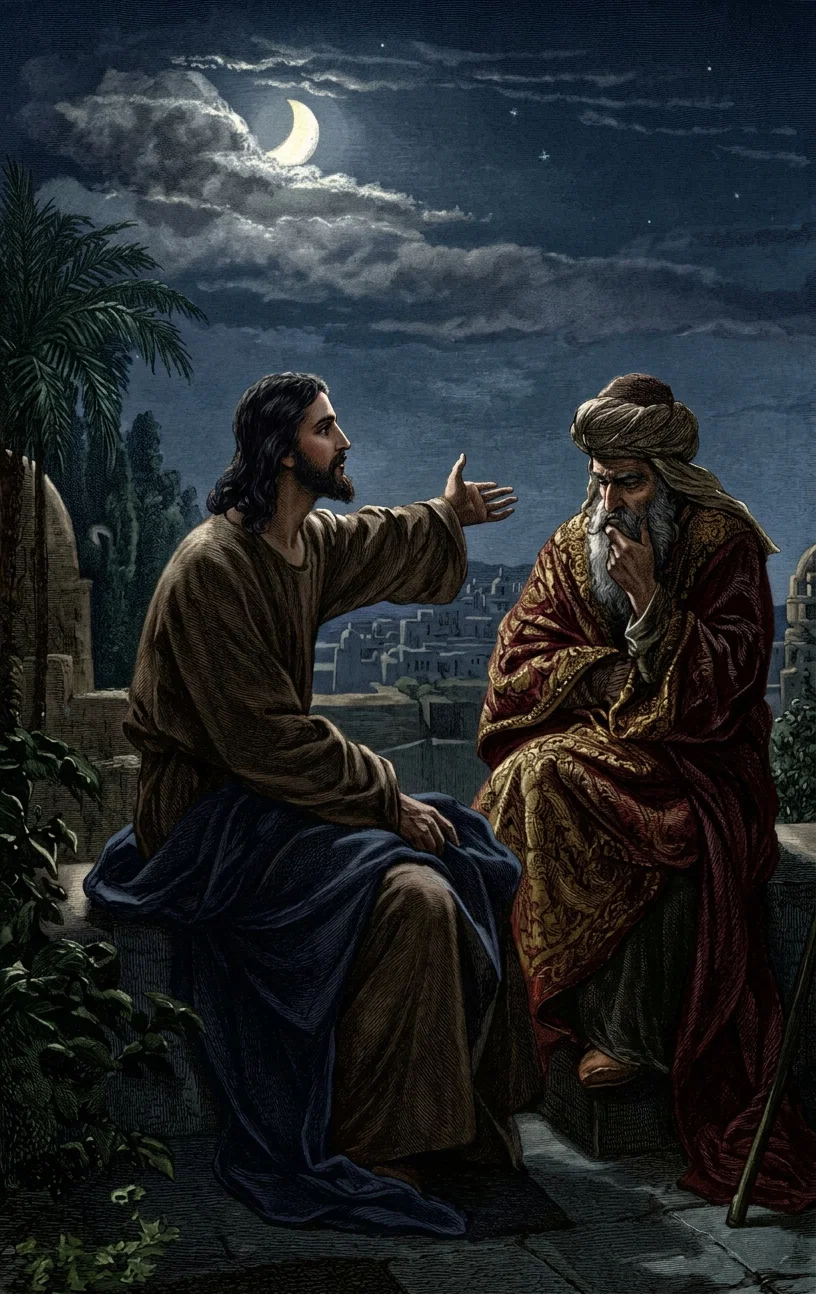
CHRIST AND NICODEMUS.
The above words express a truth taught by Jesus Christ. Shortly after beginning his ministry he had come to Jerusalem, had entered the temple, defiled by unholy traffic, had made a harmless whip of small cords, and, with divine majesty and righteous anger against sin, had driven out the unholy traffickers from the temple courts, rebuking their selfish and unholy zeal, and then with divine compassion had ministered to the bodies and souls of the sick and sinful.

The Surprised Pharisee

When the labors of the day were done, and Jesus was alone, a noted member of the Sanhedrin, a strict Pharisee, Nicodemus by name, whose curiosity and doubtless desire for truth had been aroused, came to Jesus with the courteous and somewhat patronizing address: “Rabbi, we know that thou art a teacher come from God; for no man can do these miracles that thou doest, except God be with him.” The reply of Jesus touched upon a spiritual truth so deep, yet withal so simple, that the Pharisee was surprised and nonplussed. Said Jesus, “Verily, verily, I say unto thee, Except a man be born again, he can not see the kingdom of God.” John 3:3.

How Born

Nicodemus replied as tho he understood in the most literal, material sense: “How can a man be born when he is old? can he enter the second time into his mother’s womb, and be born? Jesus answered, Verily, verily, I say unto thee, Except a man be born of water and of the Spirit, he can not enter into the kingdom of God. That which is born of the flesh is flesh; and that which is born of the Spirit is spirit. Marvel not that I said unto thee, Ye must be born again.” Verses 4–7. Very clearly was it stated by Jesus that the birth referred to was not a fleshly or material birth, but a spiritual birth, a change of the nature from fleshly to spiritual. Marvel not that so it must be.

Man’s Present Condition

“Man that is born of a woman is of few days, and full of trouble. He cometh forth like a flower, and is cut down; he fleeth also as a shadow, and continueth not.” Job 14:1, 2. The reason of this is that man can of himself rise no higher than his own nature, and this nature is sinful, inherited from Adam. See Rom. 5:12. Not alone this, but the entire race has followed on, sinning of themselves. “All have sinned, and come short of the glory of God.” Rom. 3:23. “Sin is the transgression of the law” (1 John 3:4; Rom. 7:7); and “sin, when it is finished, bringeth forth death” (James 1:15). “All unrighteousness is sin” (1 John 5:17); therefore righteousness is the keeping of God’s law, and is man’s bounden duty, else the law could not condemn him as a sinner. Moreover, the law is the reflect of God’s character (Ps. 119:172; Isa. 51:6, 7), and is what he requires of man (Eccl. 12:13; James 2:8–12). It is therefore evident that all mankind are now sinners, doomed to death. From the day of man’s birth his journey is toward the grave. He may spin out his little existence for a hundred years, but the brief moment is soon ended, and man lies down in the arms, not of a friend, but an enemy; for death is not a passport to the kingdom of God, but a bar to all its blessedness of life.

Under a Perverted Law

The law of God is the law of man’s life, not death. The “law was ordained to life.” Rom. 7:10. It was spoken in the words of God, which are spirit and life. John 6:63. If man had forever walked in God’s law, he would forever have been upheld by its life, or God’s life, which is in it; for “righteousness tendeth to life;” “he is in the way of life that keepeth instruction;” “in the way of righteousness is life; and in the pathway thereof there is no death.” Prov. 10:16; 11:19; 12:28. With the law in the heart there is life. But man perverted God’s law; and the perversion of God’s law is sin. The slightest alteration of a perfect circle destroys the circle. The change of a line or angle destroys a perfect square. So the Gospel perverted becomes “another gospel.” (Gal. 1:6, 7.) So also God’s law perverted in man’s life makes it “another law,” a law perverted by sin, leading to death, hence a law of sin and death, to which the sinner is a slave, “sold under sin.” (See Rom. 7:14, 21, 23, 25; 8:2.) The power of God is, however, still in his law, perverted tho it be. In God’s way, in the normal way of the law, the law works life; in the law perverted “thelaw worketh wrath” (Rom. 4:15); and the commandment which was “ordained to life,” the sinner finds to be unto death, because the carnal heart has perverted it (Rom. 7:10, 11, 13; 8:6). By perverting the power of the law, which was designed to work out in man only righteousness and life, its good power is used by sin to work out death. Therefore “the sting of death is sin; and the strength of sin [to cause death] is the law.” 1 Cor. 15:56. But it is God’s law perverted.

The Fruits of This Law

When man yielded to Satan, to the perverted law, he became the servant of sin. See Rom. 6:16–21. He was no longer free. He was of his father the devil, and the lusts of his father did he do, and has done ever since. (John 8:44.) His heart is carnal, bearing the fruits set forth by our Lord in Mark 7:21–23: “For from within, out of the heart of men, proceed evil thoughts, adulteries, fornications, murders, thefts, covetousness, wickedness, deceit, lasciviousness, an evil eye, blasphemy, pride, foolishness; all these evil things come from within, and defile the man.” The apostle Paul states the same thing in Gal. 5:19–21, and plainly declares that it is because of this condition that man “shall not inherit the kingdom of God.” He says: “Now the works of the flesh are manifest, which are these, Adultery, fornication, uncleanness, lasciviousness, idolatry, witchcraft, hatred, variance, emulations, wrath, strife, seditions, heresies, envyings, murders, drunkenness, revelings, and such like; of the which I tell you before, as I have also told you in time past, that they which do such things shall not inherit the kingdom of God.”

Man Helpless

And yet man of himself can do no better. He is a slave to sin, unable by the instruments of sin to break the bonds of sin. He is a child of wrath, a sinner, and therefore doomed to death. He is represented as being bound to a dead body, doomed to die with it. See Rom. 7:24. Having only the life of the perverted law, he can not rise above his perverted nature. A new power must come into his being, a stronger than he must break his bonds, a different law must take possession of his life, and he must possess a different heart, in order that he may bring forth proper fruit, and have a part in the kingdom of God. This is true of every one, outwardly exemplary tho his life may be. He may be “only strong for lack of test;” his heart may be like “a whited sepulcher,” full of corruption; his righteousness may be all of self and not of God.

“Marvel Not”

It was for reasons like the foregoing that our Lord told Nicodemus, “Marvel not that I said unto you, Ye must be born again.” The margin gives us a good thought, “Ye must be born from above.” See also in John 3:3: “Except a man be born from above, he can not see the kingdom of God.” He must be a child of the kingdom in order to inherit it. He must have its spirit in order that he may enjoy it. He must possess its life, and be infused with its power, in order that he may honor its King and keep its laws. Nay, more, the law of that kingdom must be written in his heart and mind, or he will not be loyal to its claims. But it can not be written on the carnal heart, or mind; for that is “enmity against God; for it is not subject to the law of God, neither indeed can be.” Rom. 8:7. The only way that man can be freed, the only way he can enter the fold of Christ and become a child of the kingdom, is to be converted, or changed, to be made a new creature, to have a new heart, a new mind, and new spirit. This is all implied in the “born from above,” “a new creature.”

Through Faith

This change is wrought through faith. “For ye are all the children of God by faith in Christ Jesus.” Gal. 3:26. The power which faith appropriates is of God, and is spoken in his word. “Of his own will begat he us with the word of truth.” James 1:18. “Being born again, not of corruptible seed, but of incorruptible, by the word of God, which liveth and abideth forever.” 1 Peter 1:23. The power in the word is the Spirit of God, or Spirit of Christ, for it is “by one Spirit are we all baptized into one body” or church of Christ, of which Jesus our Lord is the head. See 1 Cor. 12:13; Eph. 1:22, 23. But faith is giving up all of self to God, submitting to him in unconditional surrender, accepting the crucifixion and cross of Christ, dying with him, and letting him work in us according to his own will. And that means receiving Christ, letting him come into the heart by his own mighty power; and to those who thus receive him, to them he gives “power [‘right,’ or ‘privilege,’ margin] to become the sons of God, even to them that believe on his name; which were born, not of blood, nor of the will of the flesh, nor of the will of man, but of God.” John 1:12, 13.

The Power

The power which does all this is the creative power of God in Christ Jesus. “If any man be in Christ, he is a new creature.” “For we are his workmanship, created in Christ Jesus unto good works.” The promise is fulfilled: “A new heart also will I give you, and a new spirit will I put within you. . . . And I will put my Spirit within you, and cause you to walk in my statutes, and ye shall keep my judgments, and do them.” Eze. 36:26, 27. “The Son of God is come, and hath given us a mind.” John 5:20, Young. “I will put my laws into their mind, and write them in their hearts.” Heb. 8:10. “Tho your sins be as scarlet, they shall be as white as snow; tho they be red like crimson, they shall be as wool.” Isa. 1:18. “Now ye are clean through the word which I have spoken unto you.” John 15:3. It is all “of his own will” if we will only let him.

Through Christ

All this wonderful work is accomplished through Jesus Christ, as shown in the texts given above. He “of God is made unto us wisdom, and righteousness, and sanctification, and redemption.” 1 Cor. 1:30. He was made sin that we might in him be made righteousness. The power by which God created the world through him creates us anew in him.

The Law of Life

In him we find the law restored in humanity, as it was ordained, namely, to life; it is “the law of the Spirit of life in Christ Jesus,” which makes free from the perverted law, “the law of sin and death.” All the righteousness which was in Christ was the righteousness of obedience to the law, and when we receive him, the law of God comes into our heart with him. In fact, Christ and the law are inseparable, for he is the law in living character. That law is the law of the eternal God. Its life is the life of the “eternal Spirit,” and is therefore eternal life, given to every believer (see 1 John 5:11, 12); but “if any man have not the Spirit of Christ, he is none of his” (Rom. 8:9). By this life he becomes a new creature in Christ Jesus, the old life of sin is forsaken, the lusts of the flesh are crucified, and the erstwhile child of the world and subject of Satan becomes a child of God, and is “translated into the kingdom of the Son of his love.” Col. 1:13, margin. The new birth gives him entrance into the kingdom of Christ.

Of Water and of the Spirit

Above is shown what born of the Spirit is. The water is that symbol of faith which indicates the faith of the believer in the efficiency of Christ’s offering and the power of God not only to create anew, but to preserve to the end. This is met in believers’ baptism, immersion into the name of the Father, Son, and Holy Spirit. “Know ye not, that so many of us as were baptized into Jesus Christ were baptized into his death? Therefore we are buried with him by baptism into death; that like as Christ was raised up from the dead by the glory of the Father, even so we also should walk in newness of life. For if we have been planted together in the likeness of his death, we shall be also in the likeness of his resurrection.” (Rom. 6:3–5.) It is all in Christ’s death, burial, and resurrection. It is by the power of his resurrection that we walk in newness of life. (See Eph. 1:18–20.) It is by the power of that same “endless life,” if we are faithful to the end, that our corruptible bodies are fashioned like the glorious body of Christ Jesus our Lord, and the kingdom of grace is merged into the kingdom of Christ’s undimmed glory. (Phil. 3:21.) The kingdom begins here in giving ourselves to Jesus Christ as his subjects; it culminates in the everlasting glory of the age to come, in the kingdom and life and immortality that shall have no end. To have a part there, Christ’s words must be fulfilled in us here, “YE MUST BE BORN FROM ABOVE.”

The Essential Difference

The foundation of every false religion is selfishness. The foundation of the true religion is self-denial. The devotee of the former makes a god of his own creation or fancy, innate with all the selfish lusts and tendencies of his nature. The believer in the true religion by yielding up self puts himself in such an attitude that the great God of the universe, the God of love, can come into his life and enlightenand renew his mind. By living faith he continually reaches out and grasps more and more of the Infinite. The former puts himself in the place of God, and becomes a man of sin, a son of perdition; the latter by faith lets God take the place of self and thus becomes a man of righteousness, a son of God, an inheritor of eternal life and immortality. In Christ is revealed the true; all apart from him is doomed to perish.

THE LAW OF SIN.

In the first seven verses of the seventh chapter of Romans we have had the relation which men by nature sustain to sin, and which by grace they afterwards sustain to Christ, represented under the figure of marriage to a first and second husband. The union with the second husband can not take place while the first husband is living; and in this case the marriage is so perfect, the two parties being literally one flesh and blood, that one can not die without the other; therefore we must needs die with sin, before we can be separated from it. But we die in Christ, and as he lives, altho he was dead, we also live with him. But in his life there is no sin, and so the body of sin is destroyed, while we are raised. Thus in death we are separated from the first husband, sin, and united to the second husband, Christ.
In the verses which follow, the apostle has pictured out the struggle with the sin that has become distasteful. It is really an enlargement of that which has been presented in the first verses. It is the story of

The Struggle for Freedom.

“Sin, taking occasion by the commandment, wrought in me all manner of concupiscence. For without the law sin was dead. For I was alive without the law once; but when the commandment came, sin revived, and I died. And the commandment, which was ordained to life, I found to be unto death. For sin, taking occasion by the commandment, deceived me, and by it slew me. Wherefore the law is holy, and the commandment holy, and just, and good. Was then that which is good made death unto me? God forbid. But sin, that it might appear sin, working death in me by that which is good; that sin by the commandment might become exceeding sinful. For we know that the law is spiritual; but I am carnal, sold under sin. For that which I do, I allow not; for what I would, that do I not; but what I hate, that do I. If then I do that which I would not, I consent unto the law that it is good. Now then it is no more I that do it, but sin that dwelleth in me. For I know that in me (that is, in my flesh) dwelleth no good thing; for to will is present with me; but how to perform that which is good, I find not. For the good that I would, I do not; but the evil which I would not, that I do. Now if I do that I would not, it is no more I that do it, but sin that dwelleth in me. I find then a law, that, when I would do good, evil is present with me. For I delight in the law of God after the inward man; but I see another law in my members, warring against the law of my mind, and bringing me into captivity to the law of sin which is in my members. O wretched man that I am! who shall deliver me from the body of this death? I thank God through Jesus Christ our Lord. So then with the mind I myself serve the law of God; but with the flesh the law of sin.” Rom. 7:8-25.
Altho this is a long portion of Scripture, it does not need so long treatment as some shorter portions, since there are several repetitions. For instance, the statement in verse 15 is repeated in verses 19 and 20. Verses 17 and 21 are also the same thought, as also verses 18 and 23. The points, however, will doubtless appear very much more clearly by the usual

Questions on the Text.

What does the apostle say that sin wrought in him?
“Sin . . . wrought in me all manner of concupiscence.”
How did it do this?
“Taking occasion by the commandment.”
What was the condition of sin without the law?
“Without the law sin was dead.”
But what was the apostle’s condition without the law?
“I was alive without the law.”
What change occurred when the commandment came?
“When the commandment came, sin revived, and I died.”
What did he find the commandment to be?
“The commandment . . . I found to be unto death.”
Yet for what was the commandment designed?
It was “ordained to life.”
What did sin do?
“Sin . . . deceived me, and . . . slew me.”
How had it the power to do this?
“Sin, taking occasion by the commandment, deceived me, and by it slew me.”
What was it that deceived or slew him, the law, or sin?
“Sin . . . deceived me, and . . . slew me.”
Wherefore what is true of the law?
“The law is holy, and the commandment holy, and just, and good.”
Was then that which was good, namely, the law, made death unto him?
No, “but sin, . . . working death in me by that which is good.”
Why was this?
“That it might appear sin;” “that sin by the commandment might become exceeding sinful.”
What do we know of the law?
“We know that the law is spiritual.”
But what about ourselves?
“But I am carnal.”
And therefore in what condition?
“Sold under sin.”
What do we call one who is bought and sold?
A slave.
What is the evidence that the one who is carnal is a slave?
“That which I do, I allow not; for what I would, that do I not; but what I hate, that do I.”
What is shown by the fact that he does the evil that he hates?
“I consent unto the law that it is good.”
Therefore who is it in reality that does the evil works?
“It is no more I that do it, but sin that dwelleth in me.”
To what law is such an one subject?
“I find then a law, that, when I would do good, evil is present with me.”
In what does he delight?
“I delight in the law of God.”
How does he delight in the law of God?
“After the inward man.”
Then why does he not obey it?
“I see another law in my members, warring against the law of my mind, and bringing me into captivity to the law of sin which is in my members.”
In what condition is such an one?
“O wretched man that I am!”
What is his distressed cry?
“Who shall deliver me from the body of this death?”
Is there any hope of deliverance?
“I thank God through Jesus Christ our Lord.”
Sin Personified.—It will be noticed that in this entire chapter sin is represented as a person. It is the first husband to which we are united. But the union has become distasteful, because, having seen Christ, and having been drawn to him by his love, we have seen that we were joined to a monster. The marriage bond has become a galling yoke, and our whole thought is how to get away from the monster to which we are united, and which is dragging us down to a certain death. The picture presented in this chapter is one of the most vivid in the whole Bible.
The Strength of Sin.—“The sting of death is sin; and the strength of sin is the law.” 1 Cor. 15:56. “Without the law sin was dead.” “Sin is not imputed when there is no law.” “Where no law is, there is no transgression.” So it is that “sin, taking occasion by the commandment, wrought in me all manner of concupiscence.” Sin is simply the law transgressed; “for sin is the transgression of the law.” 1 John 3:4. Sin has no strength, therefore, except that which it gets from the law. The law is not sin, and yet it binds us to sin. That is, the law witnesses to the sin, and will not grant us any escape, simply because it can not bear false witness.
The Law of Life, and the Law of Death.—“The commandment, which was ordained to life, I found to be unto death.” The law of God is the life of God. “Be ye therefore perfect, even as your Father which is in heaven is perfect.” Matt. 5:48. His life is the rule for all his creatures. Those in whom the life of God is made perfectly manifest, keep his law. It is very evident, therefore, that the design of the law is life, since it is life itself. But the opposite of life is death. Therefore when the law is transgressed, it is death to the transgressor.
The Deadly Enemy.—“For sin, taking occasion by the commandment, deceived me, and by it slew me.” It is not the law that is the enemy, but the enemy is sin. Sin does the killing; for “the sting of death is sin.” Sin has the poison of death in it. Sin deceived us so that for a time we thought that it was our friend, and we embraced it, and delighted in the union. But when the law enlightened us, we found that its embrace was the embrace of death.
The Law Cleared.—The law pointed out the fact that sin was killing us. “Therefore the law is holy, and the commandment holy,and just, and good.” We have no more reason to rail at the law than we have to hate the man who tells us that the substance which we are eating, thinking it to be food, is poison. He is our friend. He would not be our friend if he did not show us our danger. The fact that he is not able to heal the illness that the poison already eaten has caused, does not make him any the less our friend. He has warned us of our danger, and we can now get help from the physician. And so, after all, the law itself was not death to us; but its office was “that sin by the commandment might become exceeding sinful.”
“The Law Is Spiritual.”—“For we know that the law is spiritual.” If this fact were more generally recognized, there would be much less religious legislation among so-called Christian nations. People would not try to enforce the commandments of God. Since the law is spiritual, it can be obeyed only by the power of the Spirit of God. “God is Spirit” (John 4:24); therefore the law is the nature of God. Spiritual is opposed to carnal, or fleshly. Thus it is that the man who is in the flesh can not please God.
A Slave.—“But I am carnal, sold under sin.” One who is sold is a slave; and the evidence of the slavery in this instance is very plain. Free men do that which they wish to do. Only slaves do that which they do not wish to do, and are continually prevented from doing that which they wish to do. “For that which I do, I allow not; for what I would, that do I not; but what I hate, that do I.” A more disagreeable position can not be imagined. Life in such a state can be only a burden.
Convicted, but Not Converted.—“If then I do that which I would not, I consent unto the law that it is good.” The fact that we do not wish to do the sins that we are committing, shows that we acknowledge the righteousness of the law which forbids them. But conviction is not conversion, altho a very necessary step to that condition. It is not enough to wish to do right. The blessing is pronounced upon those who do his commandments, and not upon those who wish to do them, or who even try to do them. Indeed, if there were no higher position for a professed follower of the Lord than that described in these verses, he would be in a far worse condition than the careless sinner. Both are slaves, only the latter is so hardened that he finds pleasure in his slavery. Now if one must all his life be a slave, it is better for him to be unconscious of his bondage than to be continually fretting over it. But there is something better; therefore it is a blessing that we are convicted of sin, and that our slavery is thereby made as disagreeable as possible.
Two Laws.—“I find then a law, that, when I would do good, evil is present with me. For I delight in the law of God after the inward man; but I see another law in my members, warring against the law of my mind, and bringing me into captivity to the law of sin which is in my members.” Compare this with verse 5. Remember also that all this is written to them that know the law. It is not addressed to the heathen who have not the law, but to those who profess to know God. While knowing the law, we are united in marriage to sin. This sin is in our flesh, since they who are married are one flesh. It is the law that witnesses to the fact that we are sinners, and that will not grant us any escape from it. But we are slaves. “Whosoever committeth sin is the bond-servant of sin.” John 8:34, R. V. Therefore it is that the law that will not let us be anything but what we are, is really holding us in bondage. While we are in that condition, it is not to us a law of liberty.
A Body of Death.—We are joined in marriage to sin. But sin has in it death; for “the sting of death is sin.” Sin is that with which death kills men. Therefore the body of sin, to which we are joined when in the flesh, is but a body of death. What a terrible condition! Joined in such close union that we are one flesh with that which is in itself death. A living death! And “the strength of sin is the law.” It witnesses to our union, and thus holds us in that bondage of death. If there were no hope of escape, we might curse the law for not allowing us to die in ignorance. But altho the law seems to be pitiless, it is nevertheless our best friend. It holds us to a sense of the dreadfulness of our bondage, until in anguish we cry out, “O wretched man that I am! who shall deliver me from the body of this death?” We must be delivered, or we perish.
A Deliverer.—The pagan proverb has it that God helps those who help themselves. The truth is that God helps those who can not help themselves. “I was brought low, and he helped me.” No one ever cries in vain for help. When the cry goes up for help, the Deliverer is at hand; and so, altho sin is working death in us by all the power of the law, we may exclaim, “Thanks be to God, which giveth us the victory through our Lord Jesus Christ.” 1 Cor. 15:57. “There shall come out of Zion the Deliverer, and shall turn away ungodliness from Jacob.” Rom. 11:26. “Unto you first God, having raised up his Son Jesus, sent him to bless you, in turning away every one of you from his iniquities.” Acts 3:26. “Thanks be unto God for his unspeakable gift.”
A Divided Man.—“So then with the mind I myself serve the law of God; but with the flesh the law of sin.” That is, of course, while in the condition described in the preceding verses. In purpose he serves the law of God, but in actual practice he serves the law of sin. As described in another place, “The flesh lusteth against the Spirit, and the Spirit against the flesh; and these are contrary the one to the other; so that ye can not do the things that ye would.” Gal. 5:17. It is not a state of actual service to God, because we read in our next lesson that “they that are in the flesh can not please God.” It is a state from which one may well pray to be delivered, so that he can serve the Lord, not merely with the mind, but with his whole being. “The very God of peace sanctify you wholly; and I pray God your whole spirit and soul and body be preserved blameless unto the coming of our Lord Jesus Christ. Faithful is he that calleth you, who also will do it.” 1 Thess. 5:23, 24. E. J. W.
Continue reading: Question Corner