Your ShelfYour Projects

Signs of the Times, Vol. 25, No. 2.

COLUMBUS' WISE AND WORTHY EXAMPLE

Signs of the Times

Jan 11, 1899

Pacific Press Publishing Company · Oakland, California · Jan 11, 1899

COLUMBUS' WISE AND WORTHY EXAMPLE.
FOR a good while Cuba has been the chief subject before the minds of the people of the United States. And since President McKinley, Cardinal Gibbons, and Archbishop Ireland, after "numerous conferences," have reached the determination that "sufficient money will be advanced by this government to support the Catholic Church" in Cuba, it is quite certain that Cuba will occupy a place in the experience of the American people that they hadn't expected.
But how comes it that the President of the United States determines that money shall be advanced by this government to support the Catholic Church? Thereby hangs a tale.
It was by believing that the earth is round, against the dogma of the Catholic Church that it is flat, that Columbus ever discovered Cuba and the western continent.
Of course every American schoolboy knows that before Columbus discovered America the Catholic Church insisted that the earth was flat. But it is too sadly true that along with this the impression is left, if not actually inculcated, upon the minds of the school-children that at that time all the world supposed the earth to be flat. But that is a great mistake. All except the Catholic world knew then that the earth is round.
The ancients knew that the earth is round. The Jews knew it always. Aristotle taught it; so did Ptolemy the Geographer. Indeed, this was a familiar truth among the people of those times.
It was the church fathers who, with the many other falsehoods of the great apostasy, brought in the dogma that the earth should be flat. The chief of the church fathers, and the chief author of the dogma that the earth was flat, was Augustine—the father also of the Inquisition—tho in point of time Lactantius preceded him in advocating the dogma.
Lactantius lived in the time of Constantine, and was one of the important factors in forming the union of Church and State, having so much of the favor of Constantine that Constantine gave him a place in the imperial family as tutor to the emperor's eldest son. Augustine lived from 354 to 430. He became a churchman in 386.
Thus the period in which lived Lactantius and Augustine was the very period in which the church of the apostasy got full control of the power of the State, and used that power to compel all, even to the penalty of death, to conform to her dogmas, Augustine consecrating the whole scheme by his final proposition that it is "by the rod of temporal suffering" that dissenting parties "attain the highest grade of religious development."
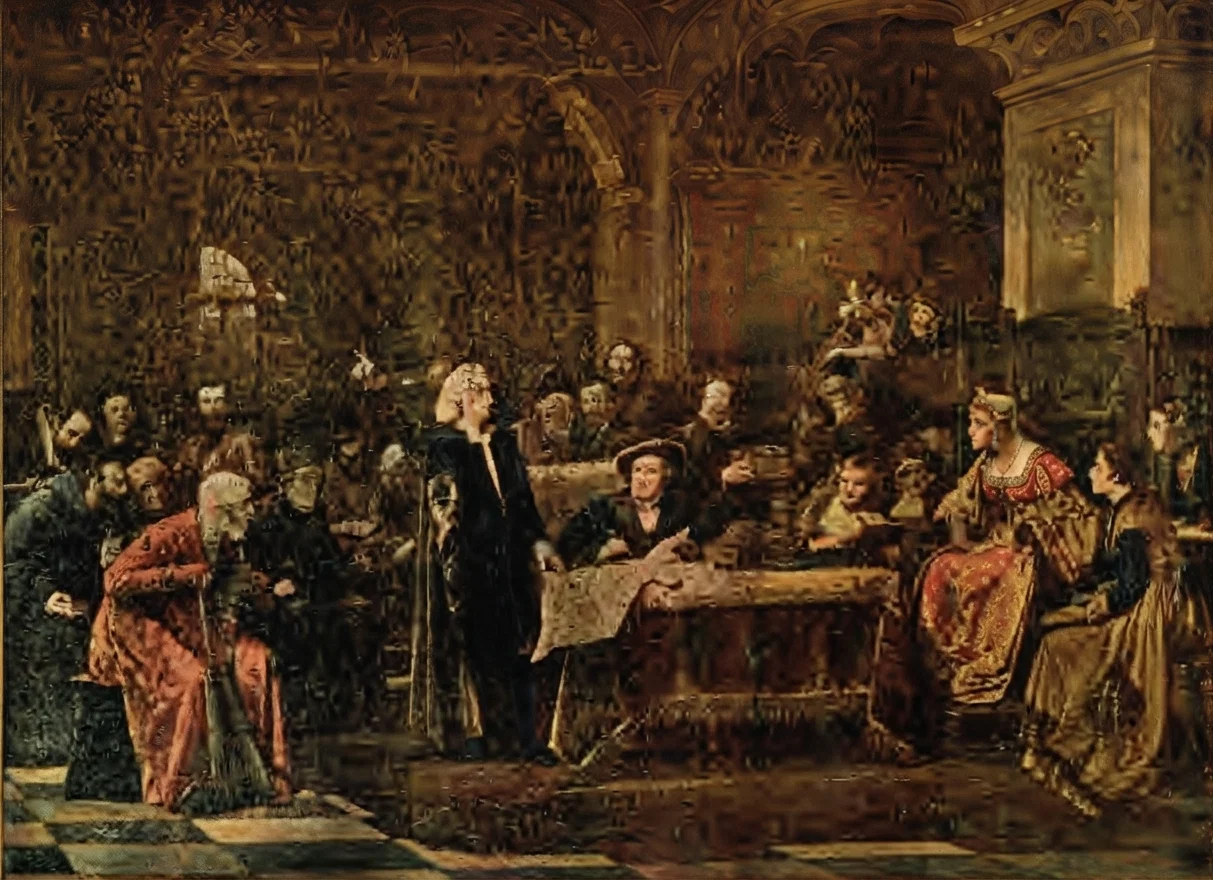
COLUMBUS BEFORE ISABELLA.
The apostasy having full control of the imperial power, and compelling all to conform to her teaching, and two of the chief factors in the creation of this Church-and-State combination being the chief authors of the dogma that the earth is flat; thus in that time and onward through the consequent Dark Ages, the truth that the earth is round was forced out of all the realm which the church controlled.
Yet outside of the region of papal influence, the truth that the earth is round still prevailed.
There, from Central Asia through all North Africa and Spain to the southern border of France, the Mohammedans ruled. In all this vast domain, schools flourished and enlightenment and civilization reigned. And in all this realm it was known that the earth is round. While Constantinople and Rome were "asserting in all its absurdity the flatness of the earth, the Spanish Moors and the Saracens in Africa and Asia were teaching geography in their common schools from globes."
In spite of all the opposition of the Papacy, some of this knowledge crept into her dark domains. Gerbert, who became pope in 999, when a boy studied in the Mohammedan schools of Spain, and there learned that the earth is round, and afterwards established a school at Rheims, and used in it a geographical globe which he brought from Cordova, the Mohammedan capital of Spain. And the Moorish State of Grenada, in Spain, continued until the very year that Columbus discovered America.
Columbus had been a sailor from the age of fourteen, and had spent many years especially in the Syrian trade from all parts of the Mediterranean, as well as having made several voyages to Guinea; and as he had thus been in almost daily contact with the Mohammedan nations, from this sketch it is easy to understand how he caught the truth that the earth is round. "Tho the state of public opinion at the time did not permit such doctrine to be openly avowed in Catholic countries, yet Columbus was thoroughly convinced of its truth."
Being so thoroughly convinced, he at last decided to brave public opinion and present his views to those in power who might help him put them to the test. "After many wearisome delays, his suit was referred to a council at Salamanca, before which, however, his doctrines were confuted" from the saintsand fathers of the church; and from "reason," since, even if he should depart from Spain, "the rotundity of the earth would present a kind of mountain up which it was impossible for him to sail, even with the fairest wind, and so he could never get back. The Grand Cardinal of Spain had also indicated their irreligious nature; and Columbus began to fear that instead of receiving aid as a discoverer, he should fall into trouble as a heretic. However, after many years of mortification and procrastination, he at length prevailed with Queen Isabella; and April 17, 1492, in the field before Granada, then just wrenched from the Mohammedans, by the arms of Ferdinand and Isabella, he received his commission."
The island of Cuba was discovered on the first voyage, October 28, 1492. The first settlement of Spaniards was in 1511, and from that year until 1898 the Church of Rome, by means of the Spanish power, has held complete possession of the island. The natives, tho under the complete control of the clergy, have been always "deprived of all political, civil, and religious liberty; have been excluded from all public stations," and yet "have been heavily taxed to maintain their Spanish rulers" and the Church of Rome.
And, tho the Church of Rome has had sole control of the people educationally these three hundred and eighty-eight years, and tho, further, she has there "a vast number of priests and high church dignitaries," yet, true to her original character, she has kept them in densest ignorance.
The Spanish Government has all these years made annual appropriations for the support of the Catholic Church and its clergy in Cuba. As the consequence, of course, "the people of Cuba have never been taught to support their church and clergy by direct voluntary contribution."
Yet at the same time these same people have been obliged to pay to the church such fees as she demanded for christenings, marriages, confirmations, exorcisms, extreme unctions, burials, masses, etc., etc. And now, upon all this, she sets up the plea that "so dire is the poverty on the island that it is doubtful if the Cubans could by any possibility raise sufficient money to keep their churches open and their priests from starving." Therefore, since the Spanish Government, with her appropriations to the Catholic Church, is cut off from Cuba, the Catholic Church demands that the United States Government shall take the place of the Spanish Government and make governmental appropriations for the support of the Catholic Church and clergy in Cuba.
And that is not the worst. It would be bad enough for that church only to make such demands; yet not only does she make the demand, but "President McKinley has held numerous conferences with Cardinal Gibbons and Archbishop Ireland on the subject," with the result that "it is the determination of President McKinley that the Catholic Churches shall be kept open, and that public worship shall be provided for. To this end sufficient money will be advanced by this government to support the Catholic Church."
In thus "determining to support the Catholic priests in Cuba," it is declared that "President McKinley has acted wisely from other points of view than mere humanity."
"Mere humanity," indeed! Of course "mere humanity" must needs be supplemented by some more important consideration, to make such action entirely worthy of approbation.
And so it is. And here is the consideration upon which, as it is published, President McKinley "wisely" supplements that of "mere humanity":—
President McKinley has acted wisely from other points of view than mere humanity. The Cuban priests, as in all countries whose population is densely ignorant, exercise complete control over their parishioners. Apart from the cruelty of withdrawing all aid from these priests, it is easy to believe that the new American Government in Cuba would have at its very inception built up a dangerous set of enemies, if the priesthood of Cuba were given reason to regret the presence of the American flag on the island. The Spanish Government at Madrid could easily give the American Government some dearly-bought information as to the malign influence that is in the power of a hostile clergy to exercise. Ever since the first Carlist uprising in 1833, every movement directed against the government of Spain has found its principal support in the clergy of Spain, who almost to a man are Carlists.
That is to say: The Government of Spain has always supported the Catholic clergy and the Catholic Churches in Cuba. And now, the United States having supplanted the Government of Spain in Cuba, if this government does not undertake "the entire responsibility for their support," "the priesthood of Cuba" will be "given reason to regret the presence of the American flag on the island." Then, having such "reason to regret the presence of the American flag on the island," and having "complete control" of their "densely ignorant" parishioners, "the new American Government in Cuba would have at its very inception built up a dangerous set of enemies." Therefore, to placate this "dangerous set of enemies," the Government of the United States must undertake the entire responsibility for their support. And if anybody does not believe it wise thus to placate these "dangerous enemies," then the Spanish Government at Madrid could easily give him pointers in "some dearly-bought information as to the malign influence that is in the power of a hostile clergy to exercise."
But when such consideration as that is counted as "wisely" supplemental to that of mere humanity, we are led to query whether the people of the United States are ready to accept either this supplemental or the original consideration as sufficient justification of the President of the United States in advancing the money of all the people of the United States for the support of the Catholic clergy in Cuba.
Yet more than this: Why should the President of the United States follow the counsels of Catholic cardinals and archbishops, any more than did Columbus? If Columbus had conformed to the views of the cardinals and archbishops of his day, he would have agreed that the earth is flat. And if all others had done so, the world would have perished in just such ignorance and despotism as have ruined Cuba. But by thinking for himself, and following wiser counsels, he repudiated Catholic ignorance, and so was successful in giving to mankind a new world.
Why should not now the President of the United States follow the example of Columbus, in repudiating Catholic ignorance, and the wise counsels of the noble men who made this nation, in the repudiation of the Catholic principles of governmental support of the church? Why should not the President of the United States thus look out and on new worlds of light and liberty, rather than turn back to the principles and practices of the Dark Ages, and put the United States Government in the lost position of Spain in supporting the Catholic Church and clergy in Cuba, whose record of three hundred and eighty-eight years is written in the dense ignorance and desolation of Cuba as it was two months ago? Why?
ALONZO T. JONES.

THE SURE FOUNDATION.

IN the construction of a building the thing of most importance to be considered is the foundation. If this is insecure, the whole building is unsafe, and liable to fall. The Saviour gave an illustration of this point in His Sermon on the Mount. He said, "Therefore whosoever heareth these sayings of Mine, and doeth them, I will liken him unto a man, which built his house upon a rock." Matt. 7:24.
It is implied in this passage that every one is able not only to hear the sayings of Christ, but to do them as well, and that he who does both hear and do the sayings of Christ, is built upon a rock, the true foundation.
Once before when the Saviour spoke from the summit of Sinai (for He it was who spake the Ten Words), the people who heard His voice "entreated that the word should not be spoken to them any more; for they could not endure that which was commanded." There must have been something singularly remarkable about a voice which was so unendurable at one time, and so gladly heard at another. What was it? Why so strong a contrast? Perhaps a few comparisons will enable us to enter somewhat into the secret.
The first was the word of Divinity, "whose voice then shook the earth."
The second was the voice of divine humanity speaking blessings to the mourner, the meek, and the merciful.
The first was a word of command spoken to a fallen race, powerless in themselves to meet its requirements.
The second was a word of entreaty to the weary and the heavy-laden, saying, "Come unto Me, . . . and I will give you rest."
The first, tho "ordained to life," was "found to be unto death."
The second was the voice of Him who "came not to judge the world, but to save the world."
Connected with the first was the sacrificial service and the ceremonial ordinance, which shadowed forth, with a pale, borrowed light, the power which would enable them to do the things which they had heard.
Connected with the second, without ceremony or sacrifice other than the sacrifice of self (and that is the greatest of all sacrifices), was the infusion of divine power to meet the requirements of the first.
The word spoken from Sinai was that of Christ the Creator.
The voice from the mount of blessing was that of Christ the Redeemer. It was the coming of the "true Light which lighteth every man that cometh into the world." And before this more glorious Light, the pale, dim light of the law is obscured, even as the light of the sun obscures the light of the moon. Yea, the church is now "clothed with the sun, and the moon under her feet." And now "ye are not come unto the mount that might be touched, . . . and the sound of a trumpet, and the voice of words; . . . but ye are come unto Mount Sion, . . . and to Jesus the Mediator of the new testament." So, instead of going forth to the world with the law in our hands, demanding obedience to its requirements by "the carnal mind, which is not subject to the law of God, neither indeed can be," we are to go forth with Christ in our hearts, entreating sinners to let the "Spirit of the living God" write the law, "not in tables of stone, but in fleshly tables of the heart," pleading with them to let the Saviour, who is the living expression of the law, dwell in their hearts by faith.
There is a passage in the Old Testament brought to mind by this saying of Christ inthe Sermon on the Mount. It is found in Deut. 18:18, 19: "I will raise them up a Prophet from among their brethren, like unto thee, and will put My words in His mouth; and He shall speak unto them all that I shall command Him. And it shall come to pass, that whosoever will not hearken unto My words which He shall speak in My name, I will require it of him."
Because the people could not endure to hear the Lord speak, and so requested that He should not speak any more, the Lord said that they had well spoken, and He gave them the promise that the words of Christ would be of such a character that they could endure to hear them. But until Christ should appear personally and speak the words of God, they had no word by which they could learn the character to which they were to attain, other than that which they had heard from Sinai; and this word they said they could not endure to hear any longer; and in saying this, God said that they had well spoken.
If, then, they could not see life in those words, they were certainly without hope. But when by living faith they could look upon those words as promises to be fulfilled in them, rather than requirements to be performed by them, their hope revived. And thus it was that they were bidden to view these words; for we read in Deut. 30:11-14: "For this commandment which I command thee this day, it is not hidden from thee, neither is it far off. It is not in heaven, that thou shouldest say, Who shall go up for us to heaven, and bring it unto us, that we may hear it, and do it? Neither is it beyond the sea, that thou shouldest say, Who shall go over the sea for us, and bring it unto us, that we may hear it, and do it? But the word is very nigh unto thee, in thy mouth, and in thy heart, that thou mayest do it."
Outwardly, upon the tables of stone merely, the children of Israel could not endure even to hear the words of the law proclaimed; much less could they do them. But in the heart they could both hear them and do them.
Here we have it, then, both in the Old Testament and in the New, that the words of Christ, heard and done, are the things for which we shall be held responsible, and that those who do this are like the man who builds upon a rock. It is to be built upon the true foundation.
It will doubtless sound very commonplace to the professed Christian to say that Christ is the foundation of all human hopes, yet there is danger that many professed Christians will trust in their exemplary lives and their stainless characters instead of trusting in the life of the sinless One. "Going about to establish their own righteousness," these good Christian people "have not submitted themselves unto the righteousness of God."
"Other foundation can no man lay than that is laid, which is Jesus Christ." 1 Cor. 3:11. In Eph. 2:20 He is called "the chief cornerstone." And the prophet Isaiah, in speaking of Christ says: "Therefore thus saith the Lord God, Behold I lay in Zion for a foundation a stone, a tried stone, a precious cornerstone, a sure foundation; he that believeth shall not make haste." The only sure foundation is "Christ in you the hope of glory." EUGENE LELAND. Bethel, P. Q.

THE PROMISES OF GOD.

Does your spirit faint? The divine promises are a dropping honeycomb, better than Jonathan's. Dip your pilgrim staff into their richness and put your hand to your mouth, like him, and your faintness shall pass away. Are you thirsty? They are the flowing stream of the water of life, of which you may drink by the way, and lift up your head. Are you overcome by the sultry burden of the day? They are as the cool shadow of a great rock in a weary land. Have your steps well-nigh slipped? They are a staff in your hand, on top of which, betimes, like Jacob, you may lean and worship God. Are you sad? There are no such songs to beguile the road and to bear you on with gladness of heart. Put but a promise under your head by night, and were your pillow a stone like that at Bethel, you shall have Jacob's vision, and the thirstiest wilderness will become an Elim, with palm trees and wells of water.—Andrew Geikie.

THE IMPORTANCE OF THE WORD.

IT is God's plan that old and young shall study His Word. This is necessary for intellectual and spiritual growth. God would have all realize that the truth is capable of expanding and increasing in grace and power. The student of the divine Word finds that an effort to comprehend truth calls forth all his powers. The truth is deep, and broad, and high. Were it otherwise than this, it would not be the truth. But its clearness is equal to its depth. Upon those who search the Scriptures, the truth found therein has an elevating, ennobling influence, enabling them to reach the standard of perfection.
But much ignorance of God's Word prevails, even among those who preach this Word. There are many teaching the Word of life to others when they are themselves dull of comprehension. They do not bring the truth into the inner sanctuary of the soul. It is not a living reality to them, because they do not practise it. It has not been digested, and converted into spiritual muscle and sinew.
Many who claim to believe the Bible do not eat the heavenly manna. Light shines upon them, but it is not appreciated. Many refuse to accept the light God sends from heaven, because it does not justify transgression of the law. They close their eyes, for fear they will see, and be converted.
Thus it was with the Jewish rabbis. "Show us a sign," they cried in unbelief. Even after Christ had fed the multitude with five loaves and two fishes, they came to Him with this demand. The miracle just performed was evidence sufficient, but the priests had closed their eyes to the light.
The professed Christian world has had opportunity to obtain light and knowledge, but many close their eyes lest they shall see. Well-educated, intelligent men preach at the Word and round the Word, but they do not touch its inner meaning. They do not present truth in its genuine simplicity. These men, regarding themselves as authority, tell their hearers that it is not possible to understand either Daniel or the Revelation. Many ministers make no effort to explain the Revelation. They call it an unprofitable book to study. They look upon it as a sealed book, because it contains the truth in figures and symbols. But the very name that has been given to it—"Revelation"—is a denial of their suppositions. The Revelation is a sealed book, but it is also an open book, recording marvelous events that are to take place in the last days of this earth's history. Its teachings are definite, not mystical and unintelligible, and God would have us understand it.
Many teachers of God's Word need to become learners before they can truly teach the Scriptures to others. Were Christ on earth, He would say to them, Ye teach for doctrine the commandments of men; ye are ignorant both of the Scriptures and of the power of God. They know little of true moral and religious science, and less of the Word of God. A knowledge of the Scriptures would make them wise unto salvation, but they stand only on the threshold of knowledge. They have never entered in to obtain true spiritual understanding. Because of the simplicity of the truth, they think it necessary to clothe it with their far-fetched explanations. But did they do no more than read the Scriptures, the common people would understand God's Word far better. The Scriptures are made intricate by the way in which they are interpreted. Better would it be for the student to compare scripture with scripture, using one passage to unlock another. Scripture can be correctly interpreted only by scripture.
John bears testimony of Christ, the Giver of the Word, saying, "For this purpose the Son of God was manifested, that He might destroy the works of the devil." In the simplest language John sets before us true practical godliness. This simplicity does not show shallowness, but depth. John is speaking to real men and women, and the Holy Spirit directed him to write in such a way that they would be brought in contact with a real, living God. He shows us what God is doing, and what man must do to meet God's requirements.
John does not present the truth hesitatingly, but in a decided manner. He speaks positively. "That which was from the beginning," he says, "which we have heard, which we have seen with our eyes, which we have looked upon, and our hands have handled, of the Word of life (for the life was manifested, and we have seen it, and bear witness, and show unto you that eternal life, which was with the Father, and was manifested unto us); that which we have seen and heard declare we unto you, that ye also may have fellowship with us; and truly our fellowship is with the Father, and with His Son Jesus Christ. And these things write we unto you, that your joy may be full. This then is the message which we have heard of Him, and declare unto you, that God is light, and in Him is no darkness at all. If we say that we have fellowship with Him, and walk in darkness, we lie, and do not the truth; but if we walk in the light, as He is in the light, we have fellowship one with another, and the blood of Jesus Christ His Son cleanseth us from all sin."
"For the life was manifested, and we have seen it." Yes, the eternal life that was with the Father was manifested to us. Christ clothed His divinity with humanity, and became a man of flesh and blood. John talked with Him, learned of Him, and loved Him with a pure, sincere, undeviating fidelity.As Paul beheld Christ in His power, he broke out into exclamations of admiration: "Without controversy great is the mystery of godliness; God was manifest in the flesh, justified in the Spirit, seen of angels, preached unto the Gentiles, believed on in the world, received up into glory." "Let this mind be in you, which was also in Christ Jesus; who, being in the form of God, thought it not robbery to be equal with God; but made Himself of no reputation, and took upon Him the form of a servant, and was made in the likeness of men; and being found in fashion as a man, He humbled himself, and became obedient unto death, even the death of the cross. Wherefore God also hath highly exalted Him, and given Him a name which is above every name; that at the name of Jesus every knee should bow, of things in heaven, and things in earth, and things under the earth; and that every tongue should confess that Jesus Christ is Lord, to the glory of God the Father." "For by Him were all things created that are in heaven and that are in earth, visible and invisible, whether they be thrones, or dominions, or principalities, or powers; all things were created by Him and for Him. And He is before all things, and by Him all things consist. . . . For it pleased the Father that in Him should all fulness dwell."
MRS. E. G. WHITE.

THE NEW FOR THE OLD.

Bury the sorrow and sin of the past, Bury the wo, Let God's kind mercy now over them cast The snow of forgetfulness, falling as fast As the flakes of the snow.
Nature will bury the past things away,— Bury the old. The sere falling leaves, in their mystic decay, She weaves into blankets for buds of the May On the dark, hidden wold.
Chastened of heart for the sorrow of old, Lift up thy face. Angels are near thee with pinions of gold; Look to their hope-light, and as you behold, Change to their grace.
Wonderful love, O most wonderful love, Cometh to you! God will most gladly the old life remove, That He may send to you new from above, The pure and the new.
FRANCES E. BOLTON.

WANTED, WORKERS.

THE following anecdote, illustrative of the workers needed in Christ's army, is attributed to Mr. Spurgeon:—
"Once when the Union soldiers were retreating from the valley of Virginia, they burnt a bridge over the Shenandoah. Stonewall Jackson, who wanted to pursue them, sent for his old bridge-builder. 'Sir,' he said, 'you must keep men at work all day and all night, and finish that bridge by to-morrow morning. My engineer shall give you a plan.' Old Miles saluted and withdrew.
'Early the next morning the general sent for Miles again. 'Well, sir,' said Jackson, 'did the engineer give you the plan for the bridge?'
'General,' said the old man slowly, 'the bridge is done; I don't know whether the picture is or not.'
"Now that, said Mr. Spurgeon, is the kind of bridge-builders we want in the church, men who go right ahead with their own work, no matter what their neighbors are doing."

THE DECALOGUE.

The Seventh Commandment.

"Thou shalt not commit adultery." Ex. 20:14.
This commandment was given to guard the chastity of all God's intelligent creatures; for He would have a pure universe. There has been much said about social purity, but there is no genuine social purity apart from Christ; for only in Him can we keep the commandments of God.
"With the pure Thou wilt show Thyself pure; and with the froward Thou wilt show Thyself froward." Ps. 17:26. The patriarch David understood that God was pure, and that He would give justice to the pure-minded man, while those who were impure would receive a just reward for their impurity.
"The words of the Lord are pure words; as silver tried in a furnace of earth, purified seven times." Ps. 12:6. Silver purified seven times would certainly be free from all dross and impurity; and when God speaks, His words are just as pure as silver thus tried. His servants, who are to dwell with Him throughout eternity, must be like Him in character. Paul exhorts Timothy thus: "Let no man despise thy youth; but be thou an example of the believers, in word, in conversation, in charity, in spirit, in faith, in purity." 1 Tim. 4:12. God's servants are to speak pure words, engage in no other than pure conversation, have pure love (charity), be pure in spirit, have a pure faith, and delight in purity. All this is included in the idea of purity, taught by the seventh commandment.
"Unto the pure all things are pure; but unto them that are defiled and unbelieving is nothing pure; but even their mind and conscience is defiled." Titus 1:15. In this text two classes are clearly pointed out, the pure and the impure. One class can see only the good there is in individuals, judging from the way they speak of them. They judge all men and women to be pure until they show by some outward act that they are not so; this is the attitude of a true child of God. The other class can see only impurity in every one, because their own hearts and lives are impure, and they judge every one to be like themselves. The writer has met men who, it seemed, could not think or talk of anything but something of an impure character. It is sad to think that any of God's creatures, made in His own image, could fall so low in sin.
"Ye have heard that it was said by them of old time, Thou shalt not commit adultery; but I say unto you, That whosoever looketh on a woman to lust after her hath committed adultery with her already in his heart." Matt. 5:27, 28. Our Saviour here gives us the true import of this commandment. The Jews were very strict in the outward observance of the law of God; but they had failed to grasp the spiritual nature of the law. They did not know that evil thoughts and desires were a violation of the commandments. They were surprised at His teaching. But we see by our Saviour's words that our thoughts must be kept pure. Satan may suggest an evil thought, but the true servant of God will not willingly retain such thoughts in his mind. He will send up a petition, and the Lord, who is a present help in every time of need, will bestow the needed grace, and a victory over the devil will be gained.
"Tho we walk in the flesh, we do not war after the flesh (for the weapons of our warfare are not carnal, but mighty through God to the pulling down of strongholds); casting down imaginations, and every high thing that exalteth itself against the knowledge of God, and bringing into captivity every thought to the obedience of Christ." 2 Cor. 10:3-5. Blessed words are these. The weapons of our warfare are not carnal, but spiritual. They are mighty, not through self, but through God. Then it is God who controls our thoughts; He has given us the weapons. By His Spirit He dwells within us; His Word and Spirit are to be our constant help and stay. Thus it is God that does the work for us through His own agencies.
How thankful we should be that it is possible for every child of God to have every thought brought into obedience to the will of Christ! This is what it means to keep the seventh commandment, yes, and all the commandments. Christ has given us a perfect example of obedience to His Father's law, and He says, "Lo, I am with you alway, even unto the end of the world." May the grace of our Lord rest upon all His dear children. J. W. WATT.

THE LOVE OF GOD.

"GOD is love." 1 John 4:8. It follows, then, that God can perform no act that is not prompted by love. The affliction of the righteous, the bestowal of blessings upon the wicked, and the giving and taking of life, are expressions of God's love and mercy.
When His judgments reap down the wicked, it is because they have filled the cup of their iniquity, and are a hindrance to those who would faithfully do the right. This is very plain from His dealings with Pharaoh and his host at the Red Sea. The Lord in His lovingkindnessdivided the waters, "and made Israel to pass through the midst of it; for His mercy endureth forever." Ps. 136:14, 15. Mercy is an element of love; and it was because of His unending mercy that He saved one and destroyed the other.

BLESSINGS OF CHRISTIANITY.

CHRIST brought deliverance from the thralldom of sin; but this freedom can only be enjoyed by those who are willing to accept Christ as their deliverer. Those who prefer evil to good are free to have their choice. There is no compulsion. Man is left to his own free-will. If he chooses the evil, he is held responsible for it. If he chooses the good, he enjoys the blessing that follows. Man could not be happy without the freedom of his will. He would not probably be happy in heaven if he were compelled to go there contrary to his wishes. Fearful as is a man's condition in the world of wo, it is more tolerable for him than to be in heaven contrary to his own will. . . . Those who accept Christ are saved, and to them Christ's coming into the world is a great and everlasting benefit. All who believe in Him and accept Him are saved from sin and sin's consequences.
The man who concludes that the world is no better for Christ's coming into it, shows plainly that he has not sought Him and not tasted of His goodness and love, and that, so far as he himself is concerned, the world is no better than before. Still for all that he is enjoying untold good as the result of Christianity.—Carnegie, Pa., Item.

THE CLOSE OF 1898.

[From The Independent.]
ANOTHER Century dies, In war, and blood, and pain. Our longing, straining eyes Look forth for Peace in vain. For Christ the myriads fall, Butchered by Turk or Kurd. Comes there no end? Is all The hope of men in vain? Comes not the Lord again O'er all the earth to reign, As spake the Word?
Slow are God's judgments, slow To man's impatient thought; Slow-paced the ages grow, In vain the goal is sought. Armed to the teeth to-day The jealous peoples stand; Worse blight than of decay, Worse burden than of war, The enormous fleets and legions are; Dumb Terror speeding fast and far O'er sea and land.
'Tis nigh two thousand years Since came the Prince of Peace. Return Thou, calm our fears, Make strife and war to cease. Thick clouds to-day of doubt Obscure our faithful sight. Shine, Blessed Sun, shine out, The storms of passion still. Again, O Hidden Well, The wintry earth fulfil With Peace and Light!
—Sir Lewis Morris.
Continue reading: The Love of God Manifested in His Creative Works