Suicide among Children.—During the ten years ending in 1896 in the State of Prussia alone, 407 children—331 boys and 76 girls—under fifteen years of age, committed suicide. The cause is said to be overstrain in education. The Berlin correspondent of the London Mail, after referring to the success of the German educational system from a commercial view-point, says: “The question is, Has this success been attained by sapping the heart-blood of the nation?” The cause, he seems to indicate, is poverty and low feeding.
“In an article in the current number of the German Imperial Gazette on ‘National Economics’ it is stated that in Prussia, out of a total population of nearly thirty-two millions, 8,740,000 heads of families and persons with an independent existence (with their families representing nearly 70 per cent. of the population) do not earn £45 ($225) per annum. This shows that the ordinary workingman is very poor, and as meat of all kinds is terribly dear in Prussia, it is evident that the pupils of elementary schools can not, as a rule, receive the nourishment necessary to sustain them during their hard school life.”
But flesh food is no more necessary to children than to colts or horses. As healthy, happy, hopeful children as there are in the world, never or rarely taste meat. Would it not be well to inquire how much beer and skepticism have to do with the matter? It certainly constitutes a sign of the times.
SENSIBLE AND CHRISTIAN.
Not a few in this country endeavor to put down heresy by force. Referring to the advocacy of this to suppress Mormonism, The Christian Advocate of Dec. 22, 1898, well says:—
“There is but one way to deal with it, and that is by greater energy and devotion on the part of the Christian church. We regret to see certain proposals, which in the end can accomplish no good.
“Some attempts are being made in this part of the country to promote a persecution of Mormon elders. The Mormon missionaries are calling at private houses and elsewhere asking people to attend their services, and distributing leaflets containing most plausible arguments in their favor. They have a right in this country to do everything that ordinary tract distributers have a right to do. There is but one way to meet the Mormons, the Spiritualists, the Christian Scientists, and all other crank religions or superstitions—and that is by making Christian churches what they ought to be, and their members active missionaries for the truth—and by pastors guarding their flocks, ascertaining what they are thinking, reading, saying, and doing.
“If any religionist or anti-religionist breaks the law, let him be brought before it for judgment; but the man or the woman who endeavors to break up a meeting by noise or disturbance, or to create any kind of a persecution which involves a violation of the rights guaranteed by the Constitution, pursues a course which, carried to its last results, would make all civil and religious liberty depend upon the caprice or the consent of mobs. Such persons may have good motives, but they perform bad actions and help the Mormons.”
Now, why is not all this true as regards Sunday “desecration”? Why not preach the Word of God, and tell the people to follow that?
The War’s Greater Loss
By William Nelson Glenn
Which Suffered the Greater Loss?—A gentleman writing from Florida to The Vineyard, North Deer-ing, Me., makes this pertinent reference to the situation in that remote Southern region:—
“There has been a great deal of sickness in and around Jacksonville for the past few months. Some attribute the cause to the soldiers who are encamped here, but whether that has anything to do with the sickness in the city I am not able to say. It is sad, to say the least, to visit the hospitals here and see the hundreds of soldier boys lying on their cots with pale faces, and to hear their groans. It is heart-sickening to see from one to eight each day taken either to the depot or graveyard, dead. Surely the United States has got the worst of the war, in that she has lost more of her men than did Spain.”
Whether the United States got “the worst of it” or the best of it, is an open question. Spain lost more territory, more ships, and perhaps more pride; but the United States lost more men—not in battle, but in the war; for all the Spanish prisoners were returned. Now for the measure of loss. Throw in all the territory supposed to be gained, how will it compare with the loss of souls? God’s estimate of one soul is that it is worth more than “the whole world.” He asks the pertinent question, “What shall it profit a man, if he shall gain the whole world, and lose his own soul? or what shall a man give in exchange for his soul?” Mark 8:36, 37. Then if the United States lost one man more than Spain did, and should gain all of Spain’s wealth, the United States would still be loser.
There is still another view: As far as Spain is concerned, the war is over—if she so elect. Her war expense stops, and much other expense connected with holding the lost territory—not the least of which is the expense of her vast church establishment. Not so with the United States. Peace with Spain does not insure peace in Cuba, or in the Philippines. And even if there be no more actual war, there is the continued great military establishments, and the continuous increase of great war vessels and armaments, in order to protect these newly-acquired “regions beyond” from the intrigues of the newly-made enemies in Europe, jealous of the imperial pretensions of the American republic.
To this is to be added the largely-increased pension roll, and expenses of which the most prolific imagination has not yet dreamed. Of immense magnitude is the continued process, in camp if not in battle, by disease if not by combat, of stringing out the list of dead or indigent with an interminable line of dependents to be sustained at government expense. Weighed in the balances of the Word of God, the imaginary glory of the nation is but dust when placed over against the sacrifice of souls on the altar of strife between man and man for whom Christ died upon the cross. The question as to whether Spain or the United States has suffered the greater loss has not yet been answered.
W. N. G.
A Near Probability of “Imperialism”
A Near Probability of “Imperialism.”—The United States up to the late war appropriated for defense an average yearly sum of $83,500,000. There is expended for education $184,500,000. Germany spends for defense $165,000,000 to $90,000,000 for education; Great Britain, $200,000,000 for defense to $50,500,000 for education; and France, $182,000,000 to $39,500,000 for education. Under the proposed “imperialism” of America we shall see in this land, if not already present, a reversal of proportions. Henceforth war and defense—the army and navy budget—will be more than education. Is this part of the trend upward?
PORTO RICO.
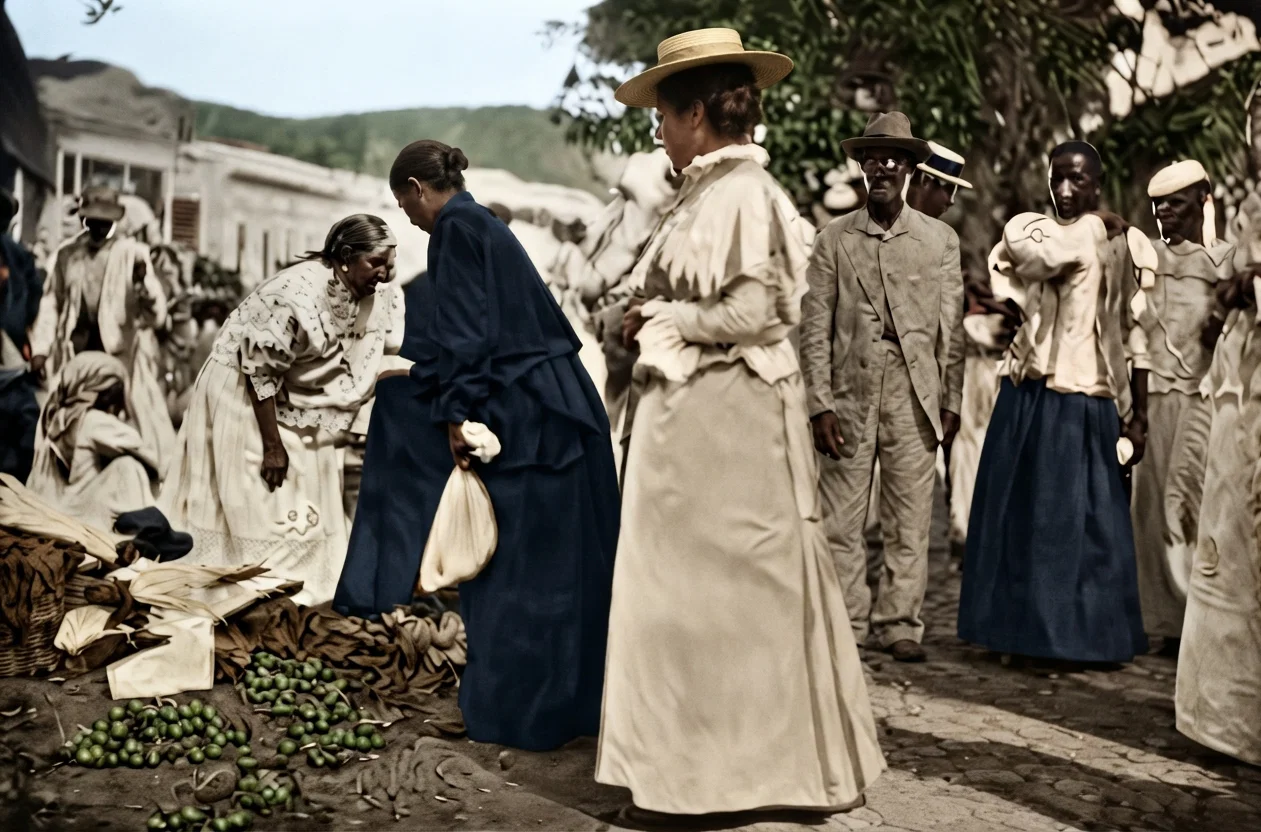
As this newly-acquired possession of the United States is now a mission field toward which all Protestants are looking with interest, a few points about the country and people may be deemed profitable information. The following is from an article in The Outlook, by Col. W. Winthrop, U. S. A.:—
A MARKET SCENE IN PORTO RICO.
The island of Porto Rico, or Puerto Rico (Rich Port), is the fourth in size of the Greater Antilles, being exceeded by Cuba, San Domingo, and Jamaica. It is situated nearly in the center of the Archipelago of the West Indies, between the seventeenth and nineteenth parallels of north latitude, and the sixty-sixth and sixty-seventh meridians of longitude. The island, in shape, is an irregular parallelogram, being a little under 100 miles long by about one-third of that distance broad. It is some 270 miles in circumference, and contains about 3,600 square miles. (Somewhat less than the area of Connecticut.)
Unlike its neighbors, this fortunate island has scarcely been disturbed by internal disorders. The movement in favor of a republic, which began in 1820, was checked, without bloodshed, through the vigorous and judicious action of the able Governor de la Torre. When, more recently, in 1867, an insurrection, in sympathy with that of Cuba, was initiated against the Spanish Government, its projectors were so terrified by an earthquake that they were induced to postpone their adventure, and a fresh rising in the following year was easily suppressed.
The surface of the island is broken and hilly. A low mountain ridge traverses it from east to west, ranging nearer the southern than the northern coast, with spurs extending northward. . . .
The climate is healthful for the tropics. The constant running streams, with the absence of stagnant water, doubtless contribute to purify the atmosphere. The island, well aerated throughout, is appreciably cooler and more salubrious than are the larger of the Antilles, or than the majority of the lesser Windward Islands, which have been termed the graves of foreigners. The mountain valleys, especially from November to April, enjoy a delightful climate, which has been likened to a perpetual spring.
In the rainy season at the north of the island a sea breeze blows from 8 A.M. to 4 P.M., in the absence of which life would hardly be tolerable near the coast. The rains, which are frequent and plentiful in May and June, come down in August and September "with the fury of a deluge." On the Southern coast there is much less rain, sometimes none at all even for ten or twelve months.
It is in August and September that the climate at the North is least healthful, especially for foreigners. Fever, dysentery, and scorbutic diarrhea are then to be guarded against, and a change to the mountains is desirable. These are also the months of the hurricanes, which have in some years proved so destructive and ruinous in their effects. "This dreadful scourge," writes Colonel Flinter, "which often visits the West Indies, may be considered as a great drawback to the planter, and is a great deduction from the value of West Indian property." . . .
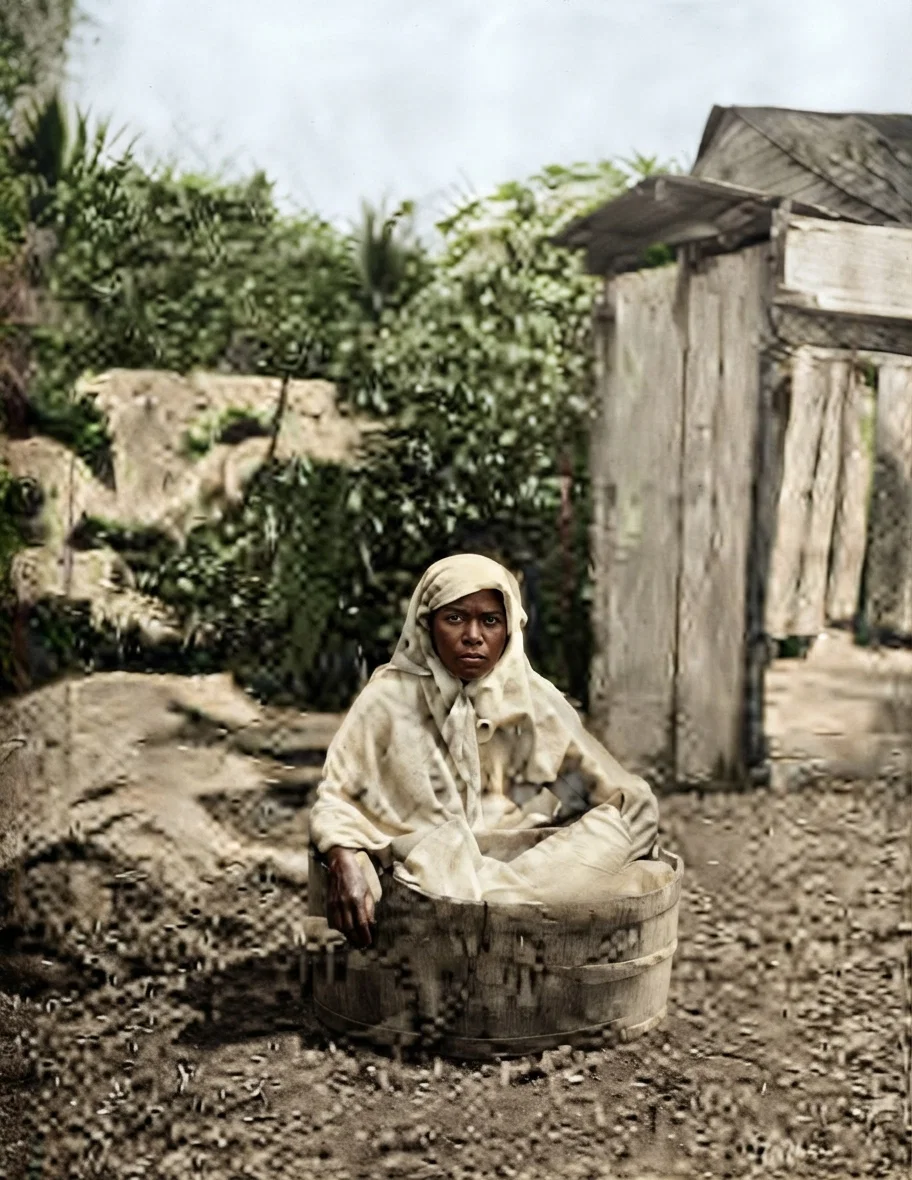
The population of this densely-peopled island is about 800,000 (three-eighths of them negroes). Eves states it, under date of 1897, at 813,937. A series of fortunate circumstances, in combination with a sagacious government, has contributed to impart to the people a quality superior to any other of the West India Islands. In the first place, they have always been a purely agricultural people. Then, at an early period, the crown lands of the island were divided among the natives, who thus became a community of small proprietors, to which was given a new consistency and stability on their being formed into a body of disciplined militia.
A Porto Rico Washer-woman.
Further, the island has not suffered to the same extent as its neighbors from the curse of slavery. The slaves were permitted to purchase their freedom on easy terms, and they have borne but a small proportion to the mass of the inhabitants. Thus, in 1873, when slavery was finally abolished, there were but few unemancipated persons left in the province. Valuable settlers have also come from San Domingo, Venezuela, and elsewhere. As a result, Porto Rico is one of the few countries of tropical America where the whites outnumber the blacks, and, it may be added, where the males outnumber the females.
There has thus been insured for Porto Rico a peasantry of free laborers—an industrious and self-sustaining population. Even the poor white Xivaro of the mountains or the interior is no burden upon the government, but, with his cow and horse, his acre of corn or sweet potatoes, his few coffee plants and plantain trees, he lives, with his family, an independent and happy existence. All the rural laboring classes, with entire simplicity of manners, unite in a frank cordiality and genuine hospitality to travelers and strangers.
The most popular vice appears to be gambling, especially in the form of cock-fighting. There are no beasts of prey, no noxious birds or insects, no venomous snakes or reptiles, to disturb the life of the inhabitants. There are no indigenous reptiles, no monkeys, and few birds. Rats are numerous and destructive, especially on the sugar plantations. . . .
Besides the capital, there are some sixty or seventy towns and considerable villages in the island. Of these the most important are Ponce and Arecibo (each with a larger population than San Juan, that of Ponce being about 35,000 to 40,000, while that of San Juan is estimated at 25,000), Mayaguez (also larger than the capital), and Aquadilla, on the west coast; Fajardo and Humacao, on the east coast; Guanica and Aroyo, on the south; and Pepino and Cayey, in the interior. Aquadilla is especially important as a rendezvous for communication and trade with Havana. Its extensive10and safe harbor has a depth of 11-15 fathoms. The best harbor, however, which is, moreover, readily defensible, is that of Guanica. Jobos, also on the south coast, has a good harbor, available as an outlet to the rich agricultural sugar district of Guayama. Other ports furnishing a shelter during a large part of the year are those of Mayaguez, Salinas de Coamo, Anasco, Cabo Rojo, and Bahia Honda.
Among the more attractive villages or smaller towns may be specified Yubacao, at the East, Toabago, in an "extensive and beautiful valley on the North coast, fronting the capital on the opposite side of the harbor," and Aybonito, on a table-land of the Southern mountains, "enjoying a cool and delightful climate." In the country near Ponce are thermal baths serviceable for invalids.
THE LABORERS ARE FEW.
"LABORERS wanted!" The ripening grain
Waits to welcome the reaper's cry.
The Lord of the harvest calls again;
Who among us shall first reply:
Who is wanted, Lord? Is it I?
The Master calls, but the servants wait;
Fields gleam white 'neath a cloudless sky.
Will none seize sickle before too late—
Ere the winter's winds come sweeping by?
Who is delaying? Is it I?
—Selected.
LESSON III.—SABBATH, JANUARY 21, 1899.
The Sabbath School International Series.
VISIT OF THE WISE MEN; FLIGHT INTO EGYPT.
Places.—Bethlehem and Jerusalem, B.C. 4.
Note.—The texts enclosed in marks of parentheses, while not essential to the lesson study, will be found to throw much light upon the lesson, and are suggested for those who wish to study further.
1 Now when Jesus was born in Bethlehem of Judea in the days of Herod the king, behold, wise men from the East came 2 to Jerusalem, saying, Where is He that is born King of the Jews? for we saw His star in the east, and are come to 3 worship Him. And when Herod the king heard it, he was 4 troubled, and all Jerusalem with him. And gathering together all the chief priests and scribes of the people, he 5 inquired of them where the Christ should be born. And they said unto him, In Bethlehem of Judea; for thus it is written by the prophet,
6 And thou Bethlehem, land of Judah,
Art in nowise least among the princes of Judah;
For out of thee shall come forth a governor,
Which shall be shepherd of My people Israel.
7 Then Herod privily called the wise men, and learned of them 8 carefully what time the star appeared. And he sent them to Bethlehem, and said, Go and search out carefully concerning the young Child; and when ye have found Him, bring 9 me word, that I also may come and worship Him. And they, having heard the king, went their way; and lo, the star, which they saw in the east, went before them, till it came and stood 10 over where the young Child was. And when they saw the 11 star, they rejoiced with exceeding great joy. And they came into the house and saw the young Child with Mary His mother; and they fell down and worshiped Him; and opening 12 their treasures they offered unto Him gifts, gold and frankincense and myrrh. And being warned of God in a dream that they should not return to Herod, they departed into their own country another way.
13 Now when they were departed, behold, an angel of the Lord appeareth to Joseph in a dream, saying, Arise and take the young Child and His mother, and flee into Egypt, and be 14 thou there until I tell thee; for Herod will seek the young 15 Child to destroy Him. And he arose and took the young Child and His mother by night, and departed into Egypt; and 16 was there until the death of Herod; that it might be fulfilled which was spoken by the Lord through the prophet, saying,
17 Out of Egypt did I call My Son. Then Herod, when he saw that he was mocked of the wise men, was exceeding wroth, and sent forth, and slew all the male children that were in Bethlehem, and in all the borders thereof, from two years old 18 and under, according to the time which he had carefully learned of the wise men. Then was fulfilled that which was spoken by Jeremiah the prophet, saying,
3. What effect did their inquiry have upon the king and people? Verse 3.
4. In their trouble, what step was taken by the king? Verse 4. (Mal. 2:7; Hosea 4:6.)
5. What did the king learn from the priests and scribes? Verse 5. (John 7:42.)
6. What reason did the priests give for this statement? Verses 5, 6. See note 2. (Micah 5:2.)
7. Having learned so much from the Jewish priests, what did the king learn from the wise men? Verse 7. See note 3. (Matt. 2:16.)
8. What instruction did he then give these men? Verse 8.
9. As they departed to find Jesus, what friendly assistance was given them? Verse 9.
10. How did they feel when the guiding star reappeared? Verse 10.
11. Having found the Saviour, what did these men do? V. 11. (Ps. 72:10; Isa. 60:6.)
12. Did the wise men follow the instruction of Herod? If not, why not? Verse 12.
13. Upon the departure of these eastern visitors, what instruction did God give Joseph? Verse 13. See note 4.
14. How long were they to remain in Egypt? (2 Peter 1:19.)
15. Of what did Joseph take advantage to cover his flight from Bethlehem? Verse 14. (1 Kings 17:3.)
16. How long was the Saviour kept in Egypt? Verse 15.
17. Why was the Lord sent to Egypt, in preference to some other place? See note 5. (Hosea 11:1; Ex. 4:22.)
18. When Herod saw that he had been "played with as a child" (sense of original word) by the wise men, how did he feel and act? Verse 16.
19. In carrying out this decree, what scripture was fulfilled? Verses 17, 18.
Side Lights.—"Desire of Ages," pp. 59-65; "Spirit of Prophecy," vol. 2, pp. 20-29.
NOTES.
1. Wise men.—"The epithet by which Matthew describes to us these eastern strangers is not so vague and indefinite as it seems in our translation. He calls them Magi from the East. The birthplace and natural home of the magian worship was in Persia. And there the Magi had a place and power such as the Chaldeans had in Babylon, the Hierophants in Egypt, the Druids in Gaul, and the Brahmans still have in India. They formed a tribe or caste, priestly in office, princely in rank. They were the depositaries of nearly all the knowledge or science existing in the country where they lived. . . . The education of royalty was in their hands; they filled all the chief offices of state; they constituted the supreme counsel of the realm. As originally applied to this Median priest-caste, the term Magi was one of dignity and honor."—Hanna's Life of Christ, p. 41. Suetonius, Tacitus, and Josephus each tell of a strong belief among the people of the East that one born in Judea was to arise and rule the world. This may have been propagated by stranger Jews, from their prophecies, and taken strong hold of those who desired a spiritual leader. See "Desire of Ages," p. 59.
2. By the prophet.—Although the priests had become so absorbed in worldly matters as to lose sight of the time of the Messiah's advent, they quickly turned to their neglected prophecies, and established the birthplace of their long-heralded King.
3. What time.—Herod sought from the wise men information as to how long since the star was first seen by them, evidently with the purpose in view which he soon carried out. His edict to slay the children of Bethlehem covered all under two years of age, "according to the time which he had diligently inquired of the wise men." Matt. 2:16. It had probably been quite a long time since they first observed the strange star, and had studied its significance.
4. Flee into Egypt.—God could, by a miracle, have preserved Christ from Herod's malice without His having been removed from Judea. But in all His dealings in behalf of men, their co-operation is sought, that they may have responsibility, and consequent interest in what is being done for them. The parents of Jesus were therefore commissioned to have a care for the infant Saviour. The journey taken was about sixty miles southward from Bethlehem.
5. Might be fulfilled.—The prophecy had said, "When Israel was a child, then I loved him, and called My Son out of Egypt." Hosea 11:1. "Israel" means a prince of God. As the Son of God, Christ was, and is, the "Prince of God" in the fullest sense. As the "Seed" of Abraham, he was a child; and as the great Antitype of Israel, must go into Egypt, and be again called forth to live temporarily in the promised land, as did Abraham and his children in the flesh. Nothing was omitted from the life of Christ which would tend to associate Him with the house of Abraham, and prove Him to be the promised "Seed" through whom the promises were to come to Israel.
19 "But when Herod was dead, behold, an angel of the Lord
20 appeareth in a dream to Joseph in Egypt, saying, Arise and
take the young Child and His mother, and go into the land of
Israel; for they are dead that sought the young Child's life.
21 And he arose and took the young Child and His mother, and
22 came into the land of Israel. But when He heard that
Archelaus was reigning over Judea in the room of his father
Herod, he was afraid to go thither; and being warned of God
23 in a dream, he withdrew into the parts of Galilee, and came
and dwelt in a city called Nazareth; that it might be fulfilled
which was spoken by the prophets, that He should be called a
Nazarene."
39 "And when they had accomplished all things that were
according to the law of the Lord, they returned into Galilee,
to their own city Nazareth.
40 "And the Child grew, and waxed strong, filled with wisdom;
and the grace of God was upon Him.
41 "And His parents went every year to Jerusalem at the feast
42 of the Passover. And when He was twelve years old, they
43 went up after the custom of the feast; and when they had
fulfilled the days, as they were returning, the Boy Jesus tarried
44 behind in Jerusalem; and His parents knew it not; but sup-
posing Him to be in the company, they went a day's journey;
and they sought for Him among their kinsfolk and acquaint-
45 ance; and when they found Him not, they returned to
46 Jerusalem, seeking for Him. And it came to pass, after three
days they found Him in the temple, sitting in the midst of
the doctors, both hearing them, and asking them questions;11
47 and all that heard Him were amazed at His understanding
48 and His answers. And when they saw Him, they were
astonished; and His mother said unto Him, Son, why hast
Thou thus dealt with us? behold, Thy father and I sought
49 Thee sorrowing. And He said unto them, How is it that
ye sought Me? wist ye not that I must be in My Father's
50 house? And they understood not the saying which He
51 spake unto them. And He went down with them, and
came to Nazareth; and He was subject unto them; and His
mother kept all these sayings in her heart.
52 "And Jesus advanced in wisdom and stature, and in favor
with God and men."
SUGGESTIVE QUESTIONS.
When and where did the Lord next appear to Joseph? Matt. 2:19. Note 1.
What did the Lord then say to Him? Verse 20.
Upon reaching the borders of Palestine, what did Joseph hear? Verse 22.
In his fear and perplexity how was he again enlightened?
Into what part of Palestine did the family then go? Verse 23. Note 2. (Luke 2:39.)
What was to be fulfilled by going to Nazareth? Note 3.
After the return to Nazareth, what is recorded of the Child Jesus? Luke 2:40. Note 4. (Luke 1:80; John 3:34.)
What was the yearly custom of the parents of Jesus? V. 41. (Ex. 23:15; Deut. 16:1.)
At what age did Christ first attend the annual feast with His parents? Verse 42. Note 5.
When the parents started to return home from the feast, what did Jesus do? Verse 43.
What caused this seeming neglect of the parents for the Child Jesus? Verse 44.
Upon missing Him at nightfall, where did they look for Him?
Not finding Him in the company, what did they next do? V. 45.
After an anxious search in Jerusalem, where did they finally discover Him? Verse 46.
How were His parents affected by the sight? Verse 48.
With what words did the mother chide Him?
What answer did she receive? Verse 49. (John 2:16.)
How did the parents receive this saying of Jesus? Verse 50. (Luke 9:45; 18:34.)
Notwithstanding the reply of Jesus on this occasion, how did He regard His parents' wishes? Verse 51. Note 6.
What is the further record of Jesus' early life? Verse 52. (1 Sam. 2:26.)
Side Lights.—"Desire of Ages," pp. 66-96.
NOTES.
1. When Herod was dead.—Some have placed the death of Herod the Great in A.D. 2. That would make the sojourn of the Saviour in Egypt six years. This hardly seems probable. In a foot-note on page 54 of Hanna's "Life of Christ," he says: "It has been accurately ascertained that Herod must have died between the 13th of March and the 4th of April 750 A.U.C. [after the building of the city, i. e., of Rome]." "Hale's Chronology," vol. 1, pp. 85, 96, gives strong arguments in favor of that date. This would set the date of Herod's death in the early part of B.C. 4, and would make the stay in Egypt cover but the period of a few weeks at most.
2. Galilee.—It was natural for the parents of Christ to turn, on this occasion, to Mary's old home among the hills of Galilee. Surrounded by prominent elevations, the little village of Nazareth was practically shut away from the world. The place was so insignificant historically that no mention of it occurs in the Old Testament. Even a Galilean felt justified in asking, "Can there any good thing come out of Nazareth?" John 1:46; 21:2. It was seventy miles north of Jerusalem, and six west of Mount Tabor.
3. Nazarene.—The word "Nazarene" was a term of contempt. The name Nazarene was derived from the Hebrew netser, meaning sprout, or shoot, and suggested insignificance. "The name is prophetically given to the Messiah (Isa. 11:1). . . . 'There shall come forth a shoot from the stock of Jesse, and a twig from his roots shall bear fruit.' As David sprang from the humble family of Jesse, so the Messiah, the second David, shall arise out of great humiliation. The fact that Jesus grew up at Nazareth was sufficient reason for His being despised. He was not a lofty branch on the summit of a stately tree, not a recognized and honored son of the royal house of David, now fallen, but an insignificant sprout from the roots of Jesse; a Nazarene of an upstart sprout town."—Vincent. "Whenever men spoke of Jesus as the Nazarene, they either consciously or unconsciously pronounced one of the names of the predicted Messiah, a name indicative both of His royal descent and His humble condition."—Smith.
4. "The Child grew, and waxed strong," etc. This is the record of the first twelve years of Christ's life. It tells much in general, but nothing in detail. Beyond the veil of the Child's gentle, sunny home life of obedience, we may not obtrude vain curiosity.
5. Twelve years old.—According to Jewish reckoning, the age of twelve was the time when a boy passed from childhood to youth, and took the name of "son of the Lord." At that age he was supposed to begin attendance at the annual feasts. At that point also he was given over to the school of the rabbis, when destined for the priest's office, in order to begin the instruction necessary to fit himself for that position.
6. Subject.—Knowing that the full time for His public ministry to begin had not yet come, Jesus became subject to His parents for eighteen years longer, doing nothing to betray His divinity, but living so naturally at home that even His brethren in all those years discerned in Him no mark of His calling. John 7:5. So little was He known that Nathanael, living but a few miles away, in Cana, had never heard of Him until Philip pointed Him out as the Messiah. John 1:45. What a lesson of cheerful, gentle patience! This was truly emptying self. In our daily life let us look to Jesus of Nazareth for a pattern, as well as to the suffering of the cross.
OUR WORK AND WORKERS.
By Editor
EIGHT persons baptized during October last at Port of Spain, Trinidad Island, is part of the report of Brother E. W. Webster, missionary.
A CHURCH of seven members was organized last month near Roby, in Fisher County, Texas, by Brother W. A. McCutcheon, president of the conference.
FROM Prof. C. C. Lewis, of Keene (Texas) Academy, we have this report: "Best attendance we have ever had at this time of the year. Enrolment, 107. Home full, and rooms rented outside for overflow."
A REPORT in the Echoes from the Field notes the organization of a church of twenty-eight members at Grand Junction, Colo., by President J. M. Rees. Baptism was administered in the Christian tabernacle.
THE St. Helena Sanitarium has opened a Hygienic Vegetarian Restaurant at 1422 Market Street, San Francisco. There ought to be many more such places, in every city or town large enough to sustain them.
A CHURCH of eleven members was recently organized at York, Neb., by Brother F. Stebbeds. A camp-meeting was held at York in the autumn. Brother Stebbeds also reports the baptism of three candidates at Seward.
OUR eight missionaries on the island of Tonga, Friendly Island group, send expressions of gratitude to the brethren in Minnesota who recently sent them a fine new tent, which arrived in good condition. The tent was made at the college in Healdsburg, Cal.
THE success of Haven of Rest Mission, Fort Worth, Texas, has stirred up other people to start missions of a similar character. Two have been instituted since ours was opened, the last one being under the auspices of the United Ministers' Association.
A SABBATH-SCHOOL convention held in the First S. D. A. Church of San Francisco, December 16, 17, proved to be a very interesting and profitable occasion. The convention was under the auspices of the State association, and much good instruction was given.
ON the 28th ult., Prof. D. Delos Lake and wife sailed from San Francisco for Apia, Samoan Islands, to engage in missionary work. Both Brother and Sister Lake were graduates of Healdsburg (Cal.) College, and had spent four years in teaching at South Lancaster (Mass.) Academy. Brother Lake was ordained to the Gospel ministry in San Francisco a short time before his departure.
A LETTER from Sister Mary T. Westphal to the Wisconsin Reporter gives some interesting items about the work in Argentina, South America:—
"We have just had a general meeting in Entre Rios. A very important feature of the meeting was the children's meetings. One day was especially devoted to them, and they did their part well. After they had sung, read, and recited, we gave each a sack containing some hygienic breads, some nuts, etc. Brother Leland had his nut-butter machine here and made them something of nuts to take the place of candy. Such a happy 126 children they were! It was decided to build a schoolhouse, in which German, Spanish, French, and English will be taught. A German brother has donated forty acres of land for the same. In December [last] Mr. Westphal and I will attend a general meeting in the northern part of Santa Fe Province. The meetings will be principally in the Spanish language. About 125 brethren and sisters are expected to attend. We have a church school in our house, and our children study German, Spanish, and English. The work progresses here. God has humbled the people by allowing their crops to be destroyed, and now they are more desirous to hear God's Word."