Your ShelfYour Projects

Review and Herald, Vol. 87, No. 14.

The Beatitudes

Review and Herald

Apr 7, 1910

Review and Herald Publishing Association · Takoma Park Station, Washington, D. C. · Apr 7, 1910

The Beatitudes

“Blessed are the poor in spirit: for theirs is the kingdom of heaven.
“Blessed are they that mourn: for they shall be comforted.
“Blessed are the meek: for they shall inherit the earth.
“Blessed are they which do hunger and thirst after righteousness: for they shall be filled.
“Blessed are the merciful: for they shall obtain mercy.
“Blessed are the pure in heart: for they shall see God.
“Blessed are the peacemakers: for they shall be called the children of God.
“Blessed are they which are persecuted for righteousness’ sake: for theirs is the kingdom of heaven.
“Blessed are ye, when men shall revile you, and persecute you, and shall say all manner of evil against you falsely, for my sake. Rejoice, and be exceeding glad: for great is your reward in heaven: for so persecuted they the prophets which were before you.”

The Johnston Sunday Bill

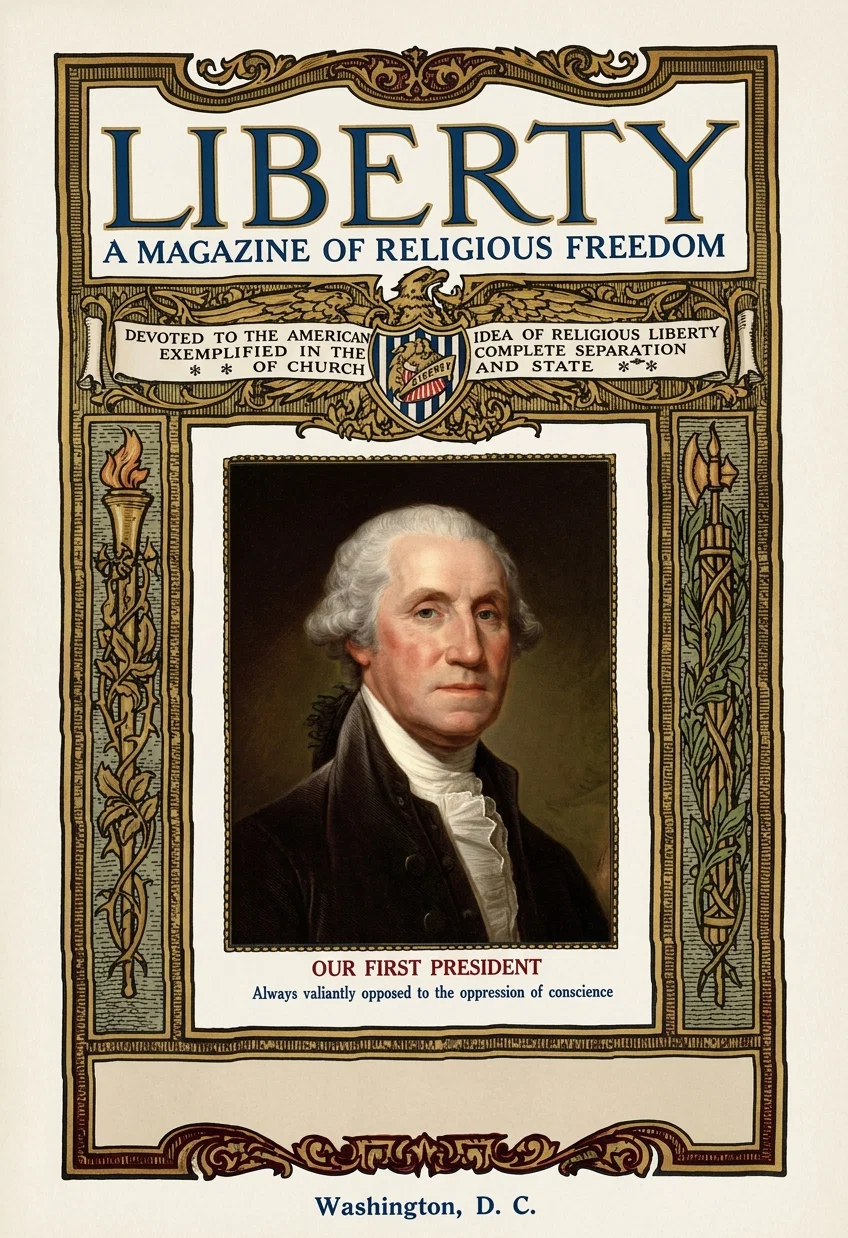
In the issue of LIBERTY for the second quarter of 1910 occurs the most complete report of the hearing on the Johnston Sunday bill before the House Committee on the District of Columbia that is likely to be published.
The Johnston Sunday bill is calculated to enforce Sunday observance in the District of Columbia. The District of Columbia as the seat of the national government is under the direct supervision and control of Congress, and a law to regulate Sunday observance in this territory would be secondary only to a national enactment. For this reason the hearing on this bill is considered the most important hearing on any Sunday bill ever held. Prof. W. W. Prescott, one of the chief speakers at the hearing, considers it the most satisfactory hearing ever held, from the standpoint of the opponents of the bill.
OUR FIRST PRESIDENT
George Washington, 1789-1797
OUR FIRST PRESIDENT George Washington, 1789-1797
At the time of the hearing the large committee-room in which it was held was crowded to the doors, and an intense interest was manifested.
No Seventh-day Adventist should fail to read the report of this hearing in LIBERTY, and to do all in his power to increase the circulation of this issue. At least one hundred thousand copies of this publication should be circulated within the next three months.
The number is very attractive, and ought to find a good sale everywhere through agents. One feature which will especially appeal to those to whom it is presented is the reproduction of pictures of the principal rulers of the world. Every one will be interested in seeing the faces of the sovereigns of the various countries, from the king of England to the boy emperor of China. This feature alone will help greatly in the sale of the magazine. LIBERTY is now ready to mail. Agents should get in their orders early.

In the Book Department

"Making Home Happy"

A great many people have gotten the idea that "Making Home Happy," by Mrs. L. D. Avery-Stuttle, is a book intended only for children, belonging to that class of literature generally termed, with a certain degree of mild sarcasm, "Sunday-school books." This is a mistake. "Making Home Happy" is a good, live, thoroughly interesting story. It is not a sugar-coated pill, but deals with real human characters and experiences. Read the first chapter of it, and you will then read the rest, not because you have to, but because you want to. You will follow with sympathetic interest the experiences of Paul and Emma Beardsley and their companions and of Old Pete, the converted drunkard, who finally finds his mistreated runaway son on the Western prairies.
Young people will read the book with as much interest as any other book in the library, and with greater benefit. Older ones will gain a new experience in reading it, for it teaches in a most impressive way an important lesson. There are smiles or tears in every chapter.
Prices: In cloth, 50 cents; in paper, 25 cents. Order from your tract society or from the publishers.

"Talks With My Students"

There are just a dozen chapters embraced in the eighty-four pages of the little book, "Talks With My Students," by Frederick Griggs, and they cover as many different phases of character building. It was the custom of Professor Griggs for a number of years to deliver short morning talks to his students as they assembled ready for work. Some of these talks were stenographically reported, and a selection was made to form this book.
Not alone to educators or students will "Talks With My Students" be interesting and helpful reading, but to all who are giving the thought to the development of Christian character that the problem demands.
In cloth, with title stamped in gold, this makes a neat volume, very suitable for a gift book. The price is 50 cents. Copies may be obtained through any tract society or direct from the publishers.

The Teacher's Choice

Some time ago the teacher in a Western public school asked her pupils to bring in for examination all the books that they had bearing upon physiology, that one might be selected from which she could read to the school. A number of books were brought in by the students, and of them all the one that was selected by the teacher was "The House We Live In," by Vesta J. Farnsworth.
"I have not seen a book better adapted for the schoolroom," the teacher said. "It is ideally arranged for presenting the facts about the body in such a way as to interest the young people. It reads more like a story than a text-book, and in this way holds the attention of the child perfectly."
"The House We Live In" is a book which is not alone valuable in the school-room, but which is of special use to parents in teaching their children to take an active interest in the care of the body.
Order From Your Tract Society, or Direct From the Review and Herald Publishing Association, Washington, D. C.

Warning the Cities

MRS. E. G. WHITE
THE spiritual darkness that covers the whole earth to-day, is intensified in the crowded centers of population. It is in the cities of the nations that the gospel worker finds the greatest impenitence and the greatest need. In these same wicked cities there are presented to soul-winners some of the greatest opportunities. Mingled with the multitudes who have no thought of God and heaven, are many who long for light and for purity of heart. Even among the careless and indifferent, there are not a few whose attention may be arrested by a revelation of God's love for the human soul.
The record of crime and iniquity in the large cities of the land is appalling. The wickedness of the wicked is almost beyond comprehension. Many cities are becoming a very Sodom in the sight of heaven. The increasing wickedness is such that multitudes are rapidly approaching a point in their personal experience beyond which it will be exceedingly difficult to reach them with a saving knowledge of the third angel's message. The enemy of souls is working in a masterful manner to gain full control of the human mind; and what God's servants do to warn and prepare men for the day of judgment, must be done quickly.
The conditions that face Christian workers in the great cities, constitute a solemn appeal for untiring effort in behalf of the millions living within the shadow of impending doom. Men will soon be forced to great decisions, and they must have opportunity to hear and to understand Bible truth, in order that they may take their stand intelligently on the right side. God is now calling upon his messengers, in no uncertain terms, to warn the cities while mercy still lingers, and while multitudes are yet susceptible to the converting influence of Bible truth.
Often the needs of the cities have appealed to those who understand by the prophecies what is coming upon the earth, and yet comparatively little has been done to enter these cities with the warning message of present truth. The Spirit of the Lord is still urging men to undertake this work with new courage and zeal, and never cease the effort until a thorough work is done.
The Lord is in earnest with his people. Long have they delayed entering the cities; and now they must seek to redeem the time. With heart and soul and voice they must respond to the summons of the Master of the vineyard to enter the cities, and work as laborers together with God for the winning of precious souls.
A little has been done in years past, it is true, in a few cities; but in order to meet the mind of the Lord, those in responsibility must plan for the carrying forward of a broad, well-organized work. They must enter into this campaign with a determination to make God their trust, and to labor with unflagging zeal. Thus they will be enabled to do a strong, solid work, and will gain confidence to continue the effort in other places.
For the accomplishment of all that God calls for in warning the cities, his servants must plan for a wise distribution of the working forces. Often the laborers who might be a power for good in public meetings, are engaged in other work that allows them no time for active ministry among the people. For the conduct of affairs at the various centers of our work, those in responsibility must endeavor, as far as possible, to find consecrated men who have been trained in business lines. There is constant necessity of guarding against the tendency to tie up at these centers of influence men who could do a larger and more important work on the public platform, in presenting before unbelievers the truths of God's Word.
As those who have talent to labor in the cities, enter upon this work, even at considerable personal sacrifice, the blessing of heaven will rest upon them. The cities everywhere are calling for earnest, whole-hearted labor from the servants of God. Had this work been done years ago, what changes would have been wrought in the experiences of many souls! O that every believer would appreciate the fact that the Lord has a definite and decided work for each of his servants to perform!
When Christ was upon the earth, he faithfully warned the cities, as well as the regions round about. Of him it is recorded in Holy Writ that, following his return to Nazareth after the temptation in the wilderness, he “dwelt in Capernaum, which is upon the seacoast, in the borders of Zabulon and Nephthalim, . . . by the way of the sea, beyond Jordan, Galilee of the Gentiles; the people which sat in darkness saw great light; and to them which sat in the region and shadow of death light is sprung up.” Jesus went from city to city, and from village to village, teaching the truth and healing the sick.
The message of the third angel of Revelation 14 is now to be proclaimed not only in lands far off, but in neglected places close by, where multitudes dwell unwarned and unsaved. God is calling his people at this time to a long-delayed work. Decided efforts are to be made to enlighten those who have never yet been warned. The work in the cities is now to be regarded as of special importance. Let workers be carefully selected, to labor two and two in the cities, in harmony with the counsel of experienced leaders, and under the direction and commission of Jesus Christ.
God desires his people to labor in perfect harmony in an effort to carry the truth into the cities. I am bidden to keep this matter before the attention of the believers, until they shall be aroused to a realization of its importance. Let not ill-advised lips utter words of discouragement, but let every one in responsibility unite in planning for the accomplishment of this work, knowing that he who has led his servants hitherto will not fail them in this time of special need. Angels of God will go before the workers, and will be their sufficiency. Angels will be in the assemblies to make an impression upon the hearts of the hearers.
The believers in every church should be aroused to take hold of this work. Let ministers, physicians, and all who know the truth, go about the Lord's work in a sensible way, with Bible in hand, and with heart open to receive divine instruction. Let them look unto Jesus, the author and finisher of their faith. If they have a proper sense of the sacredness of the work that Christ desires them to do, their ministry will be marked by a sacred influence that will give evidence of its heavenly inspiration.
In order that the work in the cities may be carried on as rapidly as possible, careful attention should be given to thedistribution of laborers who are qualified to engage in this line of work. While it is in the order of God that strong institutional centers be maintained in connection with the publishing, educational, and medical work, yet it is not his design that institutional work shall be carried forward in a way that will tie up too many men of special talent, and thus rob the field of the help that these men could render in the proclamation of the message.
Much thought and labor are given to the circulation of the printed page. This is well, and efforts along this line are never to be permitted to slacken; but if more of an effort than is now put forth were given to the sending out of the living missionary to preach the truth, many, many souls would be aroused and won to Christ. While Jesus ministers in the true sanctuary above, he is by his Holy Spirit working through his earthly messengers. The word of the living preacher will often accomplish even more than the printed page. As the Lord's servants go forth trusting in divine power, the Master of the vineyard will work through his chosen ministers, bestowing upon them his Spirit, and fulfilling to them the assurance, “Lo, I am with you alway, even unto the end of the world.”
Those who are Christian physicians may do a precious work for God as medical missionaries. Too often so many things engage the minds of physicians that they are kept from the work that God would have them do as evangelists. Let the medical workers present the important truths of the third angel's message from the physician's view-point. Physicians of consecration and talent can secure a hearing in large cities at times when other men would fail. As physicians unite with ministers in proclaiming the gospel in the great cities of the land, their combined labors will result in influencing many minds in favor of the truth for this time.
From the light that God has given me, I know that his cause to-day is in great need of the living representative of Bible truth. The ordained ministers, alone, are not equal to the task. God is calling not only upon the ministers, but also upon physicians, nurses, canvassers, Bible workers, and other consecrated laymen of varied talent who have a knowledge of present truth, to consider the needs of the unwarned cities. There should be one hundred believers actively engaged in personal missionary work, where now there is but one. Time is rapidly passing. There is much work to be done before satanic opposition shall close up the way. Every agency must be set in operation, that present opportunities may be wisely improved.
The Lord is calling upon men and women who have the light of the truth for this time, to engage in genuine personal missionary work. Especially are the church-members living in the cities to exercise, in all humility, their God-given talents in laboring with those who are willing to hear the message that should come to the world at this time. There are great blessings in store for those who fully surrender to the call of God. As such workers undertake to win souls to Jesus, they will find that many who never could be reached in any other way, will respond to intelligent personal effort.
Some have been fearful of undertaking work in the cities, because this would mean hard and continuous labor and the investment of considerable means. In some conferences it has been regarded as commendable to keep the laboring forces reduced to a minimum, and thus save up means, and show a large surplus in the treasury,—a surplus that might have been wisely expended in diligent, efficient labor. Those who have been influenced by such considerations, need to gain an understanding of the magnitude of the gift that the Lord has made for the salvation of a lost world. The Lord can not accept as workers those who, knowing the truth, can go on day by day, carrying no real burden for those who know it not. Many are in need of a new conversion.
The truth should be everything to believers. When it becomes not only a matter of intelligence, but a quickening power in the life, believers will reveal a piety and grace that will distinguish them from worldlings. When truth really finds entrance to the heart, it works with convincing power. Truth is a divine sentiment, a living element that can not help revealing itself in the life of the receiver; it will work with convincing power in the soul of every one who gives himself unreservedly to God to be used as a messenger for the saving of the lost.
The labors of the apostles in the early Christian church were characterized by wonderful manifestations of the power of God in the lives of the believers. Through the inspiration of the Holy Spirit, multitudes were brought to a knowledge of the truth as it is in Christ Jesus. The needs of the world to-day are no less than they were in the days of the apostles. Those who labor for souls in these times of impenitence and unbelief, must yield themselves wholly to God, and work in unison with heavenly intelligences. The power of the Holy Spirit will accompany the labors of those who dedicate their energies and their all unreservedly to the completion of the work that must be done in the last days. Angels from heaven will co-operate with them, and many will be brought to a knowledge of the truth, and will gladly cast in their lot with God's commandment-keeping people. Means will flow into the treasury; strong laborers will be raised up; the unwarned fields of the great regions beyond will be entered; and the work will soon close in triumph.

Raised to the Kingdom for Such a Time as This

DAVID PAULSON, M. D.
There are many who respect present truth only because their parents loved it. They can not satisfy themselves that this truth is developing a people, who, generally speaking, are better neighbors or sweeter Christians or more refined than are many other professed Christians. So they entirely overlook the significance of the special truths that are kept alive in these earthen vessels.
Fifteen hundred years after Moses died, it was said of him that he chose to suffer affliction with the people of God. Heb. 11:25. But on close inspection we find many of his people with the grave-clothes of Egyptian habits still clinging to them. They were so saturated with a murmuring and complaining spirit that when God himself set a table for them in the wilderness, they did not even have enough ordinary table manners to keep from complaining and finding fault with the food that he provided for them.
Then why were the children of Israel, in spite of all these shortcomings, called “the people of God”?—It was becausethey kept alive in the earth in their generation some vital truths which the other nations did not possess. But, sad to say, while they kept these truths alive, these same truths did not get a chance to keep the children of Israel alive. One by one their carcasses fell in the wilderness, and their bones lay there bleaching in the Arabian sun. Only two of their number permitted those great and special truths that they were keeping alive in the earth to do enough for them to keep them alive so they could pass into the earthly Canaan.
No doubt millions of interesting and thrilling experiences have occurred during the ages, which are not even hinted at in the divine record, but this account of the children of Israel was left on record especially for the benefit of those who would be living at “the end of the world” (1 Cor. 10, 11, Syriac Version), or, in other words, the last generation.
At this time some special truths are again due this old world, and it is God’s purpose again to raise up a people like the children of Israel, whose mission it is to keep these truths alive in the earth; and lest we should receive no greater benefit than did the church in the wilderness, this full account of their experience was written for our admonition, that we might not “fall after the same example of unbelief.”
This is a vital question: Does this present truth contain some active spiritual antitoxins which can neutralize the virulent moral toxins that are abroad in the land to-day?
The poison of diphtheria is so intense that one part of it will kill ten million parts of human flesh; but as soon as the child becomes infected, its blood begins to make an antitoxin to neutralize the diphtheria poison and save the child’s life.
One of the most important discoveries in modern agriculture is the principle that for every destructive bug that the farmer has to contend with, somewhere there is a good bug which will destroy the bad bug. A few years ago a certain insect nearly destroyed the orange crop of California. Millions of dollars was spent in spraying the fruit and endeavoring to exterminate the pest, but all in vain. The fruit crop seemed doomed. Then a good bug was imported from Australia, whose mission seemed to be to eat up the insect that was destroying the orange crop. It multiplied so rapidly that in a few years it saved the crops.
This is only an illustration in the physical realm of something that is even more true in the spiritual realm. The devil has never taken God by surprise. Even before sin came into the world, the remedy for it was provided.
There are abroad in the world to-day certain pestilential errors that are demoralizing the mental, moral, and physical welfare of the present generation. Is it not reasonable that God should commit to some people certain truths that are genuine antitoxins for these various erroneous ideas, habits, and practises?

The Antitoxin for Spiritualism

During the last few years Spiritualism has literally become epidemic, one reason being that it has recently become scientific. As is well known, scientists reject what they can not weigh, measure, photograph, or otherwise demonstrate by well-recognized laws.
In the estimation of scientific men, Spiritualism has been simply sleight-of-hand performances which could not bear scientific investigation. A few years ago a fakir in India astonished multitudes by holding a rope over a bare paving-stone, making a few passes with his other hand, and directly all in the audience saw a snake crawling up the rope. But a wide-awake American in the crowd took a kodak photo of the performance, and when the picture was developed, nothing was seen but the rope. In other words, the rope was real, while the snake was simply in the eyes of the hypnotized audience.
I have frequently had patients suffering with delirium tremens who insisted most energetically that they could see snakes crawling up their bed posts. But I could not see them, nor would the photographic camera have seen them. They existed only in the disordered brain of the patient.
Scientific investigators have likewise maintained that spiritualistic manifestations were simply hypnotic tricks imposed on those who were present. But now the powers of darkness have come out distinctly into the open. Photographs have been taken of tables suspended in mid-air without any known support. A perfectly visible hand, entirely detached from any visible human body, has not only been felt, but has been photographed, and a number of other severe tests have been successfully applied.
Spiritualism is also being turned to enormous commercial advantages. Recently an enterprising promoter of a tooth-paste company in Germany secured the unqualified indorsement of Martin Luther’s “spirit,” and as a consequence in a few weeks sold one hundred ten thousand dollars’ worth of stock. In the recent political struggle in England a spiritualistic medium secured from Gladstone’s “spirit” his advice to voters in the coming election. It is asserted that many of our leading business men in this country do not make any important financial investment without consulting spiritualistic mediums.
Who has the antitoxin for this satanic delusion?—Not the average scientific man; he is believing it, for it meets his tests: not the average Christian in the churches about us, for he believes that his dead relatives have simply stepped behind the veil, that the spirits of leading departed Christian workers are hovering over their assemblies, adding by their presence a benediction to the occasion. To one who believes all this, it is not a large stretch of faith to have these very spirits become visible.
No, it is only those Christian people who can read from their Bibles clearly and decisively the words, “The dead know not anything.” They, and they only, have the antidote for this spiritualistic poison.
But it is not enough to be able in a negative way to deny Spiritualism. There is in the human heart a craving for the supernatural. If God does not get a chance to satisfy this craving, the devil will. It is for us to have such a daily, personal contact with the divine as to be able to show by a transformed life that the kingdom of God within us is a mightier force for good than the kingdom of darkness can possibly be for evil in the hearts and lives of any of its subjects. And that means that while multitudes are turning toward familiar spirits and unto wizards that peep and that mutter, we should be seeking unto our God (Isa. 8:19), and thus becoming Spirit-filled men and women through whom Christ can operate to his glory.
(To be continued)
Hinsdale, Ill.

The Oldest Lodge

T. H. JEYS
Since reading Elder G. O. States's excellent articles on lodge experience, I am reminded of one lodge, which, though not often mentioned by name, is nevertheless much in evidence. It is called the Ancient Order of Free and Accepted Grumblers.
It is rightly called ancient. Its history can be definitely traced back to him who said, “I will be like the Most High.” A long line of noteworthy members could be given, among which would appear such illustrious names as Lucifer, Cain, Korah, Dathan, Abiram, Miriam, etc. These were all past masters in the mysteries of the order. The lodge was in a flourishing condition in the days of Nehemiah, and many of the staunch members were heard saying, “The strength of the bearers of burdens is decayed, and there is much rubbish; so that we are not able to build the wall.” Later, some high in the mysteries of the order were heard saying, “To what purpose is this waste? for this ointment might have been sold for much, and given to the poor.”
But this lodge is not ancient only; it is also modern. In every village and hamlet may still be discerned the sure evidence that it has lost none of its ancient vigor. Still may be heard the cry, “Ye take too much upon you, seeing all the congregation are holy.”
While we eliminate from our lives these other lodges, which are at best but a makeshift, and wholly unnecessary, let us also be sure carefully to separate from this ancient and modern machinery of mystery and mischief, which is wholly a guild of iniquity.
Campobello, S. C.

Contentment Without Anxious Thoughts

He that troubleth not himself with anxious thoughts for more than is necessary, lives little less than the life of angels, while by a mind content with little, he imitates their want of nothing.—Cave.

J. O. CORLISS

The History of the Hebrew Sanctuary—No. 11

J. O. CORLISS

Its Northern Competitors

The reckless course of Solomon’s life intensified a spirit of discontent in his kingdom, which had been rife for an indefinite time, and so hastened a long-delayed national crisis. About a year after the king’s death, his son Rehoboam went to Shechem, the ancient capital of the kingdom, to be crowned king, as his father’s successor. Taking advantage of the fact that the chief city of Ephraim still remained the seat of the nation’s coronation services, notwithstanding Jerusalem’s prominence, the representatives of that tribe came to Rehoboam, and respectfully, but firmly, stated their grievances regarding the treatment they had received from the late king his father, and asked relief from the same as the price of their proffered allegiance.
Three days were required in which to decide the future policy of government. The answer returned was a fateful one,—“for the cause was from the Lord,” that Ahijah’s prediction (see preceding article) might be brought to pass. 1 Kings 12:14-16. At this all Israel, except the tribe of Judah, and the southern part of the tribe of Benjamin (verse 20, as rendered by the Seventy, and also Jer. 6:1) revolted, and chose for their king Jeroboam, a very prominent Ephraimite, whom Solomon’s hatred had driven to Egypt (1 Kings 11:40), but who now was returned to his native heath. From this time on, Judah and Israel were to have but few things in common. In fact, under the ever-changing circumstances of the northern kingdom’s career, a public race hatred sprang up between the two nations which forbade the exchange of all courtesies between them. John 4:9.
Being so completely separated in social life, steps were taken to divide the religious sentiment as well. It wouldappear that at first there was no design to depart from the worship of Jehovah, but simply so to change the religious ceremonies as to alienate the minds of the northern tribes from the sanctuary at Jerusalem. 1 Kings 12:27. The first step in this movement was to establish places of worship in the northern kingdom. Two altars accordingly were set up, one at Dan in the far north, and the other but twelve miles north of Jerusalem, at Bethel, the consecrated abode of the patriarchal sanctuary. At each of these rival sanctuaries was erected a golden figure of Egypt’s sacred calf, and before it was placed a writing: “Behold thy gods, O Israel, which brought thee up out of the land of Egypt.” Verse 28.
It seems that the sanctuary at Dan was consecrated first, it being farthest away from the former place of worship. But when the king attempted to perform a similar service for the one at Bethel, a nameless prophet was present from Judah, to cry out, not so much against the king, but “against the altar,” which was being set apart as rival to the true sanctuary altar at Jerusalem. At the prophet’s word the altar was rent asunder, as a sign of God’s displeasure upon its existence. But Jeroboam was not to be deterred from his purpose. He not only maintained the altars at Dan and Bethel, but following the precedent of Solomon, who deposed Abiathar, the Lord’s priest (1 Kings 2:27), Jeroboam set aside all the regularly constituted priests in his realm, and made priests of the lowest of the people, those whom he could control in the interest of his own predilections. 1 Kings 12:31; 13:33. He also changed the dates of the annual feasts, special mention of which is made regarding the feast of tabernacles, which he caused to be celebrated on the fifteenth day of the eighth month, instead of the corresponding day of the seventh month. 1 Kings 12:32. Although constant war was waged between Jeroboam and Rehoboam, and even Bethel itself was captured by Rehoboam’s son Abijah, yet there is no record that steps were ever taken by either of these kings of Judah to remove the rival sanctuary, or in any way to discourage the delusive worship of its golden calf. 2 Chron. 13:19.
On the other hand, the sanctuary of Bethel survived the monarchy of Samaria (2 Kings 17:28) about one hundred years, or until it was overthrown and destroyed by Josiah, king of Judah. 2 Kings 23:15. During the three hundred years of its existence, the people evidently had come to regard the calf as God. See Hosea 8:5; 13:2. The common statement concerning the kings of that period is that they walked in all the sins of Jeroboam. It may not be out of place here to study briefly the nature of Jeroboam’s sin. It could not have been his revolt against the house of David; for this was laid upon him by the prophet of God.
Was it then the sin of idolatry? This had been practised by Solomon, and was even then the custom of Rehoboam, against which Jeroboam had constantly protested. In his effort to preserve belief in the unity of God, and so keep the first commandment, he violated the commandment which forbids the worship of earthly objects. As tersely stated by another: “The mere fact of setting up such a likeness broke down the sacred awe which had hitherto marked the divine Presence, and accustomed the Israelites to the very sin against which the new form was intended to be a safeguard. From worshiping God under a false and unauthorized form, they gradually learned to worship other gods altogether.”
It is safe to say that the national worship of Israel conducted at Dan and Bethel, paved the way for the later introduction of temples to Baal and Ashtaroth, at Samaria and Jezreel, the religion of which brought that nation to a much lower moral level than Judah had ever gone. Thus Jeroboam’s course in religious matters was that which led all Israel, and Judah, in part, into sins so gross as to defy all rules of decency, and thus brought divine displeasure upon them.
Jeroboam’s principle that the end sought justifies the means, did not cease with Israel’s active career. The divine character is even now degraded in Christianity by engaging in sincere, though questionable methods to secure desired results, such as unity of systems to gain popular sentiment; forms of entertainment to hold influence over members, and others of the same nature. Through these very things the faith of mankind has been undermined, so that which was thought to be beneficial, has corrupted the church, and led many souls into sin and down to ruin.
At last, in the days of Ahab, the wild license which accompanied the idolatrous worship of Israel, became a byword throughout the nation. 2 Kings 9:22. For Jezebel, Ahab’s Phoenician wife, two sanctuaries were set up,—one for Ashtaroth, with its accustomed grove, and four hundred attending priests, or “prophets of the groves” (1 Kings 16:33; 18:19), and the other dedicated to Baal, having four hundred fifty priests, or prophets. This sanctuary was a remarkably complete building, so large that all the worshippers of Baal could crowd into it. 2 Kings 10:21. It was said by those who saw it that its interior contained carved images of the inferior Phoenician deities, with the statue of Baal, the sun-god, in the center. We know, however, that the figure of Baal was there, as a conspicuous object. 2 Kings 10:27; 3:2.
So strong indeed had Baal worship become, that worshippers of the true God were hunted to their death. Some hid in caves and dens of the earth. 1 Kings 18:4, 13, 22. Probably these caves were in the region of Mount Carmel. See Amos 9:3. Others wandered about in the mountains or in deserts, with no clothing except the skins of animals. Heb. 11:37, 38. This state of things was a type of that which will be again, when the remnant few are again driven out by the majority of popular worshippers, who cling to a relic of sun-worship as a sacred thing, the worship of which will be enforced by law. Then will appear Elijah in his true rôle, as predicted by the prophet. Mal. 4:5.
Mountain View, Cal.
Continue reading: Standing on the Rock of Ages