Your ShelfYour Projects

Review and Herald, Vol. 89, No. 39.

Thanks to the Schools

Review and Herald

Sep 26, 1912

Review and Herald Publishing Association · Takoma Park, Washington, D. C. · Sep 26, 1912

Thanks to the Schools

[On the thirteenth Sabbath of the second quarter, this year, the Sabbath-schools contributed for the purchase of the Selukwe Reserve, in Rhodesia, and the planting of a new mission station in the Dark Continent.]
Thanks to the Sabbath-schools of America for the money raised in June to enable us to open up mission work in the Selukwe Reserve. The word reached us within a week from the time we received the lease. We are sure the Lord has arranged this in his own good time and way; and we are now en route for the new field with hearts full of courage.
T. J. Gibson. On trek for Selukwe Mission, Rhodesia, Aug. 13, 1912.
Cover Design in Two Colors

A GOOD PROPOSITION FOR AGENTS

Prices: 25 cents a year (35 cents after Dec. 31, 1912), 10 cents a copy; 5 to 40 copies, 5 cents each; 50 or more copies, 4 cents each.
Send 10 cents for sample copy. Better still, send $1.00 for 20, or $2.00 for 50. Discount to agents on yearly subscriptions.

"Catholic Federation" and "Sunday Mails" Number

Beginning with Jan. 1, 1913, the subscription price will be 35 cents a year, or $2.00 for 10 copies, one year, to one or more addresses.
COVER: "ENTRANCE TO WHITE HOUSE"
Two Editions Exhausted by August 31

PARTIAL CONTENTS

Frontispiece: Photograph of Senate Sunday Mail Report, printed upon silk and displayed in office of Postmaster-General Rome and the Prohibition Party Platform Establishing God's Kingdom by Law God's Example of Religious Liberty Putting the Church Over the State in Ecuador American Principles in the Balance—a history of the famous Senate Sunday Mail Reports Religious Liberty in Puritan Times Absurdity of Proposed California Sunday Law Proposed California Sunday Law Un-American A World Survey of Religious Freedom Religious Liberty by Divine Authority Report of Convention of American Federation of Catholic Societies Temperance the Question of the Century

SPECIAL OFFER ON TEN, ONE YEAR

Good only until Jan. 1, 1913. Ten copies, one year, to one address or to ten separate addresses, only $1.50, or 15 cents each. Sender may include his name as one of the ten. This number should be placed in the hands of every editor, attorney, clergyman, city and county official, and public-school teacher in your county. We can furnish the names and addresses.

ORDER THROUGH OUR NEAREST AGENCY

If you don't know the address of our Agency, ask "Liberty Magazine," Washington, D. C.

SPECIAL OCTOBER FEATURES

PRICES, POST-PAID
PRICES, POST-PAID

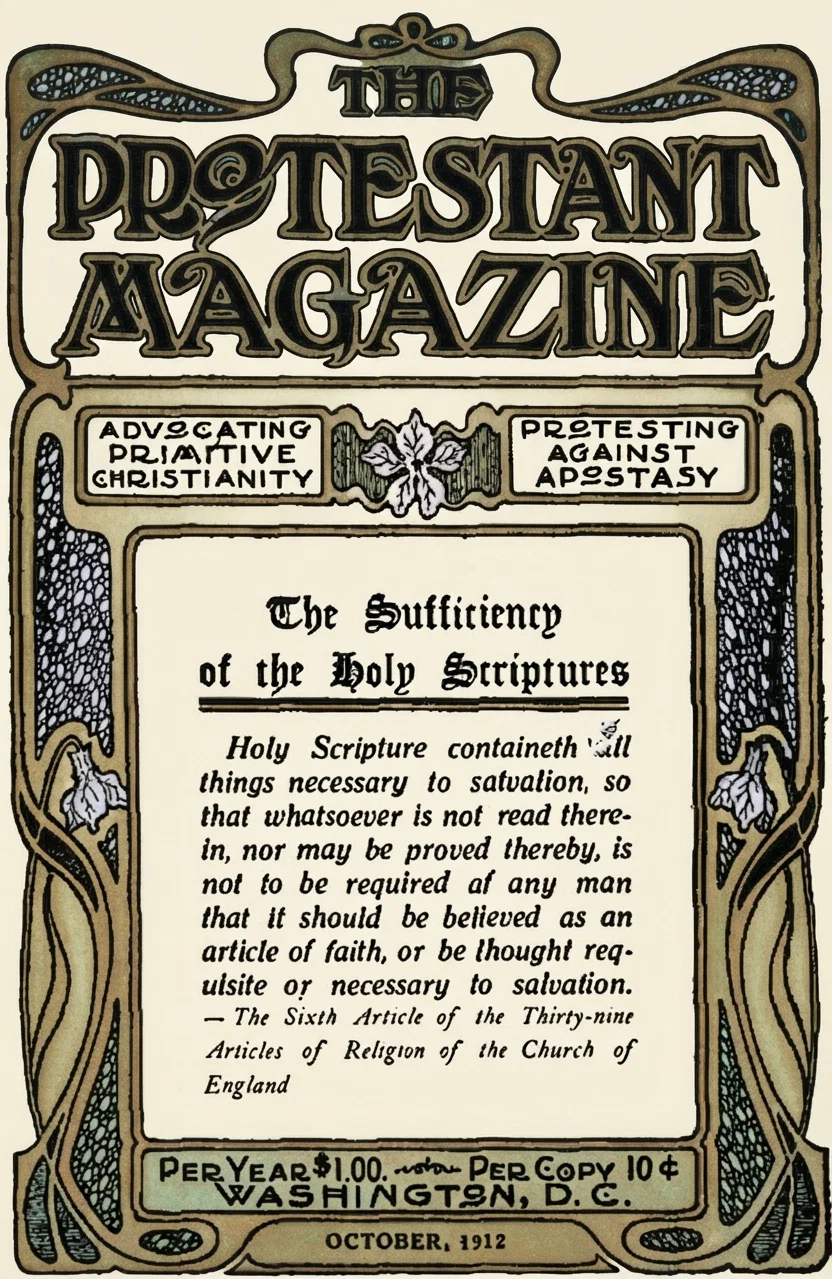
The "Rome in Prophecy" and "Marriage Laws" Number

NOW A MONTHLY! $1.00 A YEAR 10 CENTS A COPY

SPECIAL OCTOBER FEATURES

Double Frontispiece: Photographs of "Catholic Marriage Certificates," and "Roman Catholic Idolatry in Boston" Rome and Marriage Again—Rome's defeat in Canada Alexander Campbell on Romanism in Prophecy The Protestant Attitude Report of Presbyterian Assembly on Romanism The Seven Sins of the Roman Church Rome's Substitution of Human Mediators for Christ The Privilege of Peter (Concluded) A Catholic Convert in Brazil Advertising Protestants as Heretical Another Military Mass "Giving America Away" to Rome The Pope's Authority The Lion and the Lamb
PRICES, POST PAID Yearly subscription - - - - - $1.00 Six months - - - - - .50 (Subscriptions for less than six months not accepted) Three years - - - - - 2.00 Five Years - - - - - 3.00 Five copies, one year, to one or more addresses - - - - - 3.00 NO EXTRA CHARGE ON FOREIGN SUBSCRIPTIONS

SPECIAL OFFER ON FIVE, ONE YEAR

Five copies, one year, to one address or to five separate addresses, only $3.00, or 60 cents each. Sender may include his own name. Or, send $1.50 for ten copies six months. This number should be placed in the hands of every editor, attorney, clergyman, city and county official, and public-school teacher. We can furnish the names and addresses.

ORDER THROUGH OUR NEAREST AGENCY

If you don't know the address of our Agency, ask "Protestant Magazine," Washington, D. C.

The Earth Made New

F. FREDERICK BLISS
FIERCE, rolling waves of maddened mien, And maelstroms wild of depths unseen; Strong ships on fair and happy quest, Struck mad by waves at death's behest; O sea, thy better self is due:— Eternal calm in earth made new!
Fair fields of earth with thorns o'er-grown, And wrecks of storms fore'er o'erstrewn, Your cities foul with sin's dread pest, Worth scarce surviving at the best,— Ah, fields of earth, refreshing dew Distils once more in earth made new!
Pain-throbbing heart of ruined race, With honor prone in dark disgrace, With love's fond treasure all despoiled In wreck of world by sin embroiled,— Dear breaking heart, thy God to you Speaks hope again, in earth made new.
Springfield, Mo.

"Have Ye Received the Holy Ghost?"

GEO. E. HOLLISTER
"He said unto them, Have ye received the Holy Ghost since ye believed?" Acts 19:2. This is a question for us to-day as truly as it was for the believers in the days of the apostles. We should be studying this all-important theme with the greatest earnestness and the deepest interest. Let us read that question again, "Have ye received the Holy Ghost since ye believed?" That question was indited by the Holy Spirit, and to-day it is put to us through the same divine agency:—
"In my dream last night a sentinel stood at the door of an important building, and said to every one that came for entrance, 'Have you received the Holy Ghost?' A measuring line was in his hand, and only few, very few, were admitted into the building. Suppose, brethren, that it had been the question at the door as we came in, what would we have said?"—General Conference Bulletin, 1909.
What do you suppose was the purpose of that "measuring line"? Perhaps it was to measure the character of each applicant, and thus to ascertain whether or not he had received the Holy Ghost; for that was the passport, or qualification, for entrance into that building. Well, then, what must be that measuring line, or standard, by which we are tested? The inspired writers reply, "God shall bring every work into judgment, with every secret thing, whether it be good, or whether it be evil." Eccl. 12:14. "God shall judge the secrets of men by Jesus Christ according to my gospel." Rom. 2:16. "Thou art weighed in the balances, and art found wanting" (Dan. 5:27), God said to Belshazzar.
"Few, very few, were admitted into the building." May God in his infinite mercy spare us a little longer, and help us to be willing to receive that priceless gift. "That wondrous gift abused, forever turns away." "It is not so much a question of receiving the Holy Spirit [in the great outpouring] as in yielding to the Holy Spirit already given." We may ask, When, where, and how has the Spirit been given? Nehemiah says: "Thou gavest also thy good Spirit to instruct them," and "yet many years didst thou forbear them, and testifiedst against them by the Spirit in thy prophets." Neh. 9:20, 30. Thus we see, beloved, that the question is easy to answer. Jesus says, "The words that I speak unto you, they are spirit, and they are life." John 6:63. If we have been receiving those words, we can answer in the affirmative.
"Those who follow in the light need have no anxiety lest that in the outpouring of the latter rain they will not be baptized with the Holy Spirit. If we would receive the light of the glorious angel that shall lighten the earth with his glory, let us see to it that our hearts are cleansed, emptied of self, and turned toward heaven, that they may be ready for the latter rain."—Mrs. E. G. White, in Signs of the Times, Aug. 11, 1892.

Peter's Last Epistle and His Death

(Concluded)
FOR many years Peter had been urging the believers to grow in grace and in a knowledge of the truth; and now, knowing that soon he would be called upon to suffer martyrdom for his faith, he once more drew attention to the precious privileges within the reach of every believer. In the full assurance of his faith, the aged disciple exhorted his brethren to steadfastness of purpose in the Christian life. “Give diligence,” he pleaded, “to make your calling and election sure: for if ye do these things, ye shall never fall: for so an entrance shall be ministered unto you abundantly into the everlasting kingdom of our Lord and Saviour Jesus Christ.” Precious assurance! Glorious is the hope set before the believer as he advances by faith toward the heights of Christian perfection!
“I will not be negligent,” the apostle continues, “to put you always in remembrance of these things, though ye know them, and be established in the present truth. Yea, I think it meet, as long as I am in this tabernacle, to stir you up by putting you in remembrance; knowing that shortly I must put off this my tabernacle, even as our Lord Jesus Christ hath showed me. Moreover I will endeavor that ye may be able after my decease to have these things always in remembrance.”
The apostle was well qualified to speak of the purposes of God concerning the human race; for during the earthly ministry of Christ he had seen and heard much that pertained to the kingdom of God. “We have not followed cunningly devised fables,” he reminded the believers, “when we made known unto you the power and coming of our Lord Jesus Christ, but were eye-witnesses of his majesty. For he received from God the Father honor and glory, when there came such a voice to him from the excellent glory, This is my beloved Son, in whom I am well pleased. And this voice which came from heaven we heard, when we were with him in the holy mount.”
Convincing as was this evidence of the certainty of the believers’ hope, there was yet another still more convincing in the witness of prophecy, through which the faith of all might be confirmed and securely anchored. “We have also,”Peter declared, “a more sure word of prophecy; whereunto ye do well that ye take heed, as unto a light that shineth in a dark place, until the day dawn, and the day-star arise in your hearts: knowing this first, that no prophecy of the Scripture is of any private interpretation. For the prophecy came not in old time by the will of man: but holy men of God spake as they were moved by the Holy Ghost.”
While exalting the “sure word of prophecy” as a safe guide in times of peril, the apostle solemnly warned the church against the torch of false prophecy, which would be uplifted by “false teachers,” who would privily bring in “damnable heresies, even denying the Lord.” These false teachers arising in the church are accounted true by many of their brethren in the faith, but the apostle compared them to “wells without water, clouds that are carried with a tempest; to whom the mist of darkness is reserved forever.” “The latter end is worse with them,” he declared, “than the beginning. For it had been better for them not to have known the way of righteousness, than, after they have known it, to turn from the holy commandment delivered unto them.”
Looking down through the ages to the close of time, Peter was inspired to outline conditions that would exist in the world just prior to the second coming of Christ. “There shall come in the last days scoffers,” he wrote, “walking after their own lusts, and saying, Where is the promise of his coming? for since the fathers fell asleep, all things continue as they were from the beginning of the creation.” But “when they shall say, Peace and safety; then sudden destruction cometh upon them.” Not all, however, would be ensnared by the enemy’s devices. As the end of all things earthly approached, there would be faithful ones able to discern the signs of the times. While a large number of professing believers would deny their faith by their works, there would be a remnant who would endure to the end.
Peter kept alive in his heart the hope of Christ’s return, and he assured the church of the certain fulfilment of the Saviour’s promise, “If I go and prepare a place for you, I will come again, and receive you unto myself.” To the tried and faithful ones the coming might seem long delayed, but the apostle assured them: “The Lord is not slack concerning his promise, as some men count slackness; but is long-suffering to usward, not willing that any should perish, but that all should come to repentance. But the day of the Lord will come as a thief in the night; in the which the heavens shall pass away with a great noise, and the elements shall melt with fervent heat, the earth also and the works that are therein shall be burned up.
“Seeing then that all these things shall be dissolved, what manner of persons ought ye to be in all holy conversation and godliness, looking for and hastening unto the coming of the day of God, wherein the heavens being on fire shall be dissolved, and the elements shall melt with fervent heat? Nevertheless we, according to his promise, look for new heavens and a new earth, wherein dwelleth righteousness.
“Wherefore, beloved, seeing that ye look for such things, be diligent that ye may be found of him in peace, without spot, and blameless. And account that the long-suffering of our Lord is salvation; even as our beloved brother Paul also according to the wisdom given unto him hath written unto you. . . . Ye therefore, beloved, seeing ye know these things before, beware lest ye also, being led away with the error of the wicked, fall from your own steadfastness. But grow in grace, and in the knowledge of our Lord and Saviour Jesus Christ.”
In the providence of God, Peter was permitted to close his ministry in Rome, where his imprisonment was ordered by the emperor Nero about the time of Paul’s final arrest. Thus the two veteran apostles, who for many years had been widely separated in their labors, were called upon to bear their last witness for Christ in the world’s metropolis, and upon its soil to shed their blood as the seed of a vast harvest of saints and martyrs.
Since his reinstatement after his denial of Christ, Peter had unflinchingly braved danger, and had shown a noble courage and boldness in preaching a crucified, risen, and ascended Saviour. As he lay in his cell, he called to mind the words that Christ had spoken to him: “Verily, verily, I say unto thee, When thou wast young, thou girdedst thyself, and walkedst whither thou wouldest: but when thou shalt be old, thou shalt stretch forth thy hands, and another shall gird thee, and carry thee whither thou wouldest not.” Thus Jesus had made known to the disciple the very manner of his death, and even foretold the stretching of his hands upon the cross.
Peter, as a Jew and a foreigner, was condemned to be scourged and crucified. In prospect of this fearful death, the apostle remembered his great sin in denying Jesus in the hour of his trial. Once so unready to acknowledge the cross, he now counted it a joy to yield up his life for the gospel, feeling only that for him who had denied his Lord, to die in the same manner as his Master died was too great an honor. Peter had sincerely repented of that sin, and had been forgiven by Christ, as is shown by the high commission given him to feed the sheep and lambs of the flock. But he could never forgive himself. Not even the thought of the agonies of the last terrible scene could lessen the bitterness of his sorrow and repentance. As a last favor, he entreated his executioners that he might be nailed to the cross with his head downward. The request was granted, and in this manner died the great apostle Peter.

The Work in the First Apartment of the Sanctuary

THE work in the first apartment consisted principally of the morning and evening daily services, the individual sin-offerings, and services on feast-days and special occasions. God’s visible presence was manifested in the first apartment, or tabernacle of the congregation. God met and communed with the children of Israel at the first veil, or door, of the tabernacle of the congregation (Ex. 29: 42, 43; 30: 36; Num. 17: 4), where the people presented their sin-offerings before the Lord. At times the cloud of glory, representing the visible presence of the Lord, filled the first apartment so that no one was able to enter. Ex. 40: 34, 35; 1 Kings 8: 10, 11; 2 Chron. 5: 13, 14; 7: 2. God’s presence manifested in the first apartment of the earthly sanctuary was a shadow of the glorious presence and throne of the Father in the first apartment of the heavenly sanctuary, where, after enduring “the cross, despising the shame,” the Saviour sat down “at the right hand of the throne of God.” Heb. 12: 2.
The service each morning and evening was very important. Within the first apartment the high priest offered incense upon the golden altar, and trimmed and lighted the lamps. None but the high priest could perform this sacred work, which typified the adding of the fragrant incense of Christ’s righteousness to the prayers of God’s people to make them acceptable before him. Rev. 8: 3, 4. The high priest also trimmed and lighted the lamps, which were a type of the Holy Spirit emanating from God and shining at some time into the heart of every one, inviting him to accept the Lord and his service. This Spirit shines continually in the life of the individual who is faithful to God.
While the high priest within the sanctuary was performing the daily service morning and evening at the golden altar, the priests in the court were burning the whole burnt offering, the meat-offering, and the drink-offering upon the brazen altar, and the people were gathered without, praying. Luke 1: 10.
When the children of Israel were carried into captivity, the faithful ones prayed, as did Daniel, with their windows open toward Jerusalem. Dan. 6: 10. They turned toward the temple where from the altar of continual intercession the incense had ascended. This was a beautiful type; for, no matter where from the altar of continual intercession we may be, or what the bands that may hold us, if we resolutely turn our faces from our surroundings toward the heavenly sanctuary where Christ pleads his blood and presents his righteousness in our behalf, our prayer of faith will bring peace and joy to the soul, and will break asunder the bands with which Satan has bound us. Christ sets before us “an open door, and no man can shut it.” Rev. 3: 8. It makes no difference what the surroundings maybe, the soul may be free in God; no human being nor the evil one himself can hold in bondage the soul of him who trusts in God. "This is the victory that overcometh the world, even our faith." 1 John 5: 4.
Day by day sinners presented their sin-offerings at the door of the first apartment, and either by the blood sprinkled before the Lord or by a portion of flesh eaten in the first apartment, the confessed sins of the people were transferred in type and shadow to the first apartment of the sanctuary. The priest met the sinner at the first veil of the sanctuary, and carried within the veil either the blood or the flesh. The sinner could not look within the sanctuary. By faith he knew that the priest was faithful to present his sin-offering before the Lord, and he left the sanctuary rejoicing in sins forgiven. In the antitype of that service we confess our sins; and although we can not see the work in the heavenly sanctuary, we know that Christ pleads his blood and marred flesh—the prints of the nails—before the Father in our behalf, and we rejoice in forgiveness of sins. The sins are covered, hid from view. "Blessed is he whose transgression is forgiven, whose sin is covered." Ps. 32: 1. As day by day the sins of the people are transferred to the sanctuary, it becomes defiled, and must be purified, or cleansed. Sins are forgiven and covered when confessed, and will never be uncovered if the one who confessed them remains faithful; but if he forsakes the Lord and turns back into the world, the part of his past life that was covered with Christ's righteousness while he was faithful, appears uncovered on the books of heaven, for having withdrawn from Christ, he must meet the record of his entire life in the judgment. This is very forcefully taught in the parable of the unmerciful servant, who after he had been forgiven his entire debt, dealt harshly with his debtor, and was then required by his lord to pay all that had been once forgiven him. Matt. 18: 23-35; Eze. 18: 24.
The time will come when the sins of the righteous will not only be forgiven, and covered by the blood of Christ, but all trace of them will be removed from the books of heaven forever, and will never come into remembrance again. This blotting out of sin was symbolized by the work in the second apartment of the sanctuary on the day of atonement.
Type Antitype
Ex. 29: 42, 43. Visible presence of God manifested in the first apartment of the earthly sanctuary. Rev. 4: 2-5. The seven lamps were seen in heaven before the throne; therefore the throne and lamps were in the same apartment.
Ex. 30: 7, 8. High priest trimmed and lighted the lamps. Rev. 1: 13. Christ was seen among the golden candlesticks in the heavenly sanctuary.
Ex. 40: 24, 25. The lamps in the earthly sanctuary were burning before the Lord. Rev. 4: 2, 5. The seven lamps of fire were seen burning before the throne of God in heaven.
Heb. 9: 6. The priests went always into the first tabernacle, accomplishing the service of God. Heb. 7: 25. Christ ever liveth to make intercession for us.
Lev. 4: 7; 10: 16-18. By the blood and the flesh the sins were transferred into the earthly sanctuary. 1 Peter 2: 24; 1 John 1: 7. By the merits of the sacrifice of the body and blood of Christ, our sins are forgiven, and he bears them into the heavenly sanctuary.
Lev. 4: 7. The marks of sin touched the horns of the altar. Jer. 2: 22. The actual sin is marked before the Lord in heaven.
Num. 18: 7. None but the priests could look within the veil where the sins were transferred. All that remained of the sin-offering without the veil was burned. All trace of the sin-offering was covered from sight. Ps. 32: 1. When we confess our sins, they are transferred to the heavenly sanctuary, and are covered, nevermore to appear if we are faithful.
Portland, Maine.

Wisdom Is Better Than Weapons of War

“WISDOM is better than weapons of war.”

Early Conversions Desirable

THE right path for life should be found early. Therefore the young are advised to remember their Creator in the days of their youth, before evil habits block the way, or dark sorrows make the life bitter. See Eccl. 12:1-6.
There are many good reasons why this advice is given; but none of them is more important than the one mentioned by Solomon in Prov. 8:17: "Those that seek me early shall find me." The very young have not gone so far out of the way as their elders, and therefore can the more easily find the good path.
In nearly forty years of gospel work I have seen only a very few who had passed the age of fifty seeking for salvation from sin. Indeed, the great majority who find the Saviour and become happy in his work obtain a Christian experience before their physical powers begin to wane.
Jeremiah, who was himself dedicated to the prophetic work by his parents before he was born, and called unto it by the Lord when he was but a child (Jer. 1:4-7), said, "It is good for a man that he bear the yoke in his youth." Lam. 3:27.
It is fully as essential that a person, in order to be a good Christian and a successful Christian worker, begin early in life as it is that one who desires to become an expert in any profession begin that work early. It is the early years of ardent application that tell for the most in making up the sum total in the work of a lifetime.
It is absolutely impossible for any person to do a vast amount of work in any line who neglects to enter upon that work until after the sap of his life is almost gone, and his vital energies are about used up in some other calling. This is not written to discourage those of ripe years and rich experience from working, but it is written to encourage all, and especially the young, to consecrate all their powers to God's service at the earliest opportunity. Only those who begin early can put in a long life of service for God. We sometimes hear men thanking the Lord for the privilege of putting in a score of years or more in soul-saving work; but some, by seeking the Lord early, and faithfully improving the opportunities that came to them for doing good, have been enabled to labor earnestly and well for threescore and ten years. In this way they increased the sum total of their life-work. The little things, as well as the larger ones, which Providence placed in their way, received their attention. Patience strengthened as experience gave approved character to their work, and ability increased as years multiplied into decades, until in heaven it was written of them, "Blessed are these who have sought to walk in the ways of the Lord from the days of their youth even down to old age."
Those converted in their youth have grown up in the love of the truth, and have fitted into every nook and corner of God's work because they never allowed Satan to harden their hearts and destroy their Christian flexibility. These are they whom God could use and has used to best advantage in difficult places in his cause. They did not develop stubbornness, but in gentleness and faithfulness served God all the days of their lives. Even now their citizenship is in heaven (Phil. 3:20), and long ago in their souls' desire they were translated into the kingdom of God's dear Son.
No loathsome chapters of crime darken their record, for they sought and found the Lord before the evil days came. The halls of their memory are hung with bright pictures, photographed from souls converted and victories won for heaven.
Aurora, Ill.

Turned Around

ADDIE S. BOWEN
AFTER a trip by train, trolley, or boat, many a person, on arriving at a destination, finds himself turned around. The sun rises in the north perhaps, not in the east, as it does at home, and behold, it goes down at night in the south, while it ought to be high noon when the sun is in the south; and then as darkness comes on, there is the north star straight in the west. How queer! Yet it is so real that reason and try as earnestly as he may to see that what is seemingly north is really east, the delusion remains as if it were the fact. Even his compass can not change it; the needle quivers around the circle to what is west to him, and there it rests; and though he again and again sets it to his north, it will not stay there. Some persons, however, are quickly set right by the compass, by the sun, the moon, or the pole-star.Let this illustrate conditions in our relation to God and his will concerning us. Naturally, every one is "turned around." In Prov. 21:2 we read, "Every way of a man is right in his own eyes."
In Jer. 17:9 the Lord says the natural heart is deceitful and desperately wicked. We disagree with him, thinking we are good enough, while the Lord says we are on the wrong road, going the wrong way to reach him and his dwelling-place, heaven; which, although not comprehended by the natural heart, is what every sane person desires.
Is not the reason for doing anything that the Book of God says is wrong, found in a desire to get some sort of enjoyment; that is, enjoyment in this present life, to please some or all of the five senses? A man drinks some intoxicant to make him feel good, to drown trouble for a while. Another works hard, and uses wrong methods to get rich, that he may be happier. Another, for the pleasure of taste, eats harmful food or too much good food, and slowly commits suicide. Another takes delight in seeing some one suffer from the lash of his tongue or by his neglect, or finds pleasure in gazing on that which is sinful, or which leads to sinning. The other senses are by nature used for wrong-doing, perverted from the purpose for which the Lord designed them. In the Bible the Lord tells us plainly what real happiness is, and how to find and keep it. Briefly stated, it is to give up our own natural ways of doing that which seems to be right in the pursuit of pleasure or happiness, and to accept God's way.
To Adam and Eve in Eden, to every soul since then, God gave and still gives his only begotten Son to bring peace, rest, and joy in this life, and perfect bliss in the world to come. To believe this is saving faith, real happiness. Those who are turned around, unconverted, think their own schemes for pleasure are right, but the error is no more the truth than north is east.
All through the Bible God points out to humanity the right directions. We are to believe him always, in everything. Eze. 18:30 says, "Repent, and turn yourselves;" the French translation reads, "Convert you, turn you." In Matt. 18:3 Jesus says, "Except ye be converted," etc.; the French says, "Except you change." Peter tells us to repent and be converted (Acts 3:19). Convert is from two Latin words, and means to turn, to change or to be changed from one state to another, from a bad life to a good one, from enmity toward God to love for him. This is both active and passive. The Lord says, "Choose you." Joshua 24:15. He waits. We can choose to be good, but can not make ourselves good. God does what we can not do,—changes our disposition, our purposes, gives us a new heart. Eze. 36:26 and 11:19, 20.
When this change takes place, we are turned from going the wrong way to the right way, and right seems right to us, and our natural ways that seemed right, we now know are wrong. Now it is as with the person who was set right by the compass,—one clear view of God's will and way sets him right.
Others find it very hard to admit that what seems to them right or nearly so, is absolutely wrong, and that they must turn about; yet by his Word and by those who are going in the right direction, the Lord still works to set them right.
Bradford, Pa.

What the Passing of a National Sunday Law Means

1. WHAT is the nature of any movement in favor of religious legislation?
"Any movement in favor of religious legislation is really an act of concession to the Papacy, which for so many ages has steadily warred against liberty of conscience."—"Testimonies for the Church," Vol. V, pages 711, 712.
2. To what does Sunday observance owe its existence, and what will its enforcement be?
"Sunday observance owes its existence as a so-called Christian institution to the 'mystery of iniquity;' and its enforcement will be a virtual recognition of the principles which are the very corner-stone of Romanism."—Id., page 712.
3. What will be the significance of the enacting of a Sunday law by our nation?
"When our nation shall so abjure the principles of its government as to enact a Sunday law, Protestantism will in this act join hands with popery; it will be nothing else than giving life [Rev. 13:15] to the tyranny which has long been eagerly watching its opportunity to spring again into active despotism."—Ib.
4. In what will such legislation result?
"If popery or its principles shall again be legislated into power, the fires of persecution will be rekindled against those who will not sacrifice conscience and the truth in deference to popular errors. This evil is on the point of realization."—Ib.
5. What will the enforcement of Sunday by law mean to our nation?
"By the decree enforcing the institution of the Papacy in violation of the law of God, our nation will disconnect herself fully from righteousness. When Protestantism shall stretch her hand across the gulf to grasp the hand of the Roman power, when she shall reach over the abyss to clasp hands with Spiritualism, when, under the influence of this threefold union, our country shall repudiate every principle of its Constitution as a Protestant and Republican government, and shall make provision for the propagation of papal falsehoods and delusions, then we may know that the time has come for the marvelous working of Satan, and that the end is near. . . . So may this apostasy be a sign to us that the limit of God's forbearance is reached, that the measure of our nation's iniquity is full, and that the angel of mercy is about to take her flight, never to return."—Id., page 451.
6. What may we expect God to do for his people and work when this is done?
"When legislators shall abjure the principles of Protestantism, so as to give countenance and the right hand of fellowship to Romanism, then God will interpose in a special manner in behalf of his own honor and the salvation of his people."—Id., page 525.
7. What will be the sign of the close of probation?
"God keeps a reckoning with the nations. Through every century of this world's history, evil workers have been treasuring up wrath against the day of wrath; and when the time fully comes that iniquity shall have reached the stated boundary of God's mercy, his forbearance will cease. When the accumulated figures in heaven's record books shall mark the sum of transgression complete, wrath will come, unmixed with mercy, and then it will be seen what a tremendous thing it is to have worn out the divine patience. This crisis will be reached when the nations shall unite in making void God's law."—Id., page 524.

Our Words

IN the third chapter of James the tongue is described as a little member, but a powerful instrument of much good and much harm. "If any man offend not in word, the same is a perfect man." Verse 2. In the sermon on the mount, Jesus said, "Be ye therefore perfect, even as your Father which is in heaven is perfect." Matt. 5:48. We are to strive for perfection, therefore we should be very careful of our words. "Who is a wise man and endued with knowledge among you? let him show out of a good conversation his works with meekness of wisdom." James 3:13. "But I say unto you, That every idle word that men shall speak, they shall give account thereof in the judgment. For by thy words thou shalt be justified, and by thy words thou shalt be condemned." Matt. 12:36, 37. How very important, then, that we should guard our words!
"Out of the abundance of the heart the mouth speaketh." Matt. 12:34; Luke 6:45. Surely we need to pray, as did David, "Create in me a clean heart, O God." "Set a watch, O Lord, before my mouth; keep the door of my lips." Ps. 51:10; 141:3. Let us follow in the steps of our Example, in whose mouth was found no guile. 1 Peter 2:21, 22.
Burke, S. Dak.

Thinking Leads to Knowledge

THINKING leads man to knowledge. He may see and hear, read and learn, whatever he pleases, and as much as he pleases, yet he will never know any of it, except that which he has thought over, that which by thinking he has made the property of his mind. Is it, then, saying too much if I say that man, by thinking only, becomes truly man? Take away thought from a man's life, and what remains? —Pestalozzi.
Continue reading: Editorial