Your ShelfYour Projects

Signs of the Times, Vol. 32, No. 38.

DOMINION GIVEN TO CHRIST

Signs of the Times

Oct 3, 1906

Pacific Press Publishing Company · Mountain View, California · Oct 3, 1906

DOMINION GIVEN TO CHRIST.

Jehovah saith unto My Lord, Sit Thou at My right hand, Until I make Thine enemies Thy footstool. Jehovah will send forth the rod of Thy strength out of Zion: Rule Thou in the midst of Thine enemies. Thy people offer themselves willingly In the day of Thy power, in holy array: Out of the womb of the morning Thou hast the dew of Thy youth. Jehovah hath sworn, and will not repent: Thou art a Priest forever After the order of Melchizedek. The Lord at Thy right hand Will strike through kings in the day of His wrath. He will judge among the nations, He will fill the places with dead bodies; He will strike through the head in many countries. He will drink of the brook in the way: Therefore will He lift up the head.

HAVE YOU A COPY OF THE "SIGNS OF THE TIMES" BOOKLET?

It contains help for every individual or society desiring to engage in systematic missionary work. One of our readers, whose opportunities for missionary work are limited, is following one plan outlined in this booklet. She has been mailing one copy of the SIGNS regularly to a friend in Canada. She has recently received a letter from this friend telling her how much she enjoys reading the SIGNS, and how she passes it on to her neighbors, it thus going the rounds, bringing a blessing to each home in her neighborhood. This is only one example of what can be accomplished by small efforts being carried on continuously. You will receive suggestions and encouragement for your work from this booklet.
Note the cover page, with contents given below.
SIGNS OF THE TIMES BOOKLET.

CONTENTS.

1. What the "Signs" Has Accomplished. (a) Number of its Converts in One Conference. (b) Five Noteworthy Examples.
2. Club Rates for Churches. Showing Exact Cost of Any Club —5 to 100 Copies—For Any Period—One Week to One Year.
3. "Signs" Rates. (a) Single New Subscriptions. (b) To Foreign Countries. (c) Renewal Subscriptions. (d) In Clubs. (e) To Agents.
4. Who are Agents?
5. How to Organize and Pay for a Church Club.
6. How to Use the "Signs."
This booklet is filled with encouraging items and valuable suggestions.
Your State Tract Society will be glad to send you a copy free; or address SIGNS OF THE TIMES, Mountain View, Cal.
Copies will be sent free on request. Order from your State Tract Society, or address the SIGNS OF THE TIMES, Mountain View, Cal.

A FRESH STOCK

IT is a great pleasure to us to unpack and announce the arrival of new, fresh stock of such books as are given in the following list:

Helps to Bible Study

Neatly Bound in Paper 25c. Durably Bound in Dark Cloth 50c. New seventh edition. This little work is the outgrowth of the general demand for a series of simple readings covering important points of Bible truth for this time, and adapted for use in private families, especially with those who desire to become better acquainted with the Word of God. This work contains 128 pages. Here are some of the subjects treated:
INCREASE OF KNOWLEDGE AND SIGNS OF THE TIMES; THE HOME OF THE SAVED; THE SECOND COMING OF CHRIST; THE SECOND CHAPTER OF DANIEL; THE SEVENTH CHAPTER OF DANIEL; THE LAW OF GOD AND THE SABBATH; REPENTANCE AND CONVERSION; THE TWENTY-THREE HUNDRED DAYS; THE SANCTUARY; THE JUDGMENT; UNITED STATES IN PROPHECY; THE THIRD ANGEL'S MESSAGE; SATAN, HIS ORIGIN, WORK, AND DESTINY; STATE OF THE DEAD; ETERNAL AND UNQUENCHABLE FIRE.

A Friend in the Kitchen

Remember the Price Only 25c. Post-paid Our first book bound since the fire. At the time of our fire a few hundred unbound copies of "A Friend in the Kitchen" were in an adjoining shed, to which place they had been carried when the stock-room was thrown down by the earthquake. Although our binding facilities are very limited, we have been able to bind the limp edition, the price of which is 25 cents. The regular oilcloth style will not be ready until additional machinery is received. This book contains about 400 choice recipes, carefully tested, together with plain directions on Healthful Cookery, How to Can Fruit, A Week's Menu, Proper Food Combinations, Rules for Dyspeptics, Food for Infants, Simple Dishes for the Sick, Wholesome Drinks, Useful Tables on the Nutritive Value of Foods, Time Required to Digest Foods, Weights and Measures for Kitchen, etc.

The Great Earthquake

Price 25c. There are a limited number of this booklet containing some of the very best views of destruction wrought by the terrible earthquake which occurred on the Pacific Coast April 18, 1906. We are also glad to state that editions have now been published in German, Swedish, and Danish, and books in these languages may be obtained by addressing the International Publishing Association, College View, Nebraska. The price is the same as the English; viz., 25 cents. There are a limited number of the English books which were damaged, which will be sent post-paid for 15 cents, each.

Education

Price, Attractively Bound in Cloth, $1.25 A limited number of this most excellent volume has just been received from our Kansas City house. There is no class of educators, from the Parent to the President of the College, who will not be greatly helped and encouraged by carefully studying this volume. There is a chapter on "Bible Biographies" that should appeal to every young man and woman. Another chapter on "Business Principles and Methods" will commend itself to those having business responsibilities. Still another chapter, entitled, "Lives of Great Men," opens up the great principles which made successful such men as Joseph, Moses, Elijah, David, Daniel, and others. It is a book that should be in every home.
Address your Tract Society, or

Pacific Press Publishing Company

MOUNTAIN VIEW, CAL. 285 Salmon St., Portland, Ore., 1109 E. 12th St., Kansas City, Mo.

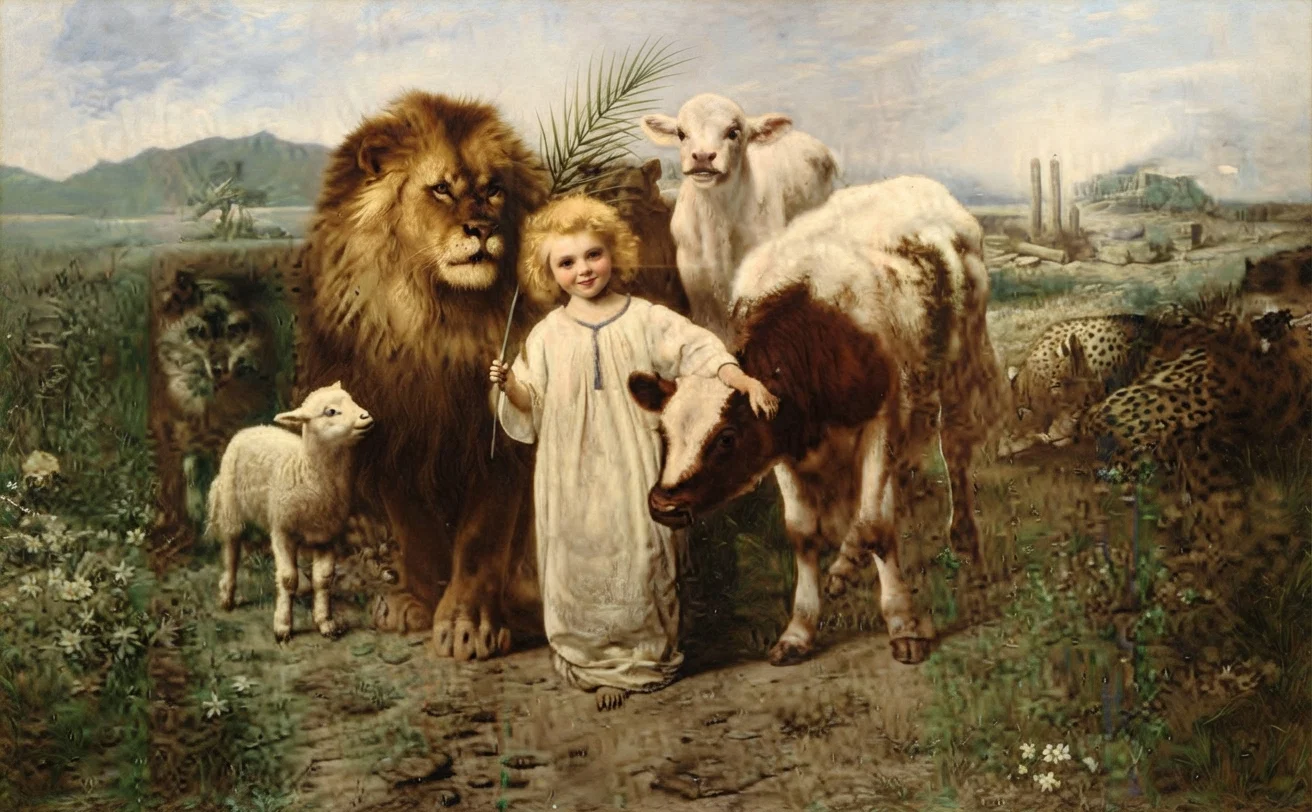
“A LITTLE CHILD SHALL LEAD THEM.”

THE above words are found in a prophecy of Christ’s kingdom, in the eleventh chapter of Isaiah. The character and spirit and work of the Branch from the root of Jesse is portrayed in verses 1-5. The blessed results which shall follow are set forth in verses 6-9. From the strife and war and wickedness of chapter ten, we are brought to the rest and peace and righteousness of chapter eleven.
THE happy condition of peace is thus set forth: “And the wolf shall dwell with the lamb, and the leopard shall lie down with the kid; and the calf and the young lion and the fatling together; and a little child shall lead them. And the sucking child shall play on the hole of the asp, and the weaned child shall put his hand on the adder’s den. They shall not hurt nor destroy in all My holy mountain; for the earth shall be full of the knowledge of Jehovah, as the waters cover the sea.”
THIS is the condition which would have been and would have persisted if man had never sinned. All that God made was good. The brute creation knew no evil, no malevolence, no savagery. No life would have been destroyed to maintain life; no blood-lust would have sent forth one part of the creation to prey on another part. All would have been at peace, and their happiness would have augmented the happiness of sinless man.
At the head of God’s earth-creation stood man. To him God gave dominion over the earth and all upon it. Under God man reigned supreme. Upon him depended the welfare, the happiness, the continuance of all the orders of life below him. Upon his moral rectitude depended his own life and the life of his subjects. Failing, they fell; triumphing, they lived. The higher law of man’s being—the mortal, the spiritual—perverted, all below it became perverted. And perverted straightness is crookedness; perverted righteousness is sin; perverted light is darkness; perverted goodness is wickedness; perverted love is selfishness and hatred; perverted gentleness is savagery; perverted peace is strife; perverted life is death. All these came when man sinned and perverted the law of his life.
“For the creation was subjected to vanity, not of its own will, but by reason of him who subjected it.” Rom. 8:20.
THAT happy condition can only be restored by Christ Jesus, the “Greater Man,” “the Seed of the woman,” “the Root and the Offspring of David,” “the Lamb of God.” Again and again He was ready to do this for His people. When He went out of Egypt before His people, He would have led them into a land where their days would have been “as the days of the heavens above the earth.” Deut. 11:21. He would have subdued their enemies, and gradually He would have made them possessors of the gate of their enemies. So also when Christ came at His first advent, it was their privilege to receive Him, yield themselves to Him, and He would have used them to convert or subdue the world; and all that Isaiah predicts would have been fulfilled. The Spirit of Christ would have taken possession of the brute creation, and the little child would have led them.
BUT again man failed. Since those attempts Christ has been gathering out from the nations a people for His name, to inhabit a new earth forever. In that new earth there shall be no more sin or war orstrife or bloodshed or death. Rev. 21:1-7. “The meek shall inherit the earth, and shall delight themselves in the abundance of peace.” And if no children shall be on that new earth, at the end of the thousand years, the condition of peace shall be such, that if there were, we would see just such scenes as predicted by Isaiah.
BUT even now in a measure we shall see fulfilled the prophecy. When the wicked man forsakes his way, and the unrighteous man his thoughts, and turn to the Lord and receive His pardon and mercy, God does a wonderful work for them. He takes away the old heart and gives a new. “Instead of the thorn” in their lives, “shall come up the fir tree, and instead of the brier” in their dispositions “shall come up the myrtle tree.” God takes the fierce heart of the human wolf and changes it to a heart of gentleness; the savage human lion heart, and makes it a strong heart to love and serve; and all are led by “the holy Child Jesus.” But the fulfilment, the plenary, glorious fulfilment of all God’s prophecies of rest and peace will be seen when Jesus Christ by His coming shall usher in His reign of righteousness and peace. It will begin in that thousand years in Mount Zion and the holy city on high; it will continue on that new earth as long as the sun and moon shall endure. To this kingdom and state Christ invites all the weary and oppressed of earth. All is found in Him. Accept Him, and find the earnest of it here and the glorious eternity of it at His coming.

CHRISTIAN GOVERNMENT NOT PARTISAN.

THE fallacy of the idea of converting this government, or any human government, into the kingdom of Christ finds demonstration on every hand. That this republic should recognize Christ as its King is a pet theory with many "reformers;" but the incongruity of such a delusion is frequently shown even by incidental allusions to other subjects. A prominent newspaper, in discussing the subject of party politics, says:
"Such forms of government as ours are not workable except by the party system, and as all parties having any pretensions to succeed are obnoxious to the criticism that they are run by bad methods, the only possible way of effecting a remedy is to reform the party."
Admitting the truth of this theory, we have the condition that with the parties reformed as far as political methods can reform them, at least two parties are essential to the working of our form of government. Now two political parties are always antagonistic, and are always striving for the mastery. And a form of government that is dependent upon such a condition can not be a Christian government, nor can it always stand. Christ has plainly told us that "a kingdom divided against itself can not stand." That is, it can not stand permanently; it may stand for a while, but it must come to an end sooner or later.
Therefore such a government can not be the kingdom of Christ, nor a kingdom of Christ. A Christian government must be a government of peace, of harmony in all its parts. The head must be Christ Himself—not a human king or president or vicegerent of any kind, but "Christ, from whom the whole body fitly joined together and compacted by that which every joint supplieth, according to the effectual working in the measure of every part, maketh increase of the body unto the edifying of itself in love."
There is no place for any "party system" in such a government as that. Christianity is not partisan. In the government of Christ the citizens are one, as He and His Father are one.
G.

THE WANING OF REPUBLICANISM.

THE United States is a republic—the greatest on earth. The dominating party is called a republican party. The second in order of influence is called a democratic party. That all this has become nominal, almost to the last degree, is evident in the czarism of party politics. That the monarchism of political partyism in the United States is second to no monarchy in the world, was illustrated at a recent state convention called for the purpose of nominating the party's candidates for state offices. There were over eight hundred delegates, nominally of the people, but they proved to be delegates of certain “bosses.” That is, the greater part of them were simply led or whipped into line by their masters. Hardly more than half of them knew how they were to vote until the half dozen “bosses” had played their game of tactics and lost or won.
Some of the “bosses” were simply lieutenants subject to the higher masters. This was proved when one of them, who “controlled” 159 votes which had been counted one way or another as the game among the “bosses” proceeded, was at last told by a higher in command how he must vote his men. These “delegates” had no choice in the matter, excepting at the peril of future favor. The captain who gave the order above mentioned was not even a delegate in the convention, but gave his order how that delegation should be voted. He said to the sub-boss, who was a delegate, “If you do not vote the — delegation for —, I will go down among the delegates on the floor of the convention and see that they are so voted.”
And that settled it. Note that there is nothing about those delegates themselves voting, but the order was as to how they should be voted. Their casting their ballots was sheer formality. Again, the mayor of a certain city, not himself a delegate, called together the delegates that were appointed officials in his city, and “issued to them peremptory orders to vote for —, under pain of his displeasure, and possible removal from the places they held if they failed to do so.”
Now all that we have said here about this convention, and the absolute rule of the “bosses,” is taken from the report of the convention in a leading party journal. And the report is not given in any spirit of criticism, but as recognized matter-of-course political procedure. There is not a hint that the game played by the half-dozen real manipulators was not a legitimate game, and that the victors were not justly entitled to the spoil. Yet the delegates, nominally of the people, no doubt walked about with an important air, drank beer, smoked cigars, and looked wise, imagining that they were really independent citizens of a great republic, working in the interest of the “dear people.”
We have not selected this particular convention for illustration because it was of a particularly political party. It is just the same in the conventions of any party that has sufficient strength to expect success at the polls. Such is politics in our great republic, and it is through such a medium that many professed Christian reformers are aiming to bring about a union of the church and politics. And with such manipulation of their franchise privilege, the masses of the people imagine they are governing themselves.
What reformation can be expected in this world when the best government ever devised by man can become so degenerate in a time even when knowledge is on the increase? Knowledge is not reformation. Knowledge without wisdom only adds to the capacity for doing evil; it adds to the facility with which the enemy of souls can use men as instruments to deceive their fellow-men. “Wisdom is the principal thing,” and “the fear of the Lord is the beginning of wisdom; a good understanding have all they that do His commandments.” It is through wisdom that reformation must come; not through mere knowledge or politics. G.

THE MORTALITY OF MAN.

THE popular fallacy that man is naturally possessed of an immortal soul is primarily responsible for all the false worship in the world. It was first promulgated in the earth when Satan contradicted the word of God, and told the first woman that she would "not surely die" if she should disobey God. The Lord had told Adam and Eve that death would be the result of their eating of the fruit of a tree of which He forbade them to eat. They believed the tempter and ate of the fruit. After they had eaten, the Lord explained to them distinctly what it meant to die. As a consequence of his sin, God said to Adam, "In the sweat of thy face shalt thou eat bread, till thou return unto the ground; for out of it wast thou taken; for dust thou art, and unto dust shalt thou return."
In this language the whole personal being was addressed; the personal pronoun "thou" always implies the entire person with all his attributes. Further along in the record we read that "all the days that Adam lived [not merely the days of Adam's body, but of Adam himself] were nine hundred and thirty years; and he died." From the circumstanceof Adam's disobedience, not only did he die, but all his posterity were afflicted with the sinful nature, "and sin, when it is finished, bringeth forth death." Thus it came to pass that "by one man sin entered into the world, and death by sin; and so death passed upon all men, for that all have sinned."
That through disobedience of the commandment of God, man became absolutely mortal, we have the statement that after the sin was committed, God placed an angel guard over the tree of life, lest the man should eat of it and "live forever." It was by eating of the tree of life that man's life was to be perpetuated; therefore when his access to the tree was cut off, he must naturally and necessarily wear out and die. And as proof that when man dies the whole man is dead, we have other testimony of the inspired Word: "The living know that they shall die; but the dead know not anything, neither have they any more a reward; for the memory of them is forgotten. Also their love, and their hatred, and their envy, is now perished; neither have they any more a portion forever in anything that is done under the sun."
When a man does not know anything, has no memory, and can not exercise any of the characteristics common to living persons, he certainly has lost all consciousness. Any one who by any incident has been rendered even temporarily insensible, knows by experience that he can not recognize or communicate with those who are close by, to say nothing of those who are at a great distance. This shows conclusively that all the organs of intelligence or sense are dependent for their action upon the activity of the physical machinery—we may say, upon the circulation of the blood, for "the life of the flesh is in the blood."
Moreover, in the plainest possible expression, the patriarch Job asks, "shall mortal man be more just than God?" To this we may add the positive testimony of the prophet Ezekiel, that "the soul that sinneth, it shall die." And this is illustrated by the action of Joshua's army, as recorded in Joshua 10. They encamped against Eglon, "and smote it with the edge of the sword, and all the souls that were therein he utterly destroyed that day." The same thing is said of other towns—Makkedah, Libnah, Lachish, Hebron, Debir, etc. The testimony of David is also to the point: "Put not your trust in princes, nor in the son of man, in whom there is no help. His breath goeth forth, he returneth to his earth; in that very day his thoughts perish."
These explicit statements of Holy Writ add much emphasis to the Gospel declaration of Christ to Nicodemus: "God so loved the world that He gave His only-begotten Son, that whosoever believeth in Him should not perish, but have everlasting life."
As to immortality, the "King of Kings and Lord of Lords" only is thus endowed, and He dwelleth in light "which no man can approach unto." The apostle Paul, through whom we get this statement, did not expect his crown of life—his immortal condition—until the Lord comes the second time to bestow it upon him by a resurrection from the dead. See 1 Cor. 15: 12-18, 51-58; 1 Thess. 4: 13-18; 2 Tim. 4: 6-8. G.

Question Corner

1895.—The Baptism of Fire.

Can you give me some light on Matt. 3:11? Are there two baptisms, the first one of the Holy Ghost, and the second with fire, or are they both the same?
It seems that the context itself makes it very clear. John is talking to the Jews, both good and bad. Some of them had been baptized in Jordan confessing their sins; others he characterizes as offsprings of vipers, and demands that they should bring forth fruit worthy of repentance. By a striking symbol he tells them what will be the fate of those who do not, and even now God is prepared to strike down the trees. If the tree bringeth not forth good fruit it is hewn down and cast into the fire; those which bring forth good fruit are preserved. Then comes the prophecy concerning Christ: "He shall baptize you with the Holy Ghost and with fire;" or, as the Revised Version puts it, "in the Holy Spirit and with fire." That is to say, one class will be baptized in the Holy Spirit, and the other class in the fire. To be baptized is to be whelmed, immersed, swallowed up. Baptism in the Holy Spirit is to be completely brought under the power of God's Spirit that the whole being shall be changed by it. It looks to the glorious culmination, the changing of mortality to immortality, when mortality shall be swallowed up of life. Rom. 8:11; 2 Cor. 5:4. The baptism by fire is the fire which shall compass the very earth itself when all the earth-dwellers, or those who reject God and His truth, will be cast into the lake of fire, or swallowed up of the fire. This will not be the case with the righteous; they will pass through it unharmed. Isa. 33:14; Revelation 20. Certainly the baptism of the Holy Spirit is a thing greatly to be desired. The baptism of fire is something that certainly no one can desire. This same thought is carried out in the twelfth verse of Matthew three: "He will gather His wheat into the garner, but the chaff He will burn with the unquenchable fire."

1896.—What Law?

What law is Paul speaking of in the third chapter of Galatians? Is the work entitled "Glad Tidings" upon this book? Does Paul bring more than one law to view, or is it the same law all the way through the chapter?
It is the same law all through the third chapter of Galatians. The first question Paul asks is, Did they receive the Spirit by the works of the law, by their own doing or the righteousness of their own deeds, or did they get it simply because they had faith in God? Of course there is but one answer to the question—they receive it by faith. We do not do the works in order that we may receive the Spirit; we do the works because we have received the Spirit. God must come into our hearts before His works can be wrought by us; so the worker of miracles does the work by the hearing of faith; and Abraham's righteousness was by faith, altho it is said of him that he kept God's commandments and statutes and laws; but it was not obedience that he might have faith, but the obedience of faith. Sinful man, therefore, can not be justified by the deeds of the law. It is an eternal truth that the righteous shall live by faith. Of course if one ever kept the law by faith his deeds would be constant justification, a witness to his righteousness, but having sinned it is only by believing God that man can be made righteous.
Of what then is the law? What is its purpose? The apostle answers in verse 19. It was added, given, or spoken, in its written form at Mount Sinai "because of transgression;" that is, man had sinned so greatly against God, had so perverted the standard of his own heart, and so obliterated God's image in the soul, that something was necessary to point out in clearer, more positive terms that he was a sinner before God. The apostle expresses the same thought in Rom. 5:20: "Moreover, the law entered that the offense might abound," so men could see that the heart is exceedingly sinful. Consequently God's written law is designed to show what great sinners we are, and showing us what great sinners we are and how we sin, to drive us to God for justification; so that the law is become a schoolmaster (tutor) to bring us unto Christ, that we might be justified by faith. But now, that faith is come we are no longer under the tutor; the law no longer condemns us; it no longer drives or brings us to Christ, Christ is our all in all, and His righteousness covers our unrighteousness, and we stand complete in Him. Verses 23-25.
How long will the law act in this way? Just as long as sinful men live in the world; till the Seed shall come to whom the promise hath been made. Who is the Seed?—Christ. Verse 16.
What was the promise made to Abraham?—That he should be heir to the world, and his seed would inherit all that God promised him. Rom. 4:13. That promise was not fulfilled at the Lord's first advent; it still waits. Its fulfilment is predicted in Eze. 21:25-27. There the prophet speaks of the last king of Judah: "And thou, O deadly wounded wicked one, the prince of Israel, whose day is come, in the time of the iniquity of the end, thus saith the Lord Jehovah: Remove the miter, and take off the crown; this shall be no more the same; exalt that which is low, and abase that which is high. I will overturn, overturn, overturn it; this also shall be no more, until He come whose right it is; and I will give it Him." Even then Judah was in the hands of Babylon; but Babylon even should be no more. Three overturnings were to follow Judah's—Medo-Persia, Grecia, Rome; but the last overturning would be by the King of Kings and Lord of Lords, at the second coming of Jesus Christ. Till that time God's law shall condemn sinners, and the Spirit will use it to make sin appear exceeding sinful.

1897.—Tree of Knowledge of Good and Evil. Gen. 2: 17.

Is the tree of knowledge of good and evil symbolical or literal?
We have no reason to believe it otherwise than literal. The garden was literal, and God planted every tree that was good for food and pleasant to the eye; and all those things were literal. And in the midst of the garden was the tree of life and the tree of knowledge of good and evil. We believe that there would have come a time when man would have been allowed to eat freely of the tree of knowledge of good and evil, but not then. He must learn what was good and what was evil by the instruction of God, by simple faith. It is not at all unreasonable to suppose that the tree in itself held properties which would affect the mentality and clearness of perception of man if taken in the right way; just as the tree of life would; just as there are many herbs and plants to-day which affect human beings variously for ill or good; but man must partake of it aright, only in harmony with the will of His Creator. So when he set aside God's express prohibition, he stepped outside of God's channel of life, walked in his own way, partook of the fruit without God's blessing, and therefore met in himself the consequences of his unrighteous deed. He perverted the law of life and brought death into his system. Separating himself from the life of God because he perverted the law of that life, he cut himself off from the inflow of the Spirit-life of God. It was only because God came in by His blessed Gospel that salvation and life came to man again. Doubtless there will come a time when that garden will be restored on this earth, and among the good things which God planted there, there will be the tree of knowledge of good and evil, partaking of the fruit of which, God's tested children shall ever know instinctively the very beginnings of evil, and so never yield to it. Nevermore will God's law be perverted.

OUR GREAT TREASURE-HOUSE

By MRS. E. G. WHITE

XVIII. HOW TO STUDY THE BIBLE.

WHEN a real love for the Bible is awakened, and the student begins to realize how vast is the field and how precious the treasure, he will seize upon every opportunity for acquainting himself with God's Word. His study will be restricted to no special time or place. And this continuous study is one of the best means of cultivating a love for the Scriptures. Keep the Bible always with you. As you have opportunity, read a text and meditate upon it. While walking the streets, waiting at a railway station, waiting to meet an engagement, improve the opportunity to gain some precious thought from the treasure-house of truth.
We should not take the testimony of any man as to what these Scriptures teach, but should study the Word of God for ourselves. If we allow others to do our thinking for us, we shall have crippled energies and contracted abilities. The noble powers of the mind may be so dwarfed by lack of exercise in themes worthy of their concentration as to lose their ability to grasp the deep meaning of the Word of God. The mind will enlarge if it is employed in tracing out the relation of the subjects of the Bible, comparing scripture with scripture, and spiritual things with spiritual.
There is but little benefit derived from a hasty reading of the Scriptures. One may read the whole Bible through, and yet fail to see its beauty or comprehend its deep and hidden meaning. One passage studied until its significance is clear to the mind, and its relation to the plan of salvation is evident, is of more value than the perusal of many chapters with no definite purpose in view, and no positive instruction gained.

Study to Know What God Says.

In your study of the Word, lay at the door of investigation your preconceived opinions and your hereditary and cultivated ideas. You will never reach the truth if you study the Scriptures to vindicate your own theories. Leave these at the door, and with contrite heart go in to hear what the Lord has to say to you. As the humble seeker for truth sits at Christ's feet, and learns of Him, the Word gives him understanding. To those who are too wise in their own conceit to study the Bible, Christ says, "You must become meek and lowly in heart, if you desire to become wise unto salvation."
Do not read the Word in the light of former opinions. Do not try to make everything agree with your creed. With a mind free from prejudice, search the Word carefully. If, as you read, conviction comes, and you see that your cherished opinions are not in harmony with the Word, do not try to make the Word fit these opinions. Do not allow what you have believed or practised in the past to control your understanding.
Open the eyes of your mind to behold wondrous things out of the Word.
We can not obtain wisdom without earnest attention and prayerful study. Some portions of the Scriptures are indeed too plain to be misunderstood; but there are others whose meaning does not lie on the surface, to be seen at a glance. Scripture must be compared with scripture. There must be careful research and prayerful attention. And such study will be richly repaid. As the miner discovers veins of precious metal concealed beneath the surface of the earth, so will he who perseveringly searches the Word of God as for hid treasure, find truths of the greatest value, which are concealed from the view of the careless seeker. The words of Inspiration, pondered in the heart, will be as streams flowing from the fountain of light.
We should reverence God's Word. For the printed volume we should show respect, never putting it to common uses, or handling it carelessly. And never should the Scriptures be quoted in jest or paraphrased to point a witty saying. "Every word of God is pure;" "as silver tried in a furnace of earth, purified seven times."
Never should the Bible be studied without prayer. Before opening its pages we should ask for the enlightenment of the Holy Spirit. And it will be given. When Nathanael came to Jesus, the Saviour exclaimed, "Behold an Israelite indeed, in whom there is no guile." Nathanael said, "Whence knowest Thou me?" Jesus answered, "Before that Philip called thee, when thou wast under the fig tree, I saw thee." And Jesus will see us also in secret place of prayer, if we will seek Him for light, that we may know what is truth.

REWARDS AND PUNISHMENTS.

(A Bible-Reading.)
WORK.—'Man goeth forth unto his work and to his labor until the evening.' Ps. 104:23. 'Son, go work to-day in my vineyard.' Matt. 21:28. 'Work . . . while it is day; the night cometh, when no man can work.' John 9:24. 'For there is no work . . . in the grave.' Eccl. 9:10. 'Have no fellowship with the unfruitful works of darkness.' Eph. 5:11. 'For God shall bring every work into judgment, with every secret thing, whether it be good, or whether it be evil.' Eccl. 12:14.
JUDGMENT.—'God is judge Himself.' Ps. 50:6. 'He hath appointed a day, in the which He will judge the world in righteousness by that Man whom He hath ordained.' Acts 17:31. 'Who will render to every man according to his works.' Rom. 2:6. 'Who shall give account to Him that is ready to judge the living and the dead.' 1 Peter 4:5.
REWARDS.—'There is a reward for the righteous.' Ps. 58:11. 'The righteous shall be recompensed in the earth.' Prov. 11:31. 'The meek shall inherit the earth, and shall delight themselves in the abundance of peace.' Ps. 37:11. 'Their inheritance shall be forever.' Ps. 37:18. 'And I saw a new heaven and a new earth; for the first heaven and the first earth were passed away; and there was no more sea. And I John saw the holy city, new Jerusalem, coming down from God out of heaven, prepared as a bride adorned for her husband. And I heard a great voice out of heaven saying, Behold, the tabernacle of God is with men, and He will dwell with them, and they shall be His people, and God Himself shall be with them, and be their God. And God shall wipe away all tears from their eyes; and there shall be no more death, neither sorrow, nor crying, neither shall there be any more pain; for the former things are passed away.' Rev. 21:1-4.
PUNISHMENTS.—'But the wicked shall perish, and the enemies of the Lord shall be as the fat of lambs; they shall consume; into smoke shall they consume away.' Ps. 37:20. 'The strong shall be as tow, and the maker of it as a spark, and they shall both burn together, and none shall quench them.' Isa. 1:31. 'They shall be as tho they had not been.' Obadiah 16. 'For, behold, the day cometh, that shall burn as an oven; and all the proud, yea, and all that do wickedly, shall be stubble; and the day that cometh shall burn them up, saith the Lord of Hosts, that it shall leave them neither root nor branch.' Mal. 4:1. 'At the revelation of the Lord Jesus from heaven with the angels of His power in flaming fire, rendering vengeance to them that know not God, and to them that obey not the Gospel of our Lord Jesus; who shall suffer punishment, even eternal destruction from the face of the Lord and from the glory of His might.' 2 Thess. 1:7-9. 'Behold, the day of the Lord cometh, cruel both with wrath and fierce anger, to lay the land desolate; and He shall destroy the sinners thereof out of it.' Isa. 13:9.
ADMONITION.—'Godliness is profitable for all things, having promise of the life which now is, and of that which is to come.' 1 Tim. 4:8. 'Wait on the Lord, and keep His way, and He shall exalt thee to inherit the land; when the wicked are cut off, thou shalt see it.' Ps. 37:34. 'With thine eyes shalt thou behold and see the reward of the wicked.' Ps. 91:8. 'Those that wait upon the Lord, they shall inherit the earth.' Ps. 37:9. 'Blessed are they that do His commandments, that they may have right to the tree of life, and may enter in through the gates into the city.' Rev. 22:14.
Max Hill.

Government Power Over the People

No GOVERNMENT has the moral right to invest a company of men with powers which enable them to coin money out of the needs of the people, and which practically doom the people to suffering or to unquestioning acquiescence in their exactions.—Geo. C. Lorimer.
Continue reading: The Temporal Power of the Papacy