Your ShelfYour Projects

Signs of the Times, Vol. 24, No. 51.

GOD'S PROTECTING POWER

Signs of the Times

Dec 22, 1898

Pacific Press Publishing Company · Oakland, California · Dec 22, 1898

GOD'S PROTECTING POWER.
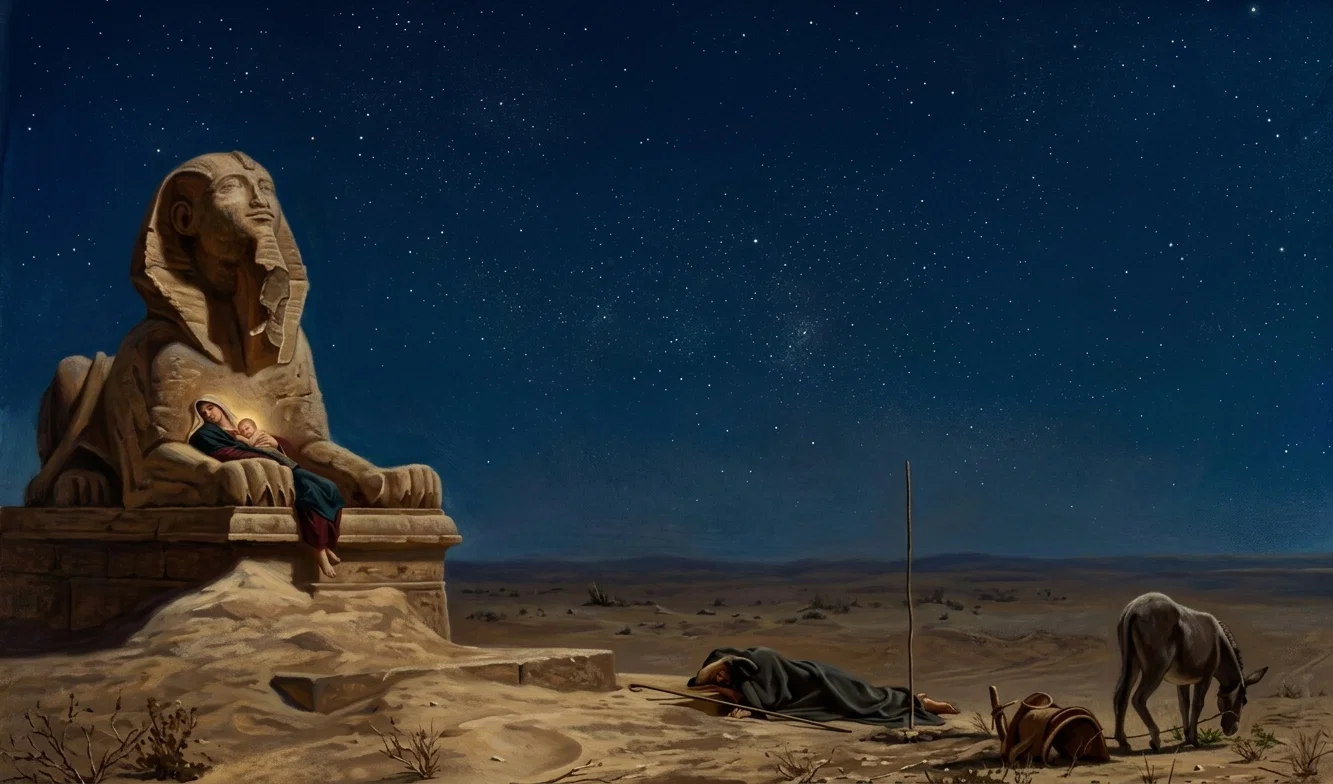
ONE of the most pleasing themes of Bible study is that of the fertility of God’s resources for the rescue of His people from distressing circumstances. To provide an asylum for the seed of Abraham in the midst of famine, Egypt was brought under the control of a member of the favored family, through the most peculiar circumstances, showing that this very protection of His people was anticipated, and being provided for during a series of eventful years. When the favor of Egypt toward that people was afterward changed to hatred, and they were oppressed under the slave-master’s lash, a man was raised up to lead them forth from bondage. When menaced with destruction by their pursuers at the hemmed-in border of the Red Sea, the waters were divided, that the oppressed might escape to the opposite shore. When the barren sand of the inhospitable desert refused them sustenance, bread was provided direct from heaven.
REST IN EGYPT. The genius of the artist has provided us an illustration typifying the protecting care of Heaven toward the seed of Abraham, by showing the infant Jesus, with His mother, resting within the arms of the sphinx—a fitting symbol of Egypt—while hiding in that country from Herod’s wrath.
Cases might be indefinitely multiplied in this line, but these are sufficient to illustrate the point referred to. One thing, however, in connection with these various circumstances is worthy of consideration. No matter what the state of the people’s mind was,—how little they appreciated God’s care, or how much inclined they were to have their own way,—the protection of Heaven was uniformly accorded them. This was not because Jehovah winked at their sins, but because He could not possibly do otherwise, on account of His oath to Abraham. Heb. 6:13–17.
In the beginning God gave the earth to man, to hold in trust for its rightful Owner, the Lord Jesus. Col. 1:16; Ps. 115:16. He having yielded it to Satan, by becoming His servant, the redemption of the lost territory of the Lord’s kingdom became as necessary as the lost subjects of the same. The first definite promise of the restoration of this territory to the redeemed subjects, was to Abraham and his seed. Gen. 13:14, 15; 17:7, 8. This promise was a proclamation of the Gospel of the kingdom (Gal. 3:8), which was to be restored through Christ (John 8:56). It was a promise to the seed of Abraham alone, and not to the seeds represented by the slave woman’s Ishmael, and the children of Abraham’s later life. Gen. 25:1–4. God recognized but one seed,—Isaac. Rom. 9:7. From Isaac was to come, through his direct line, the true Seed begotten from heaven,—Jesus Christ. Gal. 3:16.
From the moment this promise was made to Abraham, his seed became the one object of Satan’s attacks. The force of national decrees was from that time employed to destroy the promised seed, lest in the fulfilment of God’s promise to Abraham, Satan should be dethroned and thus God’s right to the usurped territory be vindicated. So, through the king of Egypt, the effort was made to prevent the return of the seed of Abraham to Palestine, by ordering all the male children of Israel slain. Ex. 1:8–16. After the people of Israel were miraculously delivered, and established in Egypt, ten of the tribes were removed by the Assyrians, and their places filled by heathen. 2 Kings 17:6, 24. The remaining tribe of Judah was then taken away by the Babylonians, and the place of God’s sanctuary left desolate. Dan. 1:2. This tribe was afterward restored to the land of promise, but, as other nations in succession gained control of the territory under dispute, the literal seed of Abraham was constantly harassed. Only by the extended power of God were they kept from being scattered abroad, before the divine Seed could be born in the land promised to Him through God’s oath to Abraham. But when the Seed in whom all the heirsof Abraham must rest their claim, was born in the land so long before promised Him, the supreme effort of Satan’s whole career was put forth in the attempt, through Herod, to wipe out all the seed of Abraham, by destroying the infant Christ, and so prevent the restoration of the usurped territory to its rightful owners. But through the keeping power of God the link necessary to connect the pedigree of Abraham’s seed was preserved, and recorded as a necessary preface to the Gospel of Christ. Matt. 1:1–17. This accomplished, the necessity for holding the Jewish nation together no longer existed, and they were soon permitted to be dispersed over the whole earth, no more to be united as a distinct commonwealth.
Satan’s hatred has ever been against the “seed of Abraham,” and whoever bears that title, in whatever age of the world, must expect the weight of his power. Gal. 3:29; 2 Tim. 3:12. The divine Seed, in whom all of Abraham’s stock must find their title to the inheritance, was the One above all others whom Satan sought to overthrow. He was, however, preserved from death by being taken into Egypt, as was the immediate seed of His patriarchal ancestor. As the beginning of that seed was preserved from death by going to Egypt, and then being led back to the land of promise, so the Seed royal, to whom this figuratively pointed, found refuge in Egypt, and was afterward led back to His own land.
The genius of the artist has provided us an illustration typifying the protecting care of heaven toward the Seed of Abraham, by showing the infant Jesus, with His mother, resting within the arms of the sphinx—a fitting symbol of Egypt—while hiding in that country from Herod’s wrath. Though purely a work of the imagination, it is a beautiful representation of the asylum which Egypt provided, under the direction of God, for Him who was given to be “The everlasting Father” of the seed of Abraham, whose seed we are, if we have given ourselves to Christ. Gal. 3:29.
JOHN ORR.

INFIDELITY CURED.

A YOUNG man was inclined toward infidelity, and, like others of his age who have imbibed such notions, he was more or less proud of his advanced ideas. He took occasion one day to go to the study of a minister of his acquaintance, and state to him his doubts and disbelief in Christianity. He expected, of course, that the minister would undertake an elaborate argument to prove the truth of the Scriptures and the reality of the religion founded on them. This would give him just what he wanted,—the opportunity to argue and combat.
But the pastor, with a wisdom not born of earth, after listening until he had concluded his harangue, said quietly, “Let us tell Jesus about it,” and dropped on his knees. The young would-be infidel was surprised into following his example. As the two knelt side by side, the man of God poured out his petition from a full heart for the young man beside him, but without any allusion to his condition of skeptical unbelief. He simply pleaded for him as a sinner needing salvation.
The prayer was answered. Before he rose from his knees, the doubter doubted no longer. Instead, he was convinced and converted, and ready to ask, with Paul, “Lord, what will Thou have me to do?” The answer came, and that young man now preaches the Gospel he once sought to destroy with his infidel arguments. That quiet, “Let us tell Jesus,” followed by the simple, earnest prayer, did what argument would have failed to do.
There is the lesson. Will soul-winners learn it? Go tell Jesus—alone, if need be, with those you would win if you can—but tell Jesus, and ask of Him the needed grace. It is not argument with man that is needed so much as telling Jesus. Take Him at His word, “Ask what ye will, and it shall be done unto you.” Go and tell Jesus.—Mid-continent.

“SEARCH THE SCRIPTURES.”

It is God's plan that old and young shall study His Word. This is necessary for intellectual and spiritual growth. Christ has given us the Scriptures as our rule of life. This book contains His teaching, and is worthy of the closest study. “The words that I speak unto you,” He declared, “they are spirit, and they are life.” These words, falling from the lips of Christ with divine authority, were to the disciples as a new revelation. They were not new, but they seemed so to the disciples, because their eyes were opened to see wonderful things in God's Word.
Should the angel Gabriel or one of the seraphs be sent to this world to take upon himself human nature, and to teach men the mysteries of science and the knowledge of God, how eagerly men would listen to his instruction! Supposing that he were able to set us a perfect example of purity and holiness, sympathizing with us in all our sorrows, bereavements, and afflictions, and suffering the punishment of our sins, how eagerly we would follow him! What exaltation he would receive! Men would desire to place him on the throne of David, and gather the nations under his banner.
If, when the heavenly being returned to his home, he left behind a book containing the history of his mission, with revelations regarding the history and destiny of the world, how eagerly would its seal be broken! How anxiously would men seek to obtain a copy! Thinking men would grasp the precious instruction, for the benefit of future generations. Thousands from all parts of the world would copy the words of this book. With intense interest they would read and reread its pages. For a time all other interests would be subordinated to this.
But One surpassing all that supposition can present, came to this world. Nearly two thousand years ago a voice of strange and mysterious import was heard from the throne of God: “Sacrifice and offering Thou wouldest not, but a body hast Thou prepared Me. . . . Lo, I come (in the volume of the book it is written of Me), to do Thy will, O God.”
The prophet Isaiah bears striking testimony to Christ: “Unto us a Child is born, unto us a Son is given; and the government shall be upon His shoulder; and His name shall be called Wonderful, Counselor, The mighty God, The everlasting Father, The Prince of Peace.”
Of Himself Christ declares: “Before Abraham was, I AM.” “I and My Father are one.” “For as the Father raiseth up the dead, and quickeneth them, even so the Son quickeneth whom He will. For the Father judgeth no man, but hath committed all judgment unto the Son.”
Christ reproached His disciples with their slowness of comprehension. They were influenced by maxims and traditionary lore, so that the truths spoken by the greatest Teacher the world has ever known were often lost truths to them. Christ led them to realize that He had put them in possession of truth of which they little suspected the value. After His resurrection, as He was walking to Emmaus with two of the disciples, He opened their understanding, that they might understand the Scriptures, so explaining the Old Testament to them that they saw in its teaching a meaning that the writers themselves had not seen.
Christ's words are represented as being bread from heaven. As the disciples ate the words of Christ, their understanding was quickened. As they diligently sought for the truth, as for hidden treasure, they understood better the value of the grace and righteousness of Christ. In their comprehension of His teaching, they stepped from the obscurity of dawn to the radiance of noon.
The work of no human author is perfect. The depth of human intellect may be measured. The richest mines of human production are not inexhaustible. But the highest, deepest, broadest flight of the imagination can not find out God. There is infinity beyond all that we in our own strength can comprehend; the Holy Spirit must reveal Him to us. Many are too well satisfied with the surface truths of revelation. Precious gems of truth are passed by because their value is not seen. Let the Bible student tax his mind as he studies God's Word; for the meaning often lies hidden beneath the surface. The knowledge thus gained will be like heavenly seed planted by the divine Sower. MRS. E. G. WHITE.

“BE YE STEADFAST.”

The apostle Paul was once a guest for many days in the home of Philip the evangelist, at Cæsarea, in Syria. He was on his way from Greece to Jerusalem, and was making his fifth visit to that city. Whether he knew it or not, it was to be his last visit to the Jewish capital.
During his sojourn in the house of Philip, the apostle was warned, in a very solemn manner, that trials and afflictions awaited him in the city to which he was bound. Agabus, who, at Antioch, seventeen years before, had predicted the famine which tried the saints in Judea during the reign of Claudius Cæsar, came down from Jerusalem, and, taking Paul’s girdle, bound himself therewith—hands and feet—saying, “Thus saith the Holy Ghost, So shall the Jews at Jerusalem bind the man that owneth this girdle, and shall deliver him into the hands of the Gentiles.”
Thereupon, Paul’s brethren at Cæsarea, alarmed for his safety, besought him not to continue his journey. His answer was characteristic of the man. Notice that portion of it which is adapted to our subject: “I am ready not to be bound only, but also to die at Jerusalem for the name of the Lord Jesus.” How clearly these strong words of the great missionary reveal the steadfastness of his characterand his unwavering devotion to the work appointed him by the Lord! In doing this work, it mattered little to Paul whither the Spirit led him, into what depths of suffering, to what utter surrender of his natural desires, will, and plans, nor to what sore travail of spirit over disciples wavering in the faith, because rooted too near the surface in the truth.
But we shall gain by looking still further into this feature of the man’s life, before we draw therefrom the lesson evidently intended for us by the divine Spirit.
Upon landing at Tyre, before his arrival at Cæsarea, certain disciples had said to him “through the Spirit, that he should not go up to Jerusalem.” And while yet in Asia, Paul had declared to his beloved Ephesian brethren, whom he had called to meet him at Miletus, “I go bound in the spirit unto Jerusalem, not knowing the things that shall befall me there; save that the Holy Ghost witnesseth in every city, saying that bonds and afflictions wait for me.” Acts 20:22, 23, margin.
— What effect had all this startling warning, entreaty, and prophecy upon the man—called in an extraordinary manner to the apostleship? His own thrilling words spoken to the brethren at Miletus tell us. Hear them:— “None of these things [care, bonds, imprisonments, afflictions] move me, neither count I my life dear [unto whom?] unto myself.” And what more?—“So that I might finish . . . the ministry, which I have received of the Lord Jesus.”
Ah, now we discover the motive of Paul’s action! For one purpose he did count his life dear, and that purpose was the finishing of his ministry, the telling the royal story of the Gospel to kings, and rulers, and bondsmen; to Jews and Gentiles, who stoned him, who laid stripes upon him, who cast him into prison, put his feet in the stocks, drove him out of their cities, expelled him from their coasts. Hence we can imagine him as ever resolving, “This one thing I do.”
Down the long centuries have come his inspiring words, establishing the hearts and steadying the footsteps of many a disciple pressing his way toward the strait gate. Surely for us also, among the lost members of the body of Christ, were they written; to us are they applicable, who stand at the final verge of the dispensation of election; us, to whom the way must become daily more narrow, difficult, and beset with dangers.
If this be so, is it not a matter of the deepest concern that we consider Paul’s words well; that we cultivate carefully, and make ours to the uttermost, Paul’s noble characteristic—steadfastness, constancy of purpose; and that we decide daily with reference to service for Christ, “This one thing I do,” as did Paul with reference to gaining the mark for the prize of the “high calling”?
Manifestly, the Holy Spirit painted upon the pages of the divine book the example of this brave martyr to the truth only for a great object,—the encouragement of the long ranks of disciples who should follow him.
Here, then, as with reference to other scriptures, must we not eat both words and example, assimilate them, incorporate them into life and character?
To not one of us is committed just such a ministry as was Paul’s. But to each one of us is committed a ministry. And who shall presume to say that the ministry of the humblest member of the “little flock” is less important in the estimation of Him who appoints him than was Paul’s? Who can foretell how great results will follow the patient, regular, persistent, gladsome efforts put forth by the least capable of the royal priesthood, solely for Christ’s sake?
When one man, at the peril of his life, saves another man from death by flood or by fire, we applaud the deed; but is life-saving at some perilous missionary post, or in long sowing the seed of truth in stubborn soil, by simple faith, less heroic? The one form of life-saving may be the result of a sudden humane impulse, coupled with a spirit naturally courageous. The other is the product of the death of self in the rescuer. He brings to shore those he has saved, and brings them out of the fires of sin; but to Another willing within him belongs the shout of approval, the acclaim for his work—and so is he glad to have it.
It is only the steadfast ones, overcomers, whom Christ will clothe with white raiment, and to whom He will grant the privilege of sharing His throne. He judges most of us by our fidelity in small things. This is a comfort, since large commissions come to so few of us. You remember what the Lord says to the servant who shall prove faithful over a few things,—“I will make thee ruler over many things.”—But His “few things” are enough to keep us busy. An idler in His vineyard would be an abhorrence to Him.
Alas, that so much unfaithful service lies behind us, so much work done indifferently, because circumstances have pressed us into it, and not our love for it; because our conception of our high calling has been so low and so narrow; because we have lacked thought, earnestness, purpose!
Let us not get the idea that only at Paul’s death did the giving up of his life take place. From the hour of his meeting the Lord on the way to Damascus it was a life laid down absolutely. Immediately he “conferred not with flesh and blood.” There was no faltering in purpose to serve Him whose glory outshone the sun on that day, nor afterward, when the Lord Jesus showed him how great things he should suffer for His name’s sake. Paul was not controlled by emotions, did not serve his Deliverer only when he felt like it—one day at his post and the next day absent therefrom—but “fought a good fight” to the end.
If any of us have become dismayed under the testing in progress in our case, an intelligent study of Paul’s steadfast course will both comfort and inspire us. So also will the words of the Lord Jesus: “He that . . . keepeth My works unto the end, to him will I give power over the nations.”
EMMA H. ADAMS.

THE MASTER.

O Thou great Friend of all the sons of men, Who once appeared in humblest guise below, Sin to rebuke, to break the captive's chain, And call Thy brethren forth from want and wo,
We look to Thee. Thy truth is still the light Which guides the nations groping on their way, Stumbling and falling in disastrous night, Yet hoping ever for the perfect day.
Yes, Thou art still the life; Thou art the way The holiest know: light, life, and way of heaven; And they who dearly hope and deepest pray, Toil by the light, life, way, which Thou hast given.
—Theodore Parker.
Continue reading: Justified by the Faith of Christ