VISIT OF THE SHEPHERDS, AND CHRIST’S PRESENTATION IN THE TEMPLE
Lesson II.—Sabbath, January 14, 1899.
VISIT OF THE SHEPHERDS, AND CHRIST’S PRESENTATION IN THE TEMPLE.
Bethlehem and Jerusalem, B.C. 5.
Note.—The texts included in marks of parentheses, while not essential to the lesson study, will be found to throw much light upon the lesson, and are suggested for those who wish to study further.
8 “And there were shepherds in the same country abiding in 9 the field, and keeping watch by night over their flock. And an angel of the Lord stood by them, and the glory of the Lord shone round about them; and they were sore afraid. And the angel said unto them, Be not afraid; for behold, I bring you 11 good tidings of great joy which shall be to all the people; for there is born to you this day in the city of David a Saviour, 12 which is Christ the Lord. And this is the sign unto you: Ye shall find a Babe wrapped in swaddling-clothes, and lying in a manger. And suddenly there was with the angel a multitude 13 of the heavenly host praising God, and saying,
14 Glory to God in the highest,
And on earth peace among men in whom He is well pleased.
15 “And it came to pass, when the angels went away from them into heaven, the shepherds said one to another, Let us now go even unto Bethlehem, and see this thing that is come to 16 pass, which the Lord hath made known unto us. And they came with haste, and found both Mary and Joseph, and the 17 Babe lying in the manger. And when they saw it, they made known concerning the saying which was spoken to them 18 about this Child. And all that heard it wondered at the things 19 which were spoken unto them by the shepherds. But Mary 20 kept all these sayings, pondering them in her heart. And the shepherds returned, glorifying and praising God for all the things that they had heard and seen, even as it was spoken unto them.
21 “And when eight days were fulfilled for circumcising Him, His name was called JESUS, which was so called by the angel before He was conceived in the womb.
22 “And when the days of their purification according to the law of Moses were fulfilled, they brought Him up to Jerusalem, 23 to present Him to the Lord (as it is written in the law of the Lord, Every male that openeth the womb shall be called holy 24 to the Lord), and to offer a sacrifice according to that which is said in the law of the Lord, A pair of turtle-doves or two young pigeons. And behold, there was a man in Jerusalem, 25 whose name was Simeon; and this man was righteous and devout, looking for the consolation of Israel; and the Holy 26 Spirit was upon him. And it had been revealed unto him by the Holy Spirit, that he should not see death, before he had 27 seen the Lord’s Christ. And he came in the Spirit into the temple; and when the parents brought in the Child Jesus, that they might do concerning Him after the custom of the law, 28 then he received Him into his arms, and blessed God, and said,
29 Now lettest Thou Thy servant depart, O Lord,
According to Thy word, in peace; 30 For mine eyes have seen Thy salvation,
31 Which Thou hast prepared before the face of all peoples;
32 A light for revelation to the Gentiles,
And the glory of Thy people Israel.
33 And His father and His mother were marveling at the things 34 which were spoken concerning Him; and Simeon blessed them, and said unto Mary His mother, Behold, this child is set for the falling and rising up of many in Israel; and for a 35 sign which is spoken against; yea and a sword shall pierce through thine own soul; that thoughts out of many hearts may be revealed. And there was one Anna, a prophetess, the 36 daughter of Phanuel, of the tribe of Asher (she was of a great age, having lived with a husband seven years from her virginity, and she had been a widow even for fourscore and four 37 years), which departed not from the temple, worshiping with fastings and supplications night and day. And coming up at that very hour she gave thanks unto God, and spake of Him to all them that were looking for the redemption of Jerusalem.”
SUGGESTIVE QUESTIONS.
1. Who were in the fields near Bethlehem? and what were they doing when Jesus was born? Luke 2:8. (Ps. 25:14; Amos 3:7.)
2. How did the Lord present Himself before the shepherds? Verse 9.
3. At the view given them, what was their state of mind? and what message of comfort was delivered to them? Verses 10, 11. (Gen. 12:3; Isa. 9:6, 7; Acts 10:36.)
4. By what sign were the shepherds to recognize Jesus? Verse 12.
5. Immediately following this announcement, what demonstration was made? Verses 13, 14. (Heb. 1:14; Gen. 28:10-12; John 1:51.)
6. Upon the departure of the angels, where did the shepherds go? Verses 15, 16.
7. Having found the Saviour, what did the shepherds then do? Verse 17. (John 1:41, 45.)
8. What effect did the words of the shepherds have upon those who heard? Verse 18.
9. How did the mother of Jesus regard the things passing around her? Verse 19. (Luke 1:66.)
10. With what spirit did the shepherds return from their visit? Verse 20. (Isa. 61:1-3.)
11. In order to fulfil the law of Moses, where did the parents of Jesus take Him forty days after His birth? Verse 22. (Lev. 12:2-4.)
12. What did this law require the parents to offer as a sacrifice on such occasions? Verses 23, 24. See note. (Lev. 12:6-8; Ex. 34:20; Num. 3:13.)
13. While this service was being performed, who came into the temple? and what led him to go there? Verses 25-27. (Acts 8:29, 39; 10:19.)
15. Taking the Child Jesus in his arms, what did Simeon say of Him? Verses 28-32. (Isa. 9:2; 60:1, 2.)
16. In blessing the parents, what predictions did he make concerning the Child? Verses 34, 35. (Isa. 8:14; John 19:35; Acts 28:22.)
17. When Simeon ceased to prophesy, who else came upon the scene? Verses 36, 37. (1 Tim. 5:5.)
18. Upon seeing Jesus, what did she do? Verse 38.
Side Lights.—“Desire of Ages,” pp. 47-57. “Spirit of Prophecy,” vol. 2, chapter 1.
NOTE.
To offer a sacrifice.—There were two reasons why the parents of Jesus took Him to Jerusalem at this time. The Mosaic law required an offering of every mother, at the end of her days of purification. When she was in circumstances to permit it, this was to consist of a lamb of the first year for a burnt-offering, and a young pigeon or a turtle-dove for a sin-offering. But when the parents were too poor to provide the lamb, the law was satisfied with simply a pair of turtle-doves, or two young pigeons. The fact that Christ’s parents offered only the latter shows that they were in the deepest poverty. Again, the law required that a first-born son should be redeemed by a fixed sum, and this requirement must be fulfilled by the parents of our Lord, since He was Mary’s first-born.
LESSON II.—SUNDAY, JANUARY 8, 1899.
CHRIST'S FIRST DISCIPLES.
NOTE.—Between last week's lesson and the present one we have the record of John's testimony concerning himself and Christ, when questioned by the priests and Levites. Of himself he said, “I am the voice of one crying in the wilderness, Make straight the way of the Lord, as said the prophet Esaias.” Of Christ he said, “In the midst of you standeth One whom ye know not, even He that cometh after me, the latchet of whose shoe I am not worthy to unloose.” On the morrow John witnessed before the people, pointing out Jesus, and saying, “Behold the Lamb of God, which taketh away the11sin of the world.” Again on the following day came the incidents recorded in the lesson.
35 “Again on the morrow John was standing, and two of his 36 disciples; and he looked upon Jesus as He walked, and saith, 37 Behold, the Lamb of God! And the two disciples heard him 38 speak, and they followed Jesus. And Jesus turned, and beheld them following, and saith unto them, What seek ye? And they said unto Him, Rabbi (which is to say, being interpreted, 39 Master), where abidest Thou? He saith unto them, Come, and ye shall see. They came therefore and saw where He abode; and they abode with Him that day; it was about the tenth hour. 40 One of the two that heard John speak, and followed Him, was 41 Andrew, Simon Peter's brother. He findeth first his own brother Simon, and saith unto him, We have found the Messiah 42 (which is, being interpreted, Christ). He brought him unto Jesus. Jesus looked upon him, and said, Thou art Simon the son of John; thou shalt be called Cephas (which is by interpretation, Peter). 43 “On the morrow He was minded to go forth into Galilee, and He findeth Philip; and Jesus saith unto him, Follow Me. 44 Now Philip was from Bethsaida, of the city of Andrew and Peter. 45 Philip findeth Nathanael, and saith unto him, We have found Him, of whom Moses in the law, and the prophets, did write, 46 Jesus of Nazareth, the son of Joseph. And Nathanael said unto him, Can any good thing come out of Nazareth? Philip saith unto him, Come and see.”
Golden Text.— “Behold the Lamb of God.” Verse 36.
SUGGESTIVE QUESTIONS.
(1) What public testimony had John given of Christ prior to that recorded in this lesson? See introductory note. (2) On the morrow, after introducing Jesus to the multitude as the “Lamb of God,” with whom was John standing? V. 35. (3) What did he say to them as Jesus was passing? V. 36. (4) What did the two disciples then do? V. 37. Note 1. (5) When Jesus saw them following Him, what did He ask them? What was their reply? V. 38. Note 2. (6) What invitation did Jesus extend to them? What is said of their acceptance? V. 39. Note 3. (7) What was the name of one of the two disciples that heard John speak? V. 40. (8) What was Andrew's first missionary act? What did he say to Simon? V. 41. Note 4. (9) To whom did he bring his brother? What did Jesus say to Simon? V. 42. Note 5. (10) Where did Jesus propose to go the next day? Whom did He find? What did He say to Philip? V. 43. (11) Where was Philip's home? What other disciples lived there? V. 44. (12) Whom did Philip find? What good news did He tell? V. 45. (13) What was Nathanael's doubtful question? How did Philip propose to remove his doubts? V. 46.
NOTES.
1. “They followed Jesus.”—The idea here is not that they followed after Him out of curiosity, as the crowds often did afterward, but that they became His disciples. Believing John's word, it would be only natural for them to leave the less and follow the Greater.
2. “Where dwellest Thou?”—At this time any dwelling-place of Jesus was but a temporary abode (Matt. 8:20), but those who asked the question would not be aware of this, especially in view of the common idea among the Jews concerning the Messiah being a great king.
3. “Come, and ye shall see.”—Jesus always invites the closest investigation of His life as well as His Word. Under all circumstances, His standing invitation is, “Come unto Me.” He was manifested unto the world, and had nothing to hide from those who desired to know all the truth concerning Him. He asks not for blind following, but desires that all may know Him intimately. “Abode with Him.”—He set an example of that hospitality which is enjoined in the scripture, “Be not forgetful to entertain strangers; for thereby some have entertained angels unawares.” Heb. 13:2. But Jesus entertained these men knowing that they were not angels, but sinful men. He “came not to call the righteous, but sinners to repentance.” Luke 5:32.
4. The first two followers of Jesus were disciples of John the Baptist. Naturally enough one of these, Andrew, sought his brother Simon, that he too might be a partaker of whatever benefits might accrue from being personally connected with the Messiah. Messias is the Greek spelling of the Hebrew word Messiah. The Greek word for the same idea (the anointed) is Christ.
5. “Simon son of John.”—The Common Version has “Jona,” but John is deemed correct. “Thou shalt be called Cephas.”—Cephas is Aramaic, a modernized form of the Hebrew language commonly used in Palestine at that time, and called Hebrew in the New Testament. This language would not be familiar at Ephesus, where John is supposed to have written, therefore he translates it for them into Greek. By interpretation Peter, that is, a stone, or, rather, a mass of rock detached from the living rock.”—Westcott.
1 “And the third day there was a marriage in Cana of Galilee; 2 and the mother of Jesus was there; and Jesus also was bidden, 3 and His disciples, to the marriage. And when the wine failed, 4 the mother of Jesus saith unto Him, They have no wine. And Jesus saith unto her, Woman, what have I to do with thee? 5 Mine hour is not yet come. His mother saith unto the servants, Whatsoever He saith unto you, do it. Now there were six water-pots of stone set there after the Jews' manner of purifying, 6 containing two or three firkins apiece. Jesus saith unto them, Fill the water-pots with water. And they filled them up 7 to the brim. And He saith unto them, Draw out now, and bear unto the ruler of the feast. And they bare it. And when 8 the ruler of the feast tasted the water now become wine, and knew not whence it was (but the servants which had drawn the water knew), the ruler of the feast calleth the bridegroom, 9 and saith unto him, Every man setteth on first the good wine; and when men have drunk freely, then that which is worse; 10 thou hast kept the good wine until now. This beginning of His signs did Jesus in Cana of Galilee, and manifested His glory; and His disciples believed on Him.”
Golden Text.— “And His disciples believed on Him.” Verse 11.
SUGGESTIVE QUESTIONS.
(1) What occurred on the third day after the events recorded in last week's lesson? What woman is mentioned as being present? V. 1. Note 1. (2) What other guests are especially mentioned? V. 2. (3) When the wine failed, what did the mother of Jesus say to Him? V. 3. Note 1. (4) What was His reply? V. 4. Note 2. (5) Then what did Mary say to the servants? V. 5. (6) What vessels were sitting there? Why were they there? How large were the vessels? V. 6. (7) What did Jesus say to the servants? How did they respond to His command? V. 7. Note 3. (8) What further directions did He give? How were these instructions carried out? V. 8. (9) What change had taken place in the water? Who knew of the miracle at this time? V. 9. (10) When the ruler of the feast had tasted, what did he say? V. 10. Note 4. (11) Where was this miracle performed? What was the result? V. 11. Note 5.
NOTES.
1. “The mother of Jesus.”—The fact that the mother of Jesus, who lived in Nazareth, eight or nine miles distant, was present at the wedding would indicate that it was at the house of an intimate friend or relative. Her knowledge that the wine had given out would indicate that she was acting in some responsible station in connection with the feast. Even the ruler of the feast, or master of ceremonies, was evidently not aware of it.
2. “Woman, what have I to do with thee.”—This was not a disrespectful remark. Jesus kept the commandments (John 15:10; Ps. 40:7, 8), therefore He would not, by word or deed, dishonor His mother. By His anointing to the work of His Father in heaven He had passed from under the personal control of His earthly parent. Mary must not presume upon her earthly kinship, however closely related, in order to control the action of the Son of God.
3. The quantity of wine.—Six water-pots, 2 or 3 firkins apiece; a firkin was about 9 gallons. If each pot held but 2 firkins, there would be 108 gallons. This enormous quantity would of itself put beyond dispute the word of the servants as to the manner in which the wine was procured.
4. The quality of wine.—Because the ruler of the feast praised the wine for its excellent quality, many suppose that it must have possessed the nature of old fermented and perhaps “fortified” wine, and was therefore intoxicating. The remarks of the master of ceremonies were based on the ordinary custom of Bacchanalian feasts, and show in themselves that the feast was at least in one respect different from the ordinary. Surely wine which the Lord Himself made good would not be good because of its containing ingredients that would make ordinary wine bad for men to use. His Word enjoins us: “Look not thou upon the wine when it is red, when it giveth his color in the cup, when it moveth itself aright [or is fermented]. At the last it biteth like a serpent, and stingeth like an adder.” Prov. 23:31, 32. The Lord would not make such wine as that, yet that is just the kind of wine that men would ordinarily call the best. While Jesus could indorse a pleasant wedding party, attending it Himself and contributing to the necessities of the custom, He certainly would do nothing to encourage, much less contribute to, a prolonged debauch.
5. Manifested His glory.—It showed that in Him was creative power, that He was the Son of God. It takes the same power to change water to wine through the grape as was manifest in Cana of Galilee, but blind, unbelieving eyes can not see it.
PERIODICALS WANTED.
Mrs. M. E. Crawford, Jackson, Cal., wishes to thank those who have so kindly sent her periodicals, and desires more, especially late copies of the SIGNS and Review.
Brother J. Reid, 1018 South O Street, Tacoma, Wash., returns thanks for past favors, and asks every one who may have idle numbers of any of our periodicals to send them post-paid to his address.
PRAYER
By A. T. Pierson
By A. T. Pierson, will bring new life and light into your church, missionary society and home. Price, $1.00 per 100
PACIFIC PRESS PUBLISHING CO.
New York City Oakland, Cal. Kansas City, Mo.
Your Life Work
Is it of Men or of God? A new tract in the Apples of Gold Library. Order A. G. L. No. 20. Price, 50 cents per 100 or one cent each in small quantities. Address, PACIFIC PRESS PUBLISHING Co., Oakland, Cal.; Kansas City, Mo.; or New York City, N. Y.
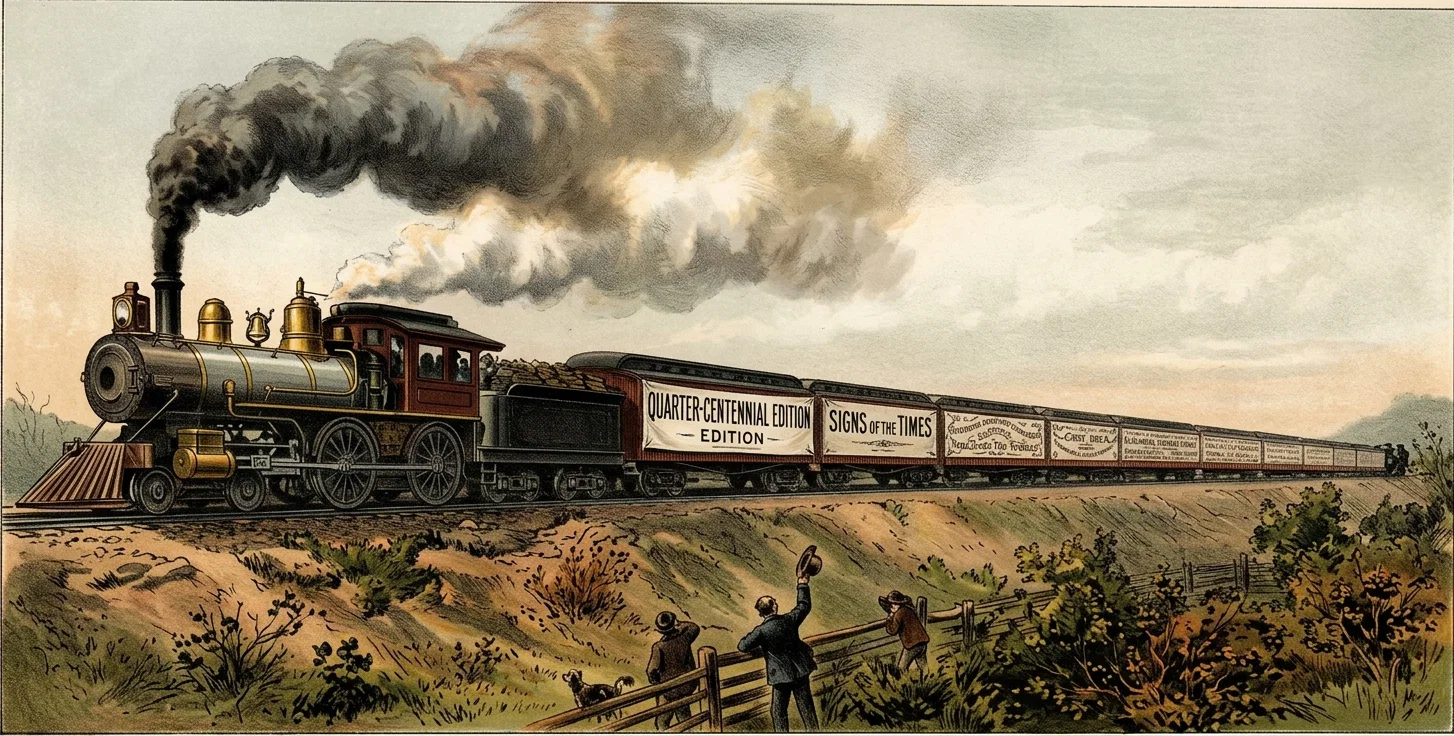
1874 QUARTER-CENTENNIAL EDITION OF 1899
The Signs of the Times
DOUBLE NUMBER—36 PAGES
ONE MILLION COPIES
READY DECEMBER 10
15 car-loads of paper used in celebrating our 25th anniversary. The largest edition of any newspaper or magazine ever published on the Pacific Coast
This Quarter-Centennial Edition will give a panoramic view of the important events of the last twenty-five years and will be a veritable mine of information, brimful of Gospel truths. Interesting and striking facts will be given on the . . . .
Military and Naval Power of To-day
Political and Ecclesiastical Changes in Europe
Church and State Union in the United States
Development of the Money Power
Astronomy—Recent Discoveries
Wonderful Inventions
God’s Witnesses in Stone
Progress in Medical Science
The Last Reformation
And many other interesting subjects
This issue will be beautifully illustrated by zinc etchings and half tone engravings. The cover design is to be printed in three or more colors, thus making a very attractive paper.
PRICE OF THIS SPECIAL DOUBLE NUMBER, 10 CENTS PER COPY
Regular subscription price, one year, 52 numbers including this special issue, $1.00. Six months, 50 cents
Address, SIGNS OF THE TIMES, Oakland, Cal.
WOMAN'S KLONDIKE.
By L. Mae La Bier
In this mad rush to the great Alaskan fields for gold, and this hurry to become heroes in war; in this time when men leave home, kindred, and comfort to face sickness, suffering, and even death in order that their coffers may contain more wealth or their names be written with a “rear-admiral” addition, “come now, and let us reason together.”
There is nothing in life so beneficial as an hour spent alone now and then. It is in quiet, deliberate thoughtfulness, and not in the nervous excitement of a crowd, that character is builded. The woman who has not learned to use one hour out of twenty-four in self-examination and improvement lacks the finest element in character-building, and is not fitted to go to our Klondike. By teaching and by practise women have been led to believe that they must depend on the judgment of others. This is wrong. We are given reasoning power, as individuals made after God’s own image. There is no difference in degree as to man’s and woman’s ability to reason only as education has made it so. As a step toward overcoming the difference already existing, let us undertake the journey to Klondike, by considering three important questions:— (1) Where is woman’s Klondike? (2) what will be the cost of going? and (3) what will be the gain?
The first question is best answered by saying, The city, street, and number of yours may differ from mine; but, no matter whether in Fifth Avenue, New York, or some far-away mountain valley, these four letters spell it, H-O-M-E.
What will be the cost of going? For the benefit of the Klondikes in process of construction, I will say it is a very expensive trip. Did some one say she could not go, then? Yes, you can. What constitutes wealth? Do money, houses, and lands alone? You may answer for yourselves after considering the matter.
An even disposition will be necessary. One not easily provoked, one that “suffereth long, and is kind.” If you can’t enter this on your inventory list, proceed to invest your one-hour-a-day capital in prayerful study of self, and learn to master the powers given into your keeping. No, you need not say, “I can’t,” because the great Teacher ever stands ready to help us overcome self, and He can crown our efforts with success.
Good health comes next on our itemized list. It is certainly true that sunny tempers, sparkling eyes, rosy cheeks, and smiling lips all depend on the condition of the body. As I see the girls of to-day, my heart aches. A short time ago I attended a lecture on “Woman,” given by a physician, who showed us our bodies on charts, and explained the functions and depending relations of the organs.
A characteristic scene of the mad rush for gold over the Chilcoot Pass for the Klondike region. The dark lines on either side of the central mount are lines of men, periling health and life for the gold that perishes.
Three girls in front of me giggled, squirmed, and punched each other until true modesty was ashamed. One of these girls was a typically-laced American; the second had not learned the A B C’s of bodily cleanliness; and the third was old enough to have listened through respect, if not interest.
Our whole existence depends entirely on the unity between soul and body. The body could be called the soul house. You know full well if a house isn’t kept clean and in order, the inmates become cross, thoughtless, and discontented. This applies as well to body and soul. So our Klondike requires a “sound mind in a sound body.” Our husbands will prize our good health. Our children will call us blessed.
O, two more articles of wealth,—husband and children! You didn’t expect to journey without either, did you? A Christian husband is a very necessary part of the wealth,—a husband you can trust, and who trusts you; one you love, and who loves you; one who is in deed and truth a companion. And children are the diamonds among our jewels. Childish prattle and trust bring out perfect consecration in the home.
Girls, put your corsets aside. Dress for comfort and natural beauty rather than style. Let your bodies develop free from hindrance. Exercise, pure air, and sunshine are nature’s medicines; take them in large doses many times a day.
Lastly, don’t be one-sided, and that the dark side. “A merry heart doeth good like a medicine; but a broken spirit drieth the bones.” Too often we fail to see the beautiful along our pathway. An old lady who picked up wood along the Elbe River was once asked by some tourists if the scenery along the banks was beautiful. “No; all you will see is wood, wood,” was her reply. Too often life becomes all work to us. We are too particular to have things in perfect adjustment, at the expense of our family. Through tired eyes we see nothing but floors to scrub, dishes to wash, and dirty-faced children with muddy feet. Look up! We get out of an enterprise just what we put into it. Live a life among women. Be queen of your throne; rule your dominion by love; then your husband, your children, and your friends will enjoy your Klondike, and angels will chant the refrain:—
“Mid pleasures and palaces
Tho we may roam,
Be it ever so humble,
There’s no place like home.”