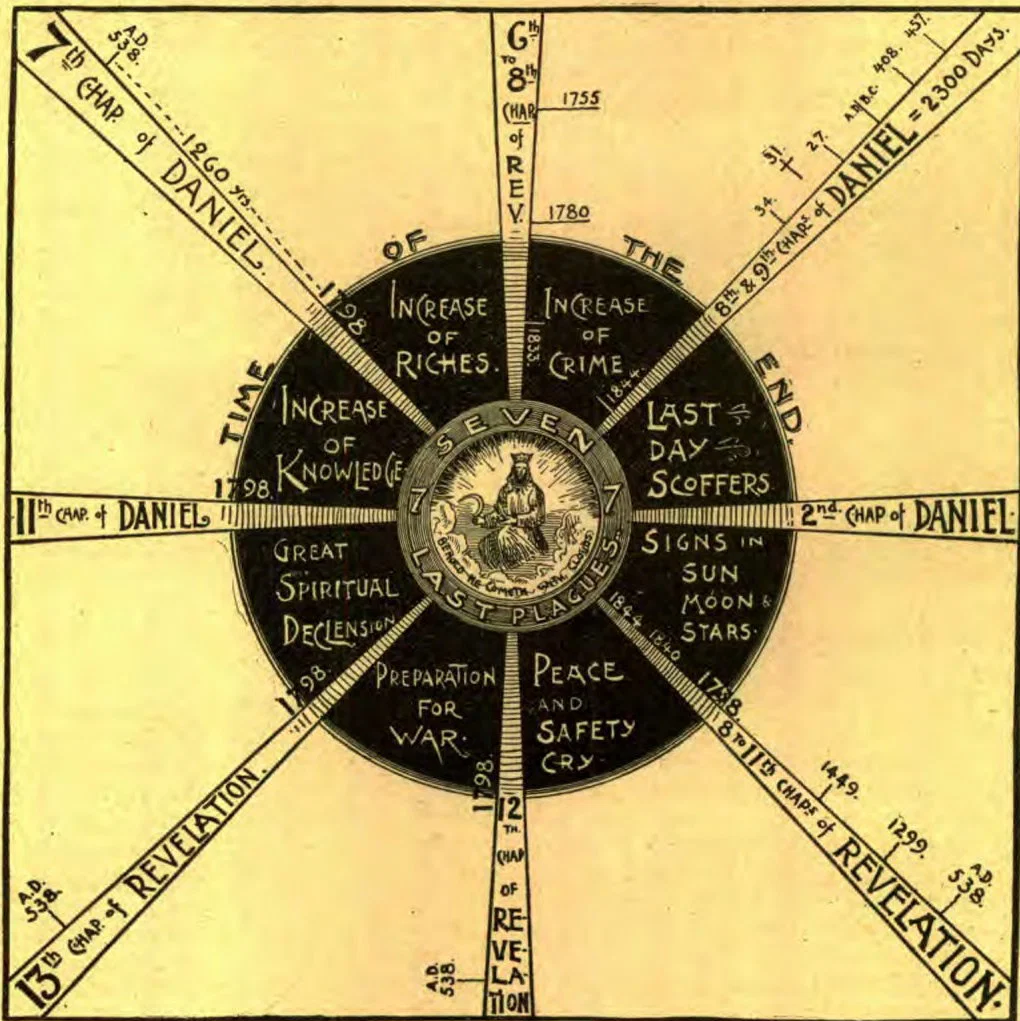
THAT the coming of our Lord in glory is near, is manifest in fulfilled and fulfilling prophecy. And this is especially true in the culmination or closing of the prominent lines of prophecy, which were given centuries ago for the very purpose that those who should observe the progress of events might discern the signs of the times, and be ready for the great event to which they pointed.
In the Book of Daniel.
In Daniel 2 we have, in the prophecy of the great image shown to Nebuchadnezzar in a dream, the advance history of the world from that time to the establishment of the kingdom of Christ in the earth. In the four sections of the image were the representations of four universal kingdoms, beginning with Babylon. These were to be the only kingdoms of such extent until the eternal kingdom should be ushered in and fill the whole earth. The prophecy has been fulfilled in the rise and fall of Babylon, Medo-Persia, Grecia, and Rome. The territory of the Roman Empire is now in the divided state indicated by the iron and clay of the feet and toes. The only unfulfilled part of the prophecy is that the God of heaven will set up a kingdom which will fill the whole earth, and will stand forever.
In the seventh chapter of Daniel the same ground is covered by another line of prophecy, the difference being that the characteristics of these four great kingdoms are given by symbolic beasts. As the four universal kingdoms before mentioned are the only ones the world has known, the fourth must be Rome. The last phase of this empire was the domination of the Papacy, symbolized by the little horn, of which the prophecy says, "He shall speak words against the Most High, and shall wear out the saints of the Most High; and he shall think to change the times and the law; and they shall be given into his hand until a time and times and half a time." All of this is in the past, and the next view the prophecy opens is of the judgment, and the everlasting kingdom.
We have this history line upon line, that it may be deeply impressed upon our minds. In the eighth and ninth chapters the story is repeated with further variation. The prophecy is given just as Babylon is passing away and Medo-Persia comes into actual view, and for this reason Babylon is omitted. Medo-Persia and Greece are specifically named in their order; therefore the succeeding one is Rome, as Rome followed Greece in history. The description also fits Rome, and fits no other; for "he"—the "king of fierce countenance"—"shall stand up against the Prince of princes." But, as in the case of the great image, "he shall be broken without hand."
This prophecy also shows a definite time that ended in 1844, at the close of which would begin the investigative judgment.
The eleventh chapter of Daniel is a prophecy beginning in the time of the Persian dominion and reaching to the time when Michael shall stand up (chapter 12:1). Events which have transpired during the past century, up to the present time, are described in this prophecy as pertaining to "the time of the end."
Predictions of Our Lord.
In Matthew 24, in Mark 13, in Luke 21, our Lord has set forth what should come to pass, covering the time from the destruction of Jerusalem to the second advent. Certain signs in the heavens were given to indicate the approach of the end. All but one of these are in the past, and "this generation shall not pass, till all these things be fulfilled." Certain conditions were foretold, and these conditions are everywhere manifest to-day.
What Paul Declares.
In the second chapter of 2 Thessalonians is a brief prophecy covering the period from the time of its writing to the coming of Christ. The "mystery of iniquity" was working in the church at that early day, and would increase until it developed "the working of Satan with all power and signs and lying wonders, and with all deceivableness of unrighteousness," just before the coming of the Lord. The world to-day is overrun with these deceptions, which are permeating the nominal churches of Christ to such a degree that they would deceive, if possible, the very elect.
In the Revelation.
Chapters 2 and 3 of the Revelation contain a prophetic history of the church from John's day to the time when the Lord stands at the door and knocks. The conditions described as obtaining in the last period of this history are significantly prevalent in our time. The message of Inspiration says: "I know thy works, that thou art neither cold nor hot; I would thou wert cold or hot. So then because thou art lukewarm, and neither cold nor hot, I will spue thee out of My mouth." Lukewarmness in the churches is the general complaint of church officials and journals in our time.
Chapters 5–7 present in a prophetic line the Gospel work, both in heaven and on earth, from the ascension of Christ to the time of His return. The successive phases of this work and the experiences of the church are set forth under the symbol of a seven-sealed book. The sixth seal (or chapter) closes with the sealing of the people of God—placing on them the mark of final approval. This is the judgment work, and it is marked in the prophecy by events in the earth that lçcate it beyond doubt in our own time. The seventh sea¹ opens to the advent of our Lord.
The Seven Trumpets.
In chapters 8–11, another prophetic line presents an outline history of political events from the breaking up of the Roman Empire to the coming of the Lord in glory. In this revelation of then future events we have the symbol of seven trumpets. It is well to note that the number seven in all these features of the Revelation implies completeness—the end of the prophetic story. These seven trumpets sound in succession, revealing successive events. The sixth, which ends with the ninth chapter, discloses the passing of the Turkish Empire under the control of the European allied powers, August 11, 1840. This is followed by the great advent movement, as foretold in chapter 10 and chapter 11 to verse 14. Then the seventh trumpet announces the kingdom of Christ, with the assurance that "He shall reign forever and ever."
The Great Controversy.
The twelfth chapter opens to view the great warfare of Satan against Christ and His church, from the birth of Christ till the time of the "remnant" of the church. The remnant must be the last of the web—the closing generation. It is said that Satan makes war with this remnant because they "keep the commandments of God, and have the testimony of Jesus Christ." For fifty years the people who answer this description have been subject to this warfare.
In the prophecy of chapter 13 we have the symbol of a great composite beast, which represents the principle of church and state government, especially as represented by Rome under the guise of Christianity. There is represented the wounding unto death of this power, and its eventual restoration, which in chapter 17 is shown to be but for a short time. There is also a two-horned beast, or government, which at first manifests a mild, lamb-like character, but in time assumes the dragon-like character of the "first beast." It practically becomes the servant of the "first beast." All this is being fulfilled in a marked manner by the increasing influence of Rome in the governments of earth, and especially in the great American Republic, which, in every particular, answers the prophecy of the two-horned beast. But the near consummation of the careers of these two powers is so plain to the student of prophetic history—as also to the student of current political events—that the end is virtually in sight. The next scene opened by the prophecy is "the Lamb standing on the Mount Zion." Chapter 14: 1–5.
All these lines of prophecy culminate in "the time of the end," and bring us to the conditions noted by special predictions—such as the increase of crime, spiritual decline in the churches, the accumulation of wealth, the rise of false prophets, and their working of deceptive signs and wonders. These conditions are matters of general remark, and no one need be mistaken as to their portent. "The coming of the Lord draweth nigh."
The Dark Day of 1780
SPEAKING of the dark day of May 19, 1780, Noah Webster, in the New Haven Daily Herald, says:
"No satisfactory cause has yet been assigned."
Also in his Dictionary, Unabridged:
"The Dark Day, May 19, 1780, so called on account of a remarkable darkness on that day, extending over all New England. In some places persons could not see to read common print in the open air for several hours together. . . . The true cause of this remarkable phenomenon is not known."
OUR FUTURE HOME.
By S. H. Lane
BY S. H. LANE.
Earth's First Dominion.
W<span style="font-variant:small-caps">hen</span> our heavenly Father gave existence to the earth by His creative power, He gave the dominion into the hand of His representative—Adam. Gen. 1:26. If that representative had not sinned, the dominion would never have passed from him. Adam would have possessed the kingship of the world forever. As Adam surrendered to the deceiver, he became a servant of Satan, and the dominion of the world passed from him to his master.
When Christ came to purchase and redeem the sin-cursed earth, Satan offered Him the dominion of the world. Luke 4:1–8. Christ would not accept the gift on the conditions specified. Had He done so, He would have become the servant of Satan, and would never have been, at most, but a sub-ruler. He spurned the offer, and through death paid the purchase-price to the right of the kingship.
"Whose Right It Is."
In all His teachings Christ recognized His own right to the kingdom, and the fact that the world will some day be redeemed and restored.
The same precious assurance runs all through the Scriptures. Speaking of His own mission, Jesus says: "The Son of Man is come to seek and to save that which was lost." Luke 19:10. Life, peace, and the dominion of the world were lost. All are to be restored. Adam's posterity would have been the deathless subjects of the King of love in this world had not sin been introduced through disobedience; and the original kingdom of God in this world would have never ceased.
Essentials to the Kingdom.
Every kingdom is made up of certain constituent parts. There must be, first, a king; second, subjects; third, territory; fourth, law; fifth, a throne. In Heb. 4:16, we are exhorted to come boldly to the "throne of grace." As the existence of a part of a kingdom presupposes the existence of every other part, therefore the "throne of grace" supposes a kingdom of grace.
The Kingdom of Grace.
Grace is the unmerited love and favor of God with their results. Grace is the only foundation of the Gospel of salvation, which is the Saviour's remedy for sin. The truths of the kingdom of grace, through the great commission, are to be carried to earth's remotest bounds, as its command sets forth: "Go ye therefore, and teach all nations, baptizing them in the name of the Father, and of the Son, and of the Holy Ghost; teaching them to observe all things whatsoever I have commanded you; and, lo, I am with you alway, even unto the end of the world." Matt. 28:19, 20.
Through the truths of the Gospel, as proclaimed by this commission, the kingdom of grace will stand complete. It is composed thus: Its king-priest is Jesus; the earth, the great Gospel field, is the territory; the throne is the throne on which Christ sits with the Father (Rev. 3:21), and upon which He is acting as mediator; and the law, the transgression of which has made unmerited love or grace necessary, is the law of the kingdom.
Thus the kingdom of grace stands complete today, and constitutes God's masterly plan to save repenting, trusting sinners. It prepares them for the kingdom of glory.
The Kingdom of Glory.
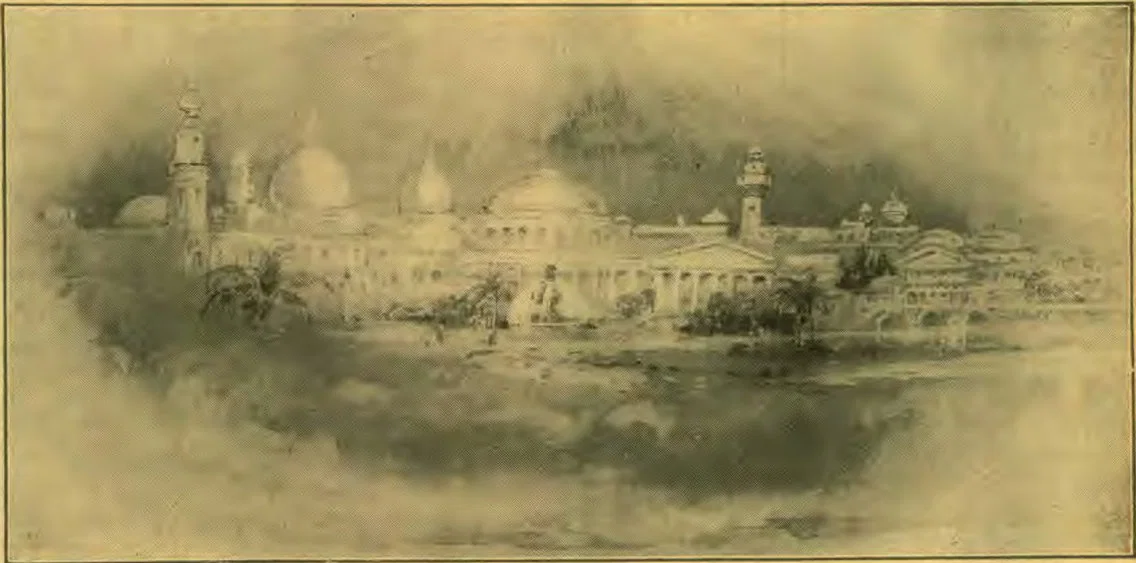
When the kingdom of glory shall be fully established, its component parts will be Christ, the King; the redeemed from sin will be its subjects; this world restored to its original beauty will constitute its territory; as God will be all in all, His law will be its law; the New Jerusalem will be its capital city, having in its midst the throne of that celestial kingdom.
The Kingdom.
The Gospel is Heaven's remedy for sin. Rom. 1:16, 17. It will save enough from the countless thousands who have inhabited this world, to repeople it, when it will constitute Paradise restored. Matt. 5:5.
The world was promised to Abraham. Gen. 13:14. He never inherited it during his lifetime, not even enough to set his foot on. Acts 7:5. He dwelt in it as a stranger (Heb. 11:9, 13), and died an heir to it (Rom. 4:13). Therefore if he ever inherits it, and the promise is fulfilled, he must live again through a resurrection.
The King in His Glory.
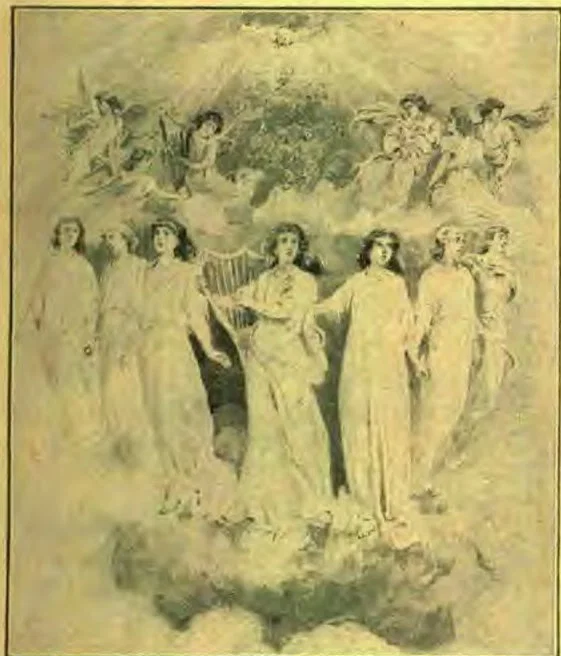
The Saviour, just before He closed His earthly mission, stated that He would come again. John 14:1–3. The angels, at His ascension, declared that the same Jesus would return. Acts 1:11. When that coming shall burst upon the world, He will come in His own glory, and that of His Father and of His angels. Luke 9:26. The Archangel's trump shall sound, and the dead shall arise. 1 Thess. 4:16. The millions who have slept in hope of the better resurrection shall awake. Heb. 11:35. They went down emaciated through disease and decrepitude. They come forth clad with immortality, in possession of perfect health and beauty.
Thus at the second coming of Christ will occur the resurrection of the righteous, the grandest and most wonderful event in all the world's history, save the death and resurrection of Jesus Christ, which made the redemption of the world and the salvation of mankind possible. The second coming of Christ is fraught with such interest to every believer that the pen of Inspiration calls it "that blessed hope." Titus 2:13.
Both King and Judge.
As Christ comes, upon His vesture is written, King of kings, and Lord of lords. Jesus, by virtue of His office as king, is Judge of quick and dead. 2 Tim. 4:1.
The judgment of the wicked occurs during the one thousand years, between the first and second resurrections (Rev. 20:1–6),—the resurrection of the righteous introducing the one thousand years, and the resurrection of the wicked terminating it.
At the close of that wonderful period, the execution of the judgment takes place. Rev. 20:12–15.
Then sinners will cease to exist. The universe will then know of a surety that the "wages of sin is death." Rom. 6:23. Rebellion will nevermore menace the government of God, nor mar His fair universe.
Complete Restitution.
The judgment and its execution being past, the time has fully come for the restitution of all things spoken of by all the holy prophets since the world began. Acts 3:19, 20. The scenes connected with this wonderful restitution are recorded in both the Old and New Testaments. The evangelistic prophet Isaiah says: "For since the beginning of the world men have not heard, nor perceived by the ear, neither hath the eye seen, O God, beside Thee, what He hath prepared for him that waiteth for Him." Isa. 64:4.
This quotation teaches that at the beginning of the world, before man sinned and the curse marred its fair territory, man did behold in Eden the same glory that will clothe the earth when it shall be restored by the power of God.
Beauty Even Here.
Altho the prophet declares that eye hath not seen nor ear heard the glory of the world as it was, yet in this one, since the fall, the human eye has beheld some wonderful glories. There are golden sunrises and rosy sunsets, mountain grandeur and ocean marvels, so beautiful and thrilling that, once seen, their impression clings to the memory during life. The ear has listened to wonderful harmonies, and the music of the sweet song has thrilled us. Into our hearts have entered spiritual visions of sunny plains and seas of bliss, but we shall never correctly picture the golden streets, the pearly gates, the broad river of life, or the glorious tree of life in our present state of existence. But in the morning time of our immortal existence, in this world restored, when we contrast the beauty of it with the faint flashes of grandeur we behold here, we shall earnestly exclaim, "The half has never been told."
The New Jerusalem
will be the capital city of the new earth. John saw in holy vision the city, and thus portrays it: "And I11saw a new heaven and a new earth; for the first heaven and the first earth were passed away; and there was no more sea. And I John saw the holy city, New Jerusalem, coming down from God out of heaven, prepared as a bride adorned for her husband. And I heard a great voice out of heaven saying, Behold, the tabernacle of God is with men, and He will dwell with them, and they shall be His people, and God Himself shall be with them, and be their God. And God shall wipe away all tears from their eyes; and there shall be no more death, neither sorrow, nor crying, neither shall there be any more pain, for the former things are passed away." Rev. 21:1–4.
It is a literal city, having streets, walls, and gates. It is laid out in a perfect square (verse 16), and it is twelve thousand furlongs around it. At eight furlongs to the mile, the entire distance around it would be fifteen hundred miles. Three hundred and seventy-five miles on a side, covering a larger area of territory than England, Ireland, Scotland, Wales, and the adjacent islands; larger than the states of Ohio, Indiana, and Illinois combined,—a city compared with which London, Paris, and New York sink into utter insignificance. Truly it is a royal city for the King of kings.
The prophet, speaking further of the city, says: "And the building of the wall of it was jasper, and the city was pure gold, like unto clear glass, and the foundations of the wall of the city were garnished with all manner of precious stones." Rev. 21: 18, 19.
As the light that will emanate from the Father and Son shines upon those transparent and translucent walls, which reflect and refract its rays, there will encircle and shine above the throne a beautiful rainbow. Rev. 4:3. Prismatic colors will tinge the verdure of the landscape, and every twig and bud will be as brightly adorned as the rosebud encircled with dew.
The Passing of the Veil.
The sun and moon will exist to lighten the world as when it was first created. In the change which results in transforming this present world into a glorious paradise, the very atmosphere will have become so thoroughly purified that it will be clear as crystal. The prophet Isaiah, in viewing the scene, says: "Moreover the light of the moon shall be as the light of the sun, and the light of the sun shall be sevenfold, as the light of seven days, in the day that the Lord bindeth up the breach of His people, and healeth the stroke of their wound." Isa. 30:26.
The rays of the sun are God's pencil, with which He paints flower, field, and forest with their many-hued colors; and, as the sun is to shine with sevenfold more brilliancy, therefore every green leaf, and every flower, and each blade of grass, will greet the eye with sevenfold more beauty, grace, and glory than in the present world.
No Funeral Trains.
Sickness, sorrow, pain, and death shall never invade that city. In the words of another, "a city never built with hands nor hoary with the years of time; a city whose inhabitants no census has numbered; a city through whose streets rushes no tide of business, no black-robed hearse creeps slowly with its burden to the tomb; a city without griefs or graves, without sin or sorrows, without births or burials, without marriages or mournings; a city which glories in having Jesus for its King, angels for its guards, saints for citizens; whose walls are salvation, and whose gates are praise."
The redeemed world will be arrayed with beauty such as language is inadequate to describe. No scenery ever gazed upon in this world can be justly compared with it. The gently-sloping hills and beautiful plains will be made joyous by the sound of babbling brooks and rippling rivulets, while the air will be richly freighted with the notes of merry songsters. The wide-spreading plains will swell into hills of beauty, and the mountains rear their lofty summits heavenward; and the ransomed of the Lord shall worship where mountain, lake, and forest meet. And in that beautiful world, God's redeemed people, so long pilgrims and strangers in this vale of tears, will find an eternal home which will constitute all that is most enduring and satisfying. Christ your Saviour, your Redeemer, your Helper, your Friend will be King. Will you be one of the redeemed subjects?
"A City without Griefs or Graves."
"The Redeemed Will Be Arrayed with Beauty."
The ROYAL LAW
By H. A. St. John.
BY H. A. ST. JOHN.
THE PURPOSE OF THE LAW.
"THE Lord hath prepared His throne in the heavens; and His kingdom ruleth over all." Ps. 103:19. This inspired declaration is the distinct statement of a great and fundamental truth, namely, that God's "kingdom ruleth over all." And this "all" is to be taken in its broadest sense, meaning all intelligences, in all places and in all ages. As the Supreme Being who has made all things, and the One who upholds all things, He has the supreme right to rule in the throne of supreme dominion. And it is always for the best and highest good of all creatures possessing reason to recognize this great truth, and to humbly acquiesce to the claims of such recognition. And this is as important for the mightiest of earthly rulers, and even more so, if possible, as for the humblest of mortals.
Nebuchadnezzar, one of the greatest of earth's kings, failing to discern this great truth, was driven from among men, and made to eat grass like an oxen, for seven years, or until he learned the lesson "that the heavens do rule;" "that the most High ruleth in the kingdom of men." Dan. 4:25, 26.
Hence it follows irresistibly, that God is the great moral Governor of the universe, and that He has a great moral law as the basis of His government; for a government is a system of laws maintained. It also follows, just as inevitably, that we are within the jurisdiction of His government, and hence amenable to His law.
The Summary of His Law.
The Bible abounds in evidence that the supreme moral law of God is summarily contained in the Ten Commandments, that law which was once spoken with a voice that shook the earth, and afterward written by the finger of God, and committed to men, the only instrument of God's own writing ever given to mankind.
Having found that God has a government, and a law as the basis of that government, and that all mankind are amenable to that law, we are now ready to consider—
The Purpose of That Law.
I think we may properly regard the purpose or object of the law of God as threefold. First, a revelation of God's character; second, a revelation of God's will; and third, a revelation of God's glory. We will briefly consider each separately.
1: A Revelation of God's Character.
The laws of any law-maker, or law-making power are always a revelation of character. God's law is declared to be "holy, and just, and good." Rom. 7:12. Such is the character of God's law in its requisitions and prohibitions. And such is the character of God. His holiness, justice, and goodness are everywhere manifest in His revelations, nowhere more clearly than in His holy, just, and good law.
Other attributes of God, such as power, wisdom, truth, mercy, and love, are all revealed in His law. His power, in that He is to be worshiped as the one God, supreme over all (see the first commandment); His wisdom, in that "the testimony of the Lord is sure, making wise the simple" (Ps. 19:7); His truth, in that the Word of the Lord declares that "Thy law is the truth." "Thou art near, O Lord; and all Thy commandments are truth" (Ps. 119:142, 151); His mercy and love, in that the law itself says, "shewing mercy unto thousands of them that love Me, and keep My commandments" (Ex. 20:6). It is because the love of God permeates His law that fulfilling that law is the love of God revealed. Rom. 13:10.
2. A Revelation of God's Will.
Where should we expect to find the will of a ruler, or law-making power?—In the laws of such power only. The good pleasure, the will, of every government, is to be learned from the laws of such government. And God's will and good pleasure concerning all His subjects, is to be found in His law. When Jesus came into the world, He came not to do His own will, but the will of Him that sent Him. John 5:30. He said, "Lo, I come; in the volume of the Book it is written of Me, I delight to do Thy will, O My God; yea, Thy law is within My heart." Ps. 40:7, 8. "Not every one that saith unto Me, Lord, Lord, shall enter into the kingdom of heaven; but he that doeth the will of My Father which is in heaven." Matt. 7:21. And that blessed, holy, and sweet will is revealed in the law of God.
3. A Revelation of God's Glory.
Ancient Israel understood that the glory of God was associated with His law; for when the ark was taken by the Philistines, one of the tribe of Levi exclaimed, "The glory is departed from Israel; for the ark of God is taken." 1 Sam. 4:22. Thus the Lord "delivered His strength into captivity, and His glory into the enemy's hand." Ps. 78:61. The apostle Paul declares that "all have sinned, and come short of the glory of God." Rom. 3:23. As sin, the transgression of the law, detracts from the glory of God, does it not follow that perfect obedience to God's law reflects His glory? Hence we see that one purpose of the law of God has ever been to furnish mankind with the opportunity of revealing the glory of God,—a glory hidden in the law until (Continued on page 14.)12
The Purpose of the Law.
(Continued from page 9.)
the law is hidden in the heart, and drawn out in living characters in the life.
Now, it being true that the purpose of the law of God to man is to reveal His character, His will, and His glory, may we, dear reader, have our eyes opened to behold these wondrous things in God's law; then the character of God, the will of God, and the glory of God may be revealed in us, as it was in the blessed Jesus. Then will we greatly love the law of God, and delight in it, after the inner man.