Your ShelfYour Projects

Signs of the Times, Vol. 27, No. 29.

THE LIVING WATER

Signs of the Times

Jul 17, 1901

Pacific Press Publishing Company · Oakland, California · Jul 17, 1901

THE LIVING WATER.
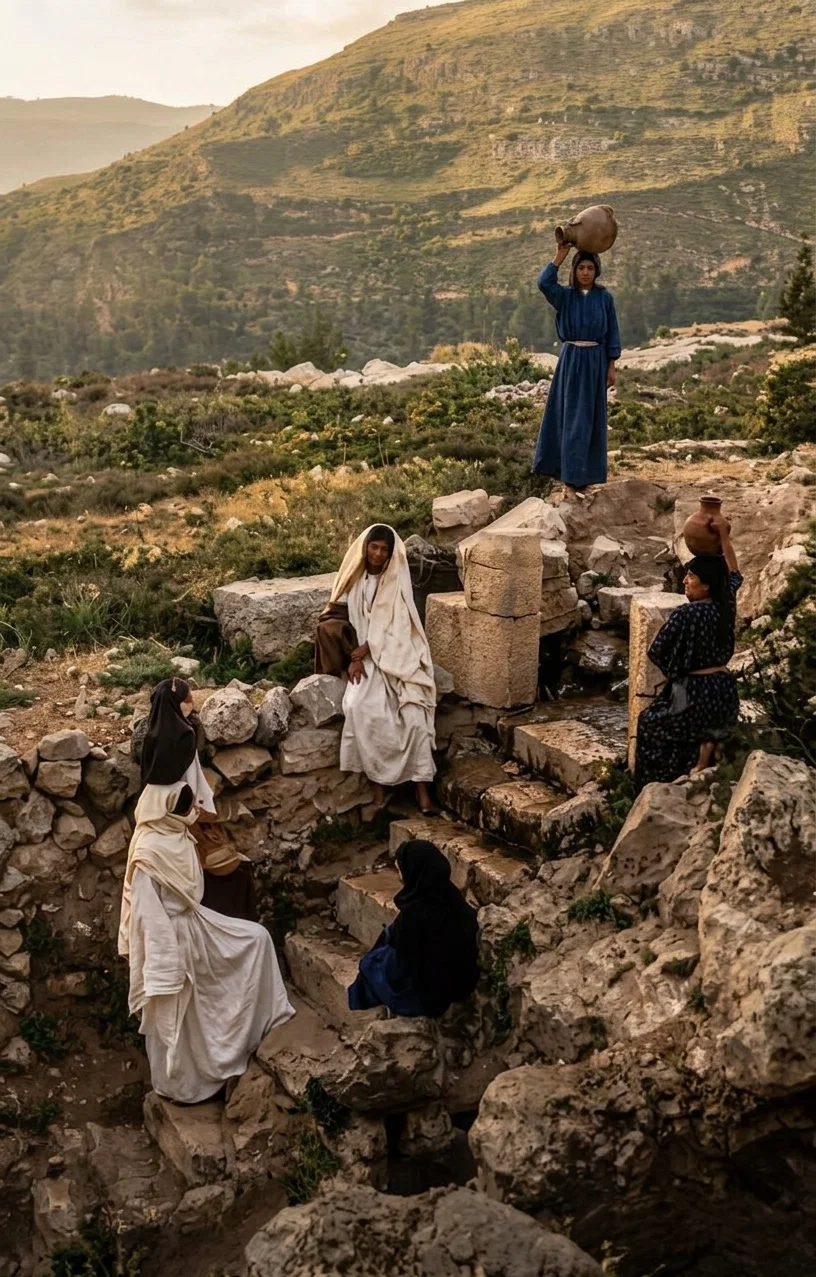
OUR illustration is strikingly suggestive of a beautiful lesson. The picture is that of women coming to draw water from a well near Nablus, the more ancient Neapolis; in New Testament times Sychar, and, further back, Shechem. It was in this vicinity that the son of Isaac opened a fountain, long afterward known as “Jacob’s Well.” And it was to just such a well as this, perhaps to the same well, that the woman of Samaria came to draw water in that long-ago noontide heat, and found sitting near a weary Jewish Traveler and Teacher. John 4:4-42. Customs change but little in Oriental lands, and women come from the city now as of old to draw water.
Women at a Well in Samaria.
YET how little many of them know of the great Teacher and His lesson. How few in that once favored land know aught of His precious teachings, other than the glossed and perverted form in which His lesson has been clothed. Jacob’s Well is now a place of pilgrimage; thousands seek it out, but receive from it no more benefit than have the majority of those who have drawn water from its store during the centuries since He sat by its brink and asked for a draught.
WONDERFULLY did the great Teacher enlist the woman’s interest. He asked her to do something for Him,—“Give Me to drink.” It was a strange request for the separated Jew to make of an outcast Samaritan. Jesus does not stop to argue the matter, or to justify Himself, in response to the woman’s question. He forthright tells her that the asking should have been reversed; she should have asked of Him, and He would have given her living water. But this does not pierce the gross materialism of the woman’s life. She reasons that the Stranger must get His water from that well, and how could He do it when He had nothing with which to draw it forth? She saw only with physical eyes.
JESUS replied again: “Every one ‘that drinketh of this ‘water shall thirst ‘again; but whoso‘ever drinketh of the ‘water that I shall ‘give him shall ‘never thirst; but ‘the water that I ‘shall give him shall ‘become in him a ‘well of water spring‘ing up unto eternal ‘life.” God’s Spirit is that water. The drinking is yielding to that Spirit absolutely, and receiving it from the great Fountain of life. It not only heals and vivifies the heart, but it makes that heart a fountain of refreshing to other hearts, a place where the weary may become refreshed. It opens the whole being to God, and all thirst for other fountains, other water, is forever quenched. Even the material liquid will be used as life from the great Giver of all.
BUT persistently the woman saw in it only physical benefit. “Sir, give me this water, that I thirst not, ‘neither come all the way hither to draw.” The wise Teacher takes another tack, and opens by an adroit question the way to the woman’s inner life, thus showing her her great need. Then, either because she knew no better, or because she did it to avoid further revelation of her past life, the woman raised the century-old controversy of salvation between Gerizim and Jerusalem. “‘What about it? Does salvation ‘come by the way of‘Gerizim, the Mount of Blessing?’ The only thing that makes holy or blessed is the presence of God, which both Jew and Samaritan had banished.
JESUS is not there to argue for mere place or time or ceremony, and what a lesson it should be for His servants! He wanted her to learn her soul’s great need; all minor matters could wait, and His words come ringing down the centuries to us, as full of life and truth as when the Master spoke them: “Woman, believe Me, the hour ‘cometh, when neither in this mountain, nor in Jerusalem, shall ye ‘worship the Father.” God is not confined to particular places. He uses them as long as they will serve His wise purpose, and no longer, and Jerusalem’s day was soon to close. Turn from the material, the man-made, the earthly.
HERE is acceptable worship, carrying with it the twofold assurance of what is evidentially true and what is pleasing to God: “Ye ‘worship that which ye know not; we worship that which we know; ‘for salvation is from the Jews. But the hour cometh, and now is, ‘when the true worshipers shall worship the Father in spirit and ‘truth; for such doth the Father seek to be His worshipers. God ‘is a Spirit; and they that worship Him must worship in spirit and ‘truth.” Not alone must the life-power be present, but the life must be that which shapes its course in harmony with God’s revealed truth. There are thousands who cry, “We have the Spirit,” yet who ignore the truth of God’s Word. Let those who abide by the Word fear lest their loyalty degenerate into adherence to a mere form of words. In the true life, both the Spirit and the truth bear equal sway. The Spirit works according to truth; it is the “Spirit of truth.”
WHETHER the woman gave Jesus to drink, we know not. It would almost seem from the narrative that she did not; but perhaps she did at once, asking her question afterward. At any rate, the Master gave to her from the great fountain of His life and love. He found refreshment from His own weariness in ministering to the woman. He sowed there, by means of simple, wayside-incident seed, the crop which was reaped by His disciples on the other side of Pentecost. Acts 4:4-8. Jesus might have said, “I am weary; why should I ‘talk with this strange woman who is not even seeking spiritual ‘things?” But there was an opportunity, God-given, and He purchased it at the cost of physical rest. So God desires His children to look “carefully how ye walk, not as unwise, but as wise; buying ‘up the opportunity [margin], because the days are evil.” Eph. 5:15, 16. So shall they not only find life, but be themselves wells of life-giving water.

THE WAGES OF SIN AND THE GIFT OF LIFE.

IN Romans 6:23, four words are contrasted: “wages” and “gift,” “death” and “life.” In the truest sense, God pays no wages for our services, because they are worthless. “All our righteousnesses” “are as filthy rags.” Isa. 64:6. He is too wise to pay wages; but He does offer gifts. The Scriptures speak of the “gifts of God” (Rom. 11:29), and the “gift of God.” The various gifts of God are all contributory to the one great gift, eternal life.
There is a great distinction between wages and gifts. While the former is money or its equivalent paid as compensation for labor, the latter is always conferred gratuitously.
The term “wages” is closely associated with the terms “master” and “servant.” Christ said, “No servant can serve two masters.” Luke 16:13. There are two masters in existence, Christ and Satan. The majority of mankind are servants of Satan, performing hard labor for him, to receive, O, such wages!—death.
In Gal. 5:19–21 Inspiration furnishes us with a list of seventeen different sins, specified as the “works of the flesh.” Those who sin, work, and work hard, too; for “the way of transgressors is hard.” Prov. 13:15. Is it not strange that so many people seem contented to work hard for death, when without working they can receive life as a gift? “To him that worketh not, but believeth on Him that justifieth the ungodly, his faith is counted for righteousness.” Rom. 4:5.
Christ, pitying the weary servants of this cruel master, heralds this joyful proclamation: “Come unto Me, all ye that labor and are heavy laden, and I will give you rest.” In Satan’s service men labor, become weary, and die; while in God’s service they cease laboring and rest, and to all eternity, live. “Choose you this day whom ye will serve.” Josh. 24:15. “The wages of sin is death; but the gift of God is eternal life.” Which will you have?
This query may now arise in the minds of many: Do not God’s servants work? Do they not keep the commandments, and do practical missionary work?—Yes; but not to earn or receive eternal life. Angels “do His commandments,” and “minister unto them who shall be heirs of salvation,” but they do not request wages nor receive any. Jesus Himself labors in the sanctuary above, receiving no compensation. The spirit of self-sacrifice, originating with God, and pervading all heaven, is infused into His earthly servants, who, like Christ and angels, labor gratuitously. What God gives them as gifts, they receive to impart to others likewise. Giving gifts is a feature of sinless human nature, while laboring for compensation is an element coherent with perverted human nature.
Self-sacrificing labor, in contrast to compensation labor, is not exhausting. His “yoke is easy and His burden light.” Strange as it may seem, this labor is “rest unto our souls.”
Satan’s servants, unlike the servants of Christ, labor solely for reward. They murder, steal, rob, defraud, violate the Sabbath, etc., all for reward, not realizing it to be death.
When will God’s gift, eternal life, be presented? “He that heareth My Word, and believeth on Him that sent Me, hath everlasting life, and shall not come into condemnation; but is passed from death unto life.” John 5:24. “I give unto them eternal life.” John 10:28. “He that hath the Son hath life.” I John 5:12.
When we cease our exhausting labor for death, and come unto Christ, He gives us refreshing rest and everlasting life. How much better to enjoy refreshing rest and live, than to suffer from exhausting labor and die.
The same One that invited the Jews to come unto Him that they might have rest, said, “Ye will not come to Me, that ye might have life.” John 5:40. Is not this the situation now? Rest and live, work and die. Which will you choose?
“The wages of sin is death.” When is pay-day? Is it entirely future?
“Sin, when it is finished, bringeth forth death.” James 1:15.
But when is sin finished? Every sinful deed is finished when it is committed, right then and there. “Sin is the transgression of the law.” I John 3:4. Our transgression finished, is our sin finished, and its result immediately follows—death. We can not sin to-day and reap the entire result at the end of the “thousand years.” To sin now is to die now, from which there is no escape. With every sin we commit, spiritual death ensues. Many sins bring forth physical death also. Naturally we are endowed with a limited amount of vitality, and like money in the bank it is gradually diminishing; there comes the day when the last vestige of life is drawn, and complete death ensues. The loss of the least particle of life means the reception of an equal quantity of death. Thus complete death is the development of a long-continued process, hastened or retarded at the sinner’s will, who may resist temptation and retain life, or sin and acquire death.
“To be carnally minded is death,” not will be. Rom. 8:6. When we cherish a carnal thought, we sin; and there is absolutely no escape from its penalty, except by miraculous power. According to past discoveries in medical science, strong physical constitutions may be ruined by intemperate thoughts unaccompanied with outward acts.
This close relation between sin and death is a revelation of truth originating in Eden: “In the day that thou eatest thereof, thou shalt surely die.” Gen. 2:17. The death of the human race, beginning with the first sin, has slowly developed from generation to generation, until modern man, diseased and degenerated, bears but little resemblance to primitive man. Were this life, with its past increase of sin, suffered to continue, the inevitable day would not be far distant when the human race, created in the image of God, would be totally extinct—dead.
But this sad state of things is not to continue much longer. Probation is about to close, and our Life-giver to come. Just now, for a short time, He offers us the gift of eternal life. “Ask, and ye shall receive.” W. C. MATHEWSON.
Luce, Mich.

TRUTH

MANY a man prays for a baptism from above who would run if he saw it coming; and not a few of those who plead so eloquently that their lips may be touched with a coal from off the altar, would faint dead away if they saw an angel go for the tongs. Spiritual privileges and power come at much cost, and few of us are really willing to pay the price.—Selected.

Ancient History Which Is Also Modern

ANCIENT HISTORY WHICH IS ALSO MODERN

ABANDONMENT OF THE CONSTITUTION.

WE have seen thru an article last week that with a grand flourish and promise of the extension of the blessings of republican liberty, the republic of Rome sent her armies and navies across the seas to fight the battles of peoples who were struggling for liberty against the oppressions of kingships.
We have seen her shortly and triumphantly deliver these struggling peoples from the oppressive power of kingships; and publish a proclamation promising to these peoples, liberty, self-government, and freedom from taxation—in one word independence.
And we have seen her so evade her published promise as in every sense to disregard it, and compel from those peoples an acknowledgment of the universal and perpetual sovereignty of the republic of Rome.
When the republic of Rome had gone thus far, it became essential that she should decide as to what should be done with these new territories and peoples. Since she had refused to them the self-government and independence which she had publicly promised, she was compelled, by the very necessities of the case, to decide how she herself would govern them. And this forced the question as to whether she would govern them according to the Roman constitution, or according to a new order of procedure adapted to the new circumstances; whether she should govern them with the constitution or without it.
“The earlier State law of Rome knew nothing of tributary subjects. The conquered communities [in the home territory of Italy] were either sold into slavery, or merged in the Roman commonwealth, or admitted to an alliance which secured to them at least communal independence and freedom from taxation.”—Mommsen. But since these people “had paid tithe and tribute to their former masters, it was, in the judgment of the shortsighted, the most judicious, and, if Rome was desirous of retaining these possessions at all, undoubtedly the most convenient, course to manage the new territories entirely in accordance with the rules” to which they had been subject under their former masters. Accordingly the Romans did not extend to the new possessions the Roman constitution, but continued there the original systems under Roman governorship. But “it was the shirt of Nessus which they inherited from the enemy.”—Mommsen.
This expression “the shirt of Nessus” is a mythological reference: in the myth a shirt of Hercules was secretly tinged with the blood of the dying Nessus, which, when Hercules again put it on, caused his ruin. The thought of the historian is that when Rome would not extend to her new possessions her own constitution and the privileges of her own government, but held them as tributary subjects ruled by foreign laws, in that she took upon herself what corresponds in the myth to “the shirt of Nessus.” And as in the myth that shirt proved the ruin of him who wore it, so this abandonment of her constitution and the inauguration of this colonial system, proved the ruin of the republic of Rome.
It is true that “at first the Roman government, in imposing taxes on their subjects, intended not strictly to enrich themselves, but only to cover the cost of administration and defense. . . . The fact, however, that they still maintained moderation in the imposition of burdens was of little consequence as compared with the conversion of their sovereignty into a profitable privilege at all: the FALL WAS THE SAME, whether a SINGLE APPLE WAS TAKEN or the TREE WAS PLUNDERED.”—Mommsen. The historian was writing on the fall of the Roman republic, not the fall of her new possessions: and he says that the Roman empire fell when she refused to extend to her new possessions and peoples her own constitution, and made those peoples tributary subjects, even tho the taxes levied were to be spent upon and within the new possessions themselves. And he declares that when that was done, the fall of the republic of Rome “was the same, whether a single apple was taken or the tree plundered:” whether the tax imposed were a single sesterce or whole talents, a single cent or millions of dollars.
Nor did the abandonment of her constitution by the republic of Rome stop with her refusal to extend it to the new possessions. Those who in that step conducted the government affairs thought to keep the constitution, and the government under it, intact at home, while refusing it to the new peoples abroad. But that step involved yet other issues, which forced the taking of yet other steps in abandonment of the constitution, in which those who were in power in the State “not only usurped in substance the government, but also remodeled the constitution according to their own views;” tho “they changed not the letter, but merely the practise of the existing constitution.”—Mommsen.
Such was the course followed by the republic of Rome, and onward to ruin; and all the people of the United States and of the whole world have seen the same course repeated so far, step by step and item by item, in the past three years and up to date, in the course of the republic of the United States.
The course of the republic of Rome did not stop at this point: will the course of the republic of the United States stop at this point?
As a matter of already accomplished fact, the course of the republic of the United States has not even paused at this point, but has passed yet further onward in the identical course of descent of the republic of Rome.
This will be followed further next week. ALONZO T. JONES.

“BE YE THEREFORE PERFECT.”

Those who serve God should aim at perfection. Wrong habits must be overcome. Right habits must be formed. Under the discipline of the greatest Teacher the world has ever known, Christians must move onward and upward toward perfection. This is God’s command, and no one should say, I can not do it. He should say instead, God requires me to be perfect, and He will give me strength to overcome all that stands in the way of perfection. He is the source of all wisdom, all power.
Individually we are to be loyal to the laws that govern God’s kingdom. Christians are to be light-bearers, saying to all with whom they come in contact, “Behold the Lamb of God, which taketh away the sin of the world.” They are to be examples of piety, representing Christ in word, in spirit, in action. Their actions are to be a copy of the actions of the Saviour. Thus they are to show the superiority of Christ’s principles over the principles of the world. They are to work upon a higher plane of action than do those who are not Christians. They are to bring the ennobling influence of the Gospel into every phase of life. Their purity and usefulness are to be a source of illumination to others.
The world has set up a standard to suit the inclinations of unsanctified hearts, but this is not the standard for those who love Christ. The Redeemer has chosen them out of the world, and has left them His sinless life as a standard. He wants them to rise above all cheapness of word or action. “Be ye therefore followers of God, as dear children, and walk in love, as Christ also hath loved us, and hath given Himself for us an offering and a sacrifice to God for a sweet-smelling savor.” “Gird up the loins of your mind, be sober, and hope to the end for the grace that is to be brought unto you at the revelation of Jesus Christ. . . . As He which hath called you is holy, so be ye holy in all manner of conversation; because it is written, Be ye holy; for I am holy.”
These words are to be believed and practised. Christians are to be superior in wisdom, in knowledge, in skill, because they believe in God and His power. The Lord desires them to reach the highest round of the ladder, that they may glorify Him. He has a treasure-house of wisdom from which they may draw. The religion of Christ never degrades; it never makes men and women coarse and rough. God wants His children to be correct in speech and correct in habits. He desires them to possess knowledge that will give them a standing-place among men.
Overcoming, means much more than we realize. It means resisting the enemy and drawing nigh to God. It means taking up the cross and following Christ, doing cheerfully those things that are contrary to natural inclination. Christ came from heaven to show us how to live a life of self-sacrifice. In His strength we are to gain perfection. He has made it possible for us to do this, and when He comes the second time, He will ask us why we have not fulfilled His purpose for us. Day by day, hour by hour, we are preparing for the judgment, deciding our eternal destiny. We are trading on our Lord’s goods. When He comes, He will reckon with us, to see how we have improved His goods. Results proportionate to the talents entrusted will be required, and to every faithful, self-denying Christian will be given a reward proportionate to his work. Nothing that is done in sincerity is in vain. Everything is accurately weighed in the golden scales of the sanctuary.
Christianity means perfect conformity to the Christ-life. Those whopossess this Christianity will show sound spiritual growth, because they are partakers of the divine nature. Heaven is full of light, and provision has been made that this light shall shine in clear rays upon those who accept Christ, and from them be reflected to those who are dead in trespasses and sins, that by the Holy Spirit’s power they may be raised to newness of life. Christians must be laborers together with God, or they will fail of overcoming, and their influence will cause others to fail. No one is lost who does not also draw others down. Let those who name the name of Christ depart from all iniquity, that Christ may not be ashamed of His professed followers.
The eye of the Lord is in every place, beholding the evil and the good. He knows all our temptations, and He expects us to resist them as Christ resisted them. Jesus died for us that we might live His life of purity. Our prayer should be, “Create in me a clean heart, O God, and renew a right spirit within me.” The heart must be purified; for out of it are the issues of life. The will must yield its helm to the command of Christ. Paul describes this as putting on the new man, “which after God is created in righteousness and true holiness.”
No compromise with sin can ever be accepted by a pure and holy God. No conversion is genuine that does not radically change the heart, the character, every line of conduct. “If any man be in Christ, he is a new creature.” Not a moment should be wasted on a patchwork religion. Our citizenship is above, where Christ sits at the right hand of God. This present life is only our training-school. Here we are to be purified that at Christ’s coming we may be without spot or wrinkle or any such thing,—prepared to receive the inheritance of the saints in light.
The true Christian obtains an experience that brings holiness. The light of truth irradiates his understanding. A glow of love for the Redeemer clears away the cloud that has interposed between his soul and God. The will of God, pure, elevated, and sanctified, becomes his will. His countenance reveals the light of heaven. His body is a fit temple for the Holy Spirit. Holiness adorns his character. God can commune with him; for soul and body are in harmony with the principles of heaven. MRS. E. G. WHITE.

BAPTISM FOR THE DEAD.

ELSE what shall they do which are baptized for the dead, if the dead rise not at all? Why are they then baptized for the dead?" says the apostle in 1 Cor. 15: 29.
Some persons regard this scripture as teaching the necessity of a distinct baptism by believers on behalf of those who have gone down to the grave without repentance and baptism. In some parts of the land expensive temples have been erected, in which the ordinance of baptism is administered for this purpose.
The sincerity of many of the adherents of this doctrine I do not doubt; but that the above scripture enjoins this practice, I do not believe, for the following reasons:—
1. It is always unsafe to build a fundamental principle of belief upon an inference from a text of Scripture, especially if such inference is unsupported by any passage of Scripture. But is this interpretation thus left without support?—Yes. There is not a text, inference, or example in all the Sacred Record of the primitive church that in the slightest degree gives strength to this view. We have no account of temples erected for its administration, no hint of any apostle or elder performing this ceremony in behalf of the dead; there is no record of the formula used.
This complete silence is all the more significant when it is remembered that this ordinance would necessarily have been a matter of special instruction, since it would have been the introduction of a new ceremony, rather than the continuation of some established custom.
The reader is asked to note carefully how explicitly other ordinances were defined and enforced. For example, baptism (Matt. 28: 19, 20; Mark 16: 16; Rom. 6: 3-6), the ordinance of humility (John 13: 1-17), the Lord's supper (Luke 22: 17-20; 1 Cor. 11: 23-34).
2. The above construction put upon the scripture in question presupposes the preaching of the Gospel by and to dead men. But this again we find to be in direct conflict with the most positive statements of Holy Writ.
We read: “The dead praise not the Lord, neither any that go down into silence.” “For the living know that they shall die; but the dead know not anything. . . . Also their love, and their hatred, and their envy, is now perished; neither have they any more a portion forever in anything that is done under the sun.” Ps. 115:17; Eccl. 9:5, 6. Again the psalmist bears testimony to this great truth: “His breath goeth forth, he returneth to his earth; in that very day his thoughts perish.” Ps. 146: 3, 4. How inconsistent to suppose that such a praiseless, loveless, thoughtless, lifeless class of beings would make either effective preachers or responsive hearers.
3. This interpretation also provides for a change of destiny beyond the grave, which is also anti-scriptural. There is no promise in the Word of God that can justify the sinner in looking forward to a future state for salvation. There will be no time when the settled and continuous choice of this present life may be reversed. “Now is the day of salvation.” 2 Cor. 6: 2. This truth is also confirmed by the words of Christ in the parable where it is represented that the rich man desires Lazarus to cross the border-line of their respective destinies, and dip his finger in cold water and cool his tongue. This was denied, for the unalterable reason that between them there was an impassable gulf “fixed,” which forbade any possible change of destiny. Luke 16:26.
4. But the primary reason for the rejection of this interpretation is that it robs the text itself of the gem of truth which it holds. We believe this text to mean just what it says, as is the case with all the words of God to men.
“Why are they then baptized for the dead?” Evidently, from the context, because the dead are the only ones to whom baptism can have any application, and this for the simple reason that they are the only ones qualified for burial, or that can require a resurrection.
But how many are dead?—All. “Because we thus judge, that if one died for all, then were all dead.” 2 Cor. 5: 14. “For as in Adam all die, even so in Christ shall all be made alive.” 1 Cor. 15: 22. To God, who sees the end from the beginning, he who is in sin is dead. “Sin, when it is finished, bringeth forth death;” actual, physical death; and this “death passed upon all men, for that all have sinned.” James 1:14, 15; Rom. 5:12. If it were not for the dead, baptism would be meaningless.
In order that the relation of baptism to the dead may appear more clearly, let us consider it in the light of the life of Christ. When the Saviour came to John at the River Jordan and requested baptism, John refused on the plea of unworthiness. But Jesus urged His request in these words: “Suffer it to be so now; for thus it becometh us to fulfil all righteousness.” Christ was not only an example to man while on the earth, but also a Substitute. It certainly was not for Himself that Christ was baptized, but for a dying world. For He knew no sin. 1 Peter 2: 22. It was not necessary for Him to die to the world, for He never lived to it. But it was for sick, dying, and dead men that Christ was slain from the foundation of the world. For man He chose an earth-life of sorrow and suffering for sins not His own, but man's. “For He [God] hath made Him to be sin for us who knew no sin, that we might be made the righteousness of God in Him.” And so He fulfilled all righteousness, not for Himself, but for mankind; for His righteousness is unto all that believe, and is declared for the remission of sins that are past. Rom. 3:22-25.
No work of my own righteousness, not even the work of baptism, counts in the process of justification; for it is emphatically stated that it is “not by works of righteousness which we have done, but according to His mercy He saved us.” Titus 3:5. It is “not of works, lest any man should boast.” Eph. 2:9. “But to him that worketh not, but believeth”—“his faith is counted for righteousness.” Rom. 4:5.
Since it is Christ's righteousness that is set forth, and applied to the sinner (Rom. 3:24), it is clearly evident that when Christ was baptized it was on behalf of mankind, and not Himself, that this act was performed. In our stead He fulfilled all righteousness; in our stead He bore our sins (1 Peter 2:24); yes, in our stead He was made to be our sins, and not ours only, but the sins of the whole world. 1 John 2:2.
For whose sins, then, was He baptized? There can be but one answer to this question,—for the sins of the world. But in what condition were all in the world?—Dead. 2 Cor. 5:15. Then for whom was Christ baptized?—For the dead, most certainly, and for no one else. And what significance has the baptism of Christ to the dead?—To those who have not rejected “the Light which lighteth every man that cometh into the world,”—whether it has shone on them thru the written Word or thru the book of nature (Rom. 1:19, 20),—His baptism, with all the perfect righteousness of His spotless character, stands imputed to them, whether they still live or are numbered with those that sleep in the dust. To those who reject the Light of life, the baptism of Christ in His own flesh, and in the person of His followers from that day to the present, stands as a positive testimony to His divinity,and that there will be a resurrection of the dead, both of the just and the unjust. Do I then believe in proxy baptism?—Most certainly, the kind that makes Christ instead of man my substitute and Saviour. But this great truth must be kept constantly before men.
And so we also are “buried with Him by baptism,” not to proclaim the merit of our own work, but to exalt the merits of His perfect life. Baptism is not a step taken toward Him, but “with Him.” Rom. 6:4. I am not baptized to obtain justification, but because I am already justified by His death and saved by His life thru faith. Rom. 5:10. My baptism is a reaffirmation of His perfect baptism. It is Christ again manifesting the great truth proclaimed by His own baptism in the person of His humble follower, who can say, as did Paul, “I have been crucified with Christ;” and now I live, not for myself, but for Him who died for me (Gal. 2:20); so that in my baptism He shall be all in all; for He hath out of twain made one new man, and that man is Christ, not I. “Why are they then [who?—Christ and His disciples—Christ and His body; for we are the body of Christ] ‘baptized for the dead?’”—Because “Christ is risen indeed,” and is able not only to quicken those who are dead in trespasses and sins, but also to wrench from the tomb every captive. “For as in Adam all die, even so in Christ shall all be made alive. . . . For He must reign till He hath put all enemies under His feet. The last enemy that shall be destroyed is death.” And until that glorious day shall burst upon this groaning earth, the blessed ordinance of baptism will remain as the perfect pledge of a perfect righteousness, sealed to the millions of the dead who have died in the Lord, and bright with the prophecy of that morn when sin and death shall be no more, and that saying shall come to pass which is written, “O death, where is thy sting? O grave, where is thy victory?” 1 Cor. 15:55.
W. A. ALWAY.
Continue reading: ENDING OF THE PROPHETIC DAYS