Your ShelfYour Projects

Signs of the Times, Vol. 27, No. 1.

A SPECTACLE UNTO THE WORLD

Signs of the Times

Jan 2, 1901

Pacific Press Publishing Company · Oakland, California · Jan 2, 1901

A SPECTACLE UNTO THE WORLD.
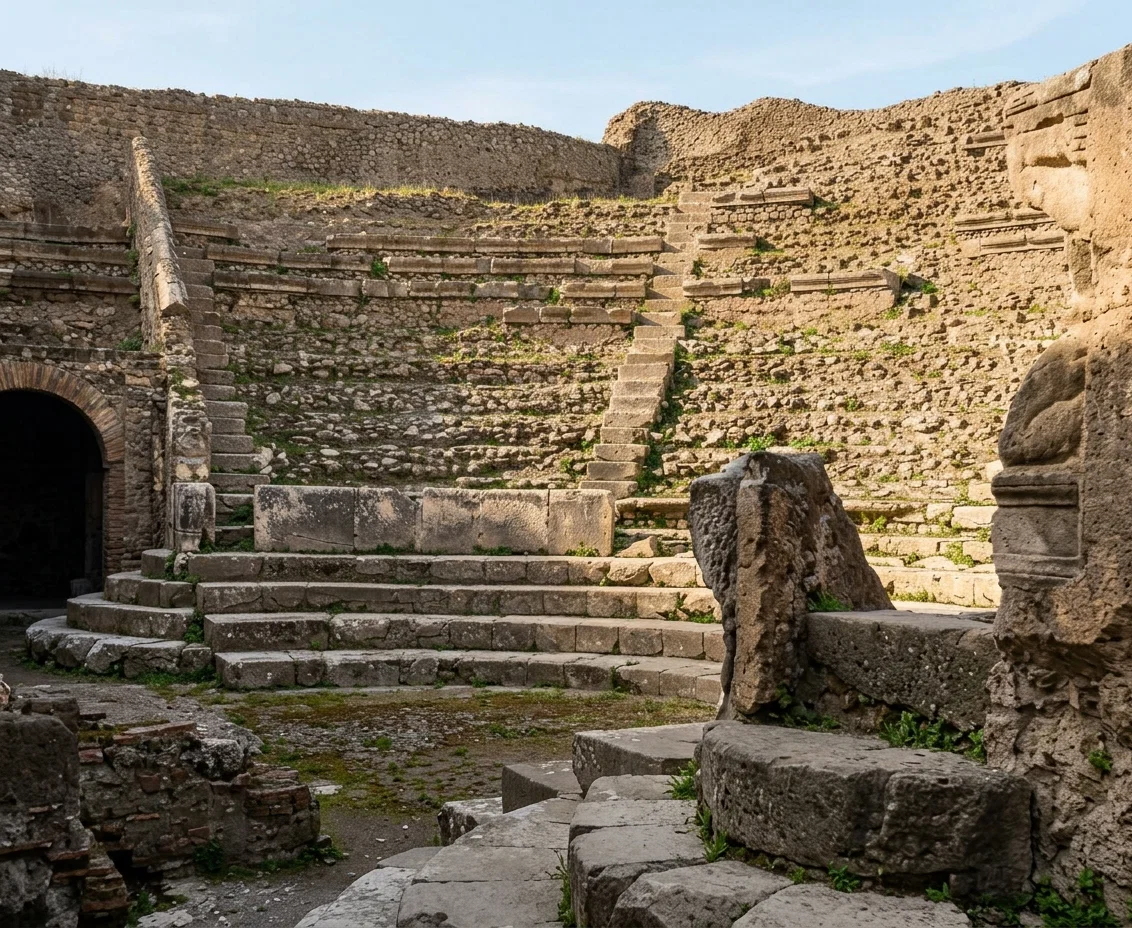
“For we are made a theater unto the world, and unto angels, and unto men.” Who is made a theater, a spectacle, unto the world, and unto angels, and unto men?—Not alone Paul and others called apostles, but every individual called by the name of Christ.
RUINS OF A POMPEIAN THEATER.
It is because they are called Christians that they become a spectacle unto the world. This is what makes them such. The word means a theater, a show, a spectacle.
It is as tho the whole world were assembled in one great amphitheater, row upon row, bank upon bank, from the arena to the sky-line of the great wall, and the actors on the central stage those called by the name of Christ. We are the spectacle, the thing looked at, the actors.
Why a theater? why actors?—O, here are those who personate others, who study to present the words and actions of other men or women, more or less renowned, or of supposed characters, in living act and word; and here are the spectators to be amused or edified, and observe the skill of the performers. A most forcible way indeed is this of appealing to the emotions of mankind. So the illustration is drawn from an institution familiar to the world for ages.
Then, being the spectacle, the show, the actors on this great stage, what is there that Christians are doing, or can do, to arrest and hold the attention of the vast audience? What characters are being depicted? Whose lives and words are being re-enacted? What great scenes from history are being presented? Men say of a great actor, “He takes the part of Hamlet;” of another, “He is Othello.” If a word means aught, there should be studied in this mighty theater only the words of One; there should be revived only one life, one character—Christ.
But is not the subject too limited? Does it not become monotonous? —Well, opinions vary here; but at one thing there is certainty,—the world continues to look on. Says the Christian actor: “The theme is as wide as the universe; for in Him is the fulness of all things. He is made unto us wisdom, and righteousness, and sanctification, and redemption.” Says the world, “It is foolishness.” The Christian replies, “God hath chosen this kind of foolishness to confound the wisdom of the world, and unto us which are saved it is the power of God.” And the world continues to look on.
What does it see? This is a tremendous question. It is written to those in this world arena: “Ye should show forth the virtues [excellencies] of Him who hath called you out of darkness into His marvelous light;” “Let the Word of Christ dwell in you richly in all wisdom. . . . And whatsoever ye do in word or deed, do all inthe name of the Lord Jesus.” And one said, “I live; yet not I, but Christ liveth in me.” “Let this mind be in you which was also in Christ Jesus. . . . For it is God who worketh in you, both to will and to do of His good pleasure.” Does the world see and hear all this? Does it see faithfully portrayed in the act before it the life of the Christ? Are the words spoken such as it should expect to hear from the Man of Galilee Himself? Professed Christian, answer.
But there is more. The question of what is seen takes on intensity and solemnity. Supposedly—and truly it ought to be—Christ the Master, in life and in word, should be seen by the world in the spectacle before it. Said Christ the Master, “He that hath seen Me hath seen the Father.” Yes, a moment’s thought shows that it must be true, and that the added truth does not enlarge the first; for in Him is the fulness of the Godhead bodily. “God was in Christ, reconciling the world unto Himself, not imputing their trespasses unto them; and hath put in us the word of reconciliation. Now then we are ambassadors for Christ, as tho God did beseech you by us; we pray you in Christ’s stead, be ye reconciled to God.” “As Thou, Father, art in Me, and I in Thee, that they also may be one in Us. . . . I in them, and Thou in Me, that they may be made perfect in One.” Does the world see all this on the stage of acting? And does it hear in the voice of the speakers the reconciling voice of the Majesty of heaven?
If it does, some will believe, for the record is, “God was manifest in the flesh, justified in the spirit, seen of angels, preached unto the Gentiles, believed on in the world.” But of the vast throng the many look on and scoff. The wisdom of this world makes the truth of God a lie, God Himself unknown, and salvation a farce. As ever it was, so now it will be, the humble actors on this stage will be “made a gazing-stock both by reproaches and afflictions.” But the greatest apostle comforted those of his day with words that carry comfort to the end: “We are fools for Christ’s sake, but ye are wise in Christ.”
A spectacle to the world, and unto angels, and unto men! There are times when the Christ-follower may think himself unobserved, when there are no human spectators. But, lo! the heavens open, and a multitude of witnesses surround him. Who are these that watch with such intent gaze every word and action?—Messengers of light from the court of Christ, and messengers of darkness from the court of Satan. Be on thy guard, Christian, that Christ be in you, your constant hope of glory, in secret and in public. Your arena is exceeding large, tho it be only in your own home and neighborhood. Be true to the character you are representing; for upon your conduct depends the honor of your Master, and the salvation of perishing souls.
L. A. PHIPPENY.

THE WAY OF THE CROSS.

JESUS says, “If any man will come after Me, let him deny himself, and take up his cross, and follow Me.” Matt. 16:24.
As we each advance in our life journey day by day, year by year, we at times encounter an obstruction which seems to arrest our progress, opposing all our plans of usefulness or enjoyment, cutting directly across the wonted current of our lives at an angle no less sharp than that of the Roman cross. This hindrance may come in the form of bereavement, sickness of self or others, the indifference of friends, or pecuniary loss. Whatever the trying event, this is our cross for the time being. To us the Saviour says: “Take up this cross, and follow Me. Be willing to give up your cherished plans, and even life itself, for My sake.”
Many tried souls can bear faithful witness that in the way of the cross there are experiences which come in no other way. The trials cheerfully borne for Christ’s sake are transformed into blessings, bringing a higher and holier life than that which you had marked out. Paths of usefulness open before you of which you had not dreamed.In that you have suffered and received consolation, you also may become a “son of consolation,” bearing the cheering word to others. The great apostle learned to glory in tribulations, “knowing that tribulation worketh patience; and patience, experience; and experience, hope; and hope maketh not ashamed.”
“Let good or ill befall, It must be good for me, Secure of having Thee in all, Of having all in Thee.”
AUGUSTA W. HEALD.

“NOT YOUR OWN.”

Some Thoughts for the New Year.

The old year, with its burden of record, is fast passing away. The new year, with all its possibilities, will soon be ushered in. What advancement have we made in the knowledge of Christ during the past year? Are we prepared to show, more decidedly than ever before, that we are on the Lord’s side? At this time, when the nations of the world are wavering between infidelity and idolatry, are we prepared to stand as faithful ambassadors for Christ? Shall we not, at the beginning of this new year, give ourselves and all we have to God? Shall we not listen to His voice, which calls us to a renewed contest, to a more thoro consecration of ourselves and our intrusted capabilities to His service?
To God we owe all we have and are. In Him we live and move and have our being. We have not been forgotten by Him. In His book each human being has a page, on which is recorded his whole history. Constantly and untiringly God is working for our happiness. The treasures which He has placed within our reach are numberless. “The Lord is good to all; and His tender mercies are over all His works. Thou openest Thine hand, and satisfiest the desire of every living thing.” He is the Father of mercies and the God of all comfort. The earth is full of His goodness. Creation proclaims, with myriad voice, the forbearance, love, and compassion of the Almighty.
Thru all the ages God has manifested for the human race a love that is without a parallel. He so loved man that He bestowed on him a gift that defies computation. That the abundance of His grace might be revealed, He sent His only-begotten Son to our world, to live a man among men, to spend His life in the service of humanity. In our behalf the Son of the Infinite God was numbered with the transgressors. Christ was the channel thru which the Father poured into the world the rich stream of His grace. God could not give less than the fulness, nor was it possible for Him to give more. “Herein is love, not that we loved God, but that He loved us, and sent His Son to be the propitiation for our sins.”
God has made us His stewards. To every one He has given some talent, which is to be improved and returned to Him. Every one is the possessor of some trust. Time, intellect, reason, money, the tender ministry to which some are adapted,—these are the gifts of God. From the lowliest to the highest, all have been intrusted with the goods of heaven, and all are called upon to make a return to the Giver.
The first thing we are to do is to give ourselves to the Lord. Life, with its endowments and privileges, is God’s gift. Let us remember that it comes from God, and is to be wholly consecrated to Him. Let us say with Paul, “I count all things but loss for the excellency of the knowledge of Christ Jesus my Lord; for whom I have suffered the loss of all things, and do count them but dung, that I may win Christ, and be found in Him, not having mine own righteousness, which is of the law, but that which is thru the faith of Christ, the righteousness which is of God by faith.”
When we have given ourselves to God, we shall be willing to give Him what He has given us. All we have and are is to be laid at Christ’s feet. We have been bought with a price which can not be estimated, and we should count it a privilege to co-operate with God by denying self, by giving of our earthly possessions to make it possible for those in the darkness of error to hear the truth. Each soul saved is worth more than a world; for he is saved unto eternal life. Those who invest their means in this work double their talents.
Whether or not we give mind, soul, and strength to God, it all belongs to Him. God speaks to each human being, saying: “I have a claim on you. Give me your zeal, your capabilities, your energy, your means.” He has a right to ask this; for we are His, redeemed by His boundless love and by the agony of the cross of Calvary from the service of sin. On no account are we to devote our powers to self-serving. Day by day we are to return to the Lord that which He has intrusted to us. And we are to ask Him, not only for temporal blessings, but for spiritual gifts. He who asks in faith, believing that God will fulfil His word, and who acts in accordance with his prayer, doing God’s will in all things, will receive rich blessings from on high. And as he receives, he is to impart to those who need help.
The Christian has been given the management of his Lord’s goods. Great trust is reposed in him, and he is to treat the property in his hands with as much care as if it were his own; yea, he is to be more exact in his treatment of it, putting more thought, more energy, more devotion into his work, because he has been trusted to stand in his Master’s place. His interests are to be bound up with the interests of his Master. He is to lose all selfishness in working for the One who has honored him by trusting him. If he were to use for his own advantage any portion of the goods intrusted to him, he would prove himself unworthy of the trust placed in him. He would sacrifice his honor at the shrine of mammon.
Christ warns us against laying up treasure on this earth, “where moth and rust doth corrupt.” He urges us to use our goods for the advancement of God’s kingdom. He sees men risking everything to secure earthly riches, crazed with the prospect of getting gain; and, lifting up His voice, He cries, “What shall it profit a man if he shall gain the whole world, and lose his own soul?” In comparison with the value of one soul, the whole world sinks into insignificance.
MRS. E. G. WHITE.

CHRISTIANITY AS A PRACTICAL NECESSITY.

GODLINESS is profitable unto all things, having promise of the life that now is, and of that which is to come.” 1 Tim. 4:8.
The rational necessity of a working theory of life, that is, for a practical basis on which to conduct both our physical and our moral or spiritual life, arises primarily from the fact of a reasoning creature, confronted by the two stupendous realities of “the life that now is,” and “the life that is to come,” being rationally bound to make provision therefor. Admitting the existence of God, the fact of a future existence of man becomes a necessary belief, flowing from the nature of God and man. And, indeed, judging from the almost uniform belief in perpetual existence beyond the grave, it may well be questioned whether it could not arise from the nature of man himself. Be this as it may, the fact that men almost without exception believe in a future, renders it their duty in the light of reason to make some provision therefor.
The man who has a wife and several children, and, knowing that winter is approaching, yet makes no effort to close up the many cracks through which the weather enters his house, provides no warm clothing, lays in no stock of wood or provisions, such a man, we say, and say justly, acts like a brute. A brute has no reason, and is not expected to act rationally; but the man who acts as if he had no reason, is actually insane, or degrades himself to the level of the brute. It is a sane man’s duty to act rationally. This is the basis of pure moral science. Many other illustrations might be given pertaining to “the life that now is,” but the above will suffice.
Not less brute-like is the person who makes no provision for “the life that is to come,” the certainty of which he admits.
Not long ago the writer conversed on the subject of religion with a gentleman who had once been a Christian, but after being graduated from a popular university and subsequently taking a master’s degree, had concluded that all religion is “founded on a mere hypothesis,” and had given up his faith.
If we are to be able to give every man a reason for the hope that is in us, as admonished by Scripture (1 Peter 3:15), this objection may well receive some attention. Let us therefore consider the reasonableness of rejecting everything that is founded on a “mere hypothesis.”
Looking at the pen held in my hand, I inquire of what it is composed, and may be answered:—
“Of gold.”
“And of what is gold composed?”
“It is an element, and can not be further analyzed.”
“But of what is it made up? Whence the mass?”
“In that sense, the mass is composed of molecules.”
“And molecules, what are they?”
“They are masses of atoms.”
“Can either of these be seen or their existence directly proved?”
“They can not be seen, but neither can the mind. Their existence is shown by experiments.”
“That is, by their relation to something which may affect some of our senses?”
“Exactly.”
“So far, then, our knowledge of the existence of molecules and atoms is purely relative, not absolute. Is this true of all the seventy or more elements of which the whole world and all that is in it are composed?”
“It is.”
“But further: what holds these atoms together?”
“Cohesion.”
“Thru what medium does cohesion work?”
“Thru ether, it is supposed.”
“What is ether?”
“It is conjectured to be a very rare fluid permeating all space.”
“Is it composed of atoms?”
“Probably it is, if our theory of matter is correct.”
“By what agency are the atoms of ether held together?”
“Probably by cohesion.”
“Thru what medium does the cohesion work which holds the atoms of ether together?”
“No one knows.”
It is thus clearly demonstrated that our whole theory of matter, the basis of all physical science, is founded not only on knowledge purely relative, but on the unknowable (scientifically speaking), and a mere hypothesis. The absurdity of rejecting everything founded on a “mere hypothesis” becomes still further apparent when we make a few practical applications.
Ask the scientist how food is converted into bone, brain, and muscle; and while he can follow it thru the digestive apparatus into the blood, in the last analysis the answer is, “It is supposed.” We must therefore refuse to believe that food sustains life, and stop eating. But surely the ridiculousness of rejecting all we can not understand needs no further amplification along the line of matter.
How is it in regard to the world of mind? The existence of mind itself is known only relatively. It is known only by its relation to certain mental facts. We are conscious of thinking, feeling, and willing; but of that which thinks and feels and wills we know absolutely nothing. Is it in the nerves of the brain, or over them? Is it spirit or matter? How is it connected with brain tissue? and how does it communicate with the nerves? Every theory thus far advanced to explain these things, is a “mere hypothesis.” We must therefore refuse to think.
It behooves us therefore as reasoning creatures to adopt some theory as a practical working basis. In the realm of science, a practical working theory is one which meets every practical need. The atomic theory of matter, Newton’s theory of gravitation, the undulatory theory of light, explain all the essential problems connected with these subjects, and are therefore very properly adopted as practical bases from which to work—not because they are ultimate, but because they are practical. What, then, shall we do as moral beings?—Precisely the same. And infinitely greater is our obligation to reckon with spiritual things than with material things.
At a mass-meeting held in the famous Old South Church on the occasion of Lovejoy’s murder, Wendell Phillips was one of the speakers. Among other things he said:—
The disputed right which provoked the Revolution,—taxation without representation,—is far beneath that for which Lovejoy died. [Confusion.] One word, gentlemen. As much as thought is better than money, so much is the cause in which Lovejoy died nobler than a mere question of taxes. James Otis thundered in this hall when the king did but touch his pocket. Imagine, if you can, his indignant eloquence had England offered to put a gag upon his lips.
But infinitely above the right for which Otis thundered, infinitely above freedom of thought, for which Lovejoy died, is the question of eternal life. Our spiritual nature has needs immeasurably greater than those of our physical nature. Shall we, then, degrade the dignity of reason below the level of the brute creation, and refuse to make provision for our moral and spiritual needs? And what we need most of all is not an ideal theory of life and duty, but a practical religion, one which meets all the essential facts of our spiritual nature.
What, then, are some of these needs?
First, a revelation of the meaning and purpose of life, of the nature and destiny of man.
Of these things, without a revelation, man possesses but little knowledge; all is dark. For some solution of these things we exhaust the resources of mind. The mighty glass that sweeps the sky, revealing the immensity of space, serves only to emphasize our impotence; the scalpel and the microscope lay stress upon our ignorance. We con with eager eye the accumulated wisdom of seers and sages. Like the Persian poet, we feel that—
“We are no other than a moving row Of magic shadow-shapes that come and go Round with the sun-illumin’d lantern held In midnight by the master of the show.”
In vain we search the sacred tomes of the nations. We scrutinize each line of the Vedas; but India, with her Vedas, gives no clew. We turn to the 325-folio volumes of the Buddhistic Tripitaka; but there is no divine explanation. We interrogate the Parsee; but his most ancient Avestas, or the Delphic oracle of Greece, offer not a satisfactory key to the great mysteries of life and death.
“Into this universe, and why not knowing, Nor whence, like water willy-nilly flowing, And out of it, as wind along the waste, We know not whither, willy-nilly blowing.”
Then the philosophers come each, and explain their little guess; but it is only a guess, there is no authority. Wearied at last with all their vanities and vagaries, we are prepared to resign our search as hopeless, exclaiming, with Omar Khayyam:—
“Why, all the saints and sages who discussed Of the two worlds so wisely—they are thrust Like foolish prophets forth; their words to scorn Are scattered, and their mouths are stopt with dust. “The revelations of devout and learn’d Who rose before us, and as prophets burned, Are all but stories, which, awoke from sleep, They told their comrades, and to sleep returned.”
These words from a heathen mind serve to illustrate the dark, vague “questionings of invisible things,” the uncertainty concerning these deep mysteries which pervade the minds of those without the light of revelation. Note the confession of awe with which he contemplates the obscurity which enshrouds death:—
“Strange is it not? that of the myriads who Before us passed the door of darkness thru, Not one returns to tell us of the road, Which to discover we must travel too.”
Vain, alas, how vain, our best endeavor, without a revelation, to solve the sphinx riddle of life, or penetrate the gloom encircling the grave!
There is a pathetic illustration of the deep heart longings of mankind for authoritative utterance on these things, in the words of the old alderman in the rude heathen days of early England, when he stood up amid an assembly of the wise men of Northumbria, who had met to deliberate on the new religion brought by the Catholic missionaries, and in solemn earnestness declared:—
So seems the life of man, O king, as a sparrow’s flight thru the hall when you are sitting at meat in the winter-tide, with the warm fire lighted on the hearth, but the icy rain-storm without. The sparrow flies in at one door and tarries for a moment in the light and heat of the hearth-fire, and then, flying forth from the other, vanishes into the wintry darkness whence it came. So tarries for a moment the life of man in our sight; but what is before it, what after it, we know not. If this new teaching tells us aught certainly of these, let us follow it.
Thus it is shown that even the heathen mind recognizes that spiritual needs are practical needs. DERBY.

THE STAR OF HOPE.

Far o'er the woe of the world I see A star thru the darkness shine, Its silvery beams falling bright on me In this wearisome way of mine. Cheer up, faint heart, there is joy and peace, There is life, where its rays may fall; And sin-sick souls find a sweet release In the light that shines for all.
I once was lost in the wilderness, And dark was the path I trod; The star shone on in its blessedness, And it guided me back to God.
Shine on, bright star, for the earth is drear, And so many are bowed with woe; O, guide us home from the darkness here Where the floods of evil flow!
Shine on, bright star, for thy love-lit ray Leads home to the land of rest, To the home of love and the hills of day, To the home of the pure and blest. Then look and live, for the hand of love Is outstretched from the throne of God. That love-light guides to the home above Thru the path our Saviour trod.
Oakland, Cal.  C. M. SNOW.

REVERENCE IN WORSHIP.

It is always our privilege to look to God as our Father. All around us are evidences of His loving care. He supplies our needs, sympathizes with us in our cares and perplexities, has compassion for us in our sorrows and afflictions, and mercy and forgiveness for us when our mistakes and sins make us loathsome in our own eyes. We know that “the heart of the Eternal is most wonderfully kind;” that “like as a father pitieth his children, so the Lord pitieth them that fear Him. For He knoweth our frame; He remembereth that we are dust.” Ps. 103:13, 14.
But God is infinite in wisdom and power, in holiness and justice, as well as in love and pity. These attributes inspired reverence and awe in the prophets and holy men of old, and they may well awaken the same emotions in us.
“I have seen God face to face, and my life is preserved,” exclaimed the patriarch Jacob after his night of wrestling at the ford Jabbok. Gen. 32:30.
In the same spirit Isaiah says: “I saw also the Lord sitting upon a throne, high and lifted up, and His train filled the temple. Above it stood the seraphims; each one had six wings; with twain he covered his face, and with twain he covered his feet, and with twain he did fly. And one cried unto another, and said, Holy, holy, holy, is the Lord of hosts; the whole earth is full of His glory.” As this sublime vision of the great God passed before the prophet he cried out in self-abasement, “Woe is me! for I am undone: because I am a man of unclean lips, and I dwell in the midst of a people of unclean lips; for mine eyes have seen the King, the Lord of hosts.” Isa. 6:1–5.
Reverence was required of those who approached God. When the Lord spoke to Moses out of the burning bush, He commanded, “Draw not nigh hither; put off thy shoes from off thy feet, for the place wherein thou standest is holy ground.” Ex. 3:5.
When He was about to descend upon Mount Sinai, Moses was told to sanctify the people, and “let them wash their clothes;” and bounds were set about the mountain. Ex. 19:10–13.
In the sanctuary, too, limits were set for the people. Everything was done to impress the Israelite that his God was holy, and His presence sacred.
Christ taught the same lesson when He drove out of the temple “those that sold oxen and sheep and doves, and the changers of money,” who were marring its sanctity by turning the courts of the house of God into a noisy mart of business. John 2:13–16.
Not less reverence is demanded of us; for the character of Godchanges not. Through Christ we may “come boldly unto the throne of grace.” Heb. 4:16. We may “enter into His gates with thanksgiving, and into His courts with praise.” Ps. 100:4. But whether in the closet, at the family altar, or in the assembly of His people, we should come into the presence of the God of the whole earth with reverence and humility: “God is in heaven, and thou upon earth; therefore let thy words be few.” Eccl. 5:2.
“God is in heaven, and man below; Be short our prayers, our words be few; A solemn reverence checks our songs, And praise sits silent on our tongues.
“Thee while the first bright angel sings, He hides his face behind his wings, And ranks of shining hosts around Fall worshiping, and spread the ground.”
E. J. BURNHAM.

PURITY OF HEART.

“BLESSED are the pure in heart; for they shall see God.” Matt. 5:8. The Lord did not say, “They may see God,” but, “They shall see God.”
The Bible tells us many things about the heart. Solomon wrote, “Keep thy heart with all diligence; for out of it are the issues of life.” Prov. 5:23. Paul says, “With the heart man believeth unto righteousness; and with the mouth confession is made unto salvation.” Rom. 10:10. But this is not an easy thing to do; for “the heart is deceitful above all things, and desperately wicked: who can know it?” Jer. 17:9.
How can any one keep such a wicked heart pure? It would be impossible if we had it all to do ourselves; “but with God all things are possible.” His Word says: “Draw nigh to God and He will draw nigh to you. Cleanse your hands, ye sinners; and purify your hearts, ye double-minded.” James 4:8. God knows that we can not do these things by ourselves; but with the command, He gives us power to obey.
Do you want to know how you can purify your heart, and keep it pure? Certainly you do; and this is the way. The Lord says, “My son, give Me thine heart, and let thine eyes observe My ways.” Prov. 23:26. When you have given Him your heart, the Lord’s way is, “I will put My law in their inward parts, and write it in their hearts; and will be their God, and they shall be My people.” Jer. 31:33. He wants you to give Him your heart, so that He can write His law in it.
After God has made your heart pure by forgiving your sins and cleansing you from iniquity, love for His law will keep it pure. David says: “The law of the Lord is perfect, converting the soul; the testimony of the Lord is sure, making wise the simple. The statutes of the Lord are right, rejoicing the heart; the commandment of the Lord is pure, enlightening the eyes.” This is the reason the heart is pure, when there is in it a love for God’s law. Again: “Thy Word have I hid in mine heart, that I might not sin against Thee.” “Thy Word is very pure; therefore Thy servant loveth it.” Ps. 119:11, 140.
For the pure in heart there are many promises. Christ says: “In My Father’s house are many mansions; if it were not so, I would have told you. I go to prepare a place for you.” John 14:2. We also read, “Eye hath not seen, nor ear heard, neither have entered into the heart of man, the things which God hath prepared for them that love Him.” 1 Cor. 2:9.
“Therefore, my beloved brethren, be ye steadfast, unmovable, always abounding in the work of the Lord, for as much as ye know that your labor is not in vain in the Lord.” Let us by divine help keep our hearts pure; for the pure in heart “shall see God.”
ARTHUR H. GEE.

REDEEMED FROM THE CURSE.

CHRIST hath redeemed us from the curse of the law, being made a curse for us.” Gal. 3:13. Some gather from this scripture that the law is a curse, something from which we have been redeemed by Christ. But the text does not say that. God’s holy law never has been, and never will be, a curse. Our earth knew nothing of a curse until Adam transgressed these divine precepts in Eden.
That the law was in Eden, and that Adam was familiar with its requirements, is made very plain by a few scriptures. In Rom. 5:12 we read, “By one man [Adam] sin entered into the world, and death by sin; and so death passed upon all men, for that all have sinned.” Adam sinned. But how was it known that he had transgressed? “For where no law is, there is no transgression.” Rom. 4:15. It is plain, therefore, that the law was present to condemn Adam for disobedience. Disobedience is always sin, and God’s law is deep enough, broad enough, and high enough to touch every thought or action possible to come into the experience of any created intelligence, either in heaven or in earth. “Whosoever committeth sin transgresseth also the law; for sin is the transgression of the law.”
But sin did not originate in Eden. “God spared not the angels that sinned, but cast them down to hell, and delivered them into chains of darkness, to be reserved unto judgment.” 2 Peter 2:4. Angels sinned. They therefore transgressed God’s holy law in heaven; for had there been no law, there would have been no transgression even in heaven itself. This scripture reveals the terrible grandeur of the law of Jehovah. Rather than set it aside in heaven, the angels “who kept not their first estate” (a state of obedience and happiness), after they had been given opportunity to repent, and chose not to do so, were cast out of heaven, reserved unto destruction.
If in heaven God so maintains the authority of His holy law as to cast out disobedient angels, let us not suppose that transgressors among men will never feel its chains resting upon them if they continue in disobedience. The wages of disobedience is death, and that death is eternal.
This certainly is a sad picture,—the world hopelessly lost in transgression. Death has passed upon all men; for all have sinned. This scene, however, is changed into a grand picture of love, sufficient to inspire every soul with praise, in the blessed fact and truth that Christ has redeemed us from this cursed state of sin. He changes not a tittle of the law, but Himself bears the stroke of sin, that the justification unto life might be upon all them that believe.
Reader, can you believe? Have you come where you know you have been redeemed from the curse of transgression? If not, delay not to heed His gracious invitation: “Come unto Me, all ye that labor and are heavy laden [with sin], and I will give you rest [forgiveness]. Take My yoke upon you, and learn of Me; for I am meek and lowly in heart; and ye shall find rest unto your souls.” Jesus will lead you from the curse of disobedience of the law, into the blessing of keeping His Father’s commandments holy. T. E. BOWEN.

OUR HOME IN GLORY.

WHEN we reach our home in glory, Where no storm-clouds ever rise, When we sing the old sweet story Round the throne beyond the skies, There will be no weary heartache, Eyes that see thru mists of tears, Earthly trials all forgotten Thru the never-ending years.
Here the heart is sad, then joyous; There 'tis joyous, never sad; Here are blasted hopes found always; There our years are always glad.
Ah! the scene as I contemplate Standing round the dazzling throne, Freed from earthly care and sorrow, “When the King shall claim His own.”
Thousands and ten thousands angels Strike anew their harps of gold, Singing, “Holy Lord Almighty For Thy faithfulness of old.” Saints enraptured swell the chorus, And their golden crowns they lay At the feet of their Redeemer Thru the bright unending day.
Saviour, how my heart is longing To behold Thy pierced hands Bearing crowns of jeweled splendor For the glad, triumphant band. Then there’ll be no weary heartache, Eyes that see thru mists of tears, When we reach our home in glory— Our blest home thru endless years.
Sidney, N. Y. FLORENCE BOOTH MILLER.

THE BLESSED INVITATION.

1. How much does God love the world?
“For God so loved the world, that He gave His only-begotten Son, that whosoever believeth in Him should not perish, but have everlasting life.” John 3:16.
2. May each know for himself the truth of the Gospel?
“If any man will do His will, he shall know of the doctrine.” John 7:17.
3. What does the Lord invite us to do?
“And the Spirit and the bride say, Come. And let him that heareth say, Come. And let him that is athirst come. And whosoever will, let him take the water of life freely.” Rev. 22:17.
4. Does this invitation include all?
“Ho, every one that thirsteth, come ye to the waters, and he that hath no money; come ye, buy, and eat; yea, come, buy wine and milk without money and without price.” Isa. 55:1.
5. What has the Lord promised to do for all who come?
“Come now, and let us reason together, saith the Lord: tho your sins be as scarlet, they shall be as white as snow; tho they be red like crimson, they shall be as wool.” Isa. 1:18.
6. When should we “come”?
“To-day if ye will hear His voice, harden not your hearts.” Heb. 4:7.
“Behold, now is the accepted time; behold, now is the day of salvation.” 2 Cor. 6:2.
“Seek ye the Lord while He may be found, call ye upon Him while He is near; let the wicked forsake his way, and the unrighteous man his thoughts; and let him return unto the Lord, and He will have mercy upon him; and to our God, for He will abundantly pardon.” Isa. 55:6, 7.
7. What danger is there in delay?
“Behold, the days come, saith the Lord God, that I will send a famine in the land, not a famine of bread, nor a thirst for water, but of hearing the words of the Lord; and they shall wander from sea to sea, and from the north even to the east, they shall run to and fro to seek the word of the Lord, and shall not find it.” Amos 8:11, 12.
8. What hope does the Lord offer for one who falls if he repents?
“Rejoice not against me, O mine enemy; when I fall, I shall arise; when I sit in darkness, the Lord shall be a light unto me.” Micah 7:8.
“Tho he fall, he shall not be utterly cast down; for the Lord upholdeth him with His hand.” Ps. 37:24.
9. How may we keep from falling?
“Trust in the Lord with all thine heart; and lean not unto thine own understanding. In all thy ways acknowledge Him, and He shall direct thy paths.” Prov. 3:5, 6.
10. What assurance does He give us?
“Now unto Him that is able to keep you from falling, and to present you faultless before the presence of His glory with exceeding joy, to the only wise God our Saviour, be glory and majesty, dominion and power, both now and ever.” Jude 24, 25.
“Now unto Him that is able to do exceeding abundantly above all that we ask or think, according to the power that worketh in us, unto Him be glory in the church by Christ Jesus throughout all ages, world without end. Amen.” Eph. 3:20, 21.
Ukiah, Cal.
MRS. M. E. BURNHAM.
Continue reading: WHAT OF THE NIGHT?