(Written by the Editor, and read on the occasion of Mr. C. M. Snow's farewell, June 23, 1906.)
BEHOLD yon beetling crag cloud-crowned,
Sun-kissed, storm-conquering, tempest-rent,
Defying every blast that sweeps it round,
A brother to the blast, with power blent,
Enrobed in cloud, enswathed in mighty storm;
Alone in mighty solitude supreme,
Above the vales and hills it lifts its form,—
The rugged, beetling crag beside the stream.
And yet upon that lone and mighty rock
The eagle bold doth build his lonely nest,
And there in path of wildest tempest shock,
He bids his mate and birdlings brood and rest;
Aye, rest and grow 'mid endless storm and strife,
And thunder-roll, and lightning's fiercest glare;
And so the king of birds has studied life,
And so he rears his tender eaglets there.
And when the time is ripe to bid them go
From parent nest, the place of food and care,
He takes them on his wings, tho tempests blow,
And casts them forth upon the ambient air.
They fall; he bears them up on pinions strong,
Then leaves them there alone, on untried wing,
And screams exultant, till his triumph song
Makes e'en the eaglet's heart with triumph ring.
Then speeds it on across the chasm deep
To other crag below the parent nest,
And there it lights awhile, yet not to creep,
But stretch its fledgling pinions after rest.
Once more the mighty bird casts off its young,
And now the rocks and hills echo its scream;
The eaglet revels now the crags among,
A prince of birds o'er vale and crag and stream.
So God in goodness, seeming cruel oft,
Disturbs our nest, and leaves us oft alone,
From our loved eyry, sure and safe aloft,
He casts us down to vale and stream and stone;
But never leaves us, ever upward bears
On mighty pinions where our weakness fails;
He sees, He knows, He loves, He works, He cares,
Would make us strong with heart that never quails.
Would by his triumph song cheer fainting heart,
Would by His wondrous grace true wisdom give,
Would give us shield to turn the tempter's dart,
Would teach us how to strive and how to live.
EARLY WRITINGS
The plates from which this book has been printed have been used so often that they are worn out and we have had to reset the entire book. While the subject matter is identical with former editions, this edition contains the following indices: References to Texts, Scriptural Index, and a General Index. These indices make a valuable addition to this already popular book. Including them, "Early Writings" now contains 316 pages. It is bound in cloth uniform with "Testimonies for the Church" at 75 cents. Also in Limp Leather at $1.25.
MAKING HOME PEACEFUL
By Mrs. L. D. Avery-Stuttle. All of the little folks (and some of the big ones) who have read "Making Home Happy" will be delighted to know that they can now read the sequel to that story in the new book, "Making Home Peaceful," by the same author. It is written in the same happy vein as her former book, that so delights the heart of the reader, and will prove very interesting and helpful from beginning to end.
It has been the supreme purpose of the author to show to the reader, by means of a happily-conceived object-lesson, how the true spirit of the ever-blessed Christ-love can be given tangible expression in every-day home life, and how the incoming of that love will transform a joyless abode into a happy home. Too often this must be accomplished through the ministry of pain and sorrow. Far better to read and heed a lesson of love and peace, and of escape from unloveliness and strife, such as is so plainly and clearly set forth in the pages of this book. 232 pages, attractive cloth cover, 75 cents.
CAPITAL VERSUS LABOR
I have read the book entitled "The Conflict Between Capital and Labor" by Elder E. T. Russel. This book presents a compilation of striking and startling facts, gleaned from a wide range of reliable sources. It is an up-to-date work dealing with one of the gravest problems confronting society at the present time. It should have a wide circulation.
—A. T. Robinson, President Nebraska Conference.
The above-mentioned book of over 160 pages, bound in substantial board covers, will be mailed post-paid on receipt of 50 cents.
CALIFORNIA'S BIG TREES
And the Famous Yosemite Valley
are attractively described and beautifully pictured in that remarkable book
"In the Heart of the Sierras"
It is the most authentic and intensely interesting description of these wonders ever written. The book contains nearly 500 pages of text, with over 150 illustrations, twenty-eight of which are full-page artotypes. To read its pages is almost to see the trees of whose discovery it speaks and to hear the thunder of the Valley's waterfalls.
Prices
Fine English cloth
-
$2.75
Fine English cloth, gold edges
-
3.25
Full Sheep Library style
-
3.50
A Cheaper Edition
The Tourist Edition contains everything described above except the full-page plates. It is bound in paper. Regular price 75 cents, Reduced to 50 cents.
Terms of Subscription
Per Year, post-paid . . . . . . . . . . . . . . . . . $1.50
Six Months, 75 cts. Three Months, 40 cts.
To Foreign Countries, per year, $1.75.
SPECIAL TERMS.
1. One new yearly subscription and one renewal, or two new yearly subscriptions, sent at one time, $2.50.
Two new yearly subscriptions and one renewal, or three new yearly subscriptions, sent at one time, $3.25.
Three new yearly subscriptions and one renewal, or four new yearly subscriptions, sent at one time, $4.00.
Sample copies sent on application.
TO OUR PATRONS.
By Editor
Please be careful to write all names of persons and places plainly.
Send money by Post-office Money Order, Express Order, or Bank Draft on New York, Chicago, or San Francisco.
Orders and Drafts should be made payable to the Pacific Press Publishing Co.
Paper money or silver should be sent in a registered letter.
Registered mail is safe. Unregistered mail is at the risk of the sender.
The address label on your paper will indicate the time to which your subscription is paid. In case of non-receipt of papers, or any other irregularity, please notify us immediately.
When subscriptions expire, no more papers are sent to the party except by special arrangement.
You are requested to watch the date on your label, and renew early, and save the loss of papers. We can not always furnish missing numbers.
When requesting change of address, be sure to give both old and new addresses.
Important,—If you order SIGNS, Our Little Friend, books, etc., at the same time, use a separate sheet of paper for each. If this request is complied with, it will materially assist in the prompt and accurate despatch of the business.
When writing to the editor, be sure to use a separate sheet of paper.
CLUB RATE ON THE
By Editor
Some of our readers who use clubs of the SIGNS send in their renewals at the old rate, 90 cents a copy for a year. As announced some time since in the columns of the SIGNS, the price is now $1.00 a year per copy where five or more copies are sent to one name and address. The following table is taken from a little booklet,
No. of Copies
One Year
Six Months
Three Months
5
$ 5.00
$ 2.50
$ 1.25
10
10.00
5.00
2.50
15
15.00
7.50
3.75
20
20.00
10.00
5.00
25
25.00
12.50
6.25
30
30.00
15.00
7.50
40
40.00
20.00
10.00
50
50.00
25.00
12.50
60
60.00
30.00
15.00
80
80.00
40.00
20.00
100
100.00
50.00
25.00
Drop us a postal requesting a copy of the little booklet mentioned above. Ask also for
Pacific Press Publishing Company
Mountain View, Cal.
285 Salmon St., Portland, Ore.
1109 E. 12th St., Kansas City, Mo.
PUBLISHED WEEKLY
(Entered September 15, 1904, as second-class matter at the Mountain View, Cal., post-office, under act of Congress of March 3, 1879.)
A. O. TAIT. - - - CIRCULATION MANAGER.
The Home of the "Signs of the Times."
THE ABIDING WORD.
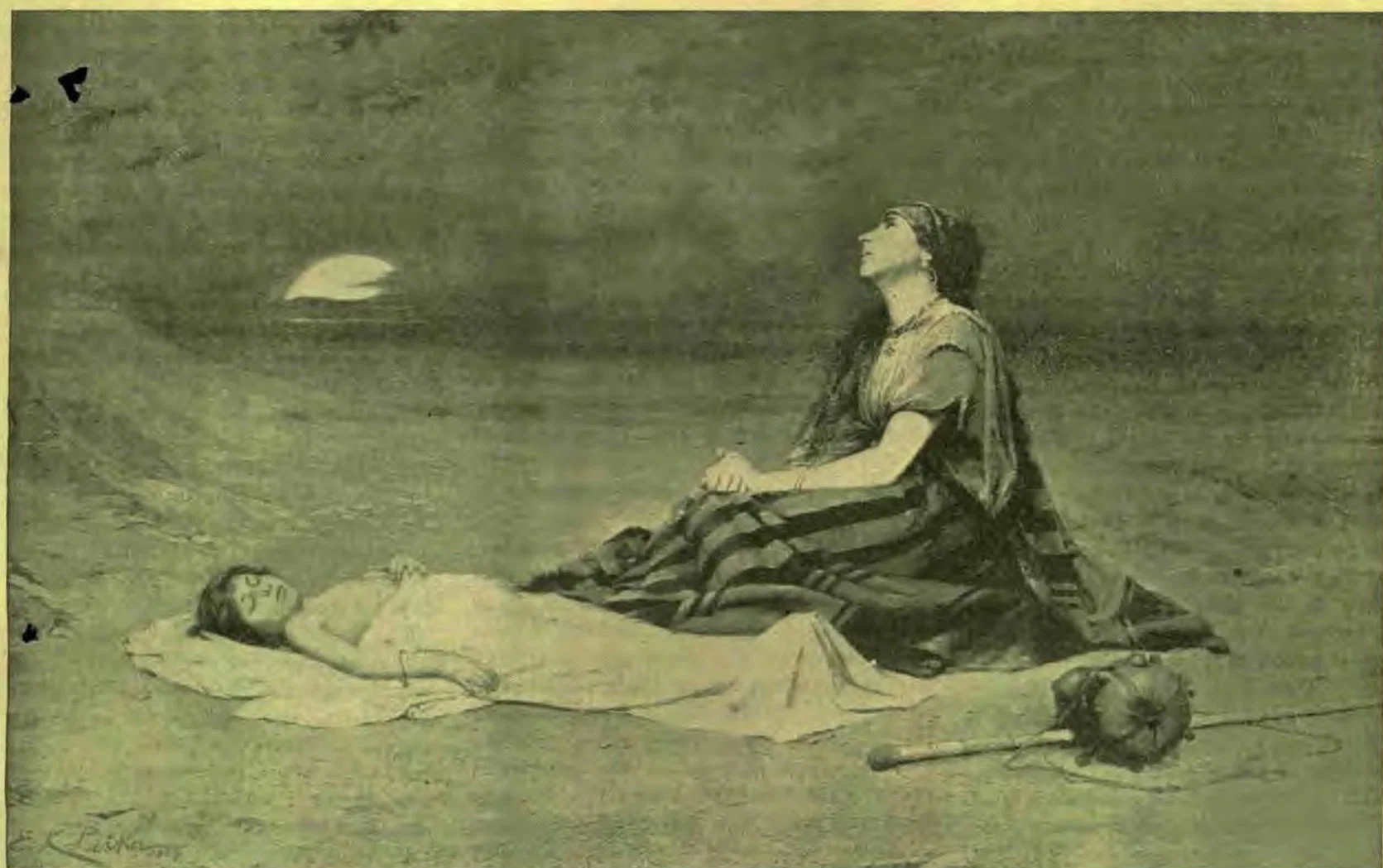
ABRAHAM had two sons, Ishmael and Isaac. Ishmael was the son of a bondwoman, the fruit of human scheming to fulfil God's promise. God had declared that Abraham's seed should be blessed, should be a blessing to all nations, and should become too numerous to reckon. God showed the old patriarch the blue vault of heaven, luminous with shining stars, and declared, "So shall thy seed be."
BUT how? was the question which puzzled Abraham and his wife. Sarah was old and barren, and of course there could be no heir from her. Then came the suggestion that Hagar should bear for her, and Abraham made the Egyptian his concubine. Ishmael was born; and upon Ishmael was set the father's heart as his son and heir, the promised seed.
GOD corrects the error of his servant and tells him that Sarah would bear a son. Barren she might be according to all human ideas, yet the power of God was sufficient to accomplish His word, and Isaac was born. Of course, in the very nature of things the lads could not live together, nor their mothers, and so Hagar and her boy Ishmael were sent away.
DISAPPOINTED, angry, and despairing, with bread and a bottle of water, the Egyptian woman goes forth into the wilderness of Beersheba. There she stays and nurses her grief till the bread is gone and the spent water bottle mocks her thirst. The lad grows weak and faint; she places him under one of the shrubs of the desert, and removes to a distance that she may not see him die, and in her sorrow and misery, she lifts up her voice and weeps.
THEN God came to her relief. The angel calls: "What aileth thee, Hagar? fear not; for God hath heard the voice of the lad where he is. Arise, lift up the lad, and hold him in thy hand; for I will make him a great nation," because he was Abraham's seed. See Gen. 21:8-21. And in the wilderness he grew up, became an archer, and the leader of wild tribes who gathered to him.
A PRAYING boy he was when he left his father's tent; but he drank in the hatred of his mother's teaching, and thus fulfilled the prophecy which God had given at his birth: "Thou shalt call his name Ishmael, because Jehovah hath heard thy affliction. And he shall be as a wild ass among men; his hand shall be against every man, and every man's hand against him; and he shall dwell over against ["in the presence of," A. V.] all his brethren." Gen. 16:11, 12.
NEARLY 4,000 years ago the words were uttered by the angel. Nearly 3,500 years ago they were recorded by Moses. Centuries have rolled their round. Ages have passed away. Nations have waxed and waned. The beginning of Ishmael was not strong. For many years his people, the Ishmaelites, were weak. They could never be considered a united nation with a central government. The Ishmaelites are the wandering tribes of the Arabian and Syrian deserts. They are against every man, and every man is against them. They live by the booty, the plunder, they gather from passing caravans and travelers, or by levying backsheesh on those whom they dare not openly rob or kill. How literally true the Word of God has spoken as to character!
AND Ishmael has dwelt in the presence of his brethren. Israel, a weak people numerically, has persisted. Scattered, peeled, divided in his own house, sold into slavery, pushed to the ends of the earth, he still lives, and his holy city is still Jerusalem, his land Palestine. And in his presence, the sheiks of the Syrian and Arabian deserts with their wandering hordes, dwell the seed of Ishmael.
4Both peoples exist, and stamp upon their progeny their own characteristics.
GOD said they would so persist. Not so with other nations. Where are the Assyrians? Where are the Chaldeans? Where are the Sidonians? Where are the Medes? the Philistines? the Egyptians? the Hittites? the Jebusites?—Gone, all gone. The very existence of some of them has been questioned, and would be still if the very stones and bricks had not borne mute but faithful witness to the truth of God's Word.
THE lesson to us is that God's word endures. What He has said of nations and cities and peoples has been demonstrated true times without number. What He has said as to our condition as sinners, our need of a Saviour, of the coming of that Saviour, are all true. We may despise His word; we may treat it lightly; but just as truly as that word was fulfilled in Ishmael, so truly will it be fulfilled in any other particular. Our only hope is to be in harmony with the eternal, living Word.
HAGAR AND ISHMAEL
HOW THE WORLD IS TO KNOW.
An important fact too often overlooked is that the instruction of the Scriptures is largely given to the Lord's people—to those who profess to believe in Him. Of what value would instruction be to an unbeliever? It was not till after God had a regularly organized church that the Scriptures began to be published. These were primarily for the use of those who at least professed to believe in the true God. How, then, could they be of any benefit to the outside world?—They could benefit the world only as they were practically carried out in the church.
Here is the manner in which the Word was to be operated for the benefit of the world: "Behold, I have taught you statutes and judgments, even as the Lord my God commanded me, that ye should do so in the land whither ye go to possess it. Keep therefore and do them; for this is your wisdom and your understanding in the sight of the nations, which shall hear all these statutes, and say, Surely this great nation is a wise and understanding people." Deut. 4:5, 6.
The Lord's people are to walk by faith in His Word—such a faith as will be manifested in the doing of His Word; and their walking by faith will demonstrate to the sight of the unbeliever that there is something of practical value in the service of the true God. The unbelieving world walks by sight; the natural man is actuated by what he sees, or is able to comprehend by means of his natural senses. Hence the believer is to show him the truth by the object-lesson of a life guided by faith in the Word of God, which is the Gospel of Jesus Christ.
When Christ came into the world, "He came unto His own," that is, to the church. They were terribly backslidden, but they were His recognized people, and it was essential that there be first a work of reformation amongst them in order that the heathen might see something to induce them to accept salvation. As a body the Jewish people rejected the Messiah they had so long looked for and talked about; but Christ found enough who would accept Him and His message to form the nucleus of a church that would illustrate the principles of the Gospel to the world by means of actual life.
To this "little flock" He gave the practical instruction which they were to receive by faith and show to the world: "Let your light so shine before men, that they may see your good works, and glorify your Father which is in heaven." Then the world is to know God, and to know the Saviour Jesus Christ, by seeing the effect His Word has upon those who believe it. And those who profess to believe are responsible to God for the influence their conduct has upon the world. By failing to "keep the commandments of God, and the faith of Jesus" in the sight of men, they bring reproach upon the cause they profess to represent.
When David became backslidden in heart, and did violence to the law of God, the Lord's prophet told him that by so doing he had "given great occasion to the enemies of the Lord to blaspheme." Thus the Lord gives the world credit with having sufficient discernment to know whether we live up to our profession or not.
A leading characteristic of the Gospel of Christ is unity; therefore when we preach the Gospel of Christ to the world, the people naturally expect to see the principles of love and harmony manifested in our lives. Knowing the essential means of influence upon the world, Jesus prayed to His Father that there might be a spirit of unity amongst His disciples; not only with His personal followers, but for all time. "Neither pray I for these alone, but for them also which shall believe on Me through their word; that they all may be one; as Thou, Father, art in Me, and I in Thee, that they also may be one in Us; that the world may believe that Thou hast sent Me."
How, then, can the professed disciples of Christ expect to do effective missionary work in the world without such a condition of harmony among themselves as will not only give the Gospel a certain note, but will commend to the world its effect upon the lives of those who truly accept it. James tells us that all wars and fightings among Christians come of selfish lusts. It is also true that the corruption that is in the world comes in through lust (2 Peter 1:4), from which the disciple of Christ is counseled to "abstain," which is to be "crucified" with all fleshly affections. Whatever will hinder a perfect union with Christ will hinder such a harmonious condition among disciples as would commend the religion which we profess and proclaim.
The boldness of faith on the part of Peter and John on the occasion of their arrest after healing a certain lame man, convinced the people "that they had been with Jesus." This is the kind of testimony that the life and work of every Christian should bear to the world. And all who are thus intimately connected with Christ will also manifest a spirit of love toward one another, and thus fulfil the commandment of Christ (John 15:12). This is the universal badge of recognition of discipleship: "By this shall all men know that ye are My disciples, if ye have love one to another." John 13:35.
Where this badge is in evidence, Christians will be known by their works, and their profession will not be questioned in the world. Their light will be on a hill, and, like their Master, they can not be hid.
G.
FALLING FROM GRACE.
YEARS ago this subject was frequently and warmly discussed. Many people held to the opinion that a person once in grace was always in grace. Altho not so often a matter of contention, the doctrine is not by any means abandoned; it is still the cause of false encouragement to the backslider. As long as he indulges the idea that because he was once converted to Christ he can not be finally lost, he will be content to take his ease spiritually, and to cater to the lusts of the flesh that have drawn him away from the Lord. He will do so under the vain impression that in time the Spirit of the Lord will bring him back to the fold even against his inclination.
To those who are led by this delusion the apostle Paul says, "Let him that thinketh he standeth take heed lest he fall." 1 Cor. 10:12. And this warning is predicated on the "ensample" of those Israelites who came out of Egypt "of faith" (Heb. 11:29) and were baptized "in the cloud and in the sea" and "did eat spiritual meat," and drank "spiritual drink," drinking of "that spiritual Rock that followed them," which "was Christ." Yet they tempted Christ by murmuring, and were "destroyed of the destroyer." They perished in the wilderness, and were not permitted to enter the promised land.
A like warning is given in the third chapter of Hebrews: "Take heed, brethren, lest there be in any of you an evil heart of unbelief, in departing from the living God. But exhort one another daily, while it is called To-day; lest any of you be hardened through the deceitfulness of sin. For we are made partakers of Christ, if we hold the beginning of our confidence steadfast unto the end." This warning is also predicated upon the failure of those Israelites who came out of Egypt by faith, but fell in the wilderness.
The Scriptures also give us other illustrations. Balaam was a prophet of the Lord, but he fell away through a natural desire for this world's honor and riches. By his fall he became a common soothsayer, or diviner, after the manner of the heathen, and was eventually slain in battle, having joined the Midianites in their opposition to Israel. See Num. 24:15-25; 31:7, 8; Joshua 13:22, margin; 2 Peter 2:15.
Another striking illustration is the case of King Saul. Of his genuine conversion there can be no question. Saul was out hunting his father's asses, and stopped at the house of Samuel the prophet. Before parting with him the next day, Samuel anointed him to be king over Israel, and told him what should come to pass on his way home. Among other things Samuel said: "Thou shalt meet a company of prophets coming down from the high place with a psaltery, and a tabret, and a pipe, and a harp, before them; and they shall prophesy; and the Spirit of the Lord will come upon thee, and thou shalt prophesy with them, and shalt be turned into another man." 1 Sam. 10:5, 6.
"And it was so, that when he had turned his back to go from Samuel, God gave him another heart; and all those signs came to pass that day." Verse 9. And the record goes on to state that when Saul met the company of prophets, "the Spirit of God came upon him, and he prophesied among them."5
But after Saul became king he departed from the Lord, and the Lord rejected him. He was not only rejected as the head of the royal line in which the Messiah should be a lineal descendant, but the Spirit of the Lord was altogether withdrawn from him. After the death of Samuel, Saul was confronted by a Philistine army and was much afraid. He inquired of the Lord, but the "Lord answered him not, neither by dreams, nor by Urim, nor by prophets."
Then he sought a witch, contrary to the express command of the Lord (Ex. 22:18; Lev. 19:31; 20:6), and took counsel of her. He had so far departed from the Lord that he could not return; he had sinned away his day of grace; the Lord would have, could have, nothing more to do with him. In the battle that followed, Saul's army was defeated, and, to avoid falling into the hands of the Philistines, he committed suicide.
The life and experience of King Saul form a complete refutation of the deceptive dogma of "once in grace, always in grace." Such a delusion is altogether out of harmony with the Word of God. The words of Jesus are, "He that endureth to the end, shall be saved."
Some say that the "one hour" of Rev. 17:12 should be translated "at the same time;" and that the word from which "hour" is translated is not the same as in Rev. 9:15. Does the hour end before or during the pouring out of the seven last plagues. If during the seven last plagues, at what time. Does Jacob's trouble come before or during the plagues. L. G. L.
(1) The word rendered hour is hōra, and is the word from which hour is translated in every place in the New Testament save 1 Cor. 8:7, rendered "until now" by the A. R. V. (2) We have not space in this department to discuss at length this subject. To our mind the "one hour" comes right in connection with the close of probation. See Rev. 3:10; 18:10, 17, 19.
1854.—Duty to Our Brother.
If a brother says something that I know to be false, or think I have the best evidence to believe is not true, and he also says something that his actions plainly show that he did not mean or think at heart, it is plainly my duty to talk with him about it, according to Matt. 18:15–17? If I neglect to do it, do I hereby cut myself off from God by disobeying that scripture? Is it applicable in such a case? Am I debarred from praying and taking part in the ordinances according to Matt. 5:23, until I follow out these instructions? Do I endanger the other person's salvation if I do not follow out these scriptures? Supposing the other person did not know or realize that he did any wrong. Are the scriptures referred to above applicable in the same cases? Is such loose talk serious enough to take up in that way, or should it be dropped without further notice? I desire clear principles. INQUIRER.
Matt. 18:15 reads: "If thy brother sin against thee, go, show him his fault between thee and him alone; if he hear thee, thou hast gained thy brother." If he will not hear, further instruction is to be followed. Some of the most ancient MSS. omit "against thee," Matt. 5:23, 24 reads: "If therefore thou art offering thy gift at the altar, and there rememberest that thy brother hath aught against thee, leave there thy gift before the altar, and go thy way, first be reconciled to thy brother, and then come and offer thy gift."
The first scripture refers to our brother's wrongs; the last refers to our own wrong-doing or what some one feels is our wrong-doing. The latter does not apply to the case in hand unless the words spoken are reflections upon the inquirer.
As to our duty when we see a brother sin, read what the Word says in Lev. 19:17; Gal. 6:1. But it requires the wisdom of God filled with love for the brother's soul to reprove, correct, or restore effectually. "Ye which are spiritual restore such an one," "considering thyself." Perhaps you did not understand him aright; kindly ask him when alone. Do it alone, almost invariably. Sometimes the best reproof to idle, silly, vapid, loose talk is a dignified silence.
"Is it always duty to reprove?"—Yes, if so God's Spirit bids you, if the salvation of a soul is at stake. "Quench not the Spirit." No man can point out your duty in such things. You must know from God. Seek Him; He will guide if your heart is right. But if you seek to reprove or correct, do it in humility, in meekness, in kindness, in private, unless very rare circumstances demand otherwise. As to the last question, it depends on the talk, the manner, the effect. Seek God to know.
1855.—Commanded to Kill.
Please explain why the Lord told Moses to kill the women children, and the cattle of the other nations. Did they have a chance to learn and obey the Lord? Some say they don't believe that was what the Lord told Moses. M. G.
If our querist had read fully the records he would have found the reason. In Numbers 31 is a record of the command to destroy the women of Midian, not because of their corruption alone, but because of their power and purpose to corrupt others. It was much better that they should die than that many should be corrupted by them. In the records given by Moses in Deuteronomy, chapters 2 and 3, the great leader doubtless felt that only corruption and evil could come by preserving alive those who were wholly given over to evil. This was also true of Amalek. 1 Samuel 15. The judgments executed against the nations of Canaan were because they had utterly shut away God notwithstanding His efforts to save them by the sojourn of His faithful servants among them, such as Abraham, Isaac, etc. These judgments are typical of what will come upon the nations of the world, the people of which utterly reject God. We see so little of some things, know so little of God's reasons, that it is not for us to pass judgment. Sometimes death is the greatest blessing that can come to the wicked. He ceases his own sinning, and will not corrupt others.
Please explain Eph. 6:5. Are we to fear before our wicked masters? I never knew we were to fear and tremble before any of our fellow men who might be our masters. W. A. H.
The word "servants" in the text means "bond-servants" or slaves, as many Christians were then and have been since. According to civil law they were the property of their masters. He must use no wrong method to be free. 1 Cor. 7:20–24. But tho a slave, let the Christian serve God with fear and trembling; not fear and trembling before his master, or on account of his master, but serve Christ in serving that master. Let him regard his service as service to Christ, since God permits him to be a slave, and then serve, in fear and trembling, doing service as to the Lord, "as unto Christ." Phil. 2:12. He who feared simply his master would do eye service; but he who feared God would do service from the heart.
The Scripture reads as follows from the American Standard Revised Version: "Let no man beguile you in any wise; for it will not be, except the falling away come first, and the man of sin be revealed, the son of perdition, he that opposeth and exalteth himself against all that is called God or that is worshiped; so that he sitteth in the temple of God, setting himself forth as God."
Note (1) that the previous verses refer to Christ's coming and the gathering of His people (see also 1 Thess. 4:15–17); but that God's children were not to be troubled in believing that that coming of Christ, or the day of the Lord, was imminent in their day. The apostle did not teach that Christ was coming in his day. His epistles were written for all time.
2. Before that day came, whatever men might say, there was to come the great falling away predicted; and that apostasy would be revealed as a professedly Christian power, sitting in the church of God, and yet opposing God and undermining His worship.
3. This falling away is predicted in Daniel, from which these very words are taken. See Dan. 11:36, a specification parallel with Dan. 7:20; 8:23–25, and which applies in every particular in its full development, to the Papacy, and to no other. For (a) the Papacy began in apostasy, in exalting human philosophy and tradition of men as equal to the Word of God; (b) in interpreting that Word by the philosophy of men; (c) and finally exalting a class of men as the head of the visible church, so that the head of the system sat in the temple, or church, of God, declaring himself to be God.
4. All this apostasy resulted in attempts to change God's law and the exaltation of that change as the test of loyalty. This was manifest, and still is, in the exaltation of Sunday as the Sabbath of the Fourth Commandment. Thus this apostasy became, not where a sinful man or woman could fitly represent it, but the man of sin, the son of perdition, or destruction; sin upheld by law.
Does the word "let," in 1 Cor. 14:34, have a permissory or a mandatory significance? If the latter, why is it openly violated by Seventh-day Adventists each week in the year? C. R. B.
If these are the apostle's words we would say that "let" was advisory, neither mandatory nor permissive. But we are inclined to believe that the words are the words of an objector which the apostle quotes; because (1) Paul has before told us how women ought to appear who prophesy or teach (1 Cor. 11:5), a thing which he certainly permitted them to do under proper circumstances; (2) Paul commends women who labored in a public or semi-public capacity, placing Priscilla before her husband (Acts 18:2, 26; Rom. 16:1–3); (3) the prophecy declares God would use women (Acts 2:17, 18), and history demonstrates its truth (Acts 21:8, 9). Elsewhere the apostle refers to what objectors say. See 2 Cor. 12:16–18; 10:10. Read 1 Cor. 14:34, then, as the words of objectors: "Let your women keep silence in the churches; for it is not permitted unto them to speak; . . . for it is a shame for women to speak in the church." And here is the apostle's rebuke to them: "What? was it from you that the word of God went forth? or came it unto you alone?" And then he tells us to heed his teaching to earnestly desire to prophesy, to forbid not to speak with tongues; but let all be done decently and in order.
1859.—Pool of Siloam. L. P.—We do not know how the waters were troubled, no more than what the text says. The last half of John 5:3, beginning with "waiting," and all of verse 4, is omitted in some of the earliest Greek copies. See Revised Version.
1860.—John the Baptist was permitted to preach, it is supposed, about three years.
1861.—Foreordination, Eph. 1:3–14. See "Bible Election," Bible Students' Library, No. 67, price, post-paid, four cents. The whole subject is discussed in this tract.
1862.—Ps. 69:22–28 is the Spirit telling what will become of the incorrigibly wicked. As they have despised God's goodness to the utmost, He will let come upon them the harvest they have sown for. Consider the Psalm as God's Word. There is no more contradiction between that and Romans 12 than between the first part and last part of Ps. 136:15, 17.
1863.—For hardening of heart see tract referred to in No. 1861. God always hardens hearts by withdrawing His Spirit, the pleading of which men reject.
1864.—"When shall we forgive; before being asked? Luke 17:3, 4."—Yes, before forgiveness is asked, and whether forgiveness is asked or not. "And when ye stand praying, forgive, if ye have aught against any, that your Father also which is in heaven may forgive you your trespasses." Mark 11:25.
1865.—What was the end of Nebuchadnezzar?—He died. From Dan. 4:1, 2, 37 it seems very clear that the old king became a converted man. The resurrection will reveal this.
1866.—Between Old and New Testament. This period, from the time of Malachi to the birth of Jesus, was about 400 years. The definite time of Malachi's prophecy is not clear, but fully 400 B.C.