In the United States Senate, May 3, Mr. Cannon presented a “memorial of the clergymen of Philadelphia, petitioning for the removal of the inequalities of the present protective system.” This memorial includes extracts from sermons of several of the aforesaid clergymen, on the general theme, “See That the Republic Receive No-Harm.”
Equality is a principle that originated with the Creator, and the opposite principle never would have been known in the universe but for sin. The principle of equality was exemplified in the giving of the manna to the children of Israel in the wilderness. The commandment was, “Gather of it every man according to his eating, an omer for every man, according to the number of your persons; take ye every man for them which are in his tents.” In obedience to this command, the record says: “And the children of Israel did so, and gathered, some more, some less. And when they did mete it with an omer, he that gathered much had nothing over, and he that gathered little had no lack.” Ex. 16:16, 18.
This same principle was again exemplified in the first Christian church at Jerusalem, which was led by the direct outpouring of the Spirit of God. “Neither was there any among them470that lacked; for as many as were possessors of lands or houses sold them, and brought the prices of the things that were sold, and laid them down at the apostles’ feet; and distribution was made unto every man according as he had need.” Acts 4:34, 35. The apostle Paul, writing to the church at Corinth, also recognizes the doctrine of equality in the matter of supporting the Gospel. He says, “I mean not that other men be eased, and ye burdened; but by an equality, that now at this time your abundance may be a supply for their want, that their abundance also may be a supply for your want; that there may be equality.” 2 Cor. 8:13, 14. He also shows how Christ had practically developed the thought to an unprecedented degree: “For ye know the grace of our Lord Jesus Christ, that, tho he was rich, yet for your sakes he became poor, that ye through his poverty might be rich.” Verse 9. That is, Christ became poor and took upon him the nature of sinful flesh in order that he might come down to the same level with us, so that he might raise us up to God.
The foregoing citations illustrate Christian equality, and of course include a relationship of universal application; for the principles of Christianity are nothing if not universal. The commandment, “Thou shalt love thy neighbor as thyself,” contemplates no national or racial lines, any more than does the prior one, “Thou shalt love the Lord thy God with all thy heart.” For God “hath made of one blood all nations of men for to dwell on all the face of the earth,” and the kingdom of Christ includes those of “every nation, and kindred, and tongue, and people.” Then how can Christians have anything to do with any scheme that sets up a discrimination between nations? From the standpoint of Holy Writ the kingdom of Christ is to be gathered from all of them, and then they are all to be destroyed together.
But the question in the memorial to Congress is equality in our protective tariff system as regards the various industries of our own country. In the discourse of one of the clergymen referred to in connection with the memorial we have these words:—
The interest of our people just now is fixed upon the question of our national prosperity. Without any regard to the welfare of the rest of the world, we are trying to find a way out of our hard times, and we have adopted what is known as the system of protection; that is, collecting such a duty on imported goods as will keep prices of such goods up to the point of profit.
Now if the policy of a protective tariff be the correct policy of the government, it would seem that justice would demand that all classes of citizens be treated alike; that is, the tariff should be so adjusted as to give all an equal share in the benefits. If this be impossible, then there is something wrong with the system; if it be possible and be not done, then there is something wrong with the law or with its execution. But even were it possible to adjust a protective tariff so as to be perfectly equal in its bearing upon all citizens of the republic, it would not be a Christian policy as long as it was “without any regard to the welfare of the rest of the world.” This fact precludes the possibility of a protective tariff being a Christian policy at all, for the reason that it must have reference to other nations, and must be detrimental to the interest of those nations if especially beneficial to our own. We are not assuming to say whether or not the protective tariff system is impolitic on the part of the government; but we do assume that if it be for our interest, as against the interest of our neighbor nations, it is not Christian.
Therefore, as it is the work of the officials of the nation to advance the interests of the nation, without any regard to the welfare of other nations, their work can not be Christian work. And we know how some of our Presidents, and some of our Congressmen and foreign representatives, have at times been berated, even by clergymen and the religious press, for taking positions alleged to be in the interest of foreign governments and detrimental to our own. Thus it is clearly demonstrated that no nation in this sinful world can be in any sense a Christian nation. In order to stand at all among the nations of worldly, self-seeking people of earth, any nation must stand for self, and advocate its own selfish interests as against the interests of all others. This Christ did not do; this the Christian can not do; therefore Christ said, “My kingdom is not of this world,” and therefore any nation or kingdom that is of this world can not be a “Christian nation.”
Then what have the professed Christian ministers of Philadelphia, or any other professed Christian minister, to do with advocating a protective tariff of any character, or with advocating any other policy of the government? It is the legitimate business of the Gospel minister to look after the interests of the kingdom of Christ, rather than to “see that the republic receive no harm.” It is his province to look to the interests of the individual souls in the republic, and wherever else he may be called, that they receive the invitation and the fitting to become citizens of the everlasting kingdom. “Let the dead bury their dead; but go thou and preach the Gospel.” W. N. G.
THE GREAT PHYSICIAN.
By Augusta W. Heald
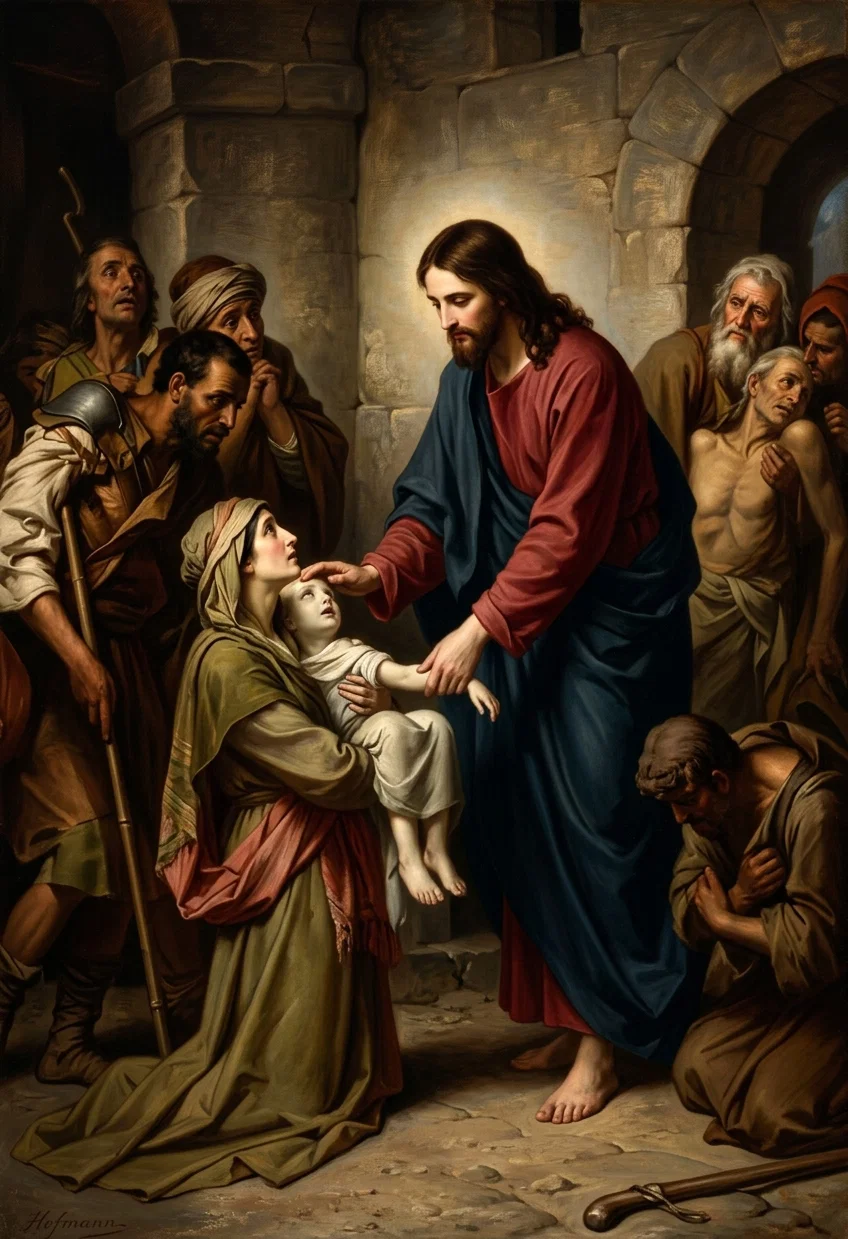
The Baptist had been cast into prison. The voice crying in the wilderness, “Prepare ye the way of the Lord” (Mark 1:3), was silent, for John’s life mission was accomplished. The Saviour was now about to enter upon his public ministry. After his early ministry in Judea, he returned to Galilee, but the quiet hills of Nazareth, where he had grown to man’s estate, were now to be left behind. Henceforth our Lord is seen in the busy haunts of men, first as an honored guest at a simple household festival, the marriage at Cana of Galilee. Here he supplied the needs of the occasion by performing his first miracle, the turning of water into wine. After this he entered into Capernaum, the city by the sea, and preached the Gospel, saying, “The time is fulfilled [referring to the prophecy of Daniel concerning himself, Dan. 9:25], and the kingdom of God is at hand; repent ye, and believe the Gospel.” Mark 1:15. Here he entered into the synagog upon the Sabbath day and taught. “And they were astonished at his doctrine; for his word was with power.” Luke 4:32. There was in the synagog a man who had an unclean spirit, who broke the Sabbath stillness with maniacal shrieks. Jesus rebuked the spirit, and commanded him to come out from the man. The demon obeyed. And tho he had thrown the man violently down, by the merciful power of Christ he hurt him not. All the people were filled with amazement at this exhibition of divine power. “And the fame of him went out into every place of the country round about.”
Returning from the synagog, Jesus entered into Simon’s house, a home filled with anxiety, care, and gloom, for the mother lay grievously sick of the fever so common on the lake shore. What joy to this anxious family when the Divine Guest entered the humble abode, and, taking the sick woman by the hand and lifting her up, rebuked the fever! “And immediately she arose and ministered unto them.” Luke 4:39.
The last lingering rays of the Sabbath sun had hardly disappeared behind the western hills when “all the city was gathered together at the door.” Mark 1:33. They came bearing the sick of whatever disease and many possessed with demons. In all that vast throng of suffering humanity, was there one who came in vain? Did any turn away disappointed, still bearing their burdens of sickness and pain?—Not one; for the Great Physician put forth his hand and healed them all, “that it might be fulfilled which was spoken by Esaias the prophet, saying, Himself took our infirmities, and bare our sicknesses.” Matt. 8:17.
In the morning following this wonderful display of power, Simon sought his Lord, but he was absent, for, rising a great while before day, he had repaired to a solitary place in the desert. There they found him engaged in prayer. Thus ever did our Lord depend upon his heavenly Father, and from that divine source draw constant supplies of grace in the fulfilment of his life mission.
When the multitude came and besought him to remain and not depart from them, Jesus said, “I must preach the kingdom of God to other cities also; for therefore am I sent.” Luke 4:43. “And Jesus went about all Galilee, teaching in their synagogs, and preaching the Gospel of the kingdom, and healing all manner of sickness and all manner of disease among the people.” Matt. 4:23. He is the same mighty, merciful Saviour to-day.
“The Great Physician now is near,
The sympathizing Jesus;
He speaks the drooping heart to cheer,
O, hear the voice of Jesus!
Sweetest note in seraph song,
Sweetest name on mortal tongue,
Sweetest carol ever sung,—
Jesus, blessed Jesus.”
AUGUSTA W. HEALD.
Bearing of the Recent Massacres on the Eastern Question
By H. P. H.
THE TURKS AND ARMENIANS. No. 6.
Bearing of the Recent Massacres on the Eastern Question.
THE present political and social condition of the world is such that a general revolution is considered inevitable. The shrewd politician easily reads it; the common people feel it; no argument is needed to prove it; everybody is at once ready to admit it. Disarmament and universal peace are not believed possible till after a general struggle.
When the naval demonstration of 1895, in Turkish waters, took place, it was expected that hostilities might then break out; and it was the common remark of the political journals at that time that if hostilities should begin, they would lead to a general European war. Professor Hilty, of the University of Bern, in his Political Year Book for 1896, treats at length the Eastern Question, and expresses the opinion that its final solution has now come, and that its settlement will lead to a European war.
While politicians expect precisely what the Lord's prophecy says will come, all other classes of people expect in substance the same thing, tho in different forms and from varied standpoints. Socialists look for a great revolution, after which their principles will reign and usher in the golden age. Among Christians is the general impression that the end is near, and that soon the millennium will dawn. Thus, politicians, socialists, and Christians are all looking for substantially the same thing, and in it all there is a semblance of truth. There will be a general war, a general gathering, followed by the millennium; but how different it will be from what the world expects! How sadly the nations are deceived!
Be Not Deceived.
But they need not be deceived; the truth as to the real outcome of the present situation is made very plain in the Bible; never was a sign of the times more plain than the one connected with this Eastern Question. The main features of what the Bible says will come out of it are so distinct in the present situation that one does not need to be a shrewd politician to read them. The average man sees them. When the politician who does not believe the Bible, looks upon the world as it is to-day, and forecasts what its immediate future must be, his description embraces in the main what we read in the prophetic Word. When a sign has become so plain as this, what should the effect be on those that profess to know and believe the Bible?
Another feature of this prophecy in Revelation 16 is of special interest in this connection. It is the place of the general gathering—Armageddon—in Palestine. As already noted, the gathering will be occasioned by the drying up of the Euphrates, the Turkish Empire; from Dan. 11:45 we learned that, in connection with his end, the Turk will move his capital to Jerusalem. As was so forcibly expressed in the Crusades, it has always been the desire of Christians to drive the Turk out of Palestine. In consequence of the Armenian massacres, this Crusade spirit has again risen high, and Christians are again loudly demanding the extinction of the Turk; at the same time, they expect, as expressed in the Age to Come doctrine, that, in connection with the beginning of the millennium, the Jews will be returned to Palestine. How remarkably all these things fit together; and how well the way is prepared for the great gathering and complete deception of the world!
It is also worthy of our attention to note the importance placed on the Indies; and how the nations of the east, after their slumber for centuries, are waking up and preparing for war; and how, in general, special attention is given to increasing the naval forces. The United States, so long indifferent about her navy, suddenly awoke to the necessity of preparing a navy with the greatest possible speed. How plain it is that one master mind is behind all, inspiring the same plan, and preparing all for the great day!
As we see the condition of Turkey, tottering on its last legs, see the nations all prepared for war, and under such a burden that they can not endure much longer, see all things ready for the great gathering, what lesson should we draw from it? After calling attention to these things, the next words of inspiration are: “Behold, I come as a thief. Blessed is he that watcheth.” That is the lesson in all this—a most solemn admonition to watch.
While this will be to the world the most terrible time that ever was, it will be a blessed time to those who watch and are ready. To one class it will be destruction, to the other the door to everlasting blessedness. For when the nations have gathered their armies, then the Lord comes with his glorious army. See Rev. 19:11-16. The result of the meeting of these two armies is not uncertain. Satan and his host and sinners will be overthrown, while the saints will be given the everlasting kingdom. As the Mohammedan expects, Christ will then truly come, but not Mohammed, and a universal kingdom will be established, over which will float, not the Turkish crescent, but the blood-stained banner of Prince Emanuel.
The Beginning of the End.
It seems as tho these troubles which began anew in the east with the recent Armenian massacres are the beginning of the end; scarce is one form of the trouble over before another7begins; hardly had the Armenian massacres subsided in 1895 when new troubles with Macedonia broke out; and ere these were quelled, the Armenian troubles commenced again, more violent than ever; and even before these were settled, new difficulties broke out with Crete, and finally war with Greece. While these troubles were in progress, the feeling that the day of the Turk had come was quite general. All Christendom is united in the sentiment that the Turk has gone too far, and should be summarily dealt with. The only question yet to be settled is, How shall this be done? So far, the “powers” have not been able to agree; and they will not agree till the Lord's work for his people is done. In Rev. 7:1-3 we learn that the angels of God are holding the winds of strife till the servants of God are sealed; and as soon as this is done, these angels not only let the winds of strife go, but they have power to hurt the earth.
This makes plain to the Bible student what men of the world can not understand—how it is that the “sick man” of the east survives so long; the unseen Hand is holding him in place, and keeping back the winds of strife, tho everything stands ready and under a heavy pressure. The moment that the Lord's restraining hand is withdrawn, the world will witness such scenes as it has never before seen. Just what moment this may begin no one knows, for no one knoweth the day nor the hour, but the Father only. But as we see all things ready, and more than ready, what manner of persons ought we to be?
Some may say in their hearts, I will wait till I see the Turks moving out, then I will haste to make ready. But that will be too late. The Turk does not move out, the Euphrates is not dried up, till under the sixth plague, while probation already closes when the first plague begins; hence he that waits till he sees the Turkish Empire dried up will have waited too long. The Lord has made it so plain beforehand that no one need mistake the meaning of the signs. And as we now see everything ready for the final step, let us take from it the intended lesson and not lose a single day. Not knowing the day when Christ will come, our only safety lies in being ready now, and every day, so that when he comes we shall be found watching. Let us therefore be admonished, and, being ourselves ready, haste to tell those that know not the meaning of these things, and are in danger of being taken unawares. In bringing these things to our attention, the Lord lays a solemn obligation upon us, first to get ready ourselves, and second to warn others. Who of us heeds the Lord's instructions? H. P. H.
FULL OF SIGNIFICANCE.
By H. F. Phelps
At Cleveland, Ohio, May 13, Archbishop Ireland was the guest of the Chamber of Commerce. The newspapers report that he gave a patriotic address, the subject being “The Foundation of True Citizenship.” There are a few statements to which it is well to call attention, for they are full of significance; and no discount should be given to the words.
He declares that “the greatness of America is her democracy.” Also that “the peril of America is in her democracy.” Yet he professes to have the “fullest faith in the democracy of America.” He therefore asks and answers the question:—
Whence will come to democracy the potency of immortality? With reverence I pronounce the word “conscience.” Conscience-ruling Americans will be a law-abiding people; for righteousness commands obedience to law and proclaims that the law of the nation is the law of the supreme Governor of men and of nations—Almighty God. Americans will respect the rights of their fellow-citizens; conscience bids them know that no one lives for himself alone, and that society, with its rights and institutions, is of divine mold.
Thus would Mr. Ireland endeavor to put the stamp of divinity upon the institutions of American society, and make the laws of the nation the laws of the Almighty. In this he would exalt the nation above God, and throw the responsibility of the nation’s laws upon the Deity. This is Catholic theory. This is Catholic doctrine, the doctrine of the fourth century and onward, over again. In connection with the above the following is significant:—
A nation without a conscience [that is, we may suppose, and logically too, a nation that will not acquiesce in this Catholic theory] is a nation without a soul. The sooner the earth is rid of it the better it is for humanity; nothing good or great can come of it.
What is in this but the spirit of utter extinction of that nation and that people that will not imbibe this theory? But it may well be asked: How is it possible for the people of this or any other nation to “respect the rights of their fellow-citizens,” when the conscience of the nation shall be brought to reflect this Catholic theory of the supremacy of the nation’s laws as the laws of “Almighty God,” and when they shall be made to believe that these laws as the laws of God are to be implicitly obeyed, and that it is their duty to see that they are obeyed? It requires no great stretch of the imagination to see the result, the logic of which is that the nation, or any class of people in the nation, that will not bring their conscience into harmony with this Catholic theory are “without a soul,” and “the sooner the earth is rid of it [or them] the better it is for humanity.”
Nor is this all. He speaks concerning the dread possibilities of the future and says:—
There are moments in the life of the country when the thoughtful patriot stands still, awestricken, before the thought of what might come if Americans betrayed their citizenship, of what might come to America herself, . . . of what might come to liberty in the whole world, since liberty for other nations reads her triumph or her duty in the triumph or death of liberty in America. Take away conscience, let voters, like the populace of old Rome, scramble for food and pleasure, democracy will have given up the ghost, and either an “imperator” will trample upon American liberties, or anarchy will light over the land its lurid fires!
This is the shadowing of the possibilities that are before us, prompted, no doubt, by what is now upon us, and what others have said of the nation, for he quotes Lord Macaulay as saying: “The peril from which democracy can not escape, will befall it in a season of hard times, when the masses of the people will make use of their political power to despoil the rich and disrupt society.” To this Mr. Ireland responds as follows:—
Americans, fear not. Macaulay did not know the people of America. America is safe. Conscience is on guard.
But how is it possible for conscience to save democracy, save the liberties of the people, and save America in order to preserve liberty to the world and for the world? The question is asked and the answer given:—
What will foster conscience in the citizens of America? I answer, religion—the sense of a Supreme Legislator, ruling the whole universe, from the tiniest flower to the mightiest sun, ruling man and aggregations of men, rewarding and punishing. Patriotism is never so potent as when it is identified with religion.
But how is it possible for a sense of a Supreme Legislator to have this molding influence when the nation makes its own laws and then accounts them to be the laws of the Almighty God, he does not tell us. But again, he says:—
Fortunately for America, deep in the hearts of Americans lies the instinct of religion; Americans will never believe that an infinite intelligence does not rule the universe; that the soul of man is not spiritual or immortal; they will never permit that the Sabbath day be taken from the service of conscience to be put to the service of matter, or that its churches cease their heavenly music.
But when a nation exalts its own laws as the laws of God, and sets itself about the work of enforcing obedience to these laws, it does thereby exalt itself above God, and then there is no supreme ruler higher than the nation itself. And when this point is reached, men worship the nation in place of worshiping God. Such a course is nothing less than idolatry.
Now put this and that together and see what we have. “Conscience-ruling Americans will be a law-abiding people.” And the safety of America is in the fact that “conscience is on guard.” And this conscience of the nation is sure to be of the right kind, because it is to be fostered by religion, the chief corner-stone of which is the Catholic Sunday. And as “the law of the nation is the law of Almighty God,” it follows, and logically too, that the Sunday laws of the nation are the laws of God, and must be obeyed as such. All of which declare most plainly that the work being performed by professed Protestants in the enforcement of Sunday laws, is in exact accord with this Catholic theory. And this work now being done by so-called Protestants is a work such as the Catholic Church would do if it was in power; and little by little they are coming out in its behalf. And it will not be long before it will be mother and daughters perfectly united in the work of ridding the earth of all who will not bring their conscience into harmony with this papal theory. H. F. PHELPS.
Question Corner
“Enquire, and make search, and ask diligently.”
NOTE.—We wish those who ask questions to take particular notice: (1) Only such questions will be answered here as we believe to be of general interest and information. (2) We can not undertake to explain from four to a dozen scriptures, as in one sentence we are often requested to do. (3) Do not ask to “explain” a certain text or passage. State clearly the point in question. (4) Give full name and address, not for publication unless desired, but as evidence of good faith, and to give us the privilege of replying by letter if deemed best. (5) Unsigned communications of any kind find the quickest way to the waste-basket. (6) It is always well to inclose stamp. (7) “Foolish and unlearned questions avoid,” also those that minister to mere curiosity. (8) Study the Scriptures yourselves.
WILL you please explain Acts 2:29, 30. Whose throne is there referred to? INQUIRER.
It refers to the throne of David and the throne of the Lord; for David and his seed, Solomon, etc., sat upon “the throne of David,” which was “the throne of Israel,” which was also “the throne of the Lord.” See 1 Kings 2:12; 8:20, 25; 1 Chron. 29:23. The simple recognition of this fact, that “the throne of David” is the throne of the Lord of Israel, would solve many of these problems about the kingdoms. The kingdom of Luke 1:32, 33 is also the kingdom of the Lord, the eternal kingdom of Christ, as well as the kingdom of David. Compare with Isa. 9:6, 7. Christ is now on his Father’s throne a priest (Ps. 110:1; Zech. 6:13; Heb. 8:1); but when his priesthood is ended, he will take the throne of David, his own throne, the rulership of the earth (Ps. 72:8; Rev. 3:21; Ps. 89:4, 25, 29, 35, 36).
PLEASE give a brief exposition of Judges 1:19, especially, “But could not drive out the inhabitants of the valley, because they had chariots of iron.” G. A.
Dr. Adam Clarke says that the first part of verse 19 belongs to verse 18, and the full stop should be after8“mountain,” and that the latter part of the verse refers to a subsequent time, after Judah had sinned. Boothroyd translates the latter part of the verse, “But went not to drive out the inhabitants of the plain,” etc. That is, they did not trust God. Their faith reached only to the mountains. The Chaldee explains, “For after they had sinned, they could not drive out the inhabitants of the valley.” “But” should be “for,” see R. V. But did not Judah conquer in the valleys or low country?—He did, for Ekron was a city of the low country. See also verse 9. That Judah did not drive out the inhabitants utterly was because of his lack of faith, for which God was not responsible; for God had promised him the land. Verse 2.
No. 607. “Third Angel’s Message.”
(1) What is the third angel’s message? (2) Why is it called such? (3) Who were first to preach it? (4) Did not the apostles preach the Gospel? And if so, did they not preach the third angel’s message? O. F.
(1) The third angel’s message in a technical sense is Rev. 14:9–12, but it embraces also in its completest sense the message of the two angels which come immediately before. It therefore embraces the entire Gospel. (2) It is called the third angel’s message because it is given to the world by the third angel in that series spoken of in Rev. 14:6–12. (3) In the light of the prophecy of Rev. 14:6–12 it was first preached to the world by men in various parts of the earth this side of 1844. The leading earlier ones in this country were Joseph Bates and James White. (4) The apostles preached the full Gospel as applicable in their day. Its chief burden was righteousness by faith, based on faith in a risen Saviour, who would sometime come again, judge the world, and reward his people. The Gospel for to-day includes all this, a return to the “old paths,” warning against apostate powers,—the beast and his image,—and the proclamation of Christ’s near coming. This latter part was not applicable in the apostles’ days; while they preached the Gospel, they did not preach the third angel’s message as such. The first angel’s message presents the positive truth of the Gospel for this time; the second angel’s message declares that Babylon has fallen, because she rejected the healing message of the Gospel; and the third angel’s message warns every soul against the corrupt powers of earth with which Babylon has allied herself.
ARE the above texts applied to the law of Ten Commandments or to the ceremonial law? D. M. R.
To the law of Ten Commandments. “Wherefore then the law?” Or, as the R. V., “What then the law?” If the law could not give life to sinners, if it only brought them under the curse, what did God give it or speak it from heaven for? The apostle answers, “It was added [given, spoken, Ex. 20:19; Deut. 5:22; Heb. 12:19] because of transgressions [‘that sin by the commandment might become exceeding sinful’ (Rom. 7:13); ‘that the offense might abound’ (Rom. 5:20)], till the Seed should come to whom the promise was made.” The Seed is Christ. The promise is the promise of the inheritance. Gen. 22:17, 18. The coming must be that coming which pertains to the reception of that inheritance. That inheritance is this earth (Rom. 4:13), now in the hands of the wicked; for thus saith the Lord: “I will overturn, overturn, overturn, it [the kingdom of David]; and it shall be no more, until He come whose right it is; and I will give it Him” (Eze. 21:27). The Seed will take the inheritance at his second coming (Matt. 25:31; Dan. 7:27), and until that time God’s law will point out the sins in the hearts of transgressors; “for by the law is the knowledge of sin” (Rom. 3:20; 7:7).
Gal. 3:24 points out the same thing as a conclusion: “Wherefore the law was our schoolmaster [Greek, pedagog, the one who accompanied the young to the teacher] to bring us unto Christ, that we might be justified by faith.” Did we not know we were sinners we would not seek a Saviour. The law reveals our sinful condition, and leads us to Christ, the Saviour from sin. Christ sets us free from sin, so that henceforth we keep and love the law. Rom. 8:4; 1 John 5:3.
SUNDAY IN CALIFORNIA.
By Editor
There are many good people in California who doubtless deeply feel what they term the “disgrace” of no Sunday law in this State; and from their talk one would think that California stock would be enhanced from 50 to 100 per cent. if a Sunday law were on the statute books of the State. From the utterances of those who thus feel, eastern people have come to believe that California is godless and sabbathless, and many came out to the great Endeavor convention expecting to verify their belief by sight. But here is what some of them said in the Sunday Examiner of July 18:—
Amos R. Mills, editor of the Golden Rule, the Christian Endeavor organ: “I made a careful study of Sunday in San Francisco, and I am glad to say that the day was much more quiet than I had expected it would be. I was surprised at the degree of sabbath observance, for the reports about it had been discouraging.
“One main objection to Sunday in San Francisco, as I found it, was that many stores and the theaters and saloons were open. The city was in good Sunday order, so far as I observed, but business was not suspended as much as it should have been. As I said before, San Francisco’s sabbath is much better than I had expected to find it.”
The Rev. Ira Landreth, of Tennessee, chairman of the convention: “If San Francisco observes all Sundays like it did the last, it deserves the banner. Really, I didn’t see anything out of the way Sunday. I was in Oakland.”
Rev. Howard B. Gross, Boston: “I do not feel that it is a very gracious thing to come to San Francisco and preach or give an opinion on Sunday observance in your city. At first it was arranged that several of us preach on the subject, but this arrangement was afterward changed. I should say in regard to keeping Sunday as a day of rest and quiet, that San Francisco is not unlike Chicago. Sunday there, like Sunday here, is what we ministers term ‘open.’ We do not believe in the east, as people do more generally in the west, that Sunday should be a day of recreation. It should be a day of rest and worship. I must say that San Francisco is not as bad as I have been led to believe. I saw no drunkards on the streets Sunday. There was no more noise than one should expect in a city running over with visitors. In fact, I have been agreeably surprised and most heartily delighted with California and San Francisco.”
Dr. Robert Johnston, London, Ontario: “The western Sunday is not as bad by any means as I have been led to believe it is. I rather expected to find all the stores open, and business carried on pretty much as usual. I was surprised to find none open, except, perhaps, a few small grocery stores.”
Grant Leet, president of the District of Columbia Union: “I didn’t see anything last Sunday that was a great shock to my nervous system. San Francisco seems to be much as other cities in its observance of Sunday. Of course the saloon and the theaters, as well as some few stores, were open, so I have been told. I was not in a part of the city to see them.”
Bishop B. W. Arnett, of Wilberforce, Ohio: “I haven’t seen anything more wicked in California or San Francisco than is to be found in other large cities. They are all about the same, and this city does not prove the exception by being more given over to vice than the others.”
Now if San Francisco and other California cities without a Sunday law, keep Sunday as well as eastern cities with a Sunday law, what is the object of such a law? Would these people rather give credit to the law than to the moral convictions of the people? Rather, do not our Sunday brethren wish to compel those who do not believe in their way or time of sabbath-keeping, to act as tho they did believe it? But this is making hypocrites. The keeping of a sabbath is a duty Godward, a duty we owe to him; according to divine law, “holy to the Lord.” To the Lord alone is each man answerable. What right, then, have Christians to endeavor to compel a worldly man to observe a law which he can not observe? For only a holy man can keep holy a holy day. And who has placed in the hands of Christians a right that even Jesus did not claim (John 12:47)—the right of judgment? We do not in any way believe in theater-going; but, under God, so far as man is concerned, the worldling has as good a right to go to the theater on Sunday as the Christian or Unitarian has to go to church. But the simple fact is that a holy day can be kept only as holy as there is a good conscience behind it. A good conscience is one enlightened by the Word of God. Why do not our Sunday friends press home the Word of God upon the consciences of men for better Sunday observance? Is not their demand for a civil Sunday a tacit confession that divine law is wanting?”