ORDERS FOR THE "THANKSGIVING AND COMING OF THE LORD" SPECIAL NUMBER OF THE "SIGNS OF THE TIMES" ARE COMING IN
Page 2
Signs of the Times
Nov 28, 1906
Pacific Press Publishing Company · Mountain View, California · Nov 28, 1906
ORDERS FOR THE "THANKSGIVING AND COMING OF THE LORD" SPECIAL NUMBER OF THE "SIGNS OF THE TIMES" ARE COMING IN.
By Editor
The following present-day conditions are given consideration in a single article in this special number.
The Increase of Knowledge;
Increase of Riches;
The War Spirit;
The False Cry of "Peace and Safety;"
Distress of Nations with Perplexity;
Spiritism—Miscalled Spiritualism;
The Power of the Papacy;
Increase of Crime;
Spiritual Declension;
Last-Day Scoffers;
The Aged Earth;
The Last Great Threefold Message.
Thus you see, this paper carries a special message to the reader. This message is given in such a clear manner as to appeal to every candid searcher for truth.
A good supply of this issue has been gotten out in advance, and already they are being sent out in large quantities.
The very first order received comes from a faithful sister in a southern city. You will be interested in a quotation from her letter:
"I would like one hundred SIGNS of the November Thanksgiving Number. I am not able to walk, and go all the time, but I want that special number."
Many—yes, thousands—because of the conditions in the world to-day are asking, "What do these things mean?"
This paper affords a wonderful opportunity for united and effective work in placing the "real meaning of these conditions" before the people. It deals with questions of world-wide interest. Societies in many places are organizing for special campaigns with the paper.
It is not too late to order a supply. One hundred copies to place in the homes of your friends and neighbors will cost you 2½ cents each. Order to-day either from your tract society, or from the
SIGNS OF THE TIMES,
Mountain View, Cal.
BOOKS FOR HOME WORKERS
By Editor
The following books are ready sellers at this time of the year The discount to those who canvass for them is forty per cent. For additional information address your tract society.
Our Little Folks' Bible Nature
This book contains simple lessons on nature, taking up the subjects in the order of creation. It is designed as a beginner's book in reading, and at the same time to teach beautiful lessons from nature, based on the Bible.
128 pages. Price, board, 25 cents; cloth, 50 cents.
Christ Our Saviour
A graphic account of the birth, death, resurrection, and ascension of Christ, interwoven with many interesting incidents in His life. The story is simply, yet beautifully told, and the lessons taught, inspiring and helpful.
The book is written in a style that will hold the interest of the children, and will so acquaint them with the life and character of the Saviour as to lead them to make Him their personal friend and to desire to be more like Him.
182 pages. Price, board, 50 cents; cloth, 75 cents; presentation edition, $1.25.
Also in German, Danish, and Swedish.
Uncle Ben's Cobblestones
Familiar talks with boys and girls about the common articles of every-day use, such as air, water, sunshine, fire, smoke, glass, coal, salt, paper, matches, etc.
Uncle Ben has a very pleasing way of telling about the origin and use of these various things. There is a ray of sunshine streaming throughout the whole book, and yet it does not touch the fickle so prevalent in books for children.
The purpose of the book, aside from the useful information given, seems to be soul culture, for we observe on every page a moral fragrance that will impress young minds in the right way.
Uncle Ben tells about more than one hundred different things in all, and intersperses with happy thoughts that bring good cheer to young and old.
221 pages. Price, 75 cents.
Education
The object of true education and how it may be realized by the youth, the parent, the teacher, the writer, the tiller of the soil, and the business man, is the great theme of this book.
The first chapter deals with the first principles of education, followed by examples of true education, as illustrated in the Israelites, schools of the prophets, and the lives of great men of Bible times. The methods of the Master Teacher, and the Bible as an educator, are particularly dwelt upon. The chapters on the Study of Physiology, Manual Training, Methods of Teaching, and Discipline, are interesting as well as helpful.
Every family will want this book, first of all for themselves, and then for their friends.
320 pages; beautifully bound in cloth. Price, $1.25.
Story of Daniel the Prophet
A biography of this wonderful prophet of God. Entirely new in its conceptions and designs. The scriptures narrating the story are printed in parallel columns with the author's delineations and interpretations. This one feature of the book alone renders it very serviceable and desirable.
In connection with the story of this remarkable life, a clear and forcible exposition of the prophecies is also given. The author has endeavored, not to arouse controversy, but to suggest thoughts, both in the story and side references, that will create a religious interest and further study in the things of God.
The book contains both a scriptural and general index of subjects, has eighteen chapters, and 369 pages. Price, $1.00.
The Vegetarian Cook Book
This book contains about four hundred very carefully prepared recipes of healthful, hygienic dishes, suitable to every taste, and every condition in life. There is also one chapter on the Hygiene of Cooking, explaining the various methods, such as boiling, steaming, stewing, baking, braizing, and broiling.
The author has had a broad experience in restaurant work, and has given the results of his experiments and observation in this practical work. We believe the good, wholesome foods, hygienically prepared, will appeal to many who are suffering from the effects of bad foods and wrong combinations.
The classification of foods is so arranged, and the work so thoroughly indexed, that any recipe may be referred to instantly.
266 pages. Price, cloth, 75 cents.
Steps to Christ
This little work, by Mrs. E. G. White, presents in a simple and attractive manner, the steps by which the sinner may find Christ and be made complete in Him.
While the book is an excellent guide to inquirers and young converts, it also contains a wealth of counsel and encouragement for those older in the way, who are experiencing difficulties.
The all-pervading spirituality and wholesome counsel blended throughout its pages, cause the book to meet with general acceptance. Once read, it is often re-read and studied as a guide-book in the way of salvation.
200 pages; 44 chapters. Price, paper, 25 cents; cloth, 75 cents.
PAPER-COVERED BOOKS
Thoughts on Daniel
A verse-by-verse study of the wonderful prophecies of this book, showing the response of history to the voice of prophecy. This is Part One of the combined volume of "Daniel and the Revelation."
Bound in pamphlet form. Price, 25 cents.
Thoughts on the Revelation
This is Part Two of the combined volume. It gives a clear exposition of the prophecies of Revelation, in which many marvelous things are brought to light that directly concern us, and our friends and neighbors as well.
These two volumes are so familiar to all that they need no further description.
Bound in pamphlet form. Price, 25 cents.
PACIFIC PRESS PUBLISHING CO.
285 Salmon St.,
Portland, Ore.
Mountain View, Cal.
1109 E. 12th St.,
Kansas City, Mo.
THE ROYAL WAY.
By Editor
THERE are many ways in this world: ways of beggars and peasants; ways of princes and nobles; ways of kings and emperors; but the ways of all lead to one place—the grave. That grave may be a hole in the ground in some potter's field, or it may be a magnificent mausoleum of costliest marble. But the one head rests as peacefully as the other, and both alike are ignorant of all things else; for thus saith the scripture: "Put not your trust in princes,
nor in the son of man, in whom there is no help. His breath goeth forth, he returneth to his earth; in that very day his thoughts perish." Ps. 146:3, 4.
—0—
VERY crooked are many of these ways of men. Many have led through dark forests of sin and crime and wickedness. Many of the ways have been over the hills and rocks of hardship and toil, of wo and pain. Many have wound devious paths through the everglades of sorrow. Many have followed ways of selfish pleasure, ending at last in the ashes and detritus of burned-out hopes. Other ways have been respectable, well-traveled ways, but ending in hopelessness and nothingness.
—0—
SOME of the most crooked ways, the most wicked ways, have been the royal ways of the world. The road has been paved with skulls and bones, and cemented with the blood of oppressed and suffering humanity. All the triumph which the way has brought has been at the expense and sacrifice and slavery and wo and misery of others. Empires have been wrecked, nations impoverished, the fairest lands despoiled and devastated, thousands have been slain, or worse than slain, that a royal way might be cast up, and a poor mortal walk therein. We need not recount them; the student familiar with history will recall not a few. What wonder that these royal names of the royal ways have undergone change, not wholly unmeaning, sometimes full of meaning, among the mass of people.
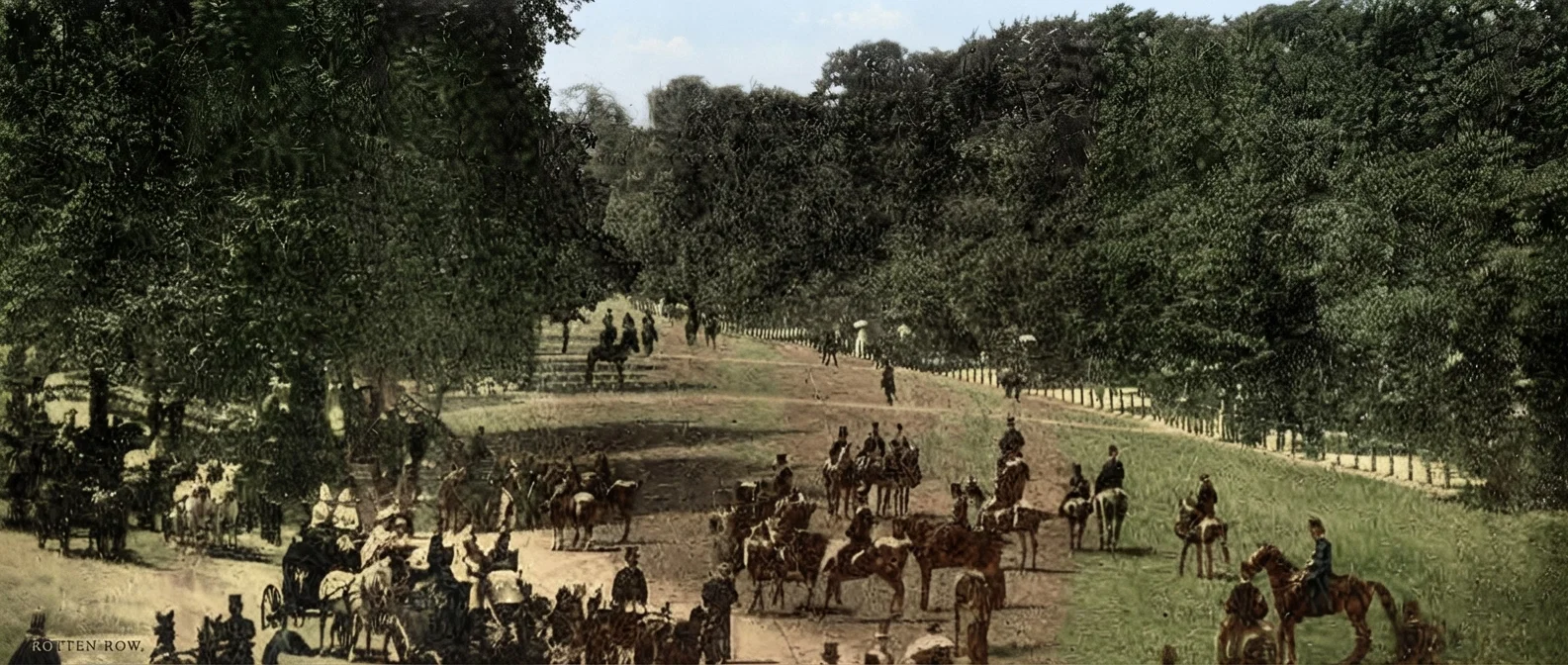
"Rotten Row," supposed to be a corruption of the French term, "Route de Roi," meaning the route or way of the King. It is a beautiful way or road, in Hyde Park, London, extending from Hyde Park Corner to Kensington Gate, one and one-half miles long. It is ninety feet wide, separated from a promenade fringed with soft green turf. Some of the most brilliant displays of wealth and fashion in the world's metropolis are seen here in the afternoons, and at the church parade on Sundays. The Route, or Way, of the King in many places of earth has, because of sin and corruption, become morally, "rotten row."
BUT there is a Royal Way which knows no corruption. It is not called that because the King alone travels it, but because the King made it for His subjects to walk in—subjects purchased by priceless ransom. It is lifted above the lowlands of lust; it sinks not to the sloughs of wickedness, or the pits of corruption. It is a highway cast up, ballasted in living rock upon a like foundation. That royal way is the way of God's commandments, the way of holiness, the way of righteousness, and life. "As for God, His way is perfect; the word of Jehovah is tried." Ps. 18:30. It is the way of His precepts. Ps. 119:27. It is the way of His commandments. Verse 32. It is the way of His statutes. Verse 33.
—0—
O, SOUL, why not turn from your own ways which end in disappointment and death, and choose the royal way of God. Truly the prophet has said, "O Jehovah, I know that the way of man is not in himself; it is not in man that walketh to direct his steps." Jer. 10:23. "There is a way which seemeth right unto a man; but the end thereof are the ways of death." Prov. 16:25. There is a curse which reaches the whole length of the way of sin; but there is blessing in God's royal way. "Blessed are the undefiled in the way, who walk in the law of Jehovah." Ps. 119:1. There is death in man's way; but in the royal way of God there is life; for "in the way of righteousness is life; and in the pathway thereof there is no death." Prov. 12:28. The soldier of God may lay down
in the midst of his struggle to sleep for awhile, but he will know that the Master will awake him in the glad morning of the resurrection. There is unmitigated, hopeless sorrow in the ways of earth; but there is rejoicing in the royal way of God's "testimonies." Ps. 119:14. There is peace and surety in God's way; for "great peace have they that love Thy law, and they shall have no stumbling-block." Ps. 119:165. Every blessing of the royal bounties is found in the royal road of God. Peace, joy, life, strength, righteousness, are the elements of His way. It is the way of Christ; "I have kept My Father's commandments, and abide in His love." John 15:10. Why not choose it, and choose it forever? Why not pray the prayer of God's servant of old. "Teach me, O Jehovah, the way of Thy statutes; and4I shall keep it unto the end. Give me understanding, and I shall keep Thy law; yea, I shall observe it with my whole heart." Ps. 119:33, 34.
PERVERSIONS OF DOCTRINE IN THE LAST DAYS.
JUST as sure as there were true prophets in olden times, there were also false ones. Such is the positive statement of the apostle Peter, who says: “The prophecy came not in old time by the will of man; but holy men of God spake as they were moved by the Holy Ghost. But there were false prophets also among the people, even as there shall be false teachers among you.” 2 Peter 1:21; 2:1. Satan’s scheme for destroying souls is hinged on the perversion of truth; so wherever we find truth, in this world, we may expect to find falsehood; if there were no truth there could be no falsehood.
Among the signs of Christ’s second advent, given by Himself, is this, “Many false prophets shall rise, and shall deceive many.” Then it follows that there will be true prophets in the last days, or there would be no false ones. Satan would have no use for that special mode of deception, or perversion of truth.
The Lord also tells us of the extent of the pernicious influence of such work: “And because iniquity shall abound, the love of many shall wax cold.” This being given as the direct result of the teaching of false prophets, it discloses the fact that such work will have an extensive influence on believers, and will have the effect of causing them to backslide.
Naturally this would be just what the adversary would most desire—the confusion, the discouragement, and the consequent backsliding of those who had been wont to receive light and courage through the spirit of prophecy. This prophecy is one of the gifts bestowed upon the church when Christ ascended to heaven, and one of its purposes was the “perfecting of the saints;” for how long?—“Till we all come in the unity of the faith, and of the knowledge of the Son of God, unto a perfect man, unto the measure of the stature of the fulness of Christ.” See Eph. 4:7-13.
Now how long will it take the church to come to this state of unity and perfection if any of the gifts or means designed by the Master for such consummation be taken away before the object is accomplished? How long will it take to perfect the saints in the knowledge of Christ if some internal influence be continually causing many to grow so cold and weak as to be easily led astray by the enemy?
We have referred to “internal” influence, because false prophecy, or perversion of prophecy, in order to gain great influence in the church must come in through those professing to be Christians. The closer they are connected with the membership of the church, and the more they have been trusted, the greater their influence when they begin to scatter doubt concerning any gift of the Spirit or other tenet of the faith. Hymnæus, Alexander, and Philetus are examples. 1 Tim. 1:18-20; 2 Tim. 2:16-18; 4:14-16.
We have the prophetic testimony of Paul also, concerning this very church at Ephesus, where Timothy was when addressed as above. Paul had warned the elders of that church long before in these words: “Take heed therefore unto yourselves, and to all the flock, . . . for I know this, that after my departing shall grievous wolves enter in among you, not sparing the flock. Also of your own selves shall men arise, speaking perverse things, to draw away disciples after them.” Acts 20:28-30. And to Peter’s testimony before noted, should be added his statement of results: “And many shall follow their pernicious ways; by reason of whom the way of truth shall be evil spoken of. And through covetousness shall they with feigned words make merchandise of you.” 2 Peter 2:2.
We may also be assured that whatever the Lord designs to make specially prominent at any time will be counterfeited or specially opposed by the emissaries of the adversary; both in and out of the church—preferably within, if possible. It is so with the doctrines of the near advent of Christ, of the resurrection of the dead, of the mortality of man and immortality only through Christ, of the unconscious state of the dead, of the saints’ inheritance in the earth made new, of reformation concerning the Sabbath of the Lord “according to the commandment,” of the sanctuary in heaven, of the spirit of prophecy in the church in the last days, and of other points of “the faith which was once delivered to the saints,” and concerning which the Lord would have His people specially put in remembrance in the last days, as a final preparation for the judgment.
The manifestation of the spirit of prophecy is an emphatic promise for the “last days.” The fulfilment of this prophecy began on the day of Pentecost (Acts 2:16-21), but the “last days” must include the last day of probation, when the Spirit will be withdrawn from unregenerate man, and prophecy will be of no further utility. Therefore it should not be a matter of surprise if we find it bitterly opposed and perverted as it becomes more prominent in the “latter rain,” which must accompany the closing work of the Gospel of salvation. G.
EXAMINE SELF INSTEAD OF OTHERS.
By G.
A VERY plain exhortation of the Word of God is, “Examine yourselves, whether ye be in the faith.” 2 Cor. 13:5. Strict attention to this counsel, a daily remembrance of its importance, would save the critical faultfinder a great deal of disagreeable experience. It would save him the bitter feeling that comes of habitually condemning other people, and of murmuringly reflecting against God because of unpleasant circumstances. What is deemed the adverse providence of God, is often the result of one’s own misjudgment.
In Rom. 8:28 we read that “all things work together for good to them that love God, to them that are the called according to His purpose.” Now the natural tendency is for one to imagine that what he would like to have is the thing that would be for his good. So if things do not come according to his liking, if even the known good thing does not come in the manner and at the time he would like, there arises a real doubt of the truth of the Word. One says, “I know that I love God, yet everything goes against me.” Even the patriarch Jacob talked in that manner (Gen. 42:36) when circumstances looked dark to him. And David made a like mistake (Ps. 73:1-3) when he saw the prosperity of the wicked. Yet this kind of reasoning just reverses the Scripture.
If the one who complains in this way would but question his imaginary love of God, question whether the thing he desires would be best under the circumstances, whether he is prepared to make a right use even of good things, it would be far better than doubting the Word of God. The one who doubts God’s promises is always critical of others, and condemnation of others is always an implied praise of self by comparison, tho it be unexpressed. However ardently one may protest his love for God, there is just one unfailing proof of such love. The Spirit gives us the proof by the pen of an apostle, in these words: “This is the love of God, that we keep His commandments.” 1 John 5:3. Now the commandment-keeper loves his neighbor as himself, and men do not condemn themselves. “No man ever yet hated his own5flesh; but nourisheth and cherisheth it, even as the Lord the church.” Eph. 5:29.
It is far better that examination be of self, and all condemnation be of self, in the light of God’s Word; then one’s life will be a condemnation of evil deeds in others. A consistent life is a far more potent reprover than condemnatory words. The consistent life of faith and patience will experience the working of good out of the providences of God, even in this life of sin and sorrow. It is possible to “overcome evil with good,” but no good ever can come of rendering evil for evil. “Put them in mind,” says Paul to Titus, “to speak evil of no man.”
Praise ye Jehovah.
Praise ye Jehovah from the heavens;
Praise Him in the heights.
Praise ye Him, all ye His angels;
Praise ye Him, all His host.
Praise ye Him, sun and moon;
Praise Him, all ye stars of light.
Praise Him, ye heavens of heavens,
And ye waters that are above the heavens.
Let them praise the name of Jehovah;
For He commanded, and they were created.
He hath also established them forever and ever;
He hath made a decree which shall not pass away.
Praise Jehovah from the earth,
Ye sea monsters, and all deeps;
Fire and hail, snow and vapor;
Stormy wind, fulfilling His word;
Mountains and all hills;
Fruitful trees and all cedars;
Beasts and all cattle;
Creeping things and flying birds;
Kings of the earth and all peoples;
Princes and all judges of the earth;
Both young men and virgins;
Old men and children;
Let them praise the name of Jehovah;
For His name alone is exalted;
His glory is above the earth and the heavens.
And He hath lifted up the horn of His people,
The praise of all His saints;
Even of the children of Israel, a people near unto Him.
Praise ye Jehovah.
THINGS THAT GOD HATES.
By G.
IN the Word of God we are told of various things that are displeasing to Him. But the wise man designates some things that are especially disagreeable to God: "These six things doth the Lord hate; yea, seven are an abomination unto Him: A proud look, a lying tongue, and hands that shed innocent blood, an heart that deviseth wicked imaginations, feet that be swift in running to mischief, a false witness that speaketh lies, and he that soweth discord among brethren." Prov. 6: 16-19.
Here are seven things especially mentioned. They are briefly stated, easy to remember, and by studiously avoiding them, many other common stumbling-blocks will be taken out of the way. So many people will disclaim a tendency to any of these faults—few indeed will acknowledge even one of them; so deceitful is the human heart. Yet the very fact that God has seen fit to make special mention of these faults, placing them permanently in His Book "for our learning," shows that there is a special and urgent call for the admonition. Everybody can see these evils prevailing on all sides, see them apparently becoming more and more prevalent in these last days. They are evidently contagious. It therefore behooves us all to note these things that are so very displeasing to our heavenly Father, and to beware of them as of a most dreaded disease. It is for this that the warning is given us. Give particular attention to the first and last specifications, if you are so very sure that you are innocent of the others. A proud look can not be disguised even from mortal eyes, and is disgusting even to those who indulge it in themselves. And the sowing of discord among brethren may spring from a very little idle gossip that "didn't mean any harm."
We are nearing the day of the Lord, and the things that He hates will not stand in that day. We can not afford to be bound by any of them.
G.
Question Corner
By Editor
1938.—What Roman Catholics Worship.
How many gods do the Roman Catholics pray to? How many have they, and how many have been created or made of late years?
Professedly they worship one God, yet they pray to or ask the intercession of a great many “saints,” how many we do not know. We are not keeping an account of the number. There would be no particular profit to us to engage in such occupation. It does not help one in the truth to learn about the theories of error.
1939.—Intercession of Saints.
Can the saints hear the prayers and intercessions by Roman Catholics? And if it is so that the Virgin Mary can hear all the prayers, would she not have godly qualities and be like God?
According to God’s Word those who have died know not anything. Ps. 146:3, 4 declares: “Put not your trust in princes, neither in the son of man in whom there is no help; for his breath goeth forth, he returneth to his earth; in that very day his thoughts perish.” The prophet Isaiah (63:16) tells us that Abraham is ignorant of us. Surely if any of the saints were living it would be reasonable to suppose that the “friend of God” was among them. The apostle Paul tells us in the fifteenth chapter of 1st Corinthians that if there be no resurrection of the dead then they that have fallen asleep in Christ are perished. Job declares that when a man dies his sons come to honor and he knoweth it not; they are brought low, and he perceives it not. Job 14:21. Therefore, according to the Scriptures the saints, unless it would be those who were raised from the dead at the time Christ arose, do not hear the petitions offered them. The Scriptures tell us that those who sacrificed their sons and daughters and offered sacrifices to the dead, really sacrificed to devils. Ps. 106:28, 37; 1 Cor. 10:20.
Secondly, on the supposition that they are all living, they could not hear all the petitions offered them unless they possessed omnipresence. For instance, there are shrines of St. Peter in a thousand different places in this world, on opposite sides of the earth, where at the same moment petitions are ascending from some devotee of the saint. Would St. Peter, if he were alive, hear all these petitions? Then he would be omnipresent; and if omnipresent, then he is God. The Virgin Mary has devotees all over the earth, who are seeking her intercession at the same moment constantly. Does she hear them all? If so, she also must have the very essentials of deity, but to thus clothe human beings is to put them in the place of God and thus profane His name and throne and deity.
There is still further a thought in making intercession to saints, one which in the very nature of the case brings resultant weakness to those who do it. It places God farther away, and in the mind of the one who prays makes the human being more merciful and kind than the Lord Himself. Why should men and women ask those once mortal like themselves to intercede with an all-merciful God, one whose mercy endures forever, one who is pleased with all those who hope for His mercy. Jesus said, “Come unto Me.” That means coming directly to Him with nothing between. The loathsome leper, whom everybody shunned, could come to Him and plead, “Lord, if Thou wilt, Thou canst make me clean;” and the Master, who is the same yesterday, to-day, and forever, put forth His hand and touched Him, and said, “I will; be thou clean.” If we are to pray to any being in the universe, why not pray to Him who is everlasting love and through whom all the love that dwells in every other heart must come.
1940.—The First Commandment; Prayers to Saints.
Does the first commandment or any other one allow us to pray to saints?
It needs but the reading of the Word of God to show the reverent believer that there is but one God, and Him only should we serve,—“Thou shalt have no other gods before Me,” or, as rendered by some, “besides Me.” And the second commandment forbids the setting up of any kind of image or likeness or form of anything in heaven above or in earth beneath to bow down to or worship. Even God’s mighty angel which had been with His people through all the ages forbade John to worship him, simply telling him that he was a fellow-servant with John and a fellow-servant with all his brethren the prophets, and that the prophet’s duty was to worship God. Rev. 19:10.
1941.—Observance of the Sabbath.
My thought is that the Sabbath is a day of rest; is it right therefore to ride on the street-cars and pay one’s fare? Is it not the same as making regular purchases on other days?
The Sabbath is not designed as a day of mere physical rest. It is resting from our own works and using the day as a day of pleasant activity in God’s service. The idea of physical rest came in because of men’s sins and the physical weaknesses consequent thereon. Yet in the service of the sanctuary the priests did double work on that day, offering two lambs in the morning and two in the evening, instead of one at each time as on the other days. When Christ, the Lord of the Sabbath, was on earth, He spent the day in busy activity for the salvation of souls. The Jews said He transgressed the Sabbath commandment. He declared, “It is lawful to do well on the Sabbath day.” What the commandment forbids is our own secular work. The divine commentary on that commandment is found in Isa. 58:13, 14, “If thou turn away thy foot from the Sabbath, from doing thy pleasure on My holy day; and call the Sabbath a delight, the holy of the Lord, honorable; and shalt honor Him, not doing thine own ways, nor finding thine own pleasure, nor speaking thine own words; then shalt thou delight thyself in the Lord.”
As to riding on the street-cars depends on the object we have in view. If we live so far away from worship that it is necessary to ride, we see no harm in using the street-car. It is not work of our own that we have initiated on the Sabbath, and we are simply using a public conveyance in serving the Lord. Yet in many cases a street-car is used where a walk would be just as well, and sometimes much better for those who took the exercise. Two or three miles’ walk is not far for a well person. There is danger on both sides of using the Sabbath as a day of pleasure or mere physical enjoyment, or in getting Pharisaical ideas of it so as to make it a yoke which we are unable to bear. God designed that it should be made alike a day of rest and pleasure, a day of true, sincere worship and fellowship.
OUR ATTITUDE TO UNIONISM.
By Editor
THE SIGNS OF THE TIMES holds to the right of men to organize into trade-unions, guilds, associations, or what not. If a man desires to submerge his individuality and choose a union boss or walking delegate to represent him, he has that privilege. He may make that union or organization so good and desirable that all may wish to join it, but he has no right to compel men to join. The rights of him who elects to stay out are as sacred as the rights of the unionist. He has a family to support, perhaps, as dear to him, as intelligent, and worth as much to humanity. Surely he should have equal right to work as he will, for whom he will, when he will, and for what he will, as the unionist.
If any organization under the sun can not succeed on its merits in winning and holding and controlling its members, and in convincing others without violence or coercion, it is worthy only to die. And this is as true of any religious institution as it is of any secular organization. If it be of God it will survive, if it be not of God and truth and justice, it deserves to die. Brethren of the labor unions, are you not willing that unionism should meet this test? If not, why not?
THE PAPACY IN PROPHECY
By ABDIEL
THE TWO-HORNED BEAST.
The Dragon Voice.
In our last study of Rev. 13:11-17 (see text below), we learned that the two horns like a lamb symbolized two principles found in the Christian religion of all religions, in the Federal Government of the United States of all governments. Therefore, in the time and the place of its coming up, as well as in its fundamental principles, the two-horned beast is a symbol of this government. It can apply to no other. All the specifications of the prophecy fit the United States alone. If it has not this application, we have a prophetic symbol applying to nothing, and one of the greatest of world-powers, the great republic of the West, has no prophetic symbol. Either supposition is unreasonable. If the only specifications of character were the lamb-like principles of equality of men and freedom of choice in religion, no one would demur to the application of the prophetic symbol to this country; for the character and fundamental law of the government demonstrate its truth.
Equality of man—republicanism—and freedom of choice—fundamental Protestantism—were the two mighty attractions in this government which brought to its shores from the Old World the liberty-loving hearts who braved all perils to find “a church without a pope and a state without a king.” The new republic engraved upon the reverse side of her great seal what her example and influence was rapidly stamping upon the dominating influences of the great nations of earth, Novus Ordo Seclorum, “a new order of things.”
Yet the same “sure word of prophecy,” which outlined the beginning of the career of this government, also declares that it
“Spake as a Dragon.”
The dragon is a symbol of the devil, the great “deceiver” of the world, the great instigator of all the tyranny and oppression which ever cursed the people of this planet. Rev. 12:9. Satan persecutes by inducing apostate and deceived civil governments to unite religion with the state and promulgate laws against dissenters. Thus, through seven great dominant dynasties, beginning with Babylon, the dragon, Satan, has persecuted the church. Rev. 12:13. The only conclusion, therefore, to which we can come is, that this government which started so grandly, with such noble principles emblazoned on her escutcheon, will forget those principles, connect religion with the state, and become a persecutor.
How Is This to Be Accomplished?
This is further shown in the prophecy. Note the forecast of the two-horned beast’s work in the scripture which is here repeated. Rev. 13:11-17:
“And I saw another beast coming up out of the earth; and he had two horns like unto a lamb, and he spake as a dragon. And he exerciseth all the authority of the first beast in his sight. And he maketh the earth and them that dwell therein to worship the first beast, whose death-stroke was healed. And he doeth great signs, that he should even make fire to come down out of heaven upon the earth in the sight of men. And he deceiveth them that dwell on the earth by reason of the signs which it was given him to do in the sight of the beast; saying to them that dwell on the earth, that they should make an image to the beast who hath the stroke of the sword and lived. And it was given unto him to give breath to it, even to the image of the beast, that the image of the beast should both speak, and cause that as many as should not worship the image of the beast should be killed. And he causeth all, the small and the great, and the rich and the poor, and the free and the bond, that there be given them a mark on their right hand, or upon their forehead; and that no man should be able to buy or to sell, save he that hath the mark, even the name of the beast or the number of his name.”
He deceives the earth-dwellers by “great signs” which it was given him to do.
He causes the earth and those who dwell therein to make an image to the seven-headed beast.
He causes the earth-dwellers to worship both the beast and its image.
He gives life to the image and makes it speak.
The worship of the image is enforced under penalty of death.
It causes all to receive a mark in the right hand or upon the forehead as a mark of homage to the beast and its image, under penalty upon refusal of confiscation of all natural rights.
We will enter upon no extended discussion of the “great signs” by which the earth-dwellers are deceived. Suffice to say that this land above all others is “the land of marvels.” In discovery and invention, and in its impulse and opportunity and encouragement to discovery and invention, America stands pre-eminent. By her very cleverness she is winning homage from the world, which the devil will bend in a wrong direction.
Here, too, in America, in public manifestation, in the year 1848, started the very beginning of the wave of occultism which is sweeping the habitable earth. It was manifest first in Modern Spiritualism, with its marvels, gross, deceptive, and otherwise. The occultism of the oriental countries has taken advantage of conditions here, and has entered America as the promising missionary field of the world. But the old and new Buddhism, Theosophy, Modern Spiritualism, Christian Science, New Thought, Telepathy, Psychic Magnetism, Hypnotism, are all but different phases and forms of spiritism used by the devil, and based on the old Satanic deception and falsehood, “Ye shall be as God;” “ye shall not surely die.”
The church of Jesus Christ, the Protestant church at large, which ought to be the great conservator of truth, calling men back from these deceptions, has lost her bearing. The Bible is no longer the word of God to her; rather it is a collection of religious myths, inaccurate history, mistaken philosophy, questionable traditions, variable ethics, expressing only the wisdom and experience of the ages in which its different parts were written. To this low condition “higher criticism” and “profound scholarship” has brought it, and even good men in the church who do not believe in all the deductions of the critics are fearful that the critics may be right, and are weakened in their convictions, uncertain as to conclusion, and timid as to assertion.
Many feel that there is a revival, an old-fashioned revival, of religion needed, but like the writer of the article on page 14, entitled, “Whom Can You Trust?” how timidly they approach it. They lack the boldness to thunder as did Whitefield, even to church-members, “Ye must be born again,” and to clinch this home as did Wesley, “If any man be in Christ, he is a new creature; old things are passed away; behold, all things are become new.”
An apostate church, a backslidden church, is ever looking for signs. Even so were the Jews in the days of Jesus: “What sign showest Thou?” “Master, we would see a sign from Thee;” “Show us a sign.” And yet the mightiest sign of all, the demonstration of the word and truth of God in the humanity of Jesus, they could not see. When the Christian church departed from the simplicity of the Word, she sought for merit in sacred places, in holy things, in bones and relics of some departed saint. And the superstition brought the appeal to civil law to support traditionary dogma, brought the Dark Ages, brought all the fearful persecutions which followed.
What Will Grow Out of This?
Just what grew out of the backsliding and apostasy in the early centuries. A church losing spiritual power will always resort to the Egypt or the Assyria of civil law. So the two-horned beast, in response to the demand coming up from the deceived ones, causes to be made an image to the preceding beast; that beast was a union of church, or religion, with the state. That is what made it the beast, the persecuting power that it was. An image to that beast means the union of religion and the state in this country, all the preliminary steps to which have already been taken.