THE brethren at Stanley, Wis., are making the preliminary arrangements for the erection of a new house of worship.
SIXTEEN adults have decided to keep the commandments of God and the faith of Jesus near Victory, Wis., as a result of meetings held by Brother N. P. Neilson in a schoolhouse, the teacher of the school being one of the number.
A GOOD work is reported at Fort Collins, Colo., by Brethren J. M. Rees and W. Zeigler. Up to March 15, there had been fifteen additions, and the interest continued. The attendance had necessitated securing a larger meeting place.
A NEW paper, entitled The Life Boat, has been started by the International Medical Missionary and Benevolent Association, at 1926 Wabash Avenue, Chicago. It is devoted exclusively to mission and rescue work, and is full of interesting matter. Issued monthly; 25 cents a year.
IF ANY people in the world should be aggressive, it should be those who bear the last message of warning to a perishing world. If you are a light-bearer, do not hide it, but keep it in a conspicuous place. “And the Lord shall make thee the head, and not the tail; and thou shalt be above only, and thou shalt not be beneath; if that thou hearken unto the commandments of the Lord thy God, which I command thee this day, to observe and to do them.” Deut. 28: 13.
OF the mission in Buffalo, N. Y., we find a good report from Brother George R. Lesch in the Indicator. The mission address is 623 Genesee Street. Immediately connected with the work, besides Brother Lesch and wife, are two missionary nurses, and several others. A dining-room has been fitted up in the basement, where a pint of soup with a good-sized slice of bread is served for one cent, regular meals at ten cents, three tickets for twenty-five cents. Gospel services are held every night. Three evenings in the week these are conducted in the German language. A most important branch of the work is the cottage Gospel meetings. Such meetings are now being held at eight different places, with good results. As soon as circumstances permit, open-air meetings will also be held. A women’s industrial department has been opened, where poor women are given an opportunity to work a few hours a day at making kitchen aprons, or other simple garments. And so in many ways the Lord gives opportunity to work for Him. This work should be liberally supported.
BROTHER R. R. KENNEDY says of the Helping Hand Mission in Cleveland, Ohio, that it “is being run on sound business principles; therefore it is self-sustaining. Hundreds of people are being lodged, fed, and clothed. Service is held every evening, and the Spirit of the Lord is in the meetings. Souls are converted, and testify to the power of the Lord to save and keep from sin. It has been demonstrated that the Lord is ready and willing to carry forward this work with power, if His people are only ready to co-operate with Him.”
CONCERNING the Haskell Home for orphans, and the James White Memorial Home for aged people, at Battle Creek, Mich., Dr. J. H. Kellogg says: “Nearly two hundred persons are sheltered in these homes, and a grand work is being done, not only in receiving the outcast, homeless, and friendless, into a Christian place of refuge, but in the education and training of children for lives of usefulness, and in the training of Christian women to go out as missionaries, and engage in rescue work for children in all parts of the world. This is a work which everywhere calls loudly for attention, and which should have the sympathy and support of Christian people everywhere.”
Literary Notices.
THE NEW DISPENSATION (THE NEW TESTAMENT). TRANSLATED FROM THE GREEK by Robert D. Weekes. 8vo, 525 pp., cloth, $2.25; full Russia, $3.75; full Morocco, $4.75. New York and London; Funk & Wagnalls Company.
This is a new translation of the New Testament from the original Greek. The object of the translation is to remedy so far as may be possible many of the infelicities and generally acknowledged imperfections of the familiar versions of the New Testament. The object has been to determine the thought of the writers, and to express it in English acceptable both to the ordinary reader and to the close scholar, with as little deviation from the literal translation as practicable, at the same time retaining as far as possible the familiar style of the conventional versions. Use has been made of all the critical helps, but none have been followed implicitly. The old and familiar division into chapters and verses, which is purely arbitrary, has been discarded, but for convenience of reference, the chapters and verses of the old version are indicated in parentheses at the bottom of each page. To our mind, however, it would have been better to facilitate reference to have indicated the verses in the margin, opposite each verse.
Some freedom has been used in regard to idiom and in the rendering of tenses and particles; also in the arrangement of clauses, redundant words have been sometimes omitted, and words obviously implied have been inserted; obsolete and antiquated words and forms of expression, as well as words whose signification has become changed, have been replaced by others; and obvious mistranslations have been corrected. Clauses that appear to be parenthetic have been so indicated. Punctuation has been carefully revised. Alternative renderings and occasional explanations are given in the foot-notes where it has seemed desirable. The author trusts that he has succeeded in ascertaining the true meaning of many obscure passages, in bringing out beauties of thought and nice shades of meaning, and the peculiar form of many emphatic expressions. The Greek text of Westcott and Hort has been followed in general, but not exclusively.
The author is not a clergyman, as might very naturally be supposed, but a deacon in a Congregational Church. He has been a Bible student and a Sunday-school teacher during a life of nearly eighty years. The present work was begun simply for his own study, and is now published from a conviction that his own conscious benefit ought to be shared with the Christian public.
This new translation may be helpful and suggestive to Bible and theological students, and it will help to stimulate anew in some circles, we hope, a dying interest in the Word of God.
THE MONEY QUESTION UNDER THE X-RAYS OF PROPHECY; OR THE BATTLE FOR GOLD DIVINELY FORETOLD. By H. W. Bowman, Advent Christian Publication Society, Boston, Mass. Price, bound in cloth, $1.00.
Among the many contributions on the Money Question Mr. Bowman's is one of the most striking. Its tremendous array of facts serves to set home the marvelous searching predictions of the prophetic Word of God. Its nine chapters are full of live, interesting matter, which ought to cause even the most careless reader to “stop and think.” We hope it may have a wide circulation, for it is worthy.
GOD’S MESSENGERS. SHOWING THE HAND OF GOD IN CHRISTIAN UNION AS REVEALED IN PROPHECY. By E. O. Bennet, Rogers, Ark.; Irving Co., Publishers, New York.
This little work of 162 pages is, we believe, an honest and sincere effort on the part of the author to promote Christian union; but it is, nevertheless, if we read the Word aright, a mistaken effort, based on a misunderstanding of the prophecies, and taking the conception and wish of the writer for what ought to be. In fact, the book is in part the literal interpretations of William Miller hitched onto the fanciful theories of a united popular church, and adds nothing but vague hopes to prophetic bibliography. Sometime we know the writer will repudiate much of what he has written.
JUST BETWEEN YOU AND ME. A TALK ON ADVERTISING. By Edgar J. Arnold, of Arnold’s Advertising Agency, San Francisco.
A neat and unique little booklet giving the author’s ideas of what to say in advertising, how to say it, where to say it, etc. With a great deal of what he has said many will not agree, but all who advertise may obtain useful hints in the perusal of the little booklet.
Birds, a beautiful magazine, illustrated by color photography, still maintains its own well. The February issue, for instance, contains 9 colored plates, with descriptive text, besides general articles of interest to lovers of birds. Among the colored plates are those of The Least Bittern, The Baldpate, The Red-bellied Woodpecker, The Black Swan, and others equally of interest. The magazine is published by the Nature Publishing Company, Chicago, Ill., and the price $1.50 a year.
McClure’s Magazine for March continues Hamblen’s interesting articles on “Railway Experience,” “Letters from the Andrée Party,” and “Where is Andrée?” “Reminiscences of Men and Events of the Civil War,” by Charles A. Dana, the present article being on the “Battle of Chattanooga—In the War Department with Stanton.” Illustrated. Price, 10 cents, $1.00 a year. For sale by all news-dealers.
Sweet Pea Review, for 1898, prepared by Sunset Seed and Plant Company, sold by William Doxey, Sign of the Lark, San Francisco. The little pamphlet gives all sorts of information and description, and a summary of all varieties introduced up to the present year, of this wondrously beautiful and fragrant flower.
BIBLE ELECTION. By M. C. Wilcox. A brief presentation of God’s plan and purpose concerning man, showing that the doctrine of election, or predestination, according to the Bible, is full of comfort and instruction. It throws new light on old controversies. Bible Students’ Library, No. 67; 24 pp.; price 3 cents. Address Pacific Press Pub. Co., Oakland, Cal.
OUR GENERAL AGENTS.
General Eastern Agency—Pacific Press Pub. Co., 39 Bond St., N. Y. City, N. Y.
General Central Agency—Pacific Press Pub. Co., 14-18 W. 5th St., Kansas City, Mo.
Argentine—Señor N. Z. Town, Casilla del Correo, 481 Buenos Ayres, Argentine Republic, S. A.
Arkansas Tract Society—Fayetteville, Ark.
Atlantic Tract Society—39 Bond St., New York City, N. Y.
Australia—Echo Publishing House, North Fitzroy, Victoria.
Australian Tract Society—251 St. George's Road, North Fitzroy, Australia.
California Tract Society—1059 Castro St., Oakland, Cal.
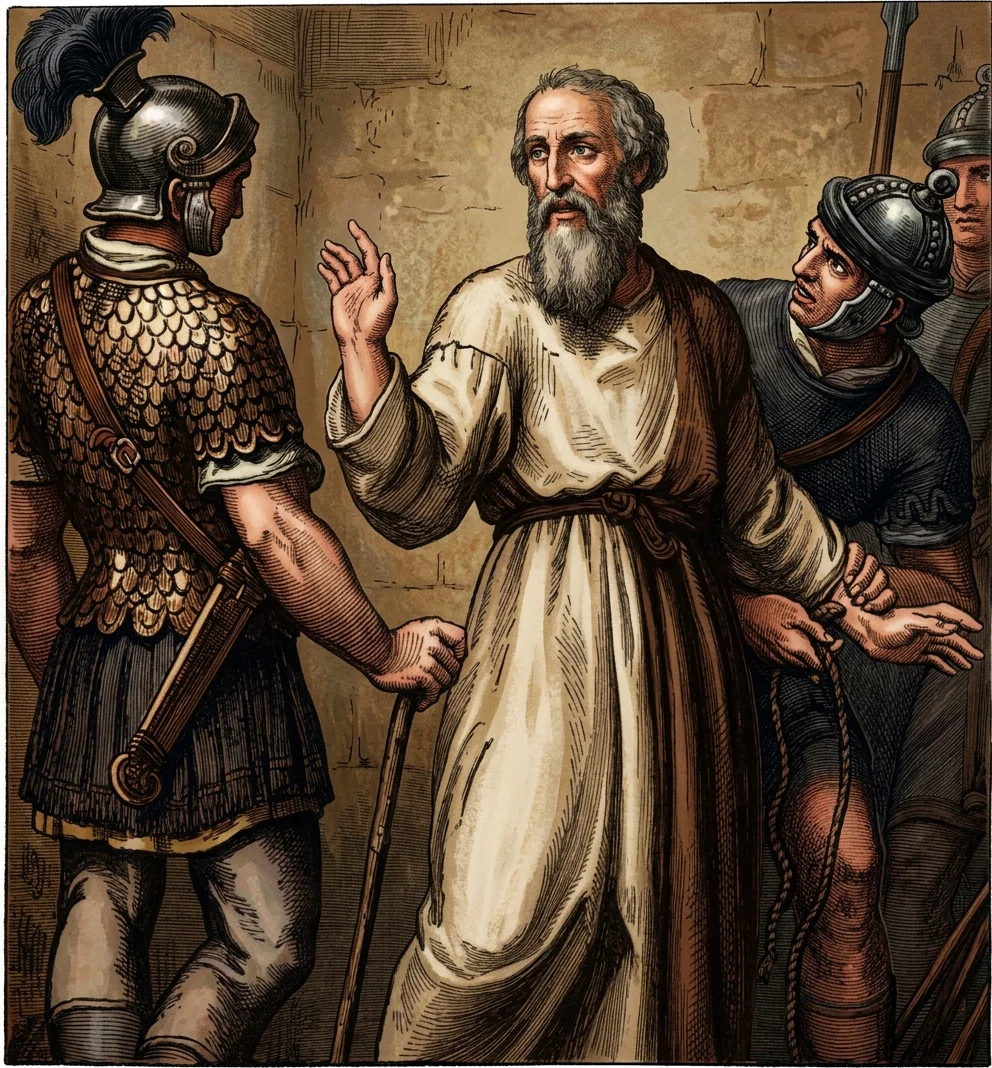
23 “And as they cried out, and threw off their garments, and cast dust into the air, the chief captain commanded him to be brought into the castle, bidding that he should be examined by scourging, that he might know for what cause they so shouted against him. 25 And when they had tied him up with the thongs, Paul said unto the centurion that stood by, Is it lawful for you to scourge a man that is a Roman, and uncondemned? 26 And when the centurion heard it, he went to the chief captain, and told him, saying, What art thou about to do, for this man is a Roman? 27 And the chief captain came, and said unto him, Tell me, art thou a Roman? And he said, Yea. 28 And the chief captain answered, With a great sum obtained I this citizenship. And Paul said, But I am a Roman born. 29 They then which were about to examine him straightway departed from him; and the chief captain also was afraid, when he knew that he was a Roman, and because he had bound him. 30 “But on the morrow, desiring to know the certainty, wherefore he was accused of the Jews, he loosed him, and commanded the chief priests and all the council to come together, and brought Paul down, and set him before them. 1 “And Paul, looking steadfastly on the council, said, Brethren, I have lived before God in all good conscience until this day. And the high priest Ananias commanded them that stood by him to smite him on the mouth. 3 Then said Paul unto him, God shall smite thee, thou whited wall: and sittest thou to judge me according to the law, and commandest me to be smitten contrary to the law? 4 And they that stood by said, Revilest thou God’s high priest? 5 And Paul said, I wist not, brethren, that he was high priest: for it is written, Thou shalt not speak evil of a ruler of thy people. 6 But when Paul perceived that the one part were Sadducees, and the other Pharisees, he cried out in the council, Brethren, I am a Pharisee, a son of Pharisees: touching the hope and resurrection of the dead I am called in question. 7 And when he had so said, there arose a dissension between the Pharisees and Sadducees: and the assembly was divided. 8 For the Sadducees say that there is no resurrection, neither angel, nor spirit: but the Pharisees confess both. 9 And there arose a great clamor: and some of the scribes of the Pharisees’ part stood up, and strove, saying, We find no evil in this man; and what if a spirit hath spoken to him, or an angel? 10 And when there arose a great dissension, the chief captain, fearing lest Paul should be torn in pieces by them, commanded the soldiers to go down and take him by force from among them, and bring him into the castle. 11 “And the night following the Lord stood by him, and said, Be of good cheer; for as thou hast testified concerning me at Jerusalem, so must thou bear witness also at Rome. 12 “And when it was day, the Jews banded together, and bound themselves under a curse, saying that they would neither eat nor drink till they had killed 13 Paul. And they were more than forty which made this conspiracy.”
QUESTIONS.
1. Give the substance of Paul’s speech on the castle stairs.
2. What caused the excited mob to listen attentively to him?
3. What expression awakened all their rage against him?
4. What did they cry out against him?
5. With what demonstrations did they accompany their cries? Verse 23.
6. What did the chief captain command concerning Paul? What was the object of this? Verse 24.
7. What did the soldiers at once proceed to do? As they were making preparations for the torture, what did Paul ask the centurion in charge? Vs. 25.
8. What was the effect of this question? Vs. 26.
9. Describe the interview that followed between Paul and the other chief officer. Repeat their conversation. Verses 27, 28.
10. What was the result of Paul’s statement that he was a free-born Roman citizen? Verse 29.
11. What did the chief captain do with Paul the next day? Why? Before what assembly did he bring Paul? Verse 30.
12. When Paul stood before the council, what solemn declaration did he make? Chapter 23:1.
13. Upon hearing this statement, what unjust order did the high priest Ananias give? Verse 2.
14. In what vigorous language did Paul denounce this piece of injustice? Verse 3.
15. What did those that stood by say to him for using the language that he did? Verse 4.
16. How did Paul excuse himself? What words did he quote showing his respect for the law? Verse 5. Where are these words found?
17. Of what two classes did he perceive the council to be composed? What did he therefore cry out? What did he declare to be the cause of the persecution against him? Verse 6.
18. What was the immediate result of this declaration? Verse 7.
19. What was the great point of difference and of contention between the Pharisees and the Sadducees? Verse 8.
20. As the result of Paul’s declaration, what did the Pharisees in the council cry out? Verse 9.
21. What kind of a scene ensued in the council? How fierce was this strife over Paul? What did the chief captain therefore do in order to save Paul’s life? Verse 10.
22. Who visited Paul the night following? What assurance and comfort did the Lord give him? Verse 11.
23. What took place the next day? What did they swear to do? How determined were they? Vs. 12.
24. How many were in this company? Verse 13.
NOTES AND QUESTIONS.
1. Why was it that the chief captain did not know the cause of the rage against Paul?
2. Quote (and give reference) words of Paul in the epistles concerning how we should regard rulers.
3. “As thou hast testified of Me in Jerusalem, so must thou bear witness also in Rome.” What did this assure Paul as to the manner of his appearance in Rome?
Soldiers about to Bind Paul.
A LESSON ON FORGIVENESS
Lesson IV.—Sunday, April 24, 1898.
A LESSON ON FORGIVENESS.
Note.—The teacher can emphasize the teachings of this lesson by using the following texts, which bear upon the question of the forgiveness of one another: Matt. 6:12, 14, 15; Mark 11:25, 26; Luke 17:3, 4; Eph. 4:32; Col. 3:13; 1 Peter 3:9. The following scriptures treat especially of the forgiveness of one’s enemies: Matt. 5:43–46; Luke 6:35–37; Rom. 12:14–21; Luke 23:34; Acts 7:60. Compare also the parable of the two debtors. Luke 7:35–50. The lesson of forgiveness is one of the most important lessons for the Christian to learn. “The aim of forgiveness is the deliverance of ourselves and others from sin. The forgiving spirit does this by keeping revenge, hate, and anger from our own hearts, and giving us the victory over ourselves; by influencing others to repent and forsake their sin. Hate inflames hate, but love kindles love. We learn from God’s forgiveness of our sins how we also should forgive.”—Peloubet.
21 “Then came Peter, and said to Him, Lord, how oft shall my brother sin against me, and I forgive him? until seven times? 22 Jesus saith unto him, I say not unto thee, Until seven times; 23 but, Until seventy times seven. Therefore is the kingdom of heaven likened unto a certain king, which would make a 24 reckoning with his servants. And when he had begun to reckon, one was brought unto him, which owed him ten thousand talents. 25 But forasmuch as he had not wherewith to pay, his lord commanded him to be sold, and his wife, and children 26 and all that he had, and payment to be made. The servant therefore fell down and worshiped him, saying, Lord, have 27 patience with me, and I will pay thee all. And the lord of that servant, being moved with compassion, released him, and 28 forgave him the debt. But that servant went out, and found one of his fellow-servants, which owed him a hundred pence; and he laid hold on him, and took him by the throat, saying, 29 Pay what thou owest. So his fellow-servant fell down and besought him, saying, Have patience with me, and I will pay 30 thee. And he would not; but went and cast him into prison, 31 till he should pay that which was due. So when his fellow-servants saw what was done, they were exceeding sorry, and 32 came and told unto their lord all that was done. Then his lord called him unto him, and saith to him, Thou wicked servant, I 33 forgave thee all that debt, because thou besoughtest me; shouldest not thou also have had mercy on thy fellow-servant, even 34 as I had mercy on thee? And his lord was wroth, and delivered him to the tormentors, till he should pay all that was 35 due. So shall also my heavenly Father do unto you, if ye forgive not every one his brother from your hearts.”
Golden Text: “Forgive, and ye shall be forgiven.” Luke 6:37.
SUGGESTIVE QUESTIONS.
(1) Who approached the Saviour on this occasion? Verse 21. (2) What question did he ask? Same verse. Note 1. (3) What reply did the Saviour make to Peter’s question? Verse 22. Note 2. (4) To what did he then liken the kingdom of heaven? Verse 23. (5) In this parable who was brought to the king? Verse 24. (6) What was the amount of his debt? Same verse. Note 3. (7) What command did his master give in reference to the servant? Verse 25. Note 4. (8) What did the servant do? Verse 26. (9) What request did he make of his master? Same verse. (10) What effect did this plea have upon the king? Verse 27. (11) What did it lead him to do? Same verse. (12) What did the servant do after he had been forgiven the debt? Verse 28. (13) What did he do to his fellow-servant? Same verse. (14) What demand did he make of him? Same verse. (15) What did his fellow-servant do? Verse 29. (16) What request did he make? Same verse. Note 5. (17) What effect did this plea have upon the servant who had been forgiven by his lord? Verse 30. (18) What did he do to his fellow-servant? Same verse. (19) What did the other servants do when they saw what was done? Verse 31. (20) What did the master say to his wicked servant? Verse 32. (21) What should the forgiveness of the master have taught the servant? Verse 33. (22) What did the master then do to his servant? Verse 34. (23) What lesson does the Saviour teach to us through this parable? Verse 35.
NOTES.
1. How oft.—Peter in placing the number of times at seven was mentioning a greater number of times than the Jews were taught by the rabbis to forgive. Their teaching was, “Forgive a first offense, forgive a second, a third, punish a fourth.”
2. Seventy times seven.—It is very evident that the expression is used simply to indicate that the forgiveness was to be extended every time forgiveness was asked. This will be seen by reference to Luke 17:3, 4. In other words, forgiveness is to be a reigning, ruling principle in the heart of the Christian at all times. The Christian forgives even before the offender requests it. Mark 11:25, 26.
3. Ten thousand talents.—Reckoning the talents at £240, this would make the debt $11,710,000. Some place the entire debt as high as $20,000,000, a sum which it was impossible to pay—a fitting illustration of our debt to the Most High.
4. Commanded him to be sold.—This was a common thing for a creditor to do to one in his debt, if he had nothing with which to pay. Hon. Selah Merrill says that in Palestine at the present day “the laws which control debtors and creditors are arbitrary in the extreme. I believe the people of Palestine dread the tax-gatherer and the money-lender more than they do the cholera or the conscription for war.”
5. Have patience with me.—The same request which he himself had made to his lord, and which his lord had more than granted; for he not only had patience with him, but forgave him the whole debt; so that he did not need to demand this money in order to pay his lord. The consequence of the unthankful servant’s course is set before us by our Lord to show us how the Lord will look upon us if we do not forgive as we expect to be forgiven. In this lesson is developed the all-important fact that heaven may be forfeited by an unforgiving spirit.
NEWS AND NOTES
FOREIGN.
—It is announced that Spain has secured from the national bank of that country a loan of 200,000,000 pesetas, guaranteed by the new treasury bonds.
—It is reported that 8,000 mining claims have been recorded at Dawson City since last September by the agent of the Dominion Government.
—A despatch from Haiti states that a terrible financial condition exists there. Gold is at a premium of 220 per cent, and flour is selling at $30 a barrel.
—William E. Gladstone has bade farewell to his friends, and is said to realize that his end is near. His physicians admit that his ailment is incurable, and their only service is in relieving his sufferings.
—The inhabitants of Hawaii in the vicinity of the volcano of Mauna Loa are said to be much concerned over the activity of that volcano. The indications seem to portend a disastrous lava flow in the near future.
—A recent batch of French conscripts were rejected as being physically incapable of military duty on account of injuries to the heart caused by hard cycling. They were not even capable of service as military cyclists.
—The French steamer Ludie, bound from Constantinople for Marseilles, foundered on March 24, carrying to the bottom her crew of thirty men. Several vessels were wrecked off the coast of England and Ireland on the same day, and a number of lives lost.
—William Jameson Reid, an American explorer, has declared his intention of visiting the sacred city of Thibet, L’Hassa. It was an attempt to reach this city which nearly cost Harry Savage Landor his life, and in which he was subjected to the most inhuman torture imaginable.
—Violent storms swept the coast of Norway on March 25, causing numerous casualties among the shipping. A telegram from Tromsoe Island states that forty-five fishermen were drowned off the north coast of Norway in the storm. Twenty-six boats engaged in salmon fishing on the Baltic are also missing.
—The steam sealer Greenland arrived at St. Johns, Newfoundland, on March 27, and reported that twenty-five of her crew were frozen to death among the ice-floes of the Arctic, as many more were missing and had been abandoned, while sixty-six of the remainder of the crew were so badly frost-bitten that many of them will lose their limbs.
—A recent report from Manzanillo, Cuba, states that the condition of the Spanish troops there is terrible in the extreme, and that starvation and disease are rapidly thinning the ranks. The report states that the government forces have sustained heavy losses in recent skirmishes with the insurgents, the wounded being brought to town in cart-loads.
—The Spanish Red Cross Society has presented a protest to the Spanish Government against the work in Cuba of the American Red Cross Society. All the members of the Spanish Red Cross Society have signed the protest. The protest was caused by the prominence recently given to the admirable relief work conducted by Miss Clara Barton in the Weyler-stricken island.
—A number of Spaniards from Havana recently planned a filibustering raid which was to be made into Texas from Mexico on the breaking out of hostilities between Spain and the United States. The leaders have been captured by Mexican authorities, and it has been ascertained that this expedition, which was to start on short notice, consisted of about 400 men, armed and mounted.
—A report from Cairo, Egypt, dated March 29, states that the Anglo-Egyptian forces have captured the Dervish stronghold of Shendy, destroyed the forts, and liberated over 600 slaves. The Dervishes lost 160 men, and large quantities of grain, ammunition, and cattle. The defeated Dervishes are entrenched at El Hilgi, and are suffering severely from lack of food. Another engagement is expected soon.
—M. Hanotaux, Foreign Minister for France, in stating the attitude of the French Government toward the delicate situation now existing between Spain and the United States, declared that France’s only action in the matter would be to try to maintain amicable relations between those “two nations equally dear” to France; but that further than that France could not go. His words were approved by the Chamber of Deputies by a vote of 300 to 111.
—China has yielded to the demands of Russia, granting a twenty-five-year lease of Port Arthur and Talien-wan, with rights for the building of the Muscovite railways. Russia has occupied the ports, raised her standards, and proclaimed the ports open to the commerce of all friendly nations. It is not believed that England’s opposition to Russia’s course will go farther than a protest. Russia has ordered 50,000 of her reserves to be sent to her newly acquired Asiatic stations.
DOMESTIC.
—The State of California has produced during the past year 31,500,000 gallons of wine. This is the greatest amount of wine ever produced in the State.
—The naval reserves of New England and New York have been called upon to man the old monitors, which are soon to be placed in the harbors of New York, Boston, and Portland.
—It is reported that the battle-ship Texas has again been so badly damaged as to require extensive repairs, having struck one of the many coral reefs near the southern rendezvous.
—Freshets along the tributaries of the Ohio have caused that river to overflow its banks, inundating a large amount of land, and flooding over 2,000 houses. The worst of the flood is believed to be over, and the waters are subsiding.
—During the week the government has purchased several staunch tugs and yachts, which are to be fitted up as torpedo-boats. One torpedo-boat, which was recently completed in England for the German navy, has been purchased and placed in commission.
—Commodore Winfield Scott Schley has been appointed commander of the flying squadron, now stationed at Hampton Roads, and various rumors are afloat as to the work laid out for this fleet. Captain Sampson has been given the position of commander of the North Atlantic squadron, in place of Rear-Admiral Sicard, retired.
—The governor of Massachusetts, the lieutenant-governor, the mayor of Boston, and fully one hundred other prominent citizens of eastern Massachusetts, have laid themselves liable to arrest, on account of attending an entertainment given for the purpose of raising a fund for a monument to the memory of the Maine sailors. The entertainment was held on Sunday, and the law of that State makes even attendance at such a gathering on that day a crime. It is expected that warrants will be issued for the arrest of those in attendance.
—The most vigorous earthquake shock which California has experienced since the memorable disaster of 1868, convulsed the north central portion of the State at about midnight on March 30. The vibrations were from northeast to southwest, and continued for forty seconds. Hundreds of persons rushed from their beds into the streets, expecting the buildings to collapse; but no serious damage was done. It is believed that had the shock been of the jarring nature, many buildings would have fallen, and many lives been lost. Altho the disturbance was very pronounced, it was of a wavy or undulating character, and therefore not so severe as it would otherwise have been.
—Judge-Advocate Marix, with the report of the findings of the Maine board of inquiry, arrived in Washington on the evening of March 24. The report was delivered to the Secretary of State on the following day, and by him placed in the hands of the President. Publicity was given to the report on March 28, which shows that the battle-ship Maine was blown up by a mine under the port side of the ship, and was due to no fault on the part of those on board the vessel. In the opinion of the court the explosion of the mine caused the explosion of the two forward magazines; but the court is unable to fix the responsibility upon any individual or individuals. The Spaniards have prepared a report of their own, stating that the disaster was caused by an internal explosion.
—The present outlook in the situation between Spain, the United States, and Cuba is anything but promising. While diplomats are hard at work trying to preserve the peace and reach some other solution than that in which war would be a factor, the members of Congress, backed by their several constituencies, are exceedingly restive under the restraint of the administration. Several bills have been introduced in Congress during the week recognizing the independence of Cuba, or the belligerency of the Cubans, or declaring war against Spain. These have been referred to the Committees on Foreign Relations, and some definite action is demanded before the close of the week. The preparations for war continue both on the part of the United States and Spain. It is reported that the latter country has purchased of Italy the cruiser Garibaldi, and has despatched another fleet of war vessels to Cuban waters. The war spirit of the Spanish people continues to become more demonstrative, and the same may be said of the people of the United States. President McKinley has stated that unless definite and satisfactory arrangements are concluded by March 31, the whole matter will be placed in the hands of Congress. The one hopeful feature of the present negotiations between the two governments is that Spain has agreed to rescind the reconcentrado order, and allow the reconcentrados to return to their homes, protected by the army; also to furnish implements for tilling the soil.