JOTTINGS FROM PALESTINE. NO. 14. Bethany, Tombs of the Kings, etc.
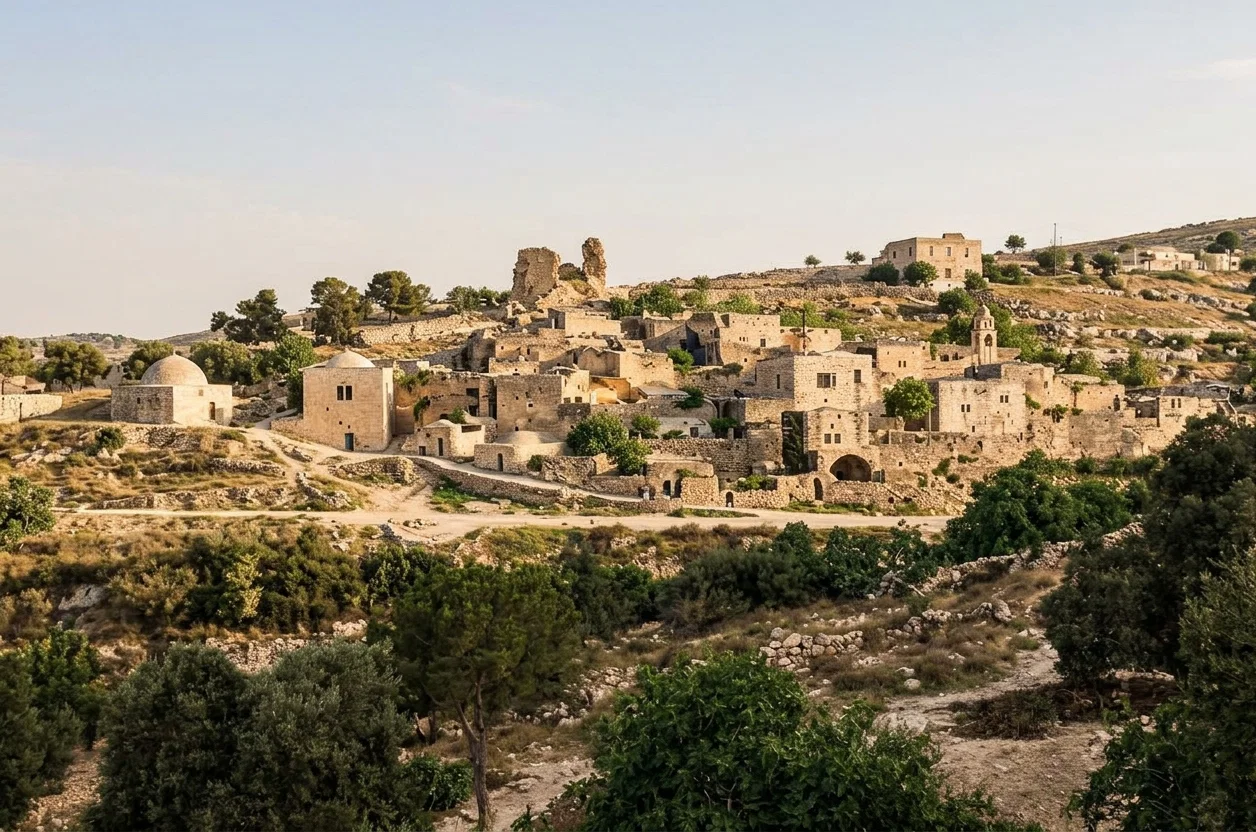
A VIEW OF THE BETHANY OF TO-DAY.
At the close of our last sketch we were on the Mount of Olives. Let us now pass over the summit to the east. In this direction, as well as to the north, the mount recedes gently, while to the south and west the descent is rapid, forming a deep valley. It is but a short distance from the summit down to Bethany, the home of Mary and Martha and Lazarus. Jesus made His home with this family more than any other during His sojourn in Jerusalem. During the day He was in the temple, teaching, but at night He returned to the Mount of Olives, to Bethany.
At present Bethany is a small village of Arabs, who evidently gain their living principally by begging of tourists and pilgrims. The village is full of children and youth, any of whom is ready to show, for a small fee, the tomb of Lazarus and where the house of Mary and Martha stood. Some of the smallest I met, just able to walk, had already begun to learn their future trade by lisping their first word, “Lazarus.”
Nothing certain is known about the house and tomb, but the village is known to occupy the same place now as anciently. Hence the general outlines of the place are the same now as in the time of Christ. Olive, fig, and almond trees are quite numerous here, giving the place a pleasing appearance in contrast with the rocky and more barren higher slopes of the Mount of Olives. Bethany is near the main road leading from Jerusalem to Jericho, at a distance of two miles. It takes about forty minutes to walk from Jerusalem to Bethany. The easiest way to reach it is by the Jericho road leading around the southern slopes of the Mount of Olives; but there is also a foot-path leading over the summit of the mount, and, judging by the Scripture narrative, Jesus took the latter route.
The Mohammedans regard Lazarus as a saint, and hence have a mosque near his tomb. The family of Mary and Martha and Lazarus must have been quite well known in Jerusalem; for at the death of Lazarus many came from the city to comfort them, and thus witnessed the resurrection of Lazarus. It was this miracle more than any other that stirred up the Pharisees to put Christ to death. John 11. Few scenes in the life of Christ are described in such detail as this; hence Bethany is a place of special interest. Here the Master sat and taught; here He wept in sympathy for mourning hearts; here He demonstrated the fact that He is the resurrection and the life; and here, while at the feast prepared for Him after the resurrection of Lazarus, Mary anointed His feet with the precious ointment and wiped them with her hair.
The next day after this feast at the house of Simon the leper, as Jesus goes to Jerusalem, at the descent of the Mount of Olives He is met by the throng with palm branches. The next day, in again going from Bethany to Jerusalem, the deceptive fig tree withers at His word. And when He takes His last walk with His disciples, it is over the Mount of Olives, doubtless by the same way which He had so many times traversed; passing for the last time the Garden of Gethsemane, He conducts them to Bethany, and thence ascends to heaven. Luke 24:50, 51. On going to the city after the ascension, it is stated that the disciples returned “from the mount called Olivet.” There is no contradiction here, as some have supposed; for Bethany is on Mount Olivet, but a short distance east of the summit, and considerably lower. In locating the point of ascension on the summit of Olivet half a mile from Bethany, tradition ignores the plain statement of the inspired record. The Mount of Olives is the last place which Jesus trod before He ascended, and it will be the first on which He will place His feet when He returns to restore all things. Zech. 14:4.
Returning from Bethany over Mount Olivet, and passing Gethsemane, we think of the returning disciples, as they went back to Jerusalem to wait for the outpouring of the promised Spirit; and we meditate on the words spoken from Olivet by the Master, which plainly indicate that we are in the time of the latter rain, when we, like the disciples, should seek with one accord the refreshing from the Lord.
Instead of entering the city, we walk up the Kidron Valley to the north, and follow a road leading from the Damascus Gate to the new suburbs here springing up, to the tombs of the kings. Like the catacombs of Rome, they are beneath the surface of the ground, and are hewn from the native rock. First, there is an extensive uncovered space for assemblies, and then large rooms in the rock round about. From the chambers in the rock are passages leading to other chambers, and places for the dead are cut in the rock on the sides of the chambers. The door from the assembly space to one of these chambers is of special interest, as it is believed to illustrate the form of door used in the time of Christ. It consists of a large disc like a grindstone, fitted in grooves in the rock above and below. To open the door, this stone, like a wheel, is rolled to the side. Some of the doors are so low that one is obliged to go on hands and knees to enter. The door of the tomb of Christ was so low that it required “stooping down” to look into it.
Not far from the tombs of the kings is a heap of ashes, believed to be the ashes from the temple sacrifices. What was formerly a large mound has now almost wholly disappeared, the ashes being used in making mortar. Judging by the Scripture statements about the crucifixion of Christ, it is quite likely that it took place in this vicinity, near the great route leading from the Damascus Gate. This was the road for all travel from Samaria, Galilee, and Syria,—the route which Jesus took when coming from Galilee to Jerusalem.10
Another walk which we enjoyed was from Jerusalem south to the plains of Bethlehem, a distance easily covered in two hours. An hour’s walk from Jerusalem, nearly south, brings one to a gentle height, affording a splendid view of the plain of Bethlehem, and the village standing out so boldly on its mound. From the time of Boaz and Ruth, Bethlehem and its plains have been of peculiar interest. At present the population, 8,000, is nearly all Christian. Many churches, schools, and various Catholic institutions are located here. Every event mentioned in the Bible as having occurred at or near Bethlehem has been located.
About an hour’s walk southwest of Bethlehem are the pools of Solomon, three huge reservoirs partly hewn from the rock and partly built up with stone walls, and fed by springs; these reservoirs were connected with Jerusalem by pipes, portions of which still remain.
We now return to Jerusalem by the excellent carriage road which leads to Bethlehem and Hebron. The many carriages coming and going indicate that there is lively traffic between the two cities. The fields on both sides of the road are tolerably well tilled. We also meet many pedestrians, some of whom are barefoot, and others wear sandals, an oval piece of leather covering the bottom and sides of the foot, and fastened over the top with strings. We have now completed our walks about Jerusalem, and will next continue our journey to Joppa.
1 “Now Jacob saw that there was corn in Egypt, and Jacob said unto his sons, Why do ye look one upon another? And he said, Behold, I have heard that there is corn in Egypt; get you down thither, and buy for us from thence; that we may live, and not die. And Joseph’s ten brethren went down to buy corn from Egypt. But Benjamin, Joseph’s brother, Jacob sent not with his brethren; for he said, Lest peradventure mischief befall him. And the sons of Israel came to buy among those that came; for the famine was in the land of Canaan. And Joseph was the governor over the land: he it was that sold to all the people of the land; and Joseph’s brethren came, and bowed down themselves to him with their faces to the earth. And Joseph saw his brethren, and he knew them, but made himself strange unto them, and spake roughly with them; and he said unto them, Whence come ye? And they said, From the land of Canaan to buy food. And Joseph knew his brethren, but they knew not him. And Joseph remembered the dreams which he dreamed of them, and said unto them, Ye are spies; to see the nakedness of the land ye are come. And they said unto him, Nay, my lord, but to buy food are thy servants come. We are all one man’s sons; we are true men, thy servants are no spies. And he said unto them, Nay, but to see the nakedness of the land ye are come. And they said, We thy servants are twelve brethren, the sons of one man in the land of Canaan; and, behold, the youngest is this day with our father, and one is not. And Joseph said unto them, That is it that I spake unto you, saying, Ye are spies; hereby ye shall be proved; by the life of Pharaoh ye shall not go forth hence, except your youngest brother come hither. Send one of you, and let him fetch your brother, and ye shall be bound, that your words may be proved, whether there be truth in you; or else by the life of Pharaoh surely ye are spies. And he put them all together into ward three days. And Joseph said unto them the third day, This do, and live; for I fear God; if ye be true men, let one of your brethren be bound in your prison-house; but go ye, carry corn for the famine of your houses; and bring your youngest brother unto me: so shall your words be verified, and ye shall not die. And they did so. And they said one to another, We are verily guilty concerning our brother, in that we saw the distress of his soul, when he besought us, and we would not hear; therefore is this distress come upon us. And Reuben answered them, saying, Spake I not unto you, saying, Do not sin against the child; and ye would not hear? therefore also, behold, his blood is required. And they knew not that Joseph understood them; for there was an interpreter between them. And he turned himself about from them, and wept; and he returned to them, and spake to them, and took Simeon from among them, and bound him before their eyes. Then Joseph commanded to fill their vessels with corn, and to restore every man’s money into his sack, and to give them provision for the way: and thus was it done unto them. And they laded their asses with their corn, and departed thence. And as one of them opened his sack to give his ass provender in the lodging-place, he espied his money; and, behold, it was in the mouth of his sack. And he said unto his brethren, My money is restored; and, lo, it is even in my sack: and their heart failed them, and they turned trembling one to another, saying, What is this that God hath done unto us? And they came unto Jacob their father unto the land of Canaan, and told him all that had befallen them; saying, The man, the lord of the land, spake roughly with us, and took us for spies of the country. And we said unto him, We are true men; we are no spies: we be twelve brethren, sons of our father; one is not, and the youngest is this day with our father in the land of Canaan. And the man, the lord of the land, said unto us, Hereby shall I know that ye are true men; leave one of your brethren with me, and take corn for the famine of your houses, and go your way; and bring your youngest brother unto me: then shall I know that ye are no spies, but that ye are true men: so will I deliver you your brother, and ye shall traffic in the land. And it came to pass as they emptied their sacks, that, behold, every man’s bundle of money was in his sack: and when they and their father saw their bundles of money, they were afraid. And Jacob their father said unto them, Me have ye bereaved of my children: Joseph is not, and Simeon is not, and ye will take Benjamin away; all these things are against me. And Reuben spake unto his father, saying, Slay my two sons, if I bring him not to thee: deliver him into my hand, and I will bring him to thee again. And he said, My son shall not go down with you; for his brother is dead, and he only is left: if mischief befall him by the way in the which ye go, then shall ye bring down my gray hairs with sorrow to the grave.
1 “And the famine was sore in the land. And it came to pass, when they had eaten up the corn which they had brought out of Egypt, their father said unto them, Go again, buy us a little food. And Judah spake unto him, saying, The man did solemnly protest unto us, saying, Ye shall not see my face, except your brother be with you. If thou wilt send our brother with us, we will go down and buy thee food: but if thou wilt not send him, we will not go down: for the man said unto us, Ye shall not see my face, except your brother be with you. And Israel said, Wherefore dealt ye so ill with me, as to tell the man whether ye had yet a brother? And they said, The man asked straitly concerning ourselves, and concerning our kindred, saying, Is your father yet alive? have ye another brother? and we told him according to the tenor of these words: could we in anywise know that he would say, Bring11your brother down? And Judah said unto Israel his father, Send the lad with me, and we will arise and go; that we may live, and not die, both we, and thou, and also our little ones. 9 I will be surety for him; of my hand shalt thou require him: if I bring him not unto thee, and set him before thee, then let me bear the blame forever: for except we had lingered, surely we had now returned a second time. And their father Israel said unto them, If it be so now, do this; take of the choice fruits of the land in your vessels, and carry down the man a present, a little balm, and a little honey, spicery and myrrh, nuts, and almonds: and take double money in your hand; and the money that was returned in the mouth of your sacks carry again in your hand; peradventure it was an oversight: take also your brother, and arise, go again unto the man; and God Almighty give you mercy before the man, that he may release unto you your other brother and Benjamin. And if I be bereaved of my children, I am bereaved.
15 “And the men took that present, and they took double money in their hand, and Benjamin; and rose up, and went down to Egypt, and stood before Joseph. And when Joseph saw Benjamin with them, he said to the steward of his house, Bring the men into the house, and slay, and make ready; for the men shall dine with me at noon. And the man did as Joseph bade; and the man brought the men into Joseph’s house. And the men were afraid, because they were brought into Joseph’s house; and they said, Because of the money that was returned in our sacks at the first time are we brought in; that he may seek occasion against us, and fall upon us, and take us for bondmen, and our asses. And they came near to the steward of Joseph’s house, and they spake unto him at the door of the house, and said, O my lord, we came indeed down at the first time to buy food: and it came to pass, when we came to the lodging-place, that we opened our sacks, and, behold, every man’s money was in the mouth of his sack, our money in full weight: and we have brought it again in our hand. And other money have we brought down in our hand to buy food: we know not who put our money in our sacks. 22 And he said, Peace be to you, fear not: your God, and the God of your father, hath given you treasure in your sacks: I had your money. And he brought Simeon out unto them. And the man brought the men into Joseph’s house, and gave them water, and they washed their feet; and he gave their asses provender. 25 And they made ready the present against Joseph came at noon: for they heard that they should eat bread there. 26 And when Joseph came home, they brought him the present which was in their hand into the house, and bowed down themselves to him to the earth. 27 And he asked them of their welfare, and said, Is your father well, the old man of whom ye spake? Is he yet alive? And they said, Thy servant our father is well, he is yet alive. And they bowed the head, and made obeisance. And he lifted up his eyes, and saw Benjamin his brother, his mother’s son, and said, Is this your youngest brother, of whom ye spake unto me? And he said, God be gracious unto thee, my son. And Joseph made haste; for his bowels did yearn upon his brother: and he sought where to weep; and he entered into his chamber, and wept there. And he washed his face, and came out; and he refrained himself, and said, Set on bread. And they set on for him by himself, and for them by themselves, and for the Egyptians, which did eat with him, by themselves: because the Egyptians might not eat bread with the Hebrews; for that is an abomination unto the Egyptians. And they sat before him, the first-born according to his birthright, and the youngest according to his youth: and the men marvelled one with another. And he took and sent messes unto them from before him: but Benjamin’s mess was five times so much as any of theirs. And they drank, and were merry with him.”
Their reception in Egypt. (a) Bow before Joseph. V. 6. (b) Known by Joseph, but do not know him. Vs. 7, 8. (c) Joseph’s accusation, and their defense. Vs. 9–14. (d) Imprisonment. Vs. 15–17. (e) Joseph’s final proposition accepted. Vs. 18–20.
Their remorse of conscience. (a) Confession. V. 21. (b) Reuben’s statement. V. 22. (c) Joseph affected. Vs. 23, 24. (d) Simeon bound. V. 24.
The cause of delay removed. (a) Judah’s proposal. Vs. 3–5. (b) Israel’s complaint. V. 6. Note 1. (c) The answer. V. 7. (d) Judah’s touching appeal and surety. Vs. 8–10. (e) Israel sends presents, and yields all into the hands of God. Vs. 11–14. (f) The departure. V. 15.
Their reception in Egypt. (a) Joseph’s order to the steward. Vs. 16, 17. (b) Their distress. V. 18. (c) Their speech to the steward. Vs. 19–22. (d) The steward’s reply, and Simeon brought forth. V. 23. (e) Preparation to meet the governor. Vs. 24, 25. (f) Meeting with Joseph. Vs. 26–29. (g) Joseph’s deep yearnings. Vs. 30, 31. (h) The feast. Vs. 32–34. Note 2.
Suggestive Readings.—“Patriarchs and Prophets,” pages 224–229; “Spirit of Prophecy,” vol. 1, pages 139–151.
NOTES.
ADDITIONAL STUDY.
(1) Recite the lesson from the outline. (2) What do you learn in this chapter of Egyptian manners and customs? (3) Note the wisdom, the meaning, the love, that characterized every act of Joseph in this lesson, and its effect. (4) In giving up Benjamin, how much did Jacob yield? Why was he permitted to be tested to the utmost with regard to his beloved Rachel, Joseph, and Benjamin? (5) Notice how Joseph attempted to awaken the consciences of his brethren. (6) Make a list of the lessons to be learned from adversity. What do you do when in trouble of any kind? See “Patriarchs and Prophets,” page 225. (7) What traits in Joseph’s character are revealed in this lesson? In Judah’s? In Reuben’s? In Jacob’s?
A TRUE STORY.
THE church building was a handsome one; the congregation was a large one; the pastor was a popular one. He was an orator. His bearing was dignified, his manner affable and pleasant. He prepared and delivered his sermons with great care. He boasted that he was in harmony with modern thought, and of liberal views. He made the people feel comfortable in their inconsistent lives, and they made him happy with many compliments for his fine rhetoric and beautiful thoughts.
His congregation was as busy as a beehive. There were suppers, socials, entertainments, society meetings, and literary pastimes. The young people were trained for opera-house exhibitions; the people praised it, and the play was repeated.
There were Christmas trees in the winter, and picnics in the spring, and night excursions on the river or lake in the summer.
There had not been a sinner saved in that church for years; no one seemed to think or care about it. People joined that church as they would have joined a club or society. They died and dropped into hell.
The pastor was responsible for the fearful condition of things. Had he lifted up his voice in awful warning against sin, and the punishment that would follow, there would have been consternation in the camp. Many would have been angry, but many would have repented. Down in his heart he knew that his people were not Christians after the New Testament pattern, but he did not have the courage to tell them so, or the faith to lead them to Christ. His name is Legion. He is described in Jeremiah, twelfth chapter, tenth and eleventh verses: “Many pastors have destroyed My vineyard, they have trodden My portion underfoot, they have made My pleasant portion a desolate wilderness. They have made it desolate, and being desolate it mourneth unto Me; the whole land is made desolate, because no man layeth it to heart.”—The Methodist.
WIND-BLOWN LIVES.
WILD geese by the wagon load were slaughtered in the suburbs of Topeka, Kansas, not long ago. It appears that some extraordinary atmospheric condition had brought vast flocks of the fowls down from their lofty courses through the air, and caused them to sail in dismal perplexity within ten or fifteen feet from the ground. As night began to come down, the geese were attracted by the blazing electric lights, and around and around these lights hundreds of the geese fluttered in blind confusion. It did not take long for the people living in the vicinity to discover the opportunity for laying up a supply of the poultry. All who had guns or revolvers began to shoot into the thick flocks, and geese by the score came tumbling to the ground. Those who had no guns took long poles and knocked down the distracted birds almost as fast as the gunners did. Men and women are caught in the winds of life like that, sometimes, and fall an easy prey to the devil’s pot-hunters. Nothing is more pathetic than the confused souls who fly hither and thither without a guide. No one need become thus endangered, for Christ offers to be our sure Guide, and those who follow Him shall not come into danger.—Homiletic Review.
BETTER
By Joaquin Miller
I TELL you ’twere better to cherish that soul—
That soldier who battles with thought for a sword,
That climbs the steep ramparts where wrong has control,
And falls, beaten back by the rude, trampling horde—
Ay, better to cherish his words and his worth,
Than all the Napoleons that people the earth.
—Joaquin Miller.
OUR WORK AND WORKERS.
BROTHER S. M. COBB, for many years a minister of the New York Conference, has been called to the presidency of the West Virginia Conference.
GENERAL meetings are announced in West Virginia as follows: At Walker, November 11-17; at Berea, November 18-23; at Amos, November 25 to December 1.
OUR brethren and sisters who are selling the SIGNS regularly should remember that the special number of January 5 is to be a double number and will take the place of two regular numbers. What otherwise would be the issue of December 29 will be omitted.
THE November number of Good Health, published at Battle Creek, Mich., is a special to celebrate its thirty-second anniversary. It contains 96 pages, profusely illustrated, and will retail for ten cents. The selling of this magazine will be good practice for those who intend to sell the quarter-centennial special number of the SIGNS.
THE American Sentinel, that sterling advocate of civil and religious liberty, published at 39 Bond Street, New York City, offers to all its subscribers an agency, and will receive from them new subscribers at 75 cents for the year 1899, adding whatever fraction of the present year may remain at the time the subscription is received. This offer began with November 1, and is an exceedingly liberal one.
OUR good church paper, The Review and Herald, of the 1st inst., in its elaborate notices of THE SIGNS OF THE TIMES, gives a good example not only of how to love your neighbor as yourself, but of that other injunction to brethren, “In honor preferring one another.” When the professed people of God shall have attained the experience indicated by the scripture, “Let each esteem other better than himself,” their reward will be at hand.
A CARD.
To ALL interested in carrying the Gospel of Jesus Christ to the inhabitants of other lands, and who desire to assist in supporting missionaries already there and others who may engage in the work, the opportunity is given to make an offering to the Foreign Mission Board of the Seventh-day Adventist denomination. Such donations should be sent to W. H. Edwards, the Treasurer of the Board, 1730 North Fifteenth Street, Philadelphia, Penn.
THE BOOK OF THE LAW FOUND
Lesson X.—Sunday, December 4, 1898.
THE BOOK OF THE LAW FOUND.
NOTE.—Josiah was the son of Amon, and began to reign when eight years old. His reign was only nominal, or under a kind of regency, for some years. He came to the throne at a time when great wickedness prevailed throughout. Following the reign of Manasseh, grandfather of Josiah, was that of Amon, who, though he only reigned two years, overturned all the good results of his father’s partial reformation. Such was the condition when young Josiah came to the throne. But in the eighth year of his reign, at the age of sixteen, “he began to seek after the God of his father David.” Four years later, “he began to purge Judah and Jerusalem of the high places, and the groves, and the carved images, and the molten images.” He seems to have exercised this authority not only in Judah but also in the territory of the northern kingdom. In the eighteenth year of his reign, Josiah set men to repairing the house of the Lord, and it was during the progress of this work that the events described in the lesson occurred. See lesson chapter, verses 1–8, and 2 Chron. 34:1–13.
8 “And Hilkiah the high priest said unto Shaphan the scribe, I have found the book of the law in the house of the Lord. And Hilkiah delivered the book to Shaphan, and he read it. 9 And Shaphan the scribe came to the king, and brought the king word again, and said, Thy servants have emptied out the money that was found in the house, and have delivered it into the hand of the workmen that have the oversight of the house of the Lord. 10 And Shaphan the scribe told the king, saying, Hilkiah the priest hath delivered me a book. And Shaphan read it before the king. 11 And it came to pass, when the king had heard the words of the book of the law, that he rent his clothes. 12 And the king commanded Hilkiah the priest, and Ahikam the son of Shaphan, and Achbor the son of Michaiah, and Shaphan the scribe, and Asaiah the king’s servant, saying, 13 Go ye, inquire of the Lord for me, and for the people, and for all Judah, concerning the words of this book that is found; for great is the wrath of the Lord that is kindled against us, because our fathers have not hearkened unto the words of this book, to do according unto all that which is written concerning us. 14 So Hilkiah the priest, and Ahikam, and Achbor, and Shaphan, and Asaiah, went unto Huldah the prophetess, the wife of Shallum the son of Tikvah, the son of Harhas, keeper of the wardrobe (now she dwelt in Jerusalem in the second quarter); and they communed with her. 15 And she said unto them, Thus saith the Lord, the God of Israel: Tell ye the man that sent you unto me, 16 Thus saith the Lord, Behold, I will bring evil upon this place, and upon the inhabitants thereof, even all the words of the book which the king of Judah hath read; 17 because they have forsaken me, and have burned incense unto other gods, that they might provoke me to anger with all the work of their hands; therefore my wrath shall be kindled against this place, and it shall not be quenched. 18 But unto the king of Judah, who sent you to inquire of the Lord, thus shall ye say to him, Thus saith the Lord, the God of Israel: As touching the words which thou hast heard, 19 because thine heart was tender, and thou didst humble thyself before the Lord, when thou heardest what I spake against this place, and against the inhabitants thereof, that they should become a desolation and a curse, and hast rent thy clothes, and wept before me: I also have heard thee, saith the Lord. 20 Therefore, behold, I will gather thee unto thy fathers, and thou shalt be gathered to thy grave in peace, neither shall thine eyes see all the evil which I will bring upon this place. And they brought the king word again.”
Golden Text.—“Blessed are they that keep His testimonies, and that seek Him with the whole heart.” Ps. 119:2.
SUGGESTIVE QUESTIONS.
(1) What surprising discovery did the high priest show to the king’s scribe? What did Shaphan do with the book? V. 8. Note 1. (2) What word did he bring to the king? V. 9. (3) What did he show the king? V. 10. (4) How was the king affected by the reading of the book? V. 11. (5) To whom did the king give commandment concerning the matter? V. 12. (6) What was the command? Why did he so command? V. 13. Note 2. (7) To whom did these men go to inquire of the Lord? V. 14. Note 3. (8) Where did this woman live? Same verse. Note 4. (9) What reply did Huldah give? Vs. 15, 16. (10) Why would the Lord bring evil upon the place and people? V. 17. (11) What encouraging word was sent to the king? Vs. 18, 19. (12) What was said to the king about his death? Why was death a special blessing in this instance? What did the men do with the message from the Lord? V. 20.
NOTES.
1. The book.—The record in 2 Chron. 34:14 says, “a book of the law of the Lord given by Moses” (margin, “by the hand of Moses”). This book had, no doubt, been providentially preserved in some secret place through the times of Judah’s apostasy. The finding was not a discovery of something new, but the rescuing of that which had been in existence from the time of Moses. It was probably the book which Moses placed in the side of the ark. See Deut. 31:24–27.
2. “Our fathers have not hearkened.”—The reading of the book of the law was enough to show Josiah that neither the people nor their fathers had been obedient to the law. Verily the book was a witness against them, as Moses had said it should be. And the principle is confirmed by the apostle Paul, when he testifies that “by the law is the knowledge of sin.” Rom. 3:20. And again he says, “I had not known sin, but by the law; for I had not known lust, except the law had said, Thou shalt not covet.” Chap. 7:7. This shows us that, altho the law as to typical sacrifices has passed away by limitation, the law of Ten Commandments, commonly called the Decalogue, is still in force. See Matt. 5:7–20; Luke 16:17; Rom. 4:15; 5:13; James 2:10; 1 John 3:4.
3. “Huldah the prophetess.”—This instance should be sufficient to convince the most prejudiced mind that the Lord is not averse to using a woman in the most important position in His work. The high priest was pre-eminently the one to intercede with God for the people; but here we have the high priest himself going to a woman, a prophetess, to inquire of the Lord for the king. And the Lord honored Huldah and her prophetic gift by answering the king through her. We read also of Anna the prophetess, who acknowledged the infant Jesus in the temple, and proclaimed Him in Jerusalem as the Saviour. Again we read, in Acts 21:8, 9, of the four daughters of Philip “which did prophesy.”
4. “The second quarter.”—The common version reads the “college;” Spurrell, Young, and other translations, as the Revised Version. The second quarter was an addition to Jerusalem built by Manasseh. Probably there was a school of the prophets there, with which Huldah was in some way connected.
A SAMPLE WICK FREE.
By Editor
We are pleased to inform our readers that arrangements have been made with the New Jersey Wick Co., Newark, N. J., by which they have agreed to mail free, to every one of our subscribers who will apply for the same, one of their “Marshall Process Wicks.”
This wick is the most marvelous invention in artificial lighting, since the adoption of electricity to this purpose. It will not clog or creep, and requires but little care. It is indorsed by the Standard Oil Co., the first time this immense corporation has ever given its indorsement to an outside product.
NOTICE TO CREDITORS.
By Josephine L. Jones
ESTATE of Eliza W. Mattingly, deceased.
Notice is hereby given by the undersigned Administratrix of the estate of Eliza W. Mattingly, deceased, to the creditors of and all persons having claims against the said deceased, to exhibit them with the necessary vouchers within four months after the first publication of this notice, to the said Administratrix, at the office of Sam Bell McKee, 957 Broadway, Oakland, California, which said office the undersigned selects as her place of business in all matters connected with said estate of Eliza W. Mattingly, deceased.
JOSEPHINE L. JONES, Administratrix of the estate of Eliza W. Mattingly, deceased. Dated Oakland, Nov. 1, 1898.