Your ShelfYour Projects

Signs of the Times, Vol. 31, No. 29.

THE PERFECTION OF GOD'S LAW

Signs of the Times

Jul 19, 1905

Pacific Press Publishing Company · Mountain View, California · Jul 19, 1905

THE PERFECTION OF GOD'S LAW

Teach me, O Jehovah, the way of Thy statutes; And I shall keep it unto the end. Give me understanding, and I shall keep Thy law; Yea, I will observe it with my whole heart.
The law of Jehovah is perfect, restoring the soul; The testimony of Jehovah is sure, making wise the simple. The precepts of Jehovah are right, rejoicing the heart; The commandment of Jehovah is pure, enlightening the eyes. The fear of Jehovah is clean, enduring forever; The ordinances of Jehovah are true, and righteous altogether. More to be desired are they than gold, yea, than much fine gold; Sweeter also than honey and the droppings of the honeycomb. Moreover by them is Thy servant warned; In keeping them there is great reward. Who can discern his errors? Clear Thou me from hidden faults. Keep back Thy servant also from presumptuous sins; Let them not have dominion over me; Then shall I be upright, And I shall be clear from the great transgression. Let the words of my mouth and the meditation of my heart Be acceptable in Thy sight, O Jehovah, my Rock, and my Redeemer.
Pacific Press Publishing Company, Mountain View, Cal.

A Testimonial to the Signs

“While I am not a professed Christian, I find many helpful things in the SIGNS. It seems good to get a paper filled with good wholesome reading, minus the whisky and patent medicine advertisements. May the Lord bless and prosper your noble work.
“Find enclosed 18 names. Kindly send the SIGNS to them for four months each. Enclosed check for same.”

"REVIEW" TESTIMONIALS.

"The Review and Herald is the greatest educator and the most important periodical for our people of any printed by our denomination. It brings comfort, hope, and consolation to all those who have been waiting so long for the coming of the Lord."
A. J. BREED, Walla Walla, Wash.
"Words fail me in expressing my appreciation of the dear old Review; for by it I first learned of the people whom it represents."
G. E. LANGDON, Hartford, Conn.

Inexpensive Publications For General Circulation

SIGNS OF THE TIMES LEAFLET—No. 4.
SIGNS of our TIMES
SIGNS of our TIMES

I. SIGNS IN THE PHYSICAL WORLD

When Jesus spoke of His coming again and of the end of the world, His disciples asked for the signs which should precede those events. Jesus said: "There shall be signs in the sun, and in the moon, and in the stars; and upon the earth distress of nations, with perplexity; the sea and the waves roaring; men's hearts failing them for fear, and for looking after those things which are coming on the earth; for the powers of heaven shall be shaken. And then shall they see the Son of Man coming in a cloud with power and great glory." Luke 21:25-27.
In the briefest possible way consistent with clearness, we present these signs under four heads, and refer the reader to larger works.

I. SIGNS IN THE PHYSICAL WORLD.

1. Increasing frequency of earthquakes, volcanic disturbances, cyclones, and electric storms.
2. Growing barrenness of land, destructive insects, famines, and increase of disease.
3. Signs in the sun, moon, and stars.
The first two classes show clearly that the earth has waxed old like a garment and her change is impending. Heb. 1:10-12. See also Joel 2:3-11; Isa. 13:6-9; Matt. 24:7, 8; et al.
The darkening of the sun and moon occurred May 19, 1780, and the falling of the stars, Nov. 13, 1833, just when the prophecy declared they would occur. Matt. 24: 29, 30; Joel 2:30, 31; Mark 13:24-27; Rev. 6:12-17. In the light of the prophecy we see these as signs of His coming.

II. SIGNS IN THE SOCIAL WORLD.

"Evil men and seducers shall wax worse and worse." 2 Tim. 3:13.
1. Rapid and unprecedented increase and concentration of wealth, with corresponding increase of luxury, extravagance, and wealth-worship in the face of dire poverty and need.
The mutterings of discontent will soon swell into the thunders of a storm, the precursors of which we see in the strife between capitalists and labor unions, and in the increase of socialism. Read James 5:1-7; Isa. 5:8-12; 2:7-11; Hab. 1:12 to 2:14.
2. The increase of intemperance, gluttony, and every form of licentiousness and violence, as in the days of Noah and Lot. Luke 17:26-30; Gen. 6:5, 11; Eze. 16:49, 50.

III. SIGNS IN THE POLITICAL WORLD.

1. Increase of crime in general, and in high circles among

HUMAN VS. RIGHTEOUS JUDGMENT.

The fact that a man is not in prison is not of itself evidence that he is honest, or that he is any better than some who are shut up. Two men indulge in unlawful acts; one is apprehended and convicted, while the other, by eluding arrest, or by the influence of friends, escapes punishment. The one is branded as a criminal, while the other may fill a post of honor. Such is the fallible judgment of the world.
But some of the men who have been so unfortunate as to be detected in their unlawful deeds, perhaps of comparatively small magnitude, are able to see the inequality of human justice. In a Western penitentiary the prisoners publish a very creditable journal, in which some of the great financiers of the country are severely criticized for their dishonest methods of doing business. And in the light of current developments, immoral social conduct could be added to the charge in many cases as well.
Who will say that the lawbreakers behind the bars have not the same right to criticize those outside that the outside Pharisees have to score the convicted class? In the final judgment, those who remain impenitent will all be in the same class—on the left hand. This judgment will not only be final, but it will be infallible; and the universe will proclaim it righteous.
What a pity that all men do not now acknowledge what they will then realize and regret, that they may all be washed and made clean in the blood of the Lamb of God, whose life wassacrificed for the sins of the world. Let the lawless ones pause and consider this: “Tho your sins be as scarlet, they shall be as white as snow; tho they be red like crimson, they shall be as wool.” “The wages of sin is death; but the gift of God is eternal life through Jesus Christ, our Lord.” And let the great financiers consider for a moment this proposition: “What shall it profit a man, if he shall gain the whole world, and loose his own soul? Or what shall a man give in exchange for his soul?” G.

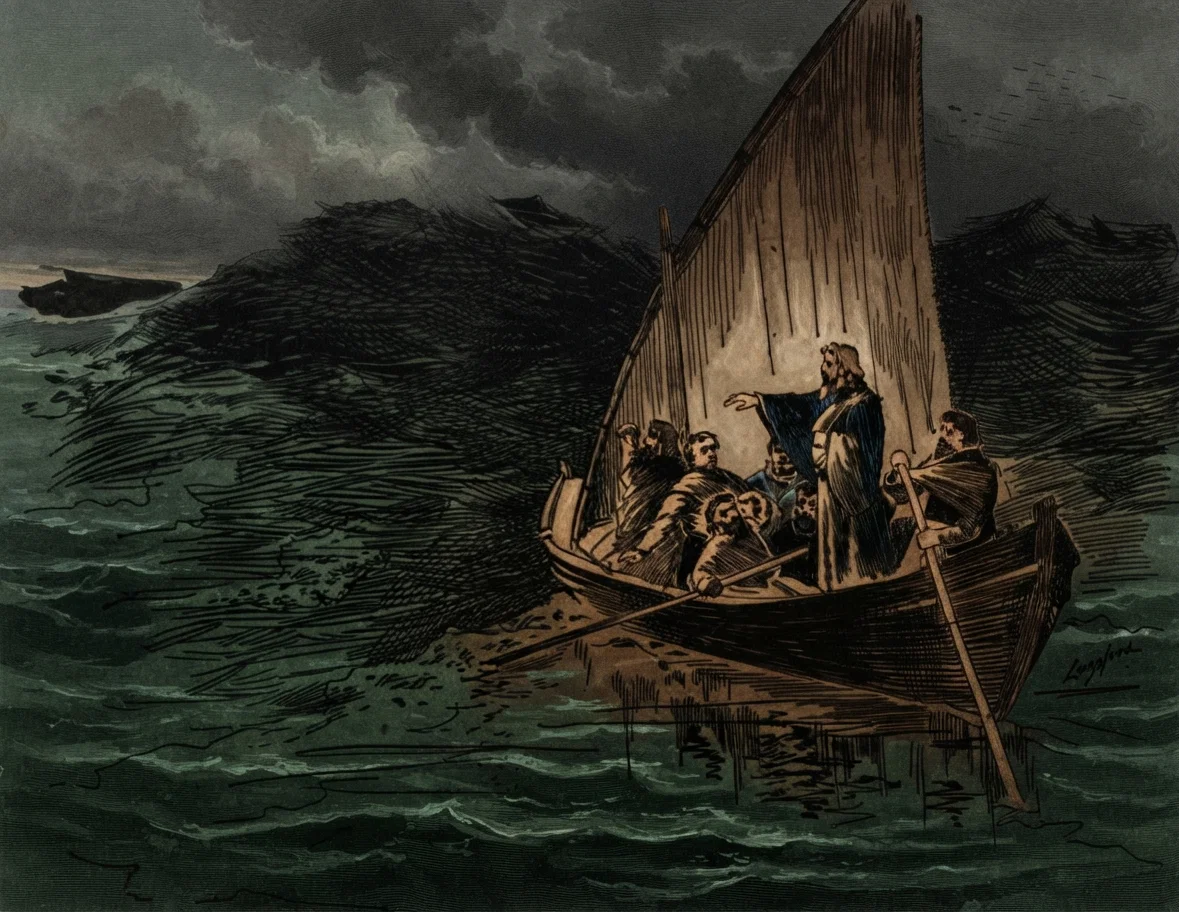
XII. HE MAKETH THE STORM A CALM.

AROUND the Sea of Galilee, occurred many of the most noted of Christ's miracles. The people of the northern part of Palestine were more ready to receive the Master; they were less bound by superstition and tradition. Here the great Teacher found a most fruitful soil, and here wonders and signs followed His teaching.
THE scene of our present miracle was "blue Galilee," so beautiful in its calmer days, so restless, turbulent, raging, when the fierce cyclonic winds of the superheated valley swept down upon its slumbering waters. It was after long hours of teaching the multitude, in which was included the parables of Matthew 13, that Jesus, weary with labor, suggested to His disciples to cross the little sea to the other side. (See Mark 4: 35-41, and also Matthew and Luke). Responsive to His wish they launch forth. Other boats accompany them. Jesus lies down in the stern of the boat, and is soon fast asleep.
THEN "the prince of the power of the air" thinks it possible to destroy the Saviour of men, and so destroy the race in destroying its Head. "And there ariseth a great storm of wind and the waves beat into the boat, insomuch that the boat was now filling." Danger was imminent and fearful. Men could not hope to live if the boat were wrecked or filled and sank. Row and bail as they will, they can not prevail against the storm demon. Their beloved Master seems to be oblivious of their peril, yet will they do all in their power before they disturb Him, calmly resting in the wild storm as tho He were sleeping in the arms of Infinite Peace, as He truly was. His life, His work, were God's; surely God could keep all that He had committed to Him. "Thou wilt keep him in perfect peace, whose mind is stayed on Thee; because He trusteth in Thee."
THERE seems to have been three calls from the disciples, utterances, perhaps from different ones, marking the progress of their fear and peril. First comes the almost reproachful cry to the wearied Sleeper, who seems so indifferent in sleeping in such a storm, "Teacher, carest Thou not that we perish?" As if to say, How can you sleep on when we are in such fearful danger.
WITH the hope that He might save them comes the second cry, "Save, Lord, we perish." It was acknowledgment that they had no power to battle with the fierce storm; their hope was in Him. But when He does not spring to their bidding at once, fear seems to have crept over them that all was lost; that the Master is Himself powerless to save, and the despairing cry is raised, "Master, Master, we perish. All is lost now."
AND then "He awoke, and rebuked the wind, and said unto the sea, Peace, be still. And the wind ceased, and there was a great calm. And He said unto them, Why are ye fearful?
have ye not yet faith? And they feared exceedingly, and said one to another, Who then is this, that even the wind and the sea obey Him?"
HERE is the lesson; will we profit thereby? There are storms of life which sweep over the human soul as fierce as any that ever beat down upon "blue Galilee." There are tempests of passion which stir up all the deeps of the human heart, till it seems that the soul must perish in their vortex. There are storms and tempests of hate, and lust, and passion, and lawlessness, and crime, which sweep over the world, over the nation, over the professed church of Christ, till it seems from the outward view that all is lost or overwhelmed, and the soul in anguish cries out as did Elijah, "Lord, . . . I am left alone, and they seek my life."
BUT let him who trusts God rest on His everlasting, strong promises. Our God is the Creator of heaven and earth. All power is His, He "ruleth in the kingdom of men." For a little while in His own wise purpose, He may suffer sin and its consequences, yet are they not forever. Every soul that trusts Him shall find deliverance. "He maketh the storm a calm, so that the waves thereof are still." Through tribulation and persecution and storm and tempest He will lead His people. If the storm be too fierce, call upon His name, and let Him say to the troubled heart, the heaving, surging passions, "Peace, be still." The same mighty power which the Christ of God exercised on Galilee He will use for you. He is "the same yesterday, and today, and forever."

UNION AND ECONOMY IN GOSPEL WORK.

THE strong tendency of the world is toward confederation. Its dependence is in numbers—unions, leagues, societies, parties, etc. When the world says, “In union there is strength,” it means in the union of great numbers.
In the Gospel work, however, the unit is the prime concern. God calls individuals to His work. He never appeals to society as such. Tho millions should hear the call at one time, the response must come from each one, if each one would receive the benefit.
In the Gospel work it is true that “in union there is strength;” but the primary union is not of weak human beings, it must be a union of the unit—the individual—with God. “God is our refuge and strength;” it is union with Him that gives strength to Christianity. A union of professed Christians without individual union with Christ is no stronger than the union of any other band of people possessing equal intelligence.
“Without Me ye can do nothing,” says the Master, and the saying has been demonstrated all through the ages. The ruins of human schemes, devised by “unions” and “boards” and “societies” and “conventions” without reference to the counsel of God and His strength, are strewn all along the way.
The apostle Peter gives us the secret of all Gospel work in these words: “Sanctify the Lord God in your hearts; and be ready always to give an answer to every man that asketh you a reason of the hope that is in you with meekness and fear.” 1 Peter 3:15. Here the Spirit contemplates the workers as individuals, and the lost ones to be rescued as individuals, and the union essential to the work a union of heart with the Lord God.
Such a union by sanctification of the Lord in the heart, He being “the light of the world,” makes the individual a light. This light, shining before men in the form of good works (Matt. 5:16), indicates that the individual has a future hope of reward. He is working for no reward as far as the world can see, but he is so happy and cheerful and tender in his ministrations, that it is evident he has a purpose in view beyond the sordid aims of the world.
The Light that so shines before the world in the good works of the true disciple must be the means of some individuals’ coming to inquire about it. And such a laborer together with God will be ready always to give a reason of his hope. Moreover he will not be boastful of his attainments or presumptuous with his reason of hope; but in a spirit of meekness he will freely give that which has been so freely imparted to him.
When Solomon came to the throne he sanctified the Lord God in his heart, and asked only wisdom commensurate with his great responsibility. And the result was that “all the earth sought to Solomon, to hear his wisdom, which God had put in his heart.” So instead of his sending missionaries to all the earth to carry the knowledge of God, the Spirit sent people from all the earth to him.
Furthermore, without his having to raise money and men to carry the truth abroad, the people who came from abroad to hear the truth brought means to Solomon. “They brought every man his present, vessels of silver, and vessels of gold, and garments, and armor, and spices, horses, and mules, a rate year by year.” They brought what in their time were the most valuable articles.
This is simply an illustration of what the Spirit of the Lord can do in the way of giving the Gospel message when his professed disciples adopt the first principles regarding plans for doing His work, the first principles of union in the work.
So much of the worry about raising means for missions, about securing efficient missionaries, and so much expenditure of time in going and coming, might be saved if we would all heed the Spirit’s injunction, “Sanctify the Lord God in your hearts; and be ready always to give an answer to every man that asketh you a reason of the hope that is in you with meekness and fear.” So much of the traveling and so much of expense would be borne by those whom the Spirit would stir up to seek the truth, if only there were those sanctified ones here and there holding up the light to which the lost one might be directed.
G.

A WARFARE OF ENVY.

GOD has commissioned neither human being nor angel to stand as an intermediary between Christ and His children. That price, the life of the Son of God and Son of Man, was not given that another might step in between Him and the object of His redemptive work.
Upon this very point of His right to retain what His blood purchased, our Lord declares: “For Mine own sake, even for Mine own sake, will I do it; for how should My name be polluted? and I will not give My glory to another.” Isa. 48:11. Christ achieved glory by His sacrifice for man. By the glorious work which He there accomplished, He won the right and the glorious position of Mediator between God and man. So we read: “And all things are of God, who hath reconciled us unto Himself by Jesus Christ, and hath given to us the ministry of reconciliation; to-wit, that God was in Christ, reconciling the world unto Himself.” 2 Cor. 5:18, 19.
Whatever other glory Christ may have achieved, whatever other position He may be now holding, He did achieve that glory of redeeming man and the earth that sin had cursed, and He does occupy that position of Mediator between God and man. That it is, then, that He will not relinquish to another. There is no power that can deprive Him of His well-earned bishopric. Of Judas it is said prophetically: “Let his habitation be desolate, and let no man dwell therein; and his bishopric let another take.” Acts 1:20; Ps. 109:8. Why?—Because his character was the very antithesis of righteousness. The reward he sought is called “the reward of iniquity.” Acts 1:18. How fitting that the betrayal price, the reward of his traitorous act, should be used for the purchase of a grave! On the other hand, the reward sought of Christ was an eternal habitation for every child of His.
“But of the Son He saith, Thy throne, O God, is forever and ever; and the scepter of righteousness is the scepter of Thy kingdom. Thou hast loved righteousness, and hated iniquity; therefore God, Thy God, hath anointed Thee with the oil of gladness above Thy fellows.” That preeminence of Christ always has stirred the animosity of Satan, even as did the Father’s council with Christ over the creation of man.
Therefore, how natural it is that the enemy of Christ and His cause, he who inspired Judas to his infamous act, should seek to wrest from Christ His office, His bishopric, His glory, in the estimation of mankind. Satan’s representative lost his office; therefore he will try to rob Christ of His, so far as the estimation of men is concerned. Christ’s position is between the Father and the people. He says: “Whatsoever ye shall ask of the Father in My name, He may give it you.” John 15:16. Again: “If ye shall ask anything of the Father, He will give it you in My name. Hitherto have ye asked nothing in My name.” John 16:23, 24. That is Christ’s own definition of His position; and nowhere in the sacred Word is any intimation given that any person or any being of any order whatsoever is ever to come between Him and those He redeemed.
What means, then, this human exaltation of the name of the Virgin Mary as an intercessor between human beings and the Christ that died to save them?—It means simply the outworking of Satan’s envy at the exaltation of Christ. Lucifer had conceived the mischievous purpose of being like the Most High. That purpose was his ruin; and so he has set himself in every possible way to war against the purpose of Jehovah. It is consistent with his plan, therefore, that he use the same great power in the earth in more than one line of opposition to Christ and His work. The same power that has instituted Mariolatry (the worship of the Virgin Mary), that has made Mary an intermediary between the people and their Saviour, putting her in the place of Christ, that same power it is that has thought “to change the times and the law” of God, as foretold by the prophet Daniel. Through that same power has come to us the pseudo-sabbath, usurping the place of the Eden-blest Sabbath of the Lord. Through that same powerful organization we have been given a doctrine which would rob Christ of His position as Lifegiver; that doctrine is the immortality of the soul. Through Christ only we have life; but that dogma would make life inherent in us, independent of Christ and His glorious work in our behalf.
So we might continue on to the end of the whole roster of false doctrines, and find them aimed at the position and glory of our blessed Redeemer; but His own word is sufficient: “My glory will I not give to another.” He is ours, and we are His; and to Him who is“touched with the feeling of our infirmities,” “tempted in all points like as we are,” we can come direct for forgiveness, blessing, and every temporal and spiritual necessity.
S.

WHERE IS THE RECORD OF THE CHANGE?

IN a recent sermon by the Rev. O. B. Chester, of Savannah, Ga., that gentleman is quoted as saying:
The seventh day was observed by the Jews in recognition of the creation, when the Lord rested on the last day. Sunday, the first day, is observed by us in recognition of the Resurrection of Christ. It was changed before the ascension of our Lord, by the disciples, and the change was indorsed by Christ.
The Jews were required to rest on the seventh day. It was a day of absolute inaction. There were no commandments to go to church or to do anything but cease from all forms of labor. But the day is not properly observed by inaction, but rather by holy action. It is right to be busy in doing good on the Sabbath day. Worship the Lord, visit the sick. You can best know yourselves the proper things to do on the Sabbath. They must be those things which will in no way interfere with the worship of the Lord.
We do not notice this because it contains anything new. It is an example of what is continually set before Christian people as Bible truth. It is, however, a mixture of truth with most perversive error.
It is true that the Jews observed the Sabbath in recognition of the creation; and so all should recognize it, because all are as much obligated to God for creation and its blessings as were the Jews. "Is God the God of Jews only? is He not the God of Gentiles also? Yea, of Gentiles also." Rom. 3:29. And so Jesus Himself declares that "the Sabbath was made for man," not the Jew man, but man generically—all mankind. Mark 2:27.
But where is there a single scintilla of evidence that any change of the Sabbath took place before the ascension? or that the disciples ever intimated such a thing? or that they ever at that time observed Sunday as a holy day? or that Christ indorsed any change of day? It is easy to state such things, but where is the evidence? Men's words compared with God's are as the chaff to the wheat. Jesus says: "Every plant, which My heavenly Father hath not planted, shall be rooted up." Matt. 15:13. Sunday is not of God's planting.
Not only was the Sabbath not a day of inaction, but it was a day when the general temple service was doubled, when the Jews went to the temple and the synagogue to worship, where the Scriptures were read. See Num. 28:9-11; Luke 4:16, 17; Acts 15:21; Ps. 96:8. See the whole of Psalm 92, "a Song for the Sabbath Day." Jesus also, the Lord of the Sabbath, taught how the Sabbath should be observed in doing good, and taught that it was not contrary to the Sabbath commandment so to do: "It is lawful [according to law] to do good on the Sabbath day." Matt. 12:12.
O brethren in the ministry, why not teach the Word? even tho the good of past ages have supposed a counterfeit genuine, why still pass it as the currency of Heaven? An error never becomes truth. Do you not see that you make of none effect all of God's law in the minds of the people by declaring it in part of no obligation? How much has this partiality in the law to do with the overwhelming wave of lawlessness? You can not force God to your terms; why not come to His?

NOT SECRECY, BUT REVELATION.

JESUS CHRIST had no secrets. "In secret have I said nothing," was His emphatic declaration. He was Himself a revelation of God to man as far as the finite is capable of comprehending the infinite. It is sin and not secrecy that keeps men from knowing God. Before man sinned, God appeared to him, and talked with him as a friend and acquaintance. He does not do so now, not because of His desire to be hidden from man, but because of His mercy. No sinner could look upon God and live. Redemption completed will restore man to his former privileged condition. "Blessed are the pure in heart; for they shall see God."
As a rule, secrecy is the antithesis of honesty, and a society whose workings are known only to its members is not for the good of other people. Therefore a secret society can not be Christian; for God's society, the church, is organized for the special purpose of doing good to others. Any so-called church that has not this object primarily in view is not a church of Christ.
God hides only that which would be hurtful under the circumstances. "I have yet many things to say unto you, but ye can not bear them now," said Jesus to His disciples. But these things were to be revealed unto them through the Word, by the Spirit. And so it is that many things are revealed in the Word of Christ that are hidden to those who do not believe, or will not search out. "The Lord God is a sun and shield; the Lord will give grace and glory; no good thing will He withhold from them that walk uprightly."
With regard to the coming of the Lord, the great deceiver does, and will, delude many with the idea that He comes in secret; that He comes when people die; or that He appears to a few in secret places. So He gives His disciples warning, and through them this warning is to go to the world: "Wherefore if they shall say unto you, Behold, He is in the desert; go not forth; behold, He is in the secret chambers; believe it not. For as the lightning cometh out of the east, and shineth even unto the west; so shall also the coming of the Son of Man be."
Jesus Christ is "the Light of the world," and He does not hide His light under a cover; nor are his disciples supposed to do so. Imparting to them His light, He says: "Ye are the light of the world. A city that is set on a hill can not be hid. Neither do men light a candle, and put it under a bushel, but on a candlestick; and it giveth light unto all that are in the house. Let your light so shine before men [not the inner circle], that they may see your good works, and glorify [not the society, but] your Father which is in heaven."
When Christ came into the world, He found it all lying in wickedness (1 John 5:19), and, in order to relieve this sad condition, He organized the church, and gave its members His Word for their guidance, to be interpreted by His Spirit. He gave no intimation of any other organization, to be governed by any other ritual. He said to His church, "Lo, I am with you alway, even unto the end of the world." Of His Word He says that it is able to make us "wise unto salvation," and to thoroughly furnish us "unto all good works." So that the works done under the teaching of any other ritual are not good works. He has established but the one way of bringing men "out of darkness into His marvelous light." And that way is open and above board. It is all in the light. Christ is the way, and "in Him is no darkness at all."
G.

Question Corner

1688.—Tobacco.

When, where, and by whom was tobacco first used, and in what forms, snuff, chewing, or smoking? A READER.
So far as we know, by the Indians of North America. When first seen using it, it was said that they twisted huge leaves together and lighted them and "smoked like devils." They may have used it in other ways. It began to be used in Europe in the sixteenth century. The vile weed is the evil gift of America to the world.

1689.—David Their King.

Please explain Hosea 3:5: "Afterward shall the children of Israel return, and seek the Lord their God, and David their king." How does David get to be king in the later days, as referred to in the text?
In Christ Jesus, great David's greater Son. "The Lord God shall give unto Him the throne of His Father David." Luke 1:32. Jesus is elsewhere called David in prophecy.

1690.—Order in Lord's House.

Will it be in order at the Lord's Supper for the elder of the church to give the bread and the wine to a brother that is not ordained as a deacon to divide it out to the church?
We should prefer in the interests of order to use only ordained officers. If there are no deacons, let the elder pass the bread and wine himself.

1691.—The Holy Spirit and Ministering Spirits.

What is the difference between the Holy Spirit and the ministering spirits (angels), or are they the same.
The Holy Spirit is the mighty energy of the Godhead, the life and power of God flowing out from Him to all parts of the universe, and thus making living connection between His throne and all creation. As is expressed by another: "The Holy Spirit is the breath of spiritual life in the soul. The impartation of the Spirit is the impartation of the life of Christ." It thus makes Christ everywhere present. To use a crude illustration, just as a telephone carries the voice of a man, and so makes that voice present miles away, so the Holy Spirit carries with it all the potency of Christ in making Him everywhere present with all His power, and revealing Him to those in harmony with His law. Thus the Spirit is personified in Christ and God, but never revealed as a separate person. Never are we told to pray to the Spirit; but to God for the Spirit. Never do we find in the Scriptures prayers to the Spirit, but for the Spirit.
The Spirit is the creative power of God by which angels and all other creatures came into existence. God fills them with His Spirit, His life, and makes them ministers of His life and power to others, especially to His people. He takes His consecrated people and makes them also ministers of His blessings to mankind. The angels are no more the Spirit of God than are His people.
God is love. He is constantly by His Spirit sending forth the blessings of life. But He will not send one blessing out to the world alone; He wants others associated with Him in the joy of giving to others. Hence He uses angels and men for all His work in this world.
Continue reading: FRANCE AND THE PAPACY