Papal Supremacy to Be Restored — Turkish Power to Be Extinguished
TWO things, above all others, are going to be clear when this terrible war is over. First, at bottom, this war is a struggle over the Eastern question. It started for the control of Constantinople and the Near East. That was the crux of the whole conflict. You may say it is a struggle between England and Germany; and it is. You may say it is a struggle between Russia and Germany; and it is. But at bottom, the whole storm wages and centers around the possession of the Near East. It was over that thing that Austria was determined to wipe Servia off the map, so that she and Germany could force their way farther to the south and east, down to Saloniki; and that is why the great drive was made a few months ago by the Teutonic forces which did wipe Servia and Montenegro off the map. But when those two tremendous drives were done, it was only to find that the allied powers had gone in and established themselves 400,000 strong in that same Saloniki.
Why was that? Have you noticed that all through this war, but few if any really decisive victories have been won? All the way along, it has been first one side gaining, and then the other. When the war started, the central empires had a cry that in three weeks they would be in Paris. Two long years have almost rolled away, and they are not in Paris yet. When they were within twenty-five miles of Paris, something happened. The government of Paris had fled from its capital, and the people were leaving the city in large numbers, when, as if an angel of God waved his hand over that advancing host, they were turned back, and driven to the line of the Aisne. Now the entente allies are making tremendous drives. What does it mean? — This,— that "the days of visitation are come, the days of recompense are come." Hosea 9:7. God is punishing every one of those sinful nations.
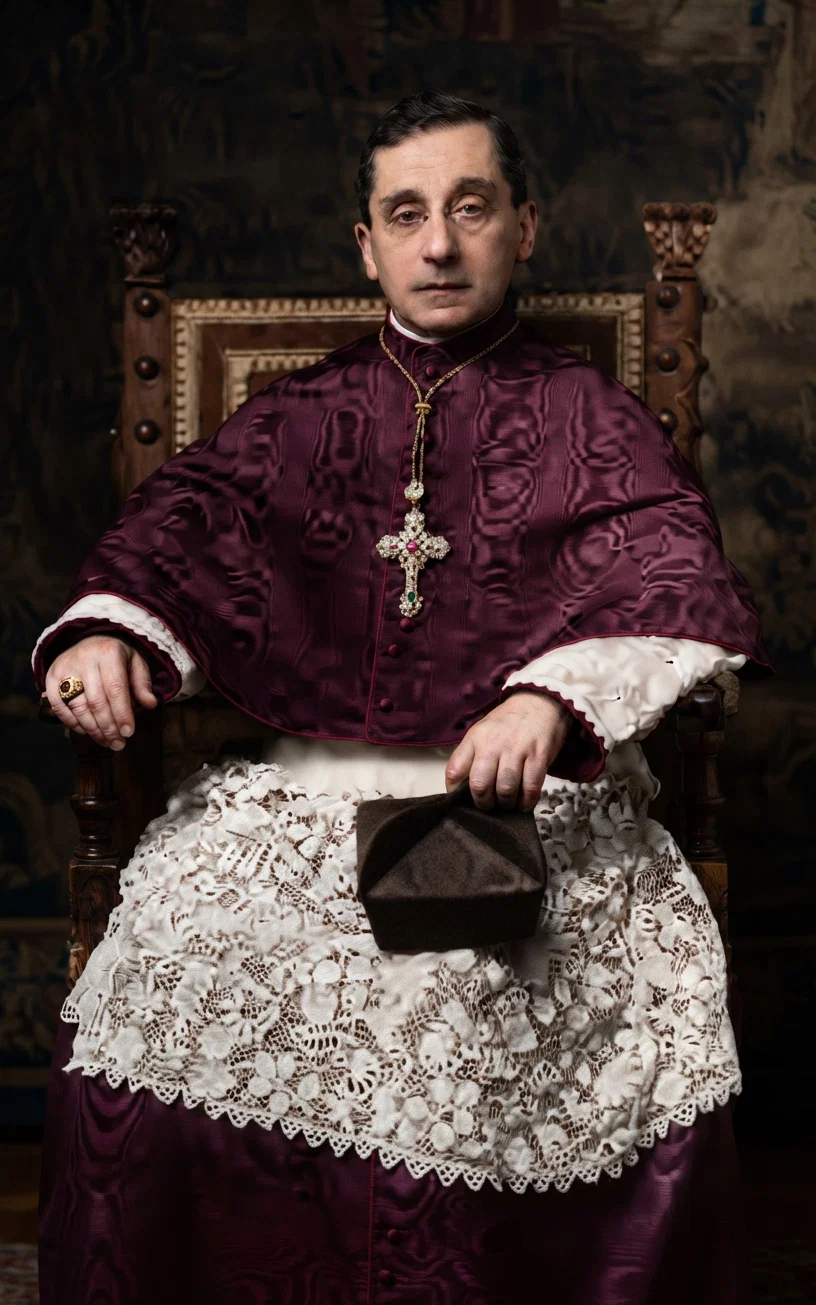
BENEDICT XV, THE DIPLOMAT
Committing Political Suicide
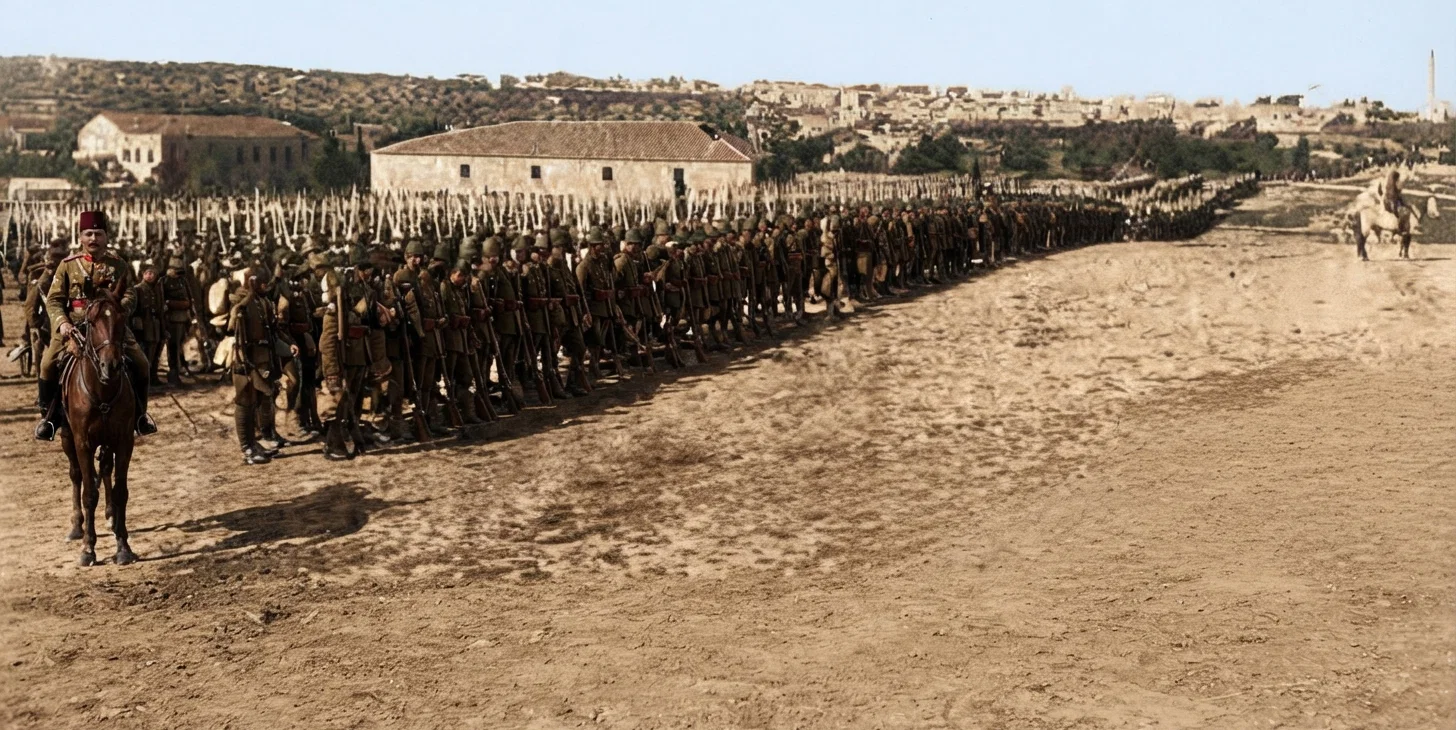
At the beginning of the war, England notified Turkey to stay out, and used the expression, "For you to enter into the struggle will be for you to commit political suicide." But in the closing days of October or the fore part of November, 1914, she entered the war on the side of the central empires.
In the month of November, 1914, on the occasion of the lord mayor's banquet in the city of London, Premier Herbert Asquith, of England, delivered a most notable speech. The lord mayor's banquet in England is one of those occasions when the prime minister of the country is supposed to take the people into his confidence, and tell them the real things the government has in its mind. On that day, at that banquet, at which were present all the ambassadors of the leading powers, all the great generals — Sir Douglas Hague, Earl Kitchener, General Joffre, and others — Asquith, in making his speech, used words something like this:
"The allied nations can never forget the base ingratitude of the Ottoman empire. France and England over and over again have stood by the Ottoman power and kept it from being destroyed. And now, in our time of need, when we are fighting a battle for our very existence, this perfidious power has unsheathed his sword upon the side of our enemies. The allied nations have sworn that we will never sheathe the sword, but will flesh it and flesh it and flesh it again and again and again, not only until the Turk is driven from Europe, but until he is extinguished as an Asiatic power."
Extinguished as an Asiatic Power
LET us get the full force and meaning of those words. Over two thousand years ago, Daniel, himself a prophet and a prime minister, said of the Turk under the name of "king of the north," "He shall come to his end, and none shall help him." Dan. 11:45. Many a statesman, from that time on, has said that the Turk must be driven from Europe. Lord Palmerston said it, Lord John Russell said it, the earl of Beaconsfield said it, Gladstone said it, Bismarck said it, and other men have said it; but Herbert Asquith was the first one of all the statesmen since the day when Daniel, the prime minister of Medo-Persia, made the prophecy, to say, We will not be contented with simply driving the Turk from Europe, but we will flesh and flesh and flesh our sword again and again and again, and never rest until that perfidious power is extinguished as an Asiatic power.
What does that mean? — It means that the mightiest aggregation of power in all the world has set its hand to this, — We will never rest until we have brought the Turkish power to an end. Over and over and over again have statesmen said, "The Turk must go from Europe;" but never until Herbert Asquith spoke has any word been uttered by any statesman to the effect that the time had come when the Turk must be not only driven from Europe, but extinguished as an Asiatic power.
What says the Scripture? —"At that time shall Michael stand up, the great Prince which standeth for the children of thy people: and there shall be a time of trouble, such as never was since there was a nation even to that same time: and at that time thy people shall be delivered, every one that shall be found written in the book. And many of them that sleep in the dust of the earth shall awake, some to everlasting life, and some to shame and everlasting contempt." Dan. 12:1, 2.
Two great things are to come out of this war. Whatever happens, you will see that this war will put the Turkish power on the road to extinction. We do not mean to say that this war itself will spell the ultimate extinction, but we do mean that it will put him on the highroad to that thing, as never before. But, you say, supposing the allies do not win? — If they do not, it makes no difference; because remember that Germany is not helping the Turk, but Germany made the Turk help Germany. It makes no difference which way this thing goes. The German powers on one side, and the allied powers on the other, are both fighting for the same goal. One may seek to accomplish it one way, the other another way; but they both have that same thing in their heads, — the control of the Near East. Germany knows if she can control that, she has struck a vital blow against the power and prestige of the British Empire. The Triple Entente, or the quadruple entente, as it is now, feels that the hour has struck for Russia to possess herself of that territory, so that their power may be more firmly intrenched in the East.505
The other thing to come out of this war is mightier than the destruction of the Turk. It is a thing which, in a way, means far more to us than the destruction of the Turk. It is the placing of the Church of Rome well on the road to the pinnacle of power. And when the war is settled, more than likely the papacy will settle it.
We have not time to go into that in detail, to substantiate this statement, but only to give you this little line of thought: Beginning with the time of Napoleon Bonaparte, when Berthier took the pope prisoner in 1798, down to 1870, when Victor Emmanuel took away the last of the papal states, the papacy was losing prestige; and to some extent, it has been losing it ever since.
TURKISH TROOPS "At the beginning of the war, England notified Turkey to stay out."
Papal Prophecies
DURING the years of 1864, 5, 6, 7, 8, and 1872, 4, and 5, the Church of Rome uttered some prophecies, the most marvelous prophecies that have ever been uttered outside of the Bible. Pope Pius IX prophesied, Cardinal Manning prophesied, the archbishop of Florence prophesied, and other prominent churchmen prophesied. Of all these prophecies, those by Cardinal Manning are the clearest and plainest, and in substance they are this:
That the world had wandered away from the true fold of the so-called church of Christ; that the kings of the earth had departed from the teachings of the papacy in regard to civil government; that the pope, the vicar of Christ, was no longer regarded as supreme above all the rulers of the earth; and because of the new doctrine that governments derive their just powers from the consent of the governed, the world had gone astray, and had left the Bible doctrine of civil government and religion.
"And," said Manning, "because of this vast apostasy in Germany, in France, in England, and elsewhere, there is only one thing that can come, and that one thing will come. There will come a mighty war, the mightiest war the world has ever seen; and it will come as a judgment from God because the world has wandered away from the Church of Rome. And when that war comes, kings and their crowns will go down in the ruin and the wreck; and when it is all over, there will be just one institution and power above them all as the only savior of mankind on earth, and that institution will be the Church of Rome, with the vicar of Christ at her head. In that day, she will be the mistress of the field; and kings and princes and potentates, and the nations of the earth, will come on bended knee, seeking at her hand the laws of tranquil repose." That is the gist of those prophecies.
And when this war came, Rome said: "This is the war we have been prophesying about. This is God's judgment because the world has gone away from the teachings of the only true church of Jesus Christ."
Chose a Diplomat
WHEN the war broke out, there sat on the throne in Rome a man who was probably the best pope who ever lived, Pope Pius X. He was a peasant, a monk, a very simple-hearted man, a man whom the Jesuits detested, a man who cared nothing for pontifical splendor, nothing to be numbered amongst the great of earth; but his whole thought seemed to be, to do good to men. In the opening days of the war, Pope Pius X died of a broken heart, because he could not bear the thought of the bloodshed and trouble and frightfulness that had come upon the earth. At least, it is said by many that that was the cause of his death. On the other hand, there are many Catholics in Europe who will tell you that he did not die, but that he was put out of the way. Be that as it may, immediately the conclave of cardinals met to elect his successor. They said something like this: We do not need a pious priest, we do not need a great theologian, we do not need a great financial administrator; but we do need a diplomat, a man who will use this war to put Rome back where she belongs; and so we will choose Guiacomo della Chiesa.
Guiacomo della Chiesa took the papal throne and the name of Benedict XV. He is an aristocrat. He was educated in a university, took his degree in law, and then took his degree as a priest of the holy orders of the church. He was picked up soon after this by Cardinal Rampolla, who was one of the favorites of Pope Leo. Rampolla was sent by Leo XIII to Madrid as the papal ambassador to that court, and he took this young man Guiacomo della Chiesa with him as his private secretary. There Della Chiesa became schooled in the arts of diplomacy and statecraft, and all that goes with them.
After a while, Cardinal Rampolla was recalled to Rome. After he got there, he was made secretary of state, and then this man Della Chiesa was made assistant secretary of state, for the papacy. So all his work and all his life and all his training has been along the ways of diplomacy and statecraft.
When Pope Pius X came to the throne, he did not want Della Chiesa around, so the young man went off and took work elsewhere. But when the conclave met, they chose him to be pope, under the title of Benedict XV. When he went in on the platform, he was told that he was elected to put the papacy back into power, or — to use the words of Scripture — to "heal" the "deadly wound." (Rev. 13:1-3.) Read those prophecies of Cardinal Manning regarding this war, and how Rome believed she would come into her own again. At the same time, read the seventeenth chapter of Revelation, and you will be deeply impressed that the papal prophecies are almost word for word what is written in that chapter of Saint John the divine. The parallel is remarkable.
Now, when Della Chiesa came to the throne, he issued a papal bull. That expression "bull" comes from the Latin word which means a seal; because the most authoritative documents that Rome issues are sealed with the seal of the fisherman Saint Peter.
In this encyclical, Benedict charges that this present war has come about because there has been a divorcing of the teaching of the gospel and the teaching of the true church from the ruling of countries and the education of the young. Then he goes on to say that God has called him to the papal throne to settle this war. We do not know how the war will be settled; but certain it is that from the time he took the throne, Guiacomo della Chiesa, Benedict XV, has never ceased to impress upon the world, by voice and pen, that he is the one to settle this struggle, and that when he does settle it, the world must acknowledge him and his church again. What is that but the "healing" of the "deadly wound"?
We do not know that Rome will get it all in one step. We do not know just what the unrollings of the scroll will be; but we should see that that is the biggest thing wrapped up in this war. Both the question of Turkey and the question of the healing of the deadly wound are in it. That means that the trials of this people are going to begin the very day this war is over; and while this war means sorrow and trouble to us now, it is going to mean such infinitely more when the war is over.
Peace, Prophecy, and the City of Refuge
Do not say "Peace, peace," when there is no peace, but hold aloft the light of the blessed Bible, so that men may know its prophecies, and see that "city of refuge" whose bulwarks are laid by the all-powerful hand of Omnipotence, whose foundations are sure to all eternity, whose inhabitants shall never know sickness, or sorrow, or trouble, or distress.
Obedience Tests Discipleship
"OBEDIENCE is the test of discipleship. It is the keeping of the commandments that proves the sincerity of our professions of love. When the doctrine we accept kills sin in the heart, purifies the soul from defilement, bears fruit unto holiness, we may know that it is the truth of God. . . . 'Hereby we do know that we know Him, if we keep His commandments.'"
Where
By William A. Spicer
SUGAR
Is King
*Fishing for Souls in Thriving Cuba—For a Readier
and Quicker Evangelization*
By WILLIAM A. SPICER
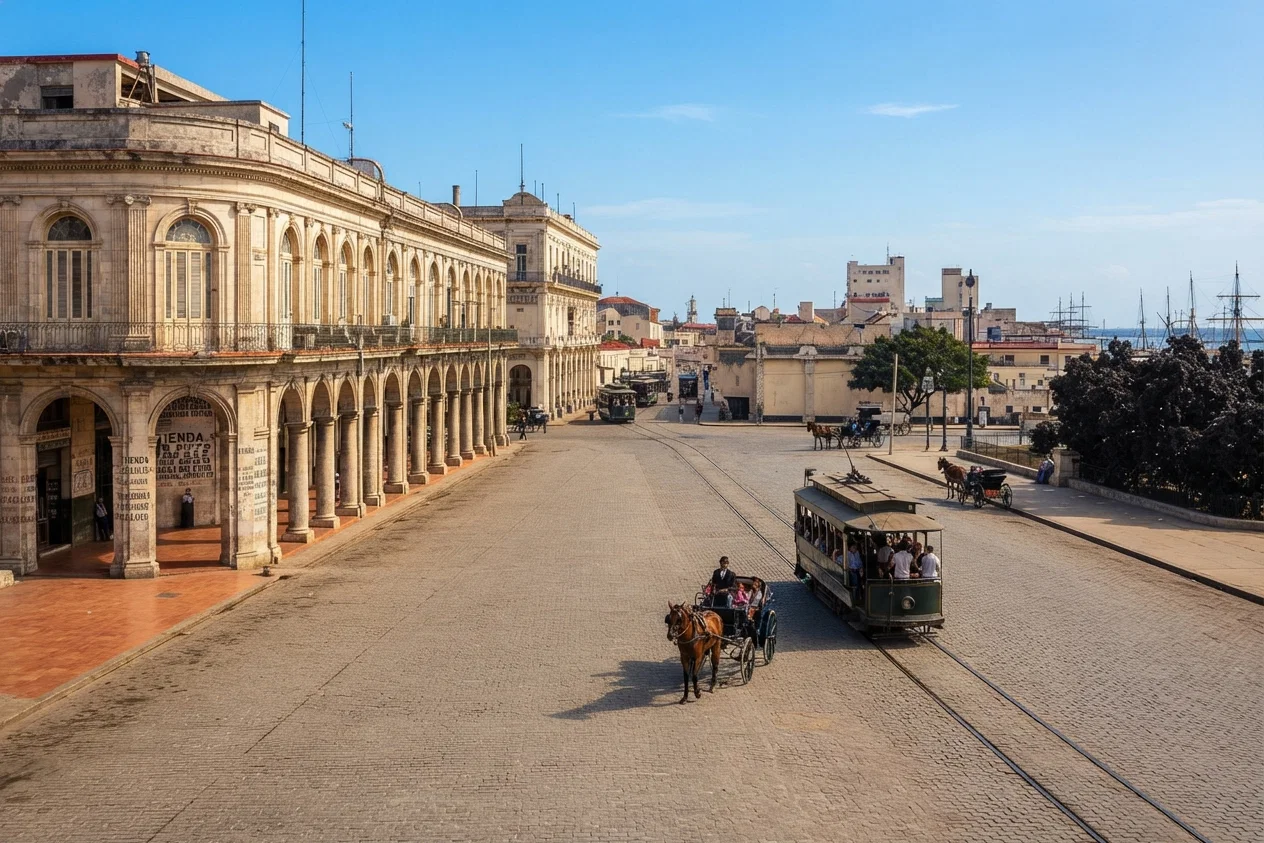
HAVANA, CUBA. Nearly as large as San Francisco, and as fine a city as any in the World
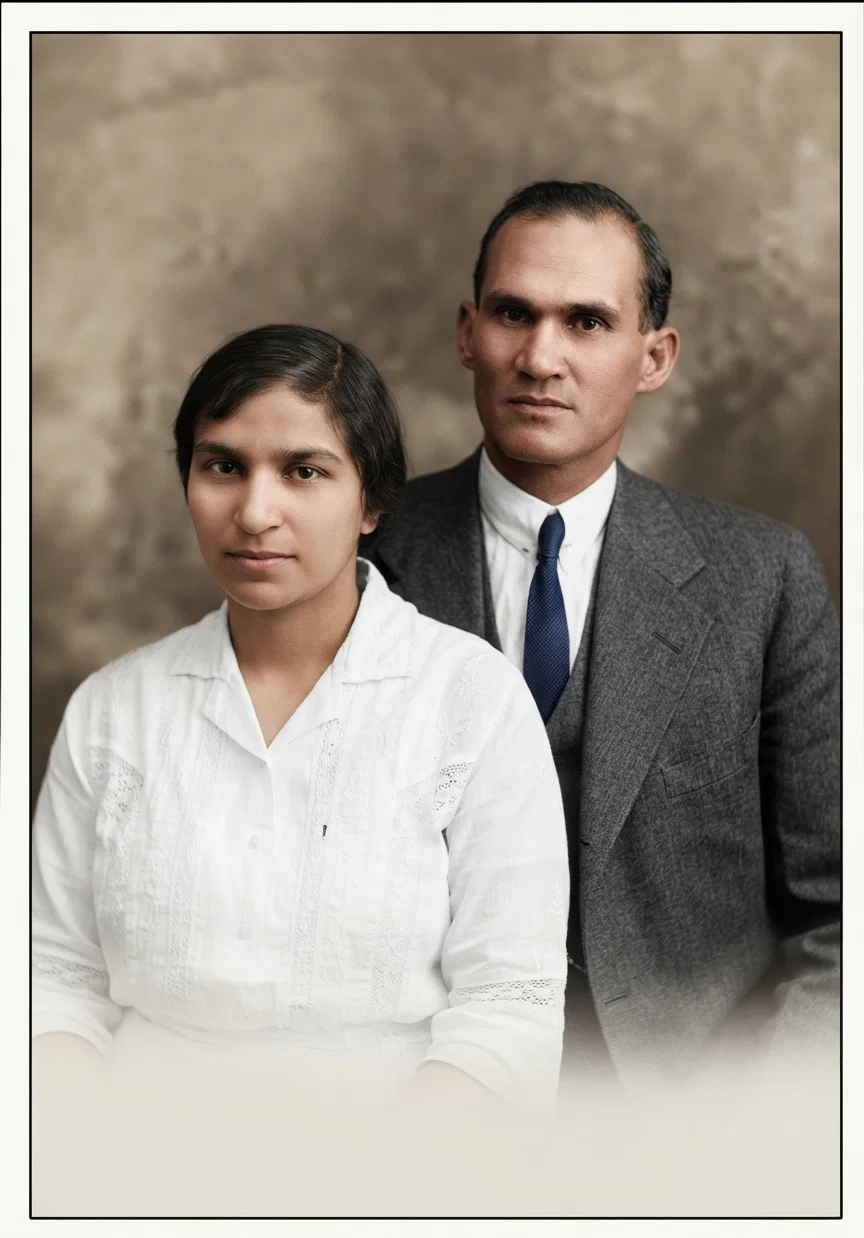
MR. AND MRS. E. WILLIAMS Who are sent on to Honduras by the Cuban Mission
JUST now Cuba seems the liveliest island country in the
West Indies. "Sugar is king" in Cuba. And in war time,
the demand for cane sugar has filled the little republic
with activity. The mills run day and night grinding out the
cane juice.
In normal times — regardless of the war — Cuba claims the
largest trade per capita of any country in North or South
America.
This visit to our missions in Cuba was my first one. Thirteen
years ago, I passed through the island, but then we had no
mission work there. Now I am meeting workers and believers
in all parts, though our work here is but just beginning. In
other ways, the field is changed.
Thirteen years ago, there was no way to Cuba from the
islands southward save by schooner — nearly three days' wear-
ing trip it was from Jamaica to Santiago. Now we make it
in comfort in eight hours, by the United Fruit Company's serv-
ice. Then it was three days' trip by rail from Santiago to
Havana, the train running only by day. Now the express
puts one through in twenty-four hours. These things are but
items in Cuba's development in many ways, all making for
readier and quicker evangelization.
They Make People Think
THE thing that impressed me most in our own little work was
the sturdy band of young people who are anxious to do some-
thing to carry the gospel message through Cuba. The pro-
portion of young people gathered out, in our work in Cuba, is
large. It explains the earnest pleas our missionaries in Cuba
have made to us for school facilities, which to train these
youth into evangelistic service.
Cuba has proved a good field for the colporteur. Thousands
of copies of our larger Spanish books have been sent there by
the Pacific Press Publishing Association. Colporteur Roman
told us, at our workers' meeting in San Marcos, that he had
sold a copy of a health book,
Salud y Hogar ("Home and
Health"), to a man who later
told him he threw it into his
trunk, saying, "There is three
dollars thrown away." The
man became sick, and started
for the Canary Islands to se-
cure a change. On the way,
he read the book that was in
his trunk, and found that the
way he was living was what
made him sick. He reformed
his manner of life, and his ail-
ments disappeared. Now, re-
turned to Cuba, he tells all his
friends of what the book did
for him. "I want every Span-
ish book," he says, "printed
by the Pacific Press."
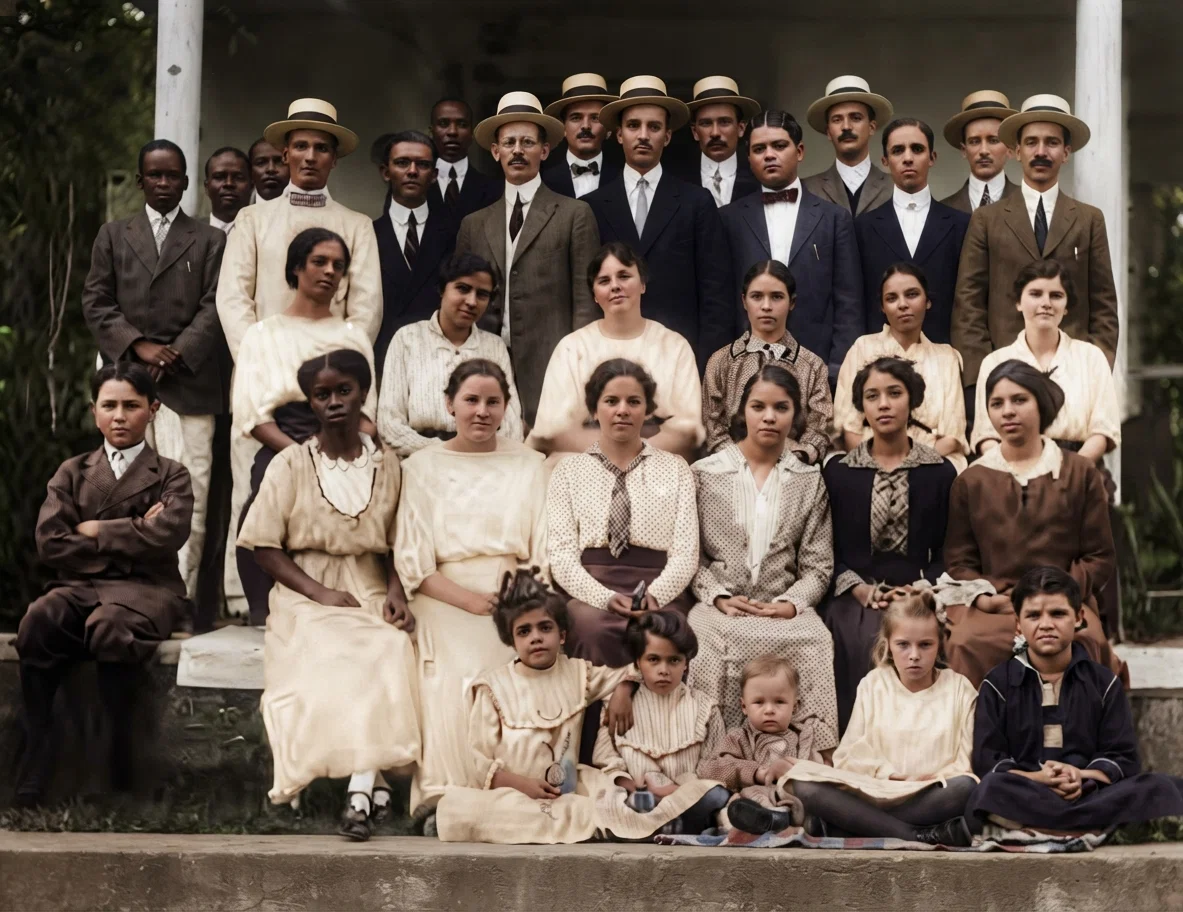
YOUNG PEOPLE AT A CUBAN WORKERS' MEETING AND INSTITUTE
So the books of all kinds are
making people in Cuba think.
One man saw the book "Com-
ing King" in Spanish translation. "Is that book published by
the Seventh-day Adventists?" he asked. "Then bring me one,"
he continued. "I knew their books in the United States, and I
want anything they print." It is the message in the books,
the word of fulfilling prophecy in this generation, that makes
the appeal to minds. Thus the message wins its way.
The conference on house-to-house Bible work was an interest-
ing one, in this Cuban workers' meeting. One young lady, last
year a student in the training school, told of experiences in
Catholic homes. She is herself just out of Catholicism. But
with the word of God in hand and heart, she is able to bring the
message of life to those who will receive it.
"One lady," she said, "gave up praying to her images. She
burned them all. But then she did not know how to pray. Al-
ways she had repeated her prayers before these images. So
she began to say, at night, 'With God I go to rest.' And in the
morning she would say, 'With God I rise to work.' So she
prayed until, in the studies, she learned about praying direct
to the Lord in heaven."
It is good, is it not, to think of souls coming out from the
mists of ceremonialism into the sunlight of the Saviour's grace,
to find that no mediator stands between Christ and the sinner?
Blessed the ears that hear His voice saying, "Come unto Me."
Again, Sister Aneita told us of a lady of culture who had
heard, in the readings, that the papacy, represented by the
"little horn" of Daniel 7, was to "think" to change the time and
laws of the Most High. Dan. 7:25.
"Which commandment has the church tried to change?" the
lady asked.
"The fourth," was the reply. "The fourth commandment
says the seventh day is the Sabbath of the Lord; but the
church enjoins Sunday, the first day."
"But Sunday is the seventh day, is it not?"
"No."
Then the Bible was studied on the point. Still the lady was
mystified.
"Well, we will go to the dictionary," said the Bible worker.
The Spanish dictionary was brought out; and there, sure
enough, Sunday was defined as the first day, and Saturday as
the seventh.
"The lady opened her mouth in astonishment," said Sister
Aneita, "and could say noth-
ing for a moment."
Then she said, with convic-
tion: "Now I see why our
church has all its service in
Latin. It is so we people will
not find out what the church
has done."
The Bible Lets in Light
THERE are many reasons that
might be given, as to why the
Church of Rome conducts so
much of its service in an un-
known tongue; but one thing
is sure,— in these Catholic
countries, the Scriptures,
translated into the common
speech, are letting in the light.
One of our experienced
Bible workers, Sister Burgos,
told us how she often gains
access to the people. Calling
on the lady of the house, she says: "I have a very important
question to ask you. Have you a copy of this Book in your
home?" showing a copy of the Bible. Thus in many homes, she
secures an opening to talk about the word of God and to study
it. It is truly fishing for souls, as the Saviour said — this
house-to-house work in Catholic cities and countries.
The
By Ellen G. White
Overflowing
Supply
"Use the means, the time, the ability, you have.
Bring your barley loaves to Jesus."
By the late
MRS. E. G. WHITE
A LL day, the people had thronged the steps of Christ and His disciples as He taught beside the sea. They had listened to His gracious words, so simple and so plain that they were as the balm of Gilead to their souls. The healing of His divine hand had brought health to the sick, and life to the dying. The day had seemed to them like heaven on earth, and they were unconscious of how long it had been since they had eaten anything.
The sun was sinking in the west, and yet the people lingered. Finally the disciples came to Christ, urging that for their own sake the multitude should be sent away. Many had come from far, and had eaten nothing since morning. In the surrounding towns and villages, they might be able to obtain food. But Jesus said, "Give ye them to eat." Matt. 14: 16. Then, turning to Philip, He questioned, "Whence shall we buy bread, that these may eat?" John 6: 5.
Philip looked over the sea of heads, and thought how impossible it would be to provide food for so great a company. He answered that two hundred pennyworth of bread would not be enough to divide among them, so that each might have a little.
The Daily Fare of the Fisher Folk
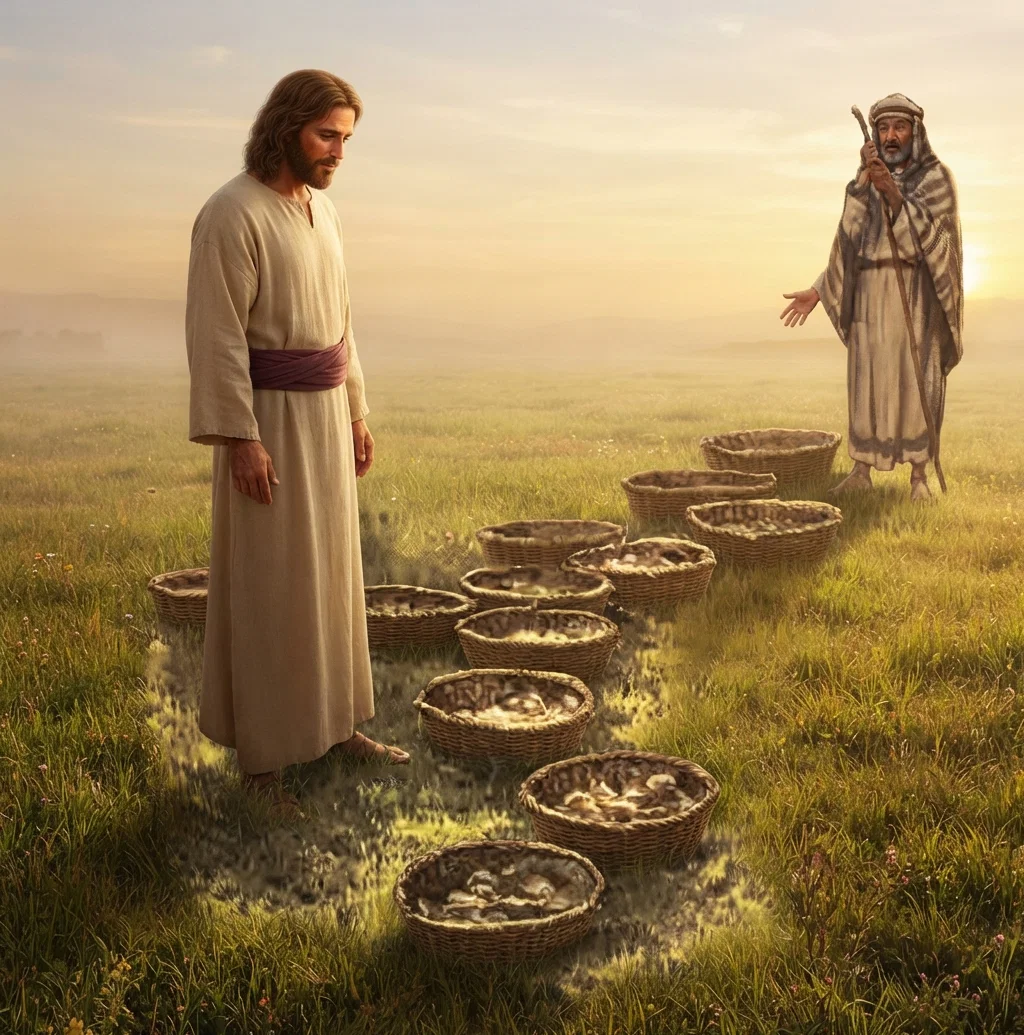
JESUS inquired how much food could be found among the company. "There is a lad here," said Andrew, "which hath five barley loaves, and two small fishes: but what are they among so many?" Verse 9. Jesus directed that these be brought to Him. Then He bade the disciples seat the people on the grass. When this was accomplished, He took the food, "and looking up to heaven, He blessed, and brake, and gave the loaves to His disciples, and the disciples to the multitude. And they did all eat, and were filled: and they took up of the fragments that remained twelve baskets full." Matt. 14: 19, 20.
It was by a miracle of divine power that Christ fed the multitude; yet how humble was the fare provided,—only the fishes and barley loaves that were the daily fare of the fisher folk of Galilee!
Christ could have spread for the people a rich repast, but food prepared merely for the gratification of appetite would have conveyed no lesson for their good. Through this miracle, Christ desired to teach a lesson of simplicity. If men to-day were simple in their habits, living in harmony with nature's laws, as did Adam and Eve in the beginning, there would be an abundant supply for the needs of the human family. But selfishness and the indulgence of appetite have brought sin and misery, from excess on the one hand, and from want on the other.
Jesus did not seek to attract the people to Him by gratifying the desire for luxury. To that great throng, weary and hungry after the long, exciting day, the simple fare was an assurance both of His power and of His tender care for them in the common needs of life. The Saviour has not promised His followers the luxuries of the world. Their lot may be shut in by poverty. But His word is pledged that their need shall be supplied, and He has promised that which is better than earthly good,—the abiding comfort of His own presence.
After the multitude had been fed, there was an abundance of food left. Jesus bade His disciples, "Gather up the fragments that remain, that nothing be lost." John 6: 12. These words meant more than putting the food into baskets. The lesson was twofold. Nothing is to be wasted. We are to let slip no temporal advantage. We should neglect nothing that would serve to benefit a human being. Let everything be gathered up that will relieve the necessities of earth's hungry ones. With the same carefulness are we to treasure the bread from heaven to satisfy the needs of the soul. By every word of God we are to live. Nothing that God has spoken is to be lost. Not one word that concerns our eternal salvation are we to neglect. Not one word is to fall useless to the ground.
The miracle of the loaves teaches dependence upon God. When Christ fed the five thousand, the food was not nigh at hand. Apparently He had no means at His command. There He was, with five thousand men, besides women and children, in the wilderness. He had not invited the multitude to follow Him thither. Eager to be in His presence, they had come without invitation or command; but He knew that after listening all day to His instruction, they were hungry and faint. They were far from home, and the night was at hand. Many of them were without means to purchase food. He who for their sake had fasted forty days in the wilderness, would not suffer them to return fasting to their homes.
Help for Every Emergency
THE providence of God had placed Jesus where He was; and He depended on His heavenly Father for means to relieve the necessity. When we are brought into strait places, we are to depend on God. In every emergency, we are to seek help from Him who has infinite resources at His command.
In this miracle, Christ received from the Father; He imparted to the disciples, the disciples to the people, and the people to one another. So all who are united to Christ will receive from Him the bread of life, and impart it to others. His disciples are the appointed means of communication between Christ and the people.
When the disciples heard the Saviour's direction, "Give ye them to eat," all the difficulties arose in their minds. They questioned, "Shall we go into the villages to buy food?" But what said Christ? —"Give ye them to eat." The disciples brought to Jesus all they had; but He did not invite them to eat. He bade them serve the people. The food multiplied in His hands; and the hands of the disciples, reaching out to Christ, were never unfilled. The little store was sufficient for all. When the multitude had been fed, the disciples ate with Jesus of the precious, heaven-supplied food.
Bring Your Barley Loaves
As we see the necessities of the poor, the ignorant, the afflicted, how often our hearts sink! We question: "What avail our feeble strength and slender resources to supply this terrible necessity? Shall we not wait for some one of greater ability to direct the work, or for some organization to undertake it?" Christ says, "Give ye them to eat." Use the means, the time, the ability, you have. Bring your barley loaves to Jesus.
Though your resources may not be sufficient to feed thousands, they may suffice to feed one. In the hand of Christ, they may feed many. Like the disciples, give what you have. Christ will multiply the gift. He will reward honest, simple reliance upon Him. That which seemed but a meager supply will prove to be a rich feast.
"He that soweth sparingly shall reap also sparingly; and he that soweth with blessings shall reap also with blessings. . . . God is able to make all grace abound unto you; that ye, having always all sufficiency in everything, may abound unto every good work: as it is written,
"He hath scattered abroad, He hath given to the poor;
His righteousness abideth forever.
"And He that supplieth seed to the sower and bread for food, shall supply and multiply your seed for sowing, and increase the fruits of your righteousness: ye being enriched in everything unto all liberality." 2 Cor. 9: 6-11, A. R. V., margin.
Doing the Will of God
By Mrs. Iva F. Cady
CHRIST says, "Not every one that saith unto Me Lord, Lord, shall enter into the kingdom of heaven; but he that doeth the will of My Father which is in heaven." Matt. 7: 21. According to this, we must do the will of God, if we would enter into the kingdom of heaven. We would learn, then, what the will of God is, so that we may know what we are to obey. Paul says, "Behold, thou . . . knowest His will, . . . being instructed out of the law." Rom. 2: 17, 18. In the law which the Lord spoke with His own voice on Sinai, we may learn His will; and then through Christ we may obtain grace to do that will. Mrs. Iva F. Cady.