Your ShelfYour Projects

Signs of the Times, Vol. 27, No. 2.

PEACE AND WAR

Signs of the Times

Jan 9, 1901

Pacific Press Publishing Company · Oakland, California · Jan 9, 1901

PEACE AND WAR.
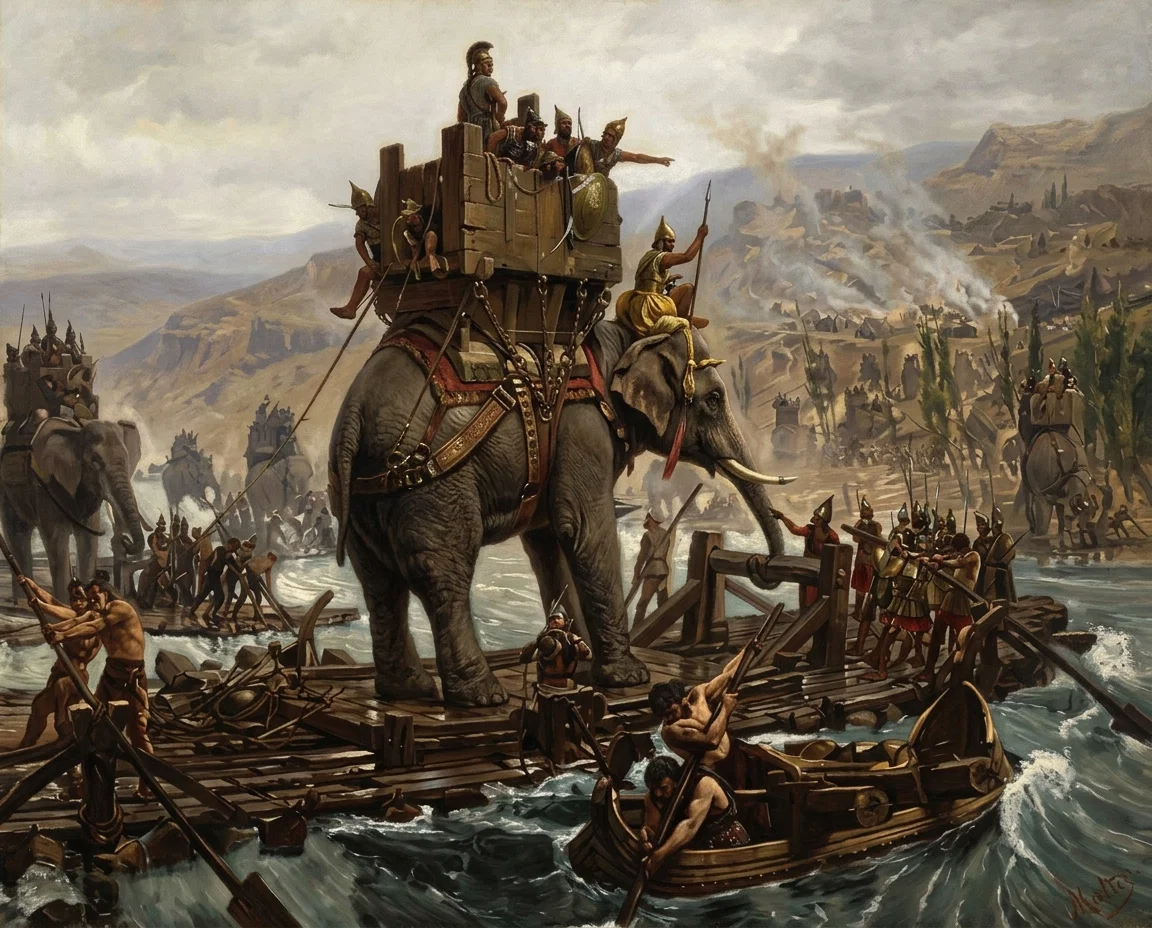
I KNOW the thoughts that I think toward you, saith the Lord, thoughts of peace, and not of evil.” Jer. 29:11. But the world is not now at peace. God’s voice is not speaking in the blare of trumpets; His Spirit is not moving the engines of war. The hand that bears war’s standard is not His. The eye that sights down the rifle barrel is not the eye nor the agent of the “Everlasting Father, the Prince of Peace.”
ALEXANDER CROSSING THE INDUS.
“PEACE and good will toward men” was the theme of the Redeemer’s annunciation; and peace and reconciliation was the mission of the Son of man. But the world is filled with violence, and the cruelties of war are wringing the hearts of the people. God is planning peace for man and the earth upon which He placed him; and failure in His purpose can never be. His word will not return unto Him void, but will accomplish that which is pleasing to Him, and will prosper in the thing whereto it is sent. It is sent for peace; and the “Gospel of peace” is the Gospel of Christ.
BUT “from whence come wars and fightings among you? come they not hence, even of your lusts that war in your members?” James 4:1. The primal seed of war is found in the principle of self-serving, as opposed to the effacement of self in the service of others. War is the weapon of the common enemy of God and man. It is Satan’s answer to the second table of God’s law.
GOD said, “Honor thy father and thy mother;” but the warrior son has slain them both, and the warrior father has slain the wife and children.
God said, “Thou shalt not kill;” but war has put a red girdle round the earth, and every generation sings the story of national murder in the ears of those that come after. In the glamour of war man has not stopped at the slaying of mortal foe; but his hungry steel has tasted the marrow of those who nursed at the same breast that nourished him, who looked up from the same lap into the same mother face.
God said, “Thou shalt not commit adultery;” but Satan thru this agent has flung defiance at this command wherever the hot breath of war has seared the green earth; and he whom God set for the shield of woman has caused her a thousand deaths wherever a glory-mad nation has flung down the gage of battle.
God said, “Thou shalt not steal;” but war has stolen everything, from the thrones of kings to the last morsel of food in the house of the poorest peasant—stolen everything, from the virtue of womanhood down to the tinsel on the cloaks of royalty.
God said, “Thou shalt not bear false witness against thy neighbor;” but the fear of war has given us the falsehoods of diplomacy, and has taught the denial and denunciation of the most binding and solemn engagements.
God said, “Thou shalt not covet;” but the war lords of earth have coveted everything that God has made or men have fashioned on the earth, and have used the sophistries of patriotism and the glamour of national glory to obtain for themselves the things they coveted.
VERILY, war is Satan’s contradiction of all that God designed for man. It was born in heaven in the envy and jealousy of him who has fostered it from then till now. It was born on earth in the envy and jealousy of him who slew his brother without cause; and the scourge of heaven and earth has become the science thru which the ends of selfishnesshave ever been attained, and the insults of men and nations, fancied or real, have been and are being avenged. The spirit of the Persian servant’s daily reminder to his king, “Master, remember the Athenians,” was the actuating force inspiring the successive blows which Persia struck at Greece, until revenge at her repeated failures and humiliations brought Xerxes’ human tidal wave upon the shores of the Aegean Sea. It was revenge for these repeated attacks of Persia that caused Philip of Macedon to create the invincible Macedonian phalanx, with which his son, Alexander the Great, crushed the power of the Eastern kings. Like a hurricane out of the West he scattered the fragmentary tribes of the mountains, leveled the massive walls of citadels, and swept the plain where were gathered the trained armies of his father’s foe; poured his forces down thru Palestine, and conquered Egypt; pushed his conquests to the gates of India, and burst the gates where the Indus rolls down to the sea; then in the bitterness of disappointment sulked alone in his tent because his soldiers were tired of war. And Islam in Europe, with all the slaughter of the Mohammeds, is Asia’s answer to Europe’s challenge in the conquests of Alexander.
THUS have the thistle and thorn of human hatred been sown around the world in the wake of war, till the work of preparing the world for its last and greatest battle is nearly done. In every nation on earth the fever of war is quickening the pulse of the people, and the triphammer has displaced the sledge in beating out the implements of death. Look where you will, the forges of Vulcan are burning, and war ships are dragging anchor on the rising tide.
AND this is not a dream. The fearful day is rushing on apace; the culmination is no longer distant. In the language of the prophet, “The nations were angry, and Thy wrath is come, and the time of the dead, that they should be judged, and that Thou shouldest give reward unto Thy servants; . . . and shouldest destroy them which destroy the earth.” Rev. 11:18. That time of anger has come; and soon will the vials of God’s wrath be poured into the earth to close this part of the history of sin.
BUT God does not leave it there. With the culmination of the work of sin there comes the long-promised reward of the tired hands that have wrought for God and the tired feet that have run to speed His message. The earth, that has been marred by war and sin of every kind, will be purified and made new in God’s refining fire (Mal. 4:1; 2 Peter 3:10-13), and sin be found no more in all the universe of God (Matt. 13:41-43). Then, indeed, “truth shall spring out of the earth” that once was cursed, and then will it be true that “righteousness and peace have kissed each other.” War will no more return to wreck and ruin the earth, for “He maketh wars to cease unto the end of the earth.” Ps. 46:9. Even the dread of its memory shall pass away; for the righteous nation which “shall inherit the earth” shall “delight themselves in the abundance of peace.” Then will the peace of God which passeth knowledge fill the earth as the waters fill the sea; tranquillity reign as in the ages before self-will and unbelief gave birth to the Ishmael of war; and the conquest of love be the “science and the song” of all who pass thru the glittering gates of the purified Eden of God.
C. M. SNOW.

Appropriating Forgiving Love.

BY REV. WALTER B. VASSAR.
In the SIGNS OF THE TIMES for November 21 there is quoted language from Abraham Lincoln that needs careful attention by all who propose working in the vineyard of Christ. What we do for the Master will largely depend on what we are as living witnesses. The quotation is, “Those who deny freedom to others, deserve it not themselves, and under a just God can not long retain it.” The editorial comment is, “And this is as true religiously as it is civilly.”
And this is just the point of the whole matter. The Christian world has been waiting two thousand years to take this in. Let sentiments like the foregoing, and all scriptures enforcing them, be quoted constantly.
To appropriate forgiveness is to dispense it. One act goes with the other, and they can not be divorced. God has joined them together; man will never put them asunder. The forgiven man is the forgiving one. It is the one and selfsame man in action. As fast as he receives, he gives, and no faster.
We need to know this; for some have made the mistake of looking only on one side, the Godward; yet it has a manward side also, and without both there is nothing of value for us in either. Some one has said, “God regards us, not only in our relations with Him, but with the people with whom we live.” Brothers have a common father. In the moral world they have common interests, tho it may not always be so in financial ways. The one Father who loves one, loves all.
But there is a difference between being children and being worthy children. The entire work of Christ is comprised in making us fit to be members of the kingdom; and in our relations one to the other, God Himself is the pattern for conduct. “He maketh His sun to rise on the evil and on the good, and sendeth rain on the just and on the unjust.”
The appropriator of forgiving love is the man who is in heart sympathy with such manifestation of good will. Jesus calls this conduct “perfect;” we are to be like it.
If we ask the question, “How does God forgive?” we find one answer, “In making us forgiving.” This is having the witness in one’s self. The apostle in his Epistle makes it a sign: “We know that we have passed from death unto life, because we love the brethren.”
Hamilton, N. Y.

SELF-DENIAL—SELF-SACRIFICE

How many there are who accept Christ, and apparently live a Christian life, until their circumstances change! Perhaps they come into the possession of property. Thus God tests them, to see if they will be wise stewards. But they fail to endure the proving. They use for self-gratification that which they should devote to feeding the hungry and clothing the naked. In want and distress, God’s children are crying to Him. Many are dying for want of the necessaries of life. Their cries have entered the ears of the Lord of Sabaoth. He will call to a strict account those who have neglected His needy ones. What will these selfish rich men do when the Lord asks them, “What did you do with the money I gave you to use for Me?” “These shall go away into everlasting punishment.” The Lord will say to them, “Depart from Me, ye cursed; . . . for I was an hungered, and ye gave Me no meat; I was thirsty, and ye gave Me no drink; I was a stranger, and ye took Me not in; naked, and ye clothed Me not; sick, and in prison, and ye visited Me not.”
The wails of a world’s sorrow are heard all around us. Sin is casting its shadow over us. Let us make ourselves ready to co-operate with the Lord. The pleasure and power of this world will pass away. No one can carry his earthly treasures into the eternal world. But the life spent in doing the will of God will abide forever. The result of that which is given to advance the work of God will be seen in the kingdom of God.
There is a world to be warned. To us has been intrusted this work. At any cost we must practise the truth. We are to stand as self-sacrificing minute men, willing to suffer the loss of life itself, if need be, in the service of God. There is a great work to be done in a short time. We need to understand our work and to do it with fidelity. Every one who is finally crowned victor will, by noble, determined effort to serve God, have earned the right to be clothed with Christ’s righteousness. To enter the crusade against Satan, bearing aloft the blood-stained banner of the cross of Christ—this is the duty of every Christian.
This work calls for self-sacrifice. Self-denial and the cross stand all along the way of life. “He that will come after Me,” Christ said, “let him deny himself, and take up his cross, and follow Me.” Those who secure the treasures of this world are obliged to toil and sacrifice. Should those who are seeking for an eternal reward think that they need make no sacrifices?
The most difficult sermon to preach and the hardest to practise is self-denial. The greedy sinner, self, closes the door to the good which might be done, but which is not done because money is invested for selfish purposes. But it is impossible for any one to retain the favor of God and enjoy communion with the Saviour, and at the same time be indifferent to the interests of his fellow-beings who have no life in Christ, who are perishing in their sins. Christ has left us a wonderful example of self-sacrifice. He pleased not Himself, but spent His life in the service of others. He made sacrifices at every step, sacrifices which none of His followers can ever make, because they have never occupied the position He occupied before He came to this earth. He was commander of the heavenly host, but He came here to suffer for sinners. He was rich, yet for our sakes He became poor, that thru His poverty we might be made rich. Because He loved us He laid aside His glory and took upon Him the form of a servant. He gaveHis life for us. What are we giving for Him? Shall we not, in the new year just before us, consecrate ourselves entirely to Him? Shall we not make Him a New Year’s offering of a portion of the means He has given us? As we follow Him in the path of self-denial, lifting the cross and bearing it after Him to His Father’s home, we shall reveal in our lives the beauty of the Christ-life. At the altar of self-sacrifice,—the appointed place of meeting between God and the soul,—we receive from the hand of God the celestial torch which searches the heart, revealing the need of an abiding Christ.
MRS. E. G. WHITE.

RELIGION AS A PRACTICAL NECESSITY.

Part II. Freedom from Condemnation.

SECOND, we need a religion having power to free us from the feeling of condemnation.
There is a universal sense of guilt; a feeling that somehow we have offended a Power greater than we; a dread of the wrath of some higher Being. No matter whence it comes, this is one of the practical sources of unhappiness. The rites and ceremonies, sacrifices, prayers, and pilgrimages of the various religions of the earth abundantly testify to this fact. It makes no difference in man's moral accountability how this sense of obligation comes about, whether intuitively or by teaching and environment, since the fact is universal, and no one can escape it, and no amount of education has been able to obviate it, that is, to give peace of conscience. “There is no peace, saith my God, to the wicked.” It is this unrest of soul which causes the unhappiness of millions. The need, then, is apparent for a religion of reconciliation.
The third practical need of our spiritual nature is a religion which can free us from bondage to sin and habit.
Mankind is in slavery, and knows it. Discontented with such a lot, man longs for freedom, but is impotent to acquire it. With yearning, yea, groanings, he turns his eyes toward the purity and holiness to which he has no power to attain. “The same divine mind that is working upon the things of nature is speaking to the hearts of men, and creating an inexpressible craving for something they have not.” This thraldom to evil within is another condition which has prompted the invention of religions and philosophies. Everywhere the human heart makes the same admission as the heathen poet Ovid:— “Video meliora proboque; deteriora sequor.” “I see and approve what is good; I follow the evil.” The apostle Paul voices the experience of mankind: “What I would, that do I not; but what I hate, that do I.” Instinctively the soul cries out, “O wretched man that I am! who shall deliver me?”
The fourth need which we shall mention has to do with “the most stupendous problem of human life.” That problem is the problem of human misery; and the need is of a religion which deals with it in such a way as at least to help us to endure it, if not to get free from it. This has been the problem of the race since the sorrowing pair turned their faces from Eden. The mystery of human suffering is the subject-matter of the oldest book of the world, the book of Job. All down thru the ages has come the trail of woe, marring every joy of life like the trail of the serpent thru the scenes of Eden; causing suffering of the body, till, like Job, we curse the day of our birth, and the thought of death is pleasant; bringing suffering of mind, ruined hopes, bitter disappointments, blasted lives, till despair suggests relief in suicide. True to life, the poet makes mental anguish alone drive his hero, a heathen prince, to that desperate soliloquy:—
“To die,—to sleep,—to be No more:—and by a sleep, to say we end The heartache, and the thousand natural shocks That flesh is heir to—'tis a consummation Devoutly to be wished. For who would bear the whips and scorns of time, The oppressor's wrong, the proud man's contumely, The pangs of despised love, the law's delay, The insolence of office, and the spurns That patient merit of the unworthy takes, When he might his quietus make With a bare bodkin? Who would fardels bear, To grunt and sweat under a weary life, But that the dread of something after death— The undiscovered country from whose bourne No traveler returns—puzzles the will, And makes us rather bear those ills we have Than fly to others that we know not of.”
Wonderful indeed, and yet most practical, will be that theory of life, that philosophy or religion, which can make human misery anything but an unmixed evil. But most wonderful, yea, divine, will be the teaching that not only affords comfort and consolation, but discovers such an interpretation to it all that it glows with a halo of meaning and purpose, till the sufferer exclaims, “Therefore I take pleasure in infirmities, in reproaches, in necessities, in persecutions, in distresses.” But this can be truly said only by one who realizes that these are but means to a great end, or gather a significance and grandeur because borne for some great cause or person. Ah, practical indeed would such a religion be!
These are all very practical spiritual needs. There are, indeed, many others, among which might be discussed the instinct of prayer, but those given will serve to illustrate the subject under review. These needs are practical, because on the true solution of how they may be satisfied depends abiding happiness, the summum bonum, or highest good, of life. Even tho there were no after-life, it would still be worth our while to adopt for this life any religion which met these practical needs.
The man who would invent an electric belt, a porous plaster, or discover a medical mixture that would fulfil these requirements, would soon be the richest man the world ever saw, and his posterity would continue to amass wealth till the end of time. Every one would have it if he could by any means obtain the purchase price.
The religion of Jesus Christ is exactly adapted to these ends. Not the least of the proofs of its divine origin is this co-ordination. Not the wealthy only may have it, but all; for the great Prophet himself said, “The Spirit of the Lord is upon Me, because He hath anointed Me to preach the Gospel to the poor.” It comes as a free gift from Him who, humanly speaking, devised it.
When we add to these personal benefits the further fact that this religion is capable of making the best of citizens, of renovating the world; that it is the universal respect for even a few of its moral teachings which makes the world fit to live in; that the longing for continued existence, salvation from utter extinction, eternal life, receives a satisfactory pledge of fulfilment from Christianity; since it is certain that if there is a future life, as practically all men of all ages have believed, this is the only means of attaining to it; that to accept Christianity can not possibly do us harm, and is certain to do us good even in this life—does not its acceptance become most practical and most reasonable? The inspired Word of God alone, of all the reverenced volumes ofthe world, supplies the knowledge of the meaning of life, of the condition in death; reveals the means of peace of mind; teaches the source of emancipation from the bondage of sin and habit; affords comfort in the deepest misery, and consolation in the darkest hour of sorrow.
What say you, sinner, is it worth the while? DERBY.

LITANY—THE CLOSING CENTURY.

OUR Father, steadfast midst the flight of years, Leading creation to Thy kingdom’s morn, Thou, the restraint of empires earth uprears, Exert Thy care o’er us, the youngest-born.
Here, in the hush of wise reflection’s hour, Here, by the bier of the great century That nursed our infant weakness into power, A nation bares its conscience before Thee.
Deal gently with us; lo, our blood is hot With youth and the excitement of success! Bear with us in such works where Thou art not; Believe we err because of thoughtlessness.
Renew our heritage—united hearts, The forward faith, the voice that fear forsakes— Renew the courage that Thy truth imparts— Courage to recognize and right mistakes.
Mighty for right or wrong our will finds sway. We judge, we champion, we assimilate; Our frontiers leap the waves. Grant, Lord, that they Expand in peace and not in racial hate.
Our challenge rings—we bid all to our feast— We guard the South’s divided diadem: Our Western star relights the night-bound East, Grant that it lead aright—to Bethlehem.
Time’s portal opens on futurity; Shadows and glories haze the mighty space; God of the unknown, grant at least that we Step fearless, as befits a sovereign race.
Then weigh us unto truth, and, testing us, Let good intent our vanities outscale; And lend the Spirit’s holy impetus To leaven many things wherein we fail.
FRED T. ELKIN.
1724 California Street, Denver, Colo.

GLIMPSES OF THE GREAT CONTROVERSY.

Christ Our Saviour.

THERE was war in heaven,” when Michael and His angels and the dragon and his angels fought out the contest between righteousness and iniquity. The result was the casting out of the forces of darkness; for Satan and the third part of the angels, who, on account of rebellion, kept not their first estate, were thus rejected from, and forever denied access to, that holy place. Jude 6. Since that time the warfare has had its seat among the children of men, for the defeated were cast “into the earth.” Rev. 12:7–9; 13:7, 8. Thus, tho the father of lies is no longer accorded the honor of personal contest against the King of the universe nor Michael, the great Prince, yet he is permitted for a time to work among men, in order that, in striking contrast with his moral deformity and selfish intrigue, the goodness, mercy, loving-kindness, and long-suffering of God might shine forth to the remotest corners of the earth; and that the eternal justice and equity of God’s laws may appear, those laws by which He governs the universe, and which the psalmist declares to be perfect, just, true, righteous, and eternal. Ps. 19:7–9; 119:137–160; Rev. 19:2.
Satan’s ultimate triumph over man, thru deception, was made to appear imminent; for by his cunning craft he was able to deceive the father of our race into sin, the transgression of the law (1 John 3:4), and consequent death; for “the soul that sinneth, it shall die” (Eze. 18:4); but that triumph is but apparent. God in infinite mercy, seeing man’s otherwise hopeless chances in the unequal contest, devised means for the salvation of all who should choose thus to share in the victory over him who has “the power of death.” Heb. 2:14. In the Gospel, the “good tidings of great joy, which shall be to all people,” is redemption from sin, and death, its dread consequence. Redemption equals “the gift to God,” “eternal life thru Jesus Christ our Lord.”
Note that, tho by sin man earns death as his wages, he can not by obedience earn life, but can receive it only as “the gift of God;” nor can it come by any other channel than “thru Jesus Christ our Lord.” Thus salvation is obtainable only by faith in the Son of God as the purchaser of our sins, that He might suffer their penalty in our stead. Man attains, therefore, as Paul says, by faith and “not by works, lest any man should boast,” and by boasting nullify his covenant of justification with God. “For all have sinned, and come short of the glory of God.” Therefore, “being justified freely by His grace thru the redemption that is in Christ Jesus,” “we have peace with God thru [by means of] our Lord Jesus Christ.” Rom. 3:23, 24; 5:1.
The richest treasure of heaven was yielded up on behalf of fallen man; for “God so loved the world, that He gave His only-begotten Son, that whosoever believeth in Him should not perish, but have everlasting life.” John 3:16. Having thus instructed, Jesus could appropriately say to inquiring Martha, as to all, “I am the resurrection, and the life; he that believeth in Me, tho he were dead, yet shall he live; and whosoever [thus] liveth and believeth in Me shall never die;” for “I will raise him up at the last day,” when “the trumpet shall sound,” and the righteous dead “shall hear His voice, and shall come forth” in the resurrection to everlasting life. Let every saint rejoice in the crown of righteousness thus laid up to be then given to all them that love His appearing. John 11:25, 26; 6:40; 1 Cor. 15:52; 1 Thess. 4:16; 2 Tim. 4:8.
Jesus says, “I am the Good Shepherd, the Good Shepherd giveth His life for the sheep.” “I lay down My life for the sheep.” John 10:11, 15. But why so great a sacrifice?—Because the demand of justice calls for death as the wages of sin, and “the blood is the life;” to shed blood is to take life. Our position, then, in the transaction of redemption is apparent in the answer to this question: “Without shedding of blood there is no remission.” Heb. 9:22.
But the slaying of animals as sin-offerings, which bore witness to the penitent’s faith of pardon thru a coming Saviour, only foreshadowed the cross, but could not actually remove sins; “for it is not possible that the blood of bulls and of goats should take away sins.” Heb. 10:4. Nor yet were ye “redeemed with corruptible things, as silver and gold,” but “with the precious blood of Christ, as of a lamb without blemish and without spot;” who verily was foreordained before the foundation of the world, but was manifest in these last times for you. Thus do we recognize Christ as “the Lamb slain from the foundation of the world.” 1 Peter 1:18–20, Rev. 13:8.
Tho the plan of salvation, which we have briefly described, is so ample in its office, it works only when applied. Hence he who would profit by its munificent provisions may do so only by an act of faith on his part,—faith in Jesus, the Christ, that He has indeed paid the price, thus satisfying the demands of the law for man’s sake.
God’s government is one of harmony and love, not of force and compulsion. He desires only willing obedience; His servants serve only from choice. In conformity with these principles, He wisely created man a free moral agent, that he may voluntarily array himself on whichever side he chooses. He does not discriminate, “for there is no respect of persons with God.” As Peter learned this by the sheet let down from heaven full of all manner of beasts and creeping things, so may we “perceive that God is no respecter of persons; but, in every nation he that feareth Him, and worketh righteousness, is accepted with Him.” Acts 10:34, 35.
None need share in the heavenly inheritance unless they so desire, but Jesus says, “Whosoever will, let him take the water of life freely.” Rev. 22:17.
Do not charge God with placing the Gospel out of your reach by means of its mysteries; for His words will answer you and say, “If any man will do His will, he shall know of the doctrine.” John 7:17.
Do not try to work out salvation upon any plan other than the divine plan; for the Saviour says, “Verily, verily, I say unto you, He that entereth not by the door into the sheepfold, but climbeth up some other way, the same is a thief and a robber.” John 10:1.
F. R. RICHARDS.

AN AWFUL DOGMA.

The above title can, we think, be truly applied to the doctrine of the eternal torment of the wicked, based on the inherent immortality of the soul. If man has by nature an immortal, never-dying soul, then it follows that those who make up that mighty caravan of the lost which is continually passing down into the grave, are weeping and wailing in torment from which there is no deliverance forevermore. The time during which they must writhe in unspeakable anguish is expressed by a poet as follows:—
“Infinite years in torment shall I spend, And never, never have an end. Ah! must I live in torturing despair As many years as atoms in the air; When these are past, as many millions more As grains of sand that bound the ebbing shore; When these run out, as many more behind As leaves of forests shaken by the wind; When these are spent, as many more to flow As blades of grass on hill and dales that grow; When these run out, as many on the march As starry lamps that gild the spangled arch; When these are gone, as many millions more As every moment in the age before; When all these doleful years are spent in pain, And multiplied by myriads yet again, I must in that fierce grief in misery lie, And madly writhe to all eternity.”
Reader, that is an awful doctrine. It is a terrible charge to bring against God, the God of love and mercy, that He will thus deal with any of His creatures. We are sometimes told that it is a gloomy doctrine which teaches that the dead are quietly sleeping in the silent tomb until the resurrection. Gloomy, forsooth! What could be more gloomy and doleful than the hideous dogma of the above lines, which are but an expression of the teaching of modern theology? To think that at this very hour there are myriads of poor, lost mortals who once lived and walked the earth as we do now, screaming with pain and anguish in the lurid flames of hell fire, and that the number is daily augmented with thousands more, is revolting. Mr. Benson, a believer in the immortality of the soul, and necessarily a believer in the eternal torment of the wicked, describes the exquisite scene thus:—
He [the Lord] will exert all His divine attributes to make them as wretched as the capacity of their nature will admit. . . . They must be perpetually revealing their enormous sums of guilt, and still running deeper, immensely deeper, in debt to divine and infinite justice. Hence after the longest imaginable period, they will be so far from having discharged their debt that they will find more due than when they first began to suffer. . . .His fiery indignation kindles, and His incensed fury feeds the flame of their torment, while His powerful presence and operation maintain their being, and render their powers most acutely sensible, thus setting the keenest edge upon their pain, and making it cut most intolerably deep.
We feel safe in saying that such teaching has strengthened infidelity in many a heart. Many, believing that such a dogma was taught in the Bible, have been unable to reconcile it with the idea that God is love, so have discarded the Scriptures as the divine Word of the Lord.
But it is clearly shown from consulting a few texts that such theology is an entire perversion of the Gospel and Scriptures of our Saviour. Life and immortality were brought to man thru the Gospel. 2 Tim. 1:10. Only thru the Gospel can man live forever. When man sinned, he forfeited his life, and if the plan of redemption, as taught by the Gospel, had not been instituted, he would never possess either immortality or eternal life; for they are the gift of God. Rom. 2:7. Sinners are “alienated from the life of God,” and have life only by laying hold of it by faith in the Lord. Eph. 4:18; 1 Tim. 6:12. The Lord gives eternal life to the sheep, those who hear His voice and follow Him. John 10:27, 28. But none except those who follow Him will live forever. “He that believeth on the Son hath everlasting life; and he that believeth not the Son shall not see life; but the wrath of God abideth on him.” John 3:36. “He that hath the Son hath life; and he that hath not the Son of God hath not life.” I John 5:12.
The finally incorrigible have not the Son of God. It is for this reason that they are lost, and they therefore have no life; and having no life, they are dead. “The wages of sin is death.” Rom. 6:23. Nowhere in the Bible is it stated that the punishment of sinners will be eternal torment. Having chosen death, they will receive it; and when eternally dead, they can not be in torment.
By holding out before the sinner life, by promising life to those to whom God has not promised life, the sinner is strengthened and confirmed in sin. Eze. 13:22.
Reader, eternal life and eternal death are set before us. Deut. 30:19. The Lord compels none; He permits us to choose. Let us heed His loving admonition to “choose life,” that we may live; for only those who make this wise choice will be granted the boon of an eternal existence. G. B. THOMPSON.
Rome, N. Y.

TAKE NOT THE NAME IN VAIN.

We often hear the expression, “There’s nothing in a name.” This should never be said by the Christian. The Bible deals in names. Jesus Christ, the Creator of all things in heaven and earth, obtained by inheritance a more excellent name than even the angels. This is our family name, for the whole family in heaven and earth is named for Him. “Provoke Him not,” the Father says, “for my name is in Him.”
Life in this family comes thru the operation of the Holy Spirit; “for,” said the Saviour, “except a man be born of water and of the Spirit, he can not enter into the kingdom of God.” In the conception of Christ, we have a practical illustration of the spiritual birth. The angel said to Mary, “The Holy Ghost shall come unto thee, and the power of the Highest shall overshadow thee; therefore also that holy thing that shall be born of thee shall be called the Son of God.” So it is written of the Spirit, “He dwelleth with you, and shall be in you.” “I will not leave you orphans; I will come unto you.” Therefore, if any man be in Christ Jesus, there is a new creation, a new birth, a new life,—a life begotten of the Holy Spirit.
At the first surgical case known to history, God administered an anaesthetic to the man whom He had made. While Adam was asleep, He took out one of his ribs, closed up the flesh, “and the rib which the Lord God had taken from man, made He a woman.” When He brought the woman to Adam, the man said, “This is now bone of my bone, and flesh of my flesh,” and she became his wife. Thus we have God’s idea of the marriage relation. The Saviour in commenting upon this said, “They are no more twain, but one flesh.” So the exhortation speaks to us, “Husbands, love your wives, even as Christ also loved the church, and gave Himself for it.”
God makes use of the marriage relation to show the union between Christ and His followers. Christ was with the church in the wilderness; He was the Rock from which they drank. Tho they continued not in His covenant, yet He says, “I was an husband unto them.” And when they turned away from Him, He pleaded with them, “Return, O backsliding children, saith the Lord; for I am married unto you.”
“I have espoused you,” says the apostle, “that I might present you as a chaste virgin unto Christ.” We are loosed from the bondage of Satan, that we may be married unto Christ.
In this union, Christ has presented Himself as flesh of our flesh, and has not left us to any speculative theories. When the fulness of time had come, God sent forth His Son, made of woman, made under the law; forasmuch as the children were partakers of flesh and blood, He also Himself likewise took part of the same flesh and blood, so becoming, in very deed, bone of our bone and flesh of our flesh, and making of twain one new man.
When a woman is taken as a wife, she leaves her own name and takes the family name of her husband. She becomes a child of her husband’s father. So when we unite with Christ we take the family name, a strong tower into which the righteous runneth and is safe.
The Spirit whereby we are begotten, beareth witness with our spirits that we are the children of God, and if children, then heirs, heirs of God and joint-heirs with Jesus Christ. He is in us, and the Father in Him, that the world may know that the Father sent Him, and loves us as He loves Him.
The words of Christ thru the prophet are, “I will greatly rejoice in the Lord, my soul shall be joyful in my God; for He hath clothed me with the garments of salvation, He hath covered Me with the robe of righteousness, as a bridegroom decketh himself with ornaments.” So when Christ’s wife has made herself ready, she is arrayed in fine linen, clean and white; for the fine linen is the righteousness of the saints; and for this righteousness His name stands.
Job specifies the simple material out of which the wedding-garment is woven: “Because I delivered the poor that cried, and the fatherless, and him that had none to help him. The blessing of him that was ready to perish came upon me; and I caused the widow’s heart to sing for joy. I put on righteousness, and it clothed me; my judgment was as a robe and a diadem.” The garment is the same to-day, and it is woven in the same kind of loom. “Deal thy bread to the hungry; bring the poor that are cast out to thy house; when thou seest the naked, clothe him, and hide not thyself from thine own flesh. Then shall thy light break forth as the morning, and thine health shall spring forth speedily; and thy righteousness shall go before thee; the glory of the Lord shall be thy rereward.”
Whosoever shall give even a cup of cold water in His name is remembered and shall be rewarded. His name is holy, and every deed that is truly done in His name is a holy deed. In His name is life, clothing, and power. It is holy and reverend, and in it are wrapped up all the blessings and possibilities of eternity to those who take it not in vain.
Continue reading: VICTORY