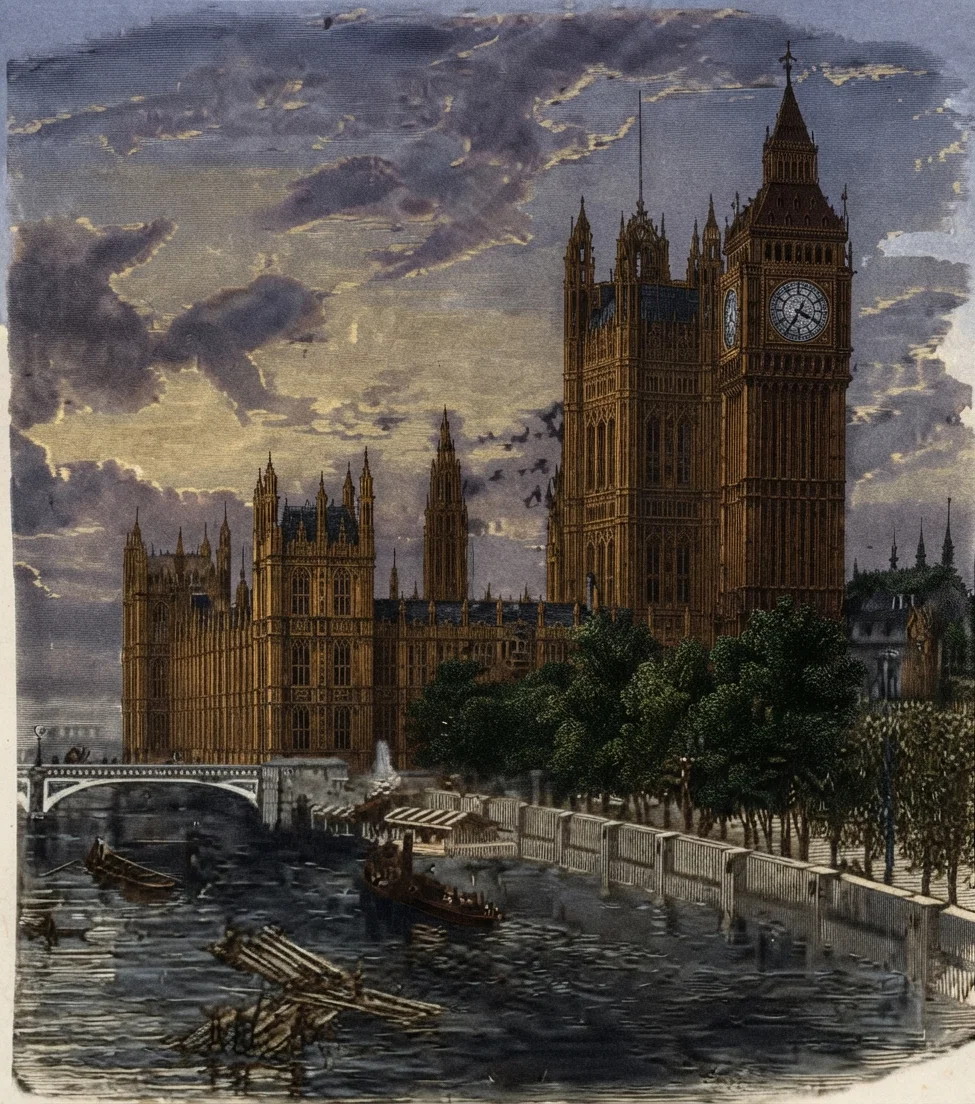
ENGLAND found herself at the opening of the year 1906 in the throes of a general election. Altho the health of the Tory Government had been in a somewhat precarious state for more than a year, yet the end came with unexpected suddenness. Only a few days previous to the Prime Minister's resignation, prominent supporters of his ministry were asserting that there was no reason whatever for expecting an early dissolution. It is well known, however, that Chamberlain has been desirous of an appeal to the country, and some recent, very plain utterances of his, relative to the fiscal question, probably had much to do with Mr. Balfour's precipitate action.
For ten years the country has been under Tory rule without interruption, and if we except the brief Liberal administration which came to an end in 1895, the whole period of Tory domination is twenty years. What has this meant to England? In what direction has the country been moving during this time? Has there been advancement or retrogression? No doubt the answers will be various; but one thing is certain, if the ideals of such statesmen as Bright, Cobbet, and Gladstone were in the line of England's highest interests, then the tendency of the last twenty years has been a retrograde one. So-called imperialism has figured large in the political arena. The army and navy budget has assumed alarming proportions, and leading newspapers standing close to the government have come out openly and advocated compulsory military training. Naval expenditures have more than doubled in this decade, and the army, tho generally acknowledged to be in a far from efficient condition, has not lagged behind in the matter of expense. In short, the regular military outlays have reached a point of extravagance well-nigh unbearable.
A Retrograde Policy.
Since the South African War the foreign policy of the government has been generally pacific, tho the newspapers have done what they could to embroil the country in a war with Germany or Russia. In its home affairs, the Tory Government has certainly shown a retrograde policy. The Brewers' Bill put a check on the gradual reduction of licenses by which the drink evil was slowly, but steadily, being forced back. The notorious Education Bill virtually handed over the country's educational system to the control of the Church of England clergy, and brought about the interesting situation which exists to-day, when children of non-conformist parents, attending schools supported by public taxes, are taught that the state church is the only true church, and all non-conformists are heretics. Is it to be wondered at that thousands of parents have become passive resisters refusing to pay such taxes, and preferring to go to jail rather than yield obedience to so unjust a law?
Finally the Chamberlain faction sought to urge upon the country a protective tariff, holding up this as an infallible remedy for all the evils of the country at home, and a sure means of cementing stronger bands with the colonies. Needless to say, the public has not taken kindly to the new fiscal policy, which indeed Balfour and his immediate supporters never assumed as part of the government policy, tho some of them expressed their sympathy with it.
The Liberal Platform.
Such, in brief, is the record of the last few years. We now have a Liberal cabinet handling the reins of government confirmed by a general election, tremendously sweeping in its Liberal and labor majorities.
The question of greatest interest at present is the platform of the Liberal party. Sir Henry Campbell-Bannerman, the new premier, in his recent speech at Albert Hall laid down Peace, Retrenchment, and Reform as the basis of the administration. Equal rights for all and special privileges for none, is another leading war-cry of the Liberals, in the carrying out of which in actual practise they expect to mend the Education Act on the one hand, and on the other see to it that huge corporations are not fostered by protective tariffs till they get entirely beyond control, and hold the country in their grasp. The party is also committed to social reforms, mainly in the direction of enlightened temperance, labor, and land legislation. As for Irish Home Rule, the rock upon which the Liberal party of former times stranded, the prime minister is rather chary of talking on the subject; but he has said that Ireland is to manage her own home affairs as, and when, the way may open, or words to this effect.
Houses of Parliament.
The make-up of the Liberal Cabinet is generally admitted to be above criticism. Such names as Sir Edward Grey, the new Foreign Secretary; Lord Elgin, the Colonial Secretary; Mr. Haldane, the War Secretary; Mr. Morley, the Secretary for India; Mr. Lloyd George, President of the Board of Trade; and Mr. Augustine Birrell, of Education, inspire the respect and confidence of all classes. The choice of John Burns as President of the Local Government Board is also a very popular one. Mr. Burns is the first Labor Member of Parliament to occupy a seat in the cabinet. Labor members, it may be said in passing, go to Parliament to represent the interests of laboring men, and being nearly always without private means, are paid a moderate salary by their constituents, the other members of Parliament serving without pay.
Mr. Campbell-Bannerman himself is not a brilliant man, but he has Scotch tenacity and grit, and withal an immense amount of tact. Born in 1836, he is the same age as Mr. Chamberlain, and twelve years older than Mr. Balfour. He has been in Parliament since 1868, and has held various government positions, serving twice as Secretary of War. As leader of the Opposition he has kept the confidence of his own party, and has made few, if any, personal enemies. His selection of colleagues has met with general approval, and the feeling in London, and quite generally throughout the country, seems to be that the Conservative Party has been in power long enough, and it is time the Liberals had a chance. The outlook seemed good for a Liberal victory, and the results have more than justified the outlook. Joseph Chamberlain is a man of tremendous energy and initiative, as well as a practised campaigner; he has had a strong backing in certain quarters, but apart from his own local field, his defeat has been overwhelming. Balfour has not displayed those qualities of leadership which the country seems to demand at the present time; he is too much of a compromiser.
It is perhaps too early to forecast the influence of a Liberal regime upon the religious development of the country. The Tory party stands for the privileged classes, including the established church. Liberalism, on the other hand, is pretty much permeated with the leaven of nonconformity. It is a fact of some significance that the leading members of the present cabinet are in favor of disestablishment, that is, of depriving the Episcopal Church of official recognition and state support, and leaving it to be maintained by its members the same as other denominations. Such a move, which would have the support of a considerable number within the church, could hardly fail to forward the cause of true religion in the kingdom, since it would make for a higher spirituality among the clergy, and for individual convictions on the part of the members.
The Present Religious Condition of England
is one of transition. Among thoughtful leaders of opinion there is a good deal of unrest and dissatisfaction. The shackles of time-worn creeds are being broken. Men are awakening to the fact of the fallibility of the clergy, and the human origin of much they have held as sacred. It is time to proclaim the Gospel in its purity and simplicity, and lead men to the Cross. While the country as a whole is marked by religious indifference, there is excellent evidence that multitudes are in the valley of decision, awaiting the appeal of the living messenger to decide for God and eternity.
Social Conditions in England
are gradually approaching the critical stage, if indeed they have not already reached it. Ever since the South-African War non-employment has been a great and growing evil. The bill passed by the late government was only a make-shift, and is proving a poor one at that. The work-houses are full to overflowing; London never had such a lot of paupers to deal with as in the present year. The relief problem presents some peculiar difficulties. It is next to impossible to help the worthy man, who is out of employment through no fault of his own, without rendering like aid to a large number of unprincipled, shiftless, ne'er-do-wells who sink lower and lower in the scale of self-respect and respectability the more they are assisted financially. It is to be hoped that John Burns, the new president of the Local Government Board, who combines with real sympathy for the poor a good deal of practical common sense and political sagacity, will be able to devise a plan which will at least better the present situation.7Trade-unions were not in much favor with the late Tory Government, which they helped to expel. Under Liberal rule their power is sure to increase, and this may not unlikely lead to untoward developments. On the whole, the immediate outlook presents interesting possibilities in a number of directions, and is well worth careful study.
The World Growing Worse
By Editor
The preachers that prophesy "smooth things," and are therefore popular (Isa. 30: 10) persist in declaring that the world is growing better. But not only do the Scriptures tell us that in the last days "evil men and seducers shall wax worse and worse," but the world itself is testifying to that effect. The world's own investigators are constantly bringing to light the generally-corrupt practises in social, political, and corporate business circles—implicating many of the recognized great men in both moral and civic defalcation. In addition to the well-worn facts of railroad, insurance, steel, oil, copper, beef, and other trust frauds, together with general political faithlessness, we are now confronted with the defalcations of a Chicago banker of great financial influence. Investigation shows that he has "violated all the vital clauses of the national banking law." Yet the secretary of the United States treasury says that he has done only that which many other bankers in the United States are doing. Is it because the custom is so common that the treasury department, whose business it is, does not put a stop to such practises?
OUT FOR STATE-ENFORCED RELIGION.
By Editor
Ohio's new governor comes squarely out for the enforcement of religion by State authority. From his inaugural message, we take this extract:
While the disobeying of any law is demoralizing and degrading to a citizen or community, the disobeying the Sunday laws is doubly so. Hence the so-called Sunday laws should be obeyed and enforced. Not only in the country and in the small villages, but in the large towns and cities as well. The village, county, community, city, state, or people that disobeys the divine law of the sabbath, which makes it a day of rest and worship, fails to realize the teachings and commands of the Almighty.
If America is to maintain her position as the nation peculiarly favored by God, and the one of all others that is to have a great destiny, we must forever maintain our respect and reverence for this holy day. While the Republic endures, let us advocate what the great masses of all the people believe in—our American Sunday and the Christian Sabbath. We should not forget that righteousness exalteth a State or nation, and that lawlessness degrades it.
To be sure, I believe in home rule for all divisions. The citizens of the large cities should continue to be governed as they are now by the same laws that are in force for all the people. Certainly the citizens of any subdivision can not take upon themselves the right to obey or disobey certain general laws unless this right is given them by the people of the State.
This is about the strongest utterance in favor of compulsory religion that has yet come from any state executive, and, taken in connection with the position of the mayors of Cincinnati and some other cities, must give increased encouragement to such bodies as the Evangelical Alliance and other National Reform auxiliaries. The idea of the people’s getting their rights from the State is a complete reversal of both republican and democratic principles. According to the Declaration of Independence—to which the people of this Republic still have a right to adhere—the rights of life, liberty, and the pursuit of happiness are God-given, and governments are formed for the protection of these rights, and not for their abridgement.
Furthermore, the State has no right to compel the observance of any religious institution. To do so is an establishment of religion, and in violation of the First Amendment of the Federal Constitution.
Governor Pattison is going contrary to every democratic principle, and more than this, every Christian principle.
SHOULD NOT BE SURPRISING.
By Editor
Our government is working toward the consummation pointed out by the prophecy (Rev. 13:11-14), namely, making an image to the Papacy, faster than most people are aware. Yes, faster than many who believe that to be her destiny are aware. We have reached the point where men are suggested for, and sometimes appointed to, office because they are Catholics. Who has heard of official appointments because an appointee was a Methodist, or Presbyterian, or Baptist? A Washington paper announces that there is no longer any doubt that the present governor general of the Philippines will shortly be retired, and that a certain man will be appointed. The reasons set forth for this belief are thus stated:
He is a Catholic. Ecclesiastical problems constitute so large a part of the difficulties of American administration that there is a strong feeling that an American Catholic would be better qualified than anybody else to handle these matters. At the very best the government must frequently find its interests running counter to the concerns of the Catholic orders. It is thought that a Catholic would be able more effectively to enlist the co-operation of the church in meeting these difficulties.
Two points of moment crop out from this statement. (1) That “ecclesiastical problems” should “constitute so large a part of the difficulties” of the government of a nation which boasts of the absolute separation of church and state. (2) That because “the government must frequently find its interests running counter to the concerns of the Catholic orders,” therefore the government should be represented by one in sympathy with the other party to the controversy.
This is strange logic, and ordinarily would be deemed in the highest degree absurd; but it is in perfect keeping with the outcome as outlined in the prophecy. It should not be surprising to any one who is inclined to heed the “sure Word of prophecy” and to note the fast-fulfilling events.
THE GREAT METEORIC SHOWER OF 1833—ITS EXTENT.
It has been thought that the great meteoric display of November, 1833—foretold in prophecy—was confined largely to the Western continent, especially North America. But this was not the case, as it was visible in Europe as well as in this country, as the following, from Word and Works, of February, 1906, clearly shows:
Query Editor:—I see in the “Query Corner,” of the June number of WORD AND WORKS, that reference is made to the great meteoric shower, which occurred in November, 1833. I saw that wonderful and magnificent shower. I can not now say whether it occurred on the thirteenth or fourteenth of the month. I was then in England. The shower must have commenced there between six and seven o’clock in the evening, as I was on my way home from the factory where I then worked. I was then in the nineteenth year of my age.
I have said it was a most magnificent sight; language can not describe it. I confess that I was somewhat alarmed, having read of aerolites and meteoric showers, and of persons being killed by them, and fear led me to increase my speed so as to get a roof over my head. I then stood and contemplated the sublime exhibition of something I could not understand. I simply desire to testify that the meteoric shower of 1833 was the most wonderful, the most sublime, I ever saw. Those that have occurred since seem to me too insignificant when compared with that one in 1833. Yours in the work of the Master.—Rev. John D. Sands, Belmont, Iowa.
Catholic Party Victories in Italy
A report from Rome tells us that the Clerical party, or the Roman Catholic party, now permitted to vote by the pope, won several elections in Italy—the first time they have voted since 1870.
Labor Troubles in Argentina
Labor troubles in Argentina, South America, have been the order of the day for about two years. There have been so many strikes that the congress has passed a law authorizing the government to expel all foreigners who were deemed antagonistic to the peace and quiet of the country. It is said that over two hundred persons have been sent away under this law. Eight hours constitutes a day's work in Argentina.
Sunday Theater Injunction in Wichita
A temporary injunction "restraining the city of Wichita, Kan., chief of police Cubbon, Police Judge Hawks, and the officers, from arresting them and putting them in jail for running their theater on Sunday," was recently obtained by the Bijou Theater Company. It seems that observance of the Sunday law has been enforced against theatrical performances in Wichita hitherto. One Sunday just before a street fair opened three years ago, two local theaters were opened for an evening performance, but the chief of police sent the patrol wagon and an officer to each place and the two managers were arrested and fined $100. Since then there has been no attempt to give performances on Sunday in any of the Wichita houses.
An Unpleasant Task.
By Editor
A field of labor it would seem to us no one would wish to engage in, much less a woman, is that of hunting up deserters from the army and navy; and yet that is what one young woman by the name of Edith King is doing, hunting up and arresting deserters from the army and navy of the United States. It is said that she has returned a little over 1,200 men, traveling extensively under many disguises. There are deserters and deserters. Many young men are induced to join the navy and army through over-persuasion, when so young that they have no purpose in life formed. It would seem as tho there ought to be some sympathy for them if they break away and turn to the ordinary pursuits of life and the home circle, especially in time of peace. Surely any one adopting work of that kind has a thankless task before her, and must do it for the one purpose, for what can be made out of it, a purely mercenary business in souls.
Science and the Alchemist’s Dream
The alchemist's dream was that base metals could be transmuted into gold, and Prof. Garrett P. Serviss tells us that some of the foremost English investigators of the wonderful new phenomenon of radioactivity are almost on the point of staking their scientific reputation upon the assertion that gold and silver are products of the gradual atomic disintegration of the baser metals such as lead and copper. “This,” says Prof. Serviss, “as far as it goes, is an amazing confirmation of the dreams of the ancient alchemists, at which the learned world has been laughing for some centuries.” And he thinks that the experiments, so far as they have gone, all point to the probability that these wonderful transformations really do occur in nature. Thus much for the wisdom of the modern scientist who has ridiculed for so long the old alchemists’ dreams. May not some of our scientific religious men also learn that God’s old way of righteousness, the Ten Commandments, and the means of transmuting those commandments into character through the atonement of Jesus Christ, is, after all, the true science of humanity?
Have Had Enough.
By Editor
It would seem that there has been so much exposure of official corruption throughout the country that the authorities in some places are becoming inclined to ignore it rather than to take chances of investigation. Real investigation strikes so many tender spots in unexpected places, that the higher officials dread coming too near home, or disturbing those upon whom they are dependent for political support. It seems that even the authorities in Washington have become satiated with investigation of corrupt practises. A press despatch says:
In the department circles it is common gossip that it is now dangerous for any one to give information leading to exposure of corruption in any place in the government; that the informers generally get the worst of it, and that it is much wiser, if one desires to hold a position, to know nothing at all of what is going on here. It is known that a number of persons who gave out information leading to exposure of corruption have been quietly dropped, and others take this as a warning.
The trouble with all earthly governments is that the profession of politics is simply a sowing to the flesh, and the result must of necessity be a reaping of corruption. Gal. 6:8. It is only by becoming partakers of the divine nature, through the knowledge of God and the righteousness of Christ, that any one can “escape the corruption that is in the world through lust,” 2 Peter 1:1-4. No amount of “reform” politics, not even religious politics, can eradicate the evil. Experience is proving that the more we have of this kind of reform, the worse the situation becomes.
THE WILL OF GOD
By W. A. Sweany
BY W. A. SWEANY
The Result of Disobedience.
IT should be known and remembered by all that while there are degrees of sin, some being greater and more heinous than others, thus necessitating varying degrees of suffering, “all unrighteousness is sin,” and “the wages of sin is death;” for “sin, when it is finished, bringeth forth death.” The terrible result of the carelessness, indifference, and impunity with which men commit sin will not be realized by many until, when too late to repent and change, they hear, despite the protestations of their prominence in the realm of religion, the awful words, “Depart from Me, ye that work iniquity.” For “not every one that saith unto Me, Lord, Lord, shall enter into the kingdom of heaven; but he that doeth the will of My Father which is in heaven.” Matt. 7: 13-29.
Many seek to palliate, excuse, and even justify indulgence of sin by pleading the "weakness of the flesh," our "natural tendency to sin," etc. But this will not do, for provision has been made for us to become "partakers of the divine nature," which hates, loathes, shuns, and avoids sin, thus escaping the "corruption that is in the world through lust." 1 Peter 1: 1-4; Heb. 1: 8, 9. Having experienced the utter weakness and helplessness of humanity, and the power of the Father to save from sin and strengthen for service, our blessed Saviour makes merciful provision of His all-sufficient grace, to enable us to always triumph over temptation and sin. John 5: 19, 30; 17: 18; 20: 21; 15: 1-4; 1 Cor. 10: 13; 2 Cor. 12: 7-10; 2: 14.
So, while men persist in excusing sin, God invariably and always condemns it, having provided a remedy for it, thus leaving the sinner without excuse for continuing therein. Rom. 8: 1-4. Sinners will be lost at last, not because of Adam's sin (as the Adamic death squares that account), but for their own sins, and rejection of proffered mercy. Rom. 5: 12-21; John 5: 39, 40.
A Fatal Deception.
Of all the soul-destroying, God-dishonoring doctrines and deceptive devices for the downfall of man, none is more in keeping with the character of its Satanic author than the comparatively-recent one, which finds such ready acceptance with the carnal mind, that Christ came to abolish or change the law of God. The result of the wide-spread promulgation of this pernicious doctrine by pulpit and press, is seen in the ever-increasing, rapidly-swelling torrent of iniquity that pours forth from the lives of not only the non-professing world, but from many of the professed people of God as well. "They that forsake the law praise the wicked; but such as keep the law contend with them." Prov. 28: 4. "He that turneth away his ear from hearing the law, even his prayer shall be abomination." Prov. 28: 9. And "whosoever therefore shall break one of these least commandments, and shall teach men so, he shall be called the least in the kingdom of heaven." Matt. 5: 19. It is easy to persuade men that obedience to God's law is unnecessary; for "the carnal mind is enmity against God; for it is not subject to the law of God, neither indeed can be." Rom. 8: 7. But the results will be fatal to both teacher and pupils.
Compliance with the popular demand for "smooth things," "fables," and "deceits," brings popularity and seeming success; but "what will ye do in the end thereof?" 2 Tim. 3: 1 to 4: 5; Isa. 30: 8-14; Jer. 5: 25-31. How Satan must exult when preachers proclaim and people practise the doctrine that Christ came to change or abrogate the law, when in reality He came to live, suffer, die, and rise again in order to fulfil or fully to preach and practise, exalt, honor, magnify, and establish it. Isa. 42: 21; Matt. 5: 17-20; 3: 13-15; Gal. 6: 2; Col. 1: 24, 25, margin; Rom. 8: 1-4; 3: 31. "It is time for Thee, Lord, to work; for they have made void Thy law." Ps. 119: 126. And it is also fully time for the watchmen on the walls of Zion to cry aloud and spare not, lifting up the voice like a trumpet, showing the people their transgressions and sins. Isa. 58: 1; 62: 1, 6, 7; Joel 2: 1-20.
Let the Trumpet Give a Certain Sound,
and make the people to know that Jesus Christ came, not to change the law, but to change transgressors of the law, bringing them into harmony with it (2 Cor. 5: 17); not to blot out, or nail to the cross, His stone-engraved precepts, but the precepts, commandments, ordinances, and traditions of men, by which they make void the commandments of God (Matt. 15: 1-9; Colossians 2); not to abolish the law of God, but that which is enmity against it, and not subject to it—the carnal mind with its commandments and ordinances (Gal. 2: 14, 15; Rom. 8: 7); not to take away the law, but our sins which are the transgressions of the law (1 John 3: 4, 5); not to destroy the law, but the works of the devil (1 John 3: 8); not to release us from obedience to the law, but to redeem us from its curse or penalty which falls on men because they transgress it (Gal. 3: 9-14); not to enable men to cater to their carnality with safety by banishing the law (Rom. 4: 15; 5: 13; 3: 20; 7 entire), but to enable them to keep it and thus to triumph over all sin. 1 Cor. 15: 57. He came to set us free, not by abolishing the law which justly condemned us, but by paying the penalty for past sins, and by bringing us into harmony with it. Ps. 119: 45; John 8: 30-36; Rom. 6: 12-23; James 1: 22-25; 2: 8-12.
"This is a faithful saying, and worthy of all acceptation, that Christ Jesus came into the world to save sinners" "from their sins." 1 Tim. 1: 15; Matt. 1: 21. But instead of accepting this faithful saying, multitudes have so misconceived, misconstrued, and misrepresented it, that the mission of the Master is merged into that in which Satan has been engaged from the beginning, namely, the effort to abrogate Jehovah's law. "Be astonished, O ye heavens!" However, the combined efforts of Satan and sinners to cast contempt on the law of the Lord, affects not in the slightest degree either the law or those that love and obey it; for "all His commandments are sure. They stand fast forever and ever, and are done in truth and uprightness." "So shall I keep Thy law continually forever and ever." The righteous shall never be moved, for "the law of his God is in his heart; none of his steps shall slide." Ps. 111: 7, 8; 119: 44; 55: 22; 37: 30, 31.
(To be continued.)
OUR SOURCE OF ENERGY, OR LIFE.
By D. H. KRESS, M.D.
THERE is nothing more certain than the truthfulness of the words, "We know nothing yet as we ought to know." This becomes more and more evident as we advance in scientific knowledge. We can not expect any of the investigations made by men of science to be infallible. By bringing them to the test of the Word of God, we are able to winnow the wheat from the chaff, truth from error. The Word of God is the only infallible judge in matters of science, and the Creator of man is the only reliable authority pertaining to the human organism. It has been an accepted theory by the scientific world for ages that physical energy is derived from food, that this energy is stored up in food, and liberated, or set free, in the body by the process of oxidation.
Recently an article appeared in the British Medical Journal in which the writer takes the position that energy is derived from a source of which as yet science knows little. He asserts that the food through oxidation merely keeps up the temperature of the body, or produces animal heat, nothing more. As an illustration that energy is not derived from food, the writer reasons something as follows:
When fatigued, or tired, or when energy is exhausted by work, we do not advise more food, but we advise sleep. If energy were derived from food, we should recommend food in place of sleep. It is generally recognized that during the sleeping hours the brain and nerve cells store up in some way that subtle something which is termed nerve energy.
This nerve energy is as much a mystery as electricity. It is an invisible power. We know that electricity exists, as we utilize it in many ways; but about it the scientific world knows little or nothing. Science gives this energy or power a name, but can not tell what it is, or where it is from. God's Word here comes to the aid of science, and says, All power is of God, or, "All things are of God," and "by Jesus Christ."
Sin would have separated this world from God and this power if, through the foreknowledge of God, provision had not been made for such an emergency before the fall of man. Christ, the Righteous One, took man's stead, being "made sin for us." He bridged the chasm made by sin and through Him God's energy has not even been interrupted by the Fall, but flows in a continuous stream to this earth. All power is, therefore, still at the command of the human race if commanded aright; for none has been withdrawn.9
Not by Bread Alone.
We certainly can not take the position that all the energy and life humanity is entitled to, is stored up in food. Neither would it be wise or in harmony with God's Word to say that we do not derive any energy from food. A certain amount of energy is stored up in food, for "man lives by bread," if "not by bread alone."
While we are dependent on food, for energy and life, it is man's privilege, as an intelligent being, to draw upon an exhaustless supply and to recognize that it is not only present in food, but is everywhere present awaiting his demands.
As the arm of the electrical tram touches the living wire, power flows through it, and the lifeless wheels begin to revolve, and the tram moves on with its heavy load. This is marvelous. A wonderful power is here laid hold of.
By the things seen we may understand the things that are not seen. By the temporal we may understand something of the spiritual. The same provision made for mankind for carrying on their temporal affairs, has been made for man's physical and spiritual needs. But all power comes from the same source. This, many of the wise men and leaders of Christ's day did not know; had they known it, they would not have crucified the Lord of glory. The power of God was present to heal them, but they failed to recognize or appropriate it. The poor woman who possessed little or no scientific knowledge, and had suffered many things of so-called scientific men, by the simple touch of faith united herself to, and appropriated, this invisible power, and was instantly healed of her infirmity. This the wise men of that time could not harmonize with science, for, according to their theory, healing could only take place gradually, even under the most favorable conditions.
To those who were present when the palsied man was brought to Jesus by his friends for healing, He said, "That ye may know that the Son of Man hath power on earth to forgive sins" (Then saith He unto the sick of the palsy) "Arise, take up thy bed, and go unto thine house." "But when the multitudes saw it, they marveled." Here was a power they never dreamed of having an existence. Their dependence for energy had been, no doubt, only in food and drink. It was demonstrated that their supposed science was wrong, and that God's Word is true. "Man liveth not by bread alone."
The Omnipresent Spirit.
If this healing power is everywhere present, why do men not enjoy more of it; or, why are not all healed? Sin separates between God and man. Sin is the transgression of law. It follows that other things being equal, he who lives most fully in harmony with law, will be in possession of the greatest amount of energy and life. Christ came to save His people from all their sins, that they might be in possession of all power.
This power can be realized in its fulness only by those who have been completely saved from all sin, or by those who have been fully brought into harmony with all of God's laws, physical and moral.
Jesus said to the palsied man, "Son, be of good cheer; thy sins are forgiven thee," before He said "Take up thy bed and walk." Removal of sin is the opening of the channel through which this invisible life and energy from God may flow to His suffering children. Daily, as we are brought more fully into harmony with these laws, we open the channel of communication between God and us a little wider, and we will accordingly experience more fully of this healing power. Physical healing was a visible evidence to those who witnessed that miracle of God's power to forgive sin. "That ye may know that the Son of Man hath power to forgive sin."
"The Lord That Healeth Thee."
God is anxious to heal. For this reason He imparts to man a knowledge of the laws of health, which men in the past have ignorantly transgressed, and, as a result, the honest and sincere, remained in ill health. He says to all, as He did anciently to the children of Israel, "If ye obey My voice, I will bless thy bread and water, and will take disease away from the midst of thee."
Health reform opens many of the channels which in the past have been closed, the closing of which prevented the flow of divine energy to mankind.
A brain that is dulled by drunkenness, by gluttony, or errors in eating, is separated to that extent from divine energy and healing power. By returning to the food provided for man by God in the beginning, the mind is made clearer, and man places himself at least where it is possible for him to receive more of the divine energy and life than the one who ignores these reforms. But to depend merely upon even the purest food for energy is a mistake; for "the just shall live by faith." By faith the just appropriate the energy stored up in the pure food, and that faith will not permit them to take anything but the best food. By faith they appropriate the life found in the pure air, and by faith they daily touch the hem of Christ's garment and appropriate the virtue that flows from God through Him to mankind.