25 "THEY therefore, when they had testified and spoken the Word of the Lord, returned to Jerusalem, and preached the Gospel to many villages of the Samaritans.
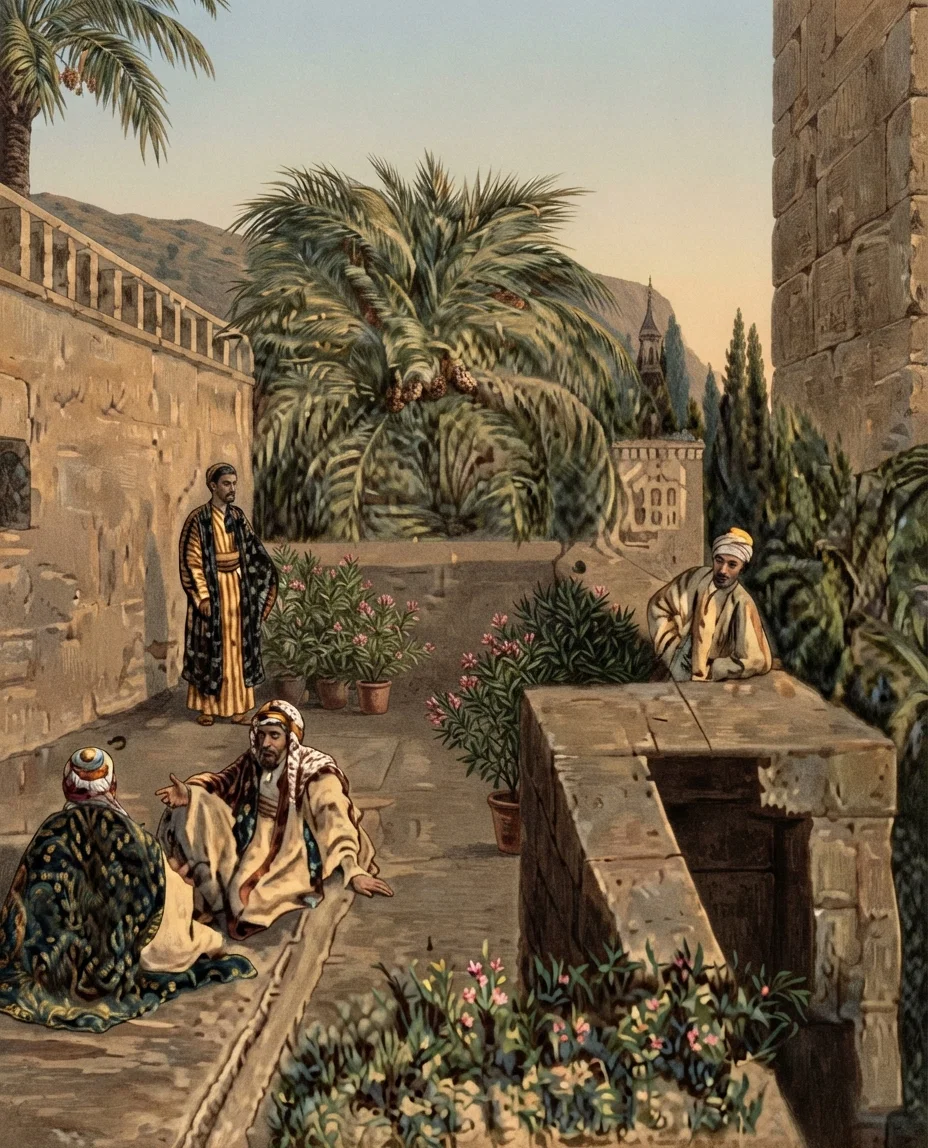
26 "But an angel of the Lord spake unto Philip, saying, Arise, and go toward the south unto the way that goeth down from 27 Jerusalem unto Gaza; the same is desert. And he arose and went; and behold, a man of Ethiopia, a eunuch of great authority under Candace, queen of the Ethiopians, who was over all 28 her treasure, who had come to Jerusalem for to worship; and he was returning and sitting in his chariot, and was reading 29 the prophet Isaiah. And the Spirit said unto Philip, Go near, and join thyself to this chariot. And Philip ran to him, and 30 heard him reading Isaiah the prophet, and said, Understand31 est thou what thou readest? And he said, How can I, except some one shall guide me? And he besought Philip to come up 32 and sit with him. Now the place of the scripture which he was reading was this,
He was led as a sheep to the slaughter;
And as a lamb before his shearer is dumb,
So he openeth not his mouth;
33 In his humiliation his judgment was taken away;
His generation who shall declare?
For his life is taken from the earth.
34 And the eunuch answered Philip, and said, I pray thee, of whom speaketh the prophet this? of himself, or of some other? 35 And Philip opened his mouth, and beginning from this scrip36 ture, preached unto him Jesus. And as they went on the way, they came unto a certain water; and the eunuch saith, Behold, 37 here is water; what doth hinder me to be baptized? And Philip said, If thou believest with all thy heart, thou mayest. 38 And he answered and said, I believe that Jesus Christ is the Son of God. And he commanded the chariot to stand still; 39 and they both went down into the water, both Philip and the 40 eunuch; and he baptized him. And when they came up out of the water, the Spirit of the Lord caught away Philip; and the eunuch saw him no more, for he went on his way rejoicing. 40 But Philip was found at Azotus; and passing through he preached the Gospel to all the cities, till he came to Cæsarea."
QUESTIONS.
What did Peter and John do after preaching in Samaria?
Where was Philip told to go, and by whom? What was the nature of the place to which he was to go?
Did he obey the voice? Give the words of the text.
Who was passing that way just as he reached the place? What was this man's position and influence? Where had he been, and for what purpose?
Where was he going, and what was he doing as he journeyed?
What command did Philip receive? From whom?
What did Philip do?
As Philip approached the chariot, what did he hear? What question did he ask?
What was the eunuch's answer? What did he desire?
Repeat the scripture that he was reading. Where is it found?
What question did the eunuch ask Philip?
What did Philip then do?
To what did they come as they passed on? What did the eunuch exclaim? What did he desire?
On what condition did Philip say baptism could be administered? What was the eunuch's confession of faith?
What did he then do? Where did both Philip and the eunuch go?
What took place when they had come up out of the water? With what feelings did the eunuch proceed on his journey?
Where was Philip found, and what did he do?
SUGGESTIVE QUESTIONS.
With what did Philip show himself to be well acquainted?
Mention the different things by which he showed his quick perception of the voice of the Spirit.
It speaks highly for Philip's promptness and obedience that he willingly turned from his brilliant success in the city of Samaria to go into the desert.
The Sunday School
International Series.
LESSON II.—SUNDAY, OCTOBER 10, 1897.
PAUL A PRISONER AT JERUSALEM.
NOTE.—This is an important lesson, and much hinges upon it. The whole section should be carefully studied, including Acts 21:18 to 23:11. It is the story of Paul's fifth visit to Jerusalem. It would be well also for each teacher to draw a map of the temple and its courts, showing the parts which were forbidden to the Gentiles, the different gates, and the place where Paul was rescued. It had now been twenty-one years since Paul's conversion. His last report was rendered to the church eight years previous to this occasion. Much work had been accomplished during these eight years. During this time two of his long missionary journeys had been made; he had visited the churches which he had previously established in Asia Minor; had opened up the work in Europe, establishing churches at Philippi, Corinth, and Thessalonica, as well as at Ephesus, in Asia Minor; he had been the instrument of many conversions, had wrought many miracles, and had carried contributions to the poor of Jerusalem.
17 "And it came to pass, that, when I had returned to Jerusalem, and while I prayed in the temple, I fell into a trance, and 18 saw him saying unto me, Make haste, and get thee quickly out of Jerusalem; because they will not receive of thee testimony 19 concerning me. And I said, Lord, they themselves know that I imprisoned and beat in every synagogue them that believed on 20 me; and when the blood of Stephen thy witness was shed, I also was standing by, and consenting, and keeping the gar21 ments of them that slew him. And he said unto me, Depart; for I will send thee forth far hence unto the Gentiles.
22 "And they gave him audience unto this word: and they lifted up their voice and said, Away with such a fellow from the 23 earth: for it is not fit that he should live. And as they cried out, and threw off their garments, and cast dust into the air, 24 the chief captain commanded him to be brought into the castle, bidding that he should be examined by scourging, that he might know for what cause they so shouted against him. 25 And when they had tied him up with the thongs, Paul said unto the centurion that stood by, Is it lawful for you to scourge a man that is a Roman, and uncondemned? And when the cen26 turion heard it, he went to the chief captain, and told him, saying, What art thou about to do? for this man is a Roman. 27 And the chief captain came, and said unto him, Tell me, art thou a Roman? And he said, Yea. And the chief captain 28 answered, With a great sum obtained I this citizenship. And 29 Paul said, But I am a Roman born. Then they which were about to examine him straightway departed from him; and the chief captain also was afraid, when he knew that he was a Roman, and because he had bound him.
30 "But on the morrow, desiring to know the certainty, wherefore he was accused of the Jews, he loosed him, and commanded the chief priests and all the council to come together, and brought Paul down, and set him before them."
Golden Text.—"If any man suffer as a Christian, let him not be ashamed." 1 Peter 4:16.
SUGGESTIVE QUESTIONS.
(1) After Paul's conversion at Damascus, to what place did he return? Verse 17. (2) To what place did he resort for worship? Same verse. (3) What occurred to him while at prayer? Same verse. (4) While in this condition what message did Paul receive? Verse 18. (5) What reason did the giver of this message state for Paul's departure? Same verse. (6) Who was the messenger? Verse 19. (7) What did Paul say that the people knew concerning him? Same verse. (8) What does Paul call Stephen? Verse 20. (9) What confession does Paul make to the Lord in regard to Stephen's martyrdom? Same verse. Note 1. (10) But what command did the Lord give him? Verse 21. (11) Where did the Lord tell Paul that he would send him? Same verse. (12) What occurred when Paul had proceeded thus far in his narrative? Verse 22. Note 2. (13) What did they say of Paul? Same verse. (14) How did they manifest their hatred of him and the work in which he was engaged? Verse 23. (15) In consequence of the uproar, what did the captain command to be done with Paul? Verse 24. (16) Why did he wish Paul examined? Same verse. Note 3. (17) What preparation was made toward carrying out the captain's command? Verse 25. (18) What question did Paul ask of the centurion? Same verse. (19) On hearing this question, what did the centurion do? Verse 26. (20) What caution did he give to the captain? Same verse. Note 4. (21) What question did the captain ask of him? Verse 27. (22) How did Paul answer? Same verse. (23) How did the captain say that he had attained Roman citizenship? Verse 28. (24) What did Paul reply? Same verse. Note 5. (25) What did those do who were preparing to examine Paul? Verse 29. (26) What effect did the knowledge of Paul's citizenship have upon the captain? Same verse. (27) On the following day what did the captain do with Paul?
NOTES.
1. I also was standing by.—It would seem that Paul was here speaking of his persecutions of the Christians to show a reason why he should remain at Jerusalem to undo the wrong which he had done to the disciples of the Lord. It would also seem that Paul was setting forth to the Lord his own unfitness to bear the Lord's message, inasmuch as he had consented to the death of one of the Lord's own messengers. But the command was imperative. The Lord knew for what Paul was best fitted, where he could accomplish the most good, and Paul obeyed that command.
2. Gave him audience unto this word.—That is, they listened to him until he had spoken thus far, and then their pent-up feelings burst forth anew, and their fury knew no bounds. Almost the very same expression is used by the mob here as was heard just before Christ was turned over to the infuriated mob. When men attempt to defend religion or religious customs by passion, deeds of violence, or the "arm of the law," just such wickedness is manifest as is here portrayed. Christ taught a nobler way; such deeds are not of him.
3. That he might know.—The captain was not a Roman by birth. He was one of many who purchased their citizenship and had, of course, been educated in some foreign tongue. So he did not understand the Hebrew language, the language in which Paul was making his defense, and of course knew nothing of the reason for such an uproar.
4. Take heed what thou doest.—There was power in the question which Paul asked of the centurion, because of the power of the Roman law, and its wonderful influence was manifest in an instant. The centurion knew that no one would dare to claim the protection of Roman citizenship if it did not belong to him, for it would mean certain death. "How often," says Cicero, "has this exclamation, I am a Roman citizen, brought aid and safety even among barbarians in the remotest parts of the earth." It was contrary to the Roman law for a Roman to be scourged under any circumstances, or to be tried by torture, or indeed to be subjected to any punishment without proper trial.
5. I am a Roman born.—Paul was born of Jewish parents at Tarsus in Cilicia. He traced his lineage to the tribe of Benjamin, and belonged to the sect of Pharisees. Being born in Cilicia, a Roman colony, Paul inherited the rights of a Roman citizen, and it was this fact which led finally to his preaching the Gospel in Rome itself.
BIBLES! BIBLES!!
In All Styles and at All Prices.
WE SELL a fine silk-sewed, leather-lined BIBLE in pearl type at $1.00. Have them in other sizes of type as low as 30c, and as high as $19.
TEACHERS' BIBLES
REFERENCE BIBLES
TEXT BIBLES
All Bindings, All Sizes of Type.
Send for our new 20-page catalogue.
PACIFIC PRESS PUBLISHING CO., Oakland, Cal.
18 W. 5th St., Kansas City, Mo. 43 Bond St., New York City.
PORK: or the Dangers of Pork Eating Exposed, is the title of a 16-page illustrated tract that is deserving of a large circulation. Get it, read it, and send it to your friends. Price, two cents per copy. Address PACIFIC PRESS, Oakland, Cal.
PERIODICALS WANTED.
CLEAN copies of the Signs, Instructor, and Our Little Friend will be used in missionary work if sent post-paid to H. M. Oliphant, Hollister, Cal.
News and Notes
FOREIGN.
—Eleven persons were killed by the explosion of a boiler at Honstaedt, Austria, on September 10.
—By the recent floods in Japan, between thirty and forty lives were lost, and nearly 2,000 dwellings destroyed.
—It is announced that peace has been declared between the president of Uruguay and the Uruguayan insurgents.
—The pope has appealed to France to oppose the plans of the Jews for the purchase and colonization of Palestine.
—A large house-boat on the Yang-tse-kiang River was capsized recently, drowning thirty Chinese girls with their servants and the boat's crew.
—The British steamer Polyphemus collided with another vessel in the Red Sea on September 11, and twenty-seven of her crew were drowned.
—It is stated that not more than 5,000 of the women of Constantinople are able to read and write. The population of the city is nearly a million.
—A disastrous explosion of dynamite took place in a Johannesburg, South Africa, gold mine on September 10, killing five white men and twenty-five Kaffirs.
—The German Jewish rabbis have declared against Zionism, that is, the purchasing and colonizing of Palestine, believing it to be contrary to the prophecies of Judaism.
—Officials of the Greater Republic of Central America have now expressed their wish to receive Capt. W. L. Merry, the recently accredited minister to the Central American States.
—The presidential election of Venezuela was concluded on Sunday night, September 12, and, as a result, General Ignacio Andrade, the Liberal leader, has been elected to the presidency.
—Many of the miners killed or injured by deputies at Latimer, Penn., are Austro-Hungarian subjects, and it is reported that the Austrian Government will demand full satisfaction and the punishment of those implicated.
—Labor unions of Great Britain are now arranging for a federation of all labor organizations, in order that the co-operation of all laborers in the United Kingdom may be enlisted in the fight against corporate capital.
—A revolt, said to be assuming serious proportions, has broken out in the western part of Guatemala. The government has asked the Pacific Mail Steamship Company to transport troops to the seat of the disturbance.
—The rebellious natives of India now number 47,000, and are besieging various British posts with varying success. The English have 59,000 troops mobilized on the frontier, and everything is reported ready for the advance from Shabkadr.
—The town of Consolacion del Sur was captured by the Cubans on September 9, and the entire garrison slain. This garrison, consisting of 200 men, had been marked for death, as it was composed mostly of deserters from the Cuban army.
—The United States minister to China announced recently that the Chinese Government is about to accede to America's demands in regard to adequate protection for American missionaries in whatever part of China they may choose to locate for work.
—Despatches from Constantinople state that all the "peace" ambassadors of the powers are in receipt of instructions from their respective governments, which will enable them to come to a speedy settlement of the terms of peace between Greece and Turkey.
—From reports received from London, it seems that the Bank of England has decided to hold one-fifth of its reserve in silver. This is considered a concession to bimetalism, and is arousing considerable opposition on the part of many eminent English journalists.
—Señor Sagasta, the Spanish Liberal leader, in an interview on the Cuban question, has admitted that the Cuban rebellion is spreading. He also states that the trouble in the Philippines is very serious, and that the Carlist movement at home demands serious consideration.
—It is reported that negotiations are in progress for the purchase of the Panama Canal by the British Government, which will complete and control this commercial waterway. Investigations by the United States Government are in progress to determine whether the report is authentic.
—Carlotta, ex-empress of Mexico, widow of Maximilian and sister of the king of Belgium, is said to be so dangerously ill that her death is feared at any moment. It was her ambition that brought about the death of Maximilian, and his execution threw her into insanity. She is now fifty-seven years old.
—A peculiar and disastrous explosion took place at the Panuelas quarry on the Vera Cruz Railway, Mexico, on September 11. An unusually large blast was set off by the workmen, and then workmen and spectators rushed forward to witness the result, when gases in the air exploded, killing twenty-four persons.
—The rebellious natives of India are reported to be flying before the British relief forces, which have reinforced a number of besieged forts, and recaptured some that had been taken by the rebels.
—General Weyler is now engaged in destroying large numbers of Cuban towns, which he has not troops enough to garrison, leaving the inhabitants without food or shelter. It would seem that it is the purpose of the Spanish officials to make the island a desolate waste, before abandoning it to the Cubans.
—According to reports from Honolulu, it seems that the Japanese Government has only agreed to arbitrate certain minor questions in dispute between the two countries. The Hawaiian minister of foreign affairs has requested the Japanese minister to define more clearly the points which Japan will agree to submit to arbitration.
—A Presbyterian missionary in China states that "there is a movement toward Christianity throughout Manchuria. The people in large numbers are casting out their idols, and taxing the powers of missionaries to provide native teachers, who, in their turn, are overwhelmed with the great numbers with whom they have to deal."
—Lieutenant-General von Shack, a Russian army officer and member of the Lutheran Church, was commanded to join the Russian State Church or resign his commission. He chose to join the Russian Church, and then committed suicide in remorse for his act. Thus is repeated the wicked farce of a union of Church and State.
—A despatch from Constantinople states that the sultan has appointed a commission consisting of two Mussulmans, three Armenians, and one Greek to visit the Armenian villages which have been the chief sufferers from the recent massacres, and raise funds to rebuild the Armenian schools, churches, and monasteries, and build orphanages. The commission is to start immediately.
—General Prospero Morales is leading the rebellion in Guatemala, which is said to be supported by men of great wealth. Severe fighting is reported from the western part of the State. The State Department at Washington has asked the Navy Department to send a war ship to Guatemala to watch over American interests, and the Alert has been ordered to the scene of trouble.
—At Los Palacios, Cuba, thirty persons died of hunger on September 11, and this is declared to be but a sample of other days. The majority of the inhabitants of other towns in Pinar del Rio province are said to be crowding the streets begging for relief, and the same awful consequences of misrule that are reported from Los Palacios are seen even in the capital of the province.
—Great excitement was caused in Madrid on September 10, by the report that the city of Victoria de las Tunas, Cuba, had been captured by the insurgents. It is one of the most important fortified towns on the island, and the report of its capture was for a time denied; but it seems now that it was authentic, tho the loss of the Cubans in the attack is reported to be about 200.
—There now seems to be an indication that the English and French expedition in Africa may meet on the upper Nile, if the British advance beyond Berber the present year. It is rumored that the French expedition is heading for Khartoum, to forestall the English in its occupation. If the report proves true, there is likely to be serious trouble between these two nations.
—The bishops of the Russian State Church have agreed to demand of the czar that Tolstoi and his followers be prosecuted; that all the sectarian schools be closed; that dissenters from the State Church be sent to Siberia; and that the publication of Lutheran books in the Russian language be prohibited. The more violent of the bishops further propose that the property of the sectarians be confiscated.
—A report comes from Argentina to the effect that locusts are destroying the crops in that country. The large wheat yield of Argentina was looked to by the poor of Europe and Asia as a retarding influence on the continued upward rise in the price of wheat. If this report proves true, and Russia continues to refuse to export wheat, there will be much suffering during the coming year among the poor of the eastern countries.
—A report from fourteen of the thirty-two counties of Ireland shows a most distressing prospect for the coming autumn and winter. Long-continued rains have rotted the potatoes, and prevented the harvesting of hay and oats; and the landlords, knowing that the little which the peasants have in the banks will be gone before spring, are pressing for their rents, and thus making more sure the famine which now seems inevitable.
DOMESTIC.
—Mining property valued at over $60,000 was destroyed by fire at Keswick, Cal., on September 13.
—At a meeting of the Christian Alliance at Old Orchard, Maine, a contribution of $70,000 was made for foreign missionary work.
—A train wreck occurred on the Iron Mountain road at Nansen, Indian Territory, on September 12, and seven men who were stealing a ride were instantly killed.
—Seymour Brothers, of New York, stock and grain brokers, with offices in various parts of the country, failed on September 15, with liabilities of nearly $1,000,000.
—The strike among the Pennsylvania miners is rapidly spreading. It is reported that fully 10,000 men are idle in that State, and it is expected that every colliery in that region will be closed in a few days.
—Five robbers who were arrested at Versailles, Indiana, on September 14, were taken from the jail by a mob and lynched. They had terrorized the community for years, subjecting their victims to all manner of cruelties.
—At Sabine Pass and Port Arthur, Texas, considerable loss of life and destruction of property were occasioned by a cyclone on September 14. Authentic reports place the death list at sixteen, while a large number were injured.
—The Methodist Protestant makes the statement that the trustees of a Methodist Church in Alabama have introduced a tax of $10 per annum upon every member of the congregation who chews tobacco. It is said to "work well."
—Another carrier pigeon purporting to come from Herr Andree at the North Pole, was captured near Logansport, Indiana, on September 13. The bird was marked "No. 21. A.," and the message which it carried read, "August 29, pole. Andree."
—The president has been asked to provide means for alleviating the distress which is bound to be felt in Alaskan mining camps during the coming winter, and the matter has already been brought before the cabinet, tho no definite action has yet been taken.
—E. B. Andrews, president of Brown University, has withdrawn his resignation, and will again take up the duties of that position. He will not conduct the Cosmopolitan University, the presidency of which had been offered him by the editor of the Cosmopolitan Magazine.
—The national troops have been ordered to the Zuni Indian reservation to arrest certain members of that tribe for cruelties inflicted upon "witches." The Zuni Indians have a strong force of braves, and it is feared that there will be trouble when the attempt is made to arrest them.
—The steam whaling vessel Navarch, of San Francisco, has been lost in the Arctic Ocean. Of her crew of fifty men only six were saved, who, with the captain and his wife, left the vessel and were picked up by the revenue cutter Bear. It is believed that the others have gone down with the vessel.
—Ten persons were killed by a head-on collision on the Santa Fe Railroad near Emporia, Kansas, on September 8, between an east-bound mail train and a west-bound express. William J. Bryan was a passenger on one of the trains, but escaped injury, and rendered valuable assistance to the less fortunate passengers.
—A serious head-on collision occurred near New Castle, Colorado, on September 10, between a passenger and freight train. It has been impossible to arrive at a definite knowledge of the number killed, as the wreck caught fire, and many of the bodies were cremated. The number who lost their lives is placed by some as high as twenty-five.
—Yellow fever is spreading among a number of towns on the gulf coast, and there is said to be a considerable exodus of people from these towns, and from some of the larger cities of the south. The government expert on yellow fever predicts a further spread of the plague, basing his prediction upon the fact that there is in the infected region abundance of material for the fever to feed upon.
—Twenty miners were killed and forty or more wounded at Latimer, Pennsylvania, on September 10, by bullets from the rifles of deputy sheriffs who were opposing the marching of the miners. The feeling in the vicinity of the terrible tragedy is strongly against the sheriff and his deputies, and by many the shooting is denounced as a cold-blooded massacre. The governor, fearing vengeance on the part of the miners, has ordered out the State troops who are now in command of the district.
—At a meeting of the Social Democracy, held in Chicago on September 12, among other expressed sentiments of a revolutionary nature, it was declared that "the time has passed for a passive resistance, and it is time for a great revolution in this country. The plutocracy of the country has the federal militia behind it, the State militia behind it, and the judges and deputy sheriffs behind it." It was reported that at this meeting were voiced the most revolutionary sentiments ever uttered since the days of Spies and Parsons.
—The San Francisco Examiner sent, July 23, an expedition to the Klondyke by the Chilcoot Pass, consisting of Joaquin Miller, E. J. Livernash, and William Kreling. They reached there August 15, 12 days by boat from the head-waters of the Yukon, 14 days from the coast, 15 from Juneau, 16 from Seattle, and 23 from San Francisco. Livernash made the trip a day ahead of this. They report much sickness, and probable suffering, but no starvation. The mail was sent out by the "Jack Dalton Trail" from Fort Selkirk, one day by steamer, and 16 days by horse, to tide water in Alaska.
New Teachers' Bible
By Editor
During October, November, and December, we will send the
# SIGNS OF THE TIMES for one year and our
New Teachers' Bible
To New Subscribers for $3.00. Last winter we gave a Bible with the SIGNS to new subscribers only, but we received so many requests from old subscribers for a Bible that we have decided to include them also in our offer for the next few months. We will therefore send this Bible to Old Subscribers Who Renew for One Year, for the same price as to new, and if your present subscription does not expire for several months, and you wish to obtain the Bible, renew during the time of the offer, sending us $3.00, and we will extend your subscription one year from the present date of expiration.
Extravagant words are really unnecessary in describing this book, as we make no representations not in accordance with the facts. Those competent to judge, who have examined this Bible, say that we are making a
REMARKABLE OFFER
and that subscribers who get this book will get a splendid Bible for the money. If you are not satisfied we will refund your money; but we have no fears. We are positive that you will wonder that we can give such a good book and the paper for the price. The Bible is an
S. S. TEACHERS' EDITION
minion type (the style most used), with references, divinity circuit, round corners, red under gold edges, size of page 5½x8 inches, cover leather lined to edges—an important adjunct to the substantial nature of the binding. It contains over
650 Pages of Valuable Bible Helps
Including the immense
New Illustrated
Bible Treasury
Containing sections on the Old and New Testaments, History and Chronology of the Bible; Geography and Astronomy of the Bible; Birds, Animals, Plants, Fishes, Calendars, Weights, Measures, etc., in short, a
BIBLE DICTIONARY
with over 350 Illustrations, the larger part being fine half-tones, clearly and beautifully printed. An entirely new and exceedingly fine feature of this Bible is the
COMBINED BIBLE CONCORDANCE
which includes, in one alphabetical list, a Concordance, Subject Index, and Dictionary of Proper Names. This must be seen to be appreciated. Besides the above is a set of
TWELVE COLORED MAPS
with complete index. All told, this is a rare chance to get the SIGNS and a fine, substantial Bible at an exceedingly low figure.
Specimen Page of the ILLUSTRATED BIBLE TREASURY
Copyrighted by Thomas Nelson & Sons
TREASURY OF ANTIQUITIES, ETC.
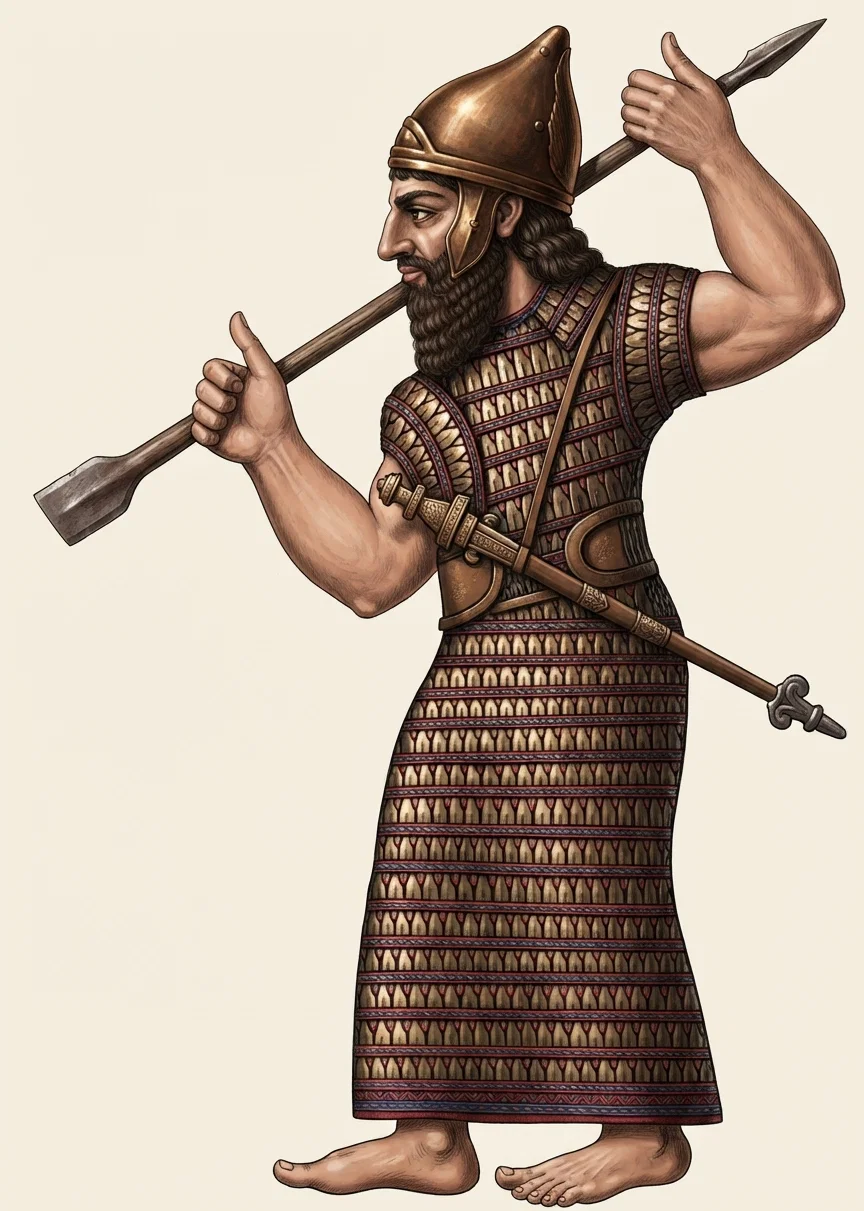
ASSYRIAN HEAVY-ARMED SOLDIER.
given in Eph. 6, the apostle has probably the accoutrements of a Roman soldier before his mind.
Down to the age of David the army of Israel consisted exclusively of foot-soldiers. These were probably divided into two classes—the heavy-armed, wearing helmet, coat of mail, and greaves, and armed with sword, one or two javelins, and a heavy spear; and the light-armed, wearing helmet and corselet of leather, and armed with sword, bow, and sling. In either case there might be added the heavy marching boots referred to by Isaiah (9. 5), "every boot of the booted warrior."
The metal which was earliest employed in the manufacture of weapons was bronze (n'choscheth), probably an alloy of copper and tin, which the Israelites mined for themselves (Deut. 8. 9). This is the same word which in A.V. is sometimes translated "steel," but elsewhere, and always in R.V., "brass." The use of iron followed later, being introduced in all likelihood from Mesopotamia (cf.Jer. 15. 12). It is uncertain whether the Israelites ever mined or cast iron for themselves.
Armor-bearer (1 Sam. 16. 21). — A servant or squire who frequently accompanied a warrior to the field, in order to carry his heavier weapons, and also to protect him during the battle by means of the huge full-length shield.
Artillery (1 Sam. 20. 40). — A general name for weapons. The word was used to include crossbows, bows, etc., long before the invention of gunpowder.
Assassins (Sicarii, Acts 21. 38, R.V.). — The most desperate section of the Zealots during the last years of their conflict with Rome. They carried daggers for secret use.
Avenger. — Hebrew custom, like that of many other early peoples, authorized and even required the next-of-kin to avenge a murdered person by killing his murderer (2 Sam. 14. 7 ff.). The custom was too deeply rooted to be suddenly abolished, and the Mosaic legislation aimed only at mitigating its effects by providing cities of refuge, in which a homicide might escape, and where he might claim a fair trial (see Num. 35. 9-32; Deut. 19. 1-10).
Baptism. — A symbolic washing or bathing, signifying repentance, the putting away of sin, and the beginning of a new life. It appears first in the New Testament in connection with the ministry of John the Baptist (Mat. 3. 6), and afterwards in connection with the preaching of the apostles, both during (John 4. 2) and after (Acts 2. 38) the lifetime of Jesus.
Battlement (Jer. 5. 10, but R.V. "branches"). — A parapet along the top of a wall to protect those fighting on the fortification. In Deut. 22. 8 the word refers to a parapet on the roof of a private house, which, being flat and used as a sleeping-place, required such a protection to prevent accidents.
BATTLEMENT.
Beacon (Isa. 30. 17). — The same word is translated "ship's mast" in Isa. 33. 23, and the picture it is intended to convey is probably that of a solitary pine-tree. The nation which had been like a thick forest had been reduced, as it were, to a single tree alone on a mountain top.
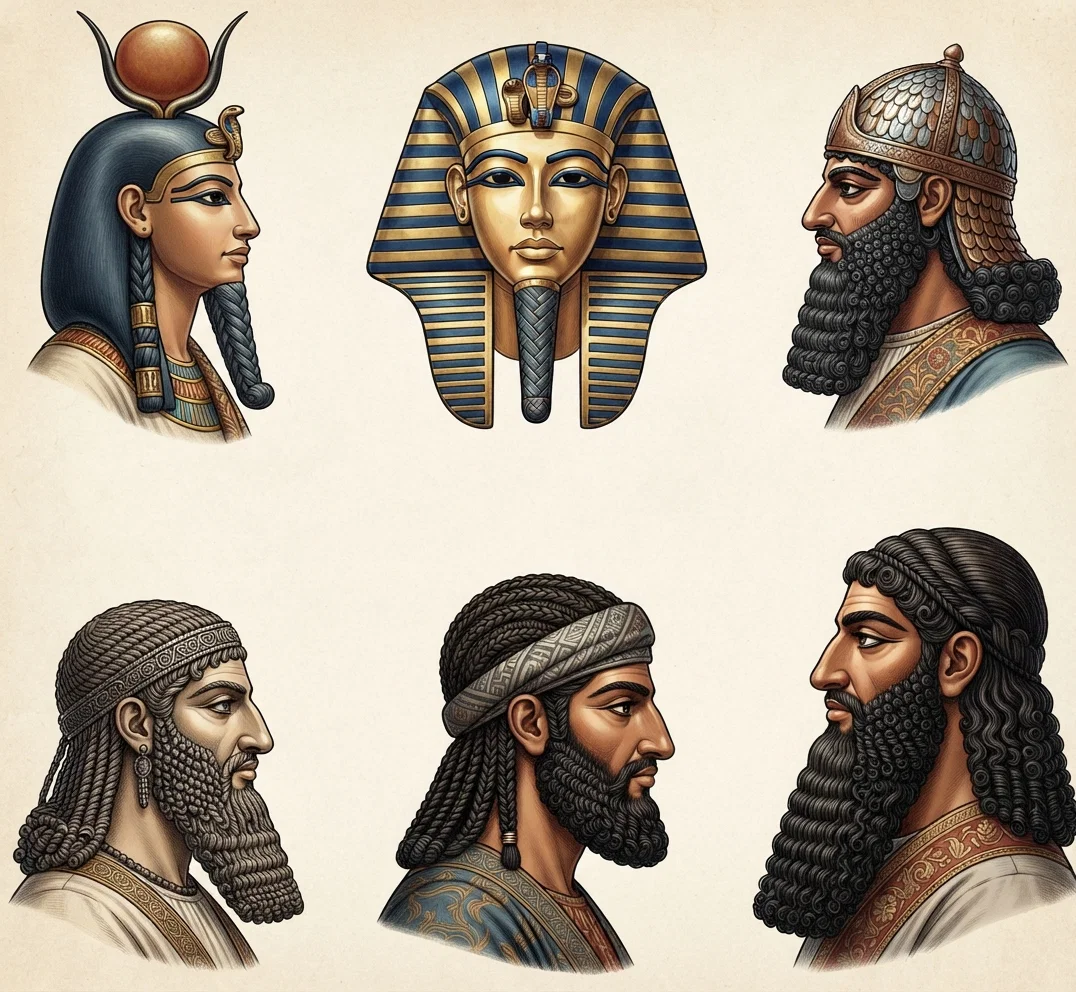
Beard (Lev. 19. 27). See also HAIR. — Beards were worn long and carefully trimmed. To neglect the beard was a sign of mourning (Isa.
Assyrian BEARDS.
FREE
By Editor
By securing for us a few subscribers to the SIGNS you can get the Bible FREE as follows:—
We will send a Bible free, postpaid, to any one sending us Seven New Subscriptions at one time, for one year each, and $7.00.
You can get the Bible at a merely nominal cost, as follows:—
1. We will send the Bible postpaid to any one sending us $3.75 for two new subscribers to the SIGNS, or for one new name and one renewal, for one year each, all sent at one time.
2. We will send the Bible postpaid to any one sending us $4.50 for three new subscribers to the SIGNS, or for two new names and one renewal, for one year each, all sent at one time.
3. We will send the Bible postpaid to any one sending us $5.00 for four new subscribers to the SIGNS, or for three new names and one renewal, for one year each, all sent at one time.
Bibles Available With Subscription Offers
By Editor
If any subscribers under any of these offers desire Bibles, add $2.00 for each one wishing a Bible.
OUR OFFER
By Editor
The SIGNS OF THE TIMES one year and the BIBLE to a new name, postpaid,
The Same Price to Old Subscribers who Renew for One Year
$3.00
Bible Not Sold Separately
By Editor
Note.—We can not sell the Bible separate from the above offers.
Bibles and Papers Sent Separately
By Editor
Note.—The Bibles and papers will be sent to different addresses if desired.
Signs of the Times
By Editor
Address,
Signs of the Times
Oakland, Cal.
Subscription Offer Dates
By Editor
This offer goes into effect Oct. 1, 1897, and will continue through October, November and December.