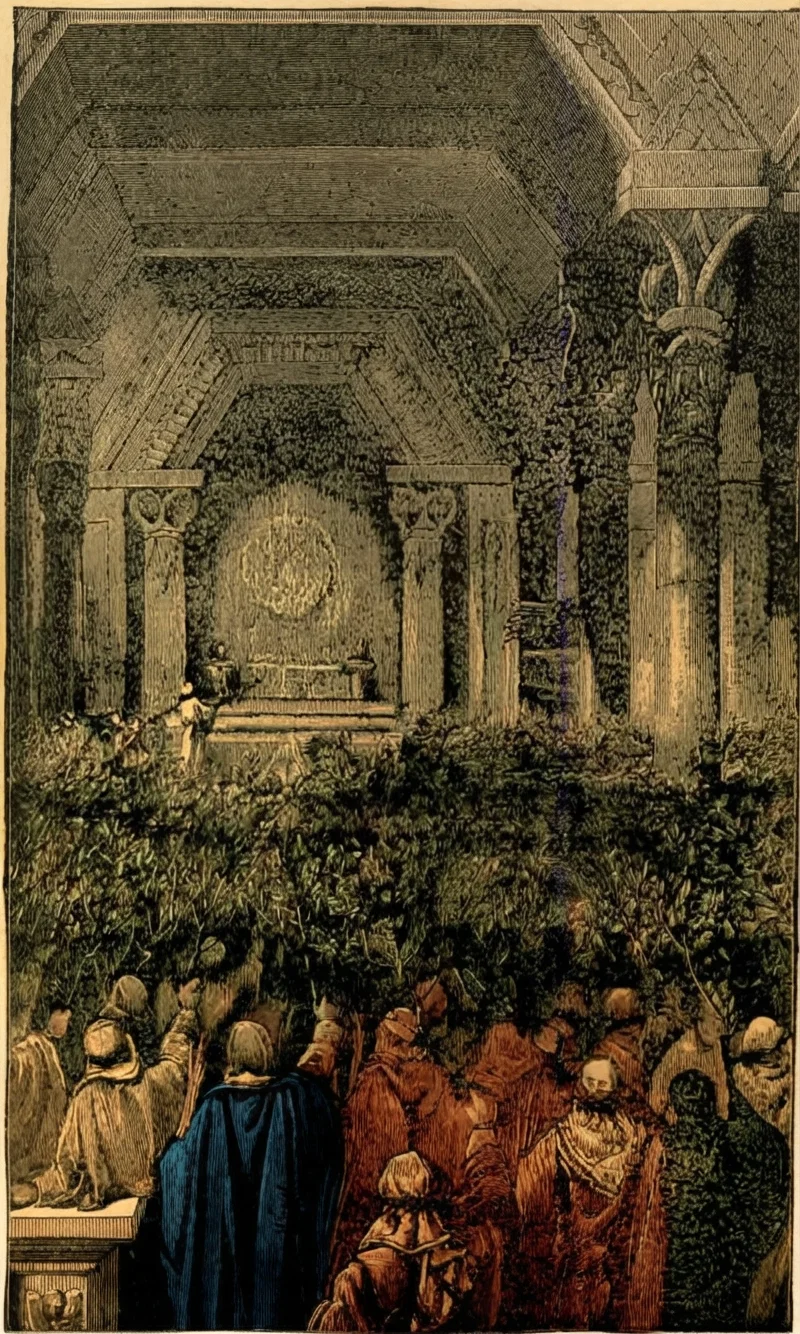
THREE times a year the Jews were required to assemble at Jerusalem for religious purposes. Enshrouded in the pillar of cloud, Israel's invisible Leader had given the directions in regard to these gatherings. During the captivity of the Jews, they could not be observed; but when the people were restored to their own land, the observance of these memorials was once more commenced. It was God's design that these anniversaries should call him to the minds of the people. But with few exceptions, the priests and leaders of the nation had lost sight of this purpose. He who had ordained these national assemblies and understood their significance, witnessed their perversion.
The Feast of Tabernacles was the closing gathering of the year. It was God's design that at this time the people should reflect on his goodness and mercy. The whole land had been under his guidance, receiving his blessing. Day and night his watchcare had continued. The sun and rain had caused the earth to produce her fruits. From the valleys and plains of Palestine the harvest had been gathered for future use. The olive berries had been picked, and the precious oil stored in bottles. The palm had yielded her store. The purple clusters of the vine had been trodden in the wine-press.
This feast continued for seven days, and for its celebration, the inhabitants of Palestine, with many from other lands, left their homes, and came to Jerusalem. From far and near the people came, bearing in their hands a token of rejoicing. Old and young, rich and poor, all brought some gift as a tribute of thanksgiving to Him who had crowned the year with His goodness, and made His paths drop fatness. Everything that could please the eye, and give expression to the universal joy, was brought from the woods; the city bore the appearance of a beautiful forest. Booths or tabernacles of boughs were erected in the streets, in the courts of the temple, or on the housetops. The hills and valleys surrounding Jerusalem were also dotted with these leafy dwellings, and seemed to be alive with people.5With sacred song and thanksgiving the worshipers celebrated this occasion. "O give thanks unto the Lord; for he is good; for his mercy endureth forever," arose triumphantly, while all kinds of music accompanied the united singing. The hills were made vocal, as the vast multitude, waving their branches of palm or myrtle, took up the strain and echoed the chorus.
At the first dawn of day, the priests sounded a long, shrill blast upon their silver trumpets, and the answering trumpets, and the glad shouts of the people from their booths, echoing over hill and valley, welcomed the festal day. Then the priest dipped from the flowing waters of the Kedron a flagon of water, and, lifting it on high, while the trumpets were sounding, he ascended the broad steps of the temple, keeping time to the music with slow and measured tread, chanting meanwhile, "Our feet shall stand within thy gates, O Jerusalem." He bore the flagon to the altar, which occupied a central position in the temple court. Here were two silver basins, with a priest standing at each one. The flagon of water was poured into one, and a flagon of wine into the other; and the contents of both flowed into a pipe which communicated with the Kedron, and was conducted to the Dead Sea. This display of the consecrated water represented the fountain that at the command of God had gushed from the granite rock to quench the thirst of the children of Israel. Then the jubilant strains rang forth, "The Lord Jehovah is my strength and song;" "therefore with joy shall we draw water out of the wells of salvation."
As the sons of Joseph made preparation to attend the Feast of Tabernacles, they saw that Christ made no movement signifying his intention of attending. They watched him with anxiety. Tho they did not rank themselves with his disciples, yet they were impressed by his works, and they hoped that he would give an evidence of his power that would lead the Pharisees to see that he was what he claimed to be. What if he were the Messiah, the Prince of Israel! They cherished this thought with proud satisfaction.
So anxious were they about this that they urged Christ to go to Jerusalem. "Depart hence," they said, "and go into Judea, that thy disciples also may see the works that thou doest. For there is no man that doeth anything in secret, and he himself seeketh to be known openly. If thou do these things, show thyself to the world." They had witnessed his works, and when it was rumored that he spent his night in prayer, after working all day, they with his mother came to him, thinking to compel him to cease from so continually taxing his strength. Now they said, "If thou do these things, show thyself to the world." The "if" expressed doubt and unbelief. They attributed cowardice and weakness to him. If he knew that he was the Messiah, if he really possessed such power, why not go boldly to Jerusalem, and assert his claims? Why not perform in Jerusalem the wonderful works reported of him in Galilee?
They reasoned from the selfish motives often found in the hearts of those ambitious for display. This spirit was the ruling spirit of the world. They were offended because, instead of seeking a temporal throne, Christ declared himself to be the Bread of Life. When he made this declaration, many of his disciples forsook him, and John says, "Neither did his brethren believe in him." They turned from him to escape the cross of acknowledging what his works revealed,—that he was the Sent of God.
WAVING PALM BRANCHES AT THE FEAST OF TABERNACLES.
Not Seeking the World.
"Then Jesus said unto them, My time is not yet come; but your time is alway ready. The world can not hate you; but me it hateth, because I testify of it, that the works thereof are evil. Go ye up unto this feast. I go not up yet unto this feast; for my time is not yet full come. When he had said these words unto them, he abode still in Galilee." His brethren had spoken to him in a tone of authority, prescribing the course he should pursue. He cast their rebuke back to them, classing them not with his self-denying disciples, but with the world. "The world can not hate you," he said; "but me it hateth, because I testify of it, that the works thereof are evil." The world does not hate those who are like it in spirit; it loves them as its own.
The world was not a place of ease and self-aggrandizement for Christ. He was not watching for an opportunity to seize its power or its glory. It held out no such prize for him. It was the place into which his Father had sent him. He had been given for the life of the world, to work out the great plan of redemption. He was accomplishing his work for the fallen race; but he was not to be presumptuous, not to rush into danger, not to hasten a crisis. Each event in his work had its appointed hour. He must wait patiently. He knew that he was to receive the world's hatred; he knew that his work would result in his death; but to prematurely expose himself would not be the will of his Father.
"When his brethren were gone up, then went he also up unto the feast, not openly, but as it were in secret." In the midst of the feast, when the excitement concerning him was at its height, he entered the court of the temple, in the presence of the multitude. Because of his absence from the feast, it had been urged that he dared not place himself in the power of the priests and rulers. All were surprised at his presence.
Standing thus, the center of attraction to that vast throng, Jesus addressed them as no man had ever done. His words were most clear and convincing, and again, as at Capernaum, the people were astonished at his teaching; "for his word was with power."
The feast was drawing to a close. The morning of the last crowning day found the people wearied from the long season of festivity. Suddenly Jesus lifted up his voice in tones that rang through the courts of the temple: "If any man thirst, let him come unto me, and drink. He that believeth on me, as the Scripture hath said, out of his belly shall flow rivers of living water." The condition of the people made this appeal very forcible. They had been engaged in a continued scene of pomp and festivity; their eyes had been dazzled with light and color, and their ears regaled with the richest music; but there had been nothing to meet the wants of the spirit, nothing to satisfy the thirst of the soul for that which perishes not. Jesus invited them to come and drink of the fountain of life, of that which should be in them a well of water, springing up into everlasting life.
The priest had that morning performed the imposing ceremony which represented the smiting of the rock in the wilderness. That rock was a symbol of Him who by his death would cause living streams of salvation to flow to all who are athirst. Christ's words were the water of life. There in the presence of the assembled multitude, he set himself apart to be smitten, that the water of life might flow to the world. In smiting Christ, Satan thought to destroy the Prince of life, but from the smitten rock there flowed living water. As Jesus thus spoke to the people, their hearts thrilled with a strange awe, and many were ready to exclaim with the woman of Samaria, "Give me of this water, that I thirst not."
The cry of Christ to the thirsty soul is still going forth, and it appeals to us with even greater power than it did to those who heard it in the temple on that last day of the feast. The fountain is open for all. The weary and exhausted are offered the refreshing draught of eternal life. Jesus is still crying, "If any man thirst, let him come unto me, and drink." "Let him that is athirst come. And whosoever will, let him take the water of life freely." "Whosoever drinketh of the water that I shall give6him shall never thirst; but the water that I shall give him shall be in him a well of water springing up into everlasting life."
Mrs. E. G. WHITE.
CONSOLATION.
By Hattie C. Kelley
"Knowing this, that the trying of your faith worketh patience." — James 1:3.
In the furnace of affliction
Must we ever, EVER stay?
Thou must kneel, in deep contrition,
Thou must wait, and trust, and pray.
Pass the trying time so slowly,
While life's lessons must be learned
From the Saviour, meek and lowly,
Who for sinners long has yearned.
Yes, "the Spirit's long been willing,
But the flesh is weak indeed;"
Lord, Thy love just now is filling—
Me with grace, to feel my need.
Come, thou helpless one and weary,
Rest thy head upon My breast;
Tho the way seems dark and dreary,
Come to Me, I'll give you rest.
List! I hear the invitation.
Saviour, I will follow Thee;
O, it gives sweet consolation
When Thou sayest, "Come to Me."
HATTIE C. KELLEY.
Crystal Valley, Mich.
Individual Work
Individual Work.—It is interesting to note that Mr. Charles Booth (no relative of the "General"), who probably knows more about the condition of the people of London than any other man, finds as the result of his studies that "almost every social and economic question . . . derives its ultimate practical importance from a more widely spread and more human care for the individual," and that the hope of uplifting the fallen lies not in State enterprise or collectivism, but in "the reform of the individual by the individual." God saves men, not in bulk, but as individuals; Christ died for the world, but only in that he tasted death "for every man;" therefore all who would join him in his work, must labor individually for individuals.
THE GOSPEL.
By Mrs. S. M. I. Henry
THE Gospel is very wonderful. We do not begin to appreciate what it is, and what it means to the human race. It is good news, glad tidings, great joy to all people, the power of God unto salvation even to those who could have no reason to expect anything but distress and disaster; and we are sent to take it out to the whole world. But, as with everything else, we must have it before we can give it away. It is also true that we can give no more than we have; that we can never tell any more than we know; so it is important that we know and have the whole Gospel as it concerns the physical as well as the spiritual man; for nothing less will meet the needs of a perishing world.
The object which Christ had in coming to this world was to actually save people from their sins, and the consequences of them. The annunciating angel said: "And she shall bring forth a son, and thou shalt call his name JESUS; for he shall save his people from their sins." Matt. 1:21. And afterward John, who had learned so much about the Gospel, said, "For this purpose the Son of God was manifested, that he might destroy the works of the devil." 1 John 3:8. But it seems questionable if even the church believes this.
A Discovery.
Within the last few weeks I have made a discovery as to how the Bible is received by Christian people at large. It came upon me like a stroke of lightning out of a clear sky; for I had never dreamed of such a thing. I find that many Christian leaders, and am afraid that almost the entire Christian world, instead of taking the Bible as it reads, are trying to "explain" and "spiritualize" it, so that it seems destined, as far as they are concerned, to vanish into thin air, leaving nothing which is of practical value to a lost world. I have all my life taken the Bible as it reads; and as long as I believed and taught the things which were of common belief with those among whom I associated, there was nothing to raise any point which would bring this fact to my notice.
Many have said to me, as I have been teaching the Bible in former years, "How very literal you are!" One minister said to me, "Do I understand that you take the Bible just as it reads?" I said, "Certainly; how else shall I take it?" "Well," he said, "if you take it that way, you will come out at a very queer place sometime;" and I suppose now he thinks I have come out at that queer place in the Sabbath truth. This I believe to be the trouble with the world to-day,—the Word of God has not been believed, is not believed by many who stand as preachers and teachers, hence these words which should mean so much mean but little, and that little a very uncertain quantity.
He Saves Now.
"He shall save his people from their sins." Actually save them. That is, he intends to save them right now—not simply wait until after the alchemy of the resurrection has done its work, or until some strange processes that are altogether beyond our reach and comprehension have happened, before we can be saved, as a "spiritualized Bible" teaches. Christ intends us to believe that he came to save us from our sins now. He intends to save the lost and the degraded to whom we are sent, just now, and make them pure enough and God-reliant enough to be respectable anywhere. It is our privilege to go to them with an experience of our own that will be a great big now to this Gospel, and demonstrate that it is given to save here in the world of sin from everything which can mar our lives, and which can hinder in the work which has been appointed for us.
Christ not only came to save, but he came to furnish the repentance which makes salvation possible. "Him hath God exalted with his right hand to be a Prince and a Saviour, for to give repentance to Israel, and forgiveness of sins." Many who have become conscious of sin, complain more of their inability to repent than almost anything else. "What is repentance?" "How shall I repent truly?" are to them perplexing questions, and any answers we may give will only add to the mystery. They will stumble over our best teaching about repentance; hence God took it upon himself to give it outright, just when it will be of practical use in a "work of grace;" and, as with all his gifts, it can be obtained in no other way; it is a free gift or nothing.
He will give repentance; that is, he will show things as they are, and our true relation to them; and we must accept this revelation as the end of controversy. When he has shown us ourselves, it is a true showing; and beholding ourselves and our sins as they are, will beget in us true penitential grief, if our sensibilities have not been utterly withered.
Repentance as Christ gives it is not a certain state of feeling, but a knowledge of the truth concerning ourselves, as well as of the authority of the God from which that knowledge has come. Anxiety about our feelings will hinder any work of salvation, by diverting us from things of vital moment. Feelings have their place, but not as facts. They are produced and changed constantly by things which we believe to be facts. An item of news distresses us; but in the midst of a great tide of sorrowful feeling the report is contradicted; we are convinced that exactly the reverse is the truth, and, presto, all our feelings change from sorrow to joy, simply because our belief as to the fact is changed. This is the only way that feeling is connected with repentance, or any other of the matters of salvation. If we believe that we are sinners, we must have sorrow; if we believe that Christ is a complete Saviour, we must have gladness.
What the Gospel Means.
Many do not realize that the Gospel means pure living, clean food, cleanliness of the body, and purity of atmosphere. These belong so much to the outward habit that many have almost considered it profanity to try to treat of them as a part of salvation; and yet salvation for multitudes of sinners must begin there. These are among the essentials in city-mission or any other kind of Gospel work. This is where our preaching of the Gospel may have to begin. Our first Gospel teaching may have to be to prepare food with our own hands, and illustrate the methods of correct living, as far as the physical is concerned. We may be compelled to make very practical applications of the word by which they are to be made clean, with scrubbing brush, soap and water, before we can teach the truth concerning the soul and salvation from sin. The sins which belong to unhygienic living, as well as those which may even be as a passport into "society," are just as deadly as those which lay men and women in the gutter. We must believe this with all our hearts before we shall be able to go out with the whole Gospel, and teach its saving truth to those people who need it.
"And we declare unto you glad tidings, how that the promise which was made unto the fathers, God hath fulfilled the same unto us their children, in that he hath raised up Jesus again; as it is also written in the second psalm, Thou art my Son, this day have I begotten thee. And as concerning that he raised him up from the dead, now no more to return to corruption, he said on this wise, I will give you the sure mercies of David. Wherefore he saith also in another psalm, Thou shalt not suffer thine Holy One to see corruption." "Whereby are given unto us exceeding great and precious promises; that by these ye might be partakers of the divine nature, having escaped the corruption that is in the world through lust." Acts 13:32-35; 2 Peter 1:4. The power of God as it was in the Lord Jesus Christ, made it impossible for him to see corruption even in his death; and as it saved him from corruption in death, it will surely save those to whom it is sent, from that corruption which is in the world through excessive appetite; for that is what the word "lust" means.
A Deadly Evil.
There is a great evil in the land, deadly as poison—deadly to physical and social life, as well as to the spiritual life; and it lies in the cradle with the little child. The salvation of the soul is limited by the material things which we take into our bodies, especially when they come into and destroy the strength of the little child. Many a child has grown up to find it very hard to accept Christ, very hard to believe that he could be saved at all, simply because he did not eat and drink the right things, and his physical system was so poisoned that he was not able to think the thoughts that would lead toward the truth. Such sinning is just as destructive as stealing, or murder, and yet it is practised in Christian homes. Many would be shocked if we should tell them that they were ruining the souls of their children by the things which they place upon the table. Children in their innocence are being eaten up by the poison of impurity, which is engendered by the "seasoning" which is put into their food; and salvation is made to seem impossible because of the lingering influence of the platter of flesh, the mustard pot, the pepper and vinegar cruets, and many other things of the same family. Against these we must contend with all our might, if we would make the Gospel practical to those who have the care of the coming generation. The great thing that some of us have been crying for is that we may have the material out of which to make a generation of men and women with clean thoughts and pure memories; but we have not yet found it. It is necessary to reform the children, and grow a generation, before we can begin to produce one of whom it would be at all possible to say that they have clean memories, because of the horrible pollutions resulting from the unclean and unhygienic living in the homes into which they were born.
A short time ago I received a request for prayer, for a young woman who had grown up in a "good Christian home" with such a tendency to impurity that it seemed impossible to save her. No one could understand the cause of her conduct, and wondered with amazement that such a thing could come out of such a home. But a glimpse of the regular diet of that family was sufficient for those who could read the language which they spake to make it all perfectly clear, to say nothing of social customs and personal habits. A menu principally of flesh, with all the highly seasoned accompaniments, late hours from early childhood, public display at church entertainments from the time she could lisp a sentence, with the sort of7admiration and flattery that a bright, beautiful child would receive under such conditions, and the extravagances in dress that always follow in the wake of these other abominations, had made it impossible for her to grow up with natural and pure impulses. She is not saved yet, and it is still an open question as to what will be the outcome.
These evils are found in the homes of the "best people," and to them, as well as to the lowest, the Gospel must come with power to convince of sin as it is committed against the law of the physical as well as the social nature. Satan is so entrenched in the flesh and in society that but for the assurance that Christ is with us in these efforts, we might almost despair. But no work is followed by his Spirit with more marvelous results than that which teaches the whole Gospel as it relates to both flesh and spirit, and that by his escape from corruption we are to put on immortality with the divine nature.
MRS. S. M. I. HENRY.
Sanitarium, Battle Creek, Mich.
THE APOSTLES AND THE LAW OF GOD.
By W. L. Iles
(Concluded.)
A False Theory.
CHRIST, to save people, came from heaven to earth and partook of the nature of man, conquered sin in the flesh, was crucified, buried, and resurrected, and then ascended to his Father's throne to act as our high priest.
"Wherefore in all things it behooved him to be made like unto his brethren, that he might be a merciful and faithful high priest in things pertaining to God, to make reconciliation for the sins of the people." Heb. 2:17.
Jesus was "made like unto his brethren" that he might be a merciful high priest, that he might save his brethren. He was "made under the law" that he might redeem them that were under the law, and that we might be adopted into the family of God. Gal. 4:4, 5. Jesus was tempted in all points like as we are. Heb. 4:15. How could this be said of Christ if he was never under the condemnation of the law?—The law did not condemn him because he had sinned, but because he bore our sins.
Many suppose the law was binding before Christ died upon the cross, and then it was abolished. They believe Christ was "made under the law" because he lived before the law was abolished. If Christ lived when the law of righteousness was binding, and we live when it is not binding, how could his life be an example of righteousness for us? Why should God require us to "hear him in all things" if, after he had taught the law, even the least commandment, he should abolish it at the cross? The theory that the law was abolished by Christ undermines the Gospel.
If it be true that the law was then abolished, the following conclusions are just:—
1. The four Gospels contain the teachings of Christ while he was under the law, and as we are not under the law, the teachings of the four Gospels do not belong to us, but to the Jews.
2. Christ was under the law, and so obeyed or fulfilled every jot and tittle of it. We are not "under the law," and so are not required to obey every "jot and tittle" of the law. If this be true, then the life of Christ is not a standard of righteousness for the new dispensation.
3. Christ did not teach any man to violate the law. He did teach men to obey it. Matt. 5:19. But if it be abolished we are not to "hear him" in all things.
As these conclusions are contrary to the Gospel, the theory that Christ lived before the law was abolished, and we live after, is a false theory. The same law of righteousness must exist in both dispensations. The theory that the law of God was abolished at the cross is a theory the logic of which would prove universal salvation for all in the old dispensation. Man is too just to condemn his fellow-men by an abolished law, and certainly God would not condemn his creatures by a dead law. Those who lived in the old dispensation are yet to be judged and receive their reward, or be punished for their sins. If the law was abolished by Christ, then there is no penalty for them to pay. A dead law has no penalty. It may be claimed that the penalty was paid before the law was abolished at the cross, as they believe. If this be true, then in the resurrection they are free. A theory that will save people without conversion or repentance is a false theory.
A Holy Law.
That law which points out sin, by which is the knowledge of sin, which witnesses to God's righteousness (Rom. 3:22), and which holds the transgressor in condemnation, or "under the law," until he finds pardon through Christ, is the law of the New Testament, and pronounced "holy," "just," and "good." How can such a law be defective? What fault can be found with it? The individual who finds a defect in the law finds a defect in the life of Christ. He that denies the perfection of the law, denies the perfection of God's righteousness, for the law witnesses to that righteousness. He who would keep nine of the commandments and break one, fails to fully follow Christ and manifest his character.
Before leaving the subject of the "teachings of the apostles and the law," we present a few texts for careful consideration.
"For circumcision verily profiteth, if thou keep the law; but if thou be a breaker of the law, thy circumcision is made uncircumcision. Therefore, if the uncircumcision [the Gentiles] keep the righteousness of the law, shall not his uncircumcision be counted for circumcision?" Rom. 2:25, 26.
God requires circumcision in this dispensation, not in the flesh but in the spirit. "For he is not a Jew, which is one outwardly; neither is that circumcision, which is outward in the flesh; but he is a Jew, which is one inwardly; and circumcision is that of the heart, in the spirit, and not in the letter; whose praise is not of men, but of God." Rom. 2:28, 29. It is possible for circumcision to be made uncircumcision. An Israelite may cease to be an Israelite in the sight of God; "for they are not all Israel, which are of Israel." "He is not a Jew, which is one outwardly."
By what means is circumcision made uncircumcision? By what means does a man cease to be a true Israelite? The answer is: "If thou be a breaker of the law, thy circumcision is made uncircumcision." The Jewish nation as a body has ceased to be the true Israel of God, because they have broken God's law.
Gentiles now become Israel, or Jews, inwardly, by "circumcision of the heart." How do they become circumcised of heart?—By keeping the righteousness of the law. "If the uncircumcision [Gentiles] keep the righteousness of the law, shall not his uncircumcision be counted for circumcision?" And this he does by faith in Jesus Christ.
The same law that the Jew breaks, and thus becomes uncircumcised, the Gentile keeps, and thus becomes the true Israel of God, and is circumcised, not in the flesh, but in the spirit. It is therefore evident that the law of God is still binding in this dispensation; "for whosoever shall keep the whole law, and yet offend in one point, he is guilty of all. For he that said ['that law which said,' margin], Do not commit adultery, said also, Do not kill. Now, if thou commit no adultery, yet if thou kill, thou art become a transgressor of the law." James 2:10, 11. Christ recognized every jot and tittle of the law. James recognized every "point" in it. The law referred to is the one that says, "Thou shalt not commit adultery," and, "Thou shalt not kill." There will be some in the new dispensation who will keep all the commandments of God. Rev. 14:12. With them the devil will be wroth. Rev. 12:17. Those who do keep them enter the New Jerusalem. Rev. 22:14.
The next article will be entitled, "The Apostles and the Sabbath."
W. L. ILES.
LESSONS FROM THE ACCOUNT OF CREATION.
By Mrs. Julia Loomis
WHERE, in all the literary productions of man, can language be found comprehending so much as the few simple words which open the account of creation?—"In the beginning God created the heaven and the earth. And the earth was without form, and void; and darkness was upon the face of the deep." Here we pause in silent awe; for language can not portray, nor imagination conceive, the grossness of that darkness which knows no light.
But we read on: "And the Spirit of God moved upon the face of the waters. And God said, Let there be light; and there was light." Now the silence is broken, and praise to God is on our lips; for we remember when our hearts, like those dark waters, were all darkened by sin, without God, and without hope, how this same blessed Spirit moved upon our hearts, brushing aside the dark veil which sin had drawn over them, and whispering hope and comfort through the Gospel of Jesus Christ. We remember, too, how our hearts yielded to the gentle wooing of the Spirit, "and God said, Let there be light; and there was light."
As we pass along down through the account, let us note other lessons that may be drawn from it. Each day had its appointed work, and that work was complete at its close. The lesson for us in this seems to be that the work of each day should be planned, and no more should be undertaken than can be accomplished with satisfaction to ourselves and to those with whom we have to do. And here a beautiful thought presents itself, that, at the close of each day's work, the infinite Creator paused for retrospection, "and God saw that it was good." O, if we could, at the close of each day, look back upon its record without one regret, what might not be accomplished in a lifetime, for the uplifting of mankind!
We notice that no animal life was created until everything necessary to its well-being was provided, which shows the tender mercy of God toward all his creatures.
This brings us to the creation of man. "And God said, Let us make man in our image, after our likeness." Here is the first intimation in our English Bible that we have of a colaborer in the work of creation; and the question naturally arises, Who is this personage? The Bible student finds the answer to this query in the first chapter of John. There he is called "the Word," and John declares, "All things were made by him; and without him was not anything made that was made." John 1:3. Verse 14 tells who the Word was: "And the Word was made flesh, and dwelt among us."8From these God-breathed truths we learn that this was none other than the Son of God, who afterward gave his life for our redemption.
"Let us." How fully do these words express the unity of the Father and the Son, the oneness of purpose, and the perfect confidence of the Father in the Son!
As we read on, and find that man was to be given dominion over the whole earth and every living thing, we pause again to reflect; for we can not conceive of a finite being capable of such a position. And when we try to consider the wonderful capabilities of man at first, and compare with that our present dwarfed condition, we can not but wonder at the forbearance of God in providing for our restoration.
So man was created, and the six days' work was done. "And God saw everything that he had made, and, behold, it was very good."
Here finite wisdom would say, It is enough. But not so with Infinite Wisdom. He had provided for man's animal nature. He had also provided for his physical nature in the six days of work, for which he had set the example. But the Creator had endowed man with higher powers than these, capable of communing with himself, and searching into those great truths which were the foundation of his throne. He also required man's worship. It was his by right; for to the Creator man owed his life, and the beautiful world he had made for his dwelling-place. So, for man's highest good, the all-wise Creator added a rest-day to the weekly cycle; by resting in it himself: "And he rested on the seventh day from all his work." In what way could he have endeared the day to mankind so perfectly as by resting in it himself, making the day holy with his own presence. He also set a perfect example for man; for Christ said, "The Sabbath was made for man." And then, to make the day more sacred and secure, "God blessed the seventh day, and sanctified it; because that in it he had rested."
MRS. JULIA LOOMIS.
NOT ALONE FOR US.
By Ella Gilbert Ives
THE forest is old, centuries old; but each spring decks it anew in the fresh garment of eternal youth. Does the pine tree's ancestry outdate the bird's?—I do not know. But for ages back, hermit and hermitage must each have joyed in the possession of the other. We mortals are prone to think that earth, with all that it contains, was made for us. The birds know better. That exquisite warbler who wears the forest colors on his back, and from his 'sweet divided throat' sings, 'Trees, trees, murmuring trees!' but extols his counterpart, and knows that when God thought a bird, his thought nestled in a tree bough. The meadows too, with their springing gladness of buttercup and clover, were they not preempted by bobolink to serve his finer uses, long before man invented the scythe? The field sparrow claims his sheltering bush in that trill of absolute ownership and content therewith. And the hermit thrush—without that gentle bright-eyes, there were no hermitage. He is the Chrysostom of the wood by virtue of his golden mouth; and hard the heart that would not melt under his eloquence. He blends the divine right of poet and of musician, to search out our finest feelings, our deepest thoughts, and reveal them to us. A mirror he creates and shatters. Could it last, a Jefferies need not struggle in vain to tell the story of his heart.
That matchless strain again, and yet again,
Grave minstrel of the wood! I know not why.
But every crystal drop is like a sigh
From Beauty's soul, which travaileth in pain
To yield her essence to the adoring brain
And passionate heart. Forever could I lie
At Beauty's door, as courtier at the high
Behest of queen: tho evermore in vain.
Nay, not in vain, I wait for Beauty's heir,
Thou sweet revealer of love's secret stair!
To climb and climb yet never to attain,
Is in itself an ecstasy of pain
Than joy more sweet. To seek the shining goal
The keenest rapture of a climbing soul.
—Ella Gilbert Ives.