Your ShelfYour Projects

Signs of the Times, Vol. 23, No. 37.

Editorial

Signs of the Times

Sep 23, 1897

Pacific Press Publishing Company · OAKLAND, CALIFORNIA · Sep 23, 1897

Editorial

Having God's Life.

Said Jesus to his Father in that wonderful prayer recorded in John 17: "And this is life eternal, that they might know thee the only true God, and Jesus Christ, whom thou hast sent." Verse 3. Whence is the life? How may we obtain it? and how may we retain it?

God the Source of Life.

All life comes from God. Said the psalmist, "With thee is the fountain of life." Ps. 36:9. Not only is the source of life in God, but it flows out from him to others, as water from a fountain. "He giveth to all life, and breath, and all things; and hath made of one blood all nations of men." Acts 17:25, 26. It is because of this that his Word declares: "But Jehovah is the true God, he is the living God, and an everlasting King. . . . The gods that have not made the heavens and the earth, even they shall perish from the earth, and from under these heavens. He hath made the earth by his power, he hath established the world by his wisdom, and hath stretched out the heavens by his discretion. When he uttereth his voice, there is a multitude of waters in the heavens, and he causeth the vapors to ascend from the ends of the earth." Jer. 10:10-13. This is the power of God's life in creation.

The Spirit of Life.

This presence and power of God, present wherever life is, is by his Holy Spirit. That spirit is "the eternal Spirit" (Heb. 9:14), it is "the Spirit of life" (Rom. 8:2). It is the life of God flowing out from the great central Fountain to all parts of the universe. God's omnipresence through that Spirit is most forcibly sung in Ps. 139:1-12: "O Lord, thou hast searched me, and known me. Thou knowest my downsitting and mine uprising; thou understandest my thought afar off. Thou compassest my path and my lying down, and art acquainted with all my ways. For there is not a word in my tongue, but, lo, O Lord, thou knowest it altogether. . . . Such knowledge is too wonderful for me; it is high, I can not attain unto it. Whither shall I go from thy Spirit? or whither shall I flee from thy presence? If I ascend up into heaven, thou art there; if I make my bed in hell, behold, thou art there. If I take the wings of the morning, and dwell in the uttermost parts of the sea; even there shall thy hand lead me, and thy right hand shall hold me. If I say, Surely the darkness shall cover me; even the night shall be light about me. Yea, the darkness hideth not from thee; but the night shineth as the day; the darkness and the light are both alike to thee." The seventh verse thus expresses God's omnipresence: "Whither shall I go from thy Spirit? or whither shall I flee from thy presence?" God is everywhere present by his outflowing life. Just as every heart-beat sends the blood to all parts of the physical frame of man, so the pulsations of the life of God, his Holy Spirit, go out to all parts of his created universe, giving life to all God's creatures, and keeping all creation in constant touch with the throne of Deity. It is the divine life-current to all his universe. It is the divine telegraphy by which the Ruler of the universe is in sympathetic communication with all his children. In it is all his fulness, and so it is said to be "the seven Spirits of God sent forth into all the earth." Rev. 5:6. It is the divine telephone by which God hears the faintest whisperings of thought. It is the divine X-ray by which he sees not merely through iron walls, but the very motives of men. Wonderful Spirit, wonderful life, of God!

An Illustration.

This earth at its best furnishes poor illustrations of God's goodness, because it is marred and stained and sick with sin. In the world—the cosmos—as it came from God's hand we have a perfect physical illustration of the goodness and character and life of God: "And a river went out of Eden to water the garden; and from thence it was parted, and became into four heads." Gen. 2:10. That stream of life sprang forth from a great central fount, and instead of gathering to itself smaller streams, it separated itself into even smaller branches, carrying fertility and life wherever its watersflowed. Our illustration of Moses smiting the rock is another symbolism of God's unperverted way. Pure and healing the water flowed forth, spreading over the desert, and distributing its refreshing coolness to the thirsty tribes and panting herds. Man in a way imitates this in the great irrigating systems of the West. Love distributes its blessings, and God is love, even as he is light and life. And his normal life is normal love, which he freely gave to all creation, bearing blessing and beauty wherever it flowed.

The Law of Life.

But God has a law, perfect, wise, complete, holy, just, and good, the expression of his own character. That law, that Word, unlike the laws and words of men, is a living law, a living Word. 'For the Word of God is quick [living], and powerful, and sharper than any two-edged sword, piercing even to the dividing asunder of soul and spirit, and of the joints and marrow, and is a discerner of the thoughts and intents of the heart.' Heb. 4:12. This is the power of the living Word. By it God created the worlds (Ps. 36:6, 9); by it he upholds and holds together the universe (Heb. 1:3; Col. 1:17). Jesus says, 'The words that I speak unto you, they are Spirit, and they are life.' John 6:63. In all the work of creation, spoken of and sung by prophet and apostle and psalmist, in the merciful work of healing and ministry of Jesus Christ, the life-giving power of the Word is ever exalted. To the leper Jesus said, 'Be thou clean,' and immediately his leprosy was cleansed. To the dead he spake, 'Lazarus, come forth,' and the living word raised the dead. To the restless, surging sea he said, 'Peace, be still,' and the sea became calm. All these things were accomplished by the Spirit or life of God in his word or law. The Word by which the firmament was called into existence, by which the worlds were made, by which light pierced the darkness, by which vegetation sprang up from the earth, by which the sea, air, and earth swarmed with living souls, from the animalcule to the mastodon, was instinct with life and planted the law of the existence of each in the physical organization of each, and continues their existence by the same outflowing life from the Fountain through the same living law. The law of the plant was the life of the plant in its creation, its existence, its propagation. So also with the animal. It is born, it lives, it propagates its species, according to a certain law, which, if followed, brings continuance of the life of God. The life given to each is according to the law of each.

The Highest Law.

The highest law of the universe is the law of character for all intelligent beings, and this law is the expression of the character or righteousness of God. That this is evident will appear from the following scriptures:— 'Ye shall be holy; for I [the Lord your God] am holy.' Lev. 11:44. 'But like as he which called you is holy, be ye yourselves also holy in all manner of living; because it is written [Lev. 11:44], Ye shall be holy; for I am holy.' 1 Peter 1:15, 16, R. V. 'Let us hear the conclusion of the whole matter: Fear God, and keep his commandments; for this is the whole duty of man; for God shall bring every work into judgment, with every secret thing, whether it be good, or whether it be evil.' Eccl. 12:13, 14. 'If thou wilt enter into life, keep the commandments.' Matt. 19:17.
'So speak ye, and so do, as they that shall be judged by the law of liberty.' James 2:12. God does not require diverse things. When he demands, 'Ye shall be holy,' he simply means, 'Fear God, and keep his commandments.' The same thought is expressed in each. Man can do no more than his whole duty; and this whole duty is to be holy and perfect, as God is perfect. See also Matt. 5:48; Rom. 7:12; Ps. 19:7. This law is the righteousness of God, unchangeable and imperishable. See Ps. 119:160, 172; Isa. 51:6, 7. This law is also the law of life of the universe. 'In the way of righteousness is life; and in the pathway thereof there is no death.' Prov. 12:28. 'The commandment . . . was ordained to life.' Rom. 7:10. Living in harmony with that law, all intelligent, rational beings would have lived forever. Suffering, sorrow, pain, misery, death, would never have been known in all the holy, happy universe of God. As the highest law, the expression of the character of God, was the law of life for every rational creature, it was by that very fact the dominant law in the earth and universe. God's servants living in harmony with that, all lower creatures would have lived forever in harmony with the laws of their being and existence. In the appointed channels of his laws God's life would have flowed on forever. 'In the way of righteousness is life.' 'The Spirit is life because of righteousness.' Rom. 8:10.

A Perverted Law, Death.

Perverted straightness is crookedness. Perverted good is evil. Perverted truth is a lie. Perverted righteousness is sin. Perverted life is death. In the living law of God is the life, the power of God. Working with that law, that power works out endless life. But working contrary to that law, that power works out death. God placed in his laws that power in order that right-doing might ever exist, and that evil-doing might accomplish its own destruction, and so the fittest would survive. Not normally does the law work out death, but life. It is the perversion of the good law which brings death. Sin is the perversion or transgression of that law. 1 John 3:4; Rom. 7:7. 'The commandment, which was ordained to life, I found,' says the apostle, speaking for the convicted sinner, 'to be unto death.' Rom. 7:10. 'The law worketh wrath.' Rom. 4:15. 'Sin, when it is finished, bringeth forth death.' James 1:15. 'The sting of death is sin; and the strength of sin is the law.' 1 Cor. 15:56. These scriptures clearly show that all the power to do sin, to bring death, is in the law or life of God, but it is by the perversion of that life. That perversion makes the law of righteousness and life 'the law of sin and death.' Rom. 8:2. It makes the life of God our life of a perverted law, 'alienated from the life of God.' Eph. 4:18. The sinner uses the power of God's life, perverted, it is true, yet nevertheless from God, to sin against God, to blaspheme his name, to trample upon all that is good and pure and true; but that same perverted power is working out death in the sinner. An electric current flowing through a trolley wire is a blessing. By its power men may travel from place to place on missions of love and mercy and life; but the foolish man who, connected with the ground, should grasp it, would be immediately injured if not killed. He has perverted the current, and death is the result. In a storm in an eastern city a few years ago, a telephone wire broke, fell over an electric light wire, the end reaching to the ground. The horse of a passing cab caught the hanging wire with his bridle, and immediately dropped dead upon its knees. The driver struck him with his wet whip, and was thrown from his seat. A policeman caught the horse by the bits, and was at once killed. The electricity flowed in that large wire to give light and blessing to that great city. According to the normal law of operation it would have so continued. But its perversion brought death to man and beast. The law of gravitation, which God has placed in all matter, is a good law. By it the equilibrium and stability of things is preserved. But let a man cast himself off from a high precipice and he is dashed to pieces on the earth below. The perverted law works out death. It is the law of the circulation of blood that it flow from the heart, through the arteries, to all parts of the body, and back through the veins, but cut an artery or vein sufficiently large, and, while the blood will flow on till it is exhausted, the person will die. The perverted law brings death. So the perversion of the moral law has brought death to man.

Death Everywhere.

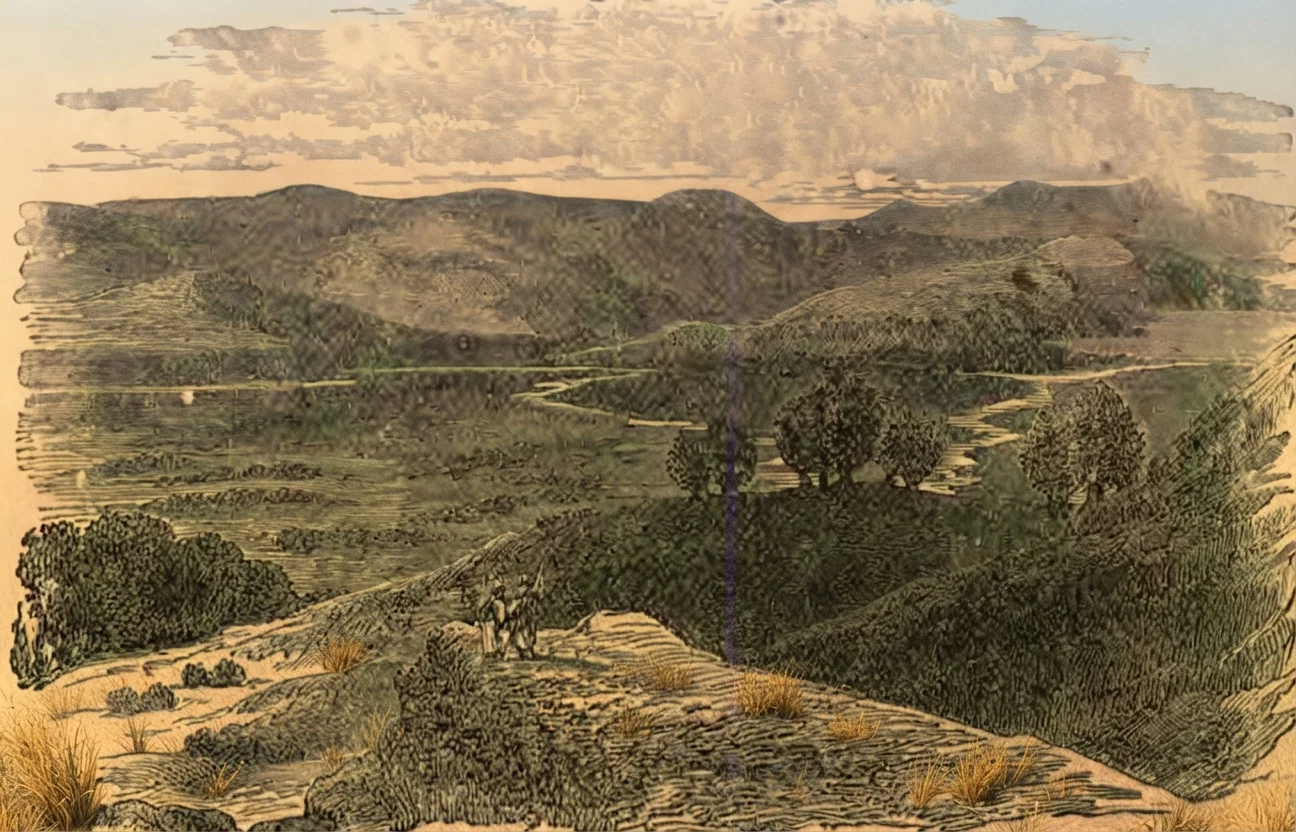
How far the perversion of God's law and life by angels and men has affected the universe of God we know not, but we know that it has perverted every physical organization of earth. The plants, the trees, the flowers, and fish, and beasts, and birds, all die. 'For the creation was subjected to vanity [emptiness, death], not of its own will, but by reason of him who subjected it.' Rom. 8:20, R. V. The fairest flowers and greenest trees bear the insignia of death, of perverted law and perverted life. Even the very streams of earth show the change. Originally the river sprang from the great central fountain and branched out to the four quarters of the earth, carrying life and blessing. Now they are like the river Jordan in our illustration. That stream rises in the cool, pure snow waters of Lebanon, furnishes 'blue Galilee' with its crystal flood, but ever robs the country through which it flows of its richness, and deposits its fertilizing flood into the salt and bitter waters of the Dead Sea. How like the sinner's life is this and the sinful world's life—using the power of God's life perverted to selfish ends to gather from others, giving only incidentally, not objectively, and burying it all at last into the great salt and bitter ocean of death!

Antidote, Remedy.

Is there no antidote, no remedy for the baleful evil of sin and its dread results? Must death inevitably and forever ensue? Man has vainly sought to check or change the tide, and especially its results. Archaeology and history mark by monument and story man's folly and futile efforts in these respects, from the tower of Babylon, in the rich valley of the Euphrates, to the human science of the present. Both Superstition and Science have put forth their mightiest efforts through M.M.'s (medicine men) and M.D.'s, but men, and women, and children, the strong, the young, the fair, still as of old sicken and die. Their efforts are as hopeless and despairing as that of the alchemists who hoped again and again that they had found the elixir of life, and yet died as others. Alonso de Pineda named the Mississippi River Espiritu Santo (HolySpirit) when he discovered its mouth, but it has proved the stream of death and destruction to many. Man was once the prince over all the earth, controlling all physical and animal life under him, but now he succumbs to the lowest forms of life—germs, bacteria, microbes, etc., without number. On him, the head, who perverted in his own being the law of God's life, has the curse fallen heaviest; and skill, or art, or superstition, or science, presents no healing remedy.

In Jesus Christ.

But God in mercy has not left man to despair. The philosophy of the plan we will not now discuss, but rest upon its facts. When man perverted God's law, Satan and sin became incarnate, dwelling in the flesh. Since that the carnal mind, the mind of the flesh, has been sinful. It has thrown itself across the normal working of God's law, and perverted its life. In order to save man God and righteousness must become incarnate, must dwell dominantly in the flesh. This was wrought out in Jesus Christ. God in his love gave his Son (John 3:16); that Son gave himself (Titus 2:14). 'God was in Christ, reconciling the world unto himself.' 2 Cor. 5:19. Christ 'did no sin' (1 Peter 2:22); he kept his 'Father's commandments' (John 15:10).
He lived the law, the character God required of man. In his life it was not a law of sin and death, as it is in the sinner, but 'the law of the Spirit of life.' Rom. 8:2. Christ willingly as a man and in man's stead submitted himself to that law. 'Lo, I come; . . . I delight to do thy will, O my God; yea, thy law is within my heart,' is his language. Ps. 40:7, 8. He 'emptied himself,' and God filled him with the fulness of his power and life. Phil. 2:5-9, R. V. He became therefore in this 'the Prince of life.' Acts 3:15. Being righteous, death, which he suffered for us, could not hold him. Acts 2:24.
He could say, 'As the Father hath life in himself, even so gave he to the Son also to have life in himself.' John 5:26, R. V. 'I am the Way, the Truth, and the Life.' John 14:6. 'Whosoever drinketh of the water that I shall give him shall never thirst; but the water that I shall give him shall become in him a well of water springing up unto eternal life.' John 4:14, R. V. That life comes to every soul in its own normal working through Jesus Christ. 'For if, by the trespass of the one, death reigned through the one; much more shall they that receive the abundance of grace and of the gift of righteousness reign in life through the One, even Jesus Christ.' 'For as through one man's disobedience the many were made sinners, even so through the obedience of the One shall the many be made righteous.' Rom. 5:17, 19, R. V. See also Rom. 3:20-22; Gal. 2:20.

How Ours.

How may we obtain this righteousness, this life, this power?—By faith in Jesus Christ, in just the way he obtained it. But faith means willing submission to God's law, agreement and harmony with his Word. It is saying, 'Amen,' to all that God says. It is giving up to him the mind of the flesh, the carnal mind, which is enmity against God (Rom. 8:7); it is letting the mind of Christ rule in us (Phil. 2:5). It is to do all this of choice. Force can not compel choice. Naked law can not enforce love or life. Human law can not therefore make men better; it can not enforce the spiritual law of God's life. The branch must receive the sap of the stock if it would grow and bear fruit. The soul must be open Godward, submitted to God, if it would know his power.

Counterfeits.

The counterfeits of God's power are in circulation to-day, and pass current with many. They have many points of likeness. The will of man submitted to that of demons makes the mediums of modern Spiritualism. The will of man submitted to that of human minds makes converts to Christian Science, or hypnotism, or to Buddhism. Those skilled in these isms use their knowledge of the power of the perverted life to draw men away from God. Music and art and oratory are used in the same way. The power of evil controls the soul which vibrates in harmony with the evil.

An Illustration.

A remarkable illustration of how power comes from superior intelligences
THE VALLEY OF THE JORDAN.
to inferior is furnished by the law of vibration in which Keeley has been experimenting for years, and in which Tesla is showing astonishing results in telegraphy without wires. He communicates intelligence, and, ultimately, power, he declares, by setting in operation a series of electric waves or vibrations or pulsations, which, like the waves on a body of water, roll and beat on and on till exhausted, or destroyed by a counter force. Well, how can these waves be read miles away? And if they can be read, why not by all?—Simply because they can be read only by means of a machine in perfect harmony with the machine in which they originate. The receiver must be in perfect harmony and sympathy with the transmitter or sender. A chord struck on a piano will awaken sound in the same chord of a guitar that is near it. One tuning-fork caused to vibrate will cause another of the same pitch to vibrate. A certain engine whistle in an eastern town would shake one window in a house a mile away. It affected no other window. The whistle of every other engine on the road affected no window. One whistle and one window were in sympathy; one responded to the other. When Tesla sends a message, there may be a hundred receivers a hundred miles away; ninety-nine are unaffected, but one, in perfect harmony with the transmitter, receives and translates the message.

The Application.

On God's part there is all fulness and all willingness. He gave himself in his Son that he might bestow his fulness upon us. On our part all that is needed is harmony with the law of God's working, the law to which Christ was obedient, the law in which God uttered his Voice from heaven, the Decalog. Every moral principle of his Word is contained in that wonderful law. Knowing God, knowing his law, knowing his voice, knowing Jesus Christ, is to have our affections, our intellect, every power of our being, submitted to him. It is waiting on God, meditating on his law, coming into the fullest sympathy with heaven. This is to know the only true God, and Jesus Christ, whom God has sent. If our heart is in harmony with God, into it flows and pulsates the life of God. We are in sympathetic touch with the great Heart of the universe. Other ears are deaf to his voice, as were the Jews of old; we hear him speaking to us in revelation and all nature. Other eyes are blinded; ours are adjusted by divine life to see the tracing of his divine hand. Others fall weak and powerless before the delusions and temptations of the enemy; we 'are kept by power of God through faith.' Read Isa. 40:28-31; Eph. 1:17-20. This is God's power to usward. O reader, will you not come into harmony with the law and life of God, and thus become acquainted, personally acquainted, with the greatest and best Being, the wisest Teacher, and the most helpful Friend and mightiest Saviour in the universe? He waits for you.

ASKING AND RECEIVING.

"Ask, and it shall be given you; seek, and ye shall find; knock, and it shall be opened unto you; for every one that asketh receiveth; and he that seeketh findeth." Matt. 7:7, 8. If we seek, with this assurance, it is worth while to know what to seek, what it is that is worth the finding. The same One who gives the assurance that we shall find, tells us what to seek: "Seek ye the Lord while he may be found." Isa. 55:6. "Seek the Lord, and his strength; seek his face evermore." Ps. 105:4.
Here is something that is certainly worth finding. If we find the Lord, we find his strength. He is the Almighty, therefore whoever finds him becomes "strengthened with all might, according to his glorious power, unto all patience and long-suffering with joyfulness." Col. 1:11. In his presence is fulness of joy. Not only so, but "in him all things consist" (Col. 1:17, R. V.), and therefore he who finds the Lord has with him all things (Rom. 8:32).
But is the Lord, with all this treasure, hard to find? Nay, quite the contrary; "he that seeketh, findeth," because he is not far from every one of us. Acts 17:27. More than this, he is seeking us: "For the Son of man is come to seek and to save that which was lost." Luke 19:10. Since he is seeking us, what can possibly hinder us from finding him, if wealso seek him? Each seeking the other, we are sure to come together.
The statement that the Lord came to seek the lost, points to the fact that man was once with him, but wandered away. "All we like sheep have gone astray; we have turned every one to his own way." Isa. 53:6. When people sin, they imagine that God is angry with them, and that he has turned away from them. Not so; it is they who turn away and hide from him, while he seeks them. Adam and Eve, after their sin, "hid themselves from the presence of the Lord God amongst the trees of the garden." Gen. 3:8. But the Lord did not hide from them; on the contrary, he sought them, and when they responded to his call, they found each other.
Therefore, since it is we who "hid as it were our faces from him" (Isa. 53:3), and he is all the time seeking us, it is evident that all we have to do to seek and find him is to turn round and look up. How easy the way, and how blessed the result! Let each one, then, make these words his own: "When thou saidst, Seek ye my face; my heart said unto thee, Thy face, Lord, will I seek," assured that the finding will be sure, speedy, and glorious.
E. J. W.

MAN VERSUS GOD.

On Which Will You Base Your Knowledge?

THE Bible idea of education is to know God. Said Jesus, "This is life eternal, that they might know thee the only true God, and Jesus Christ, whom thou hast sent." Said the ancient Idumean, "Acquaint now thyself with him, and be at peace; thereby good shall come unto thee." In God is all fulness. And he has revealed that fulness in Jesus Christ,—Creator and Redeemer,—and in the Holy Scriptures, which are "profitable for doctrine, for reproof, for correction, for instruction in righteousness; that the man of God may be perfect, thoroughly furnished unto all good works." The greatest and sublimest poetry, the most touching pathos, the keenest logic, the profoundest reasoning, the simplest and most eloquent oratory, the tenderest story of love, the grandest examples of unselfish heroism, the best rules for every-day existence, the only message of righteousness and salvation, all and more come to us in the wonderful words of life of the Book of God. And yet Christianity turns from it to the wisdom of that which is foolishness with God, from the ever-living fountain of God to the broken cisterns of paganism. Here is an example from the Los Angeles Times of August 30, preached and written by Frank Crane, D.D., of Chicago:—
I am no believer in a "business education," nor in wasting time at any school where they make a specialty of the so-called practical studies. I am old fogy enough to think that if one has but a year to spend at college, he should devote it to Greek and Latin and geometry. Such studies give a richness to the intellectual life that can be obtained from no other source. Why should the poor boy be deprived of the intense joy of knowing the classic royalty of earth's thought, simply because he is to be a bookkeeper or a carpenter, or a mechanic? Any bright youth can quickly pick up a trade, but the love for letters and the appreciation of true culture is seldom acquired outside of the classroom. Among the happiest hours of my life, among my purest pleasures, are the hours that have been passed in the study of classics, and why should I wish any man, even if he be a farmer or a mechanic, to have his youth robbed of these halcyon days? Why should he have the depth of life sacrificed to the bustling utilities of the business college? I am for the dear old-fashioned classical education for every man and for every woman. It gives poise to the heart and rightly orientates the soul, it gives a flavor to the mind that is more precious than attar, a fragrance that comes from the flowers of but one Hymettian field.
. . . The kings, the imperators, the half gods among men, are the classic authors. We can buy their voices for a pittance. Why not hold great converse with these majestic minds instead of spending all our spare time in the ephemeral gossip of current literature? With most of us it is because we lack a right taste for imperial ideas. And how shall that taste be engrafted in us? As a rule, altho there are notable exceptions, it is only in the university, it is only with some professor whose very atmosphere carries the precious aroma of learning; it is only by saturating our days and nights, during the formative period of youth, with the resonant grandeur of Homer and the exquisite grace and sweetness of Horace. To the end of time the fountain of intellectual culture will be found in the grove by the porch at Athens, and his life will always be in a measure barren who has not passed that way.
To such an one, and to those who follow such preaching and teaching, what is the Word of God? It is not even worthy of mention, and yet in it is the wisdom and power and fulness of God. It is such teaching in our pulpits, in our universities, in our colleges, in the press, that turns men from the Bible, and sets the heathen gods and demigods between the soul and the great Teacher of the world, nay, the Saviour of the world, Christ Jesus. It is such teaching that produces the following from the same page of the Times:—
"O Demosthenes, dead two thousand years and more, Yet I hear the reverberations of thy mighty voice In the passing winds, the ocean's sullen roar. Its grandeur is depicted upon the mountain's hoary brow, And its awe upon the face of the raging hurricane. Thus all nature and the elements are affected by genius, And thus nature doth preserve a great man's name."
But Jesus Christ lives; his Word is a living Word; and the mighty works of nature perverted to sound the praise of the great Greek, are here and continue to exist by the power of the word of Jesus Christ alone. It is as true now as it was in Paul's day that the wisdom of the world is foolishness with God, and that the world by that same wisdom knows not God. And yet professedly Christian teachers are filling the minds of susceptible youth with such wisdom, and teaching them to believe that it is the highest culture possible. "For the Jews [the superstitious] require a sign, and the Greeks [unbelieving and worldly-wise] seek after wisdom; but we preach Christ crucified, unto the Jews a stumbling-block, and unto the Greeks foolishness; but unto them which are called, . . . Christ the power of God, and the wisdom of God. Because the foolishness of God is wiser than men; and the weakness of God is stronger than men." See 1 Cor. 1:18–25. Then, Christian, can you not say with the mighty and eloquent hero of old, "God forbid that I should glory, save in the cross of our Lord Jesus Christ, by whom the world is crucified unto me, and I unto the world"? Gal. 6:14.
Continue reading: AT THE FEAST OF TABERNACLES